Introduction
Ownership of household assets, such as housing, savings and pensions, is much more widespread than at any time, but there is little research on their ownership and distribution within couples. There is a burgeoning body of literature around the ownership of assets and how it can have a positive effect on a range of outcomes of well-being. A key policy development in the UK in recent years has been the development of asset-based policies (Sherraden, Reference Sherraden1991; Regan and Paxton, Reference Regan and Paxton2001). However, this literature has not addressed the issue of asset ownership within households. In contrast, there is a substantial body of research on how couples manage income (and debt) within the family (see for example Pahl, Reference Pahl1989; Vogler and Pahl, Reference Vogler and Pahl1993; Burgoyne and Morison, Reference Burgoyne and Morison1997; Goode et al., Reference Goode, Callender and Lister1998; Rake and Jayatilaka, Reference Rake and Jayatilaka2002; Burgoyne et al., Reference Burgoyne, Clarke, Edmunds and Reibstein2006; Vogler et al., Reference Vogler, Brockmann and Wiggins2006; Sung and Bennett, Reference Sung, Bennett, Clarke, Malby and Kennett2007; Goode, Reference Goode2009; Burgoyne and Sonnenberg, Reference Burgoyne, Sonnenberg, Miles and Probert2009). These studies on income have highlighted different forms of money management systems, with joint pooling of income being most common, but with an increasing proportion of couples opting for more independent forms of management (Vogler, Reference Vogler, Miles and Probert2009). Independent management and partial pooling are also more common with higher-income couples and with cohabiting couples (Vogler, Reference Vogler, Miles and Probert2009).
Some of these studies also point out that responsibility for money management should not be equated with control of resources (see, for example, Burgoyne and Morrison Reference Burgoyne and Morison1997; Stocks et al., Reference Stocks, Diaz and Halleröd2007). For example, someone may have the day-to-day responsibility for managing money but not have equal access to the couple's income. There is also a distinction to be made between strategic decisions (e.g. whether or not to buy a house) versus the more detailed decisions (e.g. which house to buy). This literature has helped to challenge the idea that money is always shared equally within couples to the mutual benefit of both parties (and to the benefit of children in such couples – see Goode et al., Reference Goode, Callender and Lister1998). This can lead to hidden poverty and financial exclusion within a couple, often to the disadvantage of women in couples due to their lower levels of earnings/income (Kempson and Finney Reference Kempson and Finney2009).
Different theoretical approaches emerge from this literature, including the resource theory of power which focuses on the relative income/earnings of members of a couple (Kirchler et al., Reference Kirchler, Rolder, Holzl and Meier2001; Stocks et al., Reference Stocks, Diaz and Halleröd2007) to theoretical frameworks based more on patriarchal explanations which spotlight the impact of the ‘male breadwinner’ model on couples. Under the male breadwinner model, the man accesses ‘personal spending money’, which, in low-income families in particular, women do not have access to. In some cases, this can lead to ‘covert’ expenditure, made easier by using what Pahl (Reference Pahl1999) refers to as ‘invisible’ forms of money, such as credit and store cards.
But there has been much less research on assets within couples. One of the key exceptions to this is the analysis of the BHPS by Westaway and McKay (Reference Westaway and McKay2007) who found that women were more likely than men to have savings accounts, but their savings were worth less on average. The BHPS could not identify, however, if women in couples had access to their partner's savings and so benefited from them even if they did not legally own them. As far as housing wealth is concerned, most datasets do not tell us whether mortgages are in joint or sole names and whether the equity in the home is considered shared at all. There has been considerable research into gender and pensions (see Ginn, Reference Ginn2003, for an overview), which has highlighted the fact that men have built up far greater entitlements to state and private pensions than women due to their higher participation in the labour market. However, women's participation in paid work is increasing and the ‘pension gap’ between men and women is correspondingly decreasing, at least as far as the state pension is concerned (Department for Work and Pensions, 2005).
Data on the distribution of assets within couples are therefore limited and so are data on what happens to assets when couples separate. Westaway and McKay (Reference Westaway and McKay2007) found that women who divorce suffer disproportionately compared with men in terms of savings. However, their study did not analyse housing assets, and Warren et al. (Reference Warren, Rowlingson and Whyley2001) found that single women who were separated or divorced had higher levels of housing wealth than single men who were separated or divorced. Westaway and McKay (Reference Westaway and McKay2007) also found that women who experience cohabitation breakdown suffer even more than women who go through divorce (and more than men who go through cohabitation breakdown), perhaps suggesting that marriage provides some financial ‘protection’ for women, compared with cohabitation. But Warren et al. (Reference Warren, Rowlingson and Whyley2001) show clearly that women with the highest levels of assets are those who have never been married. Those with the lowest levels are lone parents. So partnerships and children seem detrimental to women's finances. Having said this, there is likely to be a ‘selection effect’ here: women with the greatest opportunities to accumulate wealth are less likely to partner and/or have children.
The issue of pension sharing on divorce has become increasingly important, with pension sharing orders introduced in 2000 in England and Wales (Price, Reference Price, Bochel, Ellison and Powell2003). However, Ministry of Justice (2009: 97) figures show that in 2008 pension sharing orders were made in less than 10 per cent of the divorces in the same year. Of course, many couples will have no private pension wealth to split, others may have similar amounts and others may trade-off housing wealth for pension wealth, as women appeared to do before pension sharing orders were introduced (Arthur and Lewis, Reference Arthurs and Lewis2000; Ginn and Price, Reference Ginn and Price2002). But why this is the case, and whether or not it is in their best interests, is not clear. These provisions only apply, of course, to married couples (or civil partners). Cohabiting couples are not covered in pension sharing legislation, nor indeed do they have the same protection afforded to married couples when dividing other forms of wealth, though the Law Commission (2007) has recently recommended that certain cohabiting couples might be treated the same as married couples in law.
As we have just alluded, the distribution of assets within couples has particular relevance to social policy. Although the literature on asset policy has shed light on asset inequality, particularly on class position and ethnicity, there have been few perspectives on gender and how this might play out within couple relationships. Within the social security system, means-tested benefits assume that assets are a joint resource within couples and no distinction is made between cohabiting couples and those who are married or civil partnered. But the law on separation/divorce and intestacy makes a major distinction between cohabiting and married or civil partnered couples (Distribution on Intestacy, 1989; Barlow et al., Reference Barlow, Duncan, James and Park2005). And while the law on divorce assumes that assets within a marriage are equally shared, this assumption is then moderated depending on a range of factors such as the length of the marriage.Footnote 1 In 2007, the Law Commission proposed that unmarried parents who had lived together for some time should be given new rights to make financial claims against each other's assets if they separate. However, these recommendations have not been acted on by government, probably because they might be seen as undermining the institution of marriage.
This paper sheds light on these complex issues by reporting on qualitative research on the distribution of assets within couples. The first section sets out the aims and methods of the study, followed by the main findings and then a discussion of the related policy issues.
Aims and methods of the research
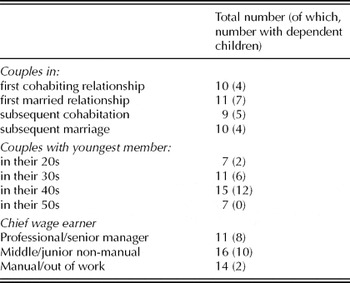
The research aimed to explore both the distribution of assets and debts within couples, and how couples made decisions about assets and debts. We interviewed 80 members of 40 working-age couples in-depth between April and June 2009. The couples were in a variety of relationship types (i.e. first cohabiting, first marriage, subsequent marriage and subsequent cohabitation), with differing ages and socio-economic positions (see Table 1). The couples were interviewed at the same time but in different parts of their home by different interviewers. All couples were opposite-sex couples. We did not exclude same-sex couples from our sample design but did not interview any, hence we have no civil partnered couples in our sample. This article focuses on the distribution of assets but discussion of decision-making can be found in Rowlingson and Joseph (Reference Rowlingson and Joseph2010) which also contains discussion of the distribution of debts within couples alongside further details of the research methods used.
Profile of couples

The level and type of asset ownership across the couples varied enormously, from professional couples with large amounts of housing equity, savings and secure pensions, to unemployed couples with no assets at all, but plenty of problem debts. Most couples lay somewhere between these extremes, with most having some housing wealth (32 out of 40 were owner occupiers) and most were managing to avoid debt, but had very few savings. This study is mostly concerned, however, with looking within couples rather than across couples.
The distribution of housing wealth within couples
Couples who were in their first cohabiting or marital relationship tended to see housing wealth split equally between them. Most of these couples had put similar amounts of money into the deposits for the home. Both members had their names on the mortgage and both were contributing to the mortgage. Some women were contributing less in direct monetary terms because they were working part-time due to childcare commitments, but their ‘contribution’ as mothers and members of the couple was seen in their eyes as enough to give them equal rights to the housing wealth. The issue of unpaid caring and the gender imbalance is widely acknowledged in the literature and presents a major challenge for policy makers in tackling inequality (Sonnenberg, Reference Sonnenberg2008; Plagno et al., Reference Plagnol, Scott and Schober2010). The husband in one such couple said:
I don't really think about it, I just think everything's everybody's really; it's all in the same pot. (Male, in his 40s, first married relationship)
In these ‘first-time’ couples, there seemed to be little difference in their perception of ownership of housing wealth between cohabiting and married couples. But the picture is rather different among couples who had been in previous relationships and were now in ‘subsequent’ relationships. Such couples were much less likely than others to consider their housing equity to be divided equally between them. In most of these cases, women had more of a share of any equity than men as a result of divorce settlements (for example, trading off his pension wealth against equity in the home – see later).
One young couple (in their twenties) had been living together in the woman's home for about a year, but the mortgage on the home was still in joint names with her ex-partner:
We're looking at getting it signed over because the last we heard, he isn't interested in the money side of it . . . he just wants shot so he can take advantage of the housing market himself as a new buyer as it were. (Female, in her 20s, subsequent relationship)
This couple's relationship was still quite new, and they were cohabiting rather than married. But even among some ‘subsequent’ couples who had (re-)married, there still seemed to be less sharing occurring than in the first-time couples. For example, one woman said she had insisted on a ‘pre-nuptial’ agreement to say that the house would remain hers if they separated. She had experienced various financial problems with her previous partner and wanted to keep control over her financial situation – not least to retain the family home for her children:
I'd been in a situation where it was difficult to get out of. I had financial issues with my previous partner. So it wasn't something I took on lightly [referring to taking on a joint mortgage/ownership with her partner] . . . I've got a legal contract drawn up that [the property] remains mine. I mean you never know what might happen. (Female, in her 40s, subsequent remarriage)
Pre-nuptial agreements were not clearly recognised in English law until October 2010 when the Supreme Court ruled that they should be recognised in certain circumstances.Footnote 2
Another woman in our sample decided not to put her new husband's name on the deeds of her property because he had accrued considerable business debts in the past and had gone bankrupt. She was concerned that his previous debts might have to be paid from ‘her’ assets if he became part-owner of the house.
But for some couples in subsequent relationships, the act of getting married, rather than the length of the relationship, led to a view that assets were now shared equally:
We've been married eight years. Eight years this year. And we just whack everything down the middle. There's no ‘she can live in the house until I die or until she dies’, none of that. (Male, in his 50s, subsequent marriage)
Pension wealth
Whereas housing wealth was often considered to be joint and equal between couples in their first main relationship, views about pension wealth were more complex. Pension products were certainly seen as individually owned. In the formal sense, this is unsurprising, as there are no pension products for couples (though there may be survivor's benefits). However, when people thought about future pension income, they tended to see this in the same way as current income. So if current income was shared, people assumed that future pension income would be shared. In some couples, current pension saving was clearly unequal but future pension income was generally seen as a joint resource. For example, in one married couple the woman was in a relatively secure, well-paid job as a teacher and had been paying into a final-salary occupation pension for over a decade. During that time her partner had been made redundant twice and was in a less secure job in manufacturing without any pension provision. He regretted his lack of pension provision but reported:
She said . . . her pension will be our pension, which is nice of her.
(Male, in his 40s, first married relationship)
Although couples tended to see their potential pension income as shared, there were no examples of pension sharing orders among those who had previously divorced, which is not surprising given that these are made in less than 10 per cent of divorce cases (see above).
Some women stated that they had explicitly traded in their entitlement to ‘his’ pension in return for more housing equity, but one woman at least had mixed feelings about this:
My ex-husband's got a very good pension . . . so to go for half of his pension would be quite a bit of money for me . . . so now I haven't got anything like that but I wish I had've done . . . He's backed down on this house, so I've got to pay him a certain amount so its sorted that way, so he's keeping his pension. (Female, in her 40s, subsequent cohabitation).
Savings
In terms of the distribution of savings within couples, our sample often talked about savings as ‘joint’ even if the savings were ‘individually’ owned. Some products, such as ISAs, have to be held individually and cannot be jointly owned, whereas some bank and building society saving accounts can be jointly or individually held. So the distinction between formal and perceived ownership was an important one. For example, one member of a couple used the first person plural ‘we’ to talk about some shares that ‘they’ had bought:
We've bought some shares in [a bank], but obviously the price dipped down to quite a low level compared to what it was previously so, we invested some money in that. (Male, in his 40s, first married relationship)
The interviewer then asked him to clarify whose name the shares were in, to which he replied:
I don't actually know that [laughs] . . . I think they probably are [all in her name] to be honest . . . [so] I suppose [I don't own any shares], not really if they were in her name. (Male, in his 40s, first married relationship)
This man saw these assets as joint even though, legally, his partner owned them (according to her account). Some couples, however, saw their savings in a more individual way. A man in one couple, for example, felt that it was not necessary to disclose to his partner the amount he had in savings. He had been living with his partner for five years and when asked about whether they talked about their respective savings he replied:
We wouldn't think that this was our business to be honest . . . I mean, yeah, we both treat each other and help each other out if needs be . . . but how much is in there – none of her business [laughs]. (Male, in his 40s, subsequent cohabitation)
Others were only ‘sort of semi-aware’ of what their partner had, suggesting that there were unsure of the type of savings account held or the amount:
[My partner's] got her own [savings] and I'm sort of semi-aware of what's in there and probably the same with mine, [she's] sort of aware because we talk about it. She knows I've got Premium Bonds, she knows I've got ISAs, she knows I keep stocks and shares, but in terms of coming down to the last penny and all of it that's in there, we wouldn't know. (Male, in his 40s, subsequent cohabitation)
There were only a few examples of couples where one member had substantially more than the other (not least because levels of savings were generally quite small). In one married couple, the woman had much more saved than the man because she had a more secure, better-paid job. She was working full-time and they had no children. They had savings in savings accounts and ISAs, and, although she had more than him in savings, he was still accumulating fairly substantial amounts by saving £100 per month in his ISA. These variations in levels of savings between partners was not perceived as problematic as these couples valued the independence of individual ownership and control of savings as much as the actual value of savings held individually.
Explaining variation in perceived ownership of assets
When analysing patterns of asset and debt ownership within couples, a range of factors seemed important, starting with the nature of the relationship. A key factor appeared to be whether or not the couple were in their first relationship or a subsequent one. People in first relationships tended to have a much more even split of assets. Those entering subsequent relationships sometimes brought with them different levels of assets, and debt which were influenced by factors such as their home ownership status, employment status, whether there were unresolved money issues in the former relationship and (in the case of men with children from a previous relationship) child support commitments. They also seemed to take a more individual view of their assets. The length of the relationship was also important here, as was marital status. Those who had been together longer and were married were more likely to see assets as joint, though there were clear examples of (re-)married couples which took a more individual view, not least in one case with a prenuptial agreement to reinforce this. Couples in cohabiting relationships, particularly those in subsequent cohabiting relationships, seemed more likely to see their assets in a more individual (and unequal) way. In some cases, the woman seemed to have more housing equity because of a previous divorce settlement, but this could be at the cost of trading future pension income (Ginn and Price, Reference Ginn and Price2002; Goode, Reference Goode2007).
Another related factor was the ‘relative resources’ of members of the couple. As we have argued above, if one member of the couple brought greater resources to the relationship, the couple generally took a more individual approach to assets, at least in the short term. In one example, a couple had been living together for five years in her home from a subsequent relationship, but the mortgage was still in her name only as she had built up the equity in the home and he had brought no money into the relationship. She was a well-paid professional woman and he had low-paid fairly insecure work. She was particularly concerned at the prospect of having to move or re-mortgage the home if he had a claim to it and they separated:
It makes things simpler if I know that I'm responsible for the mortgage. We haven't thought about his rights if we were to separate and we don't talk about separating particularly. So it's just easier for me to be in control of it. (Female, in her 40s, subsequent cohabitation)
Where one member of the couple had much higher income than the other, this also gave that person greater capacity to save and build up a pension than their partner. It was relatively unusual in the sample to have couples with a major disparity in terms of their income/socio-economic status except, of course, where women worked part-time or did not have a paid job because of childcare responsibilities. While the housing equity in such couples was still generally considered joint this could sometimes mean that he accumulated more savings (where they had separate accounts) and pension entitlements.
Policy issues
Our findings clearly demonstrate an important distinction between the legal/formal ownership of assets within couples and how members of couples see those assets. They also demonstrate that couples do not necessarily share their assets equally, particularly if the couple is: relatively new, cohabiting rather than married, a subsequent rather than a first-time couple and a couple in which the members have brought different levels of assets. This may not seem to be an issue when the relationship is going well, but it could be a source of potential conflict if the relationship ends, and the position of cohabiting couples, at least, would depend much more on the legal/formal ownership of assets than any perceptions of ownership. Furthermore, the assumptions made within social security policy, particularly around couple-based means-testing of assets, are also erroneous because they assume equal sharing.
Policies should not, therefore, assume that assets are equally shared within all couples, either in a formal/legal sense or in terms of how members of the couple perceive those assets. But it is less clear how policy should treat cohabiting couples in relation to married/civil partnered couples. The government has avoided making a decision on this following the recommendations by the Law Commission because of the complex and sensitive issues that will need to be addressed. Our findings highlight the variety of practices and views on these issues. Cohabitation appears to be linked to more independent ownership of assets, but other relationship factors are also important such as the length of the relationship, whether it is a first-time or subsequent relationship and the relative resources of the couple.
Divorce law is complex and evolving, but there is a general assumption of equal division of assets unless there are reasons to do otherwise, for example if the marriage has been short, and/or the different parties have brought different amounts to the marriage and/or made different contributions. Our findings support earlier work that women seem to be trading housing wealth for pension wealth (Ginn and Price, Reference Ginn and Price2002), but is this necessarily in their best interest? Ginn and Price's (Reference Ginn and Price2002) study of the pension prospects of women who are divorced or separated using data from the General Household Survey (GHS) found that the lack of private pension income of divorced or separated working-aged older women, relative to men, was not compensated by a higher rate of home ownership. But Warren et al.'s (Reference Warren, Rowlingson and Whyley2001) analysis of the FRS provided a slightly different picture, and this is complex terrain.
Many of the issues raised present real challenges for policy-makers. However, our findings suggest there are some policy interventions that might address one of the concerns we have identified in the study and might provide some ‘quick wins’. In the absence of any change in the law, one way forward might be for greater education about the (lack of) rights of cohabiting couples and greater promotion of ‘living together agreements’. These agreements are drawn up by couples to clarify how income and assets are distributed within the couple and how they will divide them if they were to separate. The agreement forms are provided by ‘Advicenow’, an independent, not-for-profit website providing information on rights and legal issues. The website admits that these agreements have a slightly odd status in law. They state that the courts will not let people sign away their existing legal rights but that they will generally follow the agreement if it still produces a fair result for both parties and is based on honest information. Furthermore, they state that courts are even more likely to uphold the agreement if both parties had legal advice or had a solicitor draw up a formal legal ‘deed’.
Similar issues apply to the treatment of assets on the death of one partner in a couple. In a survey in 2004, almost two respondents in five thought, incorrectly, that a long-term cohabiting couple would receive equal treatment under inheritance law as a married couple (Rowlingson and McKay, Reference Rowlingson and McKay2005). People who were themselves cohabiting were no more knowledgeable on this matter. Without a legal will, cohabiting partners currently have no clear rights to any assets on the death of their partner. And the assets will be subject to inheritance tax which is not the case for married or civil partnered couples. The government has recently consulted (Law Commission, 2009) and carried out research (Humphrey et al., Reference Humphrey, Mills and Morrell2010) on this issue, but they have not proposed any change in the law despite the main finding from extensive public attitudes research that:
There is now strong public support for law reform that expands the range of beneficiaries to include cohabiting partners (though not necessarily on an equal footing with spouse). (Humphrey et al., Reference Humphrey, Mills and Morrell2010: 10–11)
These issues are particularly timely given that the numbers of couples cohabitating is rising whilst marriage rates are decreasing (Wilson, Reference Wilson2009).
But does it matter if assets and debts are not shared equally within a couple if the couple stay together? For example, if one member of a couple has a much better pension pot than the other, neither member can benefit from this until retirement, at which time the issue becomes one of how the income from this pot is shared. But if one member of the couple feels anxious about their potential share of this pot if they were to separate, it may mean that some people remain in unhappy relationships due to their ‘asset dependency’. As far as housing wealth goes, while the couple is together and living under the same roof both are benefitting equally from the accommodation. But there could still be concerns about how any equity might be shared and therefore some degree of ‘asset dependency’ or insecurity here too. Most of the couples we interviewed said that, even if they kept their money separate, they would ‘help each other out’ from time to time. However, some couples, with the most independent forms of money management and decision-making, knew little about their partner's financial situation and so financial exclusion within couples was a distinct possibility. The findings suggest hidden forms of asset inequality are possible.
There is also evidence from couples who had experienced ‘difficult’ former relationships, where money problems were an issue, that their experience led them to change their behaviour in subsequent relationships. For example, some ringfenced any assets brought into subsequent relationship. This was perceived by the individual as providing a ‘financial buffer’ in the event that the new relationship ‘failed’. Although, divorce rates in England and Wales in 2009 are at their lowest levels since 1977, the divorce rates for men and women in their twenties are at the highest rates for all age groups for the fifth consecutive year (ONS, 2010). This would suggest that policy could target couples in this age group.
The issues we have raised here could form part of any financial education in schools as well as part of the financial advice provided by the government's new Money Advice Service. This service has a section on its website about divorce and separation but very limited information about the position of cohabiting couples in law or of ‘living together agreements’.
Conclusions
Our findings challenge the assumption, often made in policy, that assets are shared equally between members of a couple. There is considerable variation between couples depending on whether or not the couple is: newly formed, cohabiting rather than married, a subsequent rather than first-time couple and where each member has a different level of assets prior to the relationship. Our findings also show that there is an important distinction to be made between legal ownership and perceived ownership. In terms of policy response, the findings highlight the differential treatment of married/civil-partnered couples versus cohabiting couples which people are often unaware of. The research does not necessarily suggest that all couples should be treated the same, but it does, at the very least, suggest that people are better informed about the division of assets (and income) within couples which should be discussed more widely.