For the past two decades, achievement goal theory has been one of the most prominent theoretical frameworks to understand student motivation and educational outcomes in school settings, including physical education. Achievement goals are described as the purposes students perceive for engaging in achievement related behaviors, the meanings they ascribe to those behaviors (Ames, 1992; Dweck, 1986; Maehr, 1983; Nicholls, Reference Nicholls1989), or cognitive-dynamic focus of competence-relevant behavior (Elliot, Reference Elliot, Maehr and Pintrich1997). They influence students’ approaches to learning, performance, and achievement in schools.
Achievement goal theory evolved from a dichotomous model (i.e., mastery and performance goals; Dweck, Reference Dweck1986; Nicholls, Reference Nicholls1989) to a trichotomous model (i.e., mastery, performance-approach and performance-avoidance goals; Elliot, Reference Elliot, Maehr and Pintrich1997) to the current 2x2 model (i.e., mastery-approach, mastery-avoidance, performance-approach, performance avoidance goals; Elliot, Reference Elliot1999). Due to the complexity of motivational processes, more researchers are turning their attention to the 2x2 model to understand student motivation, related performance and achievement in schools. Therefore, the present study used this goal model as a theoretical perspective. In the 2x2 model, mastery-approach goals focus on learning, improving, and mastering skills, whereas mastery-avoidance goals concentrate on the avoidance of misunderstanding, not learning, or not mastering a task. Performance-approach goals focus on the attainment of favorable external judgments of competence, while performance-avoidance goals focus on avoiding unfavorable external judgment of competence (Church, Elliot, & Gable, Reference Church, Elliot and Gable2001).
Both classroom and physical education research validates the 2x2 goal model and reveals the four achievement goals are associated with different student motivational, cognitive, affective, and behavioral outcomes (Agbuga, Xiang, & McBride, Reference Agbuga, Xiang and McBride2010; Garn & Cothran, Reference Garn and Cothran2009; Guan, Xiang, McBride, & Bruene, Reference Guan, McBride and Xiang2006; van Yperen, Eliot, & Anseel, Reference van Yperen, Eliot and Anseel2009; Witkow & Fuligni, Reference Witkow and Fuligni2007). For example, Witkow and Fuligni (Reference Witkow and Fuligni2007) examined the 2x2 goal model in relation to students’ Grade Point Average (GPA) and intrinsic motivation with a diverse sample of 10th graders from three public schools. They reported that the students in their study distinguished among the four achievement goals, indicating the existence of the 2x2 goal model in high school settings. Additionally, they found that performance-approach goals and mastery-approach goals were positively related to GPA. Mastery-avoidance goals were negatively related to GPA, and performance-avoidance goals were not related to GPA. But for intrinsic motivation, only mastery-approach goals emerged as a significant positive predictor.
In high school physical education, Guan, McBride, and Xiang (Reference Guan, McBride and Xiang2007) examined the application of the 2x2 goal model with two diverse samples. Consistent with the findings reported by Witkow and Fuligni (Reference Witkow and Fuligni2007), the data from both samples confirmed this goal model in high school physical education settings. Guan, McBride, and Xiang (Reference Guan, McBride and Xiang2006) also examined the relations of the four achievement goals to students’ self-reported persistence/effort expanded toward high school physical education. They reported that mastery-approach, mastery-avoidance, performance-approach goals were found to be significant positive predictors of students’ self-reported persistence/effort. Taken together, the studies reviewed provide empirical support for the application of the 2x2 model in high school settings. But researchers need to go beyond solely motivational and educational outcomes (i.e., intrinsic motivation and persistent/effort) to gain a more complete picture of how achievement goals are related to other educational outcomes. Student personal and social responsibility behaviors represent one such outcome.
Student personal and social responsibility behaviors include putting forth effort, setting goals, staying on task, cooperating, respecting classmates and teachers. They can help create a positive learning environment in schools that is not only safe for students themselves and their neighborhood, but are also conductive to instruction and learning. Consequently, researchers have examined student personal and social responsibility development across such fields as education, psychology, and youth development (for a review, see Hellison & Martinek, Reference Hellison, Martinek, Kirk, Macdonald and O’Sullivan2006).
In physical education, Hellison (Reference Hellison2003, Reference Hellison2011) developed an instructional model, teaching personal and social responsibility (TPSR), to teach students to be personally and socially responsible while participating in physical activity. Of particular interest to the present study is how student personal and social responsibility is construed in this model. Specifically, this model views personally responsible behavior as effort (e.g., doing best) and self-direction (e.g., staying on task independently), and socially responsible behavior as respect for the rights and feelings of others (e.g., maintining self-control) and caring for others (e.g., helping peers when needed).
Inspired by TPSR, a number of researchers examined physical education students’ personal and social responsibility behaviors and related educational outcomes (Escartí, Gutiérrez, & Pascual, Reference Escartí, Gutiérrez and Pascual2011; Escartí, Gutiérrez, Pascual, & Llopis, Reference Escartí, Gutiérrez, Pascual and Llopis2010; Gordon, Reference Gordon2010; Hellison & Wright, Reference Hellison and Wright2003; Li, Wright, Rukavina, & Pickering, Reference Li, Wright, Rukavina and Pickering2008; Wright & Burton, Reference Wright and Burton2008; Wright, White, & Gaebler-Spira, Reference Wright, White and Gaebler-Spira2004). Gordon (Reference Gordon2010) implemented TPSR in a secondary physical education program in New Zealand. One important finding is that students exposed to TPSR reported an improvement in learning and classroom behaviors. Wright, Li, Ding, and Pickering (Reference Wright, Li, Ding and Pickering2010) examined the implementation of TPSR in a required wellness course for urban high school students in the United States. They reported that students in the intervention group had more positive gain scores on truancy, tardiness, grades and conduct than those in the comparison group. In addition, Escarti et al. (Reference Escartí, Gutiérrez and Pascual2011) adapted and applied the TPSR model in the Spanish school setting with elementary and secondary students. They confirmed that “the TPSR model is an effective teaching approach that helps teachers structure their classes in ways that promote their students’ learning of responsibility concepts and practices” (p. 191).
While research provides evidence that TPSR fosters students’ personal and social responsibility behaviors and has established links between student personal and social responsibility behaviors and increased classroom engagement, performance, and learning in physical education (Escartí et al., Reference Escartí, Gutiérrez and Pascual2011; Escartí et al., Reference Escartí, Gutiérrez, Pascual and Llopis2010; Li et al., Reference Li, Wright, Rukavina and Pickering2008; Wright & Burton, Reference Wright and Burton2008), little work has examined students’ personal and social responsibility behaviors from an achievement goal perspective.
In the achievement motivation literature, students’ social responsibility behaviors have been examined from the perspective of social goals (Guan, Xiang et al., Reference Guan, McBride and Xiang2006; Hicks, Murphy, & Patrick, Reference Hicks, Murphy and Patrick1995). This literature reveals students pursue a number of social goals in the classroom and physical education, including social relationship goals (e.g., accepted by other students) and social responsibility goals (e.g., staying on task). More importantly, students’ social goals are found to be associated with their achievement goals. For example, Guan, Xiang et al. (Reference Guan, McBride and Xiang2006) reported that mastery-approach, mastery-avoidance, performance-approach, and performance-avoidance goals were all significantly correlated with students’ social relationship goals and social responsibility goals in high school physical education settings. Particularly, mastery-approach goals were more strongly related to the two social goals than three other achievement goals, indicating students whose achievement goal was to learn and master learning tasks (i.e., mastery-approach goal) were more likely to demonstrate social responsibility behaviors than students whose achievement goal was to outperform classmates (i.e., performance-approach goal), or to avoid performing worse than others (i.e., performance-avoidance goal), or to avoid not learning (i.e., mastery-avoidance goal). The established relationships between achievement goals and social goals suggest that achievement goal theory might be a viable approach to the study of student personal and social responsibility behaviors as conceptualized in TPSR.
In summary, the present study applies the 2x2 achievement goal model to student personal and social responsibility behaviors within the framework of TPSR in high school physical education settings. Specifically, the following research questions were addressed: (a) what achievement goals do students endorse in their physical education settings? And (b) what are the relationships between achievement goals and personal and social responsibility behaviors? This study extends the achievement goal theory to TPSR with the hope that its findings might provide empirical evidence that the 2x2 goal model can be infused with TPSR to facilitate student personal and social responsibility behaviors in physical educaton teaching.
Method
Participants and Setting
Participants consisted of 221 high school students (116 boys and 105 girls, M age = 16.04, SD = 1.39) attending two public schools in Turkey. The purposes of the Turkish Education System are to bring up students as individuals who are acquainted with the problems of the society and who contribute to economic, social and cultural development of the country and to prepare them for tertiary education as well (Ministry of National Education, 2001). The Turkish Education System has democratic, modern and secular characteristics. At both schools, therefore, students had coeducational physical education classes once a week for 90 minutes. They were all taught by specialists with similar teaching experience (less than 10 years). The national teaching program established by the Ministry of Education was implemented as curriculum in the physical education program. Learning sports rules and practicing sports such as track and field, soccer, and basketball are the main content focus of the program (Milli Egitim Bakanligi, 1995). The command style, which is the most teacher-directed style, was primarily used by those specialists (see Mosston & Ashworth, Reference Mosston and Ashworth1994, for a review).
Variables and Measures
The students responded to a two-part questionnaire. The first part consisted of demographic information including age, grade, gender, and school. The second part assessed student achievement goals and self-reported personal and social responsibility behaviors in high school physical education.
Achievement goals
Participants completed the Achievement Goal Questionnaire–Physical Education (AGQ-PE) adapted by Guan et al. (Reference Guan, McBride and Xiang2007) from Elliot and McGregor (Reference Elliot and McGregor2001). The AGQ-PE consists of 12 items that assess four achievement goals: mastery-approach, performance-approach, mastery-avoidance and performance-avoidance. Each achievement goal is assessed by three items. The format for all items is a 7-point Likert-type scale, ranging from 1 (not at all true for me) to 7 (very true for me). All items were prefaced with the heading “In my physical education class …”
Personal and social responsibility
Students’ personal and social responsibility behaviors were assessed using the Personal and Social Responsibility Questionnaire (PSRQ; Li et al., Reference Li, Wright, Rukavina and Pickering2008). This questionnaire consists of 14 items assessing two underlying factors: personal responsiblity and social responsiblilty. For the personal responsibility factor, three items assess effort, and four items assess self-direction. For the social responsibility, three items assess respect for others, and four items assess caring for others. The format for all items is a 6-point Likert-type scale, ranging from 1 (strongly disagree) to 6 (strongly agree). The PSRQ was prefaced with the heading “It is natural to behave both well and poorly. We are interested in how you normally behave in your physical education class. Please answer the following statements honestly by checking the box that best represents your behavior.”
The self-report measures on student achievement goals and personal and social responsibility behaviors yielded reliable and valid scores with American students in secondary physical education (e.g., Guan, McBride et al., Reference Guan, McBride and Xiang2006; Guan, Xiang et al., Reference Guan, McBride and Xiang2006; Li et al., Reference Li, Wright, Rukavina and Pickering2008). It might also be worth noting that their article from Spain demonstrates the first translation and validation of the PSRQ in another language. However, participants in this study were Turkish students in high school physical education. Previously Agbuga (Reference Agbuga2009) provided reliable and valid scores of the 2x2 achievement goal model with Turkish undergraduate students in a physical education teacher education program. Since no study has utilized the PRSQ to examine Turkish high school students’ personal and social responsibility behaviors in physical education, the following steps were taken to preserve the validity and reliability of these measures: (1) Both the AGQ-PE and PRSQ items were translated into Turkish by the first author, who is fluent in both Turkish and English. Then a panel of four other bilingual (Turkish/English) physical educators evaluated item consistency between the English and Turkish versions of the questionnaires. They found no inconsistencies; (2) A pilot study was conducted with 54 nonparticipating students in grades 10–12 to assess whether the language in the translated questionnaires was appropriate for Turkish students in high school physical education. Students raised no questions while completing the questionnaires; and (3) Confirmatory factor analyses (CFAs) were conducted on items measuring students’ achievement goals and personal and social responsibility behaviors. Following the recommendations by Hoyle and Panter (Reference Hoyle, Panter and Hoyle1995) and Hu and Bentler (Reference Hu and Bentler1999), multiple fit indexes were employed to assess the adequacy of the measurement models. Indices used to determine the goodness-of-fit included: (a) the chi-square to degrees of freedom ratio (χ2 /df), for which values less than 3.0 suggest a good fit (McIver & Carmines, Reference McIver and Carmines1981); (b) the comparative fit index (CFI), for which values larger than .90 indicate a good fit; (c) the Bentler-Bonett non-normed fit index (NNFI), for which values larger than .90 indicate a good fit; and (d) the root mean square error of approximation (RMSEA), for which .06 –.08 is considered to be an acceptable fit, while .08 –.10 is considered to be a marginal fit (Browne & Gudeck, Reference Browne, Gudeck, Bollen and Long1993; Hu & Bentler, Reference Hu, Bentler and Hoyle1995). Data were analyzed using AMOS 5.0, and the models were estimated using maximum likelihood method. Cronbach’s alpha coefficients were calculated to examine internal consistency of test scores for each of the four achievement goal and the two responsible behaviors. Statisticians (e.g., Cronbach, Reference Cronbach1951; DeVellis, Reference DeVellis1991; Kline, Reference Kline2005; Nunnally & Bernstein, Reference Nunnally and Bernstein1994) agree that internal consistency reliability is acceptable if a Cronbach alpha value is greater than .70, a value we adopted in this study.
Before the analysis of the model estimation, Mardia’s coefficient was calculated to ensure the presence of multivariate normality in the obtained data. There were multivariate normality in the data obtained since the resulting Mardia’s coefficient were 48.28 for AGQ-PE and 103, 21 for PRSQ that according to Bollen (Reference Bollen1989), is less than p (p+2), where p is the number of observed variables. Moreover, all variables were below the guidelines for skewness and kurtosis (< 3 and < 10, respectively) recommended by Kline (Reference Kline2005). Using the criteria provided by Kline (Reference Kline2005), skewness and kurtosis did not appear to be problematic for this data. The Method of Maximum Likelihood was therefore applied to further in analysis.
The results of a confirmatory factor analysis (CFA) on the AGQ-PE scores indicated all indices (χ 2 /df = 1.90, CFI = .94, NNFI = .92, and RMSEA = .06) represented an acceptable fit between the four-factor model (mastery-approach, mastery-avoidance, performance-approach, performance-avoidance goals) and the data (Browne & Gudeck, Reference Browne, Gudeck, Bollen and Long1993; Hatcher, Reference Hatcher1994; Hu & Bentler, Reference Hu, Bentler and Hoyle1995; McIver & Carmines, Reference McIver and Carmines1981). Moreover, factor loadings ranged from .59 to .80 for mastery-approach goal items, .63 to .71 for mastery-avoidance goal items, .65 to .75 for performance-approach goal items, and .55 to .65 for performance-avoidance goal items, respectively. These loadings were all acceptable (see Clark & Watson, Reference Clark and Watson1995; Floyd & Widaman, Reference Floyd and Widaman1995). Consequently, scales of four achievement goals were constructed by averaging the items on the scales. Finally, Cronbach’s alphas for the mastery-approach, mastery-avoidance goals, performance-approach, and performance-avoidance goals scales were .70, .70, 73, and .65, respectively, indicating acceptable internal consistency.
The results of a CFA on the PSRQ scores revealed a poor fit between the two-factor model (personal and social responsibility behaviors) and the data (χ 2 /df = 3.01, CFI = .87, NNFI = .85, and RMSEA = .09). For an acceptable fit, the RMSEA should be less than .05 and CFI and NNFI should be higher than .95. To improve the model fit, two steps were taken. First, an examination of the factor loadings revealed the items, “I control my temper” (assessing respect for others), “I participate in all of the activities” (assessing effort), “I try hard even if I do not like the activity” (assessing effort), and “I do not make any goals” (assessing self-direction) loaded weakly on either the personal or social responsibility behaviors factors with factor loadings of .27, .34, .37, and .35, respectively. Factor loadings, however, should be equal or larger than .40 (Clark & Watson, Reference Clark and Watson1995). Therefore, these items were removed.
Second, modification indices were examined. The examination of modification indices provides a guide for path additions to the model (Kline, Reference Kline2005). If a modification index between two items is high in relation to other modification indices, then the addition of a path will improve the overall fit of the model. Based on the modification indices provided by AMOS, a path of covariance was added between error terms for the items, “I respect others” and “I respect my teacher(s).” Both items measure “respect” behaviors and belong to the social responsible behaviors factor.
Another path of covariance was also added between error terms for the items, “I help others” and “I am kind to others.” These two items measure “caring for others” behavors and represent the social responsible behaviors factor as well. After these modifications, the final model revealed an excellent fit (χ 2 /df = 1.69, CFI = .98, NNFI = .97, and RMSEA = .05) with factor loadings ranging from .57 to .80 for the personal responsible behaviors factor, and .43 to .88 for the social responsible behaviors factor. Scales of personal and social responsibility behaviors were then constructed by averaging the items on the scales. Cronbach’s alphas for the two scales were .81, and .84, respectively, indicating acceptable internal consistency.
Procedure
After obtaining institutional approval and informed consent from the participants, all data were collected during the spring semester of 2010. The questionnaires were administrated by the first researcher to students during regularly scheduled physical education classes. Each item was read aloud to the students. In addition, they were encouraged to answer as truthfully as they could and to ask questions if they had difficulty understanding instructions or items in the questionnaires. They were also informed that their teachers would not have access to their responses. To ensure the independence of their responses, the researcher had students spread out so that they could not see one another’s responses. It took students approximately 20 minutes to complete the questionnaires.
Results
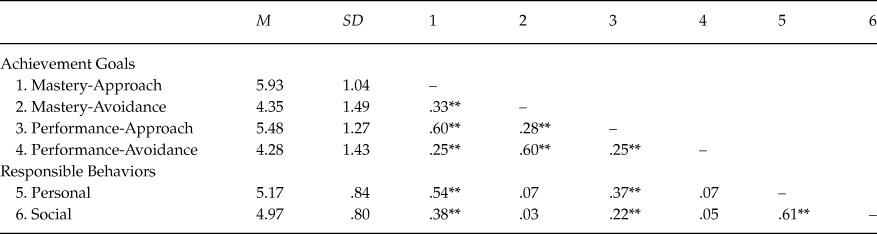
The results of descriptive statistics are presented in Table 1. While students endorsed all four achievement goals as their mean scores were all above the midpoint (i.e., 4) of the AGQ-PE scale, they reported the highest score on mastery-approach goals, followed by performance-approach goals, mastery-avoidance goals, and performance-avoidance goals, respectively. For personal and social responsibility behaviors, students’ mean scores were also higher than the midpoint (i.e., 3) of the PSRQ scale, suggesting students in this study perceived that they demonstrated personal and social responsibility behaviors such as doing one’s best and respecting others in their physical education classes.
Descriptive Data and Correlations for Achievement Goals, Personal and social responsibility behaviors

Note: **p < .01 (2-tailed).
Results of the one-way repeated measures ANOVA revealed significant differences among the four achievement goals, F(3, 660) = 137.05, p < .001, η2 = .39, after the violation of the assumption of sphericity indicated in Mauchly’s test χ2 (5) = 89.49, p < .01 had been addressed by correcting the degrees of freedom using Huynh-Feldt estimates of sphericity (ε = .79). Bonferroni post hoc tests indicated students scored significantly higher on the mastery-approach goal than the mastery-avoidance, performance-approach, and performance-avoidance goals. Students also scored significantly higher on the performance-approach goal than the performance-avoidance and mastery-avoidance goals. No significant mean score difference was observed between the two avoidance goals.
Pearson product–moment correlations revealed significant relationships between achievement goals and personal and social responsibility behaviors. As shown in Table 1, the four achievement goals were significantly and positively correlated with one another. For example, the mastery-approach goal was significantly and moderately related to the performance-approach goal. Additionally, both personal and social responsibility behaviors were significantly and positively related to each other. Finally, only the mastery-approach and performance-approach goals were significantly and positively related to personal and social responsibility behaviors.
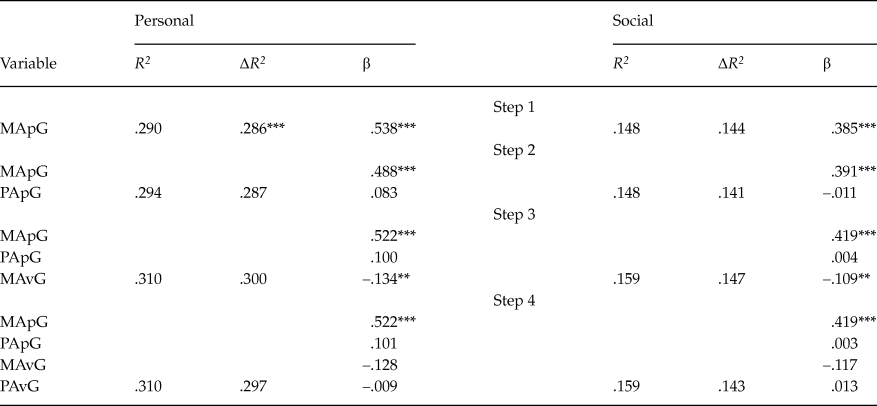
Hierarchical multiple regression analyses (the mastery-approach goal entered first and followed by the performance-approach, mastery-avoidance, and performance-avoidance goals, respectively) further revealed only the mastery-approach goal emerged as the significant positive predictor for both personal and social responsibility behaviors. It explained 15% and 29% of the variance, respectively (see Table 2).
Results of Hierarchical Regression on Personal and social responsibility behaviors

Notes: MApG = mastery-approach goal; MAvG = mastery-avoidance goal; PApG = performance-approach goal; PAvG = performance-avoidance goal; R 2 values are cumulative, with each incremental step adding to the variance explained.
** p < .01; ***p < .001.
Discussion
The present study was designed to examine whether the 2x2 achievement goal model would represent a viable theoretical perspective to understand student personal and social responsibility behaviors as conceptualized in the model of teaching personal and social responsibility (TPSR; Hellison, Reference Hellison2003, Reference Hellison2011) in the context of Turkish high school physical education. Results of the CFA and Cronbach alpha coefficients revealed the scores produced by the AGQ-PE were valid and reliable, indicating the existence of mastery-approach, mastery-avoidance, performance-approach, and performance-avoidance goals among this sample of Turkish high school physical education students. This finding is consistent with the findings reported in the academic (Elliot & McGregor, Reference Elliot and McGregor2001) and other physical education settings (Agbuga, Reference Agbuga2009; Guan et al., Reference Guan, McBride and Xiang2007). Together, these findings provide empirical evidence that the 2x2 achievement goal model can be utilized in high school physical education settings, whether in the United States or in Turkey.
Consistent with previous studies (Agbuga, Reference Agbuga2009; Cecchini-Estrada, González-Mesa, Méndez-Giménez, & Fernández-Río, Reference Cecchini-Estrada, González-Mesa, Méndez-Giménez and Fernández-Río2011; Guan, Xiang et al., Reference Guan, McBride and Xiang2006), Turkish high school students in this study were also found to endorse the mastery-approach goal more than any other three goals in their physical education classes. This finding is encouraging given that both theoretical and empirical work have demontrated that the mastery-approach goal is most likely to be associated with positive motivational and educational outcomes (e.g., intrinsic motivation, persistence) compared to the mastery-avoidance, performance-approach, and performance-avoidance goals (Adie, Duda, & Ntoumanis, Reference Adie, Duda and Ntoumanis2008; Elliot & McGregor Reference Elliot and McGregor2001; Guan, Xiang et al., Reference Guan, McBride and Xiang2006).
The students also endorsed the performance-approach goal more than the mastery-avoidance and performance-avoidance goals. Though there are no consistent findings regarding the relationships between the performance-approach goal and positive motivational and educational outcomes, some researchers observed that performance-approach goals emerged as positive predictors of student persistence/effort in university classrooms (Elliot, McGregor, & Gable, Reference Elliot, McGregor and Gable1999) and high school physical education settings (Guan, Xiang et al., Reference Guan, McBride and Xiang2006). According to Elliot (Reference Elliot1999), students endorsing performance-approach goals are likely to behave similarly to those students endorsing mastery-approach goals if they have a strong need for achievement and are engaged in challenging activities in schools. Therefore, physical education teachers must create a learning environment in their classes where student achievement of learning goals is highly valued and learning activities provide students optimal challenges. In so doing will assist students with performance-approach goals to achieve positive educational outcomes.
The second purpose of the present study was to examine relationships between achievement goals and personal and social responsibility behaviors reported by students. Simple correlations revealed only mastery-approach and performance-approach goals were positively related to students’ self-reported personal and social responsibility behaviors. The observed positive correlations seem to suggest that students whose goals were to master learning skills (mastery-approach goal) or outperform peers (performance-approach goal) were more likely to work hard, set up learning goals on their own, and respect their peers and teachers and care for them in their physical education classes than those students who did not pursue these two goals. Results of the hierarchical multiple regression analyses, however, showed that the performance-approach goal failed to remain as a significant predictor of personal and social responsibility behaviors, while the mastery-approach goal continued to be a significant positive predictor of these types of behaviors.
The finding that the mastery-approach goal was found to be significantly associated with and significantly predicted students’ self-reported personal and social responsibility behaviors adds to the research literature that has consistenly documented that mastery-approach goals are associated with positive student educational outcomes such as showing intrinsic interest in learning, putting forth effort, and displaying high levels of cognitive engagement (Adie et al., Reference Adie, Duda and Ntoumanis2008; Elliot, Reference Elliot1999; Elliot & McGregor Reference Elliot and McGregor2001; Garn & Cothran, Reference Garn and Cothran2009; Guan, Xiang et al., Reference Guan, McBride and Xiang2006). Given the link established in this study, we recommend that teachers promote mastery-approach goals when attempting to help students become personally and socially responsibility in physical educaton classes. Suggested instructional practices and strategies might include the following: defining success as task mastery and personal improvement rather than outperforming peers in class; providing learning activies/tasks that are interesting, meaningful and challenging cognitively, affectively, and physically; emphasizing learning process and active participation; engaging students in decision-making; evaluating students on task mastery and skill development rather than on ability; encouraging students to view failure as an essential part of learning; and ensuring a high rate of success to foster positive ability perceptions of students.
In their study with Turkish students in grades 8 and 11, Agbuga and Xiang (Reference Agbuga and Xiang2008) reported that performance-approach goals were a significant positive predictor of students’ self-reported effort/persistence in high school physical education. Guan, Xiang, et al. (2006) also made such observation with American students in high school physical education. Our data, however, revealed the performance-approach goal was not predictive of students’ self-reported personal and social responsibility behaviors in the present study. But this finding is consistent with the theoretical consideration that performance-approach goals can have positive consequences, null, or even negative consequences (Elliot, Reference Elliot1999). Taken together, it appears that the nature of the relationships between performance-approach goals and positive student educational outcomes is complex. More research is needed to advance our understanding of this nature.
In conclusion, this study represents the first attempt to apply the 2x2 achievement goal model to study Turkish high school students’ personal and social responsibility behaviors as conceptualized in TPSR in a physical education setting. Results of this study indicate physical education teachers can infuse mastery-approach goals in TPSR or promote mastery-approach goals to encourage their students to become personally and socially responsible for their own learning and learning environment. Specifically, if they expect their students to exhibit personal and social responsibility behaviors, they must emphasize the importance of learning, understanding, improving, and mastering tasks, value student effort, provide students challenging learning activities, and ensure a high rate of success in their teaching. All can promote mastery-approach goals among students. Future research efforts are recommended to replicate this study with a larger number of students. Future research should also try to capture the relationships between students’ achievement goals and personal and social responsibility behaviors assessed via longitudinal data, structured interviews and classroom observations.