INTRODUCTION
Shocks constitute a fundamental process in many areas of physics ranging from inertial fusion to astrophysics (Betti et al., Reference Betti, Zhou, Anderson, Perkins, Theobald and Solodov2007; Canaud et al., Reference Canaud, Laffite, Brandon and Temporal2012). In a typical fluid shock, upstream particles slow down at the shock front by experiencing an increase of collision frequency. The width of the shock front is therefore equal to a few collisional mean free paths. In a plasma, it has been known since the pioneering work of Sagdeev (Reference Sagdeev1966) that shock-like solutions exist even in the absence of collisions between particles. In this case, the dissipation needed at the shock front to slow down the upstream flow is provided by collective plasma phenomena. The bow shock of the earth magnetosphere within the solar wind provides a perfect natural illustration of such process, as its front thickness has been measured a few tens of km (Bale et al., Reference Bale, Mozer and Horbury2003; Schwartz et al., Reference Schwartz, Henley, Mitchell and Krasnoselskikh2011), while the mean ion free path at the same location is of the order of the Sun-Earth distance, namely ~108 km (Boyd & Sanderson, Reference Boyd and Sanderson2003).
The interest for collisionless shocks is partly due to their capacity to accelerate particles up to very high energies (Drury, Reference Drury1983; Blandford, & Eichler Reference Blandford and Eichler1987). In this respect, they could be the factories where ultra high energy cosmic rays up to 1021 eV are generated (Letessier-Selvon & Stanev, Reference Letessier-Selvon and Stanev2011). While being accelerated near the shock front, particles emit synchrotron radiation, which has been detected in the X-range in supernovae remnant shock fronts (Warren et al., Reference Warren, Hughes, Badenes, Ghavamian, McKee, Moffett, Plucinsky, Rakowski, Reynoso and Slane2005). It is believed that an ultra-relativistic version of the very same process could explain the origin of gamma ray bursts (GRB) (Piran, Reference Piran2004).
In recent years, this physics has progressively attracted the interest of the Laser-Plasma community, as it is now possible to generate such shocks in the laboratory from the encounter of two collisionless plasmas shells. As evidenced by numerous computer simulations (Liu et al., Reference Liu, Xie, Huang, Liu and Yu2009; Sarri et al., Reference Sarri, Dieckmann, Kourakis and Borghesi2011), such encounters drive instabilities when the shells overlap. As a result, the overlapping region turns into a turbulence where the incoming flow piles up. Depending on the nature of the instability triggered, the resulting shock can be mainly electrostatic or electromagnetic. While electrostatic shocks triggered by two-stream like instabilities have already been observed in laboratory (Romagnani et al., Reference Romagnani, Bulanov, Borghesi, Audebert, Gauthier, Lwenbrck, Mackinnon, Patel, Pretzler and Toncian2008; Liu et al., Reference Liu, Li, Zhang, Zhong, Zheng, Dong, Chen, Zhao, Sakawa, Morita, Kuramitsu, Kato, Chen, Lu, Ma, Wang, Sheng, Takabe, Rhee, Ding, Jiang, Liu, Zhu and Zhang2011), electromagnetic shocks triggered by fast growing electromagnetic instabilities in the relativistic regime are yet to be realized, although favorable conditions for their obtention have been recently obtained in Rochester (Ross et al., Reference Ross, Glenzer, Amendt, Bergner, Divol, Kugland, Landen, Plechaty, Remington, Ryutov, Rozmus, Froula, Fiksel, Sorce, Kuramitsu, Morita, Sakawa, Takabe, Drake, Grosskopf, Kuranz, Gregori, Meinecke, Murphy, Koenig, Pelka, Ravasio, Vinci, Liang, Presura, Spitkovsky, Miniati and Park2012). In this later experiment, two opposite CH2 foils were irradiated with a laser intensity of 1016 W/cm2. As a result, counter-streaming plasmas with peak velocities 2000 km/s = 6 × 10⁻³c were created. With an interaction length ~8 mm and a mean free path ~27 mm, conditions were met for a shock to form although the interaction time was not long enough.
As previously said, observations of the earth bow shock, laboratory laser-plasma experiments, and numerical simulations are now instrumental in investigating such shocks. On the theory side, the large body of available literature has so far mainly overlooked the formation process, rather focusing on the dynamic of the already formed shock. The present paper aims at filling this gap by providing a detailed theory of collisionless shock formation out of the encounter of two plasma shells. Two-dimensional (2D) particle-in-cells (PIC) simulations have thus been performed of two symmetric, cold, colliding pair plasmas. Note that besides being relevant for GRB's physics, pair plasma avoid having to deal with the proton/electron mass ratio. The simplicity of this system allows for an accurate analytical description of the unstable spectrum involved in the overlapping region. Noteworthily, pair plasma-like experiments are already possible using mixtures of positively and negatively charged C60 (Oohara & Hatakeyama, Reference Oohara and Hatakeyama2003).
Assessing both the field at saturation and the initial seed field triggering the instability, it has been possible to derive an expression for the instability saturation time in good agreement with the simulations. As will be checked, this saturation time is not the shock formation time, but only a lower bound to the later. Future works will focus on the non-linear processes that pick-up the system at saturation time and build the shock.
PIC SIMULATIONS AND INSTABILITY ANALYSIS
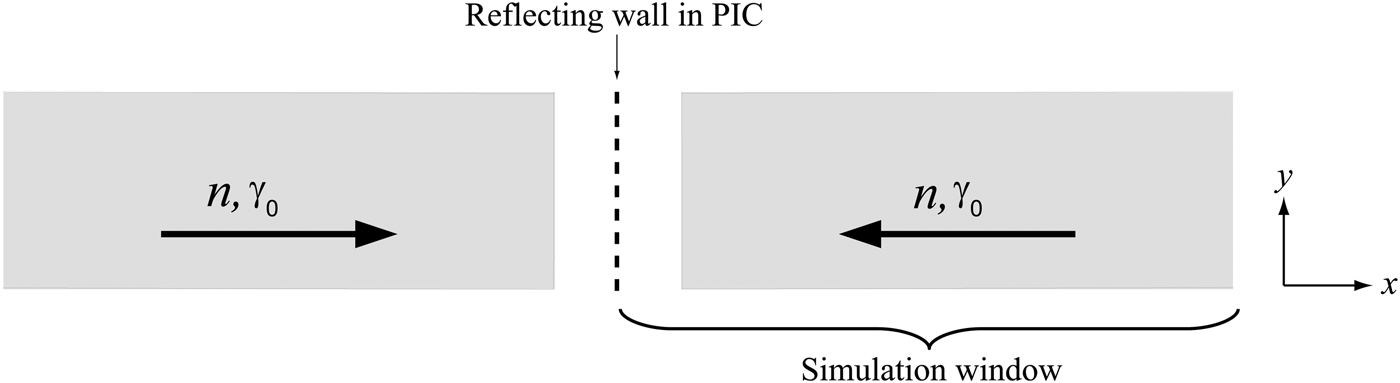
PIC simulations have been used to model the shock formation using the code OSIRIS (Fonseca et al., Reference Fonseca, Silva, Tsung, Decyk, Lu, Ren, Mori, Deng, Lee, Katsouleas and Adam2002). A pair plasma with Lorentz factor γ0 ∈ [25, 104] and reduced temperature μ = mc 2/k BT = 106γ0 is sent toward a wall where it bounces back an interact with itself (see Fig. 1). This scheme is widely used when modeling the interaction of two identical plasmas and avoids the simulation of the other half of the system (Silva et al., Reference Silva, Fonseca, Tonge, Dawson, Mori and Medvedev2003). The particles are injected from the right by a cathode along the x axis with a temporal resolution  $\Delta t=0.025\sqrt{{\rm \gamma}_0} /{\rm \omega}_p$, and reflected at the wall. The 2D box with
 $L_x = 125 \sqrt{{\rm \gamma}_0} c/{\rm \omega}_p$ and
 $L_y = 5\sqrt{{\rm \gamma}_0} c/{\rm \omega}_p$ has absorbing boundaries for the particles along x and is periodic along y. For the fields, conducting boundaries are used at the perfectly reflecting wall and open boundary conditions at the cathode.
Two identical pair plasmas collide. Only the right part is simulated. Setting a bouncing wall on the dashed line, the full system can be modeled saving half the computation time.

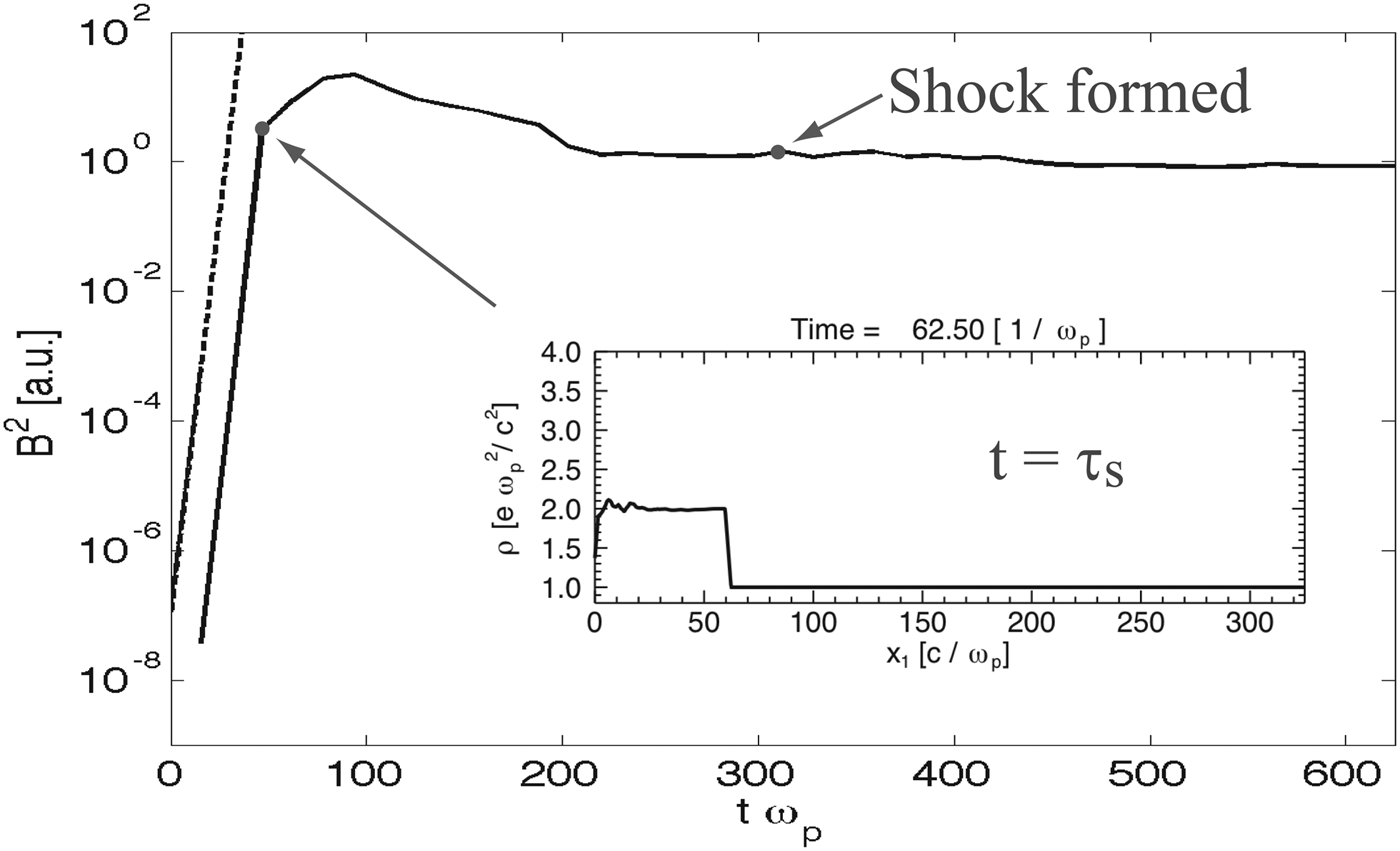
Figure 2 shows the temporal growth of the magnetic energy integrated over the overlapping region, where the right-ward bouncing part interacts with the left-ward plasma. As expected, an initial exponential growth is observed, resulting from the excitation of streaming instabilities. Previous analysis of the unstable spectrum involved (Bret et al., Reference Bert, Firpo and Deutsch2005; Reference Bret, Gremillet, Bénisti and Lefebvre2008) have shown that in the present case, the fastest growing modes are found with k x = 0. These are the so-called filamentation, or Weibel, modes, with growth rate (Bret, Reference Bret2009; Bret et al., Reference Bret, Gremillet and Dieckmann2010),
 $${{\rm \delta} \over {\rm \omega}_p} = {v_0 \over c} \sqrt{{2 \over {\rm \gamma}_0}} \sim \sqrt{{2 \over {\rm \gamma}_0}}\comma$$
where ωp is the plasma frequency of one isolated shell. As evidenced in Figure 2 by the dashed line, the field grows precisely at the expected rate.
Growth of the integrated magnetic energy B 2 (arbitrary units) in the overlapping region. The shock forms only after the instability saturates at t = τs. The insert shows the y-integrated density at t = τs. Density is normalized to the one of a single shell.
In view of the role of the filamentation instability in the present context, an evaluation of the conditions required to cancel it is important. To this day, two factors are known that can suppress this instability in the collisionless regime: thermal spread and magnetic field. For the former, several works have evidenced that temperature can potentially stabilize filamentation beyond a threshold which depends on the distribution functions involved (Silva et al., Reference Silva, Fonseca, Tonge, Mori and Dawson2002; Bret & Deutsch, Reference Bret and Deutsch2006). Regarding the later, early works by Godfrey et al. (Reference Godfrey, Shanahan and Thode1975) showed a static flow-aligned field could stabilize filamentation. Yet, astrophysical settings frequently imply non flow-aligned fields (Sironi & Spitkovsky, Reference Sironi and Spitkovsky2009). The present cold counter-streaming symmetric system has thus been analyzed accounting for an oblique magnetic field B0. The dispersion equation for the filamentation instability exhibits a behavior similar to the flow-aligned case: the growth rate in the limit k ⊥ = ∞ tends to a constant, because no kinetic pressure exists to prevent small filaments from pinching. By deriving the dispersion equation in this limit, on finds filamentation growth rate tends to a finite but non zero value, when B 0 → ∞ with (Bret & Alvaro, Reference Bret and Alvaro2011),
 $${{\rm \delta} \over {\rm \omega}_p} \sim {v_0 \over c} \sqrt{{2 \over {\rm \gamma}_0}} {1 \over \sqrt{1 + {\rm \gamma}_0^2 \cot^2 {\rm \theta}}} \quad \hbox{for} \quad B_0 \gg 2 {v_0 \over c} {\sqrt{{\rm \gamma}_0} \over \cos {\rm \theta}}\comma$$
where θ is the angle between the flow and B0. This result emphasizes the robustness of the filamentation instability in realistic scenarios where θ would hardly be exactly zero.
As long as the linear hypothesis is fulfilled, the exponential growth continues. Saturation comes at t ≡ τs, when the density perturbation generated is no longer small. As a consequence, the density in the overlapping region at t ≡ τs may be slightly larger than twice the upstream density, but only slightly, since perturbations must be small at lesser times. Because the Rankine-Hugoniot jump conditions give here a density jump ~3.3, the saturation time is necessarily smaller than the shock formation time. Starting from the saturation time where the “downstream” density is only 2 + ɛ, nonlinear processes need to intervene in order to raise it to ~3.3. Leaving this second phase for further studies, we now focus on the determination of τs, starting with the assessment of the initial and final field amplitudes.
INITIAL AND FINAL FIELD AMPLITUDES
Assuming the magnetic field grows from an initial amplitude B i to a final one B f, the saturation time τs is straightforwardly given by,
 $$B_f = B_i e^{{\rm \delta} {\rm \tau} _s} \quad \Rightarrow \quad {\rm \tau}_s = {1 \over {\rm \delta} } \ln \left({B_f \over B_i} \right).$$
The amplitude of the field at saturation has been largely discussed in literature (Davidson et al., Reference Davidson, Hammer, Haber and Wagner1972; Medvedev & Loeb, Reference Medvedev and Loeb1999). By stating that the linear approximation ceases to be valid when the cyclotron frequency of the particles in the growing field becomes comparable to the growth rate, one can derive
 $${B_f^2 \over 8{\rm \pi}} \sim {\rm \gamma}_0 nmc^2\comma$$
where n is the density of one isolated shell and m the electron/positron mass.
From the physical point of view, the initial field B i results from the spontaneous fluctuations continuously emitted and absorbed in the shells. Like a pencil in equilibrium over its tip, it takes a slight deviation from equilibrium to destabilize the system. As they approach each other, each shell presents density fluctuations with k x = 0 associated with the corresponding magnetic fluctuations. As soon as they overlap, these fluctuations result in uncompensated opposite parallel currents instantaneously destabilizing the system (Fried, Reference Fried1959). The relevant magnetic fluctuation amplitude for B i is thus the one of a single shell drifting at relativistic velocity. Such calculation has been performed by Yoon (Reference Yoon2007) in the non-relativistic regime and recently extended to the relativistic regime by Ruyer and Gremillet (Reference Ruyer and Gremillet2012). The fluctuations giving rise to the filamentation instability have both k x and ω = 0. In the regime 1 ≪ γ0 ≪ μ, the dωd 3k-energy density they contain is given by,
 $$\eqalign{{B_{k_{\bot\comma {\rm \omega}}}^2 \lpar {\rm \omega} = 0\rpar \over 8{\rm \pi}} &\equiv {B_{k_{\bot\comma 0}}^2 \over 8{\rm \pi}} \cr &= {1 \over \sqrt{32{\rm \pi}}} {{\rm \gamma}_0^3 \over \sqrt{{\rm \mu}}} {mc^2 \over {\rm \omega}_p}\comma \; \quad {\rm \mu} = {mc^2 \over k_B T}.}$$
Interestingly, the density  $B_{k_{\bot\comma {\rm \omega}}}$ is extremely peaked near ω = 0, with a peak width given by,
 $${\rm \delta} {\rm \omega} = {{\rm \omega}_p \over {\rm \gamma}_0 \sqrt{6{\rm \mu}}}.$$
In other words, almost all of the energy contained in fluctuations with k x = 0 is concentrated around ω = 0.
In order to reach an evaluation of B i, Eq. (5) has to be integrated over dωd 3k. Regarding the ω-integration domain, we just multiply Eq. (5) by the peak width Eq. (6).
Turning now to the k-integration domain, Eq. (5) has been integrated in the parallel direction between ± the largest unstable  $k_{\parallel\comma max}=\sqrt{{\rm \gamma}_0 /2} \lpar {\rm \omega}_p /c\rpar $ (Bret et al., Reference Bret, Gremillet and Dieckmann2010). With respect to the perpendicular direction, it has been found numerically that the fastest growing mode has
 $k_{\bot} \equiv k_{\bot\comma m} \sim \lpar {\rm \omega}_p /c\rpar /\sqrt{{\rm \gamma}_0}$. We thus simply integrated the energy density in this direction over [k ⊥,min, k ⊥,max] = [k ⊥,m /2,3k ⊥,m/2]. Note that such loose approximations are eventually without much consequences as the end result for the saturation time eventually involves their logarithm. Note also that one fastest wave vector is selected for growth, in spite of the fact that the unstable spectrum for the present cold system does not exhibit any local growth-rate extremum at this location (Bret et al., Reference Bret, Gremillet and Dieckmann2010). Further work will be required in order to understand this point.
To summarize, the initial field amplitude B i reads,
 $${B_i^2 \over 8{\rm \pi}} = \int_{k_{\bot\comma min}}^{k_{\bot\comma max}} 2{\rm \pi} k_{\bot} dk_{\bot} \int_{ - k_{\parallel\comma max}}^{k_{\parallel\comma max}} dk_{\parallel} \int_{ - {\rm \delta} {\rm \omega}}^{{\rm \delta} {\rm \omega}} d{\rm \omega} {B_{k_{\bot\comma 0}}^2 \over 8{\rm \pi}}\comma$$
and a little algebra gives
 $${B_i^2 \over 8{\rm \pi}} = {15\sqrt{{\rm \pi} /6} \over 4} {\sqrt{{\rm \gamma}_0} \over {\rm \mu}} \left({{\rm \omega}_p \over c} \right)^3 mc^2.$$
SATURATION TIME
The time to reach saturation follows from Eqs. (3), (4), and (8) and reads,
 $${\rm \tau}_s {\rm \omega}_p = {\sqrt{{\rm \gamma}_0} \over 2\sqrt{2}} \ln \left[{4 \over 15} \sqrt{{6 \over {\rm \pi}}} n \left({c \over {\rm \omega}_p} \right)^3 \sqrt{{\rm \gamma}_0} {\rm \mu} \right].$$
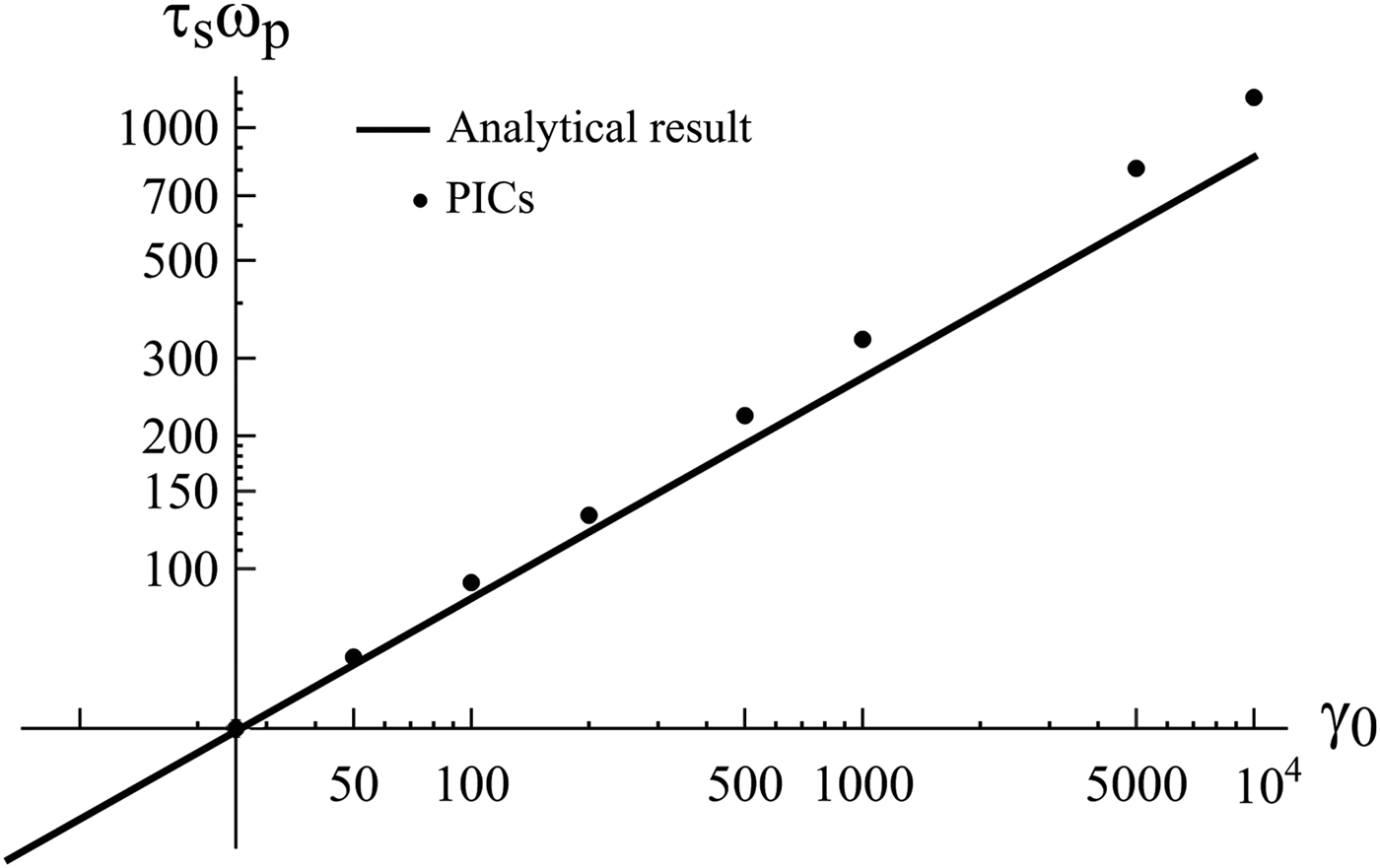
Figure 3 displays the comparison of the saturation time τs as measured from simulations, with the analytical result above. The agreement found is rather good, given the looseness of the calculations and the difficulty to model the fluctuations level in the simulations. Within the range of expected Lorentz factors in GRB context, namely γ0 < 103 (Piran, Reference Piran2004; Nakar et al., Reference Nakar, Bret and Milosavljević2011), the agreement is very good.
Comparison of the saturation time τs as measured from simulations with the analytical result (9).
CONCLUSION
We have presented a first principle theory of the formation of a collisionless shock. We focused on the first phase of this process, namely the growth of the dominant instability triggered in the overlapping region, and the time it takes to reach saturation. The analytical expression obtained is in good agreement with the simulation and represent therefore a lower bound to the shock formation time. Given the importance of filamentation instability as the shock formation trigger, it has been found that a static magnetic field can cancel it only if it is perfectly aligned with the flow.
Further works will be now dedicated to the exploration of the second phase during which the shock density jump builds up. Hopefully, an understanding of the shock formation will tell if a shock always form, and what time and space it takes to do so. These information will help design future shock experiments and constrain the parameters involved in GRB and cosmic ray physics.
ACKNOWLEDGMENTS
This work was supported by projects ENE2009-09276 of the Spanish Ministerio de Educación y Ciencia, the European Research Council (ERC-2010-AdG Grant 267841) and FCT (Portugal) grants PTDC/FIS/111720/2009 and SFRH/BD/38952/2007. Thanks are due to LorenzoSironi for useful discussions.