Approximately 45 million operative procedures are performed in the United States annually,Reference Hall, DeFrances, Williams, Golosinskiy and Schwartzman 1 and nearly 500,000 result in a surgical site infection (SSI). 2 SSIs comprise roughly one-third of all hospital-acquired infections.Reference Hall, DeFrances, Williams, Golosinskiy and Schwartzman 1 – 5 SSIs represent the most common healthcare-associated infection in surgical patients.Reference Mangram, Horan, Pearson, Silver and Jarvis 6 Patients who develop SSIs suffer prolonged hospitalizations, significant morbidity, increased mortality, and increased healthcare costs.Reference Herwaldt, Cullen and Scholz 7 The annual costs of increased hospitalizations alone due to SSIs exceed $1.6 billion.Reference Herwaldt, Cullen and Scholz 7 , Reference de Lissovoy, Fraeman and Hutchins 8
Numerous studies have outlined general risk factors for SSIs, and both the medical condition of the patient and the complexity of the procedure have been found to be contributing factors. Among published literature of SSIs complicating spine surgery, numerous risk factors have been elucidated,Reference Massie, Heller, Abitbol, McPherson and Garfin 9 – Reference Levi, Dickman and Sonntag 34 but infection surveillance methodology, definition of infection, patient population evaluated, and risk factors analyzed vary greatly among studies. SSI incidence and specific risk factors revealed also vary depending upon the specific spine procedures included in the analysis. Established patient-related risk factors for spine surgery SSIs have included advanced age,Reference Massie, Heller, Abitbol, McPherson and Garfin 9 obesity,Reference Massie, Heller, Abitbol, McPherson and Garfin 9 – Reference Maragakis, Cosgrove, Martinez, Tucker, Cohen and Perl 17 diabetes mellitus (DM),Reference Massie, Heller, Abitbol, McPherson and Garfin 9 , Reference Pull ter Gunne and Cohen 16 , Reference Olsen, Nepple and Riew 18 – Reference Wilmmer, Gluch, Franzreb and Ogon 26 preoperative hyperglycemia,Reference Olsen, Nepple and Riew 18 postoperative hyperglycemia,Reference Olsen, Nepple and Riew 18 preoperative anemia,Reference Veeravagu, Patil, Lad and Boakye 19 malnutrition,Reference Klein, Hey and Yu 28 tobacco use,Reference Veeravagu, Patil, Lad and Boakye 19 , Reference Schimmel, Horsting, de Kleuver, Wonders and van Limbeek 27 , Reference Ahn, Klug and Nho 29 , Reference Fang, Hu and Endres 30 chronic obstructive pulmonary disease,Reference Koutsoumbelis, Hughes and Girardi 11 coronary artery disease,Reference Koutsoumbelis, Hughes and Girardi 11 osteoporosis,Reference Koutsoumbelis, Hughes and Girardi 11 immunosuppression,Reference Massie, Heller, Abitbol, McPherson and Garfin 9 American Society of Anesthesiologists (ASA) class of ≥3,Reference Rao, Vasquez and Harrop 10 , Reference Olsen, Mayfield and Lauryssen 12 , Reference Maragakis, Cosgrove, Martinez, Tucker, Cohen and Perl 17 , Reference Veeravagu, Patil, Lad and Boakye 19 , Reference Apisarnthanarak, Jones and Waterman 31 disseminated malignancy,Reference Veeravagu, Patil, Lad and Boakye 19 postoperative incontinence,Reference Olsen, Mayfield and Lauryssen 12 and previous spine surgery.Reference Schimmel, Horsting, de Kleuver, Wonders and van Limbeek 27 Additionally, a wide variety of procedure-related risk factors have also been reported and include posterior surgical approach,Reference Olsen, Mayfield and Lauryssen 12 , Reference Maragakis, Cosgrove, Martinez, Tucker, Cohen and Perl 17 multilevel procedure,Reference Rao, Vasquez and Harrop 10 , Reference Schimmel, Horsting, de Kleuver, Wonders and van Limbeek 27 increased operative complexity,Reference Fang, Hu and Endres 30 , Reference Richards, Herring and Johnston 32 , Reference Weinstein, McCabe and Cammisa 33 large-volume blood loss,Reference Koutsoumbelis, Hughes and Girardi 11 , Reference Pull ter Gunne and Cohen 16 , Reference Wilmmer, Gluch, Franzreb and Ogon 26 surgical arthrodesis involving the sacrum,Reference Maragakis, Cosgrove, Martinez, Tucker, Cohen and Perl 17 presence of dural tear,Reference Koutsoumbelis, Hughes and Girardi 11 prolonged duration of the procedure,Reference Massie, Heller, Abitbol, McPherson and Garfin 9 , Reference Pull ter Gunne and Cohen 16 , Reference Maragakis, Cosgrove, Martinez, Tucker, Cohen and Perl 17 , Reference Veeravagu, Patil, Lad and Boakye 19 , Reference Wilmmer, Gluch, Franzreb and Ogon 26 prolonged use of closed suction drains,Reference Rao, Vasquez and Harrop 10 increased operating room traffic,Reference Massie, Heller, Abitbol, McPherson and Garfin 9 , Reference Koutsoumbelis, Hughes and Girardi 11 operation for tumor resection,Reference Olsen, Mayfield and Lauryssen 12 and intraoperative fraction of inspired oxygen of <50%.Reference Maragakis, Cosgrove, Martinez, Tucker, Cohen and Perl 17
However, few high-quality studies have specifically addressed SSIs complicating neurosurgical spinal fusion surgical procedures that may have unique risk factors; many of the studies that detected these risk factors were limited by their small sample size, which hampers the ability to perform multivariate analyses to determine independent risk factors for SSIs. Most of these analyses also only included a very small portion of all potential risk factors for SSIs in their respective studies. To properly identify and evaluate independent risk factors, studies need to be performed that include large numbers of patients with a uniform, standard, accepted definition of SSI as well as he examination of an extensive list of potential risk factors. Furthermore, such studies should control for the existence of multiple risk factors within individual patients by using multivariate analyses.
We performed a retrospective case-control study to determine independent risk factors for the development of SSIs in neurosurgery patients undergoing spinal fusion. We hypothesized that in addition to known nonmodifiable risk factors, modifiable risk factors are also associated with an increased risk of developing an SSI.
METHODS
Study Setting
This study was conducted at the University of Pittsburgh Medical Center (UPMC) Presbyterian-Shadyside, a 792-bed quaternary care teaching hospital affiliated with the University of Pittsburgh. The evaluation was peer-reviewed and approved by the UPMC Total Quality Council.
Study Design
We performed a case-control study to assess risk factors for SSI. The study population consisted of all patients who underwent spinal fusion between August 1, 2009, and August 31, 2013. All patients who had undergone a spinal fusion were identified by querying the surgical case report logs found in the hospital’s medical record data repository.Reference Yount, Vries and Coucill 35 Eligible operations were restricted to those performed by a neurosurgeon at our institution on patients ≥18 years of age (n=5,473). Spinal fusions are primarily performed by 5 neurosurgeons at our institution. Other operations performed by neurosurgeons were excluded. Spinal fusions performed by orthopedic surgeons were excluded.
Cases were defined as patients in our study cohort who developed an SSI. For the control arm, the remainder of the study population who did not develop an SSI was available for selection. Noninfected control patients were randomly selected from all patients who underwent neurosurgical spinal fusion surgery during the study period. In cases in which a patient developed >1 SSI following neurosurgical spinal fusion surgery, only the first SSI was included in the cohort, and any subsequent spinal fusion surgeries were excluded from the analysis.
Identification of Surgical Site Infections
Patients in whom SSI occurred following spinal fusion surgery were identified prospectively by UPMC’s Infection Prevention and Control Department based upon standard National Healthcare Safety Network (NHSN) criteria. 36 The medical records of patients with indicators of potential SSI during the hospitalization for the initial surgery or at the time of readmission to the hospital after the operation were reviewed for recorded signs and symptoms of surgical site infection. All microbiology, pathology, radiology, and operative reports were reviewed to determine whether the NHSN definition for an SSI was met. We included patients with superficial incisional SSIs, deep incisional SSIs, and organ-space SSIs according to the NHSN definitions during the study period. 36
Data Collection
All data, including demographics, comorbid conditions, perioperative data including laboratory results, procedural factors, postoperative data, and postoperative infection data including microbiology, radiology, and documentation by neurosurgeons and infectious disease physicians were collected from the electronic medical records by 1 investigator (T.L.W.), who was not involved in the initial treatment or SSI designation, utilizing a standard data collection tool. Additionally, the hospital data repository was used to verify the type of operative procedure performed, attending surgeon, approach, spinal level, number of vertebral bodies fused, ASA score, intrinsic wound contamination level, estimated blood loss, presence of implant or graft, duration of procedure from the operative report and surgical case log, and length of preoperative hospital stay. The use of preoperative chlorhexidine baths, preoperative S. aureus nares screen, prior S. aureus known nares colonization, and use of perioperative nasal mupirocin were obtained from the patients’ medical records. Potential risk factors for surgical site infection included a wide variety of demographic, comorbid, preoperative, operative, and postoperative variables, derived from an extensive review of the literature.
Data Analysis
To achieve 80% power with an ability to detect an odds ratio (OR) of 2, we performed an unmatched case-control analysis with equal numbers of cases and controls. Associations between SSI and potential risk factors were assessed using univariate logistic regression and calculation of an OR and 95% confidence intervals. P<.05 was considered statistically significant in all statistical tests. Multivariate logistic regression was used to identify independent risk factors for SSIs. Variables eligible for inclusion in the multivariate model included those with P<.20 in the univariate analysis. All analyses were performed using SAS 9.3 software (SAS Institute, Cary, NC).
RESULTS
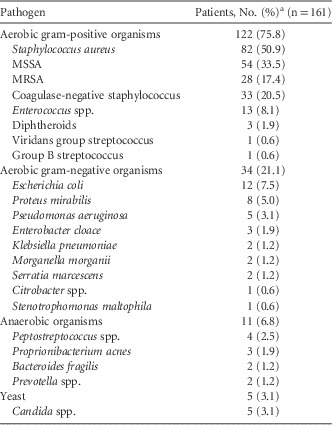
During the study period, 5,473 spinal fusion procedures were performed by neurosurgeons in our hospital. During this period, 163 SSIs occurred; however, 2 infections were excluded because the patients developed >1 SSI following spinal fusion surgery. Because only the first SSI for each patient was included in the cohort, the remaining 161 SSIs were included as part of the analysis. The overall spinal fusion SSI rate was 2.94%; among them, 34 (21.1%) were classified as superficial incisional, 114 (70.8%) were deep incisional, and 13 (8.1%) were organ space. At least 1 pathogen was identified in 155 of the 161 cases (96.3%); >1 pathogen was identified in 36 cases (22.4%), and >2 pathogens were identified in 8 cases (5.0%). Aerobic gram-positive organisms accounted for 122 (75.8%) infections, with S. aureus identified in 82 of the 161 cases (50.9%) (Table 1). Of the 82 S. aureus infections, 28 were due to methicillin-resistant S. aureus (MRSA). Aerobic gram-negative organisms were identified in 34 cases (21.1%), while anaerobic organisms were isolated in 11 cases (6.8%).
Causative Pathogens in Cases of Surgical Site Infections Following Neurosurgical Spinal Fusion Procedure

Note. MSSA, methicillin-susceptible Staphylococcus aureus; MRSA, methicillin-resistant Staphylococcus aureus.
a >1 pathogen was identified in 36 patients, so the percentages total >100.
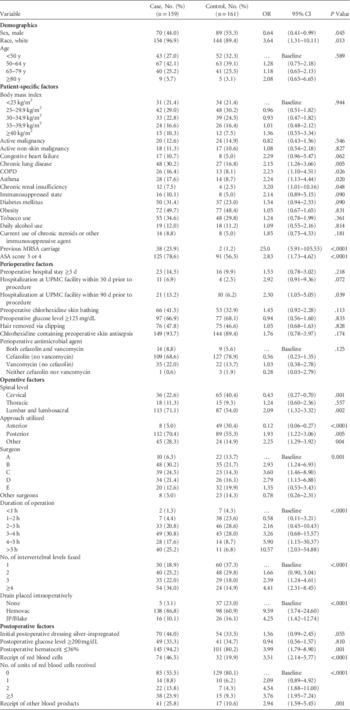
Univariate risk factor analysis is shown in Table 2. The patient-specific factors that were found to be associated with a significantly increased risk of SSI in the univariate analysis included chronic obstructive pulmonary disease, asthma, chronic renal insufficiency, male sex, white race, and previous MRSA carriage. In total, 98 patients (30.6%) were screened for MRSA carriage prior to spinal fusion, while 222 (69.4%) did not receive screening prior to surgery. Of those 98, 40 (40.8%) who received prior screening were found to be MRSA colonized prior to spinal fusion. More severe illness, as indicated by an ASA score of 3 or 4, was associated with an increased risk of SSI. Obesity, defined as a body mass index (BMI) of 30–34.9 kg/m2, was not associated with an increased risk of SSI. Neither morbid obesity (BMI, 35–39.9 kg/m2) nor extreme obesity (BMI, ≥40 kg/m2) was associated with an increased risk of SSI.
Univariate Analysis of Patient, Perioperative, Procedural, and Postoperative Risk Factors for Development of Surgical Site Infections following Neurosurgical Spinal Fusion

NOTE. OR, odds ratio; CI, confidence interval; COPD, chronic obstructive pulmonary disease; MRSA, methicillin-resistant Staphylococcus aureus; ASA, American Society of Anesthesiologists; UPMC, University of Pittsburgh Medical Center; JP, Jackson–Pratt.
Hospitalization in the 90 days prior to spinal fusion procedure was associated with a significantly increased risk of development of an SSI, whereas preoperative hospitalization of ≥3 days was not associated with an increased risk. There was no association of increased SSI risk with preoperative glucose level of >125 mg/dL and hair removed via clipping compared to no hair removal.
Significant procedural risk factors on univariate analysis included procedures lasting >4 hours, procedures where ≥3 vertebral bodies were fused, and procedures where a drain was placed intraoperatively. Additionally, procedures performed by neurosurgeons B, C, and D were associated with an increased SSI risk compared with surgeon A. Surgeries performed on the cervical spine were associated with a reduced risk of SSI. Utilizing an anterior surgical approach was found to be a protective factor.
Postoperative factors that were associated with an increased risk of developing an SSI included postoperative hematocrit ≥36%, receipt of ≥2 units of packed red blood cells intraoperatively or postoperatively, and receipt of other blood products. The use of a silver-impregnated dressing initially postoperatively did not meet statistical significance (OR, 1.56; 95% CI, 0.99–2.45; P=.055). A postoperative glucose level of ≥200 mg/dL was not a risk factor for developing an SSI.
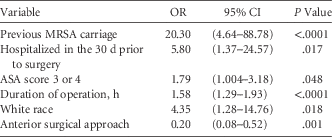
Table 3 shows the results of a multivariate logistic regression analysis to assess independent risk factors when adjusting for all other potential risk factors. In the final model, previous MRSA carriage (P<.0001), hospitalization in the 30 days prior to fusion procedure (P=.017), ASA score of 3 or 4 (P=.048), duration of operation (per hour) (P<.0001), and white race (P=.018) were independently associated with developing an SSI following neurosurgical spinal fusion. Utilization an anterior surgical approach (P=.001) was found to be a protective factor. Previous MRSA carriage (OR, 20.30; 95% CI, 4.64–88.78) was the strongest risk factor for postoperative SSI after adjusting for all other variables.
Multivariate Logistic Regression Model for Development of Surgical Site Infections Following Neurosurgical Spinal Fusion

NOTE. OR, odds ratio; CI, confidence interval; MRSA, methicillin-resistant Staphylococcus aureus; ASA, American Society of Anesthesiologists.
Of the 40 patients with prior MRSA colonization, 38 developed an SSI, and MRSA was the causative pathogen in 28 of those cases (73.7%). Of the 58 patients with a negative MRSA screen, 28 (48.3%) developed an SSI. All MRSA SSIs occurred in patients who were known to be MRSA carriers.
DISCUSSION
The aim of this study was to identify risk factors for the occurrence of SSI following neurosurgical spinal fusion at a single institution during a 4-year period. To identify independent, modifiable risk factors for SSIs, we performed a case-control study with multivariate analysis. We found that, in addition to known patient-specific, perioperative, procedural, and postoperative risk factors, prior colonization with MRSA was the strongest independent risk factor for infection. The odds of SSI following spinal fusion for those with prior MRSA nares colonization was 20 times higher than for those without colonization.
In 2014, Thakkar et alReference Thakkar, Ghobrial and Maulucci 37 were the first to correlate nasal MRSA colonization with postoperative MRSA SSI following neurosurgical spinal surgery; MRSA SSI developed in 8% of patients with prior MRSA colonization compared to 0.61% of those without prior MRSA colonization (OR, 14.23; P=.02). While S. aureus colonization has not been well described as a risk factor for SSI following spinal fusion, nasal carriage of MRSA appears to be increasingly associated with the development of SSI following other surgical procedures.Reference Kim, Spencer and Davidson 38 , Reference Bode, Kluytmans and Wertheim 39 Kim et alReference Kim, Spencer and Davidson 38 reviewed the cases of >7,000 patients undergoing orthopedic surgical procedures, among whom 22.6% were MRSA carriers. Colonized patients underwent a decolonization protocol with chlorhexidine and intranasal mupirocin prior to surgery. These decolonized patients had a significantly lower SSI rate compared to a historical control cohort. Bode et alReference Bode, Kluytmans and Wertheim 39 identified nasal S. aureus carriers undergoing general surgical, orthopedic, and neurosurgical procedures; they were then randomized to preoperative decolonization with chlorhexidine and intranasal mupirocin or control. The decolonized cohort had a decreased SSI rate (3.4% vs 7.7%). Given these findings, prior MRSA colonization represents a potentially modifiable risk factor, and attempts should be made to actively screen for S. aureus carriage prior to spinal fusion. Those with positive S. aureus carriage screens may potentially benefit from decolonization prior to spinal fusion.
With univariate analysis, we identified numerous other factors that were significantly associated with the development of SSIs. However, with multivariate analysis, duration of procedure, ASA score of 3 or 4, white race, and hospitalization within the prior 30 days were found to be independent predictors of developing an SSI following spinal fusion, while an anterior surgical approach was found to be a protective factor. White race represented most cases and controls, and the small number of nonwhite study participants may have limited the ability to assess risk.
In agreement with previous studies,Reference Rao, Vasquez and Harrop 10 – Reference Olsen, Mayfield and Lauryssen 12 , Reference Veeravagu, Patil, Lad and Boakye 19 , Reference Apisarnthanarak, Jones and Waterman 31 patients with ASA class 3 or 4 had odds 1.79 times higher of developing infection. Fusion of ≥3 vertebrae, postoperative anemia, and receipt of both red blood cells as well as blood products were found to be significant risk factors for SSI by univariate analysis. None of these were significant in the multivariate analysis, whereas procedure lasting >4 hours was a significant risk factor. This finding is likely related to the confounding associations among these variables. These data suggest that more extensive and prolonged spinal fusion procedures carry a higher risk of infection.Reference Massie, Heller, Abitbol, McPherson and Garfin 9 , Reference Rao, Vasquez and Harrop 10 , Reference Pull ter Gunne and Cohen 16 , Reference Maragakis, Cosgrove, Martinez, Tucker, Cohen and Perl 17 , Reference Veeravagu, Patil, Lad and Boakye 19 , Reference Wilmmer, Gluch, Franzreb and Ogon 26 , Reference Schimmel, Horsting, de Kleuver, Wonders and van Limbeek 27 , Reference Fang, Hu and Endres 30 , Reference Richards, Herring and Johnston 32 , Reference Weinstein, McCabe and Cammisa 33 Additionally, surgeons B, C, and D were risk factors for developing an SSI by univariate but not multivariate analysis. This finding lends further credence to the deduction that more complicated and protracted fusions are critical in the development of SSI, rather than the individual surgeon performing the procedure. We found anterior surgical approach to be a protective factor, which is consistent with prior evaluations.Reference Olsen, Mayfield and Lauryssen 12 , Reference Pull ter Gunne and Cohen 16 , Reference Maragakis, Cosgrove, Martinez, Tucker, Cohen and Perl 17 , Reference Levi, Dickman and Sonntag 34 This finding is likely related to the fact that this approach is employed primarily in shorter and less complicated cervical fusions and thus represents a surrogate for procedure complexity.Reference Olsen, Nepple and Riew 18
Contrary to other similar studies, we did not find current tobacco use,Reference Veeravagu, Patil, Lad and Boakye 19 , Reference Schimmel, Horsting, de Kleuver, Wonders and van Limbeek 27 , Reference Ahn, Klug and Nho 29 , Reference Fang, Hu and Endres 30 obesity,Reference Massie, Heller, Abitbol, McPherson and Garfin 9 – Reference Maragakis, Cosgrove, Martinez, Tucker, Cohen and Perl 17 or an immunosuppressed stateReference Massie, Heller, Abitbol, McPherson and Garfin 9 , Reference Veeravagu, Patil, Lad and Boakye 19 to be independent risk factors for the development of SSI following spinal fusion. Interestingly, we also did not find the presence of DM significantly associated with an increased risk of SSI. DM has been reported to be a prevalent comorbidity in patients undergoing spinal surgery in several studies.Reference Massie, Heller, Abitbol, McPherson and Garfin 9 , Reference Pull ter Gunne and Cohen 16 , Reference Olsen, Nepple and Riew 18 – Reference Wilmmer, Gluch, Franzreb and Ogon 26 In our study, we found neither elevated preoperative nor postoperative glucose levels to be correlated with SSI risk. This is not surprising; a 2009 Cochrane Review found insufficient evidence to support strict glycemic control versus conventional management for the prevention of SSI.Reference Kao, Meeks and Moyer 40
Our analysis has several important limitations. Whereas a case-control study is the most practical method to analyze a relatively infrequent event, the retrospective and observational nature of the study type prohibited complete analysis of some potentially significant risk factors because the accuracy of the data was dependent upon documentation in the electronic medical records. We were only able to determine prior hospitalizations that occurred at a UPMC facility. Most patients (69.4%) did not undergo MRSA screening prior to spinal fusion. If prior known MRSA carriage was not recorded in the UPMC medical record, it may not have been captured. For comorbid conditions, this method of collection via chart review based upon clinician recorded history carries the possibility of underestimation due to lack of proper documentation. Additionally, we did not differentiate whether patients with DM were well controlled versus poorly controlled or whether they were insulin dependent versus maintained on oral hypoglycemic agents. For tobacco abuse, we did not differentiate between light and heavy use, and we did not assess former smokers. In our analysis, we were not able to include a few potential risk factors including preoperative serum albumin level, closed suction drain duration, operating room traffic, and timing of prophylactic antibiotic re-dosing. Also, the study’s retrospective nature denotes the possibility of underestimating actual infection rates. At our institution, the infection prevention team reviews all outpatient and inpatient microbiology cultures. However, it is possible that a superficial infection may not have been detected, thus causing the underestimation of the total SSI infection rate. Additionally, this was a single-center analysis, so the results may not be generalizable to other facilities, especially those that do not serve as a large referral center or perform surgeries of the same complexity.
Our study has numerous strengths. This is one of the largest studies examining risk factors for SSI after spinal surgery given the large volume of spinal surgeries performed at this single institution which increases the power of our analysis. Additionally, we focused on a homogenous patient population by honing the evaluation to only spinal fusions performed by neurosurgeons in our hospital. Another study strength is the breadth and variety of variables included in our analysis. It is quite difficult to analyze a complex disease state that has numerous potential risk factors that are intimately interrelated. To attempt to identify the true independent risk factors associated with development of SSIs, we included a wide breadth and variety of variables in our analysis. Additionally, by utilizing multivariate analysis, we were better able to ascertain the degree to which these interrelated variables contribute to SSI development. This study is one of few that have evaluated risk factors for SSI following spinal fusion and have utilized multivariate analysis. Like other studies, traditional risk factors were found; however, prior known MRSA colonization, a potentially modifiable, independent risk factor, was identified in this specific patient population. Areas for continued study include the role of universal screening for S. aureus carriage prior to spinal fusion as well as the impact of decolonization strategies for colonized patients prior to neurosurgical spinal fusion.
ACKNOWLEDGMENTS
The authors would like to thank Lloyd Clarke for his technical assistance and support.
Financial support: No financial support was provided relevant to this article.
Potential conflicts of interest: All authors report no conflicts of interest relevant to this article.