INTRODUCTION
The hookworms, Necator americanus and Ancylostoma duodenale, and the human roundworm, Ascaris lumbricoides, infect an estimated 439 and 819 million people worldwide, respectively (Pullan et al. Reference Pullan, Smith, Jasrasaria and Brooker2014), primarily in areas with high levels of poverty (Holland et al. Reference Holland, Taren, Crompton, Nesheim, Sanjur, Barbeau, Tucker, Tiffanfy and Rivera1988; Hotez et al. Reference Hotez, Fenwick, Savioli and Molyneux2009; Walker et al. Reference Walker, Hall and Basanez2011; Gazzinelli et al. Reference Gazzinelli, Correa-Oliveira, Yang, Boatin and Kloos2012). Many children in endemic areas begin to acquire infections during their first year of life (Yu and Shen, Reference Yu, Shen, Schad and Warren1990; Crompton and Nesheim, Reference Crompton and Nesheim2002; Keiser et al. Reference Keiser, Ingram and Utzinger2011), and preschool children are especially vulnerable to impacts of even low numbers of worms (Chan, Reference Chan1997; Hall et al. Reference Hall, Hewitt, Tuffrey and de Silva2008). Within endemic areas, hookworm and Ascaris infection dynamics are characterized by chronic ongoing reinfection as a result of environmental contamination with parasite eggs and larvae (Hall et al. Reference Hall, Hewitt, Tuffrey and de Silva2008). Characteristics of the yard environment including vegetation cover, which protects Ascaris eggs and hookworm larvae from ultraviolet radiation and desiccation (Gaasenbeek and Borgsteede, Reference Gaasenbeek and Borgsteede1998; Maikai et al. Reference Maikai, Umoh, Ajanusi and Ajogi2008) and child behaviours including open defecation in the yard and playing with soil, have been positively associated with higher intensity of Ascaris and hookworm in preschool children (Krause et al. Reference Krause, Koski, Pons, Sandoval, Sinisterra and Scott2015). Futhermore, Cairncross et al. (Reference Cairncross, Blumenthal, Kolsky, Moraes and Tayeh1996) noted that Ascaris tends to be an infection of the ‘domestic domain’ defined as space occupied by and under control of the household, whereas hookworm transmission tends to take place in the ‘public domain’ defined as public spaces (e.g. work and recreation). However, transmission dynamics in preschool children due to agriculture-related infection risks away from the home environment are not well understood.
Subsistence farming populations in rural areas of developing countries are some of the most vulnerable to poverty-related infections such as hookworm and Ascaris (Hotez et al. Reference Hotez, Fenwick, Savioli and Molyneux2009). Within these communities, intensification of crop production is often used as a key strategy in poverty reduction and economic development (Pichon and Uquillas, Reference Pichon and Uquillas1997; Rose, Reference Rose2008; Byerlee, Reference Byerlee2009). There is evidence that more intensified production of staples, cash crops, and fruits and vegetables can lead to higher household income, food security and better child growth (Mueller et al. Reference Mueller, Vounatsou, Smith and Allen2001; Faber et al. Reference Faber, Phungula, Venter, Dhansay and Benadé2002; Low et al. Reference Low, Arimond, Osman, Cunguara, Zano and Tschirley2007; Orozco et al. Reference Orozco, Cole, Muñoz, Altamirano, Wanigaratne, Espinosa and Muñoz2007). However, agricultural workers and neighbours within proximity of agricultural land contaminated with untreated waste water have been shown to be at higher risk of hookworm infection (Ensink et al. Reference Ensink, van der Hoek, Mukhtar, Tahir and Amerasinghe2005; Matthys et al. Reference Matthys, Tschannen, Tian-Bi, Comoé, Diabaté, Traoré, Vounatsou, Raso, Gosoniu and Tanner2007; Mihrshahi et al. Reference Mihrshahi, Casey, Montresor, Phuc, Thach, Tien and Biggs2009). Thus farming families may be at increased risk of soil-transmitted nematode infection due to frequent exposure to contaminated soil or irrigation water (Udonsi and Atata, Reference Udonsi and Atata1987; Ensink et al. Reference Ensink, van der Hoek, Mukhtar, Tahir and Amerasinghe2005; Kirwan et al. Reference Kirwan, Asaolu, Abiona, Jackson, Smith and Holland2009), and these risks may extend to preschool children of caregivers whose heavy agricultural workloads and lack of other supervision options necessitate that their young children accompany them to agricultural areas (Jones et al. Reference Jones, Cruz Agudo, Galway, Bentley and Pinstrup-Andersen2012).
The literature on impacts of agricultural interventions has not considered the possibility that intensified subsistence agriculture may increase the risk of transmission of hookworm and Ascaris to preschool children who accompany their caregiver to the household agricultural plot. The lack of consideration of heightened risk of nematode transmission with intensified agriculture is problematic because these nematodes impair child growth and development (Drake et al. Reference Drake, Jukes, Sternberg and Bundy2000; Hall et al. Reference Hall, Hewitt, Tuffrey and de Silva2008). Therefore any agriculture-associated increase in infection may diminish the benefits of agricultural interventions on child nutritional status and growth.
In central Panama, an agricultural intervention has been underway in extremely poor, rural subsistence farming communities in the province of Veraguas where hookworm and Ascaris are endemic. The intervention, VERASAN (Proyecto para el Mejoramiento del Consumo y la Disponibilidad de Alimentos en Comunidades de la Provincia de Veraguas, ‘Project for the improvement of consumption and availability of food in communities in the province of Veraguas’) began in 8 communities in 2007 and was extended to 15 communities by the time of this study. VERASAN was coordinated by the Panama Ministry of Health, with support from Japan's International Cooperation Agency and in collaboration with the Panama Ministries of Agricultural Development and Education. A team of nutritionists, agronomists, public health educators and community support staff worked in the communities to improve household food security through the use of demonstration gardens where participants learned new agricultural methods.
This study follows our previous work on infection risks in the home environment, which demonstrated that proximity of the latrine from the home, child defecation in the yard and playing with soil were associated with higher eggs per gram feces (epg) of Ascaris and hookworm in preschool children (Krause et al. Reference Krause, Koski, Pons, Sandoval, Sinisterra and Scott2015). Using households involved in the VERASAN agricultural program, the main objective of this study was to explore the influence of agriculture-related factors away from the home environment, on egg counts of soil-transmitted nematodes in preschool children. Specifically, our goal was to determine whether egg counts at baseline and after reinfection in the growing and harvest agricultural seasons were associated with the diversity and intensity of subsistence agricultural practices as quantified by a novel Agricultural Activity Index (AAI), with involvement of the primary caregiver in agriculture, and with presence of the preschool child at the agricultural plot. Three of the yard factors (child plays with soil, hours/day child plays outdoors, number of dogs) that were previously associated with transmission in these children (Krause et al. Reference Krause, Koski, Pons, Sandoval, Sinisterra and Scott2015) were also included in the analyses. Given that some prevalence were very low, we were able to explore factors influencing only Ascaris and hookworm egg counts at baseline and only Ascaris reinfection egg counts during the harvest.
METHODS
Study area and population
The study was conducted in the 15 subsistence farming communities involved in the VERASAN agricultural program. Households grew rice, maize, cassava, plantains, a variety of local tubers and vegetables including cucumbers, tomatoes, squash and peppers, and had a per capita earned income of $4.63 month−1.
In this region in 2012, average temperature was 27·6 °C, average relative humidity was 76·8%, and average daily rainfall was 6·1 mm, totalling 2238·3 mm over the year with 138 days of rain (INEC, 2014). The normal rainy season is from April to early December, and in 2012 the rainiest month was June (347·8 mm) (INEC, 2014).
Study design
The longitudinal, observational study was conducted over one agricultural cycle from February to October 2012 on a cohort of preschool children. Egg counts of Ascaris, Trichuris, and hookworm were determined from fecal samples collected from all preschool children during land preparation (February–March) (‘baseline’) after which children were dewormed with albendazole. After the first 3·5 months’ reinfection period, a second fecal sample was collected during the growing season (June–July) (‘reinfection 1’) and children were again dewormed. Following the second 3·5 months reinfection period during harvest (September–October) (‘reinfection 2’), a third fecal sample was collected, and infected children were dewormed a final time. Questionnaires were used to obtain information on household socio-demographic variables and crop production activities that might have been related to transmission of Ascaris, Trichuris, or hookworm.
Participant recruitment and ethics
Inclusion criteria for households were: (1) participation of at least one household member in the VERASAN program, and (2) at least one child between 6 months and 5 years at the beginning of the study. All preschool children in the household were enrolled in the study, and a single index child was chosen randomly after the data collection for inclusion in multivariate analyses of factors influencing infection and reinfection egg counts.
The study was approved by the Internal Review Board of the Faculty of Medicine of McGill University in Canada and the National Research Bioethics Committee of the Gorgas Commemorative Institute for the Study of Health in Panama. Permission from the national and regional directors of the Ministry of Health was obtained before visiting the study communities when the proposed research project was explained, questions were answered and verbal permission to conduct the study was obtained from the community. At the time of formal recruitment of households into the study, the research was again explained, any remaining questions were answered and signed consent was obtained from the responsible adult present, on behalf of the participating household and preschool children.
Questionnaires on household socio-demographics and agriculture
Household questionnaires administered to the primary caregiver provided information about household socio-demographic variables (sex and age of the child, number of children ⩽12 years, age and education level of primary caregiver) that are commonly reported to influence soil-transmitted nematode infection in preschool children (Asaolu et al. Reference Asaolu, Ofoezie, Odumuyiwa, Sowemimo and Ogunniyi2002; Ulukanligil and Seyrek, Reference Ulukanligil and Seyrek2004; Hall et al. Reference Hall, Hewitt, Tuffrey and de Silva2008; Ugbomoiko et al. Reference Ugbomoiko, Dalumo, Ofoezie and Obiezue2009; Pullan et al. Reference Pullan, Kabatereine, Quinnell and Brooker2010; Siwila et al. Reference Siwila, Phiri, Enemark, Nchito and Olsen2010; Cundill et al. Reference Cundill, Alexander, Bethony, Diemert, Pullan and Brooker2011; Menzies et al. Reference Menzies, Rodriguez, Chico, Sandoval, Broncano, Guadalupe and Cooper2014). In addition, the asset-based household wealth index (HWI) previously constructed for this study population (Krause et al. Reference Krause, Koski, Pons, Sandoval, Sinisterra and Scott2015) was used as an indicator of long-term wealth (Filmer and Pritchett, Reference Filmer and Pritchett2001; Vyas and Kumaranayake, Reference Vyas and Kumaranayake2006) based on whether or not the household owned a shovel, hoe, axe, pickaxe, stove, horse, or cell phone, whether water was piped to the yard, and whether the home had a latrine, adobe walls, and concrete or dirt floors. Respondents were asked whether the primary caregiver participated in agricultural activities related to crop production, whether preschool children went to the agricultural plot and whether preschool children were present during the clearing of land, planting, weeding, irrigating, applying fertilizer, applying pesticides and harvesting.
Questionnaires administered to adults involved in crop production were used to obtain information on the size of the household agricultural plot, whether the household irrigated the plot, and whether the household used specific methods that were common in the region and/or taught through the VERASAN program: 12 related to seed selection, collection and growing; 11 related to soil conservation and planting; 14 related to use of fertilizers; and 10 related to use of pesticides.
Development of AAI
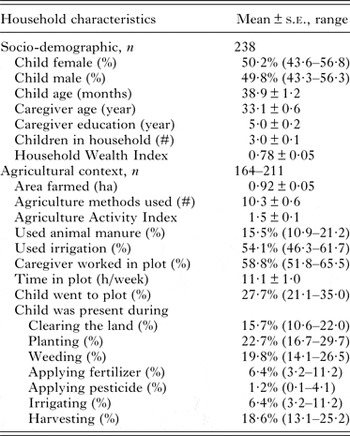
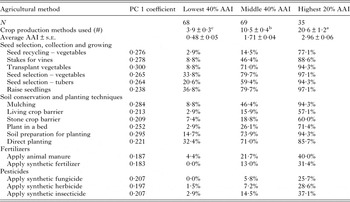
For each household, an ‘Agricultural Activity Index’ was developed using principal components analysis (PCA) to capture the diversity of crop-related methods used by the household. As the methods being introduced by VERASAN were known to intensify subsistence-level household agriculture (R. J. Krause and others, unpublished data), we developed the AAI as a proxy for intensity of agricultural practices. Of the total of 48 crop production methods considered, the AAI was constructed using 17 methods: the four that required purchase of materials (synthetic fertilizer, herbicide, fungicide and insecticide) and the 13 that contributed most to the variability in principal component 1 (PC1) (seed recycling for vegetables, staking vines, transplanting vegetables, selecting vegetable seeds, selecting tuber seeds, raising seedlings, mulching, using a living crop barrier, using a stone crop barrier, planting in a bed, preparing soil for planting, direct planting, applying animal manure and applying synthetic fertilizer). This resulted in a variable-to-observation ratio of 1:10. PC1 explained 29·4% of the total variation seen. The final AAI for each household was calculated by adding the relative weights from PC1 for each of the 17 selected crop production methods (Table 1) after which households were divided into three AAI categories based on the lowest 40%, middle 40% and highest 20% of values for the AAI.
Summary of household socio-demographic variables and agricultural context of households and index children. Mean ± s.e. or per cent (95% CI)

Range of sample sizes given for Agricultural Context variables.
Egg counts of soil-transmitted nematodes and anthelmintic treatment
Fecal samples from all preschool children were collected by caregivers the afternoon before or the morning of the visit by the research team, at which time children ⩾12 months were treated with a liquid formulation of albendazole according to age-specific dosages: 200 mg to children 12–23 months; 400 mg to children ⩾24 months (WHO, 2007). Fecal samples were immediately refrigerated upon reception, and analysed the same day in a hospital laboratory in Santiago by trained laboratory technicians. Ascaris, Trichuris and hookworm eggs were identified and counted using the FLOTAC flotation technique (Utzinger et al. Reference Utzinger, Rinaldi, Lohourignon, Rohner, Zimmermann, Tschannen, N'Goran and Cringoli2008) based on a standard volume of feces (1 g). In the few cases where fecal samples were <1 g, the number of eggs was adjusted to the number per gram. Given the relatively low efficacy of single dose albendazole against hookworm and Trichuris (Adegnika et al. Reference Adegnika, Zinsou, Issifou, Ateba-Ngoa, Kassa, Feugap, Honkpehedji, Agobe, Kenguele and Massinga-Loembe2014), children who were infected with these nematodes were retreated within 10 days with three consecutive doses to increase the likelihood that treatment successfully eliminated all infections (WHO, 2002). Children who failed to provide fecal samples after the first reinfection period were treated with albendazole. Children <12 months who were infected at baseline (February–March) could not be treated and therefore were not included in infection measures during reinfection 1 (June–July). None of the children <12 months during reinfection 1 (June–July) were infected, and therefore the exclusion of these young children from albendazole treatment did not interfere with assessment of their subsequent reinfection measured in reinfection 2 (September–October).
Statistical analysis
SAS version 9.3 (SAS Institute Inc., Cary, NC, USA) was used to perform all statistical tests. Infection and reinfection dynamics were described for all children: prevalence, and proportion of children falling into categories of light, moderate and heavy intensity infections, according to WHO standards, which defines light, moderate and heavy infections with hookworm as 1–1999, 2000–3999 and ⩾4000 epg, respectively, and with Ascaris as 1–4999, 5000–49 999, and ⩾50 000 epg, respectively (WHO, 2002). Mean epg of infected children at baseline and following reinfections were presented in box and whisker plots, showing 25th, 50th and 75th percentiles, range and extreme values. Within nematode species, reinfection prevalences were compared using non-parametric Fisher's exact tests and reinfection epgs of all children and infected children only were compared with non-parametric analysis of variance (Kruskal–Wallis). For households with two or more preschool children, a single index child was randomly selected for inclusion in descriptions of child exposures to agriculture, and in multivariate analyses of infection. For all statistical tests, significance was set at P < 0·05. Standard error or 95% confidence intervals were reported.
One-way comparisons of household socio-demographic and agricultural characteristics by AAI category (lowest 40%, middle 40% and highest 20%) were conducted using parametric or non-parametric analysis of variance or chi-square (χ 2) tests, as applicable. Post hoc Tukey HSD tests were applied to determine pair-wise differences between AAI categories.
The recommended approach of zero-inflated negative binomial (ZINB) regression models (Strunz et al. Reference Strunz, Addiss, Stocks, Ogden, Utzinger and Freeman2014) was used to examine the relationships of household agricultural practices and exposures (irrigation, use of animal manure, size of agriculture plot, AAI, time caregiver worked in the plot, child went to the plot), with egg counts of Ascaris and hookworm at baseline, and Ascaris at reinfection 2, while controlling for socio-demographic variables (child age and sex, caregiver age and education, HWI and number of children ⩽12 year in the household). Counts of zero are included within the negative binomial component on the model, and excess zero counts over and above those explained by the negative binomial dispersion are included in the logistic (zero inflation) component of the model. All agricultural variables of interest (listed above) were included in the initial model, and socio-demographic variables (listed above) were also included if they were associated with infection prevalence or intensity at P < 0·20 in parametric or nonparametric univariate analysis of variance, linear regression, or contingency tables. A backwards stepwise selection procedure was then applied. Following this, three yard infection risk variables identified in Krause et al. Reference Krause, Koski, Pons, Sandoval, Sinisterra and Scott2015 (e.g. ‘child plays with soil,’ ‘child plays outdoors,’ number of dogs) were added and a further backward stepwise selection process was used to generate the final model. Physical measures of the yard were taken only for a subset of the households (Krause et al. Reference Krause, Koski, Pons, Sandoval, Sinisterra and Scott2015), and were therefore not considered in this study. Variables were retained in the models with P < 0·15, but considered significant at P < 0·05. The overall fits of final ZINB models were compared with equivalent negative binomial models using Vuong tests, which showed, in all cases, that it was appropriate to use ZINB models. Collinearity of variables was tested using linear regression models of log-transformed egg counts (log(egg count + 1)) for Ascaris at baseline and at reinfection 2 and hookworm at baseline, on datasets including all children. Variables were considered non-collinear if variance inflation factors were <10 or if tolerances were >0·10. Prevalences of hookworm at reinfections 1 and 2 and Ascaris at reinfection 1 were too low to allow for construction of models.
RESULTS
At baseline, 208 households with 268 preschool children were enrolled. Of these, the 27 households (13%) lost to follow-up did not differ in socio-demographic variables, agricultural activities or infection variables. An additional 19 households with 30 preschool children joined the study after the first reinfection period.
Agricultural exposure and activities
Descriptive data are displayed in Table 1. A total of 58·8% of caregivers regularly worked in the agriculture plot, for an average of 11·1 h week−1. Among index preschool children (average age 38·9 ± 1·2 months), 27·7% had accompanied family members to the household agriculture plot during the previous year: 16–23% had been present during planting, weeding, or harvesting, whereas only 6·4% had been present during irrigation and application of fertilizers and only 1·2% during use of pesticides. Households farmed on average 0·92 ± 0·05 ha of land (0·5–5 ha) and used 9·9 ± 0·6 different methods for crop production.
Seed selection, collection and growing
Seed selection and intercropping were used for vegetables (66·3 and 19·5%, respectively) and tubers (51·5 and 18·3%, respectively). In addition, 50·9% of households transplanted vegetables and 22·5% recycled vegetable seeds. Stakes were used for vines (40·2%) and tubers were treated before planting (12·4%). Fruit trees were transplanted by 11·8% of households, 7·1% collected seeds from trees, 5·9% had a tree nursery and 3·6% used tree grafting.
Soil conservation and planting techniques
Half the households (54·1%) irrigated their agricultural plot with water from nearby streams. A variety of soil conservation techniques were used, including direct planting (58·0%), soil preparation (54·4%), mulching (40·8%), planting in a bed (25·6%) and use of a stone crop barrier (23·1%) or a living crop barrier (19·5%). In addition, 13·6% pre-germinated seeds in a sack, 8·9% used a wooden frame around bedding plants, 3·6% used land terracing and 1·8% used an A Level to reduce run-off.
Fertilizers
Synthetic fertilizers were used by 11·8% of households. A variety of homemade fertilizers were used on the agricultural plot: 28·4% of households made and 27·2% applied bocashi (a fermented organic fertilizer composed of green material from nitrogen-fixing plants, dried corn husks or bean shells, ash, animal manure and molasses); 19·5% composted and 18·3% used compost; 13·6% collected and 18·9% used unprocessed animal manure for fertilizer from chickens, pigs, cattle and horses as available; 1·2% made and 1·8% used vermiculture; and 1·8% made and 1·8% used green manure.
Pesticides
One quarter of households (25·4%) controlled insect pests and 13·6% controlled fungal infections. Synthetic insecticides were prepared by 21·3% of households and 14·8% applied them to their agricultural plot. Synthetic herbicides and fungicides were used by 9·5 and 7·7% of households, respectively. Households commonly used the pyrethroid insecticide, cypermethrin and the herbicide, glyphosate. In addition 4·7% of households prepared organic insect repellents made either with pepper extract or garlic extract and 4·1% used organic insect repellants.
AAI
The average number of crop production methods used per household was 9·9 ± 0·6 and the AAI derived from the PCA ranged from 0 to 4·1 units (mean 1·5 ± 0·1). Households in the lowest 40%, medium 40% and highest 20% of AAI used 3·9 ± 0·3, 10·5 ± 0·4 and 20·6 ± 1·2 of the possible 48 crop production methods, respectively (Table 2). Low AAI households were unlikely to recycle seeds (2·9%), use living crop barriers (2·9%) or stone crop barriers (7·4%), or plant in raised beds (2·9%). None of the households in the lowest AAI category used synthetic fertilizers or fungicides. In contrast, nearly all households in the highest AAI category transplanted vegetables (94·3%), used seed selection methods for vegetables (97·1%) and tubers (94·3%), and raised seedlings (97·1%); 31·4% used synthetic fertilizers and 25·7% used synthetic fungicides. Comparison among AAI categories revealed that HWI was higher for households with medium AAI (HWI of 0·91 ± 0·08) and high AAI (HWI of 0·98 ± 0·14) compared with those with low AAI (HWI of 0·64 ± 0·08; P = 0·029) but other variables related to agriculture (size of plot, whether the caregiver or index preschool child went to the agricultural plot, time the caregiver spent at the plot) did not differ among AAI categories (data not shown).
Number of crop production methods, composition of the Agricultural Activity Index (AAI) including weighting coefficients from the first principal component (PC1), and agricultural activity profiles (%) of households categorized as low (the 40% lowest), medium (the 40% middle) and high (the 20% highest) AAI

Crop production techniques out of the total of 48 methods.
Different superscripts indicate significantly different at P < 0·0001.
Nematode infection dynamics
At baseline, 38·6% of all preschool children (n = 281) were infected with at least one soil-transmitted nematode, and 5·3% of children were co-infected with Ascaris and hookworm. Trichuris infections were rare (only two children at baseline and only one at reinfection 2). As a result, Trichuris was not considered in subsequent analyses.
Hookworm
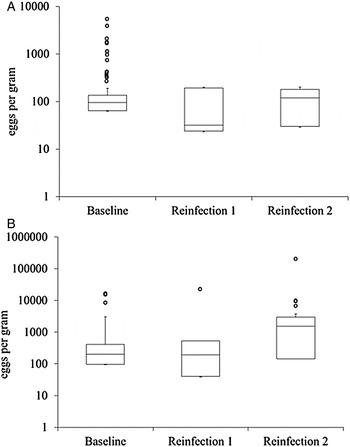
Hookworm prevalence at baseline was 25·3%. Distributions of epg of infected children at baseline, reinfection 1 and reinfection 2 are shown in Fig. 1A. The majority of infections were of light intensity, only two children had moderate intensity infections, and only one had a heavy intensity infection. The youngest infected child was 9 months of age. Hookworm reinfection prevalence was very low both at reinfection 1 (1·7%) and at reinfection 2 (3·1%), as was median epg of infected children and neither reinfection prevalence (P = 0·74) nor epg (χ 2 = 0·37, P = 0·54) differed between the two reinfection periods. As a result, multivariate analyses were restricted to hookworm at baseline.
Box and whisker plots of hookworm (A) and Ascaris (B) eggs per gram (epg) of infected children at Baseline, Reinfection 1 and Reinfection 2. Boxes represent the interquartile range and horizontal lines within boxes represent the median epg. Whiskers represent the range, and circles represent extreme values (1·5 times the third quartile).

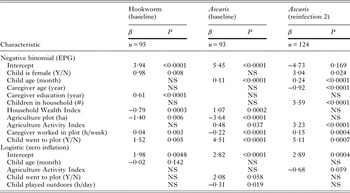
Several variables emerged within the negative binomial component of the ZINB model for hookworm egg counts at baseline (Table 3). Among socio-demographic variables, hookworm egg counts were higher in females than males, in children with a caregiver with more years of education, and in households with lower HWI. Among the agriculture-related variables, hookworm egg count was higher if the agricultural plot was smaller, if the caregiver spent more time working in the plot, and if the child went to the plot. Neither the AAI nor use of animal manure or irrigation nor any of the home yard environment characteristics or child play behaviours emerged in the negative binomial component, and no significant explanatory variables emerged in the zero inflation components (Table 3).
Zero-inflated negative binomial regression models for hookworm egg count of index preschool children at baseline and for Ascaris egg counts at baseline and after reinfection 2

NS, not significant.
Y = 1, N = 0.
The zero-inflated negative binomial model distinguishes zero counts that arise because of the negative binomial component and excess zero counts that are captured in the logistic model component.
Variables with P < 0·15 were retained in the model. Variables initially entered in the model but not retained: household irrigates, household uses animal manure in agriculture.
Vuong tests showed that ZINB models for hookworm at baseline and Ascaris at reinfection 2 were clearly superior to negative binomial models (hookworm: Z = 4·38, P < 0·0001; Ascaris: Z = 3·32, P = 0·0009). The comparison of Ascaris at baseline showed borderline differences between the ZINB and negative binomial models (unadjusted Z = 2·04, P = 0·041; Aike adjusted Z = 1·74, P = 0·082), and for the sake of consistency we have chosen to show the ZINB model.
Ascaris
Prevalence of Ascaris was 15·7% at baseline; light intensity infections were most common but 2·8% of children had moderate intensity infections. Distributions of epg of infected children at baseline, reinfection 1 and reinfection 2 are shown in Fig. 1B. The youngest child infected with Ascaris was 8 months of age. Prevalence was lower at reinfection 1 (2·8%) than at reinfection 2 (9·2%) (χ 2 = 6·31, P = 0·012), as was epg of all children (F 1,374 = 7·28, P = 0·007), although when only infected children were included there was no significant difference between epg of the different reinfection measures (χ 2 = 1·26, P = 0·26). At reinfection 2, one child had a heavy intensity infection.
At baseline, several variables emerged in the negative binomial component of the ZINB model. Ascaris egg count was higher in older children, and in those from homes with higher HWI. Ascaris epg was also higher if the agricultural plot was smaller, if the household had more intensive agricultural practices (AAI), if caregivers worked fewer hours in the plot, and if the child went to the plot. Within the zero inflation component of the ZINB model, children who spent more time playing around the home were less likely to be infected with Ascaris (Table 3).
Given the low prevalence of Ascaris at reinfection 1, multivariate analyses were done only at reinfection 2. At reinfection 2, the negative binomial component of the ZINB model revealed that Ascaris reinfection egg counts were higher in females, in older preschool children and in households with younger caregivers and more children ⩽12 years. Among agriculture-related variables, reinfection 2 egg counts were higher if the household had a higher AAI, if the caregiver spent more time per week at the agricultural plot and if the index child went to the plot. None of the home yard environment characteristics or child play behaviours emerged in the negative binomial component and no variables emerged in the zero inflation component of the ZINB model (Table 3).
DISCUSSION
The potential that interventions aimed at intensification of crop production for subsistence farmers might increase transmission of soil-transmitted nematodes in preschool children has not been previously reported and most previous studies on factors influencing Ascaris transmission in preschool children have focused on the home environment (Asaolu et al. Reference Asaolu, Ofoezie, Odumuyiwa, Sowemimo and Ogunniyi2002; Kirwan et al. Reference Kirwan, Asaolu, Abiona, Jackson, Smith and Holland2009; Kounnavong et al. Reference Kounnavong, Vonglokham, Houamboun, Odermatt and Boupha2011; Wang et al. Reference Wang, Zhang, Luo, Wang, Chen, Medina, Eggleston, Rozelle and Smith2012; Krause et al. Reference Krause, Koski, Pons, Sandoval, Sinisterra and Scott2015). Our novel AAI allowed us to associate more intensified subsistence farming practices with transmission of Ascaris in preschool children. Our models demonstrated that agriculture-associated variables increased nematode egg counts in preschool children as revealed in the negative binomial component of the regression models. Furthermore, hookworm and Ascaris egg counts were associated with involvement of the caregiver in agriculture and with the presence of the preschool child at the household agricultural plot. Of the three yard variables that could be included in our models and that were previously associated with infection in these children (Krause et al. Reference Krause, Koski, Pons, Sandoval, Sinisterra and Scott2015), only one was also significant in this study: children who spent more time playing around the home were less likely to be infected with Ascaris at baseline. Together, these data showed that, after controlling for socio-demographic variables, intensification of subsistence agricultural practices was associated with increased transmission of nematode infections in preschool children.
Much of the literature on factors influencing infection with soil-transmitted nematodes distinguishes between infected and uninfected children (Östan et al. Reference Östan, Kilimcioğlu, Girginkardeşler, Özyurt, Limoncu and Ok2007; Kirwan et al. Reference Kirwan, Asaolu, Abiona, Jackson, Smith and Holland2009; Mihrshahi et al. Reference Mihrshahi, Casey, Montresor, Phuc, Thach, Tien and Biggs2009; Balen et al. Reference Balen, Raso, Li, Zhao, Yuan, Williams, Luo, Shi, Yu and Utzinger2011; Kounnavong et al. Reference Kounnavong, Vonglokham, Houamboun, Odermatt and Boupha2011; Quintero et al. Reference Quintero, Durán, Duri, Medina, Garcia, Hidalgo, Nakal, Echeverria-Ortega, Albano and Incani2012; Menzies et al. Reference Menzies, Rodriguez, Chico, Sandoval, Broncano, Guadalupe and Cooper2014). Among those that have considered factors influencing intensity (Asaolu et al. Reference Asaolu, Ofoezie, Odumuyiwa, Sowemimo and Ogunniyi2002; Nishiura et al. Reference Nishiura, Imai, Nakao, Tsukino, Changazi, Hussain, Kuroda and Katoh2002; Gunawardena et al. Reference Gunawardena, Karunaweera and Ismail2004; Payne et al. Reference Payne, Koski, Ortega-Barria and Scott2007; Freeman et al. Reference Freeman, Clasen, Brooker, Akoko and Rheingans2013; Halpenny et al. Reference Halpenny, Paller, Koski, Valdes and Scott2013), use of the recently-recommended ZINB (Chipeta et al. Reference Chipeta, Ngwira, Simoonga and Kazembe2014; Strunz et al. Reference Strunz, Addiss, Stocks, Ogden, Utzinger and Freeman2014; Levecke et al. Reference Levecke, Anderson, Berkvens, Charlier, Devleesschauwer, Speybroeck, Vercruysse and Van Aelst2015) to explore egg counts of intestinal nematodes simultaneously has been limited (Walker et al. Reference Walker, Hall, Anderson and Basanez2009; Magalhaes et al. Reference Magalhaes, Biritwum, Gyapong, Brooker, Zhang, Blair, Fenwick and Clements2011), and to our knowledge only one study has used this method to explore risk for hookworm and Ascaris in preschool children (Krause et al. Reference Krause, Koski, Pons, Sandoval, Sinisterra and Scott2015). We showed that agricultural variables explained egg count but that no variables explained any inflation of the zero egg count class. In contrast, our previous application of the same modelling approach to variables of the yard environment had revealed that any excess from the expected number of uninfected children was inversely associated with the presence of dirt floors, storage of water in the yard, number of dogs in the yard and with children spending less time playing outdoors (Krause et al. Reference Krause, Koski, Pons, Sandoval, Sinisterra and Scott2015). From a public health perspective, it is the intensity of infection rather than presence that is of concern. If a child is infected with only a few worms, they are unlikely to experience morbidity and are unlikely to contribute much to transmission (Hall et al. Reference Hall, Hewitt, Tuffrey and de Silva2008; Levecke et al. Reference Levecke, Anderson, Berkvens, Charlier, Devleesschauwer, Speybroeck, Vercruysse and Van Aelst2015). On the other hand, children with more worms are more at risk of disease and they pass large numbers of eggs in their feces, and thus present a risk to others (Hall et al. Reference Hall, Hewitt, Tuffrey and de Silva2008; Levecke et al. Reference Levecke, Anderson, Berkvens, Charlier, Devleesschauwer, Speybroeck, Vercruysse and Van Aelst2015). The observation that agriculture-related variables influenced egg counts highlights that transmission at the agricultural plot may be of particular concern.
Our finding of a positive relationship between the presence of the child at the plot and Ascaris egg counts both at baseline and at reinfection 2 points to transmission at the agricultural plot. Transmission requires contamination of soil with eggs, survival of eggs, presence of the preschool child at the agricultural plot, spatial overlap of the child and the infective eggs, and ingestion of eggs, and our study provides several lines of evidence to indicate that all these conditions were present. First, contamination with and survival of eggs and larvae is supported by our previous report that 29% of these preschool children openly defecate (Krause et al. Reference Krause, Koski, Pons, Sandoval, Sinisterra and Scott2015). Given the distance of the plot from the home and the absence of latrines at the plot (personal observation), adults also likely defecated at the plot, as reported in other studies (Kightlinger et al. Reference Kightlinger, Seed and Kightlinger1998; Needham et al. Reference Needham, Kim, Hoa, Cong, Michael, Drake, Hall and Bundy1998). Furthermore, agricultural land is generally considered suitable for survival of the eggs because agricultural produce is often contaminated with Ascaris eggs (Amoah et al. Reference Amoah, Drechsel and Abaidoo2005; Adenusi et al. Reference Adenusi, Abimbola and Adewoga2015). Second, our novel finding that Ascaris egg count was negatively associated with the size of the agricultural plot points to spatial overlap of children with Ascaris eggs at the plot, as any fecal contamination would be more concentrated on smaller plots. Third, caregivers previously reported that preschool children put soil in their mouths (Krause et al. Reference Krause, Koski, Pons, Sandoval, Sinisterra and Scott2015). Purposeful or accidental ingestion of soil is the most direct method for transmission of Ascaris (Bethony et al. Reference Bethony, Brooker, Albonico, Geiger, Loukas, Diemert and Hotez2006). Together, these observations show that, in addition to transmission that occurs at the home (Krause et al. Reference Krause, Koski, Pons, Sandoval, Sinisterra and Scott2015), presence at the agricultural plot also places the preschool child at risk of Ascaris transmission.
Moreover, our novel finding that Ascaris egg count was positively associated with the AAI supports our hypothesis of transmission at the agricultural plot. The positive association between AAI and egg count is consistent with higher likelihood of soil contact associated particularly with soil conservation methods (soil preparation, direct planting, planting in beds, mulching) which were done manually by subsistence farmers in the study communities (personal observation). Also, children were present when these techniques were used. Although application of animal manure as fertilizer was included in the AAI, it did not emerge in the multivariate models when entered instead of AAI. This is not surprising given that human feces rather than animal feces is more likely risk factor for Ascaris transmission (Peng and Criscione, Reference Peng and Criscione2012) and that human feces is not commonly used for fertilizer in Panama (Personal observation of R. J. Krause, 2012). It is important to note that, perhaps because of their higher HWI, households with a higher AAI more commonly purchased and used synthetic fertilizers and pesticides including glyphosate and pyrethroids that are immunosuppressive (Duramad et al. Reference Duramad, Harley, Lipsett, Bradman, Eskenazi, Holland and Tager2006; Corsini et al. Reference Corsini, Liesivuori, Vergieva, Van Loveren and Colosio2008). Therefore the relationship between higher Ascaris egg counts and higher AAI scores may not only be transmission-related but also may be a sign of compromised immune function of children exposed to these chemicals.
Hookworm infection was associated with two of the same agricultural factors that influenced Ascaris transmission (the presence of the child at the plot and smaller plots) but not with the AAI. Hookworm larvae are highly sensitive to high ultraviolet radiation, whereas Ascaris eggs are less sensitive (Smith, Reference Smith, Schad and Warren1990; Mun et al. Reference Mun, Cho, Kim, Oh and Yoon2009). Hookworm larvae are also very dependent on soil moisture for their survival and irrigation is a known risk factor for hookworm infection (Smith, Reference Smith, Schad and Warren1990; Ensink et al. Reference Ensink, van der Hoek, Mukhtar, Tahir and Amerasinghe2005). Interestingly, however, we found no association between hookworm egg count and whether plots were irrigated, perhaps because irrigation water comes from nearby streams in this setting and is less likely to be a source of hookworm contamination than in regions where untreated wastewater is used for irrigation (Ensink et al. Reference Ensink, van der Hoek, Mukhtar, Tahir and Amerasinghe2005). Thus, it is likely that differences in life history explain why we did not find an association between hookworm infection and AAI.
We suggest two explanations for the associations between time spent by the caregiver at the agricultural plot and nematode egg count. Given the distance of the plot from the home, it is likely that if the caregiver spent more time at the plot, the child also did. The greater time at the plot would have increased the rate of contact with hookworm larvae and Ascaris eggs at the agricultural plot, explaining the positive association between caregiver time at the plot and hookworm egg count at baseline and Ascaris egg count at reinfection 2. On the other hand, Ascaris egg count at baseline was negatively associated with time the caregiver spent at the plot. This observation highlights that transmission of Ascaris occurred not only at the agricultural plot but also at home. We have previously shown that nematode eggs and larvae were present in soil samples from the yard around the home and that nematode egg count was associated with vegetation cover near the home, children playing with soil, storage of water, items of garbage in the yard and children playing with animals (Krause et al. Reference Krause, Koski, Pons, Sandoval, Sinisterra and Scott2015). The likelihood of transmission at home is also consistent with the report that mother's employment away from the home contributes to child infection risk because children are often left unsupervised (Al-Mekhlafi et al. Reference Al-Mekhlafi, Surin, Atiya, Ariffin, Mahdy and Abdullah2008). Together these findings highlight the need for a better understanding of interrelationships among caregiver activities, preschool child activities and presence of the child at locations that pose a risk for nematode transmission if guidance is to be provided to caregivers about how best respond to competing demands of work, provision for the family and child care activities.
Although we previously presented evidence that transmission occurred around the yard (Krause et al. Reference Krause, Koski, Pons, Sandoval, Sinisterra and Scott2015), the only yard variable to emerge in the current analysis points more to transmission at the agricultural plot than to transmission around the home. Those children who spent more time playing around the home were less likely to be infected with Ascaris at baseline both in our prior analysis of yard factors influencing transmission (Krause et al. Reference Krause, Koski, Pons, Sandoval, Sinisterra and Scott2015) and in the current analyses suggests that transmission was occurring elsewhere, likely at the agricultural plot. On the other hand, playing with soil, which was a significant predictor of baseline hookworm infection in our previous analyses (Krause et al. Reference Krause, Koski, Pons, Sandoval, Sinisterra and Scott2015), was not significant in the present models when included alongside agricultural exposure variables, indicating that exposure risks in the agricultural plot outweigh the risks of simply playing with soil, which is likely to happen in both the home and agricultural plot. We did not investigate the extent to which agricultural plots in this setting could be viewed as a domestic or public domains as described by Cairncross et al. (Reference Cairncross, Blumenthal, Kolsky, Moraes and Tayeh1996) but we have shown that preschool children were at risk of infection both in the yard and at the subsistence agricultural plots. This demonstrates that public health measures to reduce children's exposure to infection risks should not focus solely on the home environment.
We found evidence that female children were at higher risk for greater egg counts of hookworm at baseline and Ascaris at reinfection 2 than male children in our ZINB models. This is consistent with other studies that have shown that girls were more likely to be infected than boys (Haswell-Elkins et al. Reference Haswell-Elkins, Elkins and Anderson1989; Kightlinger et al. Reference Kightlinger, Seed and Kightlinger1998). One reason given for the higher infection in girls was that girls spent more time at the home, whereas boys participated in household agricultural work that took them away from the home for longer periods. However, these studies were not specifically focused on preschool children and our study showed no gender differences in whether they visited the agricultural plot or the amount of time they spent playing outside (data not shown).
In designing our study, we had hypothesized that nematode transmission would have differed among agricultural seasons because of higher risks of transmission associated with certain season-specific agricultural practices. Consistent with this hypothesis, little transmission of hookworm or Ascaris occurred in the interval between land preparation and growing seasons, whereas transmission of Ascaris was higher in the interval between the growing and harvest seasons. However, similar percentages of children were present when plots were cleared, planted, weeded and harvested (15·7, 22·7, 19·8 and 18·6%, respectively). Also none of these season-specific agricultural activities emerged in our multiple regression analyses. It should be noted that the rainy season coincided with the period between the growing season and the harvest. Higher rainfall has been previously associated with increased nematode transmission (Gunawardena et al. Reference Gunawardena, Karunaweera and Ismail2004), presumably because of more favourable conditions for survival of hookworm larvae and Ascaris eggs (Smith, Reference Smith, Schad and Warren1990; Gaasenbeek and Borgsteede, Reference Gaasenbeek and Borgsteede1998). Thus, it is more likely that the rainy season and not season-specific agricultural activities was responsible for the higher transmission observed in the interval between the growing season and the harvest compared with the interval between land preparation and the growing season.
We acknowledge the following limitations. First, because of very low reinfection rates, we were not able to explore factors influencing transmission of hookworm or Ascaris during the growing season or of hookworm during the harvest. Second, we were constrained in our ability to explore the relative contribution of the yard environment and the agricultural plot to transmission. Some of the yard variables previously associated with infection in these children (Krause et al. Reference Krause, Koski, Pons, Sandoval, Sinisterra and Scott2015) were only available for a subset of the children. Also, the combined list of yard and agriculture-related variables exceeded the number that could be explored given our sample size. Finally, we acknowledge that baseline and reinfection models were conducted on the same group of children, which may pose a multiple testing problem. Therefore caution is needed in interpreting underlying mechanisms.
In conclusion, our analyses showed that preschool children were exposed to both hookworm and Ascaris when they accompanied family members to subsistence agriculture plots. Our novel AAI captured the variability among households in use of seed selection, recycling and growing methods, in soil conservation and planting methods, and in application of fertilizers and pesticides. Furthermore, AAI was positively associated with baseline and reinfection Ascaris egg counts, indicating that intensification of subsistence agriculture increased transmission for preschool children, whether or not they went to the agricultural plot. To our knowledge, the potential that interventions aimed at intensification of subsistence agriculture might increase transmission of soil-transmitted nematodes in preschool children has not been previously reported. Given the negative consequences of soil-transmitted nematodes for child growth and development (Hall et al. Reference Hall, Hewitt, Tuffrey and de Silva2008; Gyorkos et al. Reference Gyorkos, Maheu-Giroux, Casapia, Joseph and Creed-Kanashiro2011; Cobayashi et al. Reference Cobayashi, Augusto, Lourenco, Muniz and Cardoso2014; Wong et al. Reference Wong, Moy and Nair2014), and in light of the data presented here, this is an important oversight that needs to be considered in design and implementation of agricultural interventions in areas where soil-transmitted nematodes are endemic. In particular, the risks of indiscriminate defecation in and around agricultural plots and the risks and benefits of caregiver involvement in agriculture need to be considered.
ACKNOWLEDGEMENTS
We are grateful to collaborators from the VERASAN program, particularly Dimas Ulloa, Elvia Murgas, and Dalys Abrega, who helped coordinate our research with the VERASAN program. We thank staff of the Chicho Fábrega Hospital laboratory in Santiago, Veraguas, particularly Itzol Delgado who helped coordinate analysis of fecal samples. We thank the Gorgas Commemorative Institute of Panama for logistical support, and we thank Leonardo León Castro for translating names of agricultural techniques into English. We are particularly grateful to the study participants who made this research possible. Finally, we thank two anonymous reviewers who contributed to improving this manuscript.
FINANCIAL SUPPORT
This research was carried out with the aid of a grant from the International Development Research Centre, Ottawa, Canada to RJK. In-kind support was provided by the Panama Ministry of Health. Support for the data analysis was provided by the Natural Sciences and Engineering Research Council of Canada to MES. Research at the Institute of Parasitology of McGill University is supported by a Regroupement stratégique grant from Fonds Québécois de la recherche sur la nature et les technologies.