Introduction
The family of tephritid flies or fruit flies (Diptera: Tephritidae) is widespread and comprises a number of potentially invasive, frugivorous parasites, causing major agricultural losses worldwide (Aluja & Norrbom, Reference Aluja and Norrbom2000). In Africa, damage on commercial fruits is caused by a limited number of polyphagous species, mainly belonging to the genera Ceratitis MacLeay, Dacus Fabricius and Bactrocera Macquart (White, Reference White2006; De Meyer et al., Reference De Meyer, Robertson, Peterson and Mansell2008). In developing countries, frugivorous tephritid invasions can also reduce the availability of essential dietary components and put at risk the income of rural small-scale farmers (Mwatawala et al., Reference Mwatawala, De Meyer, Makundi and Maerere2009a,Reference Mwatawala, De Meyer, Makundi and Maerereb). A number of recent fruit fly outbreaks across the African continent (White et al., Reference White, De Meyer, Stonehouse, Price and Seewooruthun2000; Lux et al., Reference Lux, Copeland, White, Manrakhan and Billah2003; Mwatawala et al., Reference Mwatawala, De Meyer, White, Maerere and Makundi2007; Vayssières et al., Reference Vayssières, Rey and Traoré2007) have further emphasized the economic significance of this group. Infestations of frugivorous tephritid flies are generally heterogeneous in space and time, and populations of the same species can infest different hosts in different locations and time periods (Vayssières et al., Reference Vayssières, Rey and Traoré2007; Mwatawala et al., Reference Mwatawala, De Meyer, Makundi and Maerere2009a). Traditionally, the distributions and abundances of frugivorous tephritid pests have been strictly related to human-mediated activities, such as agriculture, (inter)national trade of fruit and plant products, tourism, and movements of military troops and refugees (Aluja & Norrbom, Reference Aluja and Norrbom2000; Virgilio et al., Reference Virgilio, Delatte, Backeljau and De Meyer2010). The risk of accidental introductions of alien tephritid pests is a major concern since these human-mediated processes have dramatically increased their potential for dispersal (Malacrida et al., Reference Malacrida, Gomulski, Bonizzoni, Bertin, Gasperi and Guglielmino2007). Additionally, climate change is shifting the geographic distribution of many species (Parmesan & Yohe, Reference Parmesan and Yohe2003; Root et al., Reference Root, Price, Hall, Schneider, Rosenzweig and Pounds2003), so that frugivorous tephritid pests can expand their distributions to formerly unsuitable or inaccessible regions (De Meyer et al., Reference De Meyer, Robertson, Peterson and Mansell2008). Hence, the distribution of frugivorous tephritids appears to be affected by complex interactions between natural and human-mediated processes (Aluja & Norrbom, Reference Aluja and Norrbom2000).
Most of the current knowledge about the ecology and distribution of African frugivorous pests originates from studies in areas with intensive agricultural activities (Vayssières et al., Reference Vayssières, Goergen, Lokossou, Dossa and Akponon2005, Reference Vayssières, Korie and Ayegnon2009; Mwatawala et al., Reference Mwatawala, De Meyer, Makundi and Maerere2006, Reference Mwatawala, De Meyer, Makundi and Maerere2009a,Reference Mwatawala, De Meyer, Makundi and Maerereb, Reference Mwatawala, Maerere, Makundi and De Meyer2010) while information about the structure of tephritid assemblages in pristine or moderately disturbed environments is extremely scarce (but see Copeland et al., Reference Copeland, Okeka, Freidberg, Merz, White, De Meyer and Luke2005). The comparison of assemblages from areas with different levels of human-mediated disturbance (sensu Balée, Reference Balée and Balée1998) can provide valuable information on those ‘natural’ and human-mediated processes that affect the distribution of fruit flies. In this respect, the central regions of the Democratic Republic of Congo (DRC) are an ideal study area due to the co-occurrence of large portions of pristine habitats (i.e. primary and secondary tropical forests) and small rural villages where (limited) agricultural and trading activities take place. This study was performed along a 250 km stretch of the Congo River separating the cities of Kisangani (Tshopo Province, estimated population of 1,200,000) and Bumba (Mongala Province, estimated population of 107,000). In this area, the river is the main (in most cases the only) route for trade and human mobility between the main urban settlements and the small rural villages scattered along the river and its tributaries (de Wasseige et al., Reference de Wasseige, Devers, de Marcken, Eba'a Atyi, Nasi and Mayaux2009). Agriculture in these villages is predominantly low-input and subsistence-based, with little commercial activity, particularly in the wake of the civil war. The main food crops are plantain, maize, cassava, groundnut and rice. Cash crops, include coffee, cocoa, sugar, tea, cotton and rubber, are usually grown on plantations by smallholders. Palm oil products are also produced. In the tropical forests of the Congo River Basin, agriculture is a primary cause of deforestation, even if its impact remains still localized and affects a relatively small part of the landscape (Bruinsma, Reference Bruinsma2003; de Wasseige et al., Reference de Wasseige, Devers, de Marcken, Eba'a Atyi, Nasi and Mayaux2009). The main objective of this study is to quantify levels of spatial variability of tephritid assemblages in Central DRC and verify if human-mediated activities, such as small-scale agriculture and trade, can affect their distribution. For this purpose, we implemented a multi-factorial experimental design testing differences in species composition and abundance (i) at spatial scales ranging from hundreds of meters to hundreds of kilometers and (ii) between habitats subjected to different levels of human-mediated disturbance.
Material and methods
Samples were collected at four locations (Congo: 0°49′02″N, 24°16′31″E; Lomami: 0°41′20″N, 24°15′12″E; Itimbiri: 2°02′39″N, 22°49′32″E; Aruwimi: 1°16′11″N, 23°43′51″E) along a 250 km stretch of the Congo River (fig. 1). Distances among locations ranged from 15 km (between Congo and Lomami) to 220 km (between Congo and Itimbiri). The sampling area has rain throughout the year with two periods when rain is heaviest and most probable (details on average temperatures and precipitation can be found at www.bbc.co.uk/weather/world/city_guides/results.shtml?tt=TT000780). Sampling was performed from the 30th April to 2nd of June 2010 during the declining phase of the first rain peak. At each location, three sites were haphazardly chosen in tropical forests (pristine habitats) and three in rural villages (disturbed habitats). Distances between forests and villages within locations ranged from 2 to 20 km. Pristine sites included a range of plant assemblages either belonging to a truly old-growth forest (primary forest) or regenerating after natural or anthropogenic disturbance, so that the effects of this latter were no longer evident (secondary forest). Sampling sites within habitats were 400–600 m apart while replicate plots were placed in a range of approximately 30 m. At each site, three replicate plots of traps were placed. In order to maximize the number of frugivorous species sampled, each replicate plot consisted of four haphazardly interspersed modified McPhail traps. Each trap in a replicate plot was baited with a different attractant (Trimedlure, Methyl Eugenol, Cue Lure and protein hydrolysate: see Ekesi & Billah, Reference Ekesi and Billah2007). Traps were left in the field for seven days and tephritid specimens were collected, preserved in ethanol and identified at the Royal Musem for Central Africa (Tervuren, Belgium). The total number of specimens sampled in each replicate plot (viz. collected in four differently baited traps over seven days) was used as an estimator of levels of taxonomic diversity of assemblages.
Map of the study area. At each location (Congo, Lomami, Aruwimi, Itimbiri), three sites were sampled within rural villages (disturbed habitats) and three in the surrounding tropical forests (pristine habitats). Three replicate plots of traps were placed at each site. Replicate plots consisted of four haphazardly interspersed modified McPhail traps, each baited with a different attractant (Trimedlure, Methyl Eugenol, Cue Lure and protein hydrolysate).

Differences in patterns of distribution of the three most abundant taxa sampled (Dacus bivittatus, D. punctatifrons, Bactrocera invadens), as well as of total number of specimens and species, were separately analyzed through Analysis of Variance (ANOVA) with location (four levels: Congo, Itimbiri, Aruwimi, Lomami) as random factor; disturbance (two levels: pristine vs. disturbed) as fixed factor orthogonal to location and site (three levels) as random factor, nested in location×disturbance. Cochran's C tests were used to verify the homogeneity of variances, which was reached after fourth root transforming the data (see Underwood, Reference Underwood1997). The Student-Newman-Keuls (SNK) test was used for a posteriori comparisons of means (Sokal & Rohlf, Reference Sokal and Rohlf1995).
The percentage contribution of each species to the average dissimilarity between pristine and disturbed habitats was calculated with SIMPER (Clarke, Reference Clarke1993). Differences among assemblages were tested through Permutational Multivariate Analysis of Variance (PERMANOVA: Anderson, Reference Anderson2001a,Reference Andersonb) using the same experimental design described above. Tests were based on 105 unrestricted permutations of raw data. A posteriori pair-wise comparisons on significant terms were then implemented using the PERMANOVA t-statistic (Anderson, Reference Anderson2001a). Following Clarke (Reference Clarke1993), we square-root transformed the multivariate data in order to reduce differences in scale among variables while preserving information about relative abundance of taxa among replicates. Principal coordinate analysis (PCO) was used for the unconstrained ordination of multivariate data (Anderson, Reference Anderson2003). A constrained ordination was also implemented through canonical analysis of principal coordinates (CAP: Anderson, Reference Anderson2004). Based on the results of PERMANOVA, we defined eight groups, including observations in each combination of disturbance and location. CAP was used to identify the axes in the principal coordinate space that best discriminate among these groups and to produce a better resolved ordination of the data (Anderson & Willis, Reference Anderson and Willis2003).
Results
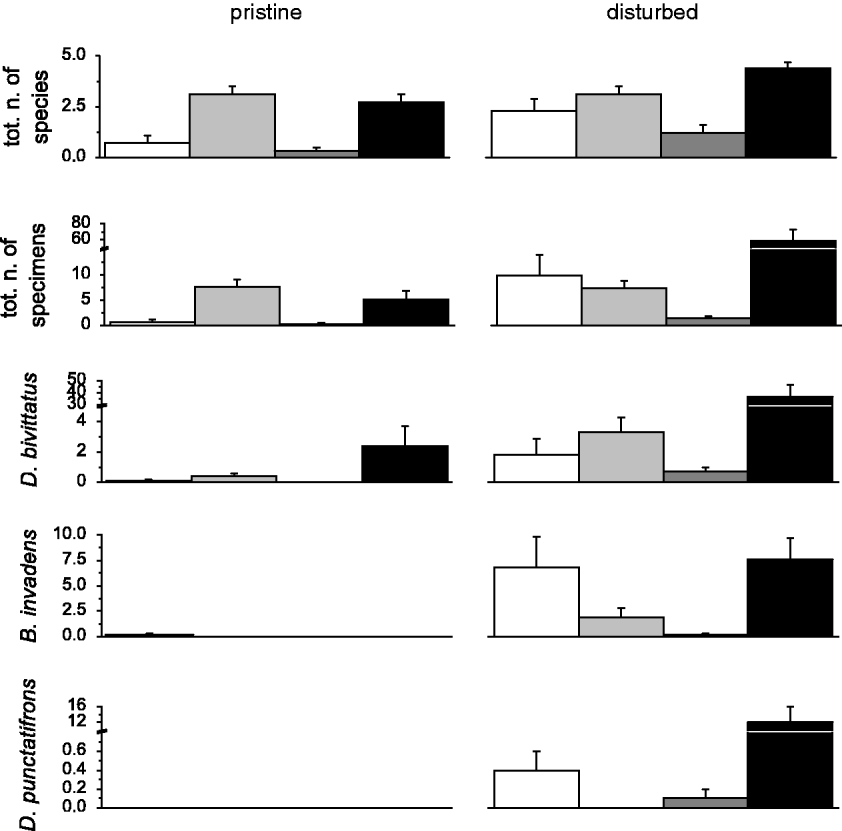
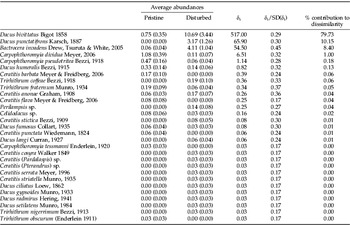
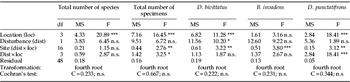
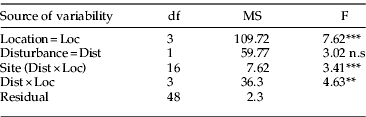
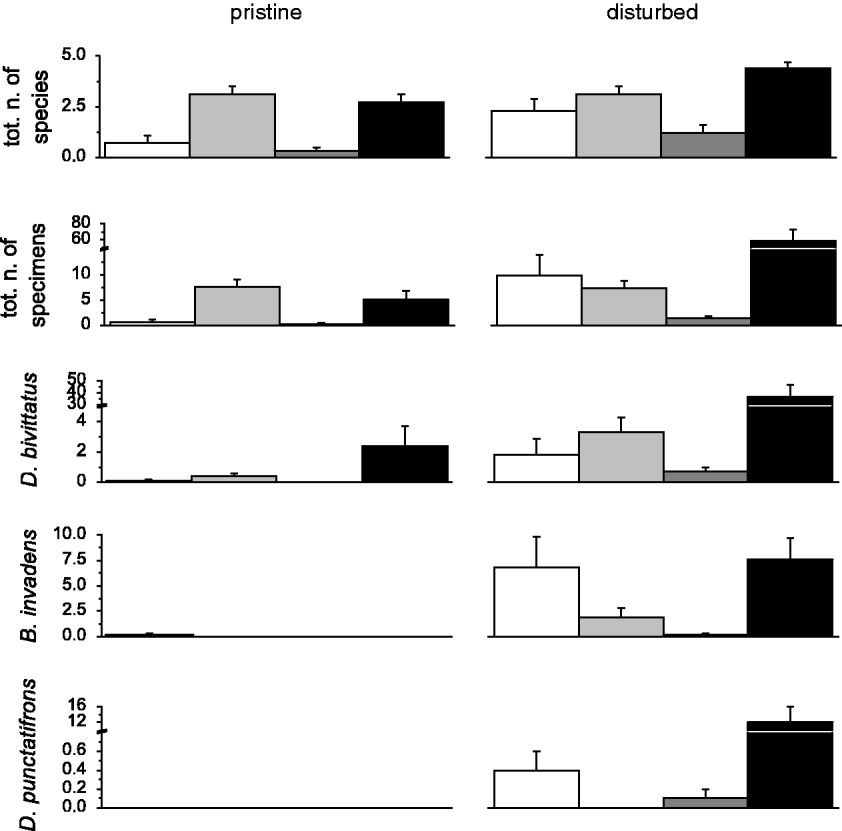
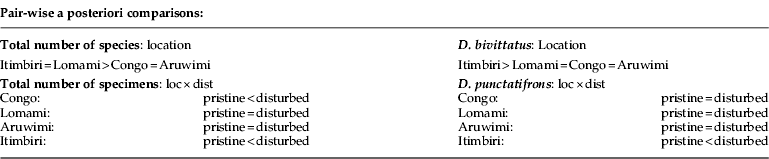
Sampling yielded 819 specimens of 29 species from seven tephritid genera: Bactrocera Macquart (B.), Carpophthoromyia Austen (Cp.), Celidodacus Hendel (Cd.), Ceratitis MacLeay (C.), Dacus Fabricius (D.), Perilampsis Bezzi (P.) and Trirhithrum Bezzi (T.) (table 1). The average number of species sampled at each location ranged from 0.78 (SE=0.22) to 3.56 (SE=0.35) in Aruwimi and Itimbiri, respectively. The average number of specimens collected in each replicate plot was 11.38 (SE=2.83) while it ranged from 0.89 (SE=0.25) to 31.83 (SE=9.66) among sites of the same location (fig. 2). Details on the percentages of specimens sampled by different lure traps are reported as Supplementary Material. ANOVA (table 2) confirmed the occurrence of significant differences in the number of specimens and species among locations and sites. A posteriori comparisons (SNK tests) showed that in two locations (Congo and Itimbiri) the total number of specimens collected from disturbed habitats (villages) was significantly higher than in pristine habitats (forests; table 2, fig. 2). The three most abundant species sampled, D. bivittatus, D. punctatifrons and B. invadens, accounted for 98.29% of the overall dissimilarity between disturbed and pristine habitats. For these three species, ANOVA (table 2) showed significant variations of abundance across sites. D. bivittatus also showed differences either among locations (with significantly higher abundances in Itimbiri) and between disturbance levels (with higher abundances in villages). D. punctatifrons showed no consistent variation across locations and differently disturbed habitats, with Itimbiri as the only location having significantly higher abundances in disturbed compared to pristine habitats.
Average abundances (+standard errors) of tephritid species and specimens and of B. invadens, D. bivittatus, D. punctatifrons sampled in two different habitats (pristine and disturbed) and four locations (Congo, Lomami, Aruwimi, Itimbiri). Changes in y-axis scale (axis breaks) are represented as white lines (□, Congo;  , Lomami;
 , Aruwimi; Itimbiri, ▪).
Average abundances of frugivorous tephritids (number of individuals per replicate plot over seven days, standard deviations in parentheses) sampled in pristine and disturbed habitats (forests and villages, respectively).

For each species, SIMPER (Clarke, Reference Clarke1993) was used to calculate the average dissimilarity between habitats (δi), the consistency of the contribution to δi across samples (δi/SD(δi)) and the percentage contribution to the average dissimilarity between pristine and disturbed habitats.
ANOVAs and a posteriori comparisons (SNK tests), testing differences in numbers of species and specimens and abundances of B. invadens, D. bivittatus, D. punctatifrons in response to location (Congo, Lomami, Aruwimi, Itimbiri), Disturbance (pristine vs. disturbed) and Site (three sites in each combination of Disturbance and Location).

df, degrees of freedom; MS, mean square estimates; F, pseudo-F; n.s., not significant, at P<0.05;
*** P<0.001,
** P<0.01;
* P<0.05.
Sixteen taxa, mostly species of agricultural importance, were only found in disturbed habitats while five species (C. barbata, C. flava, C. punctata, C. tessmanni, T. obscurum) were only found in pristine habitats. All these taxa, except for C. punctata, are African endemics known from relatively few records (9–25 specimens; http://projects.bebif.be/enbi/fruitfly). Two rare species, D. fumosus and C. serrata, are only known from a few pre-independence records (1949 and 1960, respectively).
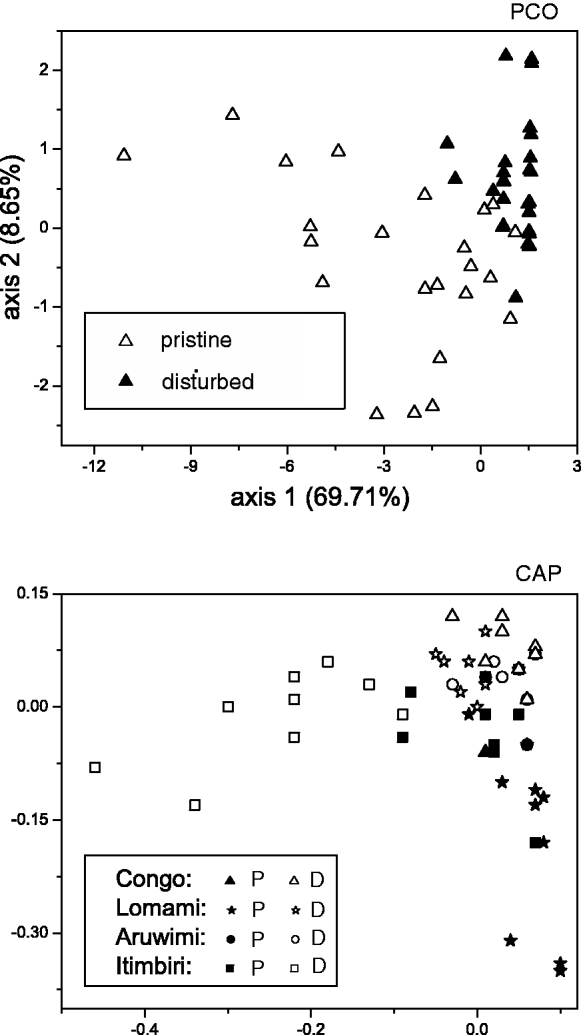
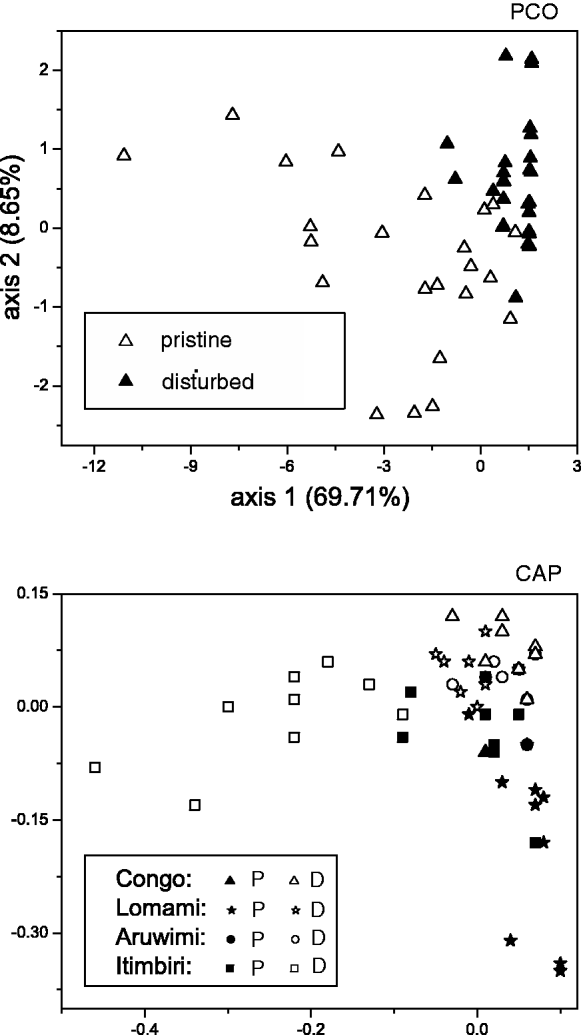
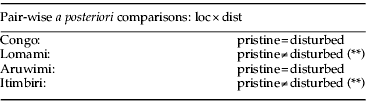
The first two axes of the unconstrained PCO of data (fig. 3) explained 78.36% of the variability in the data (69.71% and 8.65%, respectively). PCO did not show a clear separation either between assemblages from pristine and disturbed habitats or from different locations. Similarly, the constrained ordination (CAP), showed complex patterns of distribution without clearly discriminating among locations or habitats (fig. 3). PERMANOVA (table 3) showed significant differences across locations and sites. A posteriori comparisons indicated that in two locations (Lomami and Itimbiri), assemblages in pristine and disturbed habitats were significantly different (P<0.01).
Unconstrained ordination (principal coordinate analysis, PCO) of frugivorous tephritid assemblages sampled in pristine and disturbed habitats and constrained ordination (canonical analysis of principal coordinates, CAP) of assemblages sampled in each combination of Disturbance (P: pristine, D: disturbed) and location (Congo, Lomami, Aruwimi, Itimbiri). The matrix of similarity between replicate plots was based on fourth root transformed Euclidean distances.
PERMANOVA and a posteriori comparisons (t-statistic), testing differences in multivariate patterns of 29 frugivorous tephritid taxa in response to location (Congo, Lomami, Aruwimi, Itimbiri), disturbance (pristine vs. disturbed) and site (three sites in each combination of disturbance and location).
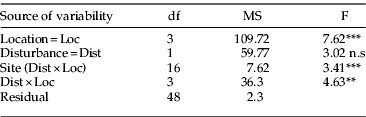
Euclidean distances, data square root-transformed.
df, degrees of freedom; MS, mean square estimates; F, pseudo-F. Probability of Monte Carlo simulations: n.s., not significant, at P<0.05;
*** P<0.001,
** P<0.01;
* P<0.05.
Discussion
This study investigates the spatial variations of tephritid assemblages in central DRC. Relative abundances of taxa were quantified by using lure traps that are effective towards frugivorous tephritids (while they are not for non-frugivorous tephritids, such as leaf miners or flower heads feeders). Only one of the attractants used (protein hydrolysate) is relatively aspecific while the others (Trimedlure, Methyl Eugenol and Cue Lure) attract different ranges of taxa (Ekesi & Billah, Reference Ekesi and Billah2007) and demonstrate varying distance-dependent capture probabilities (Shelly et al., Reference Shelly, Nishimoto, Diaz, Leathers, War, Shoemaker, Al-Zubaidy and Joseph2010). Information about specificity and attraction capability of lures for tephritid flies is far from exhaustive, particularly for rare or not economically important species. Additionally, pheromone baited traps can be subjected to interference when placed at relatively short distances (Ekesi & Billah, Reference Ekesi and Billah2007). In this work, we tried to maximize the taxonomic diversity of samples by considering replicate plots composed by clusters of four differently baited traps. This experimental design is effective in quantifying variations in assemblage composition across locations, sites and habitats and, by not considering the separate effects of each lure, allows overcoming possible biases due to pheromone interference. Note, however, that this work does not aim either to provide a checklist of frugivorous species in central DRC (for which more suitable qualitative or semi-quantitative methods should be used) or at comparing attraction efficacy and specificity of pheromones.
The three most abundant species that were sampled after the first rain peak of 2010 were D. bivittatus, B. invadens and D. punctatifrons. These are major agricultural pests in Africa (White, Reference White2006; De Meyer et al., Reference De Meyer, Robertson, Mansell, Ekesi, Tsuruta, Mwaiko, Vayssières and Peterson2010) and represent 82.5% of the specimens collected (50.3%, 18.3% and 13.9%, respectively). D. bivittatus and D. punctatifrons, are native African species and are distributed over the whole of the continent. Both species are polyphagous and mainly attack Cucurbitaceae, but they are also reported from non-cucurbit hosts such as tomato (Lycopersicon esculentum Miller, Solanaceae) (White, Reference White2006). B. invadens is a highly polyphagous pest native to Asia, attacking more than 44 different hosts belonging to 23 plant families (De Meyer et al., Reference De Meyer, Robertson, Mansell, Ekesi, Tsuruta, Mwaiko, Vayssières and Peterson2010). Its native distribution ranges from Sri Lanka to southern India (Drew et al., Reference Drew, Tsuruta and White2005). In 2003 this species was recorded for the first time on the African mainland (Lux et al., Reference Lux, Copeland, White, Manrakhan and Billah2003). Soon after its discovery in Kenya, it was recorded in many African countries from Senegal to Mozambique, as well as in the Comoro Islands in the Indian Ocean (De Meyer et al., Reference De Meyer, Robertson, Mansell, Ekesi, Tsuruta, Mwaiko, Vayssières and Peterson2010). These three species show different distribution patterns. D. bivittatus is consistently more abundant in disturbed habitats and shows significant variations across locations and sites. Conversely, B. invadens only shows significant variation among sites hundreds of meters apart, while average abundances of both locations and habitats are not significantly different. D. punctatifrons has more complex distribution patterns and shows either differences among sites and, in one out of four cases, differences between pristine and disturbed habitats.
The other species sampled in this study occur in relatively low abundances (below 5.3% in terms of numbers of individuals) and were often represented by single specimens (Cp. tessmanni, C. cosyra, C. (Pardalaspis) sp., C. (Pterandrus) sp., C. serrata, C. striatella, D. ciliatus, D. gypsoides, D. radmirus, D. setilatens, T. nigerrimum, T. obscurum). Average numbers of species and specimens show significant variation across the two spatial scales investigated (viz. among both sites and locations). The number of specimens sampled also varies between pristine and disturbed habitats; and, in two out of the four locations, abundance of specimens is higher in disturbed habitats. Similarly, multivariate analyses reveal a remarkably patchy distribution of species at scales ranging from hundreds of meters to hundreds of kilometers and show that differences among locations and sites, rather than between habitats, are the main source of variability among assemblages.
Human-mediated disturbance is traditionally assumed to influence the composition of fruit fly assemblages. Agriculture is supposed to increase the availability of suitable habitats for fruit flies while human mobility and trade promote the dispersal of frugivorous tephritid pests (Aluja & Norrbom, Reference Aluja and Norrbom2000; Malacrida et al., Reference Malacrida, Gomulski, Bonizzoni, Bertin, Gasperi and Guglielmino2007). This first quantitative survey of the frugivorous tephritid assemblages of central Congo shows consistent differences between pristine and disturbed habitats in two out of the four locations sampled. These data suggest that, in rural villages of central DRC, human activities, such as small-scale agriculture and local commerce, are not always sufficient to promote differences between the tephritid assemblages of villages and those of the surrounding tropical forests. Conversely, differences at spatial scales, ranging from hundreds of meters to hundreds of kilometers, which could be related to differences in the environmental features of locations and sites, do represent the main source of variability that affect the distribution of frugivorous tephritid pests in central DRC.
Acknowledgements
MV is funded by the Belgian Science Policy Action 1 (project MO/37/017). Data were collected during the expedition Boyekoli Ebale Congo 2010 (http://home.bebif.be/cr/) organized by the Congo 2010 Consortium and composed of the University of Kisangani, Royal Museum for Central Africa, Royal Belgian Institute of Natural Sciences and the National Botanic Garden of Belgium, funded by Belgian Development Aid and Belgian Science Policy. We are grateful to Erik Verheyen (RBINS), Alexandra Ley (Université Libre de Bruxelles) and Camille Couralet (RMCA) for stimulating discussion and to Hilde Keunen and Koeki Claessens (RMCA) for continuous assistance in the organization of field activities. This work would not have been possible without the active support of the people from the villages of Yaekela, Lieki, Bomane and Mwenge (DRC). We are grateful to two anonymous reviewers who provided valuable comments on an earlier draft of the manuscript.