With deepening integration into the global economy, governments are subject to increased economic volatility. While flows of international capital provide opportunities for receiving international investment, they render possible sudden capital outflows and speculative attacks that can have severe economic consequences. In addition, growing trade openness leaves countries’ economies vulnerable to economic downturns in major trade partners.
A central question in comparative and international political economy is how governments respond to and manage these issues of economic openness and its associated volatility. It is well established that domestic politics play a considerable role. The partisanship of governments (Quinn and Inclan Reference Reinhart and Rogoff1997; Kastner and Rector Reference Kastner and Rector2005) and the role of veto players (Kastner and Rector Reference Kayser and Peress2003) have previously been found to impact countries’ capital account openness. Moreover, the role of domestic financial interests have long been considered important in understanding how governments react to the rise of global capital (Frieden Reference Gallagher and Shrestha1991). Additionally, financial crises which have become more frequent with greater economic openness, are often a driver of changes in economic policy (Drazen and Grilli Reference Drazen and Easterly1993; Drazen and Easterly Reference Dreher, Sturm and de Haan2001; Biglaiser and DeRouen 2004; Abiad and Mody Reference Abiad and Mody2005).
In this paper, I argue that in addition to these factors, a government’s past political experiences affect incentives to use economic policy to reduce exposure to the pressures of economic globalization. Governments form expectations about the political outcomes of failing to prevent economic shocks from the outcome of previous shocks. When a government lost political power during the previous crisis, future governments have a stronger expectation that a similar fate would occur if they too oversaw such a crisis. As a result, governments use economic policy to insure against this possibility. Moreover, previous events provide information about the efficacy of policies in preventing political change, as well as whether political accountability conforms to expectations.
To analyze how political change during past financial crises influences governments’ attempts to protect against international capital movements, I focus on the use of foreign exchange reserve accumulation in the aftermath of currency crises. In the years after the spate of currency crises in the 1990s, the large-scale accumulation of reserves became a prominent feature of the global economy. Reserve holdings are worth ~30 percent of developing countries’ gross domestic product (GDP) (Rodrik 2006). Furthermore, this accumulation occurred at a higher level than expected, given macroeconomic fundamentals of those countries (Edison Reference Flood and Garber2003) suggesting other, political, concerns in the accumulation of reserves.
The empirical analysis of this paper lends support to the theory outlined above. Governments accumulate higher levels of reserves when previous currency crises resulted in political change. Moreover, the conditions surrounding the previous currency crisis influence the effect of this information. Governments further increase reserve accumulation when political change occurred in situations where governments would not expect to be held accountable, such as currency crises that did not have negative economic outcomes and regional currency crises. In addition, when reserve sales were effective at preventing political change during previous currency crises, future governments continue accumulating reserves.
This paper contributes to the existing literature in three ways. First, it offers an explanation of why some governments, in spite of recently undergoing a financial crisis, still put themselves in the position of being vulnerable to the possibility of a future currency crisis or speculative attack. This complements existing work on governments’ ability and credibility in attempting to prevent currency crises (Leblang Reference Leblang and Satyanath2003; Chiu and Willett Reference Chwieroth and Walter2009; Steinberg and Malhotra Reference Walter2014). Moreover, it emphasizes that governments’ expectations of the consequences of currency crises are important to take into consideration, much like the importance attached to the expectations of investors and speculators in previous research (Leblang and Satyanath Reference Leblang and Satyanath2005).
Second, it adds to the literature on how financial crises induce governments to make changes in economic policy (Drazen and Grilli Reference Drazen and Easterly1993; Drazen and Easterly Reference Dreher, Sturm and de Haan2001; Biglaiser and DeRouen 2004; Abiad and Mody Reference Abiad and Mody2005) and in particular the use of capital controls during crises (Haggard and Maxfield 1996; Pepinsky Reference Plümper and Neumayer2012). This prior research typically examines how the existence of a crisis leads to changes in economic policy. In this paper, I further contribute to understanding the role of crises in changing economic policy, by disentangling how previous currency crises differ in the information they provide to future governments. By examining political change and the conditions surrounding it, this paper offers a new explanation as to why governments who have recently experienced a similar form of economic crisis, nevertheless, respond with different economic policies.
Third, the paper adds to literature on the relationship between currency crises and political turnover. Previous literature has focused on how political changes affect the beliefs of speculators, subsequently increasing the likelihood of a currency crisis (Leblang and Satyanath Reference Leblang and Satyanath2005; Bernhard and Leblang Reference Biglaiser and DeRouen2008; Leblang and Satyanath Reference Marshall and Jaggers2008). Conversely, this paper looks at how currency crises influence political survival, which in turn affects governments’ expectations about the political costs of currency crises. This provides further understanding of the link between financial crises and political change.
The paper proceeds as follows. In the next section I outline a political theory of economic policy choice in the aftermath of a financial crisis, with a focus on the case of reserve accumulation after currency crises. Third section describes the data used for the empirical tests in subsequent sections. Fourth section tests the hypotheses derived from the theory and conducts robustness tests on time-series cross-sectional data from 1970 to 2007. The final section offers concluding thoughts.
A Political Theory of Economic Policy Choice After Financial Crises
While countries can choose economic policy to ensure economic stability in the aftermath of a financial crisis, not all do so. To explain this divergence of responses, I focus on how governments whose countries experienced similar crises can learn different lessons. I assume governments are opportunistic. Therefore, the effect of a crisis upon political survival is of primary importance. Although governments believe that citizens will attribute some amount of blame toward an incumbent presiding over a crisis, they are uncertain about its exact magnitude.
More explicitly, I focus on the case of accumulating foreign exchange reserves after currency crises. Governments accumulate reserves as a form of insurance against currency crises. A substantial body of empirical research has found that large holdings of reserves decrease the likelihood and severity of currency crises (Berg and Patillo Reference Bernhard and Leblang1999; Edison Reference Edison2000; Goldstein, Kaminsky and Reinhart Reference Haggard and Maxfield2000; Bussière et al. Reference Chinn and Ito2014).Footnote 1 Furthermore, large stocks of reserves buy governments time to implement reforms necessary to improve fiscal policy. Therefore, reserves can be useful in maintaining political survival, by allowing governments to gradually implement reforms and build a political consensus behind such reforms in the event of a currency crisis.
Governments do not necessarily know ex ante whether or not a currency crisis will result in loss of political power. Instead, governments rely upon their expectation of the probability of removal from office, given the occurrence of a currency crisis. The more likely it is that citizens will attribute blame to the government for the occurrence of a currency crisis, the greater the incentive for the government to insure themselves through reserve accumulation to prevent this.
Political Change During Previous Currency Crises
When forming an expectation of the likelihood of losing political power during a financial crisis, the events of previous financial crises can provide information. An important source of information is the political experience of past governments during previous currency crises. By observing whether a government lost political power during the previous currency crisis, governments update their beliefs on the probability of removal were a currency crisis to occur. In cases where a past government lost political power as a result of a currency crisis, future governments have a stronger belief that a future currency crisis will also result in a loss of political power. In contrast, governments who observe that the past currency crisis did not lead to a loss of political power will have a weaker belief that a future currency crisis will result in losing political power.Footnote 2
Differing beliefs in the probability of removal from office were a currency crisis to occur, result in differing levels of reserve accumulation. Governments have a greater incentive to avoid currency crises, and thus insure themselves through reserve accumulation, when their expectation of losing political power in the event of a currency crisis increases. Consequently, governments in countries where a previous currency crisis resulted in political change, will hold larger stocks of foreign reserves. For these governments who believe a currency crisis will result in a loss of political power, the opportunity cost of reserve accumulation is of little importance. In contrast, governments in countries where a previous currency crisis resulted in no political change will be less likely to increase reserve accumulation. This is because the benefits of crisis prevention are lower, due to a lower belief in the probability of removal from office in the event of a crisis. Consequently, the opportunity costs of preventing a crisis through reserve accumulation are higher. The preceding discussion leads to the following testable hypothesis:
Hypothesis 1: If political change occurred during a previous currency crisis, then subsequent governments accumulate more foreign reserves.
In addition, conditions surrounding the onset and outcome of a previous currency crisis can also provide relevant information to governments. Whether a crisis was domestic or regional, implies how responsible a government was for a currency crisis. The change in GDP during a currency crisis, suggests how damaging the currency crisis was for citizens. These two aspects entail different mechanisms of political accountability for currency crises, which are discussed below. Importantly, past crises will be particularly informative to governments when they do not align with expected mechanisms of accountability.
Governments will expect the likelihood of losing political power to be lower when other countries in a region area also experiencing currency crises. This is because it is less clear that domestic policies were the determinant of the crisis. When observing that many countries are undergoing currency crises, individuals benchmarking their government’s performance will attribute less blame to the government than if the country was the only one experiencing such a crisis.Footnote 3 As a result, governments have a stronger expectation of being held accountable when a currency crisis occurs domestically and not in combination with other countries in the region.
Furthermore, the economic outcomes of the currency crisis are related to political accountability. When currency crises lead to large declines in GDP, governments expect to be held politically accountable for allowing the crisis to occur. This is because such a crisis entails economic harm upon citizens. In contrast, a currency crisis that does not lead to such negative economic conditions would not be expected to lead to political costs, as individuals within the country are less affected.
Given these prior expectations of accountability, governments observe the events of the previous currency crisis. When political change occurs that runs counter to these expectations, future governments will further update their expectations related to political change in the event of a currency crisis. If political power was lost in spite of the fact that multiple crises were occurring, then governments learn that regional currency crises are also politically costly. Therefore, their expectation of losing political power from a currency crisis increases, as they no longer believe that only domestic crises lead to losing political power. Similarly, if the previous government lost political power when the currency crisis did not have negative economic effects, then governments learn that there are additional negative political effects of currency crises independent of the economic component. In this case, the very occurrence of a crisis acts as a possible signal of incompetence. Thus, governments perceive the likelihood of losing political office in the event of a currency crisis to be higher.
This information, which informs governments’ beliefs about the political costs of currency crises, affects the incentives for governments to insure against future crises. This leads to the following testable hypotheses:
Hypothesis 2: The effect of political change upon future reserve accumulation increases when the number of currency crises in other countries that occurred at the same time increases.
Hypothesis 3: The effect of political change upon future reserve accumulation is stronger the better the economic outcomes of the previous currency crisis.
The Efficacy of Reserves to Prevent Political Change
So far I have argued that political change during previous currency crises, and the conditions surrounding the crisis, lead to an increased expectation of losing political power were a currency crisis to occur again. Therefore, governments insure themselves against the possibility by accumulating foreign exchange reserves.
This, however, leaves unanswered the question of why governments would specifically choose reserve accumulation to insure themselves, rather than other policies. A possible answer is that governments can also learn from previous currency crises about the efficacy of reserves for preventing political change. Specifically, governments can learn about the efficacy of reserve sales by observing the extent to which reserves were spent during the previous crisis. This, in combination with whether the crisis resulted in political change, provides information on the effectiveness of reserve accumulation. Reserves become an attractive option if they are expected to be effective at preventing political change during a crisis, in addition to their established effectiveness in preventing currency crises.
Observing political change during a previous currency crisis leads governments to form different expectations of the benefits of reserve accumulation, when taking into account reserve sales during the previous crisis. If the previous currency crisis involved large sales of reserves yet still resulted in political change, then future governments will assess the use of reserves to be ineffective. Thus, while reserves may still be useful for preventing the occurrence of a crisis, they will be judged less useful for surviving a crisis were one to occur. As a result, the incentive to increase reserve accumulation will decrease.
Governments can consider two pieces of information about the role of reserves during previous currency crises: the stock of reserves before the crisis and the proportion of reserves spent during the crisis. When pre-crisis levels of reserves are large then high proportions of reserve sales that do not prevent political change should lead future governments to doubt the efficacy of reserves. Thus, governments will not have an incentive to increase reserve accumulation in the future. In contrast, the lesson learned will be different when initial levels of reserves were small. In this case, a high proportion of reserve sales coupled with political change does not necessarily imply reserves are ineffective. Rather, it can imply that the pre-crisis level of reserves was insufficient. Therefore, governments will have a greater incentive to increase reserve accumulation in order to avoid loss of political power in the future. This leads to the following testable hypothesis:
Hypothesis 4: When the amount of reserves spent during the previous crisis and pre-crisis levels of reserves increase, the effect of political change decreases.
The Costs and Constraints of Reserve Accumulation
While reserve accumulation can prevent the occurrence and severity of currency crises, it is not costless. The economic cost of accumulating reserves will determine the degree to which a government is able to accumulate reserves. Notably, foreign exchange reserves are typically held in currency deposits and bonds, with the US Dollar being the dominant reserve currency (Edison Reference Flood and Garber2003). As a result, the ratio of the interest rate offered for US bonds to the domestic interest rate is an important determinant for the cost of reserve holding.
Countries’ economic conditions affect incentives to accumulate reserves. If the interest rate on domestic deposits is higher than US bonds, then the opportunity cost of reserve accumulation is higher. The money spent on holding reserves receives a lower rate of return than if it were invested domestically. Governments in this situation, who may wish to accumulate reserves after learning that currency crises are politically costly, will be constrained. In contrast, when interest rates on US bonds are relatively higher investment in reserves has a higher rate of return than domestic investment, reducing the opportunity cost of reserve accumulation. Therefore, governments who wish to insure against future currency crises by accumulating reserves are less constrained. This leads to the following testable hypothesis:
Hypothesis 5: As interest rates on US bond yields become larger relative to domestic deposit rates, countries who experienced political change during previous currency crises will accumulate larger levels of reserves than those who did not.
Moreover, governments can face institutional constraints on their ability to accumulate reserves. Central bank independence is of importance, as reserves are typically held by central banks. Therefore, the extent to which a government is able to pursue large-scale reserve accumulation is constrained by the independence of the central bank. With independent central banks, political influences on reserve accumulation are removed. Therefore, the political outcomes of previous currency crises should not influence future reserve accumulation in the presence of an independent central bank. In contrast, a non-independent central bank allows governments to both over and under accumulate foreign reserves. Consequently, if a previous currency crisis resulted in loss of political power, governments with non-independent central banks are easily able to increase reserve holdings. Governments with non-independent central banks will also be less likely to accumulate reserves if there was no political change, compared with those with independent central banks. This is because those governments will have less incentive to accumulate reserves, and be unconstrained by a central bank that would be adverse to under-insuring against possible future crises. This leads to the testable hypothesis:
Hypothesis 6: The effect of political change during previous currency crises is stronger, the weaker the level of central bank independence.
Research Design
Dependent Variable
The dependent variable of interest in this paper is the ratio of foreign exchange reserves to months of imports. This measure is used as the effectiveness of reserves as insurance against currency crises is dependent upon the amount of imports they are able to cover (Edison Reference Flood and Garber2003; Rodrik 2006; Gallagher and Shrestha Reference Goldstein, Kaminsky and Reinhart2012). Data on the number of months of imports covered by foreign exchange reserves are taken from the World Development Indicators (World Bank Reference Banks and Wilson2013). As this variable exhibits heavy positive skew, I use the natural logarithm of the ratio of reserves to months of imports, which better approximates a normal distribution and has weaker skew.Footnote 4
Key Independent Variables
In operationalizing the key independent variable of political experience during previous currency crises, I use two measures of political turnover during previous currency crises from the Cross-National Time-Series Data Archive (Banks and Wilson Reference Beck, Clarke, Groff, Keefer and Walsh2013).The first variable is a count of major cabinet changes. This variable is defined as a new premier being named and/or 50 percent of cabinet posts being assumed by new ministers.Footnote 5 The second variable is a count of changes of effective executive. This is defined as changes in effective control of executive power. For a change to be coded as having taken place, the new executive must be independent of the previous executive. As this variable explicitly requires independence from the previous executive this can be seen as a stronger measure of political turnover than the major cabinet changes variable.Footnote 6 These variables are summed individually over the currency crisis years as a measure of the level of political turnover during the currency crisis, and are entered separately into the estimations. Both variables are entered as binary variables, indicating whether that form of political change occurred during the previous currency crisis.Footnote 7 A possible concern with this measure is that governments may not learn much about the probability of political survival if there was a change in institutional structure since the past currency crisis. Therefore, I also create a version of this variable weighted by similarity in the current political system and the system that oversaw the onset of the currency crisis as defined by the combined polity2 score (Marshall and Jaggers Reference McGrath2010).Footnote 8
To measure whether the currency crisis was purely domestic, or in conjunction with other countries, I use data from Reinhart and Rogoff (Reference Reinhart and Rogoff2009). I create a variable that counts the number of countries within a given country’s region that experienced a currency crisis in the same year as the given country.Footnote 9
To measure the economic severity of the previous currency crisis, I use data on GDP from the World Development Indicators (World Bank Reference Banks and Wilson2013). For cases where there was no political change, this is defined as the difference between the level of GDP in the year before the crisis and the minimum level of GDP during the currency crisis, as a proportion of the level of GDP before the crisis. For cases where there was political change, this is defined as the difference between the minimal level of GDP during the crisis before the political change occurs and the level of GDP in the year before the crisis, as a proportion of the level of GDP before the crisis. This variable is interpreted as the maximum decline in GDP as a result of the currency crisis.
To operationalize reserve sales during the previous currency crisis I use data on the value of reserves (excluding gold) in current US Dollars from the World Development Indicators (World Bank Reference Banks and Wilson2013). I create a variable that is the maximum proportion of reserves spent during currency crises, taking into account the year when political change took place. Therefore, I construct this variable in the same manner as the severity of the economic crisis outlined above. This variable is interpreted as the maximum response that the government made during the crisis. The variable is theoretically bounded below at −1 (all reserves spent) and values above 0 indicate that reserve levels were increased during the crisis.
To measure the cost of reserves I use data on interest rates for domestic deposit rates and ten-year US bonds. As in previous research (Edison Reference Flood and Garber2003) the cost is defined as the difference between the real interest rate for domestic deposits and the interest rate on ten-year US bonds. Thus, negative values indicate that the interest rate on ten-year US bonds is larger than that for domestic deposits. Data on the nominal domestic deposit rate and the inflation consumer price index (CPI) rate used for creating the real interest rate are taken from the World Development Indicators (World Bank Reference Banks and Wilson2013). Data for the interest rate on ten-year US bonds are taken from the federal reserve economic data (FRED) set (Board of Governors of the Federal Reserve System (US) Reference Bussière, Cheng, Chinn and Lisack2014).
Central bank independence is measured using the level of turnover in central bank governors, a common proxy in the literature. As in Plümper and Neumayer (Reference Quinn and Inclan2011) I use the square root of the number of irregular turnovers in the past five years, multiplied by −1 so that a value of 0 indicates central bank independence and decreasing values indicate decreasing central bank independence. The data for this comes from Dreher, Sturm and de Haan (Reference Edison2010).
Control Variables
For other independent variables I follow and add to the specification of Edison (Reference Flood and Garber2003). Edison (Reference Flood and Garber2003) notes that there are three categories of economic factors that influence foreign exchange reserve accumulation. First, as a country’s economic size increases, international transactions are also likely to increase resulting in a greater need for foreign exchange reserves. Thus, countries’ GDP per capita and population size are included. These data are collected from the World Development Indicators (World Bank Reference Banks and Wilson2013). Related to this aspect, countries that run current account surpluses will be unconsciously accumulating reserves. Therefore, I include data on a country’s current account balance (as a percentage of GDP) using data from the World Development Indicators (World Bank Reference Banks and Wilson2013). Second, more open economies are likely to have higher current account variability, thus resulting in higher reserve holdings to offset this. Data on the level of imports as a percentage of GDP, are included to capture this. These data are collected from the World Development Indicators (World Bank Reference Banks and Wilson2013). Third, higher levels of capital account openness result in a higher susceptibility to financial crises as well as greater possibility of capital flight, thus increasing the demand for foreign exchange reserves. To capture this the Chinn–Ito index, measuring capital account openness, is used (Chinn and Ito Reference Chiu and Willett2008). Fourth, countries with pegged exchange rates typically need greater levels of reserves in order to maintain these pegs. I use data from Reinhart and Rogoff (Reference Rodrik2004), which classifies historical exchange rate regimes. Using this data I create a binary variable, which takes the value of 1 if a country has a pre-announced or de facto peg or crawling peg, and 0 otherwise.Footnote 10
To account for the level of international involvement in the previous currency crisis, I include a binary variable which indicates whether there was an international monetary fund (IMF) program that lasted for at least five months during the previous currency crisis. This is important as a common conjecture for the large-scale reserve accumulation in South East Asia after the currency crisis in the late 1990s was dissatisfaction with international involvement. This data comes from Midtgaard, Vadlamannati and Soysa (Reference Obstfeld2014). Finally, to measure the extent to which governments are accountable to the general population, and thus likely to wish to avoid bad economic outcomes, I include the combined polity2 score (Marshall and Jaggers Reference McGrath2010), which measures the level of democracy, and a binary variable indicating whether the political system is a presidential system or not from the Database of Political Institutions (Beck et al. Reference Berg and Patillo2001).
Sample
This paper is concerned with the behavior of governments in terms of foreign exchange reserve accumulation after experiencing a currency crisis. Hence, I restrict the sample to countries that have experienced a currency crisis. Data on the occurrence of currency crises come from Reinhart and Rogoff (Reference Reinhart and Rogoff2009), who define a currency crisis as a depreciation of 15 percent or more against the US Dollar or another relevant anchor currency in a given year. A country first enters the sample the first year after a currency crisis episode occurs and remains until the end year of available data. If a country experiences another currency crisis within this time frame, the indicator of whether political change occurred is updated. In order to capture differing dynamics in reserve accumulation during currency crises, a binary indicator for whether there is currently a currency crisis or not is included in all estimations. This process repeats for the number of currency crises that a country experiences during the time period of the available data. The original sample covers the time period of 1970–2007.Footnote 11
Estimation
The main statistical estimator used in this paper is fixed effects regression, which is used to account for unobserved time invariant unit heterogeneity. In order to account for temporal dependence in the level of reserves I include a lagged dependent variable, as well as a linear time trend.Footnote 12
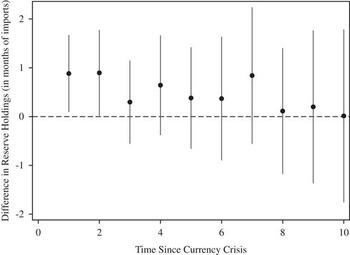
Before presenting the results of the estimation, I display descriptive statistics related to the main result of the paper. Figure 1 displays the difference in the average levels of reserves for countries who experienced any form of political change during a currency crisis to those who did not, for the time period after the previous crisis. We can see that countries who experienced political change have approximately one month worth of imports more reserves than those who did not for the first two years after experiencing the crisis. As a common rule of thumb for insuring against exogenous shocks is three months of imports (Edison Reference Flood and Garber2003; Rodrik 2006; Gallagher and Shrestha Reference Goldstein, Kaminsky and Reinhart2012), political change leads to governments accumulating approximately one-third of this amount more than cases of no political change, a considerable amount. This is in line with the implications of the theory. Political change during previous currency crises lead to subsequent governments accumulating foreign exchange reserves. Over time this difference between countries decreases, becoming negligible eight years after the crisis.
The difference over time in the mean reserve holdings for countries who experienced political change during the previous currency crisis and those who did not Note: Points indicate the difference in means, vertical lines indicate 95 percent confidence intervals.

Results
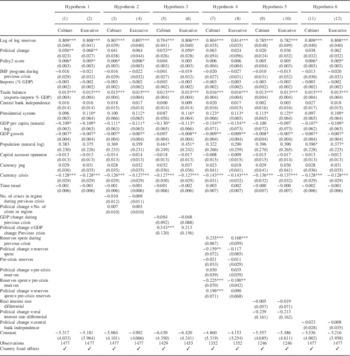
Table 1 shows the effects of political change during currency crises upon the level of foreign exchange reserves.Footnote 13 Models 1 and 2 test the unconditional effects of past major cabinet changes and changes in effective executive, respectively, weighted by the similarity between the current political system and the system when the crisis occurred. For both major cabinet changes and changes in effective executive there is a positive and statistically significant coefficient. Previous currency crises that led to political change are thus associated with increased levels of reserves in subsequent years, supporting the implications of the theory.Footnote 14
The Effect of Political Change During Previous Currency Crises Upon Reserve Accumulation

Note: Country clustered standard errors in parentheses.
IMF = international monetary fund; GDP=gross domestic product.
*p<0.10, **p<0.05, ***p<0.01.
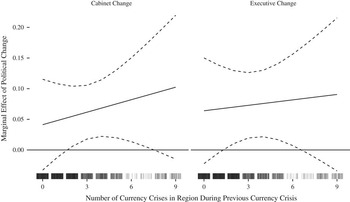
I next turn to assessing whether the number of currency crises in a region during the previous currency crisis affects the lessons governments learn about political change during currency crises. Figure 2 displays the marginal effect of political change during the previous currency crisis conditional upon the number of countries simultaneously experiencing an onset of a currency crisis.Footnote 15 In line with Hypothesis 2, the results show that the effect of political change upon reserve accumulation increases when the currency crisis was part of a regional episode rather than a domestic occurrence. Political change when there were multiple currency crises has a stronger effect in these cases as governments would expect to not be held accountable for such a regional crisis. While the value of 0 is not contained within the confidence intervals when four other countries experienced a currency crisis at the same time as the previous crisis, the confidence intervals overlap at all points along this conditioning variable. Thus, there is only moderate support for the interaction effect.
The marginal effect of political change upon reserve accumulation, conditional upon the number of currency crisis onsets in the same region at the start of the previous currency crisis Note: The dashed lines indicate 95 percent confidence intervals. Tick marks display the marginal distribution for the (jittered) number of currency crisis onsets in the same region at the start of the previous currency crisis.

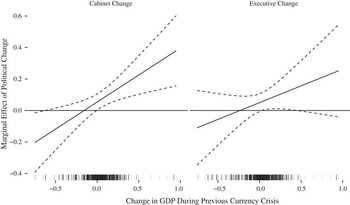
Figure 3 displays the marginal effect of political change during the previous currency crisis, conditional upon the proportional change in GDP.Footnote 16 The results provide some support for Hypothesis 3. The effect of political change upon subsequent reserve accumulation increases the less severe economic outcome of the crisis was. This suggests that governments learn that currency crises have negative implications for political survival, beyond the effect of the crisis upon economic conditions. In contrast, political change matters little for reserve accumulation when the currency crisis had negative economic outcomes. This suggests that future governments, independent of the political outcomes, invest in reserve accumulation to avoid such economic outcomes in the future. However, the statistical significance of this interaction effect is only moderate due to overlapping confidence intervals in the case of changes in effective executive. Nevertheless, the confidence intervals do not include 0 when the economic outcomes during the crisis were sufficiently positive (above 0.05).
The marginal effect of political change upon reserve accumulation, conditional upon the change in gross domestic product (GDP) during the previous currency crisis Note: The dashed lines indicate 95 percent confidence intervals. Tick marks display the marginal distribution for the change in GDP during the previous currency crisis.

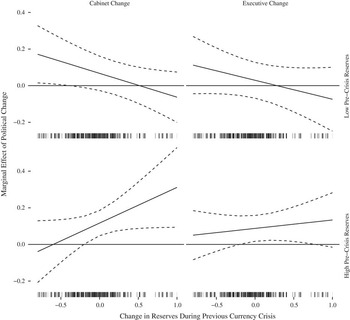
I now move on to exploring Hypothesis 4, which says that governments’ are more likely to accumulate reserves after currency crises if the expenditure of reserves led to previous governments’ retaining political power. Figure 4 displays the marginal effect of political change dependent upon the proportion of reserve sales and whether pre-crisis reserves were at a low or a high level.Footnote 17
The marginal effect of political change upon reserve accumulation, conditional upon the proportion of reserves spent during the previous currency crisis and the pre-crisis level of reserves Note: The shaded polygon indicates 95 percent confidence intervals. A high level of pre-crisis reserves is approximately six months of imports (the 90th percentile), while a low level of pre-crisis reserves is ~1.1 months of imports (the 10th percentile). Tick marks display the marginal distribution for the proportion of reserves spent during the previous currency crisis.

Figure 4 shows that when the previous currency crisis led to political change, in spite of large levels of reserve sales, governments do not increase reserve accumulation. This is because the political purpose of reserve accumulation is perceived to be ineffective, thus there is less incentive for a government to further accumulate reserves. However, there is a positive effect of political change upon future reserve accumulation when pre-crisis reserves were low. When the previous currency crisis exhibited both political change and high reserve sales, future governments are more likely to accumulate reserves. While the previous government may have spent a large proportion of reserves, the low pre-crisis level of reserves indicates that this entailed a low absolute level of sales. Therefore, when political change occurs this informs future governments that further reserves need to be accumulated. In contrast, in the cases where there was no political change the level of reserves would not be considered too low, therefore leading to a lower level of reserve accumulation than when political change occurs.
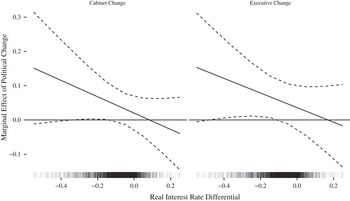
I now examine the implications related to the cost component in the choice of reserve accumulation. In line with Hypothesis 5, Figure 5 displays the marginal effect of previous political change for a range of values of the interest rate differential.Footnote 18 The results suggest that when the cost of holding reserves is low, political change during previous currency crises leads to greater reserve accumulation than when the cost of holding reserves is higher. However, this interaction effect is not statistically significant at conventional levels.
The marginal effect of political change upon reserve accumulation, conditional upon the difference between the real domestic interest rate and the interest rate on ten-year US bonds Note: The dashed lines indicate 95 percent confidence intervals. Tick marks display the marginal distribution for the difference between the real domestic interest rate and the interest rate on ten-year US bonds.

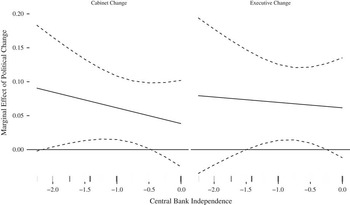
Finally, Figure 6 displays the effect of political change during previous currency crises upon reserve accumulation, conditional upon the degree of the central bank independence.Footnote 19 The direction of the effect is line with Hypothesis 6, with decreased central bank independence governments are freer to accumulate reserves leading to a stronger response to previous political change. However, the substantive size is small and the confidence levels overlap at all points. This suggests that these constraints play a small role in influencing governments’ ability to change economic policy in response to the political outcomes associated with currency crises.
The marginal effect of political change upon reserve accumulation, conditional upon the degree of central bank independence Note: The dashed lines indicate 95 percent confidence intervals. Tick marks display the marginal distribution for the degree of central bank independence.

Robustness
I also implement a series of robustness checks, to assess the sensitivity of the effect of political change during previous crises to alternative model specifications. For reasons of space, the full details of the robustness tests are presented in the appendix.Footnote 20 In summary, the main results on the association between political change and reserve accumulation are robust to all the robustness tests performed. This is also the case for the results on how the circumstances of the previous currency crisis, multiple crises in a region, and the economic severity of the crisis, condition the effect of political change. In model specifications for the efficacy of the reserve sales during the previous currency crisis, the results are robust for major cabinet changes; however, they are less robust for changes in effective executive. In contrast, the model specifications for the costs and constraints of reserve accumulation are much less robust. Results are not stable across all robustness tests for the conditioning effect of real interest rates, and there are changes in the direction of coefficients in the central bank independence specification for four of the robustness tests.
Conclusion
The aftermath of financial crises can often lay bare the costs associated with the increasing role of international capital movements in domestic economies. Yet, governments often vary in their choice of economic policy to respond to these pressures. In this paper, I develop a theory to explain the variation in governments’ decisions to use economic policy to prevent future economic shocks. Governments can learn the political cost of failing to prevent such shocks by observing previous political outcomes. When the previous economic shock resulted in loss of political power, future governments are more likely to use economic policy to prevent future recurrence. In addition, if the previous crisis possessed features that would lead governments to expect not to be held accountable politically, then the occurrence of political change further leads to the use of economic policy to insure against these shocks in the future. Governments also learn from previous crises the efficacy of economic policy to prevent political change, determining the use of that specific policy in the future.
This theory was applied to the accumulation of foreign exchange reserves after currency crises, an economic policy that can both reduce the likelihood and severity of currency crises. In line with the implications of the theory, governments accumulate larger amounts of reserves when past currency crises led to governments losing political power. This implies that the extent to which governments respond to potential economic instability, due to increasing globalized economies, is dependent upon their expectation of the political costs of failing to do so. Consequently, the effect of political change is stronger when past governments are held accountable in cases where governments would not expect to be held to account: regional crises and crises that did not have negative economic outcomes. Furthermore, when reserves are shown to be effective in preventing political change during previous currency crises future governments tend to hold higher levels of reserves than otherwise.
The findings contribute to our understanding of why governments differ in their use of economic policy to manage the volatility associated with the rise in global capital mobility. Existing research has largely focused on how the existence of a crisis leads to changes in economic policy (Drazen and Grilli Reference Drazen and Easterly1993; Drazen and Easterly Reference Dreher, Sturm and de Haan2001; Biglaiser and DeRouen 2004; Abiad and Mody Reference Abiad and Mody2005). This paper furthers our understanding of these processes by disentangling how different features of the past currency crisis can lead to differences in governments post-crisis behavior. That two governments can learn different lessons from a past currency crisis, dependent on both the existence and nature of political change during such a crisis, provides an interesting insight into understanding heterogenous responses. These differences can also shed light on the specific choices of policies used to manage this volatility. When a particular policy is shown to be effective then it is more likely to be used in the future, leading to policies that are substitutes being used less frequently.
While this paper deals with the case of reserve accumulation after currency crises, the theoretical approach is sufficiently general to be applied to other areas of interest. In particular, the theoretical approach is well suited to cases where governments are uncertain about the political costs of failing to insure against the increased volatility from economic integration. Therefore, future research, using this approach to examine different forms of crises and their associated policy responses, could offer new insights into how governments vary in their responses to economic openness. Furthermore, this paper provides a bridge between two separate literatures on the political outcomes of financial crises (Chwieroth and Walter Reference Crespo-Tenorio, Jensen and Rosas2010; Crespo-Tenorio, Jensen and Rosas Reference Drazen and Grilli2014) and the literature on changes in economic policy induced by financial crises (Drazen and Grilli Reference Drazen and Easterly1993; Drazen and Easterly Reference Dreher, Sturm and de Haan2001; Biglaiser and DeRouen 2004; Abiad and Mody Reference Abiad and Mody2005). Future research on the intersection of these two literatures can provide further understanding of the interdependence between economic policy choices and political outcomes.