


INTRODUCTION
Between 2011 and 2016, about 30,000 foreign fighters traveled to Syria and Iraq to join the Islamic State (Benmelech and Klor Reference Benmelech and Klor2018). Fighters came to ISIS from all over the world, many from Western countries like France, Britain, Belgium, Germany, and the United States. A large number of Western recruits were radicalized online by consuming extremist content on the Internet and social media (Carter, Maher, and Neumann Reference Carter, Maher and Neumann2014; Vidino and Hughes Reference Vidino and Hughes2015). Online radicalization was not limited to certain social groups or those with national grievances; rather, recruits came from different backgrounds, age groups, education, and income levels (Greenberg Reference Greenberg2016). Why did so many Westerners come to support groups like the Islamic State? How could one organization attract so many individuals to a conflict not their own?
This study brings together research on violent extremism and radicalization, along with the literature on immigration in the West, to examine how anti-Muslim sentiment is linked to radicalization and support for the Islamic State in Western European countries. I argue that hostility toward Muslims in the West can lead individuals to seek comfort and acceptance elsewhere, making radical messages promulgated by foreign rebels seem attractive. A large body of research on immigration to the West studies factors that facilitate or inhibit immigrant integration, with a particular focus on economic outcomes (Dancygier and Laitin Reference Dancygier and Laitin2014). This literature emphasizes the powerful role that natives’ attitudes play in this context, and points to cultural, economic, and psychological factors that determine natives’ acceptance, or lack of acceptance, of immigrants in social and economic settings (Hainmueller and Hopkins Reference Hainmueller and Hopkins2014).
A recent strand of this important body of work has focused on discrimination against Muslim immigrants in particular, empirically documenting the central role of anti-Muslim discrimination in facilitating Muslims’ lack of integration. In France, for example, Adida, Laitin, and Valfort (Reference Adida, Laitin and Valfort2016) found that Muslims and non-Muslims are often caught in a vicious cycle in which the latter discriminate against the former, falsely equating “Muslim” and “Jihadist,” and Muslims, in turn, tend to distrust non-Muslims and withdraw from French society, thus perpetuating their nonintegration. But this body of research has yet to examine other outcomes of discrimination. Focusing primarily on social and economic integration, it has not systematically considered how native attitudes toward immigrants might increase the likelihood of jihadi radicalization.
One of the most distinctive aspects of the Islamic State’s recruitment strategies is its extensive use of social media. The organization has not only been distributing provocative content to general audiences on the Internet, it has also been using social networks on Twitter, Facebook, and related platforms to attract new members from all over the world. Twitter has been particularly popular, as it enabled fast and large-scale public dissemination of content. Studies documenting the usage of Twitter by Western foreign fighters have noted that it played a central role in their radicalization process by intensifying their mental and emotional connection to war events on the ground (Carter, Maher, and Neumann Reference Carter, Maher and Neumann2014). Potential recruits found it appealing to connect to the organization through Twitter, as the platform enabled the anonymous consumption of radical and extremist ideas, without being exposed to the risk of physically interacting with a recruiter (Berger Reference Berger2015). In fact, the organization’s online radicalization operation has been so vast and extensive that many security agencies found it challenging to keep track of every aspect of these activities (McCaul et al. Reference McCaul, Thompson, Katko, Sanchez, Loudermilk, Vela, Ratcliffe, Payne, Hurd and McSally2015).
In this study, I take advantage of the presence of this widespread radicalization in the West, and the availability of large amounts of public Twitter data, to examine whether anti-Muslim hostility is linked to support for ISIS in Europe.Footnote 1 Using an original method described in the body of the article, I collected granular data on the social media activity of about 15,000 accounts of ISIS activists, as well as the full social network of their followers across the world (N ≈ 1.6 million). I monitored the online behavior of ISIS activists and their followers in real time, capturing their activity prior to account suspension, and recorded textual and image content, which I use for analysis.
Using computer science methods to predict the physical geographic location of Twitter users, I matched user-level data to local-level administrative data from the four European countries with the highest share of Western foreign fighters: France, the United Kingdom, Germany, and Belgium (Barrett et al. Reference Barrett, Berger, Ghosh, Schoenfeld, el-Shawesh, Skinner, Sim and Soufan2015). I collected data on levels of unemployment, the share of immigrants and asylum seekers in each locality, and local-level vote share for far-right, anti-Muslim parties in recent elections across Europe. As voting for far-right parties strongly correlates with anti-Muslim sentiment,Footnote 2 I use vote share for these parties as a local-level measure of anti-Muslim hostility, examining whether it predicts support for ISIS on social media.
I developed several measures of online radicalization and support for ISIS on Twitter. Using supervised machine learning, I classified millions of tweets in English, Arabic, French, and German along various dimensions of ISIS support. These include expressing sympathy with ISIS, tweeting about the life of fighters in ISIS-controlled territories, and expressing an interest in traveling to Syria or becoming foreign fighters. In addition, I classified tweets as containing anti-West rhetoric to examine how Western ISIS sympathizers might refer to their own countries. I kept track of which users were flagged as ISIS activists by several hacktivist groups, and also noted when they were suspended from Twitter.
The results show that local-level vote share for far-right, anti-Muslim parties in France, the United Kingdom, Germany, and Belgium correlates significantly with online radicalization. In substantive terms, an increase of one percentage point in the local-level vote share for far-right parties is associated with a 6% and 5% increase, respectively, in the probability of a user being flagged as ISIS-affiliated and being among the top 1% posters of radical content. A one percentage-point increase in the right-wing vote share is associated with an average increase of up to 10,000 pro-ISIS tweets across the entire sample, including tweets sympathizing with ISIS, discussing life in ISIS territories, and expressing interest in foreign fighters and travel to Syria.
As the relationship between pro-ISIS radicalization and support for far-right parties is complex and may also run in the other direction or be driven by omitted variables, I run several additional tests. First, I take advantage of the high-frequency nature of Twitter data and examine whether events that likely spur sympathy with ISIS among potential recruits, such as terrorist attacks, propaganda dissemination events, and anti-Muslim protests, are immediately followed by increased posting of pro-ISIS content, especially in areas with high far-right support. Second, I examine whether the results might be driven by the local presence of minority populations. In analyses with data available only in the United Kingdom, I include covariates for the proportion of Muslims, Arabs, Pakistanis, Bangladeshis, and foreign-born in each local area. After controlling for these covariates—many of which are negatively or not correlated with radicalization measures—I find that vote share for the far-right remains strongly positively associated with posting pro-ISIS content on Twitter.
RADICALIZATION
Why do individuals living in Western countries begin to support groups like the Islamic State? What attracts people to ISIS’s extremist ideology? A large literature has sought to explain the causes of radicalization and violent extremism, especially in the context of militant jihad. Most agree that radicalization involves a change in ideology or beliefs that support indiscriminate violence against civilians for political reasons, or a group that represents this ideology and actions (Borum Reference Borum2011; Sedgwick Reference Sedgwick2010; Wilner and Dubouloz Reference Wilner and Dubouloz2010). Scholars view radicalization as a process that occurs over time, in which a person becomes increasingly committed to extreme and violent worldviews.Footnote 3
While models of radicalization vary, most involve the following stages. First, an individual begins to find extremist ideology appealing by interacting with others who have radicalized, or by exploring extremist content on the Internet—a phenomenon that has been more frequent in recent years (Walter Reference Walter2017). In the second stage, the person becomes increasingly committed to the ideology and begins to vocally express radical sympathies or take actions to show affiliation with the cause (Borum Reference Borum2011; Wiktorowicz Reference Wiktorowicz2005). Finally, an individual might take violent actions, though some argue that radicalization need not culminate in violence (Neumann Reference Neumann2013; della Porta Reference della Porta2018).
In this study, I focus on the second stage, examining the online behavior of individuals who have already expressed interest in the Islamic State by choosing to follow ISIS accounts. My study does not consider what makes an individual begin to find extremist ideology appealing (the first stage), nor do I examine what tips an individual toward violence (the third stage). My focus is on expressions of support for the Islamic State and the ideology that it promotes, among those who may already be embarking down the path of radicalization, as evidence that the radicalization process is progressing.
Researchers seeking to explain radicalization and the rising global appeal of extremist groups have emphasized the role of ideology.Footnote 4 Walter (Reference Walter2017) showed that in recent civil wars, rebel groups upholding extreme ideologies have been more successful than moderate groups in attracting supporters, a phenomenon she attributes to the strategic use of ideology by groups in competitive environments. Hegghammer (Reference Hegghammer2010) argued that the rise in the number of Muslim foreign fighters since the 1980s is driven by the emergence of a new ideological movement, “populist pan-Islamism,” that paints the world as a place that threatens the existence of Muslims worldwide. Empirically, Malet (Reference Malet2013) found that armed groups portraying conflicts as posing an alarming danger to both local rebels and foreign supporters have historically attracted most foreign fighters.
The micro-level implication of these theories is that individuals are more likely to support extremist groups if they are receptive to radical ideologies. But what makes someone receptive to extremism in the first place? Why do people located thousands of miles away from the location of civil wars pay attention to violent propaganda promoted in these wars? Over four decades of scholarship on terrorism has ruled out the notion that personality types explain one’s propensity for extremism (Borum Reference Borum2011). Instead, scholars point to structural factors, such as social, economic, or political grievances (Bass Reference Bass2014; Lyons-Padilla et al. Reference Lyons-Padilla, Gelfand, Mirahmadi, Farooq and van Egmond2015), the powerful role of social networks (Dalgaard-Nielsen Reference Dalgaard-Nielsen2010; Wiktorowicz Reference Wiktorowicz2005; Mousseau Reference Mousseau2011), and thrill and identity-seeking (Bass Reference Bass2014; Bayman and Shapiro Reference Bayman and Shapiro2014; Nussio Reference Nussio2017) as explanations for radicalization.Footnote 5
This article focuses on a slightly different explanation, arguing that experiences of social isolation can exacerbate a process of radicalization. I contend that in Western countries, local and personal exposure to anti-Muslim hostility can increase individuals’ attraction to extremist jihadi ideologies. Prior research on jihadi radicalization in the West has shown, using case studies, that experiences of discrimination led individuals to radicalize (Borum Reference Borum2011; Wiktorowicz Reference Wiktorowicz2005; Wilner and Dubouloz Reference Wilner and Dubouloz2010). While not focusing on radicalization as an outcome, related work on the impact of anti-Muslim discrimination has shown that it tends to inhibit integration and assimilation (Adida, Laitin, and Valfort Reference Adida, Laitin and Valfort2016; Bryan Reference Bryan and Foner2005; Gould and Klor Reference Gould and Klor2016). Indeed, recent evidence from the United States suggests that failed integration of Muslim immigrants can increase support for violent extremism (Lyons-Padilla et al. Reference Lyons-Padilla, Gelfand, Mirahmadi, Farooq and van Egmond2015).
I argue that groups like the Islamic State seek to attract isolated individuals in the West, by providing an alternative ‘virtual community’ on the Internet and social media. A large number of people who radicalized and joined ISIS from Western countries began embracing the organization’s ideology when searching for belonging and identity (Shane, Apuzzo, and Schmitt Reference Shane, Apuzzo and Schmitt2015; Vidino and Hughes Reference Vidino and Hughes2015). Hoda Muthana, for example, an American student from Alabama, was radicalized on social media after opening a secret Twitter account without her parents’ knowledge. After interacting with ISIS supporters on Twitter, she adopted radical interpretations of Islam and eventually traveled to Syria to join the organization (Hall Reference Hall2015). Ali Shukri Amin, an American teenager from Virginia, found solace from his troubled life in the virtual communities of ISIS activists on Twitter. In the end, Amin disconnected from his family and friends, spread ISIS propaganda to thousands of followers online, and recruited one of his friends to travel to Syria to become a foreign fighter (Robinson Reference Robinson2015; Shane, Apuzzo, and Schmitt Reference Shane, Apuzzo and Schmitt2015).
Indeed, evidence from the United States shows that among over a hundred individuals charged with providing material support for ISIS or plotting a violent attack on the organization’s behalf, about 62% used social media when they were radicalizing, and among those, 86% expressed their support for ISIS in publicly viewable posts.Footnote 6 The Internet and social media seem to play a central role in exposing Western individuals to paths of radicalization. These findings are consistent with research on the social media usage of European foreign fighters, which shows that online social networks played a dominant role in fighters’ radicalization process (Carter, Maher, and Neumann Reference Carter, Maher and Neumann2014). However, our knowledge of the online behavior of ISIS supporters and its relation to real-world events is currently very limited. In this article, I examine whether online indicators of pro-ISIS radicalization are stronger for individuals experiencing greater levels of anti-Muslim hostility.
ANTI-MUSLIM HOSTILITY AND SUPPORT FOR FAR-RIGHT PARTIES
Animosity against Muslims in the West has been rising in recent years, especially after 9/11 (Burrows Reference Burrows2016; Jamal Reference Jamal, Jamal and Naber2008; Karam Reference Karam2012; Naber Reference Naber, Jamal and Naber2008; Stack Reference Stack2015). Examples include setting fire to mosques, spreading anti-Muslim graffiti, and physically attacking individuals who practice Islam. Take the case of Ms. Khola Hasan, an Islamic scholar from the U.K.’s Epping Forest region, who has been targeted by anti-Muslim violence multiple times in recent years. In an interview with The Guardian, she said, “I was walking down Epping High Street and a man shouted at me ‘You bloody ISIS supporter.’ Another time… someone stopped their car and threw an empty glass bottle at me. I was absolutely terrified” (Flaig Reference Flaig2016).
Epping Forest is among the constituencies with the highest vote share for far-right parties in the United Kingdom. In the 2015 general elections, over 18% of its voters voted for far-right parties, putting the locality at the top 10% of far-right vote share in the country. A similar pattern is observed in other European localities with high far-right support. In Dartford, U.K., right-wing activists launched an “anti-halal operation,” targeting Muslim restaurants selling halal food with the claim that they support terrorism by paying a zakat religious tax (Kent Online 2015). In Provins, France, where vote share for the Front National party in the 2015 Departmental Elections was above 37%, a local mosque was desecrated with anti-Muslim graffiti (Inge Reference Inge2013).
Indeed, far-right parties are one of the most prominent mobilizers of anti-Muslim sentiment in contemporary Europe. A common theme in the platforms of these parties is support for exclusionary, “nativist” populism that combines nationalism and xenophobia, seeking to ostracize groups with certain cultural, religious, or ethnic characteristics (Golder Reference Golder2016). For example, France’s Front National party has long blamed Muslim immigrants for many of the country’s social problems, ranging from unemployment to security and national unity (Adida, Laitin, and Valfort Reference Adida, Laitin and Valfort2016; Front National 2017). The Alternative for Germany (AfD) party, who in the 2017 German parliamentary elections gained an unprecedented share of the votes, mobilized support with an anti-Muslim xenophobic campaign (Wildman Reference Wildman2017).
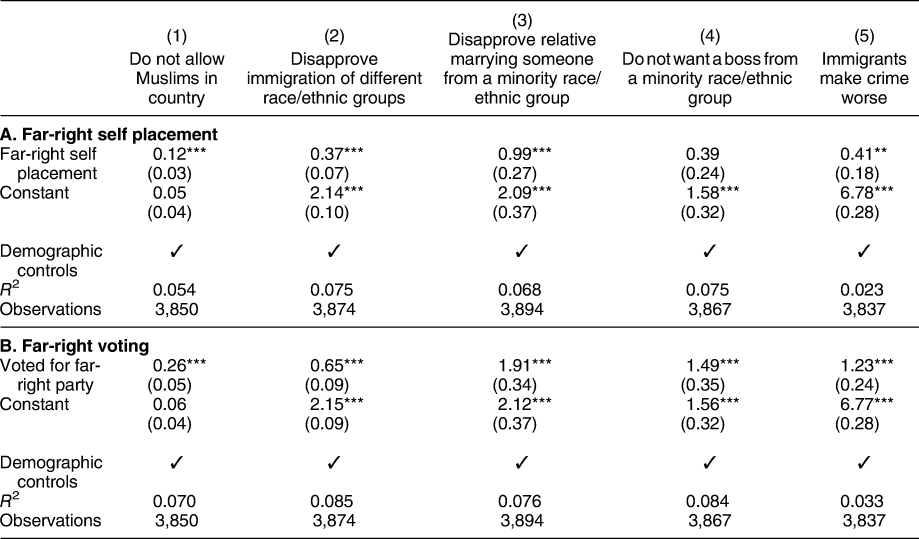
Several scholars have suggested that far-right voting is strongly linked to anti-Muslim sentiment (Lubbers and Scheepers Reference Lubbers and Scheepers2002; Norris Reference Norris2005; Rydgren Reference Rydgren2008). Using data from the European Social Survey Round 7, I tested the relationship between far-right voting and anti-Muslim attitudes in Europe. Table 1 shows that there is a strong correlation between holding anti-Muslim and anti-immigrant attitudes and self-identifying as a far-right supporter (Panel A) or voting for far-right parties (Panel B). The regressions control for demographic variables that might also explain anti-Muslim attitudes, such as being native-born, education, income, gender, age, and religious beliefs.
Far-Right Support and Anti-Muslim Attitudes in Europe

Standard errors in parentheses.
*p < 0.10, **p < 0.05, ***p < 0.01.
Note: The table reports the correlations between voting for far-right parties in France, Belgium, Germany, and the United Kingdom and holding anti-Muslim and anti-immigrant attitudes. The Far-right self placement variable is an indicator coded one for individuals who identify as ‘10’ (farthest on the right) on a 1–10 scale of left-right placement. Voted for far-right party is an indicator variable coded one for individuals who voted for Front National (FN) in France, United Kingdom Independence Party (UKIP) in the United Kingdom, National Democratic Party of Germany (NPD) and Alternative for Germany (AfD) in Germany, and Vlaams Belang (VB) in Belgium. The table presents estimates from ordinary least squares regressions of the outcome variables reported in columns (1) through (5) on indicators of support for far-right parties, controlling for being native-born, education, income, gender, age, and religion. Data source: European Social Survey Round 7 (2014).
While the overall popularity of far-right, anti-Muslim parties in Europe has increased nationally, support for these parties still varies significantly at the local level.Footnote 7 I argue that areas with higher levels of far-right support are likely to provide a fertile ground for jihadi-inspired extremism, as they present a more hostile environment for individuals at risk of radicalization. If anti-Muslim hostility has any role in attracting Westerners to the Islamic State, then we should observe more signs of radicalization among individuals located in areas where far-right parties are popular.
It is certainly possible that the relationship also runs in the opposite direction: that the presence of pro-ISIS radicals in a given locality drives support for far-right parties. However, there are strong reasons to believe that the correlation does not run only in that particular direction. Research on radicalization in the United Kingdom over the last decade has found that far-right and jihadi extremists frequently feed each other in a vicious cycle of “cumulative extremism” (Bartlett and Birdwell Reference Bartlett and Birdwell2013; Eatwell Reference Eatwell2006). In addition, the radicalization stories of Western Islamic State recruits and others who have become supportive of jihadi-inspired terrorism illustrate the powerful impact of xenophobic hostility and discrimination on people’s support for violence (The Atlantic 2017; Victoroff, Adelman, and Matthews Reference Victoroff, Adelman and Matthews2012; Wiktorowicz Reference Wiktorowicz2005).
This study systematically examines, for the first time with large scale data across thousands of locations in four countries, the local-level relationship between far-right support and pro-ISIS radicalization. In the following section, I explain how I created measures for online support for ISIS by identifying and observing in real-time the content and social media activity of individuals at risk of radicalization.
DATA
Identifying ISIS Activist and Follower Accounts on Twitter
As discussed previously, this study focuses on individuals in the second stage of radicalization: conditional on having shown some sign of interest in the Islamic State, to what extent does local-level hostility relate to greater levels of support for ISIS? I am interested in two kinds of users in this category: those which are overtly affiliated with the organization, and those who are not affiliated, but show some lesser indication of interest.
As for ISIS affiliates, the organization did maintain its own accounts on Twitter—at one time, as many as 40,000–125,000 (Berger and Morgan Reference Berger and Morgan2015; Isaac Reference Isaac2016). To systematically identify accounts associated with the organization, I tracked in real time lists published by several anti-ISIS hacking groups that since 2015 have been monitoring ISIS-affiliated accounts and publicly flagging them for suspension.Footnote 8 I designed an algorithm that between December 2015 and January 2017 continually monitored these accounts, recording information on user profiles, user locations, historical tweet timelines, and lists of friends and followers.Footnote 9 This real-time data collection enabled capturing information on accounts of about 15,000 ISIS activists before they were deleted from the Internet.
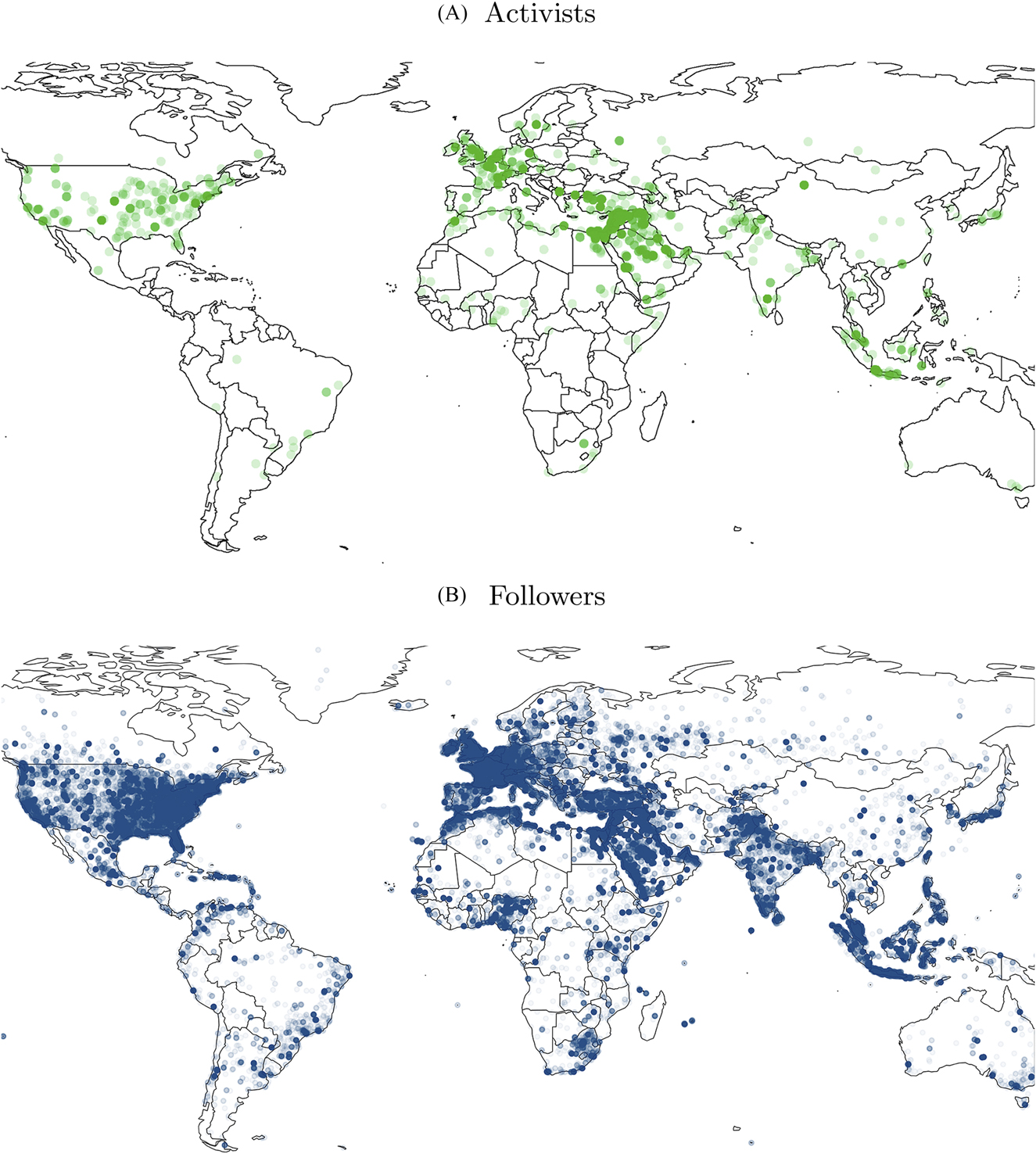
The more challenging task is to find individuals who have expressed interest in the Islamic State but are not ISIS activists. I collected information on the followers of all ISIS-affiliated accounts—about 1.6 million in total—to identify those who may have begun the radicalization process but have not progressed to the point of overt ISIS affiliation. The data contain user-level information, taken as “snapshots” of each user’s profile at various points in time, as well as tweet-level information on over 100 million tweets posted by these users over the course of several years. Figure 1 shows the geographic distribution of ISIS activists and followers across the world.
Predicted Locations of ISIS Activists and Followers on Twitter
Note: Locations are predicted using a spatial label propagation algorithm (Jurgens Reference Jurgens2013; Jurgens et al. Reference Jurgens, Finethy, McCorriston, Xu, Ruths, Quercia and Hogan2015).

Both Islamic State social-media activists and their followers are in the second stage of radicalization, and thus form the sample for this study.Footnote 10 Since the article focuses on Western Europe, the sample is restricted to activists and followers who are located in France, Germany, Belgium, and the United Kingdom.Footnote 11 While ISIS activists have clear connections to the organization and are most likely to represent individuals who adopted extremist worldviews,Footnote 12 the followers’ group, which represents over 99% of the data, consists of a range of users, from individuals who actively support the organization, through accounts of interested citizens, to accounts that seek to counter ISIS. While it is hard to precisely identify what drives someone to follow Islamic State accounts on Twitter, the online appendix shows that ISIS followers are largely indistinguishable from a random Twitter sample across user-level metadata.Footnote 13
Predicting Geographic Locations
A central aspect of this study involves predicting the geographic location of Islamic State activists and followers on Twitter, in order to match them to geographic data on socio-economic variables that might correlate with online radicalization. Since a very small share of Twitter users enable geo-tagging of their tweets or provide location information in their accounts,Footnote 14 social network and computer science researchers have developed methods in recent years to triangulate a user’s location based on locations provided by their networks of friends and followers (Backstrom, Sun, and Marlow Reference Backstrom, Sun and Marlow2010; Jurgens et al. Reference Jurgens, Finethy, McCorriston, Xu, Ruths, Quercia and Hogan2015; McGee, Caverlee, and Cheng Reference McGee, Caverlee, Cheng, He and Iyangar2013). I employ a spatial label propagation algorithm developed by Jurgens (Reference Jurgens2013) to predict Twitter users’ locations, which performs three rounds of prediction to maximize predictive accuracy.
Spatial label propagation algorithms rely on the finding in social network research that location information in a user’s online network is a powerful predictor of a user’s offline geographic location (Goldenberg and Levy Reference Goldenberg and Levy2009; McGee, Caverlee, and Cheng Reference McGee, Caverlee, Cheng, Berendt, de Vries, Fan, Macdonald, Ounis and Ruthven2011; Takhteyev, Gruzd, and Wellman Reference Takhteyev, Gruzd and Wellman2012). While social media platforms allow people to connect with others across the globe, recent studies have found that physical relationships in the offline world still strongly influence online social relationships. When people live their lives offline, they form relationships that subsequently transfer to the online world—e.g., co-workers or classmates who meet offline and then connect on social media platforms. As a result, a large share of individuals’ online social network usually includes geographically close friends. Figure S19 in the online appendix, which is taken from Jurgens (Reference Jurgens2013), shows that across various social networks on different platforms, the majority of individuals in the network had at least one friend that was located within 4 kilometers. The online appendix provides more information on the details of this location prediction process, as well as a discussion of its out-of-sample predictive accuracy.Footnote 15
While this method is imperfect and subject to prediction error, the rich data that it provides allow us to examine the local-level correlates of online support for Islamic State in Europe. As existing quantitative research on ISIS foreign fighter recruitment has so far remained at the country level (Benmelech and Klor Reference Benmelech and Klor2018), this is an important step forward. In addition, while prediction errors make estimations more noisy, there is little reason to think they are plagued by systematic biases.Footnote 16 Location predictions are carried out on a very large and relatively deep network of over 1.6 million Twitter users across the world. Location prediction errors are likely to bias the results if they affect the network structure of individuals showing support for ISIS, e.g., by leading them to strategically choose friends so that their locations are systematically predicted (incorrectly) in areas with higher vote share for far-right parties. Strategic choice of friends in this way is difficult to perform systematically.Footnote 17
Moreover, location prediction is carried out for all users in the database and analysis is carried out across thousands of localities in four countries. For systematic biases to be present, location predictions for ISIS supporters would have to appear systematically across countries in a pattern that correlates with far-right party vote-share locally.Footnote 18 To address the concern that Internet usage varies across rural and urban areas, regressions control for local population size.
Measuring Online Radicalization
I measure online radicalization using various user-level and tweet-level variables from the ISIS activists/followers database. First, I employ data from user-level fields to create indicators for whether a given user is flagged as an ISIS activist. Second, I use data on account suspension to code whether a user is suspended from Twitter for being associated with ISIS. Third, I use the network information in the database to count the number of ISIS accounts that each user follows. Fourth, I create textual measures for the number of pro-ISIS tweets posted by each user along several dimensions of ISIS support.
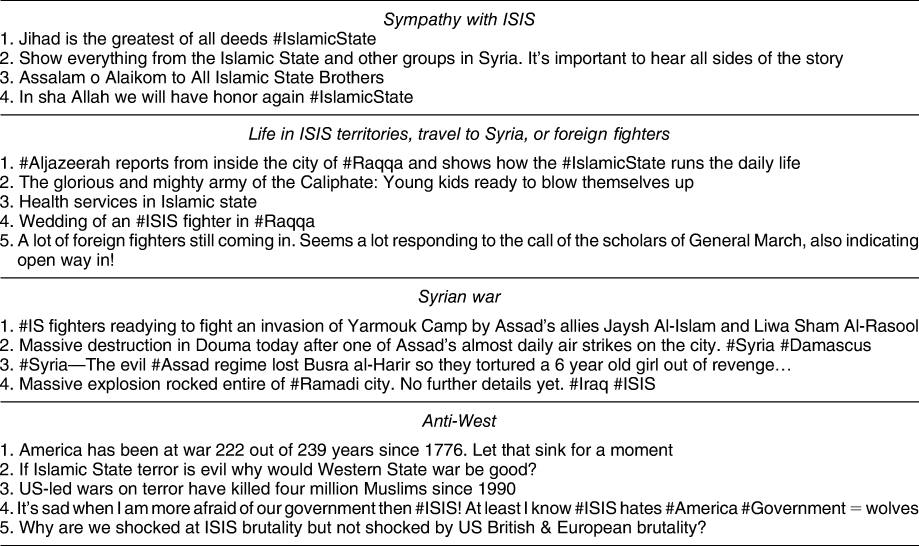
To generate the textual outcomes, I use supervised machine learning to classify tweets in English, Arabic, French, and German into one or more of these categories:Footnote 19
1. Sympathy with ISIS—expressions of support or sympathy with the Islamic State, its ideology, and its activities in territories under its control.
2. Life in ISIS territories, travel to Syria, or foreign fighters—tweets describing the life of ISIS activists in the territories controlled by the Islamic State, posts expressing interest or intent to travel to Syria, discussion of foreign fighters, or all.
3. Syrian war—tweets describing events in the Syrian civil war, discussion/analysis of those events, or both.
4. Anti-West—anti-West rhetoric, criticizing Western countries’ foreign policy and military operations in the Middle East.
Of course, anti-West sentiment often has no connection to radical ideology and can simply reflect legitimate grievances against Western countries’ foreign policy. Nonetheless, I include it in a very limited way in my analysis, for two reasons. First, anti-West rhetoric has been a central part of ISIS activists’ discourse on social media.Footnote 20 Second, studying anti-West sentiment sheds light on the way in which Western Islamic State sympathizers view their own countries. Since the organization’s strategy has included driving a wedge between its supporters and the West,Footnote 21 this is an important topic to study. Table 2 shows examples of English language tweets for each of these topics.
Examples of Tweets in Different Topics

The supervised learning process works as follows. First, about a thousand human coders from two crowdsourcing platforms, Amazon Mechanical Turk and CrowdFlower,Footnote 22 labeled a random sample of posts by hand. Then, an algorithm used information on the words in each labeled post to “learn” the categorization rules and classify unlabeled posts.Footnote 23 I obtained a random sample of tweets posted by ISIS activists in English, Arabic, French, and German to create a training set for the classification model.Footnote 24 Each tweet was labeled by three coders, and label(s) were retained for a given tweet only if at least two out of the three coders assigned the same label(s) to the tweet.Footnote 25
Since Twitter textual data are very noisy and radical pro-ISIS content is rare, many tweets in the database were coded as unrelated to any of the above categories.Footnote 26 To facilitate statistical prediction, I follow King and Zeng (Reference King and Zeng2001) and randomly over-sample pro-ISIS tweets and randomly under-sample unrelated tweets to obtain a class proportion of 0.5 for each of the categories, for each topic, for each language. I trained separate logit models using the labeled rebalanced training sets for each category in each language. For all specifications, I used the elastic-net generalized linear model (Friedman, Hastie, and Tibshirani Reference Friedman, Hastie and Tibshirani2010), selecting the regularization parameter λ by cross-validation to maximize the area under the ROC curve. Using this method, the models were able to predict pro-ISIS content with an in-sample accuracy over 95%. More metrics on the performance of the models for each topic and language are reported in section S3 in the online appendix. The classification models for each topic and language were then employed on the full set of tweets in the database to classify each unlabeled tweet as belonging to one or more of these categories.
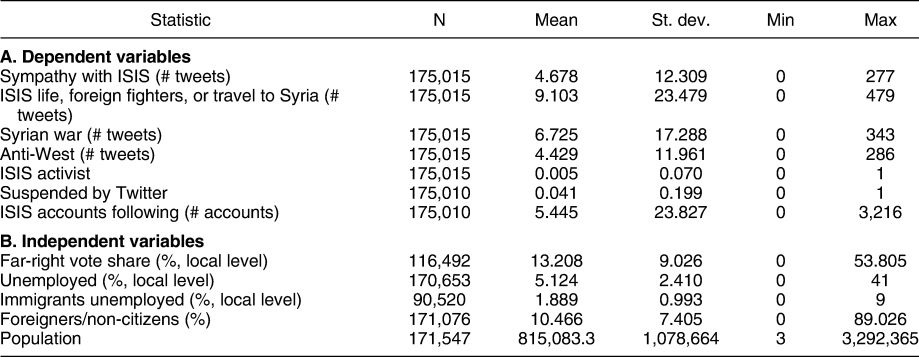
To measure users’ posting of radical and pro-ISIS content, I counted the number of tweets classified in these categories for each user. I also created a combined measure that counted the number of tweets falling into any of the ISIS-related categories.Footnote 27 To ensure that I capture users that post highly pro-ISIS content, I created an indicator that is coded one for users who are at the top 1% of the distribution of radicalized content posting and zero otherwise.Footnote 28 Panel A in Table 3 provides summary statistics for these various measures of online radicalization.
Summary Statistics

Note: This table reports summary statistics for the sample of ISIS activist and followers who are predicted to be located in France, Germany, Belgium, and the United Kingdom. Data represent content posted between 2014 and 2016.
While these measures only capture expressions of support for the Islamic State in the online world, they are nonetheless a plausible proxy for underlying radicalization. Social media played a central role in the radicalization process of European foreign fighters (Carter, Maher, and Neumann Reference Carter, Maher and Neumann2014). In the United States, the majority of individuals who attempted to travel overseas to join ISIS or planned a violent attack on the organization’s behalf used social media when radicalizing. Importantly, most of these individuals have expressed their support for ISIS on social media by posting publicly viewable posts.Footnote 29 This suggests that studying radicalization using online measures of ISIS support can be a fruitful way to better understand this phenomenon.
Independent Variables
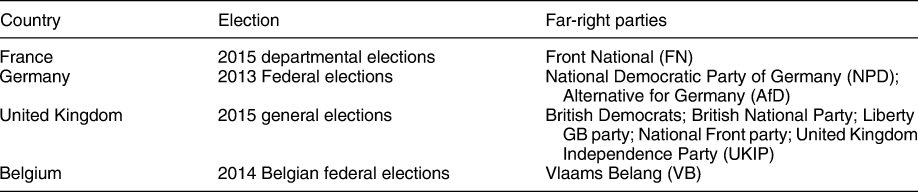
To create a local-level measure of anti-Muslim hostility, I relied on the finding presented earlier on the strong link between far-right voting and holding anti-Muslim attitudes. I created local-level measures of support for the far-right by calculating the percent of votes for parties associated with far-right positions at the electoral constituency level in France, Germany, Belgium, and the United Kingdom. Table 4 shows the elections and parties used to construct this variable. Using Twitter users’ predicted geo-location data, I matched users in my database to electoral constituencies, thereby assigning users to different areas with varying degrees of far-right support. Panel B in Table 3 shows that vote share for these parties varies substantially, where some users are located in areas with zero vote share for far-right parties, and others in areas with more than 50% support for these parties.
Far-Right Parties in Recent European Elections

In addition, I created variables for other indicators that might predict online support for ISIS. First, I examine whether economic grievances might be linked to radicalization by using official data on unemployment from France, Germany, the United Kingdom, and Belgium, at the lowest possible level of aggregation. In France, Germany, and Belgium, the lowest possible level was the town/municipality. In the United Kingdom, data were available at the sub-municipality level.Footnote 30 I matched users to their respective areas for which unemployment data exist. As some have hypothesized that unemployment among immigrants in particular feeds ISIS radicalization (Holland Reference Holland2016), I also created a measure for the share of unemployed immigrants in each location. Panel B in Table 3 provides information on the distribution of these variables across Twitter users in the dataset.
Second, I examine whether areas that are likely to have stronger social networks have a greater number of radicalizing individuals. I use census data on the share of foreigners or noncitizens in each locality to examine the extent to which ISIS supporters on Twitter are located in areas with higher shares of noncitizen populations. To account for the recent debates over the link between refugees and support for ISIS in Europe (Marans Reference Marans2015), I looked for variables that might proxy for the presence of refugees in a locality. I use information on the number of asylum seeker centers across localities in France, and the share of asylum seeker benefits receivers in localities in Germany.Footnote 31 As these two variables are measured on different scales, I created a standardized measure for this combined variable. Table 3 shows the distribution of these variables across users. The online appendix provides more details on the data sources and construction of the independent variables.
DESCRIPTIVE ANALYSIS
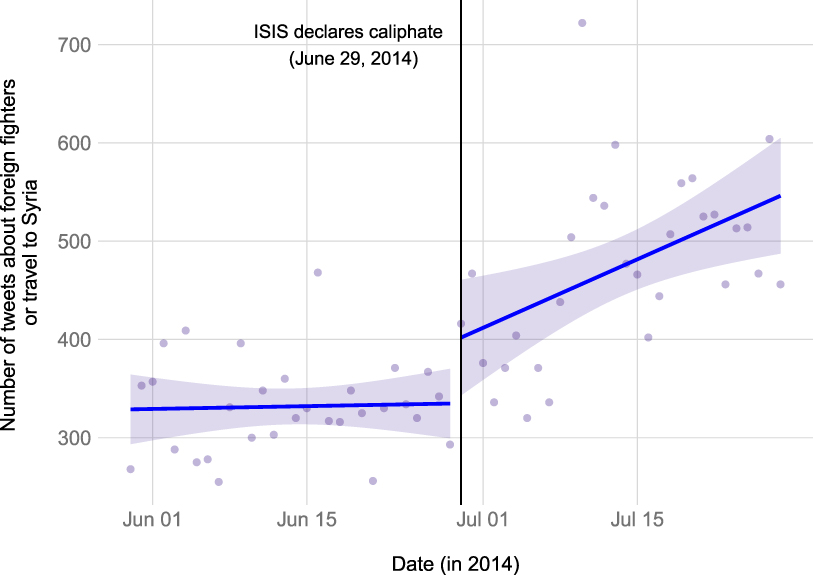
This section presents a few examples that illustrate the kind of content that I collected and its connection to real-world events. On June 29, 2014, ISIS declared the establishment of a caliphate in an online statement distributed through Twitter and the group’s media center, calling all Muslims to pledge allegiance and travel to the territories it controlled in Syria and Iraq. I calculated the daily number of tweets discussing foreign fighters or travel to Syria posted by accounts located in France, Belgium, Germany, and the United Kingdom in the month surrounding ISIS’s caliphate declaration. Figure 2 shows that after the declaration, discourse on foreign fighters significantly increased among these Twitter users.
ISIS Declares Caliphate and Tweets Discussing Foreign Fighters or Travel to Syria
Note: The figure shows the daily number of tweets discussing foreign fighters or travel to Syria in the month surrounding ISIS's caliphate declaration on June 29, 2014.

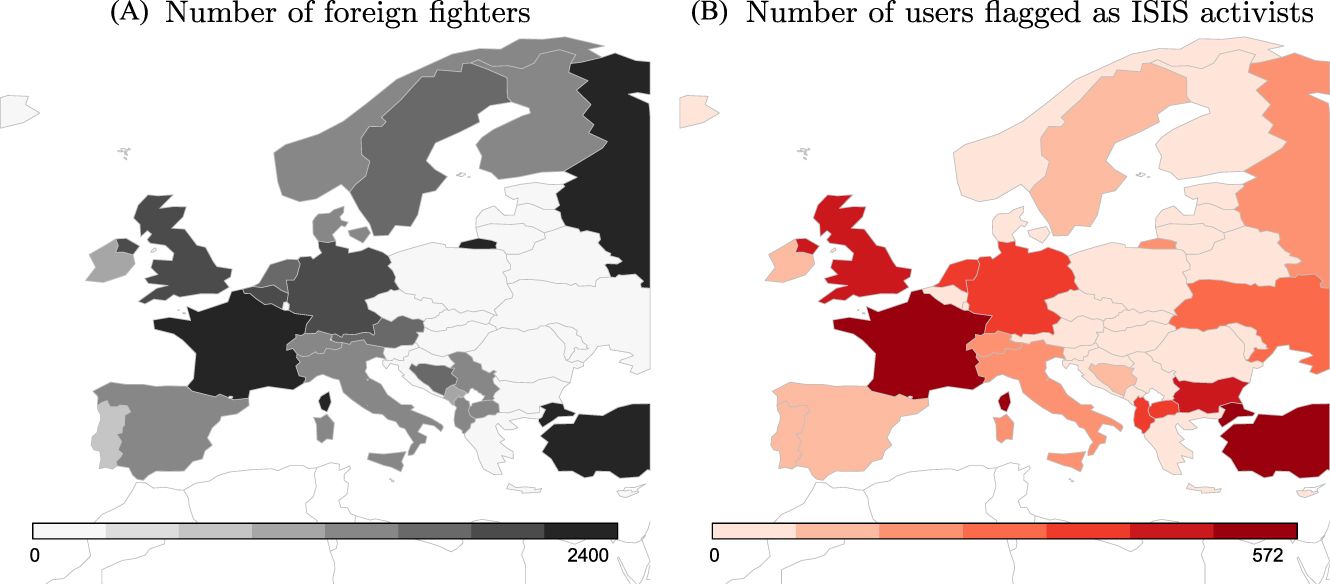
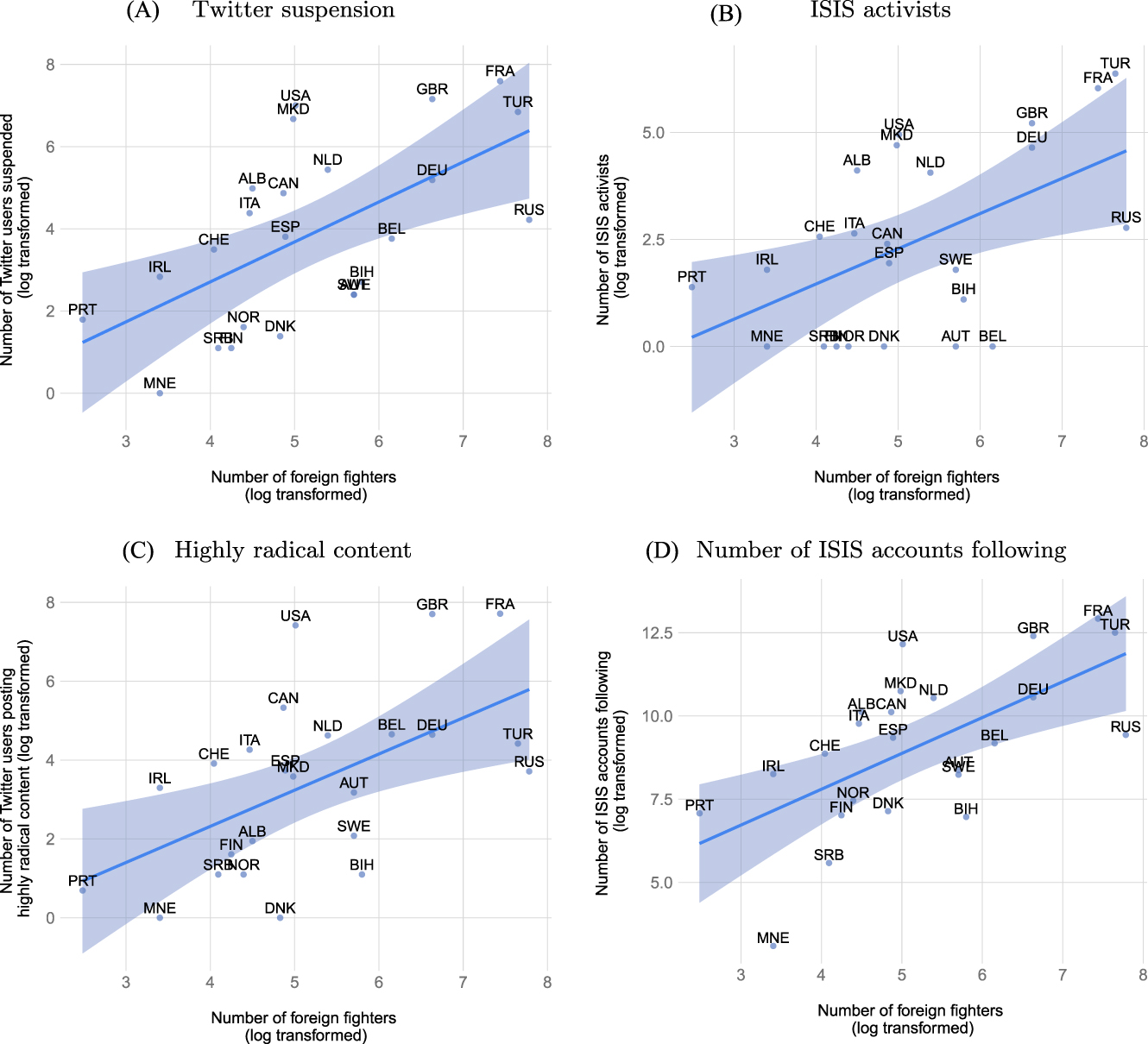
Next, I examine whether online radicalization measures correlate with Western foreign fighter figures. Figure 3 shows a map of ISIS foreign fighters from Europe (Panel A), along with a map showing the number of Twitter users flagged as ISIS activists in each country (Panel B). France, the United Kingdom, and Germany have higher numbers of foreign fighters and Twitter users flagged as ISIS activists than many other European countries. Figure 4 displays the correlation between additional online radicalization measures and the number of foreign fighters in the West. It can be seen that online measures of support for ISIS closely track official foreign fighter counts. While these scatterplots show bivariate relationships, the online appendix provides estimations controlling for population size, which show the same pattern.
Foreign Fighters and Online Radicalization in Europe
Note: Panel (A) displays official counts of ISIS foreign fighters in Europe, calculated by Barrett et al. (Reference Barrett, Berger, Ghosh, Schoenfeld, el-Shawesh, Skinner, Sim and Soufan2015). Panel (B) shows the number of Twitter users flagged as ISIS activists, aggregated to the country level.

Foreign Fighters and Online Radicalization (Additional Measures)
Note: The figure presents scatterplots of the relationship between the number of foreign fighters and online radicalization measures in countries that had at least one foreign fighter with ISIS. Data on foreign fighters are taken from Barrett et al. (Reference Barrett, Berger, Ghosh, Schoenfeld, el-Shawesh, Skinner, Sim and Soufan2015). Online radicalization measures are based on data collected by the author and are aggregated to the country level. The values are log-transformed.

CROSS-SECTIONAL STUDY
This section examines whether local-level measures of anti-Muslim hostility are linked to greater online support for ISIS. I regress the different online radicalization outcomes on the independent variables described above using a combined dataset covering all localities in France, Germany, Belgium, and the United Kingdom. The dependent variables are summarized in Panel A in Table 3 and are measured on the Twitter user level. The independent variables, summarized in Panel B in Table 3, are matched to each individual user in the dataset, but originate in local-level administrative data. To account for possible dependency across users in the same area, I cluster the standard errors at the locality level in my main regressions. I use the following least squares model in my primary estimations:
 $${Y_{ijk}} = {\beta _1}{V_{jk}} + {\beta _2}{U_{jk}} + {\beta _3}{F_{jk}} + {\beta _4}{P_{jk}} + {\beta _5}P_{jk}^2 + {\alpha _k} + {\varepsilon _{ijk}},$$
where i is a Twitter user in geographic area j in country k; Y ijk is one of the online radicalization measures for user i in area j in country k; and V jk represents the locality-level vote share for far-right parties matched to user i in area j in country k. U jk, F jk, and P jk represent unemployment, share of foreigners, and population size matched to user i in area j in country k, respectively, and αk is a country fixed effect.Footnote 32 The main coefficient of interest in these regressions is β1, which estimates the relationship between the local-level vote share for far-right parties and online measures of support for ISIS. While this coefficient cannot be interpreted as evidence of a causal relationship, it provides a systematic test of the link between a context of anti-Muslim hostility and online pro-ISIS radicalization.
Far-Right Vote Share and Support for ISIS
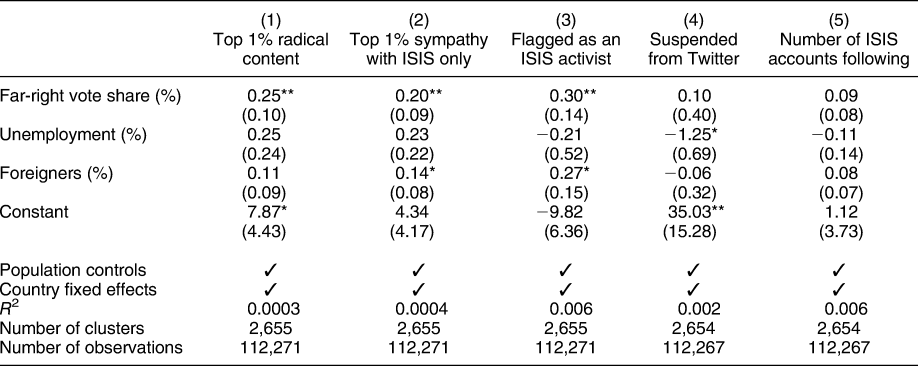
Tables 5 and 6 report the main results. In Table 5, Column (1), the dependent variable is a text-based measure that is coded one for individuals who are at the top 1% of the distribution of posting pro-ISIS content, and zero otherwise. To ensure that this content-based measure captures individuals who frequently express sympathy with ISIS, in Column (2), the dependent variable includes only tweets sympathizing with ISIS. Regardless of the measure used, it can be seen that local-level vote share for far-right parties is positively associated with posting large numbers of pro-ISIS tweets. In substantive terms, a one percent increase in far-right vote share is associated with a 3–5% increase in the probability of being among the top 1% of posters of extremist content.
Far-Right Vote Share and Support for ISIS on Twitter

Robust standard errors in parentheses, clustered at the locality level. Base category is Belgium.
Coefficients in columns 1–4 are × 1,000 to account for the skewed distribution of the dependent variables.
*p < 0.10, **p < 0.05, ***p < 0.01.
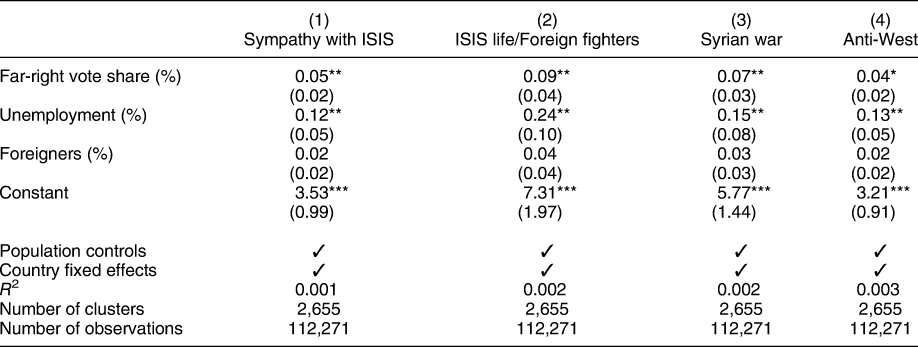
Far-Right Vote Share and Posting Pro-ISIS and Anti-West Content on Twitter

Robust standard errors in parentheses, clustered at the locality level. Base country is Belgium.
*p < 0.10, **p < 0.05, ***p < 0.01.
Columns (3)–(5) in Table 5 report the results when the dependent variable is measured as being flagged as an ISIS activist, being suspended from Twitter for association with the organization, and with a count measure of the number of ISIS accounts that a user follows. Here, as well, the results show that vote share for far-right parties is positively related to these radicalization outcomes. However, suspension and number of ISIS accounts followed are not statistically significant at conventional levels with the clustered standard error specification, although results are significant when estimating the models without clustered standard errors (see Table S27 in the online appendix). In substantive terms, vote share for far-right parties is associated with a 6% increase in the probability of being flagged as an ISIS activist.
Table 6 reports the results when the dependent variables reflect the number of tweets posted by a user across the content outcomes. Here, a one percent increase in the vote share for far-right parties is positively and statistically significantly associated with increases in the number of tweets sympathizing with ISIS, discussing life in ISIS-controlled territories and foreign fighters, discussing the Syrian civil war, and expressing anti-West sentiment. Substantively, these reflect an average increase of 4,000–10,000 pro-ISIS tweets across the entire sample. Note that these measures are calculated from content generated in English, Arabic, French, and German and are measured across thousands of individuals in four countries. The consistency of the results across these text-based measures suggests that this association did not occur by random chance.
Hate Crimes and Support for ISIS
One might wonder whether the findings are driven by greater levels of animosity against Muslims in areas where far-right parties are popular. Earlier in this article, I showed that at the individual level voting for far-right parties strongly correlates with anti-Muslim sentiment. In this section, I test if the relationship found in the previous section holds when using hate crimes as a proxy for anti-Muslim hostility. I also examine whether hate crimes moderate the link between far-right vote share and pro-ISIS radicalization.
As systematic local-level data on hate crimes is not publicly available in most countries, this section only uses data from the United Kingdom. Using official data from the U.K. police, I matched accounts of Twitter users in the United Kingdom with information on hate crimes motivated by religion in each police force area,Footnote 33 as well as granular geo-spatial data on public order crimes.Footnote 34 Public order crimes are incidents that “cause fear, alarm, or distress” and subsume most hate crimes in the United Kingdom.Footnote 35 To estimate the link between hate crimes and pro-ISIS rhetoric on social media, I regressed online radicalization outcomes on local-level hate crime data, controlling for other variables that might explain support for ISIS and the likelihood of hate crimes in each area.Footnote 36
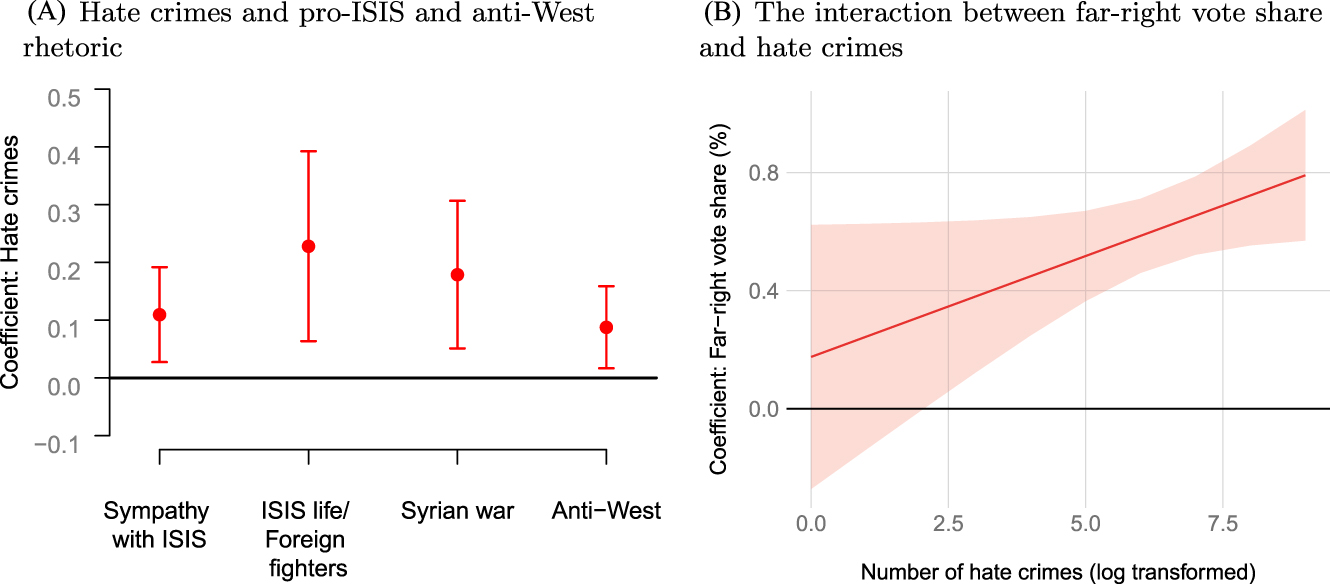
Figure 5A shows the correlation between the number of hate crimes and pro-ISIS tweeting in the United Kingdom. It can be seen that individuals located in areas with a higher number of hate crimes are more likely to post greater number of tweets expressing sympathy with ISIS, discussing life in ISIS territories and foreign fighters, and expressing interest in the Syrian civil war. In addition, individuals located in these areas tend to voice greater anti-West sentiment. Substantively, a unit increase in the number of hate crimes is linked to an increase of about 10–11% in the number of pro-ISIS tweets posted by each user, or an average increase of 7,000–18,000 tweets across the entire sample.
Far-Right Vote Share, Hate Crimes, and Support for ISIS in the U.K.
Note: Panel (A) shows the correlation between the number of hate crimes and pro-ISIS tweeting in the U.K. Panel (B) presents the interaction between far-right vote share and hate crimes in a regression where the dependent variable combines all pro-ISIS tweets posted by users in the U.K.

To examine whether hate crimes moderate the relationship between far-right vote share and online support for ISIS, I interact far-right vote share with hate crimes in a regression where the dependent variable combines all pro-ISIS tweets.Footnote 37 Figure 5B presents this interaction, showing that the relationship between far-right vote share and pro-ISIS tweets is stronger in areas with more hate crimes. These findings suggest that anti-Muslim hostility likely drives the relationship between far-right vote share and support for ISIS on Twitter, at least among users located in the United Kingdom.
OTHER CORRELATES OF ONLINE RADICALIZATION
Unemployment
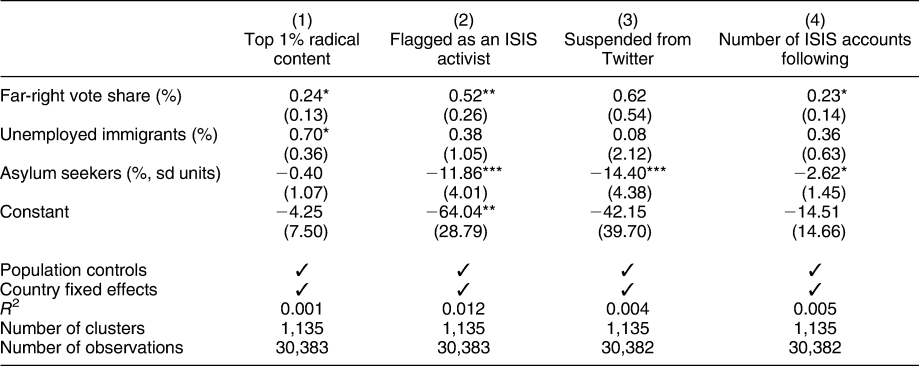
Next, I investigate other correlates of online radicalization. As can be seen in Table 6, the unemployment rate at the local level is also strongly associated with online support for ISIS when considering the content-based outcomes. A one percent increase in the level of unemployment is associated with a 1–3% increase in posting tweets sympathizing with ISIS, discussing life in ISIS territories, or expressing an interest in traveling to Syria to become foreign fighters. Unemployment, however, is not positively related to other radicalization outcomes, such as being flagged as an ISIS activist, being suspended from Twitter, or the number of ISIS accounts followed (Table 5). In Table 7, I find that the share of unemployed immigrants is not significantly related to online measures of pro-ISIS radicalization.
Unemployed Immigrants, Asylum Seekers and Support for ISIS on Twitter

Robust standard errors in parentheses, clustered at the locality level. Data available only for France and Germany. Base category is Germany.
Coefficients in columns 1–3 are ×1,000 to account for the skewed distribution of the dependent variables.
*p < 0.10, **p < 0.05, ***p < 0.01
Since levels of unemployment can drive both far-right vote share and support for ISIS, I run additional estimations to further rule out the confounding effect of unemployment. First, as presented in the next section, I conduct high frequency studies around events that may mobilize support for ISIS and examine whether pro-ISIS rhetoric increases after these events more strongly in areas with higher levels of far-right vote share. In particular, when I examine heterogeneous changes following these events for both far-right vote share and unemployment, it is clear that these high-frequency changes are linked to the former and not the latter. The results show systematic evidence that ISIS followers express greater support for the organization after these events in localities where far-right parties are more popular.
Second, in the online appendix, I carry out a more comprehensive examination using a matching design. In the matching approach, I compare users located in areas with high and low far right vote share that are matched on levels of unemployment, the proportion of foreigners, population size, and the country in which they are located. I find almost identical results.Footnote 38 This suggests that unemployment does not confound the relationship between far-right vote share and pro-ISIS radicalization.
FOREIGNERS, REFUGEES, AND OTHER MINORITIES
In addition, I examine whether support for ISIS on Twitter relates to the share of foreigners or noncitizens in a locality. The third row in Tables 5 and 6 shows that a greater number of foreigners in a locality is positively associated with online radicalization, but the relationships are not statistically significant for almost all outcomes. I also investigate in Table 7 whether the share of refugees in a locality relates to greater support for ISIS on Twitter. I find that the share of asylum seeker and/or asylum seeker centers in a locality is negatively related to being flagged as an ISIS activist, being suspended from Twitter, and to the number of ISIS accounts followed.
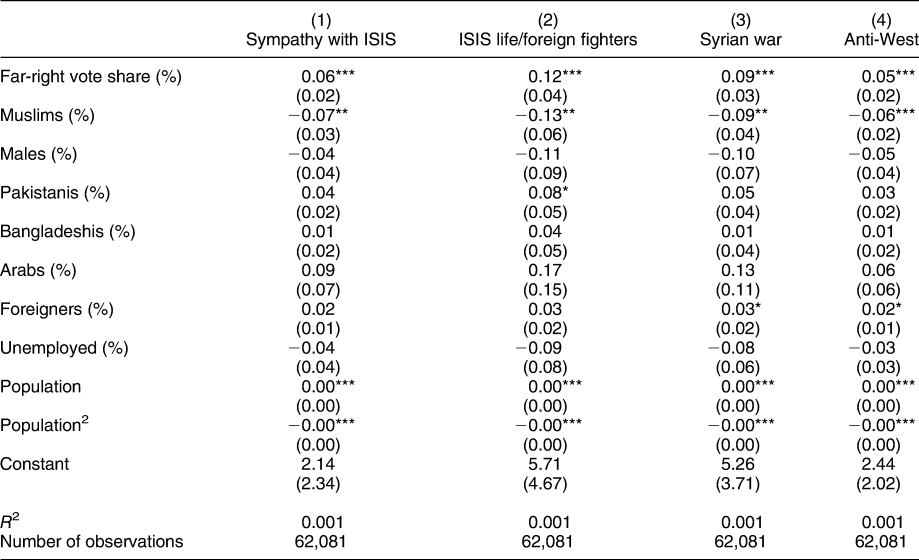
To examine whether these results might be driven by a common third variable linked to both radicalization and far-right support, I use data on possible omitted variables that are available only in the United Kingdom, such as the share of Muslims, Arabs, Pakistanis, Bangladeshis, and foreign-born in each local area. Table 8 shows that when controlling for these variables, vote share for far-right parties remains strongly correlated with posting pro-ISIS content on Twitter. The findings also show that the local proportion of Muslims is negatively correlated with posting pro-ISIS content. This is an important finding in light of recent debates on Muslim populations in the West, as it casts doubt on the argument that areas with larger Muslim populations are more likely to be prone to jihadi radicalization.
Pro-ISIS and Anti-West Content in the United Kingdom, Additional Controls

Heteroskedasticity robust standard errors in parentheses.
*p < 0.10, **p < 0.05, ***p < 0.01.
Overall, these results are consistent with the hypothesis that exposure to anti-Muslim animosity, measured as the local-level vote share for far-right parties, might lead individuals to radicalize and support the Islamic State on social media. The results hold across various dependent variables, in a large number of locations in four European countries. However, since the findings are based on cross-sectional comparisons, it is possible that these relationships are driven by reverse causality or omitted variables. In the remaining parts of the article, I investigate these relationships using high frequency Twitter data surrounding events that likely stir support for ISIS, such as terrorist attacks, releases of propaganda materials on the Internet, and anti-Muslim protests.
HIGH FREQUENCY EVENT STUDIES
The relationship between anti-Muslim hostility and pro-ISIS radicalization is complex and may also run in the other direction or be driven by omitted variables. To further investigate the link between far-right vote share and support for ISIS on social media, I take advantage of the high-frequency nature of Twitter data and examine whether events that likely stir sympathy with ISIS among potential recruits are immediately followed by increased posting of pro-ISIS content in areas with high far-right support. While this design cannot completely rule out reverse causality, it strengthens the inference that anti-Muslim hostility is indeed linked to pro-ISIS content and not reflecting a spurious cross-sectional correlation.
It is important to note that observing high frequency changes in pro-ISIS content does not imply that people are radicalizing in such short amount of time. While the process of radicalization often unfolds slowly and gradually, it is possible to identify events that ‘trigger’ this dynamic. Prior research from other conflicts showed that individuals’ support for extremism can be strongly shaped by exposure to violent events (Crone Reference Crone2016). I seek to examine whether changes in the voicing of radical sentiments are stronger among individuals in areas with greater levels of anti-Muslim hostility.
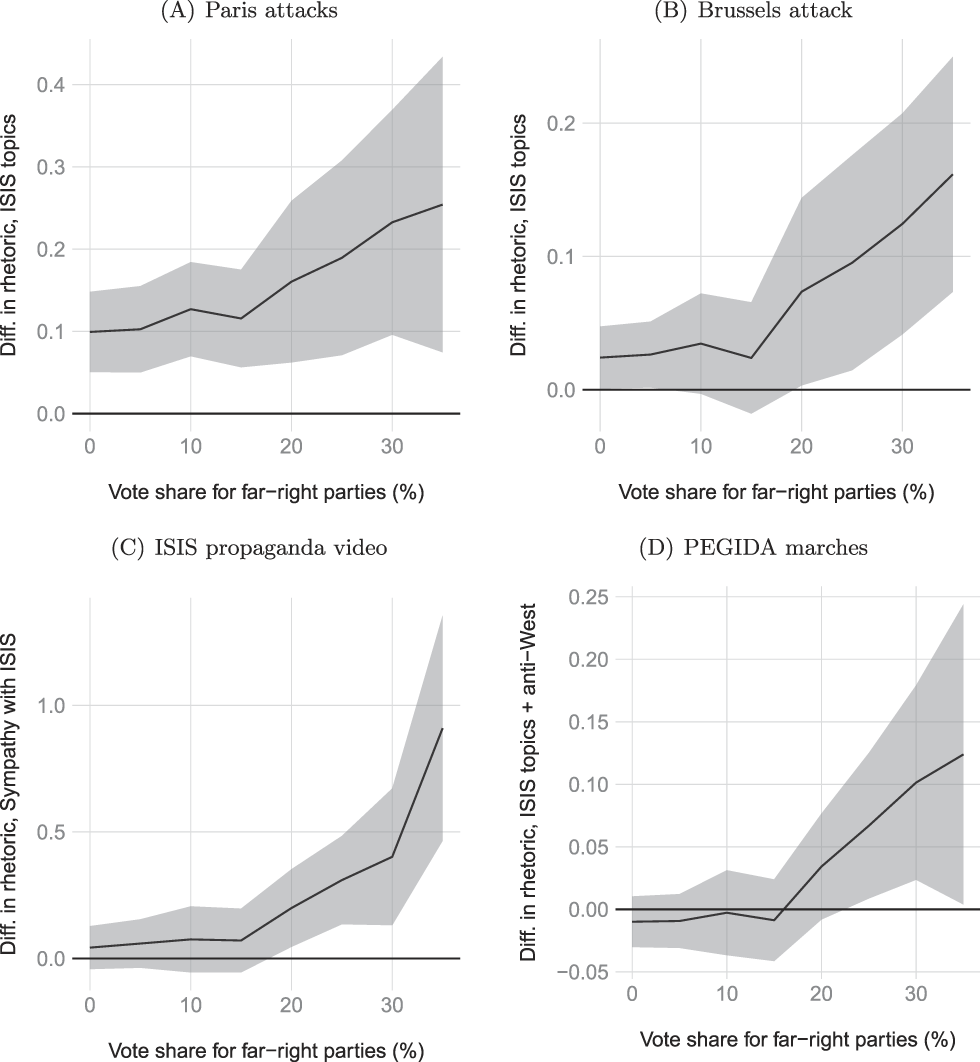
In this section, I carry out several high-frequency analyses around three types of events. First, I examine the impact of the terrorist attacks in Paris (11/13/2015) and Brussels (3/22/2016) on support for ISIS on Twitter. Second, I study the effect of a widespread propaganda release by ISIS, which was distributed on the organization’s Twitter networks on June 29, 2014. Third, I evaluate how individuals responded to a high profile anti-Muslim event, the Patriotic Europeans Against the Islamization of the West (PEGIDA) marches across Europe on February 6, 2016. If a local hostile context has any influence on support for ISIS on social media, then we would expect to find a significantly different pattern in the responses to these events in areas where far-right parties are popular.
Events that Can Increase Support for ISIS
Terrorist Attacks
Terrorist attacks perpetrated by individuals associated with the Islamic State might inspire individuals sympathetic to the group to voice their support for the organization. I examine whether the Paris attacks of November 2015Footnote 39 and the Brussels attacks of March 2016Footnote 40 were immediately followed by increased radical, pro-ISIS content among Islamic State followers on Twitter, especially in locations with high support for far-right parties.
ISIS Propaganda Releases
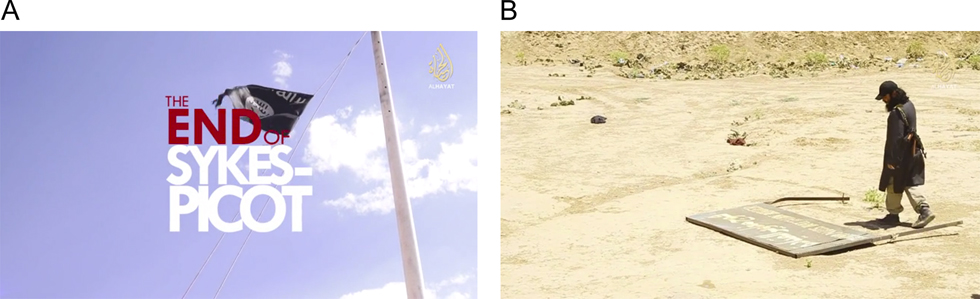
Propaganda materials distributed on the Internet can also increase pro-ISIS rhetoric among potential supporters. On June 29, 2014, ISIS disseminated on Twitter a video called “The End of Sykes Picot,” which showcased the territory captured by the organization and stated that it will eliminate all “so-called borders” created by Western powers in the Middle East. Figure 6 shows screenshots from the video, in which an Islamic State soldier steps over a sign that used to mark the border between Syria and Iraq. I examine how ISIS followers on Twitter responded to this video, and especially whether individuals located in areas with high-far right support were more responsive to the propaganda release.
“The End of Sykes Picot” Propaganda Video Disseminated by ISIS on Twitter
Note: Screenshots from the propaganda video “The End of Sykes-Picot,” disseminated by ISIS on Twitter on June 29, 2014. Source: http://jihadology.net

Anti-Muslim Marches
Events that exhibit animosity to Muslims may also lead individuals to voice their support for ISIS. On February 6, 2016, PEGIDA organized large marches in multiple cities in Germany, Britain, France, Netherlands, Austria, Ireland, Poland, Czech Republic, and Slovakia, to protest against the “Islamization of Europe” (Reuters Reference Reuters2016). The marches drew thousands who came to express their opposition to the arrival of millions of migrants from Middle Eastern and North African countries, and to warn about Europe “being overrun by Muslims” (Reuters Reference Reuters2016). Since the anti-Muslim hostility expressed in the PEGIDA marches was likely to most resonate in areas where far-right parties are popular, and therefore stir hostility in these areas, I examine whether individuals located in these areas responded differently to the PEGIDA marches, compared to individuals located in areas with little far-right support.
Estimation
I estimate several heterogeneous event study models, where I examine whether the difference in the number of pro-ISIS tweets three days after the event is larger in areas that have higher vote-share for far-right parties. A ‘pro-ISIS tweet’ is coded one if its predicted value of belonging to any of the content categories is above the mean of the predicted values for that category, and zero if not. To measure content that explicitly sympathizes with ISIS, I also create a variable for the Sympathy with ISIS topic only. For each event, I estimate the following least squares model:
 $${Y_{ijk}} = {\beta _1}{T_i} + {\beta _2}{V_{jk}} + {\beta _3}\left( {{T_i} \times {V_{jk}}} \right) + {{\bolddelta }}{{\bf{X}}_{jk}} + {\alpha _k} + {\varepsilon _{jk}},$$
where Y ijk represents the level of radical content in tweet i posted in area j and country k, T i is an indicator coded one for tweets appearing after the event (Paris attacks, Brussels attacks, ISIS propaganda release, and the PEGIDA marches) and zero if before, V jk is the locality-level vote share for far-right parties in area j in country k, Xjk represents other independent variables described in equation (1), αk represents country fixed effects, and εjk are standard errors clustered at the locality level.
RESULTS
Terrorist Attacks and ISIS Propaganda
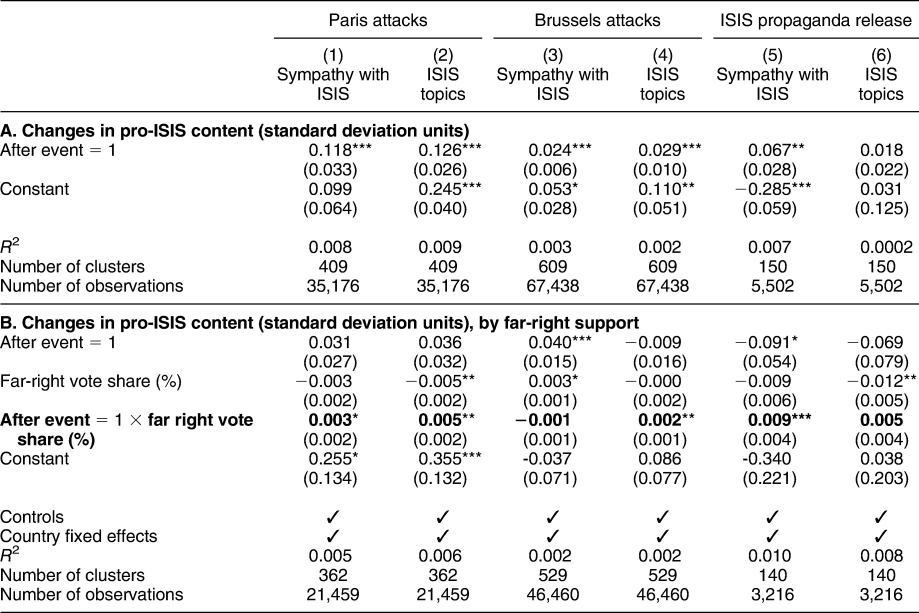
Table 9 presents the findings for the terrorist attacks and the ISIS propaganda release. Panel A reports the pooled results for each of these events. In the first few days after the terrorist attacks in Paris and Brussels, individuals posted significantly more pro-ISIS content on Twitter. We find a similar result after the release of ISIS’s propaganda video, where ISIS followers posted more tweets sympathizing with ISIS after the video’s dissemination.
Terrorist Attacks, ISIS Propaganda, and Changes in Pro-ISIS Rhetoric

Standard errors in parentheses, clustered by location.
*p < 0.10, **p < 0.05, ***p < 0.01.
Panel B in Table 9 reports the heterogeneity results, where I interact far-right vote share with the timing of the events. It can be seen that the largest changes in the number of pro-ISIS posts were concentrated among individuals in high far-right support areas. For the Paris attacks, this finding holds for all ISIS-related topics, as well as when restricting the analysis to sympathy with ISIS only. For the Brussels attack, the difference is only significant for the content outcome combining all ISIS-related topics. For the ISIS propaganda video, the changes are significant with the variable capturing sympathy with ISIS.
Anti-Muslim Marches
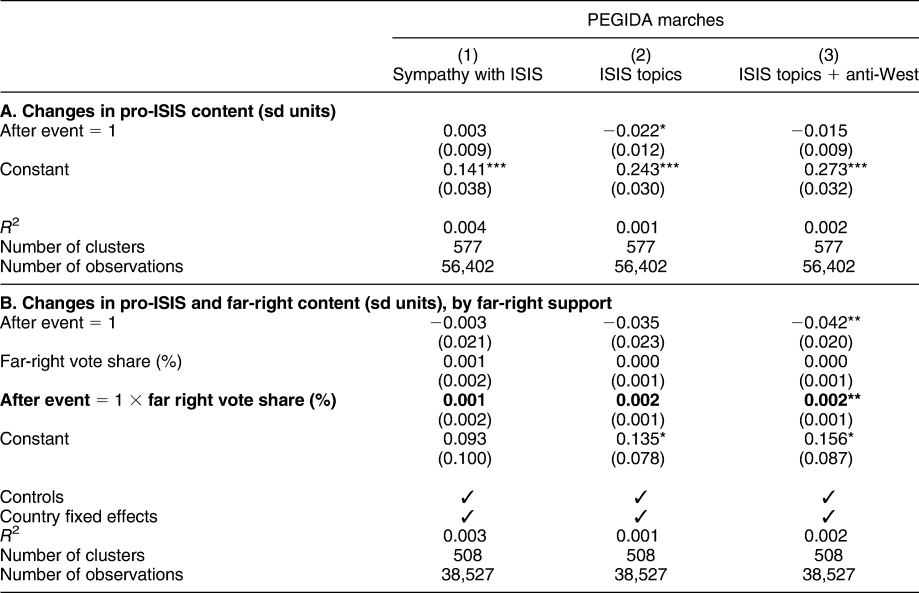
Table 10 presents the findings for the PEGIDA marches. It can be seen that the marches did not lead to an increase in pro-ISIS tweets when considering the sample as a whole. However, when examining how the responses varied by areas with different levels of far-right vote share, we find that pro-ISIS tweets increased in areas with high levels of far-right support. However, the difference is not statistically significant when restricting the analysis only to topics that explicitly discuss ISIS.
PEGIDA Marches and Changes in Pro-ISIS and Anti-West Rhetoric

Standard errors in parentheses, clustered by location.
*p < 0.10, **p < 0.05, ***p < 0.01.
Since qualitative data revealed that ISIS supporters generate high levels of anti-West content, I also examine how tweeting patterns changed when considering a measure including the anti-West topic. I find that anti-West discourse significantly increased after the PEGIDA marches among individuals located in areas with high far-right support. While anti-West sentiment does not necessarily imply support for violent extremism, it is certainly part of the discourse of ISIS supporters, especially around incidents carried out by Western actors (Cunningham, Everton, and Schroeder Reference Cunningham, Everton and Schroeder2017). The difference between the ISIS-initiated events (terrorist attacks and propaganda release) and the PEGIDA marches could be driven by the different kinds of actors involved (Western vs. non-Western). Nonetheless, the pattern across these events is strikingly similar.
Figure 7 presents these patterns visually, showing that across all four events, the increase in pro-ISIS and anti-West tweeting is significantly larger in areas with higher far right vote share. The figures also illustrate why the PEGIDA marches did not lead to a positive change in tweeting in the pooled analysis: in areas with low far-right vote share, the marches were followed by a decrease in the number of ISIS-related and anti-West tweets. Indeed, on the day of the PEGIDA marches, many counter-protests took place in opposition to the movement’s positions (Worley Reference Worley2016). This illustrates the powerful role of local context in facilitating support for ISIS.
Responses to Terrorism, Propaganda, and Anti-Muslim Marches, by Far-Right Vote Share
Note: The figure plots the difference in the frequency of pro-ISIS and anti-West tweets after various events for areas with different levels of far-right vote share. The differences are reported in standard deviation units.

As a robustness test, in the online appendix, I run the same estimation when interacting the events’ timing with local-level unemployment. I find no difference in the tweeting patterns after the events in areas with high levels of unemployment.Footnote 41 This suggests that there is something unique about areas with high support for far-right parties that might shape support for extremism. As the results reflect responses to various types of events taking place in different (even arbitrary) points in time, these consistent findings provide further support for the hypothesis that a local context of anti-Muslim hostility can facilitate support for ISIS.
CONCLUSION
This study seeks to shed light on what drove so many to support the Islamic State in the West in the past several years. By collecting data on thousands of Twitter users affiliated with or following ISIS accounts, classifying millions of tweets along various dimensions of ISIS sympathy, and mapping Twitter users to geographic locations in France, Germany, Belgium, and the United Kingdom, I showed that those located in areas that voted for far-right, anti-Muslim parties were more likely to show signs of radicalization than others in less hostile areas. While some have noted that there might be a link between the rise of far-right parties and support for ISIS in Europe (Van Zeller Reference Van Zeller2016), this article has provided the first systematic, rigorous study of this proposition.
The findings stress the importance of understanding the process of radicalization and support for extremist movements in the age of social media. The ability to directly reach potential recruits on the Internet, interact with them through online platforms, and persuade them to embrace extremist ideology is changing how we think about recruitment in subnational conflicts. As the Internet and mobile technology continue to spread across the world, radicalization through the Internet is likely to continue, given the ongoing conflicts in the Middle East, North Africa, and other parts of the world. Studying how the online and offline worlds interact in this setting suggests that hostility in one’s offline world might lead to the consumption of online radical content.
Looking forward, research on radicalization in the West would benefit from more localized studies aiming to causally identify the mechanisms by which hostility can facilitate support for extremism. Does an environment of anti-Muslim hostility increase support for jihadi ideologies through a process of identity-seeking? Or is it driven by lack of opportunity to integrate into the surrounding society, e.g., by finding employment or increasing social status? In addition, studies could unpack the role of inter-group contact in this setting, especially in light of the finding in prior research that support for far-right parties tends to be stronger in areas where minority communities are smaller (Biggs and Knauss Reference Biggs and Knauss2012).Footnote 42
Future work can also study the determinants of ISIS radicalization in non-Western countries. While some of the same mechanisms might be at play, descriptive evidence suggests that recruits’ motivations, as well as ISIS’s recruitment strategy have been different in Middle Eastern and North African countries (Raghavan Reference Raghavan2016; Wilson Reference Wilson2015). Nonetheless, it is certainly possible that institutional exclusion in authoritarian settings might create a similar dynamic, where individuals who feel alienated from the regime become attracted to propaganda disseminated by ISIS and other extremist groups.
Finally, future studies might examine ways to de-radicalize potential recruits. With the rise of Islamic State recruitment on social media, there has been a dramatic increase in initiatives to counter extremism around the world: in just a few years, over forty countries have announced official national strategies to fight violent extremism, and many more initiatives have been launched by nongovernmental organizations.Footnote 43 While policy efforts such as the U.S. Department of State’s “Think Again Turn Away” campaign have had limited impact (Fernandez Reference Fernandez2015), other, more local de-radicalization efforts have reportedly been more successful in this and prior conflicts (Frenett and Dow Reference Frenett and Dow2016; Horgan Reference Horgan2015; Rabasa et al. Reference Rabasa, Pettyjohn, Ghez and Boucek2010). The findings of this study, especially those showing differential results across localities around the PEGIDA marches, suggest that it might be fruitful to investigate the role of an inclusive local context in quelling support for extremism. A better understanding of what drives individuals to sympathize with foreign extremist groups could guide policymakers in responding to this troubling phenomenon.
SUPPLEMENTARY MATERIAL
To view supplementary material for this article, please visit https://doi.org/10.1017/S0003055418000618.
Replication material can be found on Dataverse at: https://doi.org/10.7910/DVN/5QUCW7.




Comments
No Comments have been published for this article.