Trisomy 18 is the second most common autosomal trisomy after trisomy 21 in live-born patients. Patients with trisomy 18 have severe psychomotor mental retardation, characteristic craniofacial features, and various visceral and skeletal malformations. More than 90% of patients with trisomy 18 have congenital cardiac anomalies, and congestive heart failure is considered to be one of the major causes of their exceedingly short lifespan. The most common cardiac anomalies are ventricular septal defect, patent ductus arteriosus, and atrial septal defect. Population-based studies have shown that the median survival time is from 3 to 14.5 days, and the 1-year survival rate is 5–10%.Reference Baty, Blackburn and Carey 1 – Reference Van Dyke and Allen 3
Owing to the poor prognosis of trisomy 18 and no well-defined criteria for surgical intervention, offering cardiac surgery to these patients is controversial. At present, it is unclear whether the presence of a cardiac lesion affects survival.Reference Van Dyke and Allen 3 Some studies have determined central apnoea to be the primary cause of death.Reference Embleton, Wyllie, Wright, Burn and Hunter 2 , Reference Rasmussen, Wong, Yang, May and Friedman 4 Previous reports have indicated that cardiac surgery – not only palliative surgery such as pulmonary artery banding but also intracardiac repair such as ventricular septal defect closure – contributed to an increased survival rate and hospital discharge.Reference Graham, Bradley, Shirali, Hills and Atz 5 – Reference Suzuki, Oshima and Doi 8 Indeed, with the development of neonatal intensive care at many centres, the policy for treatment of patients with trisomy 18 has been shifting from non-aggressive to aggressive management, including surgical intervention. In the most recent American Heart Association neonatal resuscitation guidelines, trisomy 18 was removed from the list of conditions for which cardiopulmonary resuscitation is withheld. 9 We retrospectively reviewed our experience of patients with trisomy 18 to investigate the effectiveness of cardiac surgery, its contribution to survival rate, and significant predictors of increased survival time.
Patients and methods
Data collection
Data analysis for this retrospective review was approved by the Institutional Review Board of Nagoya City University Hospital. The need for patient consent was waived. Patients who were discharged from the hospital were followed-up in the outpatient clinic or by telephone survey. Patients’ data were collected on 31 July, 2013.
We treated 23 consecutive infants with trisomy 18 and cardiac anomalies at Nagoya City University Hospital from August, 2003 to July, 2013; three patients were excluded from this review because we could not contact their families after hospital discharge. We divided the remaining 20 infants into two groups: the surgical group (n=10, three male infants) underwent pulmonary artery banding with or without patent ductus arteriosus ligation; and the conservative group (n=10, four male infants) was conservatively treated without cardiac surgery.
Definitive diagnosis of trisomy 18 was based on chromosomal analysis from peripheral blood using G-banding or fluorescence in situ hybridisation after written informed consent was provided by their parents. Cardiac anomalies were detected by transthoracic echocardiography. Infants in critical condition with symptoms attributable to their cardiac lesions were considered candidates for surgical intervention by the entire medical team, which consisted of a neonatologist, a paediatric cardiologist, and cardiovascular surgeons, after agreement that selective procedures would likely ameliorate symptoms and allow the patient to wean from the ventilator. Parental consent was obtained after a thorough discussion of the risks and benefits of cardiac surgery.
For all patients, factors considered in our analysis were gestational age, body weight, Apgar score at 1 and 5 minutes, sex, cardiac anomalies, major extracardiac anomalies, length of hospital stay, possibility of weaning from mechanical ventilation, and survival. In the surgical group, we also included age and body weight at surgery in our analysis. Conservative treatment consisted of administration of intravenous or oral diuretics and/or digitalis and cardiac inotropic support.
Statistical analysis
All the results are presented as mean±SD. Continuous variables were compared using the Student’s t-test or unpaired t-test. Nominal variables were compared using the χ2-test or Fisher’s exact test. Cox proportional hazard regression models were used to analyse survival risk for time to either date of death or date of completion of follow-up to evaluate the impact of surgery. Time 0 was the date of birth. Variables that met the statistical significance level by univariate proportional hazard regression analysis were submitted for multivariate proportional hazard regression analysis to determine independent multivariable factors of survival. Actuarial survival curves obtained by the Kaplan–Meier method were compared using log-rank analysis. Two-sided p values were calculated using log-rank tests. A p value<0.05 was considered statistically significant. All statistical analyses were conducted with JMP® 10 (SAS Institute Inc., Cary, North Carolina, United States of America).
Results
Patient characteristics
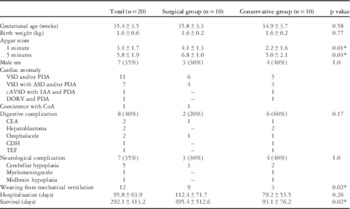
The patients’ clinical profiles are presented in Table 1. All the patients developed respiratory and/or cardiac failure due to excessive pulmonary blood flow from left-to-right shunting. There were no statistically significant differences in gestational age, birth weight, male sex, digestive complications, or neurological complications between the surgical and conservative groups, but there were differences in Apgar scores at 1 and 5 minutes (p=0.01 and p=0.03, respectively).
Clinical profiles of the surgical and conservative groups.

ASD=atrial septal defect; cAVSD=complete atrioventricular septal defect; CDH=congenital diaphragmatic hernia; CEA=congenital oesophageal atresia; CoA=coarctation of the aorta; DORV=double-outlet right ventricle; IAA=interruption of the aortic arch; PDA=patent ductus arteriosus; TEF=tracheo-oesophageal fistula; VSD=ventricular septal defect
*Statistically significant (p<0.05)
Surgical group
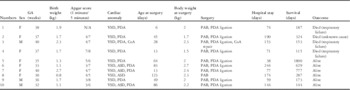
Characteristics of the surgical group are summarised in Table 2. No patient underwent intracardiac repair at our institution; nine patients had not yet undergone complete intracardiac repair subsequently. Patient no. 6 underwent intracardiac repair consisting of ventricular septal defect patch closure, atrial septal defect primary closure, and pulmonary artery debanding at another hospital at the age of 540 days and body weight of 6.4 kg, but her ventricular septal defect patch closure patch was taken down and repeat pulmonary artery banding was performed because of poor left ventricular function that resulted in inability to be weaned from the cardiopulmonary bypass.
Characteristics of the surgical group (n=10).

ASD=atrial septal defect; CoA=coarctation of the aorta; F=female; GA=gestational age; M=male; N/A=not available; PAB=pulmonary artery banding; PDA=patent ductus arteriosus; VSD=ventricular septal defect
Outcomes
The mean duration of hospital stay of the surgical group was 112.4±71.7 days (range, 38–244 days). Only one patient died of acute respiratory failure in the hospital. The other nine infants were discharged alive, but one died of infection, one of acute respiratory failure, and one of unknown causes after hospital discharge. There were no cardiac-related deaths. The remaining six patients were alive at the time of the final follow-up.
For the conservative group, the mean duration of hospital stay was 79.2±53.5 days (range, 1–183 days). Of 10 infants, eight died at the hospital; two survived to be discharged, but both ultimately died of intra-abdominal haemorrhage caused by hepatoblastoma rupture.
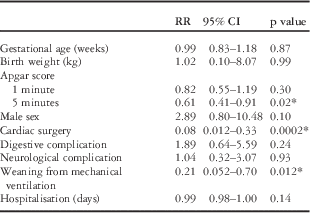
Although no difference was found in the duration of hospitalisation, there was a significant difference in the number of hospital deaths between groups (p=0.005). There was also a significant difference between groups in the percentage of patients weaned from mechanical ventilation (nine in the surgical group [90%] and three in the conservative group [30%]; p=0.02). Within the surgical group, the age of survivors at the time of surgery was significantly greater than that of non-survivors (69.7±37.3 versus 23.0±17.3 days, respectively; p=0.049). Other factors, as shown in Table 3, did not affect operative outcomes.
Survival risk analysis for cardiac surgery and other factors.

CI=confidence interval; RR=risk ratio
*Statistically significant (p<0.05)
Survival
The overall curve is shown in Figure 1. In all, six patients survived to the date of final follow-up. The duration of survival was 495.4±512.6 days (115–1800 days) in the surgical group and 93.1±76.2 days (1–251 days) in the conservative group. Actuarial survival at 1, 3, 6, and 12 months after birth was 100, 100, 78.8, and 63.0% in the surgical group and 80, 30, 10, and 0% in conservative group, respectively. Actuarial survival was significantly higher in the surgical group (p<0.001).
Kaplan–Meier curve showing the probability of survival of the surgical and conservative groups. Survival was significantly longer in the surgical group compared with the conservative group (log rank p<0.001).

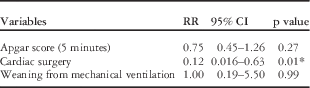
Univariate Cox proportional hazard regression analysis revealed that the hazardous variables for survival were Apgar score at 5 minutes, cardiac surgery, and weaning from mechanical ventilation. The relative risk was 0.65 for each point of 5-minute Apgar score. Cardiac surgery also decreased the risk by 0.09 (Table 3). Independent predictor of survival was cardiac surgery by multivariable analysis (risk ratio of 0.12, 95% confidence interval 0.016–0.63; p=0.01) (Table 4). Other factors did not affect survival.
Multivariate Cox proportional hazard regression analysis for survival rate in patients with trisomy 18.

CI=confidence interval; RR=risk ratio
*Statistically significant (p<0.05)
Comment
Trisomy 18 has a reported incidence of 1:3000–1:8000, and >90% of this cohort have congenital cardiac lesions.Reference Embleton, Wyllie, Wright, Burn and Hunter 2 , Reference Carter, Pearn, Bell, Martin and Anderson 10 – Reference Niedrist, Riegel, Achermann and Schinzel 12 Of these, 90% have ventricular septal defect with polyvalvular disease and the remainder have a wide variety of complex cardiac anomalies such as double-outlet right ventricle, tetralogy of Fallot, complete atrioventricular septal defect, and hypoplastic left heart syndrome. These cardiac anomalies sometimes include coarctation of the aorta and atrial septal defect and/or patent ductus arteriosus.Reference Van Praagh, Truman and Firpo 13 , Reference Balderston, Shaffer, Washington and Sondheimer 14 Thus far, two major population-based studies have revealed that the presence of a congenital cardiac anomaly does not seem to be associated with early death;Reference Embleton, Wyllie, Wright, Burn and Hunter 2 , Reference Rasmussen, Wong, Yang, May and Friedman 4 however, the causes of death in trisomy 18 patients, as assessed by investigating autopsy cases, were cardiac failure and pulmonary haemorrhage due to CHD.Reference Kinoshita, Nakamura and Nakano 15 , Reference Kosho, Nakamura, Kawame, Baba, Tamura and Fukushima 16 Early progression of pulmonary vascular obstruction induced by congenital cardiac lesions results in disproportionate development of pulmonary hypertension in patients with trisomy 18.Reference Van Praagh, Truman and Firpo 13 , Reference Kaneko, Kobayashi and Achiwa 17 Therefore, surgical intervention to manage excess pulmonary blood flow may ameliorate the poor prognosis of these patients. Our study indicates that palliative surgery consisting of pulmonary artery banding and patent ductus arteriosus ligation contributed to increasing the duration of survival and weaning from mechanical ventilation. This result does not contradict previous reports.Reference Graham, Bradley, Shirali, Hills and Atz 5 – Reference Suzuki, Oshima and Doi 8 , Reference Kaneko, Kobayashi and Achiwa 17 , Reference Maeda, Yamagishi and Furutani 18
On the other hand, the effectiveness of intracardiac repair remains controversial. Although some have reported increased survival with successful intracardiac repair,Reference Van Dyke and Allen 3 , Reference Graham, Bradley, Shirali, Hills and Atz 5 , Reference Kobayashi, Kaneko, Yamamoto, Yoda and Tsuchiya 7 other reports have demonstrated the duration of survival to be shorter after intracardiac repair than after palliative surgery because of complicated cardiac lesions.Reference Kaneko, Kobayashi and Achiwa 17 Our policy regarding surgical treatment for infants with trisomy 18 is based on increasing their lifespan and quality of life and minimising risk.
We also believe that cardiac complications should be treated individually. Most of these patients have several coexisting anomalies of the digestive and neurological systems that may affect physical development and sometimes be fatal. Therefore, to manage heart failure and respiratory distress, we perform pulmonary artery banding to reduce high pulmonary blood flow, which also directly impacts their prognosis. It is well known that genetic syndrome, young age, and perioperative blood transfusion are risk factors for postoperative infection and death.Reference Allpress, Rosenthal, Goodrich, Lupinetti and Zerr 19 – Reference Van de Watering, Hermans and Houbiers 22 Infantile open-heart surgery requires more blood transfusion, including blood priming of cardiopulmonary bypass circuits, and thus may entail a higher risk of perioperative infection and death.Reference Mangram, Horan, Pearson, Silver and Jarvis 23 Furthermore, systemic inflammatory response syndrome induced by cardiopulmonary bypass can be critical in neonates and infants with trisomy 18.Reference Kouchoukos, Blackstone, Doty, Hanley and Karp 24 We would never perform definitive surgery until their condition is stable enough for the procedure after pulmonary artery banding; two of our patients (patient nos 5 and 7 in Table 2) who have survived more than 1 year are now thought to be able to tolerate definitive surgery. Although surgery is planned for these patients in the near future, it must be remembered that each treatment decision must be made with consideration of the parents’ emotions. After the orchestration of multidisciplinary consideration of ethical problems and medical care, we must inform the immediate family that, although cardiac surgery may contribute to preventing heart-related death and improving the survival rate to some extent, other problems including the risk of sudden death will remain even after cardiac surgery.
Limitations
There are some limitations to this study. The number of cases reviewed was too small to allow universal application of results, and cases and demographic factors reviewed were from a single institution. We have no definite treatment strategy for patients with trisomy 18; therefore, the decision to perform initial surgical intervention is affected by various factors, and there may have been selection bias towards surgical intervention for patients without severe extracardiac anomalies and poor general status that may have affected their survival.
Conclusion
Our analysis of the clinical outcomes of 20 patients with trisomy 18 suggests that cardiac surgery to control pulmonary blood flow adequately contributes to enabling patients to wean from mechanical ventilation and increases survival. Although these patients have a short lifespan, surgical interventions should be considered as a therapeutic strategy. Patients’ families should be provided with sufficient information to make decisions that will optimise the quality of life of both patients and their families.
Acknowledgements
The authors thank all the members of the Department of Cardiovascular Surgery and Pediatrics at the Nagoya City University Graduate School of Medical Sciences.
Financial Support
This research received no specific grant from any funding agency, commercial, or not-for-profit sectors.
Conflicts of Interest
None.
Ethical Standards
The authors assert that all procedures contributing to this work comply with the ethical standards of the relevant national guidelines on human experimentation and with the Helsinki Declaration of 1975, as revised in 2008, and has been approved by the institutional committees.