The time does seem to be ripe for revisiting the urban-rural divide, with an eye toward understanding what lies beneath it. The last two presidential elections have revealed an urban-rural cleavage that is hard to ignore. Most observers now recognize that the “red” vs. “blue” Election Night maps really mask an urban-rural divide within states—a gap that has increased in recent years according to a range of definitions. In 2004, the difference in Democratic support between the most and least populous counties in the nation exceeded 25 points (see Figure 1). Survey marginals are comparable, although rural populations are not well represented in most national polls. Tabulations from the 2004 American National Election Studies (ANES) indicate a 20-point gap in presidential preference between inhabitants of counties with more than a million people and those in non-metro counties of less than 25,000.

Difference in Support for Democratic Presidential Candidates, by County Size
Party strategists are alarmed by this gap, particularly on the Democratic side. Although on their own, the nation's tiniest burgs do not amount to much, collectively they do cast enough votes to anchor the Electoral College to the Republican candidate in many states. In the wake of the 2004 election, newly elected Democratic National Committee chair Howard Dean is said to have urged his party's elites to study and address their “rural problem.”
Surprisingly, political science seems remarkably ill-prepared to do this. For all the research on urban politics, there is no remotely comparable body of accumulated wisdom on rural populations (but see Lewis-Beck 1977). In this essay, we take up Dr. Dean's charge to seek a deeper understanding of the rural side of the urban-rural divide.
Explanations of the urban-rural gap are right to note the obvious compositional differences that make places politically distinct from one another. Areas with low population density may stand out from other locations because only certain types of people have come to reside there. If so, there is nothing magical about place-of-residence, per se, but the peculiar economic and demographic traits of resident populations identify rural behavior and beliefs. Tabulations from major national surveys show that rural voters are, on average, more White, Christian, evangelical, religiously devout, elderly, less educated, and less affluent than urban and suburban populations. They also own more guns, are more likely to oppose abortion rights, and hew to more traditional family arrangements than those living elsewhere.
A few other traits of rural voters are less obvious. Rural voters are not more Republican in party identification than suburban voters, although they are much more so than those living in central cities. Rural voters are also much more likely to be homeowners, and to be self-employed, than non-rural residents. Contrary to widely held hillbilly stereotypes, they are not entirely Southern; 29% of the nation's rural voting-age residents reside in Deep South states, with another 21% residing in Border states.1
These figures are based on the more expansive definition of rural as non-metro counties with a population of less than 25,000. If we use the stricter definition of less than 10,000, the rural population is even less Southern with 38% of voting-age residents residing in Deep South and Border states.
In summary, the profile of the rural American contains potential cross-pressures. Rural voters tend to be morally and socially conservative, but they might also have good reasons to vote with Democrats on matters of economic import. Nevertheless, data show that their voting loyalty is growing more Republican, while people in America's most populous locations head in the opposite direction, giving rise to the unmistakable gap shown in Figure 1. Suburbs, for their part, churn restlessly in the middle—on balance suburbanites are Republican, but there is wide variation.2
We will not address suburbs or their increasing economic and political heterogeneity in great detail in this essay. While suburbs now house a majority of the American electorate, it is also clear that Democrats compete successfully for suburban voters in presidential and congressional elections. The Democrats have no “suburban problem” of comparable proportion to their “rural problem.”
The Rural American as Ignorant Rube
On the subject of cross-pressures, it is impossible to ignore Thomas Frank's (2004) recent work arguing that economic vulnerability has been displaced as an issue among rural Americans by the wily deployment of religious and moral symbols by business-oriented Republican elites. According to Frank, the moral focus has distracted foolish rural voters from their legitimate economic grievances, duping them into voting with the most affluent. The result has been the formation of a coalition on the American right of working-class rural voters and corporate business interests, with the latter wielding the greater influence.
In Frank's view, rural voters mindlessly elect people who follow the business interests of Wall Street and unwittingly undermine their own economic position for nothing in return. This, according to Frank, is why some of the poorest counties in the nation in predominantly rural states gave over 80% of their vote to Republican candidates in recent presidential elections. Geographic divisions in American politics are often anchored in non-political stereotypes about the way people live and think in places distant and unfamiliar. Frank's contention that rural citizens are ill-bred dimwits who vote incorrectly will resonate with metropolitan readers, and most university faculty. The unflattering views that urban sophisticates have come to harbor toward rural Americans, and vice versa, have dredged a wide moat. City dwellers evidently believe that rural Americans are dumb, boorish, and bigoted.3
At this point one should take note that Thomas Frank is not from rural Kansas, but from an affluent suburb of Kansas City, which is arguably as culturally remote from rural western Kansas as a suburb of Chicago, St. Louis, or New York.
Economic Change and the Experience of Economic Change
Our contention is that the urban-rural divide is rooted in much more than morality politics. Frank's (2004) argument that rural Americans are easy to fleece politically has been challenged by Bartels (2006), but not on the grounds articulated here. Bartels soberly insists that Frank's evidence is flawed because economic conditions continue to be important to Americans, regardless of place-of-residence. There are several other possible explanations of rural political distinctiveness, however, including: (1) the possibility that economic struggle in rural areas has been exaggerated; (2) the fact that rural self-images are not well understood; and (3) widespread misunderstanding of rural Americans' adaptability to and perceptions of changing economic circumstances.
Perhaps rural Americans are not laboring to choke down their economic misery. This is not so difficult to believe if accounts of rural economic collapse have been exaggerated, or if economic conditions and the experience of economic conditions are separable. Republican voting habits may be sustained throughout rural America because it is not so evident to residents that economic conditions have worsened dramatically under Republican leadership more than they did under Democratic leadership, or more than they have in other geographic locations.
In spite of globalization and the move to market-based corporate farming, the sky has not fallen on rural and small-town Americans, rather few of whom actually are employed in the agricultural sector anyway. Economic decline in some sectors has been met with improvements in others. The upshot is that rural residents may see little compelling reason to revolt against their Republican masters, at least from a pocketbook perspective.
A number of studies of life and job satisfaction show that people who live in rural areas are more satisfied with their lives and jobs than those in urban and suburban locations (Drury and Tweeten 1997; Martinson and Wilkening 1984; Rodgers 1980). Much of this happiness appears to be anchored in self-employment or an enlarged scope of job responsibility. But even if we control for occupation or self-employment, we must note that key differences in socialization experiences have shaped subjective judgments about the meaning and value of work (Martinson and Wilkening 1984, 204).
Data (not shown) from the 2000 ANES indicates that rural residents working for an employer other than themselves were more likely than those living elsewhere to say they were completely satisfied with their lives. Rural residents who were self-employed were far more likely to say they were completely satisfied than self-employed individuals in non-rural areas. Based on this evidence and that of other studies addressing life satisfaction, health, and happiness (Putnam 2000, Chapter 20), there is no groundswell of discontent in the remote hinterlands. Maybe the real puzzle is why so many unhappy urban and suburban citizens are not translating their high levels of discontent into political demands.
Entrepreneurial Self-Images and Private Property
People who live in rural areas are no different than other Americans in that they discriminate between those who deserve government assistance and those who do not. In addition, however, rural residents express the same desire for lower taxes, less regulation, and free markets as do residents of wealthy suburbs. Why is this so? A strong sense of self-reliance anchored in an individualistic ethic is traceable to the earliest days of the republic (Feldman 1988; Feldman and Zaller 1992; Knoke and Henry 1977; McClosky and Zaller 1984). This ethic is tied closely to a preference for little or no government regulation of business and a belief in the notion that those who succeed in a competitive marketplace owe nothing to those who fail (Greenberg 1981; Schlozman and Verba 1979). Economic individualism shows up not only in the indisputably conservative attitudes of rural Americans toward welfare but is also reinforced by two cornerstone aspects of the rural economy: self-employment and widespread property ownership.
As business owners and homeowners, rural dwellers' commitment to private property thwarts many policy sentiments that might run contrary to an individualistic and competitive ethic. The mode of production that historically has shaped rural areas is that of the small independent owner-operator—the petit-bourgeois (Greenberg 1981; Engels 1975). There has been little sense of class oppression among rural Americans in contemporary times because of high levels of self-employment and homeownership. According to the 2004 ANES, for example, 3.1 rural residents worked for someone else for every one who reported to be self-employed, but in non-rural areas, this ratio was more than double that: 6.3!
Many rural families own land or other capital items such as buildings, equipment, and store inventories, and are in entrepreneurial control of the allocation of these resources. Moreover, families historically have provided much of the labor in these enterprises, although this tradition is changing with corporate penetration of agriculture and small-town enterprise. Finally, farm and small business owners naturally operate in a competitive marketplace subject to commodity price shifts, interest rates, and commercial lending practices and regulations. Family farms continue to survive because their reliance on largely unpaid family labor allows them to absorb market downturns that might crush a corporate farm (Buttel and Flinn 1975; Flinn and Buttel 1980, 950–951).
The upshot is that many rural voters are comfortable voting Republican because they see themselves as independent businesspersons rather than on-the-clock wage slaves. Actual monetary income plays a relatively small role in their economic evaluations compared to self-perceived economic status. As long as these rural owner-operators view their own success as contingent upon market forces, individualistic beliefs and attitudes will be sustained. No doubt these rural entrepreneurs are not the same sort of businesspeople one finds in the boardrooms of corporate America, but they may have more in common with the corporate CEO than they do with the urban service worker or the industrial laborer, both of whom pay exorbitant rents for modest housing, punch a time clock, and must ask permission to take a bathroom break, go to see a physician, or attend a school play.
Survey researchers have suggested that the commitment to self-reliance and small government is somewhat at odds with the value of equality, although the two are not polar opposites (Feldman 1988). One of the signal facets of rural life is its relative income equality, typified by a narrow income distribution and a smaller gap between rich and poor than what prevails in metropolitan areas. It is this level aspect of rural life that allows a fierce commitment to individualism to thrive. Rural voters express relatively little systematic concern about the concept of equality in response to survey questions. Who needs leveling when it exists already?
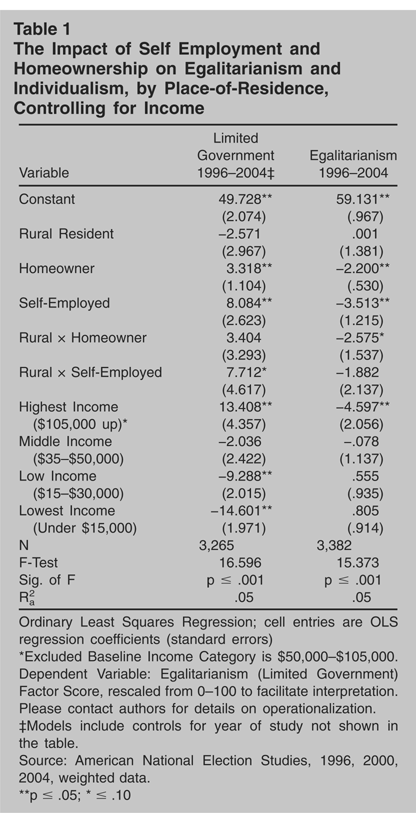
Table 1 illustrates the impact of homeownership and self-employment on the values of egalitarianism and limited government using standard instrumentation from three recent studies. We have controlled for place-of-residence to evaluate whether it has a separate impact on these core values independent of the general spatial distribution of self-employed persons and homeowners. Controlling for income ensures that homeownership and self-employment are not simply standing in as substitutes for affluence. The results show that homeownership is an especially strong and consistent predictor of individualistic attitudes favoring less government intrusion and greater resistance to egalitarianism. Self-employment generally has a positive impact on individualism and a negative impact on egalitarianism, but is not always statistically significant.
The Impact of Self Employment and Homeownership on Egalitarianism and Individualism, by Place-of-Residence, Controlling for Income

Generally, however, rural residence does not matter much independent of the geographic distribution of self-employment and homeownership (see Table 1). If rural areas do stand apart from other locations in their propensity to favor individualism and express skepticism about leveling policies, it is primarily because there are more homeowners and self-employed workers in rural areas than in more urbanized areas. Place-of-residencealone is not a highly significant explanatory factor in this instance. However, the interaction of rural place-of-residence and homeownership lowers commitment to equality, and the interaction of rural place-of-residence and self-employment increases individualism.
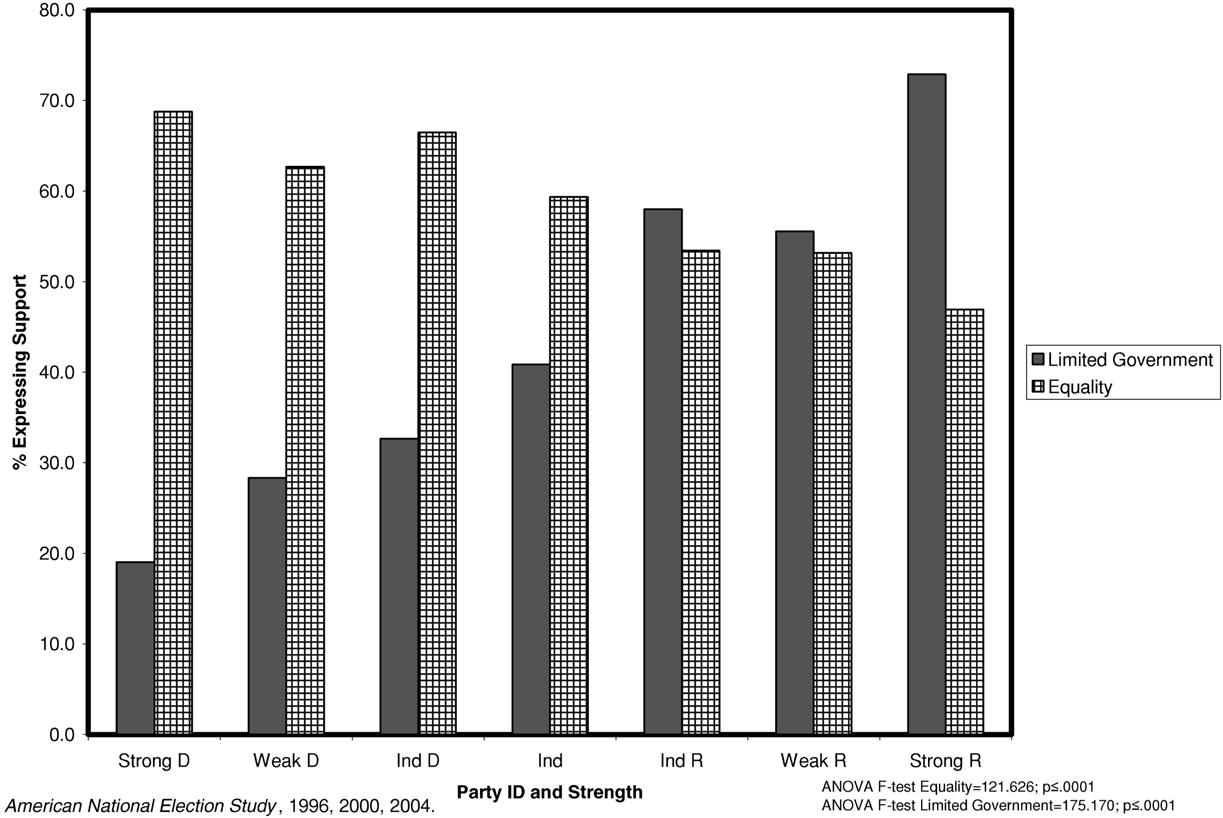
Furthermore, views about equality, individual rights and limited government are closely associated with—and perhaps determinative of—the direction and strength of political party identification (see Figure 2). Traditional moral views also play an important role in shaping party allegiance, but they are not the only source of Republican sympathy either in the rural electorate, or the electorate at large.

Beliefs about Limited Government and Equality, and the Direction and Strength of Party Identification
Weeding out the Failures: Labor Market Migration
Corporate America has extended its reach from farming into small-town banking, wholesale and retail trade, and, increasingly, service delivery. True, corporate interests, such as agricultural middlemen in meatpacking and food processing, are sometimes at odds with the interests of farmers and ranchers, but other rural Americans have come to depend on employment with these companies. Besides, government rarely has shown any willingness to regulate the consolidation and concentration of these industries, so there is little the small producer can do politically to effectuate change. They have learned that neither party will respond to complaints, so they struggle on or find work elsewhere.
The economic consequences of globalization have been mixed. Large corporations are often viewed as hostile to the interests of Main Street, as we see in the various battles Wal-Mart has faced when trying to locate stores in certain areas. But in almost every case, when a “big-box” store moves in, one person's loss is someone else's gain. Rural residents appreciate shopping in big-inventory stores with a wide range of inexpensive merchandise. Consistent with their self-image as independent entrepreneurs, small retailers often will close their struggling enterprise, leaving town to find employment elsewhere. Population mobility allows labor market supply and demand to remain in equilibrium in rural America. The next time a pollster calls rural residents, a large share of those who have failed economically in the preceding decade may no longer be there to answer the telephone, while those who remain report that the local economy has remained about the same. Political discontent in reaction to economic downturn is difficult to gauge because different people constitute the rural electorate in each successive election.
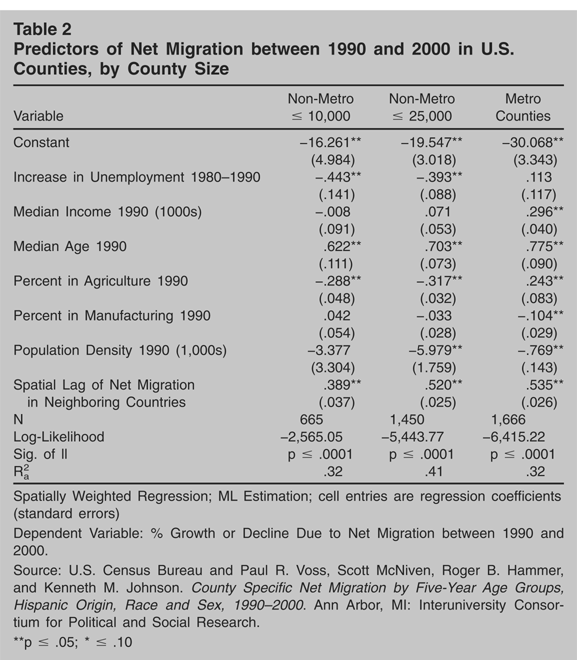
The challenging task for the student of rural economic grievance is to locate the displaced rural workers who would be more likely to express economic discontent. Economic decline in rural areas typically has been accompanied by steady population losses, whereas this has been less true of metro areas facing the same extent of decline. Table 2 shows that net migration (population gain minus population loss due to mobility) between 1990 and 2000 dropped in rural locations as a consequence of rising unemployment in the previous decade and the base level of agricultural employment in 1990. Notably, it is the change in unemployment that drives out-migration in rural areas, not the absolute level of unemployment (or income). Residents of many rural counties that have experienced sustained high unemployment rates over long periods have learned to live with a modicum of joblessness. Metropolitan locations, however, saw no corresponding drop in migration as a consequence of rising unemployment.
Predictors of Net Migration between 1990 and 2000 in U.S. Counties, by County Size

Because of the stigma associated with public assistance, rural Americans who struggle economically and have no family todraw upon for support usually leave. This migration can be prohibitively costly, but White rural out-migrants will not usually meet the kind of racial discrimination that traps African Americans in bad urban labor markets. As long as one has the means to pack up, travel, and afford a first- and last-month's rent payment at the destination, labor market migration can proceed with some efficiency. The massive 20th-century outflow of labor surpluses from the rural South to northern cities and from the Midwest and southern plains to the nation's west coast are clear examples of the human capital generalization that people move from areas of poor opportunity to places where jobs can be found. Rural locations consistently have lower unemployment rates than big cities, not because the rural economy is always better, but because of the way in which rural workers respond to hard times.
Conclusions
Nearly all contemporary surveys show that rural Americans are more religiously and morally conservative than those living elsewhere. They are more family-oriented and adhere to traditional values. But these are not the only reasons why they have been less inclined to vote for Democrats in contemporary presidential elections. In spite of prevailing low income, their individualistic ethic and legacy of self-employment and home-ownership inclines them to adopt the self-image of the independent entrepreneur and property owner rather than that of the laborer in need of state regulation and protection. Perhaps it is for this reason that allegiance to the New Deal was temporary and fleeting in most of the nation's rural areas (Gimpel and Schuknecht 2003).
Rural Republican voters are not daft. Serious inquiry into a subject must not begin by taking a prejudicial posture toward it—even if the promulgation of common stereotypes makes the storyline easy to believe. To the extent that we can say that the electoral color of rural America is Republican red rather than Democratic blue, we can cite a variety of concrete explanations for this trend, some anchored in moral views and religious beliefs and others anchored in economic considerations. The Republican emphasis on personal effort, limited government, and free markets fits comfortably within this self-image. There are always exceptions to these core commitments, but these are easily rationalized without abandoning basic principles.
Labor market out-migration has kept the supply and demand for labor in a respectable equilibrium, resulting in lower unemployment rates in small towns than in larger cities. Certainly there are rural counties with high unemployment rates (Appalachian poverty comes readily to mind), but the scale of the problem is small relative to urban unemployment. Legions of Appalachian families have packed up and moved to Atlanta, Charlotte, Cincinnati, and other growing cities, leaving their hometowns smaller but with less poverty and unemployment than would have been present otherwise. These moves usually result in substantial improvements in income for the displaced, although the rural poor sometimes become the urban poor. Those who remain in rural areas arguably suffer less than if the surplus labor would have remained in surplus. Rural industries regularly resort to importing immigrants to fill jobs in food processing industries that were once filled by the native-born.
Perhaps rural Americans report greater life satisfaction because steady out-migration in the face of globalization has made rural life sustainable at an acceptable, though far from luxurious, standard-of-living. Rural voters with economic grievances against government are fewer and further between than in cities and suburbs. Perhaps we now have the explanation for why Bartels' (2006) analysis shows that working class White voters position themselves closer to the Republican Party than to the Democrats on economic issues. The Democrats are not an attractive party for rural Americans, not only because of their positions on commonly understood issues of morality politics (gay rights, abortion, or prayer in schools) but also because many rural Americans doubt whether typical Democratic economic positions fit with what they believe is true about themselves and the world.
Biographies
James G. Gimpel is professor of government at the University of Maryland, College Park.
Kimberly A. Karnes is a Ph.D. student at the University of Maryland, College Park. She received her B.A. from Christopher Newport University.