Introduction
Aseel poultry are an important indigenous breed in India, which has been selectively bred by the local indigenous communities from the original Red Jungle Fowl (Gallus gallus) that live in the forests. This has resulted in the Konda Reddy, Koya Dora and Konda Kammaris strains of birds found in the Eastern Ghats in Andhra Pradesh. Gopalakrishnan et al. (1985), discussed how the Aseel has been recognized as the ancestor of many of today's modern domestic poultry breeds world-wide. Women are primarily responsible for the care and management of the bird under backyard poultry systems. It is also the only resource which is completely owned and controlled by women from the moment of selection of the bird to sales/purchase and control over the income earned from the birds (Anthra and Girijana Deepika, Reference ANTHRA and GIRIJANA DEEPIKA2000).
As reported by Ramdas and Ghotge (Reference RAMDAS and GHOTGE1998), there are approximately eight different strains or sub-strains of indigenous chickens that are recognized by the communities in the area such as Nati kodi, Shankar jati kodi, Geesa kodi, Medajari kodi, Rencha kodi or Agees kodi, Denki kodi, Mattedu kodi and Juttu kodi. Among these, it is the Aseel that has historically been the breed of choice, valued for its tasty meat, cockfighting abilities, agility and ability to escape predators that frequent the forest regions.
The Aseel has a short, broad breast, straight back and a close set strong tail root. The outstanding feature of this breed is the thick and long neck, long and slender face (without feathers), short beak, short, small comb, ear lobes and the absence of wattles. The legs are long, strong and straight and the bird has an upright and majestic gait. The plumage colouring is brilliant, as detailed by Girijana Deepika et al. (Reference GIRIJANA DEEPIKA, WOMEN'S GOTTI, ANTHRA and YAKSHI2002) and the Aseel cock comes in many colours: typically Dega (red plumage), Reza (golden and red spotted plumage), Massara (blue black), Poola Massara (spotted), Savala (white and black spots), Kaki (pure black), Petta maru (hen-like colouring), and Settuva (white). The preferred colours are Dega, Reza and Massara. The average weight of a 2-year-old full sized adult male ranges between 5-8 kg. The average weight of a hen is 3-4 kg.
The Aseel have been traditionally bred for meat quality. With 36-60 eggs laid per year, it is not a prolific layer. The hen matures and begins to lay eggs at between 5-6 months of age, and lays 3-4 clutches per year, with each clutch having 10-12 eggs. It is evident that women are primarily interested in producing live birds, and not eggs, as indicated by Ramdas and Ghotge (Reference RAMDAS and GHOTGE1998). In these studies it was found that 95% -100% of total annual eggs laid by a bird are kept for hatching. There is higher consumption of eggs during summer (May), as high ambient temperatures leads to higher deterioration of eggs. Of the live birds that hatch and survive, between 60-70% are sold, 15-20% are consumed at home and the remaining 10-15% are kept as breeding stock to increase the flock.
Empowering local cultural traditions
The strong, pivotal role that women and poultry play in the lives of indigenous communities and the positive image of women is captured and reflected through the following proverbs and metaphors:
‘Tholasuri aadapila puttale, tholakari korasene aina veyale, korakothaku kollu koyale’ which translates to ‘May your first child be a girl, may you sow Korra (a millet), as your first crop, and may you offer a poultry bird in thanksgiving to the gods when you harvest your Korra crop.’
‘Kodi thinnadi, Kodala thinnadi, lekka ki radhu, ekadiki podhu’ meaning ‘What the chicken eats, or what a daughter-in-law eats should never be measured or counted as they only multiply wealth in your home, which remains with you.’
In local cultural context this means that both will bring good luck and prosperity to the home, and one should never begrudge the expenses incurred on them.
Another saying is ‘Kolanu ammina dabbulu, kodaliki eruka’ which states that ‘Only the daughter-in- law knows the amount earned from the poultry in the house’, and this proverb which reveals the bonding and friendship between women and birds ‘Raitamma ki nidra lepyedi kodi’, where the proverb speaks of how the woman farmer is awoken each morning by poultry.
These proverbs are culturally and sociologically extremely significant, particularly in a global context, where gender-discrimination continues in a majority of societies, and there is an overwhelming preference for boys even before the girl-child is born.
Culturally, poultry are an essential pre-requisite to celebrate important festivals of indigenous communities. Worshipping ancestors and forest gods prior to sowing the new crop and at harvest of each crop (locally know as ‘kotha’), has to be accompanied by sacrifice of poultry. The bird is also traditionally used in the popular cockfighting sport that peaks in January, which is the month of the popular harvest festival ‘Shankranti’. The regular cost of poultry meat in the local market is USD 3.5Footnote 1. During Shankranti the cost of a live bird ranges from USD 37.5 to USD 75. When relatives visit each other, having chicken on the menu is a sign of respect and courtesy. Poultry birds also are an indispensable part of the ‘bride-price’, when marriages are negotiated.
High production losses and prevention strategies
In 1996, rural surveys conducted in villages revealed that, while the potential annual earnings from an adult hen was USD 100 after accounting for acceptable losses, in reality the farmer was earning less than half of this due to production losses resulting from egg spoilage/infertile eggs (63%) and chick mortality (37%) which was largely due to predators, fowl pox and salmonellosis. The average annual mortality amongst the village poultry population ranged between 70-80% and was primarily due to diseases such as Ranikhet (Newcastle disease) and Salmonellosis/ bacterial white diarrhoea. This translated into an average annual monetary loss of between USD 750 and USD 1250 in every village. In a livelihood scenario where every Adivasi family is steeped in debt that could run into thousands of Indian rupees, this loss was recognized as critical.
Girijana Deepika et al. (Reference GIRIJANA DEEPIKA, WOMEN'S GOTTI, ANTHRA and YAKSHI2002) and Ramdas (Reference RAMDAS2001) explained how preventing the loss was clearly one of the ways to prevent indebtedness amongst indigenous communities and of strengthening local livelihoods. Key prevention strategies included: improving the availability of village health care services by training village animal health workers; building women's capacities to effectively manage and feed their poultry; enabling women to access regular preventive vaccinations from the government services; encouragement of local systems of asset creation known as ‘Vaata’; and strengthening local marketing systems. It was hoped that improved feeding would be achieved by rebuilding local agricultural practices and crop diversity (millets, pulses and oil seeds), thus providing poultry with a more balanced and nutritious diet, based on the by-products of traditional crops. The community animal health workers, who were selected by their communities and trained, focused on extending poultry management and health information to women. They were also equipped to prevent and treat diseases using a combination of modern and indigenous technologies such as preventive vaccinations, worming and herbal medicines. A preliminary assessment of the strategy which was initiated in 1996, was carried out in 1998-99, (Ramdas, Reference RAMDAS2001), and was found to have had an extremely positive impact at household level through enhanced consumption of chicken and increased income to the family. At a community level there appeared to be higher availability of Aseel poultry and an upward trend in the Aseel poultry population.
An attempt was made to evaluate the impact of these interventions over the years between 1998 and 2008, to understand the long-term impact of the strategy on people's livelihoods, food security, the Aseel poultry population, as also its cultural significance.
Evaluating intervention impact
The original work with the Aseel poultry in East Godavari district was collectively undertaken by several individuals from four organisationsFootnote 2. By January 2008, the Women's ‘Gottis’ had organised themselves into a collective known as the Tholakari Adivasi Mahila Vedika, with a membership of 1800 women spread across 80 villages. In 2002 the organisation ‘Anthra’, which had provided veterinary, animal husbandry and ethno-veterinary technical support in the early years, ceased to be directly involved in the day to day implementation strategy. An impact study was carried out in collaboration with Tholakari, in sample villages where members of the collective are active.
Participatory Rural Appraisal (PRA) and other socio-cultural survey methods such as semi-structured interviews, focus group discussions, sample case studies and key informants, were used. These were carried out with women from 68 villages, which formed the membership base of Tholakari as of November 2007. In addition, in-depth village case studies of three villages, which attempted to capture both quantitative and qualitative changes at the level of household and community, were carried out. The selected villages included two villages which had been part of the original action-research program in 1998, and the third was a village where women had recently organised themselves into a group and had begun to adopt and implement similar strategies. The household survey was carried out in January 2008. The primary objective was to understand the changes in relation to the three key areas of intervention, namely: changes in cropping practice and a shift from mono crops to mixed cropping which would generate crop by-products for poultry feed; adoption of preventive and first aid practices based on indigenous and modern practices; and the spread or reach of the traditional asset- building ‘Vaata’ system, and assess its impact on the local poultry genetic resources. Finally we were interested to understand its overall impact on food sovereignty and people's livelihoods, as perceived by women. Hence a combination of qualitative and quantitative methods was used.
Surveying effectiveness of the intervention strategies
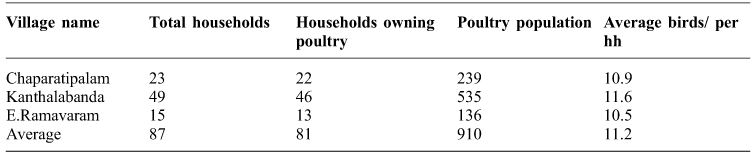
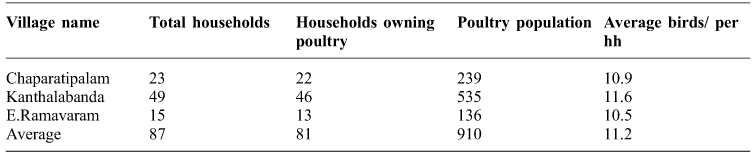
Women reported that the Aseel poultry populations in the households and villages had remained constant and, in some instance, increased. Village level studies were consistent with these observations, where in a total number of 87 households, 93% owned Aseel backyard poultry (Table 1). There appears to be a slight increase in the average per-capita poultry holding which was found to be 11.2 birds in 2008 as compared to 1998 where, according to Girijana Deepika et al. (Reference GIRIJANA DEEPIKA, WOMEN'S GOTTI, ANTHRA and YAKSHI2002), it ranged from 5 to10 birds per household.
Aseel poultry population in January 2008.
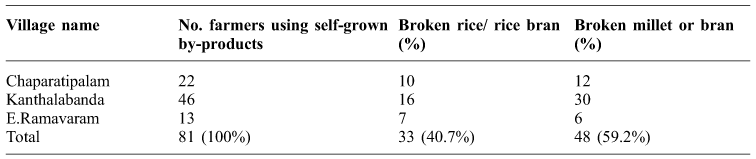
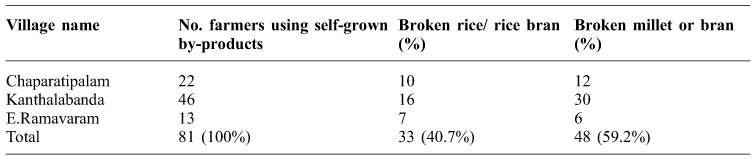
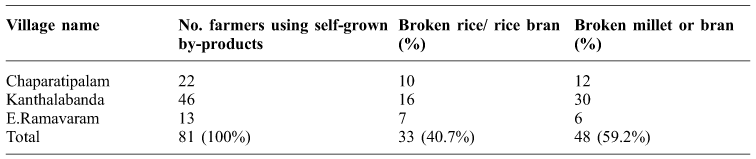
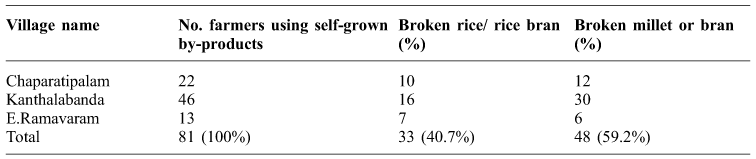
On a larger scale, the most recent agriculture survey was carried out by Tholakari, in April 2007 in 68 villages, to estimate the crops cultivated in the season June 2006 to March 2007. They revealed that 1032 farmers had cultivated food crops utilising 3096 acres, which comprised 60% of the total available cultivable land. Over 20 different food crops, including cereals (finger millet, Italian millet little millet, pearl millet, sorghum, fox-tail millet, kodo millet, corn, dryland rice), pulses (green gram, red gram, black gram, horse gram, Bengal gram), oilseeds (sesame, niger) and legumes were cultivated. In 1998 the average coverage of food crops was less than 25% (Muralidharan and Raghuram, Reference MURALIDHARAN and RAGHURAM2003). This indicated that not only the area of land under food crops but also the spread across villages had increased. These food crops provide the primary nutrition base for backyard poultry. The birds are fed broken or waste grains and the bran of pearl millet plus other cereals mixed with the wastage after processing pulses and oil seeds. As long as these are available from the produce of the household, feed costs are negligible. Women reported that, whereas earlier they had needed to purchase feed from the market for 8-10 months in the year, now they were able to feed their birds from their own produce for almost 11 months in the year. In certain years where they had experienced crop losses (for example in 2005 (Anthra, Reference ANTHRA2005), many farmers lost their entire crop due to severe floods), women were forced to purchase feed from the market. Women reported that cultivating food crops had helped them reduce the costs of feed for the poultry, as these were available from their own farms. Of the farmers who owned poultry, all without exception fed their birds with by-products obtained from the crops they cultivated. The main feedstuffs included broken rice, rice bran, bran of other millets, pearl millet by-products and finger millet. It is interesting to note that nearly 60% of the women fed a combination of different by-products of millets, which is the dominant dryland crop cultivated in the region, and the remaining 40% fed rice by-products (Table 2).
Aseel poultry feed source and type.
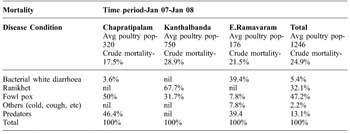
In January 2007, women were able to mobilise Newcastle (NCD) preventive vaccinations from the government's Animal Husbandry Department, and 12,000 birds across 45 villages were vaccinated. Women reported that they had been consistently having their birds immunized against NCD for the past 7 years, through mobilising vaccinations from the government, which was available free of cost. The actual vaccinations were administered by women and men from the villages, who had earlier been trained as animal health workers by Anthra, to vaccinate birds. The greatest challenge was obtaining sufficient quantities of vaccines at the correct time, prior to the usual season of outbreak. Preventive vaccinations against fowl pox were even more difficult to obtain. Focussed group discussions with women revealed that while there had not been a major NCD outbreak in any of the villages, over the past 6 years, although in 2008 they had receive reports of NCD outbreaks from some villages. They attributed this to the fact that the government had no NCD vaccinations available in the month of December 2007 when the women had approached them for vaccines. Birds had been vaccinated in January 2007, and by January 2008, when NCD outbreaks were reported from some villages, it was well beyond the immunity period provided by the previous year's vaccinations. Village-level studies confirmed this observation. In one of the villages which reported an overall mortality rate of 29%, (Table 3), 68% mortality was attributed to NCD which had occurred in January. There were no reports from the other two villages.
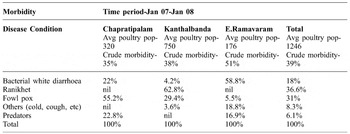
Village mortality and morbidity studies, revealed an average crude morbidity rate of 39% and mortality rate of 25%.This however masks the variation between villages (see Tables 3 and 4). Once again it was evident that NCD and fowl pox continue to be the major causes of both morbidity (36%-NCD; 31%-FP) and mortality (47%-NCD; 32% FP).
Morbidity and Proportionate Morbidity rates of disease conditions.

Mortality and Proportionate Mortality rates of disease conditions.

While this continues to be lower than in the original base-line study of 1996, which reported an overall crude mortality rate of 70%, it is significantly higher than the crude mortality rate of 6% reported in the year 1999, three years after interventions began (Table 5).
Comparative Crude Mortality Rates in Poultry Population 1996 and 1999.
Women commented that the relatively high proportion of bird losses due to predators was mostly observed in the age-group 0-4 months. They stated that, due to the increase in the poultry population, one of the problems they faced was protecting young chickens from predators such as dogs, wild cats and snakes, which were extremely common in these forested areas. It was particularly difficult to protect the birds during the time when women went to work in their fields during the day.
Women reported that many of them were preparing and using traditional herbal remedies, which they had learnt through training and extension programs carried out in the village by ‘Tholakari’ animal health workers. The most widely adopted practices included:
i) Feeding birds with garlic (Allium sativum) pods in winter months and Allium cepa during the summer
ii) Adding turmeric (Curcuma longa) or potassium permanganate to the drinking water every day
iii) Feeding birds every week with alternating herbal medicines such as leaves of Andrographis paniculata, leaves of Pergularia daemia, Curry leaves or Momordica charantia leaves.
iv) Treating bacterial white diarrhoea with powdered bark of Ailanthus excelsa
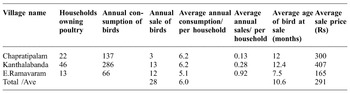
Despite the continued losses due to NCD and Fowl pox, what the study determined was that women can ensure that many more birds are consumed at home from their own production than are sold (Table 6).
Pattern of consumption and sales of backyard poultry 2007-08.

Another significant change that emerged through the village level studies was that women were now selling their birds at an older age. The average age of bird at sales was 10.1 months compared to 3-4 months as reported by Girijana Deepika et al. (Reference GIRIJANA DEEPIKA, WOMEN'S GOTTI, ANTHRA and YAKSHI2002). Women stated that a major reason for being able to sell birds at a later age, which hence fetched a higher price (Table 6) was due to the increased availability of feed at the household level.
Experience of asset building
To understand the experience of ‘Vaata’, the traditional system of rebuilding poultry flocks, a detailed case study of one of the original 20 villages, where the system had been initiated in 1999, was made. ‘Vaata’ is based on a system where the recipient of a hen is obliged to return half of its offspring to the original donor, for the full life-span of the donated hen. The women's ‘Gotti’ (group) Tholakari, modified this so that the recipient was required to return half the offspring only once after receiving the bird. In 1999, 10 women from the village Noogamamidi, who did not own poultry, were each given two Aseel hens, and two Aseel cocks were given to the entire group. In 2000, they collectively returned 25 chicks aged five months to the village women's Gotti. These birds, were re-distributed to other women in Noogamamidi village, who did not possess poultry. In 2001, beneficiaries returned 55 chicks to the village group. As there were no further takers in the village that year, the women's group decided to sell the birds, for which they received USD 75. This amount was deposited in the women's Gotti village bank account. Women members are able to borrow money from the account in times of emergencies. In 2002 the women's group received 15 birds from beneficiaries, and these were passed to 15 new members who required birds in the same village. In 2003, women returned eight hens which were passed on to eight women in a new village, Chaparathipalem. In 2004 the women from Chapratipalam returned three birds, and these were distributed to three new women in the same village. In 2005, ten new recipients, five from village E.Ramavaram and five from village Ravulapadu, received birds from Chaparathipalem. In 2006, three women, one from village Endapally and two from village Peddaddapally received four hens from village E.Ramvaram. It is interesting to note that over the past eight years, the offspring of the original germplasm spread to 63 women, in six villages.
Conclusions
These studies have revealed that, even after ten years, the basic strategy to strengthen the backyard poultry livelihoods of indigenous women in East Godavari district in Andhra Pradesh has proven successful, and has been sustained by local women, even after the withdrawal of outside organisations. The strategy has been shown to have had an extremely positive impact on stabilising the Aseel poultry population in the area, regenerating the bio-diversity of the region and enhancing household food sovereignty and income. The latter is clearly visible by the increased consumption of birds at home as the ability of women to market their birds at a later age, which increases income. Critical to all this has been the huge success of women in rebuilding their diverse food-farming production system, which provides nutrition for the family as well as by-products of food crops as a key source of feed for birds, thereby ensuring there is essentially no competition between food grain for humans and the backyard poultry. Herbal remedies that have been shown to be effective in building immunity and treating certain conditions are now widely used and adopted by women who in turn share this knowledge with others both within and between villages. The overall experience of the Vaata system has varied. While it continues to work in about ten of the original villages, it has ceased functioning through women's group in others. The reason for this is primarily related to the interest and leadership taken by the women's group in ensuring that the system worked.
Finally, the most crucial challenge to the indigenous women's groups continues to be accessing timely vaccinations to immunise their birds against endemic diseases such as Newcastle disease and Fowl pox, the two diseases that continue to kill birds in the absence of annual vaccinations. The main problem associated with this is insufficient production and availability with the local government veterinary department, who are responsible for providing public and preventive health services to the local communities. Additionally there is the challenge of maintaining the vaccination under refrigerated conditions. Another grave concern of indigenous women in recent years, has been the potentially disastrous consequences of a ‘bird-flu’ epidemic, were it to occur. There is a fear that the administration would unfairly target backyard poultry and destroy the very birds that are the soul of this culture and people, and which women have so lovingly nurtured and re-established as a resource for the benefit of future generations.