Research on the effectiveness of treatments for personality disorders (PD) leads to the consensual conclusion that different treatment packages produce similar results (e.g., Bateman & Fonagy, Reference Bateman and Fonagy2008; Davidson, Tyrer, Norrie, Palmer, & Tyrer, Reference Davidson, Tyrer, Norrie, Palmer and Tyrer2010; Gunderson et al., Reference Gunderson, Stout, McGlashan, Shea, Morey, Grilo and Skodol2011; McMain, Guimond, Streiner, Cardish, & Links, Reference McMain, Guimond, Streiner, Cardish and Links2012; Zanarini, Frankenburg, Reich, & Fitzmaurice, Reference Zanarini, Frankenburg, Reich and Fitzmaurice2012).
Treatments which have been proven to be effective have also been shown to be persistently inefficient on a significant proportion of individuals, leading to the proliferation of studies on the results of such treatments, but also on the processes involved (Clarkin & Levy, Reference Clarkin and Levy2006) in order to determine the variables involved in the different assimilation and benefit of the therapeutic offer, either related to the intervention’s technique, or to the therapist, the patient and their interaction (Rodríguez-Morejón, Reference Rodríguez-Morejón2016). The emotional state of the individual is a crucial factor in the process of therapeutic change, both due to its motivational consequences and its modulation of cognitive processes and interpersonal communication (Greenberg, Reference Greenberg2002).
Until recently, research has focused on discovering the nature, antecedents and consequences of the emotional “state” (Kuppens, Oravecz, & Tuerlinckx, Reference Kuppens, Oravecz and Tuerlinckx2010). But affect is essentially dynamic: the fluctuations and changes in emotional experience reflect in the individuals the transformations exhibited by everyday life. Hence, Kuppens et al. (Reference Kuppens, Oravecz and Tuerlinckx2010) proposed a theoretical model called DynAffect to account for the basic components underlying the emotional fluctuations people experience differently over time. According to the DynAffect model, affective valence and emotional arousal are combined in the concept of core-affect, an “integral state that is consciously accessible as a simple, non-reflective feeling” (Kuppens et al., Reference Kuppens, Oravecz and Tuerlinckx2010, p. 1043). At any given moment, a person can identify whether he/she is feeling pleasantly or unpleasantly (valence), and whether he/she is more or less activated (arousal). This two-dimensionally characterized core-affect varies from moment to moment, describing a particular trajectory over time, and becomes the system’s attractor: the point of emotional equilibrium toward which the self-regulating processes fluctuate back to each time the trajectory moves away from it. The model advocates that individual differences in these three processes (core-affect, trajectory variability and attractor strength) can adequately explain the fluctuations in people’s emotional dynamism. In order to prevent the system from falling into extreme values that could endanger its normal functioning, various emotion-regulation processes are activated, which prevent harmful emotional inertia (Bornas, Noguera, Pincus, & Buela, Reference Bornas, Noguera, Pincus and Buela2014).
This dynamic model of affection provides an integrative framework for both the understanding of individual differences in the normal changing emotional experience and the identification of processes involved in the abnormal or pathological emotional experience (Trull, Lane, Koval, & Ebner-Priemer, Reference Trull, Lane, Koval and Ebner-Priemer2015). The model shows that the valence of the core-affect is positively related to indicators of psychological well-being, the variability of the core-affect is negatively related to such indicators, and that the emotional regulation strategies are associated to attractor strength (Kuppens et al., Reference Kuppens, Oravecz and Tuerlinckx2010).
Ebner-Priemer et al. (Reference Ebner-Priemer, Houben, Santangelo, Kleindienst, Tuerlinckx, Oravecz and Kuppens2015) applied this theoretical framework to people diagnosed with borderline personality disorder (BPD), and observed a correspondence between the processes of the dynamic theory of affect and the elements identified by Linehan’s biosocial theory (1993): a high sensitivity to negative emotional stimuli carries a more negative level of core-affect; the intense response to emotional stimuli produces a great fluctuation around the core-affect; and the slow return to the emotional baseline corresponds to a limited attractor strength of the core-affect. These authors found in people with BPD a more negative emotional valence than in those in the healthy control group (their emotional experience was attracted more strongly towards negative valence states), a greater emotional fluctuation, and a tendency towards a slower return to baseline when emotion drifted towards extremes of negative valence, but not when it drifted towards more positive emotions. Santangelo et al. (Reference Santangelo, Limberger, Stiglmayr, Houben, Coosemans, Verleysen and Ebner-Priemer2016) obtained similar results when comparing patients with BPD versus healthy subjects’ results, but not when comparing with other clinical groups such as posttraumatic stress disorder, bulimia nervosa, panic disorder and major depression. Wright and Simms (Reference Wright and Simms2016) studied the fluctuation of the PD symptomatology through a daily record over 100 consecutive days, finding that the individual’s manifestation of the pathology varied according to the day and differed greatly in its frequency.
This line of research, which tries to evaluatively and analytically capture the temporal factor (for which it uses methodologies that allow a moment-to-moment emotional record and account for the affect dynamics of daily life), is obtaining relevant findings in the field of psychopathology (Trull et al., Reference Trull, Lane, Koval and Ebner-Priemer2015). Following this perspective, some of the hypotheses derived from the dynamic model of affect have been contrasted in a group of patients diagnosed with severe PD, with the general objective of verifying whether the individual’s emotional processes contribute to the explanation of the differences found in the results of a therapeutic intervention, that is, to explain the diverse individual responsivity to a common therapeutic program. Specifically, the following hypotheses have been considered: (1) affective valence and arousal are independent and relate to psychopathology and therapeutic change; (2) the core-affect construct explains the results of treatment better than valence and arousal separately; (3) emotional variability is negatively related to therapeutic improvement; and (4) the change in core-affect and emotional variability experienced by participants between the first and the sixth month of intervention is related to therapeutic change.
Method
Participants
The group of patients with a diagnosis of PD who were referred to the Specialized Unit of Personality Disorders (UTP) of the Dr. R. Lafora Hospital (Madrid) between 2008 and 2015 took part in this study, after a process of diagnostic and motivational screening carried out by the professional who derived them from a Mental Health Center (CSM) of the Community of Madrid, by a committee of experts from the Regional Office of Mental Health Care Coordination (ORCSM) and finally, by the professionals from the UTP itself. The patient’s profile is characterized by a previous history of severe autolytic attempts, polymedication, frequent use of mental health care services (emergencies, short hospital admissions, outpatient visits), altered family relationships, work inactivity, dependence on subsidies and social aids and a sustained blockage in their outpatient therapeutic progress, which corresponds to the concept of severe mental disorder (Slade, Powell, Rosen, & Strathdee, Reference Slade, Powell, Rosen and Strathdee2000).
All of the participants voluntarily took part, following the signing of a therapeutic contract, within a 6-month intervention program inspired in a therapeutic community model (Haigh & den Hartog, Reference Haigh, den Hartog, Sarkar and Adshead2012). This combined a hospital environment with an intensive interdisciplinary treatment in which the patients assumed the responsibility of their own therapeutic process, where interpersonal experience acquired a central role and the patient went through a process of reconceptualization of their problems, validation of their limitations and empowerment in order to approach in the most effective way the challenges to which the patient was submitted in their specific socio-familial environment. The patient also agreed to undergo a psychometric evaluation as part of the program, fulfilling a battery of self-report questionnaires from which the instruments used in the present study were selected. The non-adherent participants (those who voluntary left the study prior to its scheduled completion) and those who did not completely and adequately fulfill all the instruments used were excluded from the analyses. Therefore, of the 234 patients who were admitted into the unit, the sample of the present study was N = 103.
Instruments and variables
The different variables related to the dynamic model of affect, as well as other sociodemographic (age and sex) and psychopathological variables were studied, based on the self-report instruments described below:
Positive and Negative Affect Schedule, (PANAS; Watson, Clark, & Tellegen, Reference Watson, Clark and Tellegen1988; Spanish version by Joiner Jr, Sandín, Chorot, Lostao, & Marquina, Reference Joiner, Sandín, Chorot, Lostao and Marquina1997)
The subject is asked to assess the magnitude with which he/she has experienced each of the 20 adjectives (10 positive and 10 negative) presented in a specified time (that day, the previous week, etc.) in reference to a 5-point scale (not at all, a little, moderately, quite a lot, very much), with scores ranging between 10 and 50 for each of the two scales. Their reliability is adequate, with Cronbach’s α of 0.89 for the positive affect scale (PA) and 0.85 for the negative affect (NA) scale, as well as their construct validity and factor structure (see Crawford & Henry, Reference Crawford and Henry2004; López-Gómez, Hervás, & Vázquez, Reference López-Gómez, Hervás and Vázquez2016). The variables related to the structure and dynamics of affect were constructed and analyzed as follows:
-
a) Affective valence: it is the mean daily difference between each individual’s score in the positive affect scale and the score in the negative affect scale (PA-NA) during the 6 months of the study. It ranges between –40 to +40, with scores greater than 0 indicating a predominantly positive emotional balance. For some of the analyses, the initial emotional valence (average for the first month) was compared to the final emotional valence (average of the sixth month) [(PA-NA)6 – (PA-NA)1].
-
b) Emotional arousal: is the average of the sum of the absolute values in the two scales [(PA + NA) / 2] throughout the entire study. It ranges between 10 and 50, and the score is indicative of the intensity of emotional activation of the individual.
-
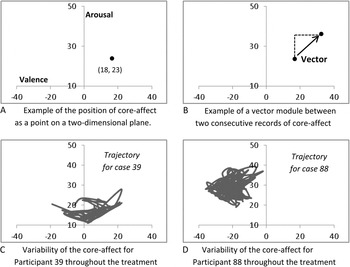
c) Core-affect: it is the daily combination of affective valence and arousal (V, A) averaged throughout the study. It is a matrix variable and can be visualized as a point in a two-dimensional space (see figure 1a).
-
d) Emotional variability: is the average distance that core-affect moves within the daily records, that is, its movement or the fluctuation of its trajectory over time. As it is represented as a distance on a plane, it is calculated as the sum of the vector modules divided by the number of modules; each module (see Figure 1b) is calculated using the formula Σ √[(V1-V2)2 + (A1-A2)2], where (V1, A1) is the core-affect of a record at Time 1 and (V2, A2) is the consecutive core-affect at Time 2. The distance between the core-affect points is an indicator of the magnitude of affective fluctuation (see Figure 1c and 1d).
Core-affect representation on a two-dimensional plane.

“Millon Clinical Multiaxial Inventory_II” (MCMI-II; Millon, Reference Millon1999, Spanish version)
The internal consistency is satisfactory, with KR coefficients between 0.81 and 0.95. The Severity of PD (SPD) variable is defined as the sum of the scores of those scales that exceed the base rate of 75.
“Symptom Checklist 90 Revised” (SCL90-R; Derogatis, Reference Derogatis1992; Spanish version by González de Rivera, Reference González de Rivera2002)
Its reliability is acceptable, with high internal consistency coefficients (α > 0.81) and test-retest values higher than 0.78. For this study, the Global Severity Index (GSI) was used, which is a generalized and indiscriminate measure of the intensity of symptomatic distress (general disturbance).
“Beck Depression Inventory” (BDI; Beck, Rush, Shaw, & Emery, Reference Beck, Rush, Shaw and Emery1979; Spanish version by Sanz & Vázquez, Reference Sanz and Vázquez1998)
It rates the intensity of depressive symptomatology (affective disturbance). Its reliability coefficient, with the two halves method, is of 0.93. In the present sample, a Cronbach’s alpha of 0.94 was obtained.
“Three-dimensional Questionnaire for Depression” (CTD, Jiménez-García & Miguel-Tobal, Reference Jiménez-García and Miguel-Tobal2003)
Using 34 items, it evaluates the three response systems (cognitive-subjective, physiological-somatic and motor-observable) in which depression occurs. It also includes a scale that assesses the potential risk of suicide (suicidal tendency, ST, which will be used in this work), and a total score. It has a high reliability, with test-retest correlations after 6 weeks ranging between 0.63 and 0.85 and good internal consistency (α = 0.88 and 0.96). Moreover, it shows adequate convergent validity, high capacity to distinguish between clinical and control populations and a solid factorial structure. In our sample, the TS scale obtained a Crombach’s alpha of 0.88.
“The Barratt Impulsiveness Scale” (BIS– 11; Oquendo et al., Reference Oquendo, Baca-Garcia, Graver, Morales, Montalban and Mann2001; Stanford et al., Reference Stanford, Mathias, Dougherty, Lake, Anderson and Patton2009)
It has an internal consistency (α) between 0.7 and 0.9.
“Social Skills Scale” (EHS; Gismero, Reference Gismero2000)
It evaluates assertiveness and social skills through 33 sentences. It has 6 scales, plus an overall score, which is the one used in this work. It has a Crombach’s alpha reliability of 0.88.
“Rosenberg Self-Esteem Scale” (RSS; Rosenberg, Reference Rosenberg1989; Spanish version by Martín-Albo, Núñez, Navarro, & Grijalvo, Reference Martín-Albo, Núñez, Navarro and Grijalvo2007)
It shows adequate levels of reliability and validity (Baños & Guillén, Reference Baños and Guillén2000; Martín-Albo et al., Reference Martín-Albo, Núñez, Navarro and Grijalvo2007; Vázquez, Jiménez, & Vázquez, Reference Vázquez, Jiménez and Vázquez2004). In the present sample, the Crombach’s alpha obtained was 0.77.
The centile score was used, as it is more easily interpreted, in the global severity index (GSI) of the SCL90-R as a variable indicative of the general symptomatic disturbance, in the suicide tendency scale (ST) of the CTD and in the total scale of social skills (EHS). On the other hand, the direct scores in the BDI, the BIS-11 and the RSS were maintained as indicators of depression, impulsivity and self-esteem, respectively.
Procedure and statistical analyses
Participants were asked to complete the PANAS scales at the same time (before dinner), day by day during the 6 months of admission, in order to get into the habit of reflecting on how they have felt that day using a range of emotional nuances. The rest of the instruments were questionnaires that were administered during the first weekend (“pre” measurement) and during the last fortnight before the programmed discharge (“post” measurement), yielding the dependent variables.
Appropriate descriptive statistical techniques were used to analyze the continuous variables, and categorical techniques were used to characterize the sample. The Student’s t-test was used to check differences between scores in all of the instruments at the beginning and at the end of the program. Multiple linear regression analyses were performed on the clinical change (pre-post mean difference in the indicated dependent variables), taking as predictors, first, the three emotional components (valence, arousal and variability) and afterwards, their change (means for the first month minus the means of the last month), to verify the relative influence of these components of affect and their change during the intervention on the change of the other variables. The analysis of the data was performed using the IBM SPSS Statistics v.21 statistical package.
Results
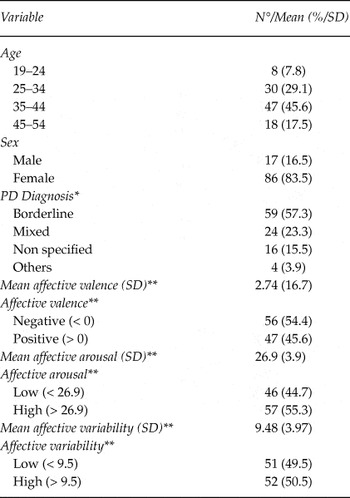
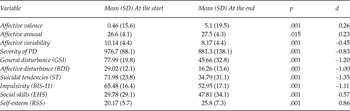
Table 1 shows the main characteristics of the sample in relation to the studied variables. The mean age was 36.9 years (SD = 8.0) and the proportion of females was 5.1 higher than that of males. No differences were found between them either for affective valence (t (101) = –0.848; p = .398), arousal (t (101) = –1.552; p = .124), or variability (t (101) = 0.914; p = .363). Gender differences did not reach statistical significance for the rest of the variables examined, except for the severity of PD (SPD), in which men scored higher than women (t (88) = –2.024; p = .046). Table 2 shows the results of the psychometric tests performed at the beginning and at the end of the intervention, with the differences between the two moments.
Sociodemographic characteristics of the sample, diagnosis of remission and descriptive data of core-affect (affective valence and arousal) and affective variability (N = 103)

Notes: *Main diagnosis performed by the psychiatrist responsible for each patient when referred to our Unit. **Variables obtained from the Positive and Negative Affect Schedule, PANAS.
Main results of the psychometric tests performed at the beginning and at the end of the intervention. The significance of the differences (p) between the two moments is indicated, as well as the magnitude of the effect (d)

Notes: GSI = Global Severity Index of the 90 Symptom Cheklist; BDI = Beck depression inventory; ST = Suicidal tendency index from the Tridimensional questionnaire for Depression; BIS-11 = Barratt impulsiveness scale; EHS = Social skills scale; RSS = Rosenberg Self-Esteem Scale.
The two components of core-affect (valence and arousal) recorded during the first month do not correlate with each other, nor with age. Affective valence correlated positively with self-esteem (r = .491; p < .01) and social skills (r = .375; p < .01), and negatively with Global disturbance (r = –.395; p < .01), depression (r = –.631; p < .01) and suicidal tendency (r = –.490; p < .01). Emotional arousal, on the other hand, correlated positively with impulsivity (r = .345; p < .01) and with affective variability (r = .252; p < .05). The latter does not show significant correlations with any of the clinical variables.
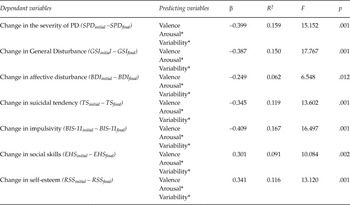
Multiple linear regression analyses were performed to verify the relative influence of valence, arousal and overall variability on change in the clinical variables (“pre” measurement – “post” measurement). The results show (see Table 3) that only affective valence contributes to the explanation of a percentage of the variance of the change observed at the end of the intervention within the dependent variables (between 6% and 16%).
Multiple linear regression analysis, using the stepwise method, of the three global affective components (valence, arousal and variability) on each of the dependent variables

Notes: *Non-predicting variables (excluded). SPD = Severity of PD; GSI = Global Severity Index of the Symptom Checklist 90; BDI = Beck Depression Inventory; ST = Suicidal tendency index from the Tridimensional Questionnaire for Depression; BIS-11 = Barratt Impulsiveness Scale; EHS = Social skills scale; RSS = Rosenberg Self-Esteem Scale.
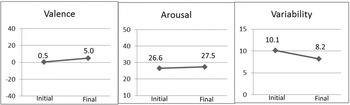
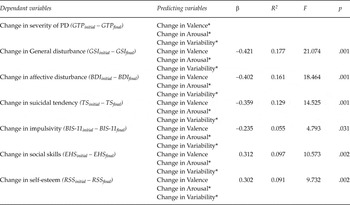
During the 6 months of intervention, a change in the patients’ affective valence, arousal and variability was observed, as can be observed when comparing the means of the first month’s records with those of the last month (Figure 2). Valence became more positive (M final – M initial = 4.58; IC 95%: 1.9 – 7.2; t = 3.443; p = .001; d = 0.26), arousal increased (M final – M initial = 0.95; IC 95%: 0.2 – 1.7; t = 2.473; p = .015; d = 0.22) and variability decreased (M final – M initial = –1.97; IC 95%: (–2.9) – (–1.1); t = –4.416; p = .001; d = –0.43). But only the change in affective valence is related to the change in clinical variables (Table 4).
Initial mean (records during the first month of intervention) and final mean (records of the sixth month) for the three affective variables.

Multiple linear regression analysis, using the stepwise method, on the change of the three affective components (mean of the records of the 6th month minus the average of the 1st month) on each of the dependent variables

Notes: *Non-predicting variables (excluded). SPD = Severity of PD; GSI = Global Severity index from the Symptom Checklist -90; BDI = Beck Depression Inventory; ST = Suicidal tendency index from the Tridimensional Questionnaire for Depression; BIS-11 = Barrat Impulsiveness Scale; EHS = Social skills scale; RSS = Rosenberg Self-Esteem Scale.
Discussion
Based on the dynamic (versus static) consideration of affect and the individual differences in emotional experience, we attempted to relate such differences to the clinical change experienced by a group of patients with severe PD after participating in an intervention program, by examining the role of affect as one of the factors involved in the therapeutic improvement or assimilation.
Our results confirm that valence and arousal appear as two independent dimensions of emotional experience, both in global measures and in their change between the initial and final mean score, supporting the orthogonal structure of affect. Its integration into the concept of core-affect, plus the introduction of time as a third dimension, can illustrate the complexity of this experience that is essentially changing and describes a traceable trajectory.
Of the two components of core-affect, valence appears to be related to general symptomatology, depression and suicidality, confirming one of the deductions of Kuppens et al.’s (Reference Kuppens, Oravecz and Tuerlinckx2010) model. This finding supports research that finds in a negative affect (Watson et al., Reference Watson, Clark and Tellegen1988) a transdiagnostic mechanism present in a wide range of pathologies, related to the construct of neuroticism (Rusting & Larsen, Reference Rusting and Larsen1997) or affective instability (Eid & Diener, Reference Eid and Diener1999; Kuppens, Van Mechelen, Nezlek, Dossche, & Timmermans, Reference Kuppens, Van Mechelen, Nezlek, Dossche and Timmermans2007), and identified as general vulnerability for the development of diagnostically diversified disorders (Santangelo et al., Reference Santangelo, Limberger, Stiglmayr, Houben, Coosemans, Verleysen and Ebner-Priemer2016). The second component, arousal, appears to be related to impulsivity, something that is not surprising as this trait is understood as a tendency towards action. The intensity with which a person lives his/her emotion has motivating effects to execute action tendencies activated in a specific context. If affect has a negative valence, the intensity hinders the inhibitory control of avoidant or compensatory actions, such as intake of alcohol or toxic substances, the purchase of superfluous items, binge eating, self-harm or suicide attempts, typical impulsive behaviors in the PDs that maintain and complicate the individual’s problems and obstruct his/her therapeutic resolution.
Throughout the course of the intervention, moderate changes in the dynamics of affect and robust changes in the clinical variables were observed. With respect to the affect changes, when comparing the core-affect registered during the first month with that registered during the last month, it is observed that patients referred having a more positive emotional color and a more intense emotional tone, as well as less variability (it is assumed that the fact that the trajectory covered in the first month was greater denotes a greater initial change in core-affect, when this was at the most disturbing levels and the impact of therapeutic novelty could also have been higher). Regarding the clinical changes, when comparing the scores at the beginning and at the end of treatment, it is observed that the total group of patients in the sample was able to reduce the general symptomatology, depression, suicidal ideation, impulsivity and severity of PD. In addition, self-esteem and social skills were increased.
The favorable change experienced by participants in all these variables is associated to the change in affective valence, but not to the change in arousal. This finding contradicts expectations and leads to the rejection of the second hypothesis: the core-affect construct does not explain the results of the intervention better than valence and arousal alone. Valence alone explains between 6% and 17% of the clinical changes recorded. If the evaluative component (valence) is the one that makes the difference, it is necessary to study the role played by the intensive component (arousal), which appeared to be related to impulsivity, but not to the change in impulsivity. Two morbid levels can be assumed for the extremes of the medium level of this dimension: a minimal emotional activation would hinder change due to lack of involvement and a maximum activation would impair change due to the lack of containment and the overload of cognitive resources (Ditzfeld & Showers, Reference Ditzfeld and Showers2014). Their change within the medium level would therefore not have to have marked effects on the clinical change. Other authors have pointed out the complex role of emotional arousal in psychopathology (Kuppens, Champagne, & Tuerlinckx, Reference Kuppens, Champagne and Tuerlinckx2012): on the one hand, a high arousal is associated with emotions that promote approximation (such as excitement or rage) which can connect with personal agency and hope; however, on the other hand, they can also be associated with emotions such as fear and anxiety, and in these cases, self-reports of disadvantage and despair appear. If affective valence gives information about the desirability of what is affecting us, emotional arousal informs about its urgency and importance (Storbeck & Clore, Reference Storbeck and Clore2008).
Moreover, the third hypothesis must also be rejected as the expected negative association between affective variability and therapeutic improvement was not found. It is possible that the recorded variability is not a pure measure of the fluctuation factor that studies with other methodology have associated with psychopathological severity (Kuppens et al., Reference Kuppens, Oravecz and Tuerlinckx2010; Trull et al., Reference Trull, Lane, Koval and Ebner-Priemer2015), and therefore, with therapeutic difficulty, but rather that this measure has also reflected the positive emotional change, thus neutralizing its expected effect. The individual trajectories, such as those shown in Figures 1c and 1d, yield more information than the mere group mean of the mean daily distance between two consecutive points on the two-dimensional space of core-affect (Patient 39 and Patient 88 in the mentioned figures may have a comparable variability, yet their trajectories during the 6 months of treatment are very different, as is the clinical change experimented by each participant). This aspect should be further studied in future research with single case methodology or with analyses that are more sensitive to the time variable (Trull et al., Reference Trull, Lane, Koval and Ebner-Priemer2015).
Only the change in affective valence, and not the change in arousal, has been related to clinical changes. Furthermore, the reduction of affective variability has not been associated with patients’ improvement, despite the fact that its effect size is almost twice the effect size of the change in valence. While affective fluctuation is characteristic of various pathologies (Santangelo et al., Reference Santangelo, Reinhard, Mussgay, Steil, Sawitzki, Klein and Ebner-Priemer2014; Trull et al., Reference Trull, Lane, Koval and Ebner-Priemer2015) and is presented as a criterion for the diagnosis of BPD, it was expected that its reduction during the 6-month intervention with our patients would be associated to an improvement in symptomatology, but this has not been the case. It seems that affective dynamism, which was faster in the first month and slower in the last month, would reflect, on the one hand, the different adaptive demands between the two treatment periods (novelty versus routine) and, on the other hand, different processes of change (contemplation-action versus maintenance; Prochaska & diClemente, Reference Prochaska and DiClemente1982). The relationship between the trajectory of core-affect and the transtheoric perspective of the change mechanisms may be a field for future research, in which the dynamic perspective of affect can foster the understanding of change processes, as is shown in the field of aging (Isaacowitz & Blanchard-Fields, Reference Isaacowitz and Blanchard-Fields2012). In addition, a smaller affective distance may prelude, if certain factors of cognitive change occur (Kuppens et al., Reference Kuppens, Champagne and Tuerlinckx2012), a further qualitative leap (Miller, Reference Miller2004).
Research on the processes concerning the dynamics of affect have been historically neglected (Ebner-Priemer & Trull, Reference Ebner-Priemer, Trull, Mehl and Connor2011), yet, it has begun to generate (thanks to the development of a methodology sensitive to change and to adequate analytical techniques) promising findings within the field of psychopathology (Trull et al., Reference Trull, Lane, Koval and Ebner-Priemer2015). To our knowledge, this perspective has not yet been applied to the field of differential therapeutic assimilation, whose relevance and timeliness in the field of PDs adds value to the present work. Similarly to how a reiteration of actions allows for the prediction of its reappearance under similar stimuli conditions (concept of habit), the observation of core-affect fluctuating around a nucleus (attractor) would allow for the prediction of the most probable emotional response (emotional habit) of a person to significant interoceptive and exteroceptive cues. Thus, refining the evaluative and analytical methodology to better capture the temporal dynamics of core-affect, this research line seems promising to obtain measures of the “basic affective style” and to better predict the impact of a therapeutic intervention on the personal system of an individual involved in a treatment program. It is noteworthy that affective dynamism interacts within the network (Kuppens et al., Reference Kuppens, Champagne and Tuerlinckx2012) of other personal processes (attention, social cognition, prejudices, memories, action tendencies) transactionally activated in a particular spatiotemporal episode. All these processes intervene in emotional regulation (Carpenter & Trull, Reference Carpenter and Trull2013) to enable, from moment to moment, certain strategies of adaptive coping.
Some limitations should be taken into account when weighing the scope of the findings of this study. One important limitation is the interpretive ambiguity inherent in the dynamic measure of affect: emotional fluctuation can be attributed to both personal tendencies and the impact of the intervention. Taking the baseline for the first month and comparing it with the last month does not eliminate this difficulty in the attribution of the dynamics of affect. One possibility could be to analyze at what moment a change of attractor is verified and on the basis of what circumstances this change can be explained (Ogden, Reference Ogden2009). Moreover, it is interesting to analyze whether it has been progressive or discontinuous (Miller, Reference Miller2004), for which it would be necessary to propose another research methodology. Another limitation of the present study is the grouped use of individual data, which cushions and blurs the particular effect that various variables have on the personal trajectory of core-affect. Carrying out an evaluation of the process, not only of the results, would yield precise information regarding the moments of change and their concrete configuration in different individuals, thus, single case research can be of value in this field. Nevertheless, group orientation -in dialectical relation to the single case perspective- also provides the possibility of identifying common processes of change at different times for different people, allowing for the integration of the idiographic and nomothetic perspectives.
Another limitation of the present study stems from the sampling and lack of representativeness of the population of PD; however, the position of our hospital unit as a specialized step within the public resource network of the health care system for the treatment of people with PD, as well as our sample size, can allow for reasonable inferences about the most severe patients with PD in general. We could have chosen to select only those diagnosed with borderline personality disorder, but there would still be great heterogeneity within this group (due to the polythetic nature of their diagnosis). Moreover, in severe levels of personality pathology, a significant comorbidity and overlap of criteria occurs (Ramos, Sendra, Sánchez, & Mena, Reference Ramos, Sendra, Sánchez and Mena2015), making it difficult to find a large sample of patients with “pure” BPD (which would be unrepresentative of the usual comorbid reality of its presentation). The fact that severe patients may show a positive mean affective valence recorded daily dos not contradict the severity of their PD, as the manifestation of this disease usually fluctuates (Wright & Simms, Reference Wright and Simms2016). Another limitation observed for this study is the adhesion bias: there has been a significant loss of participants when those who left the treatment program before its scheduled completion were excluded from analyses. Further research should investigate the relationship between adherence and core-affect, and show whether dropouts can be associated with valence, arousal or both factors together.
The consideration of the core-affect profile of the people we receive in our health institutions or in our surgeries, particularly in the case of people diagnosed with severe PD, can help us to adapt the therapeutic objectives, so that the therapist will not become frustrated with expectations which will unlikely be accomplished by certain patients. Therapeutic frustration is one of the recognized iatrogenic factors (Boisvert & Faust, Reference Boisvert and Faust2002) which explains, on the one hand, the patient’s demoralization (who sees failure after failure in his/her search for effective therapies) and, on the other hand, the therapists and institutions’ rejection towards those patients considered as “difficult”.