INTRODUCTION
Innovation is considered a competitive advantage with which firms compete in international markets for profitability (Tan & Mathews, Reference Tan and Mathews2015; Zahra, Ireland, & Hitt, Reference Zahra, Ireland and Hitt2000). Because each country has its own limitations, it is hard to achieve sustainable innovations only within the home countries of firms (Anand, McDermott, Mudambi, & Narula, Reference Anand, McDermott, Mudambi and Narula2021). Outward foreign direct investment (OFDI) has been widely recognized as an essential internationalization strategy that can serve as an effective means of learning and developing innovative capabilities on a global basis (Fu, Hou, & Liu, Reference Fu, Hou and Liu2018; Li, Li, & Shapiro, Reference Li, Li and Shapiro2012; Piperopoulos, Wu, & Wang, Reference Piperopoulos, Wu and Wang2018). However, most existing studies have explored the impact of geographical diversity (i.e., the spatial dimension of international expansion) on the innovation performance of firms (Du, Chang, & Wu, Reference Du, Chang and Wu2019; Jones & Coviello, Reference Jones and Coviello2005; Lu & Beamish, Reference Lu and Beamish2004). Even in the case of the same international spatial layout, differences in the internationalization process have varied influences on innovation performances of firms. In essence, OFDI is a dynamic process that takes time to unfold, and the temporal behaviors of firms should be treated as an explicit and primary factor in the analysis (Ancona, Okhuysen, & Perlow, Reference Ancona, Okhuysen and Perlow2001; Eden, Reference Eden2009). We expect there is an important relationship between the temporal behaviors of firms and their innovation performance in OFDI expansion, which at present is insufficiently understood.
The temporal behaviors of OFDI expansion essentially have two aspects: speed and rhythm (Chang & Rhee, Reference Chang and Rhee2011; Vermeulen & Barkema, Reference Vermeulen and Barkema2002; Wang, Deng, Kafouros, & Chen, Reference Wang, Deng, Kafouros and Chen2012; Wang, Ning, & Zhang, Reference Wang, Ning and Zhang2017). OFDI speed relates to distance and time, and it is generally defined as the relationship between a specific period and the completion of certain events by firms (Casillas & Acedo, Reference Casillas and Acedo2013). Another temporal behavior, OFDI rhythm, refers to the regularity of the expansion pattern (Vermeulen & Barkema, Reference Vermeulen and Barkema2002). During the OFDI process, firms take time to learn ways of adapting to local environments, setting up operations, and interacting with local stakeholders (e.g., suppliers, customers, competitors, and governments; Barkema & Vermuelen, Reference Barkema and Vermeulen1998), which implies that firms have to make a strategic decision for their OFDI speed and rhythm to achieve effective learning. Nevertheless, firms will suffer inefficient learning if the process of expansion is too slow – or face time compression diseconomies if the OFDI is suddenly increased (Mohr & Batsakis, Reference Mohr and Batsakis2017; Yang, Lu, & Jiang, Reference Yang, Lu and Jiang2017). Therefore, the learning effects from different temporal behaviors of OFDI expansion may lead to divergent innovation performances.
Emerging multinational enterprises (EMNEs) are the latecomers, both in OFDI and global innovation competition (Cockburn, Henderson, & Stern, Reference Cockburn, Henderson and Stern2000). They generally lack ownership advantage (Dunning, Reference Dunning1981), are keen to build a global innovation network to acquire and absorb complementary knowledge, and want to learn from professionals through OFDI expansion (Hitt, Hoskisson, & Kim, Reference Hitt, Hoskisson and Kim1997; Li et al., Reference Li, Li and Shapiro2012; Lyles, Li, & Yan, Reference Lyles, Li and Yan2014). Some of them have become quick movers in OFDI to catch up with advanced economies over the last few decades. Just as Chang (Reference Chang2007: 980) emphasized, ‘for latecomers, the potential risk associated with rapid FDI expansion could be secondary to the risk of being a perennial late mover’. Others appear to be more opportunistic and have expanded at an irregular pace in their OFDI expansions. Thus, the diverse temporal behaviors in OFDI expansion from EMNEs have attracted our attention and provided suitable cases for this study.
The objective of our article was to examine the extent to which temporal behaviors in OFDI can determine EMNEs’ innovation performance. Using a panel dataset of the OFDI of listed Chinese firms from 2008 to 2014, we found interesting accounts of temporal behaviors for innovation performance. The results demonstrated that the OFDI speed of a firm has an inverted U-shaped effect on its innovation performance. Moreover, the uneven rhythm reduces a firm's innovation performance; the more irregular a firm's OFDI expansion, the lower its innovation performance. Our contributions are threefold: First, by directly and concomitantly examining two dimensions of temporal behaviors – speed and rhythm – in our research, we offer a comprehensive understanding of dynamic behaviors in the OFDI pace and their effects. Second, this is one of the few studies focusing on the effects of temporal behaviors on innovation performance by introducing the temporal dimension into the international expansion–innovation performance relationship, and we confirm that temporal decisions inherently can provide sources of competitiveness to improve innovation performance under certain conditions. Third, we dive deeply into the impact of OFDI speed and rhythm on innovation for Chinese firms, a typical emerging market in which firms have recently begun to expand aggressively but currently possess insufficient experience and capabilities.
THEORETICAL BACKGROUND
The Temporal Dimension of OFDI Expansion
Traditional international business literature views firms’ internationalization as operating via a strict sequence of ‘stage’ or stage models (e.g., Johanson & Vahlne, Reference Johanson and Vahlne1977, Reference Johanson and Vahlne2009). Critics of the stage model have argued that the model takes a static observation of internationalization, one in which time is treated as an implicit rather than a primary factor in analysis (Casillas & Acedo, Reference Casillas and Acedo2013; Eden, Reference Eden2009). With the rise of research on the sequence and evolution of overseas investment of firms, the temporal behaviors of OFDI expansion have attracted more and more attention (Casillas & Moreno-Menéndez, Reference Casillas and Moreno-Menéndez2014; Chang & Rhee, Reference Chang and Rhee2011; Wang et al., Reference Wang, Deng, Kafouros and Chen2012, Reference Wang, Ning and Zhang2017).
This study focuses on two temporal behaviors – speed and rhythm – which can capture a firm's strategic response to time-compressed competition (e.g., Chang, Reference Chang2007) and explore the pace effects on its learning and innovation capability building process. According to Casillas and Acedo (Reference Casillas and Acedo2013), the initial speed refers to the time interval between a firm's founding and its first international activity, whereas the post-entry speed refers to the average OFDI growth of firms within a period after their initial entry into the overseas market (Jones & Coviello, Reference Jones and Coviello2005; Wang et al., Reference Wang, Ning and Zhang2017). We primarily focused on post-entry speed in this study. Moreover, in the field of international business, Vermeulen and Barkema (Reference Vermeulen and Barkema2002) introduced the ‘rhythm’ to describe the regularity of OFDI expansion, that is, the regularity of establishing subsidiaries in OFDI expansion. OFDI rhythm reflects the variability in the frequency of strategic activities within a certain period (Ancona et al., Reference Ancona, Okhuysen and Perlow2001); it becomes volatile when the temporal pace reaches a peak or sinks to the bottom frequently (Casillas & Acedo, Reference Casillas and Acedo2013; Shi & Prescott, Reference Shi and Prescott2012). To our surprise, past studies mainly focus on speed, with little attention given to rhythm. A missing speed or rhythm will result in an inability to capture the pace effect.
Existing studies have extensively debated whether speed and rhythm affect performance; meanwhile, the relationship is inconclusive in the IB literature. Different views have been documented in the literature: some address the positive effect of speed on performance (e.g., Chang, Reference Chang2007; Chang & Rhee, Reference Chang and Rhee2011; Mohr & Batsakis, Reference Mohr and Batsakis2017), whereas others address the negative effect due to time compression diseconomies (Dierickx & Cool, Reference Dierickx and Cool1989; Jiang, Beamish, & Makino, Reference Jiang, Beamish and Makino2014; Vermeulen & Barkema, Reference Vermeulen and Barkema2002). Scholars have also suggested that there may be no effect of time-based advantages on performance (Khavul, Pérez-Nordtvedt, & Wood, Reference Khavul, Pérez-Nordtvedt and Wood2010). Additional researchers have argued that the performance relevance of internationalization depends on the types of knowledge pursued by firms (De Clercq, Sapienza, Yavuz, & Zhou, Reference De Clercq, Sapienza, Yavuz and Zhou2012). Our study extends temporal arguments to a particular group of actors: EMNEs. For them, time to acquire knowledge and learn is important in measuring non-financial performance. However, there is still a lack of discussion regarding the relationship between such temporal behaviors and the innovation performance of firms.
Organizational Learning, Absorptive Capacity, and Innovation
It is generally believed that innovation often arises from novel combinations of existing knowledge (Schumpeter, Reference Schumpeter1939; Xie & Li, Reference Xie and Li2015, Reference Xie and Li2018). Organizational learning refers to changes in an organization's knowledge (Argote, Reference Argote2015) through which a firm can learn in different ways, depending on its learning ability, prior experiences, and the knowledge base that they have developed (Barkema & Vermuelen, 1998; Piperopoulos et al., Reference Piperopoulos, Wu and Wang2018). OFDI expansion has become one of the important channels for parent firms to orchestrate and learn geographically dispersed knowledge (Chen, Li, & Shapiro, Reference Chen, Li and Shapiro2012), which can support a firm's innovation. It has been argued that a firm's OFDI follows an incremental process, in which the firm exploits its knowledge base, learns from prior investments, and builds OFDI-related capabilities in a variety of institutional and cultural settings (Vermeulen & Barkema, Reference Vermeulen and Barkema2002; Yang et al., Reference Yang, Lu and Jiang2017). Consistent with these arguments, we introduce organizational learning as a crucial ‘transformation’ process (Ancona et al., Reference Ancona, Okhuysen and Perlow2001: 516).
When firms invest in the foreign market, prior researchers have suggested several learning paths. First, firms may develop their learning ability incrementally and know how to perform better when they implement the same task again (Lieberman, Reference Lieberman1987); this is called learning curve effects (Levitt & March, Reference Levitt and March1988). Scholars have found that learning curve effects can enhance a firm's OFDI capabilities through repeated and constant efforts in OFDIs, thus leading to cost reduction and efficiency improvement (Lieberman, Reference Lieberman1987; Yang et al., Reference Yang, Lu and Jiang2017). Second, a firm's prior experience at separate subsidiaries can be aggregated up or routinized at the firm level to benefit later expansion. As such, the path-dependent learning process helps the firm overcome the liability of foreignness and deal with the increasing complexities in global management (Barkema & Drogendijk, Reference Barkema and Drogendijk2007; Jiang et al., Reference Jiang, Beamish and Makino2014). Particularly, in the dynamic environment, the learning effect depends more on the value of the experience, which will change with the substitution of old experience and renewal of new experience (Huang, Chen, Zhang, & Ye, Reference Huang, Chen, Zhang and Ye2018). Third, firms can acquire novelty and advanced knowledge through OFDI expansion to enrich their knowledge base, which becomes an important source of learning. Due to the depreciating effect of knowledge over time (Dierickx & Cool, Reference Dierickx and Cool1989), the firm's knowledge base can also be rendered obsolete, thus undermining its learning gains.
Actually, the extent to which a firm can realize the above-described learning benefits from OFDI expansion is constrained by its absorptive capacity to handle and absorb the complexities of the international setting (Vermeulen & Barkema, Reference Vermeulen and Barkema2002). Absorptive capacity is defined as the ability to recognize the value of new information, assimilate it, and apply it to commercial ends (Cohen & Levinthal, Reference Cohen and Levinthal1990). Multinational firms with strong absorptive capacity are better at learning or transferring knowledge from one subsidiary to another to generate new ideas and develop new products (Tsai & Yang, Reference Tsai and Yang2013; Xie & Li, Reference Xie and Li2015). It is also argued that absorptive capacity drives time compression diseconomies (Jain, Celo, & Kumar, Reference Jain, Celo and Kumar2019; Vermeulen & Barkema, Reference Vermeulen and Barkema2002), constraining the capacity of a firm to absorb expansion is constrained. EMNEs are not endowed with superior absorptive capacity (Li et al., Reference Li, Li and Shapiro2012; Smith, Reference Smith2014), and they usually find it hard to identify and translate their knowledge into an innovation advantage. In this case, they suffer from information overload, cognitive limitations, and structural inertia, which lead to greater challenges in their organizational learning (Chang, Reference Chang2007; Cohen & Levinthal, Reference Cohen and Levinthal1990; Wang, Chen, & Chang, Reference Wang, Chen and Chang2011).
HYPOTHESES DEVELOPMENT
OFDI Speed and Innovation Performance
Prior research has suggested the potential benefits of rapid OFDI expansion (Chang, Reference Chang2007; Chang & Rhee, Reference Chang and Rhee2011; Mohr & Batsakis, Reference Mohr and Batsakis2017). First, rapid OFDI can efficiently leverage an EMNE's learning ability developed through previous OFDI expansion, such as learning how to identify local opportunities, interact with local stakeholders, and effectively acquire novel knowledge. With the increase in OFDI repetition in the same period, such learning curve effects on innovation performance become more significant. Second, rapid OFDI gives the role of experience a full play. By quickly applying prior experience of expansion, an EMNE can gain more learning benefits via maximizing the value of experience before it becomes out of date due to the fast-changing world and natural elimination intrinsic in the organizational life cycle (Huang et al., Reference Huang, Chen, Zhang and Ye2018), thereby further enhancing the innovation performance of a firm. Third, quickly acquiring valuable innovative resources (e.g., advanced technology and talent) will give EMNEs the ability to more quickly expand and improve their knowledge base (García-García, García-Canal, & Guillén, Reference García-García, García-Canal and Guillén2017). Considering the fast pace of upgrades and depreciation of knowledge (Dierickx & Cool, Reference Dierickx and Cool1989), rapid OFDI helps EMNEs learn more effectively through making better use of knowledge, thus supporting innovation.
However, when the speed of OFDI expansion is too fast, it goes against an EMNE's innovation performance. EMNEs are endowed with limited absorptive capacities and tend to engage in OFDI with competitive disadvantages such as the lack of international experience or limited knowledge necessary to search, identify, and evaluate innovative assets new to them (Phene & Almeida, Reference Phene and Almeida2008). When OFDI is sped further, an EMNE has to familiarize itself with new customers, build relationships with local stakeholders, understand competitors, and so forth in less time (Vermeulen & Barkema, Reference Vermeulen and Barkema2002). It also can encounter information overload problems. All of which can tax an EMNE's already inadequate absorptive capacity and increase pressure to identify, de-codify, and absorb local knowledge for innovation. As a result, EMNEs have to afford the exponentially growing learning costs associated with rapid speed, which often leads to inefficient learning, eventually hampering innovation performance.
By considering the benefit and cost of learning, we can expect the net innovation performance to vary across different speeds of OFDI expansion, as well as to take the shape of an inverted U-curve, with the innovation peaks at the medium level of speed. Accordingly, we hypothesize the following:
Hypothesis 1: An EMNE's speed of OFDI has an inverted U-shaped effect (first increasing and then decreasing) on its innovation performance.
OFDI Rhythm and Innovation Performance
In addition to speed, the rhythm of serial OFDI expansion may also play an important role in innovation performance of EMNEs. The rhythm of the establishment of new subsidiaries reflects the regularity of the internationalization process. The OFDI from some EMNEs appears to be more opportunistic in acquiring strategic assets (Li et al., Reference Li, Li and Shapiro2012), and they may have an irregular OFDI expansion because the availability and access to such assets cannot be planned.
As suggested by Vermeulen and Barkema (Reference Vermeulen and Barkema2002), there is a typical situation depicting the irregularity of serial OFDI expansion. For example, one firm involves large peaks of rapid expansion followed by long periods of inactivity. We argue that irregular OFDI expansion is more likely to be negatively associated with an EMNE's innovation performance for two reasons. First, when an EMNE has steeply increased international activities, its absorptive capacity, because of a presence in a surge of new knowledge, cannot accommodate sufficient de-coding, interpretation, and absorption of external knowledge from host counties (Wang et al., Reference Wang, Deng, Kafouros and Chen2012). Faced with information overload and opportunistic unpredictability, the overstretched absorptive capacity cannot help EMNEs relate with similar actions in their recent past and absorb additional expansions (Cohen & Levinthal, Reference Cohen and Levinthal1990; Vermeulen & Barkema, Reference Vermeulen and Barkema2002). Hence, it is difficult for EMNEs to evaluate and reconfigure their limited knowledge base to respond whenever new opportunities or dangers emerge. All the learning chaos is not conducive to innovation. Second, when EMNEs make no investments for an extended period, they lack the motivation to learn from experience. At the same time, due to the limited organizational memory of EMNEs, even acquired knowledge is lost because of lack of practice or the resignation of experienced managers (Yang et al., Reference Yang, Lu and Jiang2017). As such, EMNEs become locked more rigidly into their existing routines, which goes against innovation (Vermeulen & Barkema, Reference Vermeulen and Barkema2002).
Contrary to the highly volatile scenario, relatively steady OFDI expansion can help firms fully absorb their experience and draw lessons from their OFDI expansion in the recent past. This allows firms to efficiently deploy absorptive capacities for learning and accumulate knowledge, as well as establish routines that are relatively replicable in other international contexts, thus making innovation economical and effective (Brown & Eisenhardt, Reference Brown and Eisenhardt1997; Shi & Prescott, Reference Shi and Prescott2012). Furthermore, relatively steady OFDI can enhance predictability through planned processes in which required actions are clearly defined, and appropriate resources are available (Laamanen & Keil, Reference Laamanen and Keil2008). This can increase learning benefits for firms, such as more effective resource allocation and premeditated knowledge acquisition and recombination – thus enhancing innovation performance.
To summarize, when confronting a potentially high level of volatility in OFDI rhythm, the innovation performance of EMNEs may suffer. Thus, we hypothesize the following:
Hypothesis 2: As an EMNE's OFDI expands in a more irregular pattern, its innovation performance will be lower.
METHODS
Data and Sample
This study takes Chinese A-share listed companies with overseas subsidiaries from 2008 to 2014 as research samples and is mainly based on the following considerations. First, the rising and diversified outbound direct investment from China in recent years, compounded with the general trend of latecomer firms in continuously improving their innovation performance under capacity constraints, enables Chinese firms to be highly representative of EMNEs (Wang et al., Reference Wang, Ning and Zhang2017). Second, according to the Statistical Bulletin of China's Outward Foreign Direct Investment (2017), despite challenges of the post-financial crisis world, China's FDI rose in 2008, with a net foreign investment of US$55.91 billion, an increase of 111% over the previous year. In 2015, China overtook Japan and became the world's second-largest foreign investor with US$145.67 billion, achieving a net capital output. Therefore, the period between 2008 and 2014 was crucial and representative of the rapid expansion of China's OFDI scale.
In this study, we used the China Stock Market & Accounting Research (CSMAR) database of GTA and Wind database to download the list of subsidiaries of all A-share listed companies. After removing duplicate items, we referenced the annual reports of the firms as well as the credit information publicity systems of the national firms in coding the registered places of the subsidiaries. To avoid sample bias, we screened the subsidiaries by the registration place, excluding subsidiaries (1) with unconfirmed registration addresses, (2) those registered in Hong Kong and Macao, and (3) those which invested in the tax havens on the OECD list.[Footnote 1] We further screened out inconsistent name changes of the subsidiaries of listed companies. As a result, we obtained a sample with 3,318 overseas subsidiaries of 849 listed companies in China, established between 2008 and 2014.
We then built panel data based on the establishment year of the overseas subsidiaries of firms, as well as on the corresponding host countries, including the number of newly added overseas subsidiaries and newly entered host countries on a yearly basis. Using this foundation, we calculated the speed and rhythm of OFDI. However, according to the kurtosis formula, the kurtosis coefficient could not be calculated until three years after the initial establishment of the overseas subsidiary. Therefore, we eliminated such observation values with less than three years of internationalization. Meanwhile, because the research topic involves the impact of dynamic internationalization on the innovation performance of parent firms, we excluded industries that were not clearly related to R&D innovation from the sample.[Footnote 2] Finally, we obtained a sample of 1,092 firm-year observations of 385 firms that expanded abroad over a period of seven years (2008–2014).
Variables and Measurement
Dependent variable
Innovation performance
Due to the objectivity and availability of patents, they are used widely to evaluate firm innovation performance (Hagedoorn & Cloodt, Reference Hagedoorn and Cloodt2003; Wu, Wang, Hong, Piperopoulos, & Zhuo, Reference Wu, Wang, Hong, Piperopoulos and Zhuo2016). We used the total number of invention patents applied for by the parent firm in China in t + 1 year as the dependent variable. First, compared to the lag time of patent authorization, patent application years of a firm can better reflect the actual innovation time (Fang, Tian, & Tice, Reference Fang, Tian and Tice2014; Hitt et al., Reference Hitt, Hoskisson and Kim1997). Second, considering the poor data availability of overseas subsidiaries, we used the total number of invention patents applied by the parent firm in China to measure innovation output (Belderbos, Reference Belderbos2001; Li-Ying, Wang, & Salomo, Reference Li-Ying, Wang and Salomo2014). Third, because it takes time to absorb or apply knowledge in innovation output (Choi, Lee, & Williams, Reference Choi, Lee and Williams2011), invention patent applications in t + 1 year can capture the ‘flow’ rather than the stock of patents and excludes patents that originated before the firms’ OFDI expansion (Wu et al., 2016). Therefore, we collected invention patent data from 2009 to 2015 in the CSMAR database of GTA.
Independent variables
OFDI speed (OFDIS). In this study, we focused on post-entry speed, which was the expansion speed of firms after their OFDI (Prashantham & Young, Reference Prashantham and Young2011). We utilized the annual average number of subsidiaries established through the OFDI of a firm, which referred to the number of overseas subsidiaries established by a firm divided by the number of years since the firm's first OFDI (Chang & Rhee, Reference Chang and Rhee2011; Lin, Reference Lin2012; Vermeulen & Barkema, Reference Vermeulen and Barkema2002). The higher the value of this variable, the faster the firm's OFDI speed.

OFDI irregularity (OFDII). We used the kurtosis value of the first derivative of the number of subsidiaries established through OFDI to measure the firm's OFDI rhythm (Vermeulen & Barkema, Reference Vermeulen and Barkema2002). The specific formula is as follows:

In this formula, n represents the number of years since firm i's first foreign expansion till year t; xt represents the number of subsidiaries established through OFDI in year t; $\bar{x}$ is the average number of overseas subsidiaries, whereas s represents the standard deviation corresponding to the number of overseas subsidiaries. The lower kurtosis represents the more regular and stable OFDI expansion, whereas the higher one represents the more irregular and uneven OFDI expansion.
Control variables
In the scenario of OFDI by Chinese firms, we adopted control variables identified in prior research at the levels of firm, industry, and region. First, we controlled for firm-level factors. We included firm age (the difference between observation year and establishment year; Li et al., Reference Li, Li and Shapiro2012), firm size (the natural logarithm of the total employees in a given year; Chao & Kumar, Reference Chao and Kumar2010; Du et al., Reference Du, Chang and Wu2019), state-owned equity (the proportion of state-owned shares; Li et al., 2018; Wu et al., 2016), R&D spending (the natural logarithm of the total R&D expenditures; Leiponen & Helfat, Reference Leiponen and Helfat2010), and market power (Lerner Index subtracted by the average value of Lerner Index weighted by sales of listed companies in the same industry; Datta, Iskandar-Datta, & Singh, Reference Datta, Iskandar-Datta and Singh2013). A higher level of debt-to-capital ratio may cause firms to cut R&D investment, thus affecting innovation output. As a measure of financial leverage, we included the debt-to-capital ratio according to Chang and Rhee (Reference Chang and Rhee2011), Lu and Beamish (Reference Lu and Beamish2004), and Yang et al. (Reference Yang, Lu and Jiang2017). To further control for firm-level differences in managerial capacity in dealing with an internationalization-specific operation, we included foreign sales intensity (the ratio of foreign sales to total sales; Lu & Beamish, Reference Lu and Beamish2004) and international experience (the natural logarithm of multiplying the number of foreign countries with years of international operation until year t−1; Jiang et al., Reference Jiang, Beamish and Makino2014).
Second, we controlled for industry-level factors. Based on the top four sales revenue to the total industrial sales turnover (CR4), we measured industry competition intensity by 1−CR4 (Li, Chen, & Shapiro, Reference Li, Chen and Shapiro2009). Because high industry competition intensity may encourage firms to differentiate from other competitors via innovation, and is also influenced by the Schumpeter effect, firms are more incentivized to innovate in highly monopolized markets to acquire excess profits.
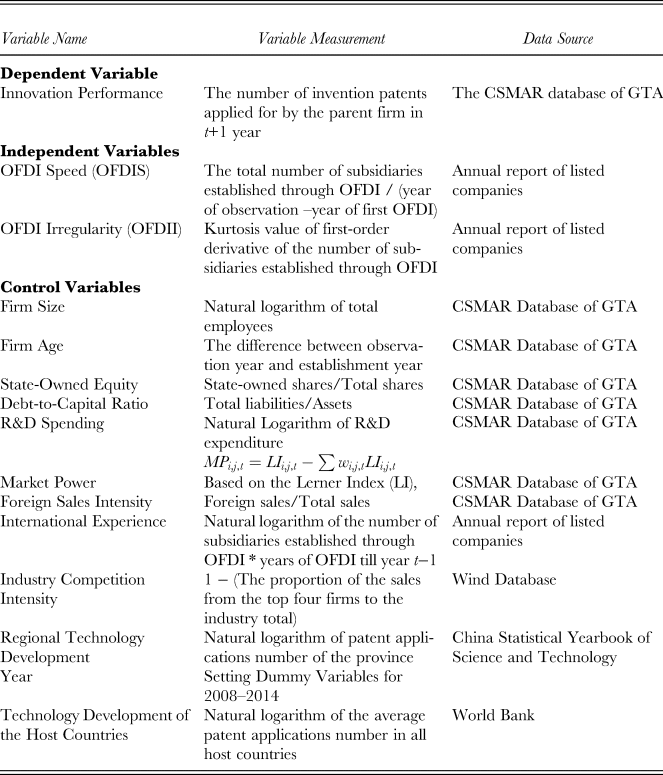
Third, we also controlled for regional level factors. Regional technology development is included to assess the regional development, as measured by the natural logarithm of the patent applications and the number of the province where the firm headquarters is located. To capture the potential impact of external technologies and knowledge throughout a firm's international process in this study (Frost, Reference Frost2001), we used the average number of patent applications in all host countries at the end of the observation year as the proxy variable of technology development of the host countries, and we took the natural logarithm to avoid extreme values. Table 1 shows details of the variable measurement method and data sources used in this study.
Variable measurement

Estimation methods
Because our predicted effects are count variables (the number of invention patent applications), we used the ‘xtpqml’ command in STATA 16.0 to estimate a Poisson quasi-maximum likelihood fixed-effects estimator with robust standard errors (Simcoe, Reference Simcoe2007). The advantage of this approach is that it generates consistent estimates under rather weak assumptions, and only the conditional mean must be specified, which removes the necessity of assuming a specific distribution (even in cases of over/under dispersion) and enhancing the estimation's efficiency (Jiang et al., Reference Jiang, Beamish and Makino2014; Simcoe, Reference Simcoe2007). We also lagged all the explanatory variables for one year, taking into consideration the time needed for the effects of host country institutions to materialize and influence the parent firm's innovation. The adoption of a lag structure can also help control for potential endogeneity.
ANALYSIS AND RESULTS
Descriptive Statistics and Correlation Analysis
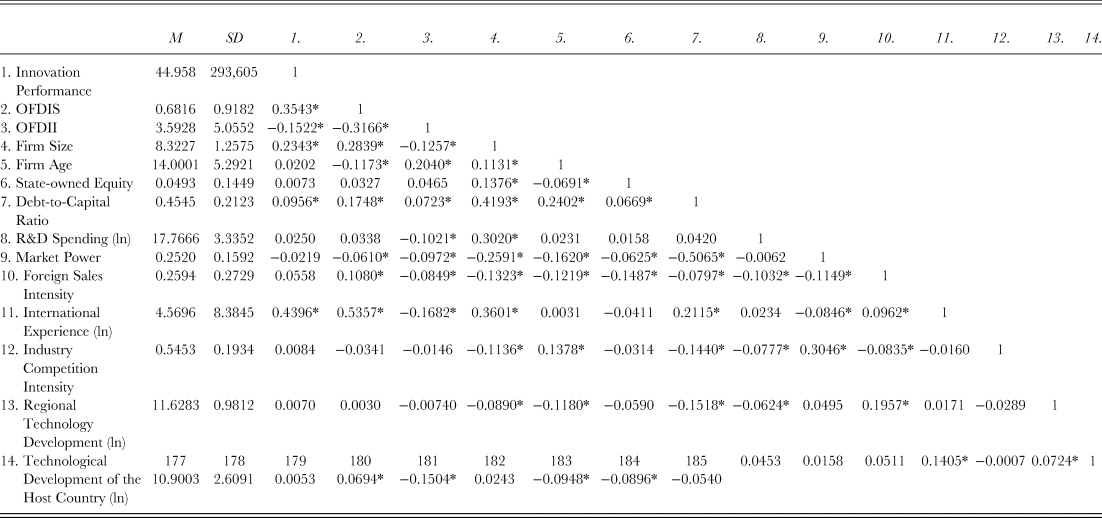
Table 2 provides descriptive statistics and correlations for all the variables used in the analysis. The absolute value of the correlation coefficient among all the variables is lower than 0.6. The dependent and independent variables show considerable variance, and correlation coefficients are thus consistent with our expectations.
Descriptive statistics and correlations

Notes: The coefficient with asterisk indicates that it is significant at the 5% confidence level, N = 1092.
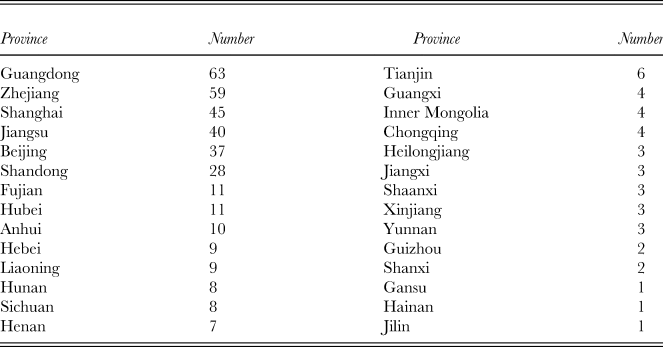
Among the 385 sample firms, 84.7% (326/385) belonged to the manufacturing sector, whereas 7.8% fell in the information transmission, software, and information technology services sectors. Both are typical industries with active innovation and abundant innovation output. These firms are distributed across 28 provinces, among which more than 75% are in eastern China. These regions have relatively strong economies and good infrastructure that can effectively support the operation and development of firms. Moreover, according to the Wind Database, in 2017, there were 3,328 listed companies in China; Guangdong, Zhejiang, Jiangsu, Beijing, and Shanghai were the top five regions (see Table 3) where the listed companies were located, which is consistent with the distribution of our samples.
Regional distribution of the samples

Regression Analysis
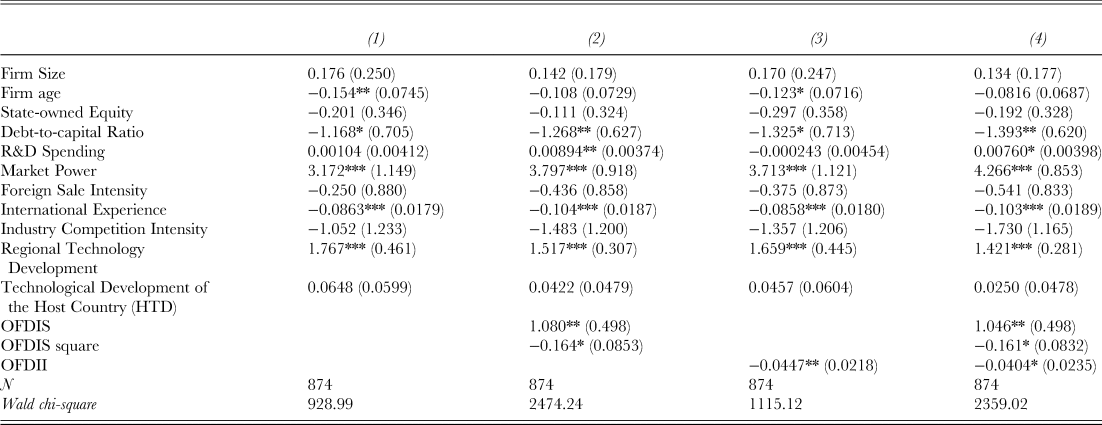
Table 4 displays the regression results. The data structure of this study included an unbalanced panel, and the model utilized a Poisson quasi-maximum likelihood regression with a fixed effect. Model 1 represents the base model that includes only the control variables. Models 2 and 3 represent the main effects of OFDI speed (OFDIS) and its squared term and OFDI irregularity (OFDII), respectively. Model 4 is the full model, including all independent and interaction variables.
Quasi-maximum likelihood Poisson regression results of fixed effects

Notes: * p < 0.1, ** p < 0.05, *** p < 0.01; Standard error in parentheses.
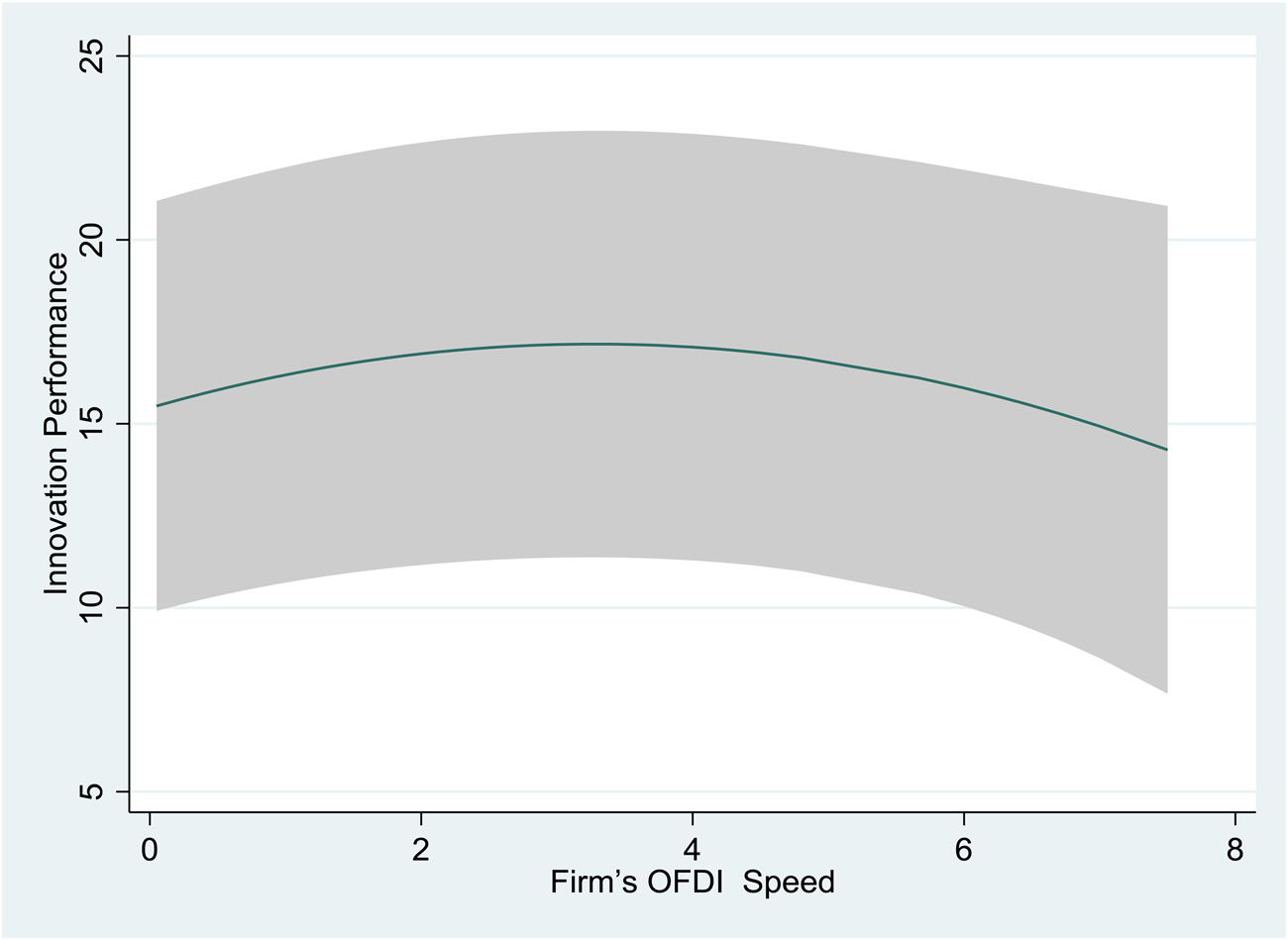
Models 2 and 4 consistently demonstrate that both the linear term (β = 1.046, p < 0.05 in Model 4) and the quadratic term (β = −0.161, p < 0.1 in Model 4) of OFDIS are highly significant for a firm's innovation performance. The positive coefficient on the linear term and negative coefficient on the quadratic term of OFDIS are consistent with the predicted curvilinear (inverse U-shaped) effect of OFDI speed on a firm's innovation performance. In this study, we examined the marginal effects of this relationship, following the three steps Lind and Mehlum (Reference Lind and Mehlum2010) suggested. First, we examined whether the second-order term was significant and of the expected sign; the result confirmed this. Second, we tested whether the slope was sufficiently steep at both ends of the data range of OFDIS. We confirmed that, when OFDIS = 0.05, the slope = 1.0295 (p < 0.05), and that when OFDIS = 8.4, the slope = −1.84552 (p < 0.1). Third, we tested whether the turning point was located within the data range of OFDIS. Following Haans, Pieters, and He (Reference Haans, Pieters and He2016) methodology, we calculated the inverted U-shaped turns when OFDIS = 3.255, and the 95% confidence interval for the turning point [1.56, 4.949] was within the value range of OFDIS. We provided additional support by plotting this relationship in Figure 1. These findings suggest that Hypothesis 1 was supported.
The relationship between a firm's OFDI speed and innovation performance (95% confidence level)

At the same time, OFDII in Model 3 (β = −0.0447, p < 0.05) and Model 4 (β = −0.0404, p < 0.1) negatively influenced innovation performance, which indicates that the more irregular the expansion, the worse the innovation performance of the parent firm. The marginal effect suggests a one-unit increase of irregular OFDI expansion would be expected to cause innovation performance to decrease by 0.8297. Therefore, we concluded that Hypothesis 2 was supported.
The results of the control variables were largely consistent with our expectations (in Table 1, Model 1). Among all the control variables, market power and regional technology development were positive and significant to a firm's innovation performance. Firm age, debt-to-capital ratio, and international experience were negative and significant for innovation performance.
Robustness and Supplementary Analyses
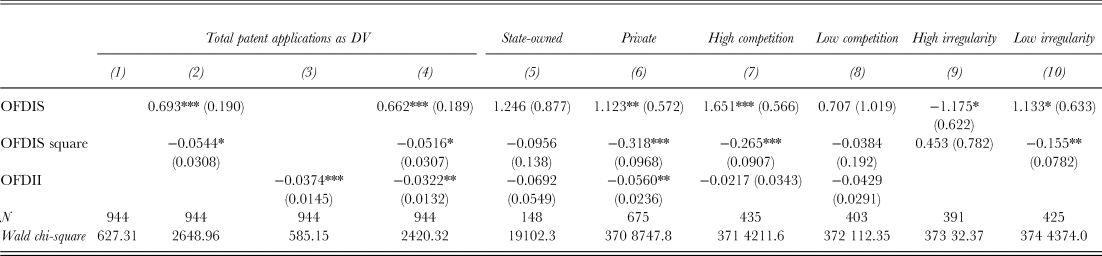
In this study, we conducted robustness checks for our results and gained additional insights into the primary relationships. We tested whether the results were robust to use an alternative measure for innovation performance through the total patent applications (including invention patents, utility model patents, and design patents) in year t + 1. As shown in Table 5, we found that the coefficient of the quadratic term of OFDIS in Model 2 was still negative and significant (β = −0.0544; p < 0.1), and that the coefficient of OFDII in Model 3 supported our primary findings as well (β = −0.0374; p < 0.01). Thus, we had high robustness of the measurement for the dependent variable.
Results of supplementary analysisa

Notes: * p < 0.1, ** p < 0.05, *** p < 0.01; Standard error in parentheses.
a Results related to control variables are not shown to save space but are available from authors.
Furthermore, we wanted to see whether the main findings were consistent in different subsamples through post hoc analyses. It can provide information for a finer-grained interpretation of the relationships posed and suggest some interesting and potentially important conclusions. First, we reran all the models for state-owned firms and private firms separately. The findings suggested that the quadratic term of OFDIS of the private firms’ sample was negative and significant (β = −0.318; p < 0.01) and that of OFDI rhythm was negative and significant (β = −0.056; p < 0.05) (seen in Table 5, Model 6), which were consistent with the main findings in Table 4. However, the results of the state-owned firms indicated that OFDI speed and rhythm might not have significant impacts on their innovation performance. We have provided possible explanations for these intriguing results. Compared with private firms, state-owned firms are endowed with more financial resources and relatively stronger absorptive capacity (Cuervo-Cazurra, Inkpen, Musacchio, & Ramaswamy, Reference Cuervo-Cazurra, Inkpen, Musacchio and Ramaswamy2014; Lazzarini, Mesquita, Monteiro, & Musacchio, Reference Lazzarini, Mesquita, Monteiro and Musacchio2021), which may alleviate the negative effect from fast and uneven OFDI expansion.
Second, we tested the impact of industry competition. As shown in Table 5, we found that there was an inverted U-shaped relationship between OFDI speed and innovation performance in high competition industries (Model 7) but not in the low competition industries (Model 8). Industry development remained relatively stable and predictable under low competitive intensity. Therefore, the learning challenges might be mitigated, and more financial resources could be left for a firm's learning that helps it buffer against rapid OFDI.
Third, to explore the effect of OFDI speed and rhythm concurrently, we divided the sample into high and low irregularity patterns and performed an additional analysis on speed impact. Table 5 shows that the OFDIS square was negative and significant (β = −0.155; p < 0.05) in the low irregularity samples (Model 10), which complied with H1. We further calculated its turning point and found that the peak of innovation performance occurred later than the result in Table 4, Model 4. This indicated that, at a more even rhythm, the firm could gain more innovation benefits from rapid OFDI.
DISCUSSION
In the present study, we examined the effects of temporal behaviors in OFDI on innovation performance, a question that is under-investigated by existing research in the IB literature. Although internationalization is acknowledged as an essentially dynamic process (Johanson & Vahlne, Reference Johanson and Vahlne1977, Reference Johanson and Vahlne2009), its dynamic nature has not been sufficiently studied (Autio, Sapienza, & Almeida, Reference Autio, Sapienza and Almeida2000; Eden, Reference Eden2009). In this study, we considered the effect of two fundamental temporal behaviors, speed and rhythm, on innovation performance. The results based on EMNEs’ OFDI lend support to our foundational assumption that temporal behaviors inherently provide sources of competitiveness in time-based competition. Our contributions are thus threefold.
First, we directly examined temporal behaviors in OFDI using speed and rhythm as our primary focus. Our contributions in temporal research encompass two aspects: First, unlike traditional IB studies of time, which have been dominated by concerns of internationalization stages or sequences (Johanson & Vahlne, Reference Johanson and Vahlne1977) or pre-internationalization entry duration (e.g., Oviatt & McDougall, Reference Oviatt and McDougall2005), we focused on temporal dynamics in the post-initial foreign-entry processes (Autio et al., Reference Autio, Sapienza and Almeida2000). With this focus, we avoided taking any static stage view (Eden, Reference Eden2009) so we could better capture dynamics in the main process of internationalization. Second, current studies on the pace of internationalization primarily pay attention to speed (e.g., Casillas & Acedo, Reference Casillas and Acedo2013; Casillas & Moreno-Menéndez, Reference Casillas and Moreno-Menéndez2014). We also took into account the regularity of the pace, that is, the rhythm (e.g., Chang, Reference Chang2007). By doing so, we developed the debate on whether firms should expand into foreign markets with a fast or slow speed by concurrently considering the irregularity of their foreign expansion patterns.
Our findings support the curvilinear (inverted U-shaped) effect of OFDI speed on the innovation performance of firms (thus supporting H1). Additionally, there was a negative relationship between high irregularity in OFDI expansion and innovation performance (thus supporting H2). Both results imply that time-based competitive advantages can be derived, but with boundaries. Specifically, a too-fast speed or too-high irregularity does not seem to benefit innovation performance. A too-fast speed exposes firms to knowledge beyond their absorptive capacity (Cohen & Levinthal, Reference Cohen and Levinthal1990). Similarly, a too-high level of irregularity disturbs the existing learning process and deteriorates innovation performance.
Second, we associated time with OFDI activities in the context of the global innovation competition. Our contribution lies in examining the conditions under which temporal behaviors may improve innovation performance. We argue that global innovation competition is temporally sensitive under increasingly time-based competition conditions. However, past research has tended to associate temporal behaviors with financial performance (e.g., Chang & Rhee, Reference Chang and Rhee2011). For example, firms’ time to market (i.e., quickly introducing new products to the global market; Cohen et al., 1996) and time to build (i.e., quickly building manufacturing facilities; Pacheco-de-Almeida, Hawk, & Bernard Yin, Reference Pacheco-de-Almeida, Hawk and Bernard Yin2008) lead to improvements in financial performance. We argue that, under certain circumstances, time to acquire knowledge and learn is important for non-financial performance measures such as innovation performance.
Third, this study extends temporal arguments and the effect on innovation performance to a particular group of actors: EMNEs. We argue that, as latecomers, EMNEs present potentially unique behaviors regarding temporal decision and innovation strategies, yet existing research offers little examination of the relationship between EMNEs’ temporal behaviors in OFDI and the impact on their innovation performance. According to Li (Reference Li2007), latecomer Asian firms present certain characteristics in both temporal and spatial behaviors. They do not rely on ownership advantage as a precondition to engage in OFDI; their strategic motive for OFDI is to gain the advantages started earlier, with asset-seeking rather than asset-exploiting (Li et al., Reference Li, Chen and Shapiro2009, Reference Li, Li and Shapiro2012). Our findings, based on Chinese-listed firms, evidence the unique temporal strategies adopted by EMNEs in a global innovation competition. For example, despite the lack of absorption capacity and ownership disadvantages, EMNEs in this study exhibit a positive correlation between a certain level of speed and innovation performance, indicating that they maximize and upgrade learning capacity quickly in the OFDI process (part of the H1 argument). They undeniably share issues that MNEs from advanced economies (AMNEs) experience: a rapid OFDI may deter performance (Yang et al., Reference Yang, Lu and Jiang2017; part of our H1 argument). In addition, a high irregularity of OFDI expansion seems to deter learning efficiency and negatively affects EMNEs’ innovation performance. This result implies the fragility of EMNEs’ learning ability, which has extended the extant studies. Overall, our results echo those of Aaltonen (Reference Aaltonen2020), who found that internationalization is a dynamic and complex process that is unlikely to be presented as linear or nonlinear.
The present study was constrained by its current focus and capacity but offered some new directions for future research. First, we used an OFDI event (counted foreign subsidiaries) to examine the association between temporal patterns and innovation performance. However, we do not believe that counted events can provide a comprehensive picture of activities that contribute to innovation performance. To truly disentangle the temporal effect, we must further relate the temporal dimension with activities (Ancona et al., Reference Ancona, Okhuysen and Perlow2001). For example, if we could associate time with activities such as learning, types of knowledge acquired, and stage (begin and end) of innovation, then we stand a better chance of disentangling the mechanism of the temporal effect on innovation performance. Second, OFDI is treated simply as a vehicle or platform for accessing innovation assets or as a learning platform or innovation network. We did not go into detail about the nature of OFDI, such as entry mode, repeated mode, or extended multiple modes. We encourage future researchers to detail and control OFDI information when testing the effects on innovation performance.
DATA AVAILABILITY STATEMENT
The online appendix provides a description of the code and the data files. Code and data are openly available in the Open Science Framework at http://doi.org/10.17605/OSF.IO/GQ6SP