Although bronchopulmonary dysplasia, intraventricular haemorrhage, and necrotising enterocolitis have been attributed to the haemodynamic consequences of a left-to-right ductal shunt, a cause-and-effect relationship has been questioned.Reference Laughon, Simmons and Bose 1 The neonatal morbidity of a persistent ductus arteriosus may be associated with the magnitude of the shunt across the persistent ductus arteriosus and the ability of the neonate to cope with it.Reference Harling, Hansen-Pupp, Baigi and Pesonen 2 , Reference Sellmer, Bjerre and Schmidt 3 Clear evidence, however, is lacking for or against many of the approaches to persistent ductus arteriosus treatment.Reference Clyman and Chorne 4 – Reference Bose and Laughon 7 In addition, no uniform definition of a haemodynamically significant persistent ductus arteriosus or uniform indication for ductal closure exists.Reference Bose and Laughon 7 , Reference Zonnenberg and de Waal 8 The frequency of persistent ductus arteriosus depends on the timing of investigation, diagnostic criteria used, and the characteristics of the population studied, and is inversely related to gestational age.Reference Sellmer, Bjerre and Schmidt 3 , Reference Zonnenberg and de Waal 8 In near-term and full-term infants, almost all ducts will close spontaneously within 7 days. In very preterm infants, spontaneous closure is reported with considerable variability.Reference Clyman, Couto and Murphy 5 , Reference Laughon, Bose and Clark 6 , Reference Koch, Hensley, Roy, Brown, Ramaciotti and Rosenfeld 9 , Reference Van Overmeire, Van de Broek, Van Laer, Weyler and Vanhaesebrouck 10 Important risk factors for a persistent ductus arteriosus are preterm birth, low birth weight, and total fluid intake.Reference Stephens, Gargus and Walden 11 – Reference Hajj and Dagle 13 In general, closure of a persistent ductus arteriosus with a significant left-to-right shunt is advised in ventilated preterm infants and achieved pharmacologically using cyclo-oxygenase inhibitors or by surgery.Reference Clyman, Couto and Murphy 5 , Reference Jhaveri, Soll and Clyman 14
In the Netherlands, neonatal intensive care is centralised at 10 Neonatal Intensive Care Units; however, owing to further centralisation of paediatric cardiac surgery, surgical ligation of a persistent ductus arteriosus is offered only at four centres. All neonatal ICUs have a policy of using cyclo-oxygenase inhibitors – indomethacin or ibuprofen – for pharmacological treatment of a haemodynamically significant persistent ductus arteriosus. Non-responders with a haemodynamically significant persistent ductus arteriosus are transported to one of the four cardiac centres for ductal ligation. Owing to a recent policy change in the Netherlands, preterm infants of 24 weeks of gestation are resuscitated and admitted to neonatal ICUs.Reference de Laat, Wiegerinck and Walther 15 This might potentially lead to more preterm infants with a persistent ductus arteriosus and possibly the need for more surgical ligation procedures.
In the Netherlands, there is a feeling that the incidence of ductal ligation is different between Dutch neonatal ICUs. As there are no national Dutch guidelines for persistent ductus arteriosus management, local differences in the incidence and efficacy of treatment are possible. We conducted a multicentre benchmark study of neonatal ICUs affiliated with the same cardiac surgery centre to identify inter-centre differences in persistent ductus arteriosus treatment. Furthermore, the secondary aim was to determine whether these inter-centre differences were associated with differences in morbidity and mortality.
Materials and methods
Design
We performed a retrospective, multicentre study in which all preterm infants, born at a gestational age of less than 28 weeks, admitted to the neonatal ICUs in the period between January 2010 and December 2011, were included. The participating centres were Radboudumc Nijmegen; Máxima Medical Centre Veldhoven; Amalia Children’s Centre Isala and University Medical Centre Utrecht. According to Dutch Law on Medical Research with Humans, a waiver for ethical assessment was provided by the local Medical Ethical Committee of Máxima Medical Centre, given that retrospective and anonymous data collection was performed using routinely collected medical chart data solely.
Diagnosis and treatment
In all centres, echocardiography was used as a standard procedure to confirm the diagnosis of a persistent ductus arteriosus and to document ductal closure. In all centres, paediatric cardiologists were involved in the diagnostic workup. The paediatric cardiologists at Radboudumc, Máxima Medical Centre, and Amalia Children’s Centre Isala are working closely together with paediatric cardiologists and cardiac surgeons at University Medical Center Utrecht. In general, persistent ductus arteriosus was treated if echocardiography showed a significant persistent ductus arteriosus (diameter of ductus >1.5 mm; continuous left-to-right shunting; left atrium/aorta ratio >1.4) in combination with any form of respiratory support, such as nasal continuous positive airway pressure or invasive ventilation. In one centre – University Medical Center Utrecht – all patients received indomethacin (3×0.2 mg/kg at 12-h interval). In the other three centres, patients received ibuprofen (Radboudumc and Máxima Medical Centre, 10, 5 and 5 mg/kg at t=0, t=24 and t=48 hours, respectively; Amalia Children’s Centre Isala dose dependent on postnatal age: <72 hours: 10, 5, and 5 mg/kg; <108 hours: 14, 7, and 7 mg/kg; and postnatal age >108 hours: 18, 9, and 9 mg/kg at t=0, t=24, and t=48 hours, respectively) or indomethacin (0.2, 0.1, and 0.1 mg/kg at t=0, t=12, and t=24 hours, respectively). Contraindications for pharmacological treatment, with respect to minimal urine output, serum creatinine, low platelet count, unstable intraventricular haemorrhage, necrotising enterocolitis, and sepsis, were comparable in all centres. All four centres had similar oxygen saturation targets (85–95%) for their patients. All centres restricted fluid intake (by 10–40 ml/kg/day) during treatment of persistent ductus arteriosus with a significant left–right shunt. After two courses of pharmacological treatment and a haemodynamic, significant persistent ductus arteriosus, the affiliated centres consulted the cardiac centre of University Medical Center Utrecht for further policy. Depending on postnatal age and clinical characteristics such as respiratory support and oxygen need, contraindications for pharmacological treatment, ductal size, and left-to-right shunting, a third, and incidentally a fourth, drug course or ductal ligation was chosen. All participating neonatal ICUs referred infants for ductal closure to the same cardiac surgery department at the University Medical Centre Utrecht.
Data collection
From the electronic patient files, data on demographic variables such as gestational age, birth weight, and sex, variables related to the diagnostic workup, that is, echocardiography, and variables at the time of drug courses, such as respiratory support, oxygen requirement, weight gain or loss, and volume intake, were collected retrospectively. The national neonatal registration database was used to collect data on short-term morbidity: bronchopulmonary dysplasia is defined as oxygen need >21% at 28 days and oxygen need >21% at 36 weeks of postmenstrual age, intraventricular haemorrhage is defined as intraventricular haemorrhage⩾grade 3 according to the Papile grading, and necrotising enterocolitis⩾stage 2b according to Bell’s criteria.Reference Burstein, Papile and Burstein 16 , Reference Bell, Ternberg and Feigin 17 Controls were infants who did not receive any persistent ductus arteriosus-related treatment.
Statistical analysis
Normal data are expressed as mean±standard deviation, otherwise as medians and interquartile ranges. The Fisher exact test was used to compare categorical data between centres. The Kruskal–Wallis test and post-hoc Dunn’s multiple comparison tests were used to compare continuous nonparametric data between centres. A multivariate analysis, using logistic regression, was used to study the influence of patient characteristics on outcome measurements – for example, ductal closure, ligation, and mortality. To compare differences between centres, they were categorised, with the surgical centre of University Medical Center Utrecht as the reference centre. The results are presented as percentages or as odds ratios with 95% confidence interval. A p-value below 0.05 was considered statistically significant. All analyses were performed using the statistical software package SPSS version 19.0 (SPSS Inc., Chicago, Illinois, United States of America).
Results
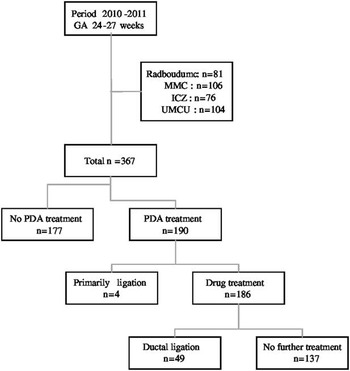
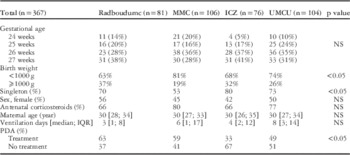
In total, 367 preterm infants below 28 weeks of gestation were admitted to the participating neonatal ICUs (Fig 1). Several demographic variables are illustrated in Table 1. Extremely low birth weight infants (birth weight<1000 g) and singletons were not equally distributed over the centres (Fisher’s exact test, p<0.05). Radboudumc had the lowest percentage of extremely low birth weight infants (63%), whereas Máxima Medical Centre had the highest number (81%). Out of 367 infants, 190 (52%) were treated for persistent ductus arteriosus, and four preterm infants underwent primary ligation for persistent ductus arteriosus, because of contraindications for pharmacological treatment such as renal insufficiency, intraventricular haemorrhage, and necrotising enterocolitis. Overall, 186 infants were treated primarily with either indomethacin or ibuprofen. Infants treated for persistent ductus arteriosus were not equally distributed between centres (Fisher’s exact test p<0.05), with the lowest proportion in Amalia Children’s Centre Isala (33%) and the highest proportion in Radboudumc (63%).
Flow diagram of patients. MMC=Máxima Medical Centre; PDA=persistent ductus arteriosus; UMCU=University Medical Center Utrecht; ICZ=Amalia Children’s Centre Isala; GA=gestational age.

Basic distribution of the treated patients.

IQR=interquartile range; ICZ=Amalia Children’s Centre Isala; MMC=Máxima Medical Centre; UMCU=University Medical Center Utrecht
Radboudumc, MMC, ICZ, and UMCU refer to the participating centres
Distribution of gestational age, low birth weight, singletons, sex, antenatal corticosteroids (two doses of bethamethasone), maternal age, ventilations days, and infants treated for persistent ductus arteriosus (PDA) across the centres
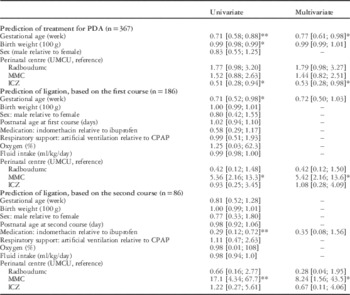
Univariate analysis of the total population (n=367) showed a significant risk reduction for persistent ductus arteriosus treatment of 0.71 (confidence interval 0.58–0.88) and 0.99 (confidence interval 0.98–0.99) for gestational age and birth weight, respectively (Table 2). Sex was not associated with persistent ductus arteriosus treatment. After categorising the perinatal centre into four units, with the University Medical Center Utrecht as the reference, infants from Amalia Children’s Centre Isala showed a reduced risk of 0.51 (confidence interval 0.28–0.94) for persistent ductus arteriosus treatment. In a multivariate model, including gestational age, birth weight, and perinatal centre, significant risk reduction in persistent ductus arteriosus treatment remained for gestational age and perinatal centre Amalia Children’s Centre Isala (Table 2).
Identifying risk factors.

CPAP=continuous positive airway pressure; ICZ=Amalia Children’s Centre Isala; MMC=Máxima Medical Centre; PDA=persistent ductus arteriosus; UMCU=University Medical Center Utrecht
Odds ratio with 95% confidence intervals between brackets. Radboudumc, MMC, ICZ, and UMCU refer to the participating centres
*p<0.05; **p<0.01
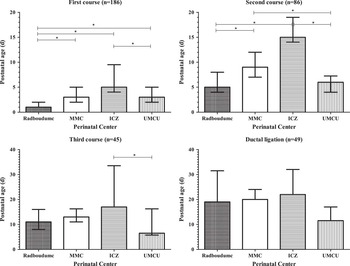
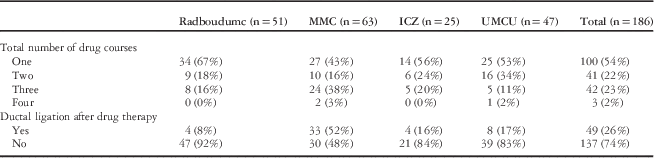
There were differences in pharmacological therapy between centres. University Medical Center Utrecht exclusively used indomethacin for persistent ductus arteriosus treatment, whereas the other three centres mainly used ibuprofen (Radboudumc, first course 75%, second course 77%; Máxima Medical Centre, 79–78%; Amalia Children’s Centre Isala, 96–55%). The postnatal age for starting pharmacological treatment was statistically different for both the first course and the second course (Fig 2). Radboudumc started this treatment early, at a median postnatal age of 1 [interquartile range, 1–2] and 5 [interquartile range, 4–8] days for the first and the second course, respectively. In contrast, the starting date in Amalia Children’s Centre Isala was relatively late compared with the other centres, at a median postnatal age of 5 [interquartile range, 4–10] and 15 [interquartile range, 14–19] days. The number of drug courses for persistent ductus arteriosus closure was different between the centres, with more infants treated with ⩾3 courses at the Máxima Medical Centre (Fisher’s exact test, p<0.01) (Table 3). No differences were noted in oxygen requirement or need for ventilator support, such as nasal continuous positive airway pressure or artificial ventilation, at the start of the first or the second drug course. Only fluid intake was significantly different at the start of the first course between the centres, with the highest intake at Amalia Children’s Centre Isala and the lowest in Radboudumc.
Postnatal age at time of pharmacological treatment and ductal ligation. Time of first, second and third course is statistically different (indicated by capped line) between the centres (Kruskal-Wallis and post-hoc test for multiple comparison; *p<0.05). Bars representing median values with whiskers indicating inter quartile ranges. The abbreviations Radboudumc, MMC, ICZ and UMCU refer to the participating centres. Note that the y-axis differs between the upper and lower graphs. ICZ=Amalia Children’s Centre Isala; MMC=Máxima Medical Centre; UMCU=University Medical Center Utrecht.

Distribution of drug courses and ductal ligation in the participating centres.

ICZ=Amalia Children’s Centre Isala; MMC=Máxima Medical Centre; UMCU=University Medical Center Utrecht
Overall, 186 infants were treated pharmacologically before ductal ligation. Radboudumc, MMC, ICZ, and UMCU refer to the participating centres.
The number of drug courses (p<0.05) and ductal ligation (p<0.001) were statistically different between the centres
In 26% of the cases, ductal ligation was performed after one to four courses of indomethacin or ibuprofen. We observed substantial differences in ductal ligation between perinatal centres (Table 3). After a first course of treatment, analysis showed a significant risk reduction of 0.71 (confidence interval 0.52–0.98) in ductal ligation for gestational age (Table 2). In addition, use of indomethacin a second course showed a relative risk reduction of 0.29 (confidence interval 0.12–0.72) for ductal ligation. After excluding University Medical Center Utrecht, the centre that only used indomethacin, however, there was no relative risk reduction. Increased risk of ductal ligation was found in Máxima Medical Centre with a relative risk of 5.36 (confidence interval 2.16–13.3). In a multivariate analysis, including significant covariates such as gestational age, drug choice, and perinatal centre, only the perinatal centre Máxima Medical Centre remained statistically significant as an independent risk factor for ductal ligation.
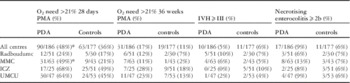
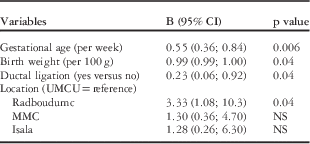
A large variability of several short-term morbidity characteristics were noticed between the four centres (Table 4). Despite centre variability, within each centre, we observed more infants with extra oxygen need at 28 days and 36 weeks postmenstrual age and necrotising enterocolitis in the treatment group for persistent ductus arteriosus compared with controls; moreover, only oxygen need at 28 days was significantly different. The unadjusted mortality in patients treated for persistent ductus arteriosus was 17%. The adjusted mortality showed independent risk contribution of gestational age, birth weight, ductal ligation, and perinatal centre (Table 5).
Short-term morbidity in the study group.

ICZ=Amalia Children’s Centre Isala; IVH=intraventricular haemorrhage; MMC=Máxima Medical Centre; PMA=postmenstrual age; UMCU=University Medical Center Utrecht
A large variability in several short-term morbidity characteristics was noticed between the four centres. Despite centre variability, within each centre, we observed consistently more infants with oxygen need at 28 days, oxygen need at 36 weeks postmenstrual age, and necrotising enterocolitis in the treatment group for persistent ductus arteriosus (PDA) compared with controls. No association was found between persistent ductus arteriosus treatment and intraventricular haemorrhage grade ⩾III. Radboudumc, MMC, ICZ, and UMCU refer to the participating centres
Fisher’s exact test, *p<0.05
Multivariate analysis of mortality.

MMC=Máxima Medical Centre; UMCU=University Medical Center Utrecht
Multivariate analysis of mortality in patients treated for patent ductus arteriosus (n=186), adjusted for gestational age, birth weight, ligation, and location of birth. B (odds) with 95% confidence interval (CI) Radboudumc, MMC and Isala refer to the participating centres
Discussion
In this study, significant differences were found between four Dutch perinatal centres affiliated with the same cardiac surgery department with respect to persistent ductus arteriosus management. The Netherlands is not unique in this. In the United States of AmericaReference Jhaveri, Soll and Clyman 14 and the United Kingdom,Reference Kulkarni, Richards and Duffy 18 significant variations exist in practice among neonatologists concerning the management of persistent ductus arteriosus in preterm babies. The most prominent finding was that the incidence of ductal ligation after failure of pharmacological treatment differed between centres. Máxima Medical Centre had a relatively high rate of referrals for surgical ligation compared with the other centres; however, ductal ligation, was not associated with higher mortality or short-term morbidity.
The factors that explain the differences between the four centres are quite complex. Known risk factors such as gestational age, birth weight, and need for respiratory supportReference Stephens, Gargus and Walden 11 – Reference Hajj and Dagle 13 were evaluated and showed no differences. We observed a difference in total fluid intake at the start of the first course, but this can be explained by the normal increase in fluid intake during the first few days of life. Moreover, the centre, Amalia Children’s Centre Isala, with high fluid intake was also the centre with a relatively low referral for ductal ligation.
When further comparing the persistent ductus arteriosus treatment protocols of the four perinatal centres and the analysis performed in this study, the differences in pharmacological treatment were the most obvious. In one centre – University Medical Center Utrecht – only indomethacin is used. In the other perinatal centres, children were treated with both ibuprofen and indomethacin, but predominantly ibuprofen. This change in medication was made because of a lack of availability of indomethacin. Recently, a meta-analysis showed no significant differences between ibuprofen and indomethacin in the effectiveness of ductal closure.Reference Ohlsson, Walia and Shah 19 The duration of a total course of indomethacin (three doses at 12-hour interval) is considerably shorter than a course of ibuprofen (three doses at 24-hour interval). The time differences after a first, second, and third course of indomethacin versus ibuprofen are, at least, 24, 60, and 96 hours, respectively. This might explain the relatively high success rate of the second treatment course at the University Medical Center Utrecht. As the ductus arteriosus becomes less sensitive to treatment with cyclo-oxygenase inhibitors with increasing postnatal age, it could be that the timing of the following course is a more important factor, compared with the pharmacological compound. In an earlier study conducted at Máxima Medical Centre, the efficacy after two courses of indomethacin on ductal closure was 84%, with a referral rate of only 6% for ductal ligation.Reference Dani, Vangi and Bertini 20 With the assumption that within Máxima Medical Centre ductal screening strategy has not changed over time, the change of indomethacin to ibuprofen might be associated with a later start of the second course, and thus lower efficacy of ductal closure.
Another important factor is the role of the dosage of medication used. A recent randomised control trial conducted in preterm infants <29 weeks of gestation suggested that a higher dose (20, 10, 10 mg/kg/day) of ibuprofen is more effective in closing a persistent ductus arteriosus than a standard (10, 5, 5 mg/kg/day) pharmacological regimen. There was no increase in side-effects with the higher dose regimen.Reference Hirt, Van Overmeire, Treluyer, Langhendries, Marguglio and Eisinger 21 Another study described the pharmacodynamics and pharmacokinetics of ibuprofen in preterm infants <34 weeks of gestation.Reference Sosenko, Fajardo, Claure and Bancalari 22 This study showed that ibuprofen elimination clearance significantly increased with postnatal age. Ductal closure was strongly associated with area under the curve on day 1 and 3 of the ibuprofen course. On the basis of this model, a stepwise increase in ibuprofen dose was advised according to the postnatal age of the patient.
This study also showed that there were differences in the timing of treatment onset. Earlier treatment may lead to better ductal closure as a study by Van Overmeire et alReference Van Overmeire, Van de Broek, Van Laer, Weyler and Vanhaesebrouck 10 has suggested, although a relatively small study with ibuprofen did not clearly establish this effect for ibuprofen;Reference Sosenko, Fajardo, Claure and Bancalari 23 however, it is possible that an early treatment approach results in over-treatment of infants whose ductuses would have closed spontaneously and normally.Reference Clyman, Couto and Murphy 5 , Reference Koch, Hensley, Roy, Brown, Ramaciotti and Rosenfeld 9
Thus, it is clear that Radboudumc starts early (median day 1) and Amalia Children’s Centre Isala starts relatively late (median day 5) with treatment. Radboudumc uses a standard dose of ibuprofen, whereas Amalia Children’s Centre Isala uses the stepwise approach of increasing the ibuprofen dose with postnatal age.Reference Hirt, Van Overmeire, Treluyer, Langhendries, Marguglio and Eisinger 22 University Medical Center Utrecht and Máxima Medical Centre start their treatment at median day 3. University Medical Center Utrecht uses only indomethacin and can start relatively early with a following course. In contrast, Máxima Medical Centre uses a standard dose of ibuprofen, regardless of postnatal age, and finishes a second or third course much later than the other centres. This may explain the high incidence of medical treatment failure and a high incidence in surgical ligation.
The long-term benefits of ductal closure on the incidence of bronchopulmonary dysplasia, intraventricular haemorrhage, and necrotising enterocolitis are not clear.Reference Clyman and Chorne 4 Several studies suggest that early surgical ligation is an independent risk factor for the development of bronchopulmonary dysplasia.Reference Chorne, Leonard, Piecuch and Clyman 24 , Reference Clyman, Cassady, Kirklin, Collins and Philips 25 Although Máxima Medical Centre referred a considerable higher amount of infants for ductal ligation after drug failure, this did not lead to higher bronchopulmonary dysplasia, intraventricular haemorrhage, or necrotizing enterocolitis compared with other centres. Our results are in line with observations of a cohort-controlled study comparing two treatment approaches, early versus late surgical ligation, in infants with failed persistent ductus arteriosus closure after indomethacin treatment.Reference Jhaveri, Moon-Grady and Clyman 26
The adjusted mortality (Table 5) showed independent contribution of gestational age, birth weight, ductal ligation, and perinatal centre. Of these variables, gestational age and birth weight are known risk factors for mortality.Reference Anderson, Baer and Partridge 27 A recent meta-analysis on ductal ligation and health outcome confirmed the decreased mortality risk after surgical treatment of a patent ductus arteriosus, although the increased risk on adverse neurological outcome is of major concern.Reference Weisz, More and McNamara 28 We observed an independent contribution of one perinatal centre to mortality. We do not have a clear explanation for this, but it might reflect centre differences towards the approach of extremely preterm infants and withdrawal of treatment.
Methodological limitations
The results are based on retrospective analysis of patient data. Differences in routine medical care or ductal screening strategy and pharmacological treatment may be responsible for the observed differences in ductal closure and referral for ligation. We cannot rule out that differences existed in the interpretation of a haemodynamically significant persistent ductus arteriosus between the collaborating centres and that differences existed in the decision for surgical referral. On the other hand, although a difference in approach towards defining a haemodynamically significant persistent ductus arteriosus could partially explain the results, it is unlikely that this completely explains the differences. A close collaboration between the neonatology and pediatric cardiology departments of Radboudumc, Máxima Medical Centre, and Amalia Children’s Centre Isala and the neonatology, pediatric cardiology, and cardiac surgery departments at the University Medical Center Utrecht exists.
In conclusion, the use of benchmarking tools is effective to identify inter-centre differences and to improve persistent ductus arteriosus treatment. In these four perinatal centres, the factors that explain the differences between the four centres are quite complex. Implementation of national guidelines with the same timing, choice of medication, and dosing is probably important for the best treatment to pursue closure of persistent ductus arteriosus. Owing to great differences in treatment and the considerable similarities in outcome, however, a randomised controlled trial to determine whether treatment is needed altogether is recommended. This trial is being conducted in the Netherlands at present (BeNeDuctus Trial, ID NTR5479).
Acknowledgements
The authors thank C. Schröer, paediatric cardiologist at Máxima Medical Centre, M. Molenschot, paediatric cardiologist, and F. Evens, paediatric cardiothoracic surgeon, both at University Medical Centre Utrecht, for their critical review of the paper. The authors also thank L. Atallah for reviewing the manuscript as a native speaker.
Financial Support
This research received no specific grant from any funding agency or from commercial or not-for-profit sectors.
Conflicts of Interest
None.
Ethical Standards
According to Dutch Law on Medical Research with Humans a waiver for ethical assessment was provided by the local Medical Ethical Committee of Máxima Medical Centre, given that retrospective and anonymous data collection was performed using routinely collected medical chart data solely.