INTRODUCTION
In parasites, the sex ratio often deviates from unity (Poulin, Reference Poulin2007). There are a variety of reasons for this deviation (Morand et al. Reference Morand, Pointier, Borel and Théron1993; Krasnov et al. Reference Krasnov, Khokhlova, Fielden and Burdelova2001). For example, skewness of parasite sex ratio is often thought to be a consequence of high among-host variability in number of conspecific parasites they harbour (Morand et al. Reference Morand, Pointier, Borel and Théron1993; Poulin Reference Poulin2007). As a result, the sex ratios of parasite infrapopulations is expected to correlate with the size of infrapopulations (Rozsa et al. Reference Rozsa, Récási and Reiczigel1996) due to local mate competition (because inbreeding is expected to be more pronounced in small infrapopulations; see also Clayton et al. Reference Clayton, Gregory and Price1992) or local resource competition (Clark, Reference Clark1981). Indeed, Tripet et al. (Reference Tripet, Jacot and Richner2002) demonstrated that the proportion of female fleas Ceratophyllus gallinae increased with an increase of larval food availability.
Aggregated distribution of parasites often occurs because some host individuals represent better habitat patches for parasites than other individuals of the same species, for example, providing food resources of better quality and/or being less defensible (Combes, Reference Combes2001). Suitability of hosts as resource patches of parasites may thus determine host infestation level which varies among hosts belonging to different age cohorts and/or genders (Rousset et al. Reference Rousset, Thomas, de MeeÛs and Renaud1996; Zuk and McKean, Reference Zuk and McKean1996). Consequently, one can expect the sex ratio of parasites to be affected by host gender and/or age. However, this effect is poorly known. An example of the relationship between parasite sex ratio and gender/age of a host was reported by Bursten et al. (Reference Bursten, Kimsey and Owings1997) who found that juvenile males of the California ground squirrel (Spermophilus beecheyi) were infested with more fleas (Oropsylla montana) than juvenile females, and that the disproportionate infestation of juvenile males was mainly due to male fleas. Bursten et al. (Reference Bursten, Kimsey and Owings1997) did not imply that the infrapopulation size can explain this difference. Instead, they argued that the male-biased parasitism of the juvenile cohort may be an adaptation of fleas to decrease chances of inbreeding. The main behavioural difference between male and female juvenile rodents is the further natal dispersal distances of the former. A greater number of male fleas on further dispersing hosts presumably allowed these males to increase their chances of mating with unrelated females. In contrast, female fleas preferred to stay on closer dispersing hosts to ensure successful development of their offspring in the burrows of hosts with guaranteed resources. Although emigration is a risky strategy, an emigrating male flea jeopardizes its own life only, whereas an emigrating female flea jeopardizes not only its own life but also the lives of its offspring. Furthermore, this explanation is valid only if fleas are able to distinguish between host individuals belonging to different genders and age cohorts. According to experimental studies, this appears to be the case (Mears et al. Reference Mears, Clark, Greenwood and Larsen2002; Hawlena et al. Reference Hawlena, Abramsky and Krasnov2007).
Here, we studied the sex ratio in flea infrapopulations in relation to an infrapopulation size, host gender and host age. Fleas are obligate haematophagous parasites, most abundant and diverse on small and medium-sized burrowing mammals. Pre-imaginal development of most flea species occurs off host. Fleas thus usually alternate between periods when they occur on the body of their host and in their burrows. Consequently, estimation of the sex ratio of fleas has to be based on sampling from both host bodies and host burrows. However, excavation of animal burrows is usually labour- and time-consuming, and, therefore, fleas are usually sampled from host bodies only. Hence, prior to any analysis of the sex ratios in fleas, one should be certain that estimates of the sex ratio based on the samples from host bodies as opposed to samples from host burrows do not differ.
Spatial distribution of parasites is fragmented amongst host individuals, host species and locations. In this study we considered the sex ratio of fleas at two scales of this fragmentation, namely among the ensembles harboured by all individuals of all host species in a particular locality (i.e. populations sensuCombes, Reference Combes2001) and among the ensembles of conspecific fleas harboured by each individual host of a particular species (i.e. infrapopulations sensuMargolis et al. Reference Margolis, Esch, Holmes, Kuris and Schad1982). The aims of this study were 3-fold. First, we asked whether the sex ratio of fleas collected from host bodies is a reliable indicator of the sex ratio in the entire flea population. To answer this question we used available literature data and tested the correlation between the sex ratio of fleas collected from hosts and the sex ratio of fleas collected from their burrows across 18 flea species, controlling for the effect of flea phylogeny. Second, we asked whether a host is a proportional random sampler of male and female fleas. If this is the case, then the sex ratio in a flea infrapopulation does not differ from the sex ratio in the entire flea population. Finally, we asked whether and how the sex ratio in flea infrapopulations depends on flea-related (infrapopulation size) and host-related (gender and age) factors. To answer the two last questions, we used field data and analysed the sex ratio in infrapopulations of 7 flea species parasitic on 4 rodent species.
MATERIALS AND METHODS
Comparative study
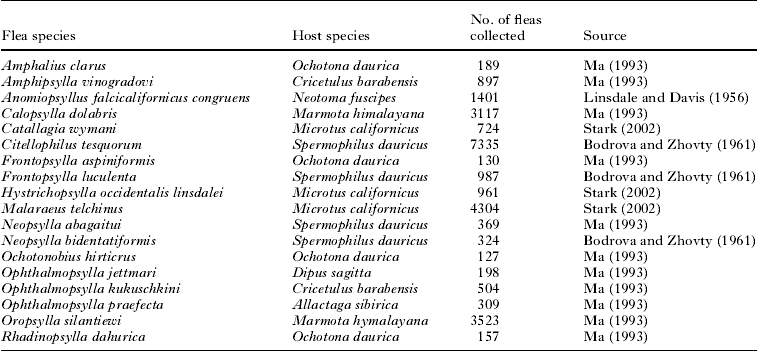
To test whether the sex ratio of fleas collected from host bodies can be used as a reliable indicator of sex ratio in the entire flea population, we used published data on 18 flea species that were sampled on the hosts and in their excavated burrows simultaneously (Table 1). The sex ratio was expressed as the number of females to the number of males.
Flea species and publication sources used for estimates of the sex ratios in flea populations collected from hosts and from their burrows

Initially, to test for the relationship between the sex ratio of ‘body sample’ versus ‘burrow sample’, we regressed the non-transformed female:male ratio of the former on the non-transformed female:male ratio of the latter across flea species and tested whether the slope of the regression differs significantly from 1. This regression was forced through the origin for the sake of biological reality.
Then, to control for the effect of flea phylogeny, the method of phylogenetically independent contrasts (Felsenstein, Reference Felsenstein1985) was used. To compute independent contrasts, the PDAP:PDTREE program (Garland et al. Reference Garland, Dickerman, Janis and Jones1993; Midford et al. Reference Midford, Garland and Maddison2007) was used implemented in Mesquite Modular System for Evolutionary Analysis (Maddison and Maddison, Reference Maddison and Maddison2007). Procedures for the analyses followed Garland et al. (Reference Garland, Harvey and Ives1992, Reference Garland, Dickerman, Janis and Jones1993). The phylogenetic tree was based on the only available molecular phylogeny of fleas constructed recently by Whiting et al. (Reference Whiting, Whiting, Hastriter and Dittmar2008). The positions of the flea taxa which were not represented in the original tree of Whiting et al. (Reference Whiting, Whiting, Hastriter and Dittmar2008) were determined using their morphologically-derived taxonomy (see Poulin et al. Reference Poulin, Krasnov, Shenbrot, Mouillot and Khokhlova2006 for details). The initial branch length was set to 1, since no information on branch length was available.
Field study
Rodent trapping and flea collection were carried out in the central and western Negev Desert of Israel. A detailed description of the study area can be found elsewhere (Krasnov et al. Reference Krasnov, Shenbrot, Medvedev, Vatschenok and Khokhlova1997, Reference Krasnov, Morand, Khokhlova, Shenbrot and Hawlena2005; Hawlena et al. Reference Hawlena, Abramsky and Krasnov2005). Each plot was sampled with 25–50 Sherman live-traps. We collected fleas from each individual rodent only when captured the first time. The animal's fur was combed thoroughly, using a toothbrush, over a white plastic pan and fleas were collected. Fleas were stored in 70% alcohol and transferred to the laboratory, where male and female fleas were identified by examining their genitalia under light microscopy. Each rodent was sexed, weighed (to ±0·1 g; Pesola spring scale), marked by either toe-clipping or by implanting a micro-transponder (Trovan) subcutaneously, and released.
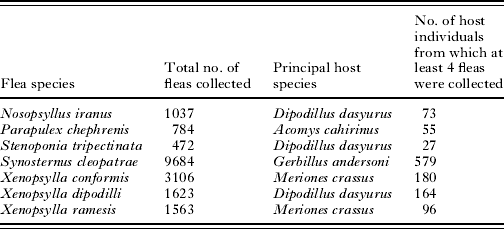
In this study, data on 7 most common flea species (Xenopsylla conformis, Xenopsylla dipodilli, Xenopsylla ramesis, Parapulex chephrenis, Nosopsyllus iranus, Stenoponia tripectinata and Synosternus cleopatrae) were used. Five of these flea species are active in all seasons, whereas N. iranus and S. tripectinata are active during winter only (Krasnov et al. Reference Krasnov, Shenbrot, Medvedev, Vatschenok and Khokhlova1997, Reference Krasnov, Hastriter, Medvedev, Shenbrot, Khokhlova and Vatschenok1999). Parapulex chephrenis is highly host specific and parasitizes mainly the Egyptian spiny mouse Acomys cahirinus. The remaining species are host generalists, being parasitic on a variety of gerbilline rodents. These fleas differed in their abundance among different host species (see details in Krasnov et al. Reference Krasnov, Shenbrot, Medvedev, Vatschenok and Khokhlova1997, Reference Krasnov, Morand, Khokhlova, Shenbrot and Hawlena2005). We considered the host species that supported the largest part of a flea population (that is, the host species on which the flea attained highest abundance) to be the principal host species for a given flea species (Table 2). It should be noted that although X. conformis and X. ramesis exploit the same principal host (Meriones crassus), these two fleas demonstrate parapatric distribution in our study area (see Krasnov et al. Reference Krasnov, Shenbrot, Medvedev, Vatschenok and Khokhlova1997 for details). Consequently, M. crassus that harboured either X. conformis or X. ramesis did not spatially overlap.
Field data on fleas and their principal rodent hosts used in the analyses

Initially, for each flea species, we calculated the proportion of females and the female:male ratio of fleas collected from all rodent species during 1–5 days of a survey. We tested (a) whether the proportion of females in flea populations varied among years of sampling using Kruskal-Wallis ANOVAs and (b) whether the female:male ratio differed significantly from the null expectation of unity using χ2 tests. Then, we calculated the mean proportion of female fleas of each species collected during a survey and used it to calculate the number of female fleas of a given species expected to be collected from an individual of the principal host species. We focused on host individuals that harboured no less than 4 conspecific fleas simultaneously. This resulted in 1174 individual hosts of 4 species and 13 017 individual fleas of 7 species (Table 2).
We distinguished between 2 age groups of rodents according to individual body mass, which is considered to be a good age indicator in post-weaned mammals (Peters, Reference Peters1983). Hosts with body masses below 75% of mean adult body mass in summer were considered young. These were D. dasyurus with body mass less than 17·5 g, M. crassus with body mass less than 60·1 g, A. cahirinus with body mass less than 35·1 g (see Khokhlova et al. Reference Khokhlova, Krasnov, Shenbrot and Degen2001) and G. andersoni with body mass less than 20·8 g (see Hawlena et al. Reference Hawlena, Abramsky and Krasnov2005). They are between 1 and 3 months old that live independently of their mothers and do not usually reproduce. Animals above this body mass are usually physiologically ready to reproduce and thus were considered adults (Krasnov et al. Reference Krasnov, Shenbrot, Khokhlova, Degen and Rogovin1996; Shenbrot et al. Reference Shenbrot, Krasnov and Khokhlova1997; Hawlena et al. Reference Hawlena, Abramsky and Krasnov2005). To test whether the sex ratio in flea infrapopulations harboured by hosts of different gender and age cohorts differed from expected, the observed number of female fleas collected from an individual host was compared with the number of female fleas expected if a host was a proportional sampler of fleas using χ2 tests separately for each flea species and for each gender-sex cohort of hosts. Nosopsyllus iranus and S. tripectinata are active when host populations are represented almost exclusively by adult animals. Consequently, host gender only was taken into account in the analyses of the sex ratio in the infrapopulations of these two fleas.
To investigate further the effect of various factors on the sex ratio of flea infrapopulations, generalized linear models with binomial error distribution and logit link function were used, according to Wilson and Hardy (Reference Wilson, Hardy and Hardy2002). Three series of models were run. In the first series, we asked whether the sex ratio in a flea infrapopulation (expressed as the proportion of females) is affected by host- and flea-related factors. The exploratory terms considered in these models were host gender, host age (except for N. iranus and S. tripectinata; see above) and total size of a flea infrapopulation. The aim of the second and third series was to determine host- and flea-related factors that predict whether an infrapopulation is female- or male-biased. In the second series, the value of the response indicator variable was either 1 (if there were more females) or 0 (if there were more males or the numbers of males and females were equal). Analogously, in the third series, this value was 1 if there were more males, or 0 otherwise. The exploratory terms in the second and the third series were the same as in the first series.
To avoid inflated Type I error, we applied Bonferroni adjustment of α-level which resulted in α=0·007 for the analyses at the population level and α=0·002 for the analyses at the infrapopulation level.
RESULTS
Comparative analysis
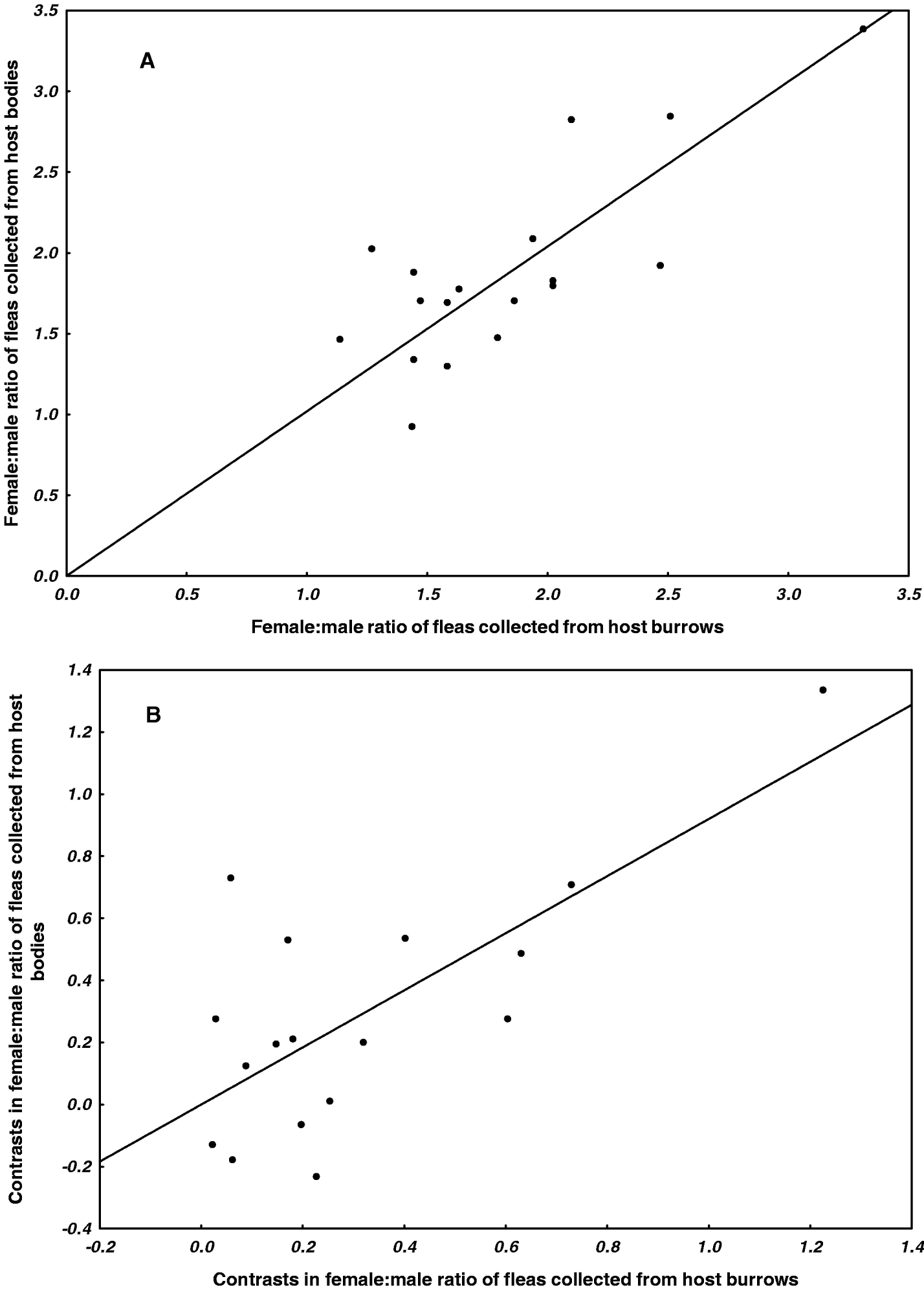
Across flea species, the female:male ratio of fleas collected from hosts strongly correlated with the female:male ratio of fleas collected from burrows (r=0·98, F 1,17=459·5, P<0·0001) (Fig. 1A). Slope of the regression was 1·02±0·05, thus being not significantly different from 1. The method of independent contrasts produced similar results (r=0·84, F 1,16=37·1, P<0·0001; slope=0·92±0·15; Fig. 1B).
Relationship between the sex ratios of fleas collected from hosts and from their burrows using conventional statistics (A) and independent contrasts (B) across 18 flea species.

Field study
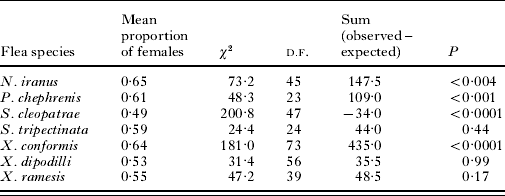
No significant among-year difference in the proportion of female fleas was found in any species (Kruskal-Wallis ANOVAs, H=0·01–11·45, n=27–579, P>0·18 for all). Four of 7 flea species demonstrated significant deviations of the sex ratio from unity (Table 3). Of them, 3 species were female-biased, whereas the fourth (S. cleopatrae) was male-biased.
Summary of χ2 tests of the deviation of the sex ratio of fleas collected during a survey from all host species (i.e. flea populations) from the null expectation of unity

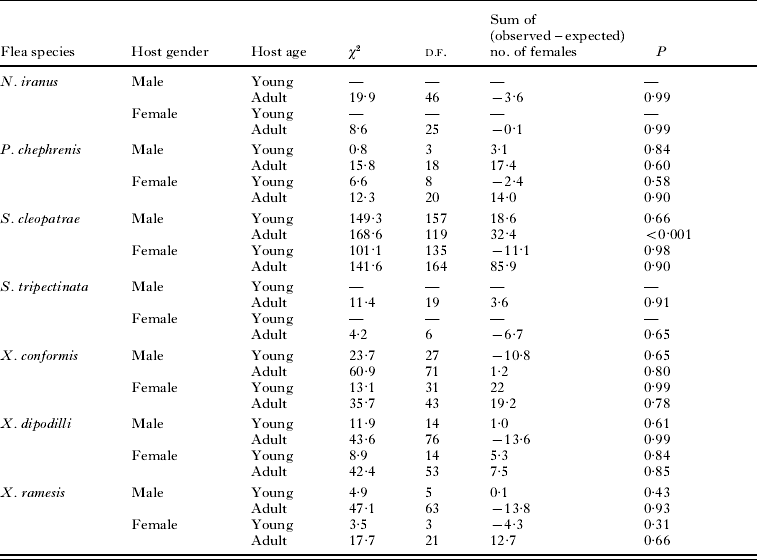
In general, the sex ratio of fleas on an individual rodent did not differ significantly from the sex ratio in the entire flea population (Table 4) except for S. cleopatrae on adult male G. andersoni. These animals harboured a disproportionately high number of female fleas, as evidenced by the positive sum of the difference between the observed and expected number of females (Table 4).
Summary of χ2 tests for deviation of the sex ratios in flea infrapopulations from the sex ratios in flea populations

Results of the generalized linear models with the proportion of females as a response variable demonstrated that neither the factors considered nor their interactions affected the sex ratio in flea infrapopulations (Wald's statistic=0·001–3·37, P>0·06 for all). Furthermore, no factor affected the probability of a host to harbour either a female or male-biased infrapopulation of any flea species (Wald's statistic=0·004–6·38, P>0·01 for all). However, the effect of some factors on the probability of infrapopulations of X. conformis and X. dipodilli was significant prior to Bonferroni adjustment of the α-level. In X. conformis, probability of an infrapopulation to be female-biased decreased with an increase in an infrapopulation size (Wald's statistic=4·80, estimate=−0·04±0·02, P=0·03). In X. dipodilli, female-biased infrapopulations were mainly characteristic for young as opposed to adult hosts (70% and 43%, respectively, of infrapopulations were female-biased) (Wald's statistic=6·38, estimate=−0·53±0·21, P=0·01).
DISCUSSION
Sex ratio estimates and sampling fleas from hosts
The identity of flea sex ratios estimated via sampling from hosts' bodies and via sampling from their burrows suggests that an individual host is a proportional sampler of both male and female fleas. Obviously, the main reason for this is that both males and females have to feed on a host occasionally. In spite of the fact that fleas demonstrate gender differences in their feeding ecology and physiology, the frequency of feeding in males and females may be equal (but see Kunitskaya et al. Reference Kunitskaya, Gauzshtein, Kunitsky, Rodionov, Filimonov and Aikimbaev1965). Indeed, on the one hand, the chances of a successful attack of a host seem to be relatively lower in male fleas due to their lower locomotory ability (Krasnov et al. Reference Krasnov, Burdelov, Khokhlova and Burdelova2003a, Reference Krasnov, Khokhlova, Burdelov and Fielden2004). Male fleas of some species have been shown to digest blood faster than females (Krasnov et al. Reference Krasnov, Sarfati, Arakelyan, Khokhlova, Burdelova and Degen2003b; Sarfati et al. Reference Sarfati, Krasnov, Ghazaryan, Khokhlova, Fielden and Degen2005), although this was true for newly emerged fleas only. Male fleas are characterized by a lower amount and activity of the salivary gland lysates (apyrases) than female fleas (Ribeiro et al. Reference Ribeiro, Vaughan and Azad1990). On the other hand, mass-independent metabolic rate is higher in female than in male fleas (Fielden et al. Reference Fielden, Krasnov, Khokhlova and Arakelyan2004; Krasnov et al. Reference Krasnov, Khokhlova, Burdelov and Fielden2004). The urgency of a bloodmeal is more critical for females than for males as it triggers mating behaviour, egg maturation and oviposition (Iqbal and Humphries, Reference Iqbal and Humphries1970, Reference Iqbal and Humphries1976; Vatschenok, Reference Vatschenok1988; Hsu and Wu, Reference Hsu and Wu2001; Dean and Meola, Reference Dean and Meola2002). The net result of these opposing forces may be proportional representation of male and female fleas on the body of a host.
Strictly speaking, the analyses in our study are valid for interspecific comparisons only. To the best of our knowledge, there are no data on the sex ratios of fleas collected from the body and the burrow of the same host individual. Nevertheless, we believe that the sex ratio on hosts may be a reliable indicator of true sex ratios also for intraspecific comparisons.
Interspecific variation in flea sex ratio
Among species in this study, some fleas with contrasting sex ratios belonged to the same family (S. cleopatrae and P. chephrenis), but in other cases, fleas from different families had similar sex ratios (N. iranus and X. conformis). This suggests that phylogenetic constraints are not likely to be involved in the determination of the sex ratio in flea populations. The reasons for this variation are unknown. It is believed, but has not yet been demonstrated, that flea gender is determined via Mendelian segregation of sex chromosomes at conception. Thus, males and females should be produced initially in equal numbers (Marshall, Reference Marshall1981a). For example, the sex ratio of newly-emerged Oropsylla silantiewi in a laboratory culture was found to be 1:1 (Zhovty and Peshkov, Reference Zhovty and Peshkov1958). This suggests that the main reason for the deviation of the sex ratio from unity observed in the field is related to gender differences in lifespan and/or differential sensitivity of males and females to some extrinsic factors such as environment (e.g. air temperature and RH) or host defensiveness. However, the direction of these gender differences varies among flea species, which may result in contrasting sex ratios. For example, females of Xenopsylla cheopis are more resistant to starvation than are males (Leeson, Reference Leeson1936; Edney, Reference Edney1945), whereas the opposite is true in Caenopsylla laptevi ibera (Cooke, Reference Cooke1999).
Does flea infrapopulation size matter?
According to Fisher's (Reference Fisher1930) theory of sex allocation, the sex ratio in a population is driven towards the equivalence of investment, so that parental investment is equally distributed between male and female progeny. However, if the ‘cost’ of males and females differs, the production of the more costly sex is expected to be lower. Female fleas are likely more ‘costly’ to be produced than male fleas due to their greater size. We should thus expect that the sex ratio in fleas would be male-biased, which is not the case. Instead, the sex ratio is variable. If we combine Fisherian expectation and considerations related to local mate competition, the probability of mating or chances of extinction, then we suggest that a trade-off may exist between the high ‘cost’ of female production and the level of abundance. Indeed, if abundance is low, then the increased number of females should be advantageous as a single male can inseminate several females. If, however, abundance is high, the chances of extinction are low, the mating probability of every individual is high, and the proportion of females may decrease because they are costly to produce. In other words, the proportion of females is expected to decrease with an increase in abundance.
We did not find any significant trend of the sex ratio to be affected by flea infrapopulation size except the hint that in X. conformis, probability of an infrapopulation to be female-biased decreased with an increase in infrapopulation size, which is in agreement with the above prediction. The only other evidence involving fleas, and supporting this observation, is the decrease of the female:male ratio in Malaraeus telchinus parasitic on the vole Microtus californicus with an increase in the number of co-occurring fleas reported, although not specifically mentioned, by Linsdale and Davis (Reference Linsdale and Davis1956). This issue remains to be further studied.
Do host gender and/or age affect the sex ratio of fleas?
Our results do not support the observations of Bursten et al. (Reference Bursten, Kimsey and Owings1997) that male-biased sex ratio is characteristic for flea infrapopulations on young animals and represents the mechanism of dispersal. The only indication that host age may have any effect on the infrapopulation sex ratio was that female-biased infrapopulations of X. dipodilli were mainly characteristic for young as opposed to adult D. dasyurus. The lack of general effect of host gender and age on the sex ratio may be due to a variety of reasons. First, patterns of flea dispersal are not necessarily related to patterns of dispersal of their hosts (Slonov, Reference Slonov1965). Second, male and female fleas of some species may have similar dispersal patterns, although there are no data supporting this suggestion. Third, relative abundance of male and female fleas on adult versus young or male versus female hosts may be determined by a complicated interplay of various factors (see Hawlena et al. Reference Hawlena, Abramsky and Krasnov2005). Fourth, although the necessity of a female host's hormones for reproduction in females of some fleas (e.g. Cediopsylla simplex, Spilopsyllus cuniculi; see Rothschild and Ford, Reference Rothschild and Ford1972, Reference Rothschild and Ford1973 and references therein) suggests that this can cause biased sex ratio, host hormone levels are apparently not important for reproduction of the majority of flea species (see Marshall, Reference Marshall1981b for review). Finally, female or male bias in flea infrapopulations may be associated with factors that act independently of host characteristics. For instance, the ability of female fleas to survive harsh conditions is higher than that of males (Krasnov et al. Reference Krasnov, Khokhlova, Fielden and Burdelova2001). This may result in lower female mortality and, consequently, a female-biased sex ratio. The effect of the emergence schedule may be another flea-related reason for the variation in the sex ratio in infrapopulations. In N. bidentatiformis and C. tesquorum, the peak of emergence of one sex alternated with that of the other sex (Ma, Reference Ma1993). As a result, the snap-shots of newly emerging fleas from laboratory cultures demonstrated strong either male or female biases (see also Dean and Meola, Reference Dean and Meola2002). However, when the cumulative number of males and females emerged from pupae over 30 days was considered, the sex ratio appeared only weakly female-biased (Ma, Reference Ma1993).
In conclusion, this study demonstrated that (a) flea sampling from a host can be used reliably for estimation of its sex ratio; (b) a host individual appears to be a proportional sampler of male and female fleas from a flea population; (c) the sex ratio in flea populations varies interspecifically; and (d) in general, the sex ratio in flea infrapopulations is affected neither by host gender and age nor by the infrapopulation size.
This study was supported by the Israel Science Foundation (Grant no. 249/04 to B. R. K. and I. S. K.). This is publication no. 615 of the Mitrani Department of Desert Ecology and no. 250 of the Ramon Science Center.