1 Introduction
This paper presents a new case of voicelessness dissimilation, found in the Thetogovela dialect of Moro, a Kordofanian (Niger-Congo) language spoken in the Nuba Mountains of Sudan and within displaced communities in the Khartoum/Omdurman area in Sudan, and elsewhere. We use ‘voicelessness dissimilation’ to refer to a situation where dissimilation obtains between two voiceless consonants, and produces alternations in which one becomes voiced. In Moro, voiceless consonants become voiced when preceding another voiceless consonant across a vowel, as in (1).Footnote 1
-
(1)

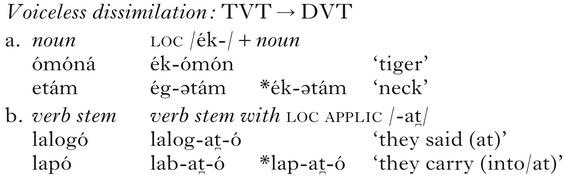
The dissimilation is subject to conditions on locality and morphology, but can be observed in multiple morphological contexts (all detailed in §2). The examples here are sufficient to show that both triggers and targets can occur in both roots and affixes.
1.1 Proposal
We argue that the facts of the Moro pattern motivate treating it as dissimilation of [–voice]. The phonological behaviour does not lend itself to an analysis using privative [voice] (cf. Lombardi Reference Lombardi1995). The only laryngeal contrast found in the language is between voiced and voiceless obstruents, and the phonetics of voiceless plosives do not warrant reanalysis in terms of other features, such as [spread glottis] (cf. Uffmann Reference Uffmann2013). Voiceless stops are not aspirated, and voiced stops are fully voiced (or prevoiced, when initial).
Our analysis of the pattern employs [–voice] as the dissimilating feature. Both phonetic data and phonological behaviour converge on this conclusion. It is therefore in agreement with proposals such as that of Wetzels & Mascaró (Reference Wetzels and Mascaró2001), who also advocate the inclusion of [–voice] as an active feature. The dissimilation pattern is analysed using the theory of surface correspondence (Rose & Walker Reference Rose and Walker2004, Hansson Reference Hansson2010, Bennett Reference Bennett2015). This approach does not require that dissimilation apply only to marked features, so even though [–voice] is the unmarked value of [±voice] for obstruents, it can still participate in dissimilation. We further show that exceptions to dissimilation are not random, but due to specific constraints on the distribution of voiced and voiceless consonants in the language.
The structure of the paper is as follows. In §1, we lay out in more detail the chequered history of [–voice], and the accordingly problematic status of voicelessness dissimilation. In §2, the basic Moro dissimilation data is presented. In §3, we present results of an acoustic study showing that the laryngeal contrast in Moro is indeed a matter of voicing, not aspiration. In §4, we present the formal analysis in the surface correspondence theory of dissimilation; comparison with some alternative analyses can be found in Appendix B in the online supplementary materials accompanying the paper.Footnote 2 §5 has concluding discussion.
1.2 The problem: what doesn't exist can't dissimilate
Dissimilation has received various formal analyses and functional explanations (perception, production), with avoidance of similar elements at the core (Kent Reference Kent1936, Ohala Reference Ohala, Masek, Hendrick and Miller1981, Alderete Reference Alderete1997, Suzuki Reference Suzuki1998, Frisch Reference Frisch, Hayes, Kirchner and Steriade2004, Frisch et al. Reference Frisch, Pierrehumbert and Broe2004, Gallagher Reference Gallagher2010a, b, Jurgec Reference Jurgec2011). In nearly all of these approaches, dissimilation of a given property entails certain things about the representation of that property. For example, theories that understand dissimilation as an OCP effect holding over features (e.g. Yip Reference Yip1988) entail that dissimilation can only apply to actual features (or feature-geometric bundles); they predict that non-featural properties such as length should not be able to dissimilate. Similarly, featural markedness-driven approaches to dissimilation (Alderete Reference Alderete1997, Itô & Mester Reference Ito and Mester1998) entail that dissimilating properties are not merely features, but more specifically marked features. In all of these approaches, things that are not real (in representational and/or perceptual terms) should not dissimilate.
Dissimilation of voicelessness is problematic, as [–voice] is often treated as an unmarked or non-existent feature. Some previous work argues that voicing should be regarded as privative, such that the feature [–voice] does not exist (Mester & Itô Reference Mester and Itô1989, Cho Reference Cho1990, Rice & Avery Reference Rice and Avery1990, Lombardi Reference Lombardi1991, Reference Lombardi1995, Brown Reference Brown2016). Some other theories use different features or elements, but make the same assumptions. For example, Avery (Reference Avery1996, Reference Avery1997) and Avery & Idsardi (Reference Avery and Idsardi2001) use the features [slack] and [stiff] rather than [voice] and [spread glottis], but still leave voiceless unaspirated consonants unspecified for both features. Approaches like these make it difficult to explain dissimilation of voicelessness: if we reject the existence of […voice], then it is impossible to characterise voicelessness dissimilation as avoidance of [–voice] … […voice].
The puzzling status of voicelessness dissimilation is not unique to privative theories of [voice]. Other work admits [±voice] as a binary feature, but takes [+voice] to be the universally marked value (e.g. Kiparsky Reference Kiparsky, van der Hulst and Smith1982, Krämer Reference Krämer2000, Clements Reference Clements2001, Reference Clements2003, de Lacy Reference de Lacy2006; see also Keating Reference Keating1984, Kingston & Diehl Reference Kingston and Diehl1994, Tang Reference Tang2008, Kingston et al. Reference Kingston, Lahiri and Diehl2011). On this interpretation, phonological patterns applying specifically to [–voice] should be possible, but relatively unlikely and marked. In much the same spirit, markedness-driven theories of dissimilation (Alderete Reference Alderete1997, Itô & Mester Reference Ito and Mester1998) would exclude [–voice] dissimilation entirely, or only allow it if a language also has [+voice] dissimilation. Either way, we arrive at a very similar conclusion to the privative [voice] line of reasoning: when we encounter a pattern like the one in Moro, we should seek alternative explanations before making crucial reference to [–voice].
Perceptual explanations for dissimilation come with similar entailments: Ohala (Reference Ohala, Masek, Hendrick and Miller1981) proposes that dissimilation arises from hypercorrection by the listener in order to undo presumed coarticulation; features whose acoustic cues are temporally ‘spread out’ enough to be present on distant segments are subject to hypercorrection. This theory makes clear predictions on which properties would be prone to dissimilation. Certain laryngeal features, such as glottalisation and aspiration, have acoustic cues that tend to spread out over adjacent segments; these are predicted to dissimilate (as indeed they do; see Gallagher Reference Gallagher2010a, Reference Gallagherb, Reference Gallagher2011 and Bennett Reference Bennett2015 for examples). But since the cues for voicing distinctions are primarily durational in nature, they are internal to the segment. Consequently, the listener hypercorrection theory predicts that neither [+voice] nor [–voice] should dissimilate – a prediction which Ohala notes as problematic (see also Alderete & Frisch Reference Alderete, Frisch and de Lacy2007 and Bye Reference Bye, van Oostendorp, Ewen, Hume and Rice2011 for related discussion).
Taken as a group, these arguments point away from analysing voicelessness dissimilation as straightforward dissimilation of [–voice]. If [–voice] even exists, it should be unmarked, and moreover should not have the right kind of phonetic implementation to lend itself to dissimilation. As such, when we find voicelessness dissimilating, we should seek alternative analyses first.
1.3 Work-arounds: voicelessness dissimilation without [–voice]
If the apparent voicelessness dissimilation in Moro is not simple dissimilation of […voice], then it must be something else. In some previous treatments of other cases of voicelessness dissimilation, the general approach is to appeal to some other feature. But which other feature could it be?
One alternative that can be ruled out immediately is [+voice], i.e. that the pattern is actually dissimilation of voicing. This is the line taken in Lombardi's (Reference Lombardi1995) analysis of Dahl's Law in Gikuyu, which appeals to an OCP constraint for privative [voice], aided by a number of default fill-in rules that insert [voice] by default in various places at different crucial points in the derivation.Footnote 3 The result obtained is a basic pattern of alternating voiceless–voiced sequences, derived by having voiced stops dissimilate to voiceless before any voiced consonant (including sonorants and other voiced obstruents alike).
Lombardi's (Reference Lombardi1995) analysis requires a number of uncomfortable stipulations, but even leaving those aside, a similar scheme cannot explain Moro. Key to the analysis is the generalisation that Dahl's Law in Gikuyu applies principally in prefixes, where voicing is not contrastive. But it is clearly contrastive in Moro, even in the contexts where dissimilation occurs. Some examples are given in (2). In (2a), we see that a root with voiceless /p/ triggers dissimilation ([íg-ɜ́pwɜ], *[ík-ɜ́pwɜ]), and that /b/ does not trigger this alternation. The near-minimal pairs in (b) and (c) show the same /p/ vs. /b/ contrast in root-initial position, both before and after underlying /g/. This demonstrates that there is no dissimilation between voiced obstruents. So dissimilation in Moro cannot be explained away using underspecification and dissimilation of privative [voice].
-
(2)

Another, much more intuitive, approach is to characterise the voicing contrast in terms of [±spread glottis] (or [long VOT] (Gallagher Reference Gallagher2011), or the element H (Backley Reference Backley2011); the choice among these is not essential). This is the approach that Uffmann (Reference Uffmann2013) takes to explain Dahl's Law in Kitharaka, and goes back to an earlier suggestion by Meinhof (Reference Meinhof and van Warmelo1932: 181) that the essence of the pattern is dissimilation of aspiration rather than of voicelessness. Since [+spread glottis] is more widely regarded as a marked and specified feature, and since aspiration is known to dissimilate in other cases,Footnote 4 the resulting picture of dissimilation fits more comfortably with previous thinking both about dissimilation and about voicing.
The proposition that voicelessness dissimilation is really dissimilation of aspiration draws considerable support from a large body of work under the banner of ‘laryngeal realism’. A major conclusion of this work is that some cases of putative [±voice] contrasts are not really distinctions based on voicing. Thus, Beckman et al. (Reference Beckman, Jessen and Ringen2013) distinguish between ‘voice’ languages, which use [voice] (e.g. Spanish, Polish), and ‘aspiration’ languages, which use [spread glottis] (e.g. English, German) (Iverson & Salmons Reference Iverson and Salmons1995, Reference Iverson and Salmons1999, Reference Iverson and Salmons2003, Honeybone Reference Honeybone, van Oostendorp and van de Weijer2005, Petrova et al. Reference Petrova, Plapp, Ringen and Szentgyörgyi2006, Beckman et al. Reference Beckman, Jessen and Ringen2013; see also Avery & Idsardi Reference Avery and Idsardi2001).Footnote 5 These categories realise their laryngeal distinctions in different ways. Voice languages have a contrast between early or negative VOT stops (voiced) and short-lag VOT stops (voiceless unaspirated). Aspiration languages have a contrast between short-lag VOT stops and long-lag VOT stops (voiceless aspirated). Arguments are drawn from directionality of assimilation and positional neutralisations such as final devoicing, which support the conclusion that voiceless unaspirated stops are laryngeally unspecified, and not crucially [–voice].
Given these issues, it is important to determine whether Moro is a voice language or an aspiration language. If it is a voice language, then it should not have voicelessness dissimilation. If it is an aspiration language, the dissimilation of voiceless consonants could be analysed as dissimilation for the feature [spread glottis], without making crucial reference to [–voice].
In §2, we present the data in more detail, and show that voicelessness dissimilation in Moro is robust and real. In §3 we then take up the question of whether Moro is a voice language or an aspiration language, with an acoustic study of the phonetic realisation of the voicing contrast.
2 The Moro dissimilation data
2.1 Moro background
Moro is classified as a Heiban language within Kordofanian (Schadeberg Reference Schadeberg1981). It has six or seven dialects; the data in this paper are from the Thetogovela dialect (also known as Tobə‹elda), and were collected from two speakers residing in the United States, and one residing in Omdurman, Sudan. The native name for Moro in this dialect is [ðəmwaɾə́ŋá]. Descriptions of other dialects include Black & Black (Reference Black and Black1971) on the ‘Umdorein dialect’, which is probably the dialect referred to as Werria, and forms the basis for standard, written Moro. There is also some discussion of Moro dialects in unpublished material collected by Elizabeth Guest.Footnote 6
The obstruent inventory of Moro is given in (3). Obstruents contrast for voicing, but not other laryngeal features. Two fricatives have no contrastive counterparts: voiceless [s] and voiced [ð].
-
(3)

The voiceless consonants and [ð] may appear as geminates (sonorants may also be geminated). We will show that when geminated, voiced obstruents (except /ð/) undergo devoicing.
2.2 Dissimilation case 1: the locative prefix
The locative prefix in Moro is [é-] before consonant-initial stems, but [ék-] before vowel-initial stems of the g- noun class and [és-] before vowel-initial stems of the j- noun class. The /e/ surfaces as [i] under vowel harmony. The g- noun class are singular nouns that historically had initial *g and pair with l- class or n- class plurals (Gibbard et al. Reference Gibbard, Rohde, Rose, Matondo, Laughlin and Potsdam2009).Footnote 7 The locative marker /ék-/ undergoes dissimilation preceding a voiceless consonant across a vowel (in a rule-based format: /k/→[g] / _VC[–voice]). The /és-/ marker does not undergo dissimilation to [z]; there is no [z] in Moro.
The examples in (4) illustrate locative /ék-/ before g- class vowel-initial nouns that lack voiceless consonants. The addition of the locative prefix also causes high-tone spreading, reduction of some vowels following the prefix and elision of some final vowels; we do not analyse these effects here.
-
(4)
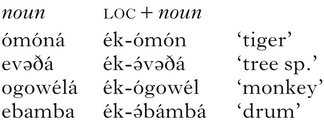
If a vowel-initial noun of the g- class has a voiceless consonant following the initial vowel, dissimilation occurs. With nouns of this form, the locative prefix appears as [ég-] or [íg-] rather than [ék-] or [ík-], as shown in (5). Not much data is available for dissimilation before fricatives, as voiceless fricatives are infrequent sounds in Moro. In the one example we found, ‘spirit’ in (5), speakers were unsure whether the prefix should have [k] or [g], which may suggest that fricatives only optionally trigger the dissimilation, or that examples are too rare for speakers to be certain.
-
(5)
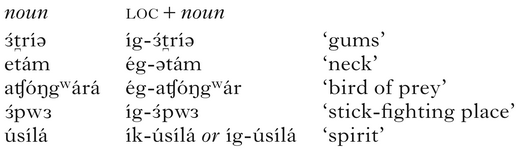
The dissimilation is subject to a CVC proximity restriction: prefixal /k/ only dissimilates when a voiceless consonant immediately follows the root-initial vowel. Thus the voiceless consonants in (6) do not trigger dissimilation.
-
(6)
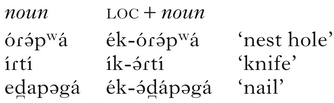
This kind of proximity restriction is well attested in previous surveys of dissimilation, as well as assimilation (Rose & Walker Reference Rose and Walker2004, Hansson Reference Hansson2010, Bennett Reference Bennett2015).
Two further remarks are in order before moving on to other morphological constructions that exhibit the same phonological pattern. First, the data clearly shows the voicing of /ék-/ → [ég-] to be dissimilatory. It is not the case, for instance, that the consonant is simply voiced intervocalically: words like [logopájá] ‘cup’, [lókógóŋ] ‘scorpion’, [ebamba] ‘drum’, [opéréə] ‘sword’ and [lapaba] ‘circular mat for fanning fire’ clearly show contrastive voicing in the intervocalic position. Second, this dissimilation is clearly for voicelessness, not voicing. Voiced stops may co-occur in adjacent syllables, and do not dissimilate, e.g. [ibəgwɜ́gá] ‘back of knee (instr)’, [ɜ́dígá] ‘skin (instr)’, [égabəɾó] ‘I touched’. Voicing is also not otherwise predictable, e.g. in an alternating voiced–voiceless rhythm. These alternative, non-dissimilatory, characterisations of the data do not fit the facts. We turn now to further data that demonstrates the generality of the phenomenon.
2.3 Dissimilation case 2: verbal suffixes
Dissimilation is not limited to the locative prefix; it is also found with other morphemes. One group is formed by verbal suffixes with the shape /-Vt̪/. These include the benefactive applicative suffix /-ɘt̪/,Footnote 8 the inchoative /-et̪/ and the locative applicative /-at̪/; they cause dissimilation of a voiceless consonant in the root, i.e. /T-Vt̪/ → [D-Vt̪].
The benefactive applicative suffix triggers vowel harmony, which raises all vowels in the stem, and causes final dental stops to palatalise; due to dissimilation, these are realised as [ᵈᶾ] rather than [ʧ]. It is clear that this is due to dissimilation, as the passive suffix /-ɘn/ also triggers palatalisation, but here final voiceless dental stops are realised as [ʧ]: e.g. [l-ɜ-wɜʧ-ɘn-ú] ‘they were sewn’. The forms in (7) are conjugated in the 3rd plural perfective with the structure sm.cl1-rtc-root-(appl)-pfv.
-
(7)
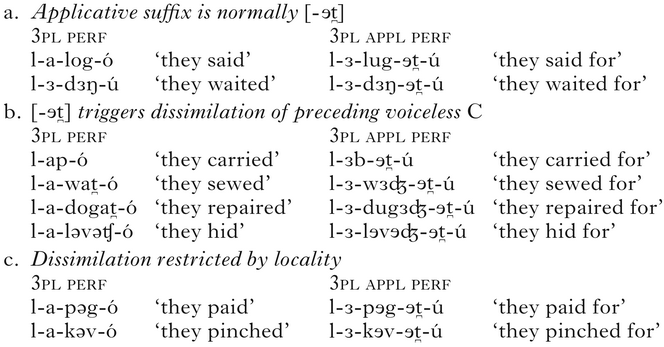
The examples in (7a) show the applicative suffix in a form with no voiceless consonants, where it is realised as [-ɘt̪]. In the examples in (b) it causes dissimilation in a preceding voiceless consonant. Here, as in the locatives, dissimilation is subject to a CVC proximity restriction, illustrated by the non-dissimilation of root-initial /p/ and /k/ in (c). In applicative forms, we can observe dissimilation applying to consonants other than /k/. Dissimilation in both the applicative and the nominal locative in §2.2 holds in a strictly right-to-left fashion. There are two exceptions to the pattern in regular roots, [l-ɜ-murkw-ɘt̪-ú] ‘they rolled (for)’ and [l-ɜlɘf-ɘt̪-ú] ‘they promised (to)’. The first case may be due to the labial [w] intervening between the voiceless root consonant and the suffix, disrupting locality. The second may be due to fricatives not participating in the dissimilation process as targets. It is an Arabic loanword, so may also be an exception for this reason.
Dissimilation can also be seen with a suffix that we label ‘inchoative’, realised as [-ət̪] or [-et̪], which causes dissimilation in preceding roots. This morpheme appears in imperative forms derived from adjectives, as in (8a). It is [-et̪] if the root is short and contains a short [ə] or [ɘ], and [-ət̪] if the root contains a full vowel or no vowel. We assume that the form with [ə] is a reduced form of the suffix with a full vowel. The form in (b) shows it causing dissimilation in the same fashion as the applicative suffix /-ɘt̪/ above.
-
(8)
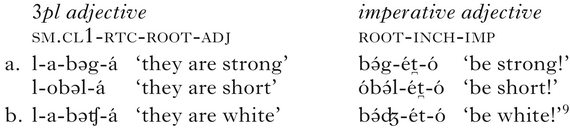
The locative applicative/malefactive suffix /-at̪/ triggers dissimilation, but unlike the benefactive applicative, it causes no other phonological changes (such as vowel harmony or palatalisation), as shown in (9).
-
(9)

The two applicative suffixes /-ɘt̪/ and /-at̪/ cannot combine, so no dissimilation effect can be observed between them. Instead, benefactive + locative applicative meaning is conveyed with a single suffix, /-it̪/, which also triggers dissimilation, e.g. [l-ɜb-it̪-ú] ‘they carried into for’.
2.4 Dissimilation case 3: the reduplicative durative/iterative prefix
The final morphological context where we can observe dissimilation is a durative/iterative prefix. This prefix takes the shape /CaC-/ before roots that are consonant-initial. The consonants of the prefix are copies of the root-initial consonant. The second consonant forms a geminate with the initial root consonant; the vowel is [a] or [ɜ], depending on vowel harmony. Examples are given in (10), with the reduplicant in bold. Labialisation may or may not be copied, depending on the speaker.
-
(10)

The /CaC-/ prefix has a [DaT-] pattern with obstruents, as in (11). The result is a voiced–vowel–voiceless sequence: a structure that looks conspicuously like the expected outcome of dissimilation.
-
(11)
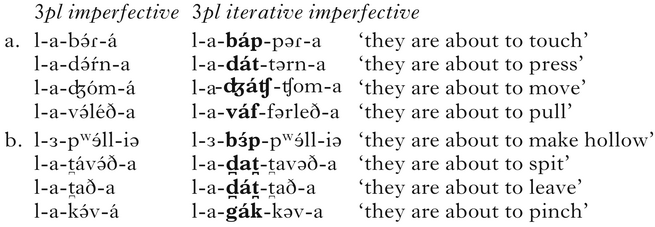
Two alternations are discernable here: devoicing of geminates, and voicelessness dissimilation. Moro systematically disallows voiced geminate obstruents, with the exception of [ðð], and these are repaired by devoicing, as in (11a): for example, root-initial /b/ in /bə́ɾ/ changes to [p] in [-báp-pəɾ-]. Thus geminates are created by the last consonant of the prefix copying the root-initial consonant, and these are all predictably voiceless, irrespective of the underlying voicing of the root-initial consonant. Further support for the existence of a ban against voiced obstruent geminates comes from the fact that voiceless geminate consonants fail to voice when followed by a voiceless obstruent in a CVC configuration, normally the locus of dissimilation. For example, the inchoative suffix [-et̪] in [mə́ttét̪ áŋəno] ‘be smooth!’ fails to trigger dissimilation: *[mə́ddét̪ áŋəno].
The forms of interest for the voicelessness dissimilation pattern are those in (11b), which show dissimilation of the first consonant in the reduplicative prefix. This first consonant is predictably voiced on the surface, even though the initial root consonant it copies from is voiceless. This fits with the same dissimilation pattern seen elsewhere: in CVC reduplicants, C2 is always voiceless, which causes C1 to dissimilate from voiceless to voiced. That is, perfectly faithful copying in the final form in (b) would lead to *[lakákkəva]; but what we find is instead [lagákkəva], reflecting dissimilation of /k/ to [g].
Finally, the voiced fricative /v/ displays variability, as in (12). This is expected, given the previous data on fricatives from locative nominals. The voiceless fricative /s/ shows no variability and is never realised as voiced [z], which, as we have seen, does not exist in Moro.
-
(12)

2.5 Dissimilation in roots?
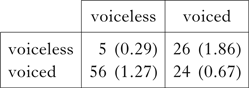
There is evidence that the dissimilation pattern holds within roots as well. From a database of around 1200 lemmas (noun, adjective and verb roots, adverbs and postpositions; compounds were excluded), 111 occurrences of stops/affricates co-occurring across a vowel (CVC configuration) were noted. Observed/expected (O/E) ratios were calculated to test whether there is underrepresentation of particular combinations (Pierrehumbert Reference Pierrehumbert1993). An O/E ratio less than one indicates underrepresentation. ‘Observed’ is the number of stop/affricate pairs for each voicing combination in a CVC configuration. ‘Expected’ is the probability of each combination of [ɑvoice] stops/affricates co-occurring, based on the individual frequency of each. This is calculated by the actual number of [ɑvoice] stops/affricates in C1 / total number of CVC stop/affricate combinations × the probability of [ɑvoice] stops/affricates in C2 × the total number of CVC stop/affricate combinations. This distribution is significant (x 2 = 26.029, df = 3, p < 0.0001). Table I shows that voiceless–voiceless combinations are very underrepresented and voiced–voiced combinations are also underrepresented, whereas the combinations of voiceless and voiced are overrepresented, particularly voiceless–voiced.
Static restrictions on voiceless and voiced non-continuant combinations. O/E ratios are given in parentheses.

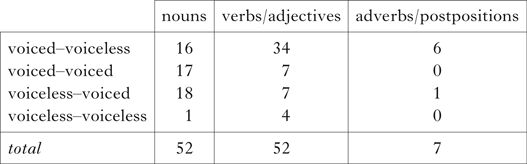
However, there is considerable skewing, depending on word-class, as can be seen in Table II.
Number of transvocalic non-continuant obstruent combinations.

In nouns, the distribution is even among all classes, except for the voiceless–voiceless combination. However, in verbs and adjectives, the voiced–voiceless combination dominates. Of the 34 attested combinations, 28 of them involve a second consonant that is either [t̪] or [ʧ], the likely vestige of a lexicalised extension suffix that would have triggered dissimilation, like the applicative markers. This likely accounts for the overrepresentation of this combination in verbs/adjectives. There are too few patterns in the adverb/postposition class to draw many conclusions.
The five examples of voiceless–voiceless combinations are given in (13) (verbs are provided in the proximal imperative, which has a single suffix [-ó]~[-ú]).
-
(13)

These words are reasonable exceptions. Geminate stops are always voiceless and never undergo dissimilatory voicing, so dissimilation is not expected in (13a): [óppə́t̪ó], *[óbbə́t̪ó]. The [pw] in (b) and (c) might be considered insufficiently local, due to the [w]. Another possible explanation is that root-initial consonants resist dissimilation. This would also explain the verb [t̪ét̪ó] in (d). The noun [t̪ét̪ə́m] in (e) has an alternative form [d̪ét̪ə́m], showing vacillation between respecting dissimilation and possibly respecting a preference for root-initial voiceless consonants.
As noted above, the behaviour of fricatives in the dissimilation pattern is indeterminate. Co-occurrence of voiceless fricatives with other voiceless obstruents is uncommon in roots, in part due to the low attestation of voiceless fricatives in general (ten lexemes with /f/ and 25 lexemes with /s/ in the non-ideophonic vocabulary). Of these, seven involve combinations of a voiceless fricative with another voiceless obstruent in a CVC configuration. Five of these are cases in which /s/ precedes a voiceless consonant, but /s/ cannot voice to [z]. Two involve /s/ following other voiceless consonants: [alfásəl] ‘room’, borrowed from Arabic, and the verb [tɜ́sí] ‘shake’. It may be the case that fricatives are just not involved in dissimilation in roots, but the evidence is unclear.
2.6 Morpheme-specific dissimilation patterns
We have presented several cases in which dissimilation is triggered by both verbal suffixes and the root. In this section, we outline cases in which dissimilation does not occur, even though the linear configuration voiceless–vowel–voiceless is present. This is due to morphological or prosodic restrictions on its application.
Dissimilation in nouns occurs only across a prefix–root boundary. In (14a), the nouns /et̪a/ ‘lake’ and /opa/ ‘grandmother’ trigger dissimilation on the locative prefix, as expected. However, they fail to undergo dissimilation from the demonstrative suffixes /-íkki/ and /-íkkɜtíkɜ/ in (b), so *[óbɜ́-kki], for example, is not possible.
-
(14)

There is also no dissimilation within the demonstrative suffix itself. That is, the form is [-kkɜtíkɜ], not *[-kkɜdíkɜ]. Vowel harmony obeys similar domain boundaries in Moro. Nominal prefixes harmonise, but suffixes, with the exception of inalienable possessives, do not. These demonstratives can stand alone as independent demonstrative pronouns, but vowel-hiatus resolution (/a + i/ → [ɜ]) shows that they are nevertheless phonologically integrated with the preceding noun when suffixed. The domain of dissimilation in nouns is therefore restricted to the morphological unit [prefix–root].
For verbs, we presented all the suffixes with voiceless consonants in §2.4. Here we briefly discuss two cases of single-consonant voiceless prefixes. First, the consecutive complementiser /t̪-/ appears in phrase-initial position, and never undergoes voicing, e.g. [t̪-a-kəl-a] ‘and then you sliced’. Second, there is a phrase-initial strengthening process that causes the noun-class subject agreement prefix /g-/ to be realised as [k-] in phrase-initial position, even in a potentially dissimilating context. In (15a), the noun-class agreement marker is realised as [g], as it is medial in the sentence/phrase. In (b), it is sentence-initial, and is realised as [k], despite the fact that there is a following [t̪].
-
(15)
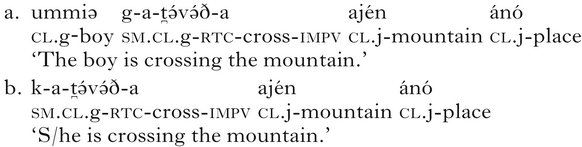
The phrase-initial strengthening process applies regardless of the fact that it creates a voiceless–vowel–voiceless configuration. Phrase-initial strengthening only applies to the initial noun class concord marker /g-/. Other phrase-initial voiced obstruents, as in the imperative verbs /bə́ɾó/ ‘touch!’ and /gə́ɲó/ ‘kill!’, do not undergo devoicing. These two cases show that phrase-initial voiceless realisation of prefixes trumps dissimilation. Other examples of this kind of initial effect will be discussed and analysed in §4.2.
3 The status of Moro voicelessness as genuine [–voice]
We have so far identified a robust pattern in the Moro data: sequences of two voiceless obstruents are changed to voiced–voiceless sequences in a number of morphemes, and are avoided in the lexicon. The pattern seems to be dissimilation for voicelessness, but, as we noted previously in discussion of laryngeal realism (§1.3), it is also conceivable that the dissimilation is really for [spread glottis] or some other equivalent feature that is not [–voice]. This goes hand in hand with the question of how the laryngeal contrast in Moro is represented, i.e. whether it is a voice language or an aspiration language.
The voice vs. aspiration distinction is readily testable. If Moro is really a voice language, then the ‘voicing’ distinction should be a difference between fully voiced or prevoiced stops and short-lag voiceless stops. If, on the other hand, Moro is really an aspiration language, then the ‘voicing’ contrast should actually be a contrast between short-lag voiceless stops and long-lag voiceless stops (e.g. aspirates). We therefore conducted a descriptive acoustic study to determine the general characteristics of Moro stops, as a way of confirming whether Moro stops fit the profile of languages that make their laryngeal distinctions using [voice] rather than [spread glottis].
3.2 Acoustic study of Moro stops
3.2.1 Methods
Three speakers of Thetogovela Moro participated in the study, two males and one female. All three are also fluent in English and Sudanese Arabic.
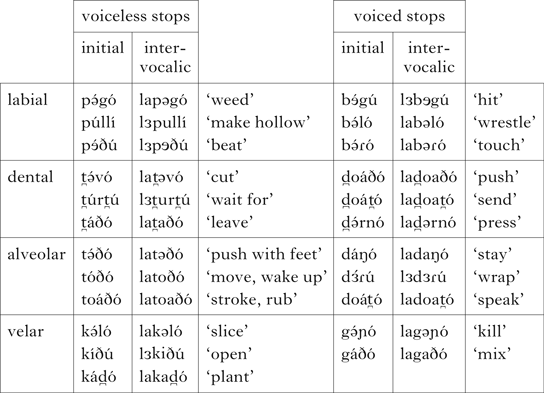
The 23 monosyllabic verb roots with initial stops in Table III were selected for the study. For labial, dental and alveolar places of articulation, three verbs with voiceless stops and three verbs with voiced stops were selected. For velars, three verbs with voiceless stops and two verbs with voiced stops were selected (there is a paucity of verbs with initial /g/). Verbs were conjugated in two forms, to create a phrase-initial context (singular imperative) and an intervocalic context (3rd plural perfective). The tone patterns of these two forms were identical across verb roots. An attempt was made to select one root with a following short central vowel [ə] or [ɘ] and one root with a following full vowel [ɜ o i e u a], but this was not possible in all cases. In intervocalic position, the preceding vowel was [a] or [ɜ], depending on vowel harmony. Each word was produced four times.
Materials for acoustic study.

Data were recorded by the second author in a private home on a PMD 660 Marantz recorder with an external microphone sampled at 44.1 kHz. This setting was comfortable and convenient for the speakers. Measurements were assessed for the second through fourth repetitions of the words. For initial voiceless stops, VOT was measured from the release burst of the stop up to the onset of the periodic waveform of the following vowel. For initial voiced stops, negative VOT or prevoicing was measured from the onset of voicing (onset of periodicity and onset of energy in the voicing bar) up to the release burst of the stop (Francis et al. Reference Francis, Ciocca and Ching Yu2002). For intervocalic voiced stops, closure duration was measured as the decrease in amplitude between the two vowels. For intervocalic voiceless stops, closure duration was measured between the offset of voicing of the preceding vowel and the onset of the periodic waveform of the following vowel. In addition, the release of the voiceless stop was measured up to the onset of the periodic waveform of the following vowel.
3.2.2 Results
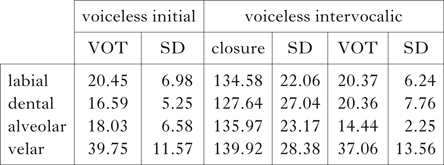
We found that the voiceless stops in Moro are short-lag voiceless stops: they are not aspirated. The duration measurements are given in Table IV for voiceless stops, averaged across all tokens for the three speakers. The duration from stop release to onset of the following vowel is labelled as VOT duration for intervocalic stops.
Average duration measurements (ms) for voiceless stops (three speakers).

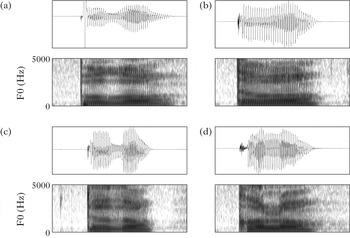
In Fig. 1, we provide waveforms and spectrograms for four words with initial voiceless stops, produced by speaker M2. In each case, there is a period of silence before the release of the stop, followed by a short VOT before the onset of the vowel, except in the case of [k], which shows a slightly longer VOT. In this token, the measurement is 36.49 ms.
Waveforms and spectrograms of initial voiceless stops (speaker M2): (a) [pǝ́gó] ‘weed’; (b) [t̪ǝ́vó] ‘cut’; (c) [tǝ́ðó] ‘push with feet’; (d) [kǝ́ló] ‘slice’.

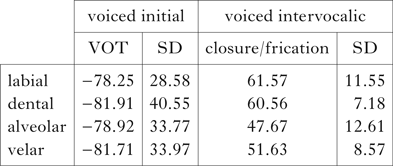
The voiced stops in Moro are not simply unaspirated; they are prevoiced. The duration measurements are given in Table V for voiced stops, averaged across all tokens at the same place of articulation for the three speakers. Average durations per speaker are provided in Appendix A in the online supplementary materials. For intervocalic stops, the realisation was in many cases more like a fricative or approximant. However, there is voicing throughout the articulation of these sounds; they are not passively voiced.
Average duration measurements (ms) for voiced stops (three speakers).

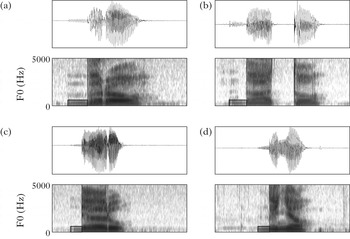
In Fig. 2, we provide waveforms and spectrograms for four words with initial voiced stops, again produced by speaker M2. In each case, a voice bar is identifiable on the spectrogram before the onset of the vowel, and the corresponding waveform shows low-amplitude periodicity corresponding to the voicing.
Waveforms and spectrograms of initial voiced stops (speaker M2): (a) [bǝ́ɾó] ‘touch’; (b) [d̪oát̪ó] ‘send’; (c) [dέɾú] ‘wrap’; (d) [gǝ́ɲó] ‘kill’. The voice bar preceding the onset of the vowel is indicated.

3.2.3 Discussion
In phrase-initial position, voiced stops seem to be routinely prevoiced, with negative VOT, averaging around 80 ms. There is a high standard deviation for initial voiced stops. Nevertheless, all initial voiced stops show some degree of prevoicing. Intervocalic stops are often spirantised (/b d g/ → [B ð ɣ[; /d̪/ is unaffected), but are still fully voiced.
As for voiceless stops, the voiceless velar stop shows the highest VOT, averaging 39.75 ms in initial position; that voiceless velars have higher VOT than more forward articulations is a result typical of many languages (Cho & Ladefoged Reference Cho and Ladefoged1999). Nevertheless, the other voiceless stops all average less than 21 ms, with the dental and alveolar stops the shortest. The voiceless stops as a group cannot be considered to be aspirated or to display long-lag VOT; instead they are best characterised as having short-lag VOT. The durations fall within the ranges typically attested for languages with unaspirated stops (approximately 10–30 ms for labials and coronals, 20–40 ms for velars; Cho & Ladefoged Reference Cho and Ladefoged1999). In intervocalic position, voiceless stops have a long voiceless closure and short VOT. As for the release, the VOT durations are comparable to those observed in initial position.
Based on the tenets of laryngeal realism in previous work (Beckman et al. Reference Beckman, Helgason, McMurray and Ringen2011, Beckman et al. Reference Beckman, Jessen and Ringen2013), Moro would be classified as a voice language, and not as an aspiration language. In initial position, the contrast is between prevoiced stops (with negative VOT) and voiceless stops (with short-lag VOT). Intervocalically, it is a contrast between fully voiced stops with short closure and voiceless stops with long closure and a short-lag VOT. The series of voiced obstruents are thus fully voiced, and the series of voiceless obstruents are simply unvoiced – not aspirated. Treating the contrast as one of [spread glottis] requires a significant mismatch between phonetics and phonology. We therefore conclude that the best analysis of Moro dissimilation is one employing the feature [–voice].
4 A correspondence-driven analysis of Moro dissimilation
The aim of this section is to demonstrate that when [–voice] is admitted as a feature, the Moro pattern receives a relatively natural and straightforward formal analysis within a theory of dissimilation that has two key properties: (i) the avoidance of highly similar segments, and (ii) no reliance on markedness as the explanation for dissimilation. Various approaches to dissimilation have these characteristics, including classical formulations of the OCP (e.g. McCarthy Reference McCarthy1986, Yip Reference Yip1988, Myers Reference Myers1997), Generalised OCP (Suzuki Reference Suzuki1998), anti-similarity reformulations of the OCP idea (Krämer Reference Krämer2001, Reference Krämer2003, Frisch et al. Reference Frisch, Pierrehumbert and Broe2004, Coetzee & Pater Reference Coetzee and Pater2008, etc.; see also Gallagher Reference Gallagher2010a, b, 2011), and the more recent Surface Correspondence Theory of Dissimilation (Bennett Reference Bennett2015; see also Faytak Reference Faytak, Kingston, Moore-Cantwell, Pater and Staubs2014, Noguchi Reference Noguchi2014, Shih & Inkelas Reference Shih and Inkelas2014, etc.). The analysis we lay out here follows the surface correspondence theory (henceforth SCTD). We choose this as the most current theory of dissimilation in the recent literature, and because it does not rely on any stipulations about relative markedness of features. Bennett (Reference Bennett2015) presents a survey of 154 dissimilation patterns, showing that dissimilation targets a variety of segments and features, both marked and unmarked. In this section, we give a basic overview of SCTD in general terms, then spell out our analysis of Moro using this approach.
Based in Optimality Theory, SCTD is an extension of Agreement by Correspondence (ABC; Rose & Walker Reference Rose and Walker2004), designed for consonant harmony. The foundational assumption of the theory is that featural similarity between segments is the basis for establishing surface correspondence relationships between them (as mandated by Corr constraints). Consonant agreement or harmony emerges from these relationships as the result of a drive for closer identity among similar consonants, due to their correspondence (a drive formalised by the family of CC·Ident constraints). Limits on harmony can likewise be handled by constraints imposing demands on the basis of correspondence relationships, such as a requirement that correspondent segments be in the same domain (the work of CC·Edge constraints), or they could be built into the Corr constraints that require correspondence, as locality conditions that narrow the scope of the constraints.
Given the basic architecture of ABC, dissimilation can be handled as the avoidance of correspondence (Walker Reference Walker2000, Bennett Reference Bennett2015). Reducing their featural similarity means that segments are not required to correspond with each other – and are therefore not subject to any other demands imposed on the basis of correspondence.Footnote 10 The basic idea, then, is that penalising correspondence has the effect of disfavouring similarity. If correspondence between C1 and C2 cannot satisfy all the demands (of identity, locality, etc.) imposed on correspondence relationships, then C1 and C2 should not correspond – in which case it's better for them to be dissimilar on whatever feature or features is driving the correspondence. Segments are thus faced with a choice between corresponding and obeying any limits imposed on correspondence, and dissimilating to become different enough that they are outside the correspondence requirement.
Note that the dissimilation interaction that emerges from surface correspondence is fully independent of any assumptions to be made about markedness. This differentiates the surface correspondence approach to dissimilation from various formalisations of the OCP that seek to derive dissimilation from segmental markedness (cf. Alderete Reference Alderete1997, Itô & Mester Reference Ito and Mester1998). The SCTD approach also makes no crucial assumptions about segmental or autosegmental representations, apart from the existence of a [–voice] feature specification to characterise voiceless obstruents. As such, the analysis does not come with any presuppositions about default feature fill-in or underspecification of [±voice], nor about tier-based adjacency or any relationships between markedness and autosegmental structure. Such questions are entirely orthogonal to the explanatory adequacy of the account, and we therefore abstract away from them.
4.1 The core dissimilation pattern
The analysis we propose derives dissimilation from the combination of two main constraints. The first is a Corr constraint that motivates correspondence between similar consonants – in this case, voiceless consonants. This defines the featural ‘scope’ of dissimilation: voiceless consonants are the ones that face pressure to correspond or dissimilate. The second major constraint is one that limits correspondence, to make such correspondence impossible in the conditions where dissimilation occurs. We take this to be a CC·Edge constraint, which prompts would-be correspondents to dissimilate when they straddle the edge of a domain.
Locality is built into the theory by making the correspondence constraints sensitive to the particular locality configuration. In the Moro case, this is a CVC sequence or ‘transvocalic’ domain, identified as a domain of correspondence for many other cases of consonant harmony and dissimilation (Rose Reference Rose2000, Hansson Reference Hansson2010, Bennett Reference Bennett2015). This confines the interaction to adjacent syllables. The participating consonants are highly similar: voiceless stops and affricates, identified by the features [—voice, —continuant] (fricatives are set aside, as their participation is doubtful). If [–voice] were not employed as a defining feature of the natural class, [—continuant] alone would be insufficient: this would predict correspondence among all stops and affricates, and dissimilation for continuancy. Absence of a feature cannot be referred to formally to define a class without invoking a [Ø] feature.
-
(16)
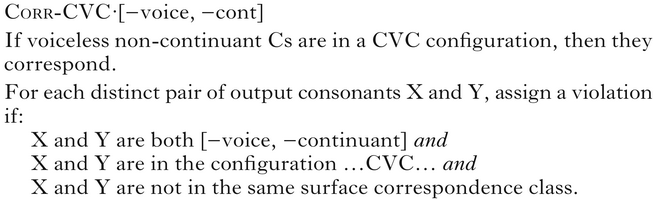
The Corr constraint in (16) interacts with another constraint that penalises correspondence across domain edges by requiring correspondence to be within a particular domain: CC·Edge(domain). Domains may be phonological (syllable, foot, prosodic word) or morphological (root, stem, word). This constraint also establishes domains for consonant harmony (see Bennett Reference Bennett2015 for more details). Since the three clear and productive subcases of dissimilation in Moro (discussed in §2 above) each hold across root–affix boundaries, we presume the relevant CC·Edge constraint to be one that picks out the root as its domain, as in (17).
-
(17)
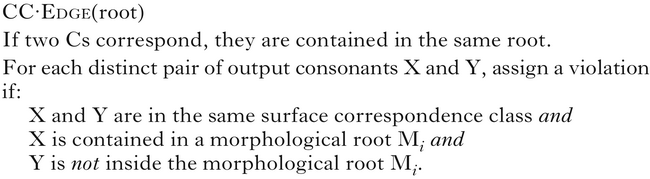
To illustrate with the example /ék-etám/ → [égətám] ‘in the neck’, the two surface correspondence constraints are ranked above a faithfulness constraint that prevents changes to the feature [voice]: IO·Ident[voice]. This is shown in (18).Footnote 11
-
(18)

Correspondence relationships between surface consonants ( ) are marked in set notation, with each group of correspondents co-indexed to the consonants it includes. If there is total non-correspondence among segments, as in (18a) and (c), then each consonant forms its own set. Corr-CVC·[—voice, —cont] requires voiceless obstruents to correspond. This rules out faithful non-correspondence between two voiceless stops, as in (18c). CC·Edge(root) wants the voiceless consonants here to not correspond; since they are separated by a prefix–root boundary, correspondence between them crosses the edge of the root. This rules out faithful correspondence between the voiceless stops, as in (b). Thus pairs of […voice] consonants are required to correspond by one constraint, but are prohibited from doing so by the other constraint: they cannot both correspond and also satisfy the requirement imposed on correspondence by CC·Edge. The solution is to make them not be a pair of [–voice] Cs: dissimilating one to [+voice] as in (18a) allows both constraints to be satisfied at the same time.
This same basic constraint ranking also applies to cases in which a suffix triggers a change to a root consonant, as in /l-ap-ɘt̪-ó/ → [lɜbɘt̪ú] ‘they carried for someone’. This is because a suffixal voiceless consonant and a root /p/ straddle the root edge, just like the /k-Vt/ sequence shown in (18). Any pair of voiceless stops or affricates that crosses the root edge is compelled to dissimilate under this ranking.
Moro dissimilation is always regressive, so the output in (18) is [égətám], not *[ekədám]. We do not propose an explanation here for this rigid directionality, but simply note that left-to-right dissimilation is systematically not found. Recent work on surface correspondence has viewed directionality as an unsolved problem (see e.g. Rose & Walker Reference Rose and Walker2004, Hansson Reference Hansson2010, Bennett Reference Bennett2015). In the Moro case, a faithfulness constraint that protects the rightmost of any two voiceless consonants would be sufficient to force this right-to-left directionality on the process. Jurgec (Reference Jurgec2011) posits positional faithfulness constraints that pick out the rightmost or leftmost occurrence of a feature in a domain; a constraint of this form, such as IO·Ident[voice]/CVC-Rightmost, would suffice for our analysis.
Now let us turn to reduplicated prefixes. Roots with initial voiceless consonants show dissimilation in the reduplicative prefix – exactly what would be expected from copying the root consonant in the usual way, then applying the dissimilatory alternation in the same fashion as above. In this case, we see dissimilation trump base–reduplicant identity, rather than input–output identity; like IO·Ident, BR·Ident is also ranked lower than the Corr and CC·Edge constraints, as shown in (19). (We take the geminates created through this reduplication, such as [kk] in (19), to be single long consonants which straddle the root–prefix boundary, and indicate their uniformity with a tiebar.)
-
(19)

The reduplicative prefix shows a further layer of complexity, because Moro has a ban on voiced geminate obstruents (as noted above in §2.5). If the initial root consonant is voiced, we would expect a voiced geminate to be created through reduplication: reduplicative prefixation of /bəɾ/ ‘touch’ should yield [-báb-bəɾ-]. However, the ban on voiced geminates, formalised here as a constraint *VoiObs-Gem, rules this out in favour of a geminate [pp] instead of [bb]. *VoiObs-Gem is thus ranked higher than BR·Ident[voice], as in (20). Given this ban on voiced geminates, the initial consonant of the reduplicative prefix exhibits a further dissimilatory effect. With /bəɾ/, geminate devoicing and faithful reduplication should give [-páp-pəɾ-], as in (c, d); however, the form we actually observe is [-báp-pəɾ-] in (a), with apparent dissimilation in the reduplicant. This result falls out from the ranking established in (19), together with undominated *VoiObs-Gem.
-
(20)

4.2 Resistance to dissimilation
In §2 we briefly discussed three situations in which dissimilation does not apply to a TVT sequence: (i) if the first T is a geminate obstruent, (ii) if the second T is in a nominal suffix and (iii) if the first T is in phrase-initial position. In this section we present two more cases of dissimilation failing to apply in the TVT configuration, ones for which the explanation constitutes an emergent effect. We show that both cases can be attributed to higher-ranked constraints that interact with those given above.
The first case involves the iterative/durative reduplicative prefix when it appears in stems in the imperative. Unlike in other verb forms with this prefix, there is no dissimilation, as shown in (21). In fact, there is an additional requirement that both obstruents be voiceless, no matter the original voicing of the initial root consonant.
-
(21)
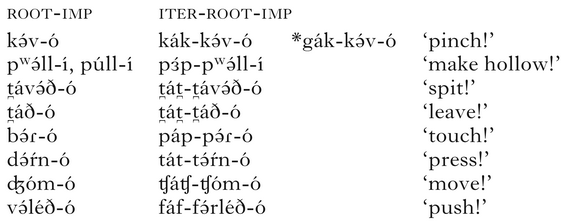
We propose that there is a preference for initial obstruents to be voiceless rather than voiced, which is manifested in these forms as a resistance to dissimilation. Two known aerodynamic factors conspire towards initial voiceless obstruents: (i) utterance-initial position favours longer closures (Westbury & Keating Reference Westbury and Keating1986), and (ii) the longer the stop closure, the harder it is for voicing to be maintained (Ohala & Riordan Reference Ohala, Riordan, Wolf and Klatt1979). In Moro, voiced stops and affricates in word-initial position are permitted, as we have already seen in the acoustic experiment. However, there is some evidence that there is a gradient tendency to avoid them. Voiced consonants in initial position are less common than voiceless ones both for lexemes overall (70 vs. 104) and within all lexical categories. Initial /g/ has been lost historically in most words. Word-initial /b d̪ d ᵈᶾ/ are rare in nouns (ten attestations), largely because most nouns have a noun class prefix, and none of the class prefixes include these consonants (Gibbard et al. Reference Gibbard, Rohde, Rose, Matondo, Laughlin and Potsdam2009). They may appear word-initially in verbs, but only in imperative forms; in all other contexts they are preceded by prefixes. Moreover, in related Kordofanian languages, a preference for voiceless initial consonants is also reported. In Koalib (Quint Reference Quint2009), only voiceless obstruents are attested word-initially; voiced obstruents appear postvocalically. In Dagik (Vanderelst Reference Vanderelst2016), the distribution is similar: voicing is allophonic, with voiceless stops only appearing word-initially and word-finally (the latter position limited to [k]).
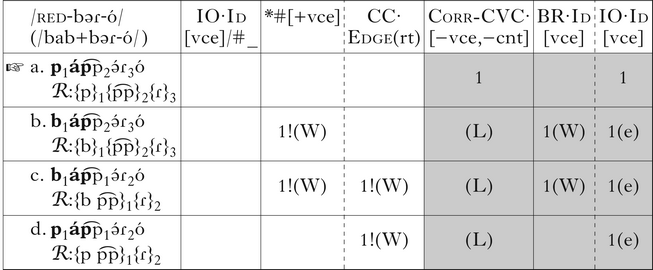
We therefore suggest that a preference for voiceless initial consonants can emerge in reduplication. Unlike word-medial consonants, initial Cs resist dissimilation. This effect is independent of the morphemes involved, and is entirely about the initial position, as is clear from a comparison between [páppə́ɾó] ‘touch!’ and [labáppəɾa] ‘they are about to touch’, both from the root /bəɾ/. The core explanation for these differences is that reduplicated [+voice] stops and affricates are different from underlying ones, as they are subject to BR faithfulness, but not IO faithfulness. Positional IO faithfulness protects underlying initial voiced stops, but allows reduplicated ones to be neutralised.
First, we assume that there is a penalty against initial voiced obstruents: *#[+voice].Footnote 12 However, a high-ranked positional IO faithfulness constraint protects underlying voiced obstruents in word-initial position from altering their voicing specification. The result is that underlying voiced stops are faithful in initial position, as in (22).
-
(22)
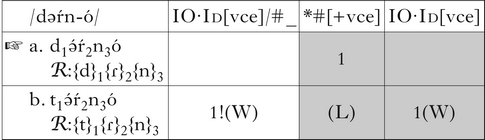
Reduplicated consonants, however, are not subject to the positional faithfulness constraint, as it targets the input–output relationship. Since the markedness constraint penalising initial voiced obstruents outranks the surface correspondence constraints (which drive the dissimilation), the result is an initial voiceless consonant, as in (23). This happens to obey base–reduplicant identity, though BR·Ident is not what drives the interaction.Footnote 13
-
(23)
Second, there is a case of resistance to dissimilation with roots consisting of only a single voiceless consonant. While some of these are geminate consonants, and would be covered by the ‘no voiced obstruent geminates’ generalisation, others are not. Two adjectives of this type, /ʧ/ ‘bad’ and /t/ ‘small’, remain voiceless when a following inchoative suffix is added in the imperative, and when the benefactive applicative is added (with a comparative sense), as in (24a). This shows that it is not their word-initial status in the imperative that favours maintaining their voiceless status. In addition, three verbs, /pw/ ‘beat’, /t̪/ ‘drink’ and /t̪w/ ‘get lost’, also show resistance to voicing with the benefactive applicative, as shown in (24b).
-
(24)
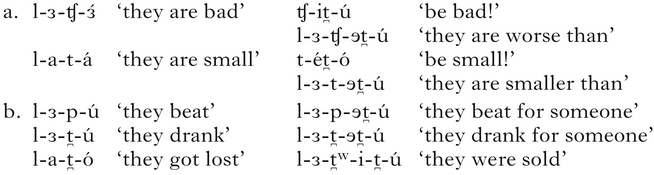
This does not apply to the VC root /ap/ ‘carry’. The applicative perfective is [lɜbɘt̪ú] ‘they carried for’ with dissimilation, which can be compared with [lɜpɘt̪ú] in (24), with no dissimilation.Footnote 14 As such, resisting dissimilation appears to be a property of single-consonant roots, or perhaps more generally of root-initial consonants (all roots are consonant-final, so there are no CV roots).Footnote 15 We do not develop a full analysis of this here, but note that a markedness or positional faithfulness constraint is required that outranks the standard dissimilation-inducing constraints. We propose that this is a constraint that penalises root-initial voiced obstruents. As such obstruents are attested, this dispreference would only emerge when a root is short enough to fit the CVC configuration required for dissimilation triggered by a suffix – when the root is C only. This analysis has the advantage of connecting to the other cases of dispreference for voiced obstruents in initial positions. In phrase-initial position, /g/ devoices to [k], and /t̪-/ resists dissimilation (§2.6). In word-initial position, voiced obstruents are allowed, but are realised as voiceless when copied in reduplication, which is not subject to general faithfulness.
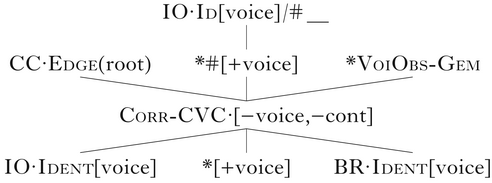
In conclusion, these two cases highlight the special status of initial word position and initial root position in disallowing voiced obstruents as the result of dissimilation. The cumulative ranking for the full pattern is given in (25).
-
(25)
4.3 Dissimilation in the lexicon revisited
In §2.5 we noted the tendency for voiceless–voiceless sequences to be underrepresented in lexical roots. What this observation means for the grammar is not obvious. One interpretation of the facts is that voiceless–voiceless sequences are rare because dissimilation also applies within roots: TVT roots are uncommon because they productively dissimilate to DVT. On this interpretation, dissimilation crucially holds not only across root boundaries, but also within roots.
The analysis developed so far does not predict dissimilation within roots: the combination of CC·Edge(root) and Corr-CVC·[—voice, —cont] can derive dissimilation only across the edge of the root domain. However, it is possible to construct a very similar analysis, also using the SCTD, which does make that prediction. This is done by calling on a different CC·Edge constraint: CC·Edge(σ). In precisely the same way that CC·Edge(root) prohibits correspondence – and accordingly supports dissimilation – when two voiceless consonants straddle the edge of a syllable, CC·Edge(σ) supports dissimilation across the edge of any syllable. As such, if we slot CC·Edge(σ) in place of CC·Edge(root) into the same ranking structure given in (25), the result in (26) is a grammar that enforces voicelessness dissimilation across any syllable edge, modulo the same restrictions on voicing geminates and initial consonants.Footnote 16
-
(26)
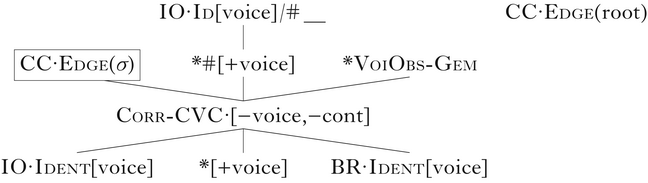
By requiring voiceless obstruents in CVC sequences to correspond, and prohibiting correspondence across syllable edges, this ranking causes dissimilation for transvocalic heterosyllabic voiceless consonants, irrespective of morphological structure. The key interaction is illustrated in (27), using a hypothetical input /apoto/ (cf. [ábótó] ‘climb’) to show root-internal dissimilation.Footnote 17
-
(27)

The outcome here is intensionally (and intentionally) different than in the previous version of the analysis, but its extensional effects are largely the same. The morphology of Moro is such that any CVC pair of obstruents that straddles the edge of the root always straddles a syllable boundary too (e.g. [é.g-ə.tám]). So the interaction illustrated here also derives dissimilation in all the morphological contexts considered above.
The point here is that if the root-internal co-occurrence facts are taken to reflect a real dissimilation process happening in the phonology of Moro, then we can explain that process using the same theory and same basic approach as in the analysis laid out above. The situation is that the data does not fully reveal what is happening in the phonological grammar of Moro. Underrepresentation of voiceless–voiceless pairs in roots could be the result of dissimilation in the root (albeit with some lexical exceptions), or it could be that such roots are rare for independent reasons: perhaps voiced–voiceless sequences accumulated over time in the lexicon, while voiceless–voiceless ones did not (à la Coetzee Reference Coetzee2014, for instance). The general approach of our analysis is consistent with either scenario, and both of the resulting patterns can be explained by the SCTD.
5 Conclusion
We have presented a heretofore undescribed pattern of dissimilation in Moro, which is widespread and productive, and affects both roots and affixes. We argue that the pattern involves the feature [–voice]. This conclusion is based on the phonetic properties of Moro obstruents, which show evidence for a short-lag VOT vs. prevoiced distinction. These characteristics suggest that the language is a voice language, and does not employ the feature [spread glottis], unless there is a serious mismatch between the phonetic properties and phonological representations.
The Moro dissimilation pattern poses problems for theories that dispense with [–voice] in favour of a privative feature [voice] that only marks voiced stops. Dissimilation for featural properties must refer to a feature that exists. This study therefore calls into question research programmes that attempt to dispense with binary features as a general theoretical principle. This finding is not entirely novel; it further supports the claim made previously by Wetzels & Mascaró (Reference Wetzels and Mascaró2001) that […voice] is, and must be, a real feature specification.
The formal analysis we construct shows that the dissimilation pattern is explained if [–voice] is accepted as a feature. We have demonstrated this by constructing an analysis using the Surface Correspondence Theory of Dissimilation (Bennett Reference Bennett2015), a theory that makes no crucial assumptions about featural markedness or autosegmental representations. In this theory, dissimilation results from the avoidance of a correspondence relationship between similar consonants. Similarity is based on featural representations, so the use of [–voice] is crucial in defining classes of sounds. In the Moro cases, dissimilation operates across morphological boundaries between root and prefix and between suffix and root, and the correspondence relationships reference these boundaries. The analysis also addresses exceptions to the pattern involving geminates, short roots and word-initial consonants.
Some other theories of dissimilation might also yield workable analyses of Moro, provided they also make the crucial assumption that the voiceless stops are [–voice]. Whether the SCTD offers the best analysis is orthogonal to the necessity of […voice]. Nonetheless, we consider the SCTD to have certain conceptual and empirical advantages over the alternatives; more detailed remarks about how the SCTD relates to other approaches to dissimilation can be found in Appendix B in the online supplementary materials.
A number of other bigger-picture ramifications remain to be explored in further detail. Much previous work notes robust asymmetries between voiced and voiceless obstruents, often compiled under the umbrella notion of markedness. For instance, word-final or coda neutralisation of obstruents to [–voice] is robustly attested, while final neutralisation to [+voice] is exceedingly rare (see Yu Reference Yu2004 on Lezgian final voicing), as is selective preservation of voicing in coda positions (Lombardi Reference Lombardi1999, Wetzels & Mascaró Reference Wetzels and Mascaró2001, etc.). Our conclusion that [±voice] is a binary feature does not dictate how typological patterns like these should be construed. It does, however, challenge assumptions about privative [voice] and its connection to markedness. The role of [±voice] in sonorants is similarly an open question, particularly since sonorants that have non-modal voicing have often received various other analyses; it is not clear if [–voice] is a feature specification permitted outside of obstruents. Binary [±voice] also presents a challenge for recent work on laryngeal realism that presumes only a monovalent [voice] vs. [Ø] representation. For instance, one might imagine that ‘spread glottis’ languages might, on closer investigation, be divided into subcategories: some languages might conceivably contrast [spread glottis] vs. [Ø], and other languages [spread glottis] vs. [–voice], and still others [–voice] vs. [Ø] – presumably with concomitant differences in the phonetic exponence of the feature contrast(s). The answers to such questions do not bear directly on the analysis of Moro, however: the phonetics of the stops in the language are most transparently represented using [±voice], and this analysis fits well with the Surface Correspondence Theory of Dissimilation, which allows for dissimilation of both marked and unmarked features.