Introduction
Shallow-water reef corals play a fundamental ecological and structural role in tropical marine ecosystems. For this reason, their distribution across time and space is of great interest to paleontologists, biologists, and environmental managers (Greenstein, Reference Greenstein2007; Pandolfi and Jackson, Reference Pandolfi and Jackson2007; Bennington and Aronson, Reference Bennington and Aronson2012). An understanding of coral biodiversity and the processes that have influenced taxonomic composition of reef corals over geological timescales is useful in understanding how reef ecosystems will respond to present-day environmental stressors (Pandolfi, Reference Pandolfi2011; van Woesik et al., Reference van Woesik, Houk, Isechal, Idechong, Victor and Golbuu2012; López-Pérez, Reference López-Pérez2017).
Paleontological studies of zooxanthellate corals in Caribbean shallow waters date back to the start of the twentieth century (e.g., Vaughan, Reference Vaughan1900, Reference Vaughan1901, Reference Vaughan1919). Since then, numerous studies and taxonomical descriptions based on the morphology of the skeleton have been carried out (e.g., Vaughan, Reference Vaughan1919; Wells, Reference Wells1936, Reference Wells1956; Vaughan and Wells, Reference Vaughan and Wells1943; Weisbord, Reference Weisbord1971, Reference Weisbord1973; Frost and Langenheim, Reference Frost and Langenheim1974). Subsequently, more detailed descriptions of the families Astrocoeniidae and Faviidae were provided by Foster (Reference Foster1987), Budd (Reference Budd1991), Budd et al. (Reference Budd, Stemann and Stewart1992, Reference Budd, Stemann and Johnson1994), and Budd and Johnson (Reference Budd and Johnson1999). Since publication of these works, there have been important advances in the taxonomy and phylogeny of cnidarians, particularly of the order Scleractinia (Fukami et al., Reference Fukami, Budd, Paulay, Solé-Cava, Chen, Iwao and Knowlton2004; Budd and Stolarski, Reference Budd and Stolarski2009, Reference Budd and Stolarski2011; Budd et al., Reference Budd, Romano, Smith and Barbeitos2010, Reference Budd, Fukami, Smith and Knowlton2012), clarifying, in part, their phylogenetic relationships, as well as the key macrostructural, micromorphological, and microstructural key characters for the classification of fossils and recent samples. As such, it is a fitting time to reestablish the morphologic basis for identification of Cenozoic coral species. Furthermore, phenotypic description of taxa from diverse localities provides a critical source of information in establishing regional variability and assessing evolutionary processes in time and space (Jablonski and Shubin, Reference Jablonski and Shubin2015).
In addition to significant advances in coral systematics, a number of recent works have contributed updated paleoecological information on coral communities of the Caribbean and western Atlantic region (e.g., Geister, Reference Geister1975, Reference Geister1983, Reference Geister1992; Budd et al., Reference Budd, Johnson and Edwards1995, Reference Budd, Johnson and Stemann1996, Reference Budd, Klaus and Johnson2011; Budd, Reference Budd2000; Johnson, Reference Johnson2001, Reference Johnson2007; Klaus and Budd, Reference Klaus and Budd2003; Stemann, Reference Stemann2003; Johnson et al., Reference Johnson, Jackson and Budd2008, Reference Johnson, Sánchez-Villagra and Aguilera2009; Klaus et al., Reference Klaus, McNeill, Budd and Coates2012). Three important events of coral faunal turnover and speciation have been recognized within the region: the Eocene-Oligocene (ca. 34 Ma), the Oligocene-Miocene (ca. 23 Ma), and the Pliocene-Pleistocene (ca. 2.6 Ma) (Budd et al., Reference Budd, Stemann and Johnson1994, Reference Budd, Klaus and Johnson2011; Budd, Reference Budd2000). According to these studies, at the Oligocene–Miocene transition, reef-building capacity was greatly reduced due to the loss of an estimated 50% of zooxanthellate corals (Edinger and Risk, Reference Edinger and Risk1994, Reference Edinger and Risk1995; Budd, Reference Budd2000; Johnson et al., Reference Johnson, Jackson and Budd2008, Reference Johnson, Sánchez-Villagra and Aguilera2009).
Although these studies have provided insights into the coral diversity during important periods of speciation and extinction, few have addressed the Oligocene to Miocene transition in the southern Caribbean–northern South America region (Johnson et al., Reference Johnson, Sánchez-Villagra and Aguilera2009), and no significant study has been performed on the continental fossil reefs of Colombia. The current study is based on new coral collections from early Miocene reefs of the Cocinetas Basin in La Guajira Peninsula, northern Colombia. The purpose of this work is to provide a taxonomical account of this collection that will serve for future work on the Cenozoic corals of the southern Caribbean. We describe the morphospecies included in seven of the 12 families found, along with their occurrences in other regions and paleoenvironmental significance.
Geologic setting
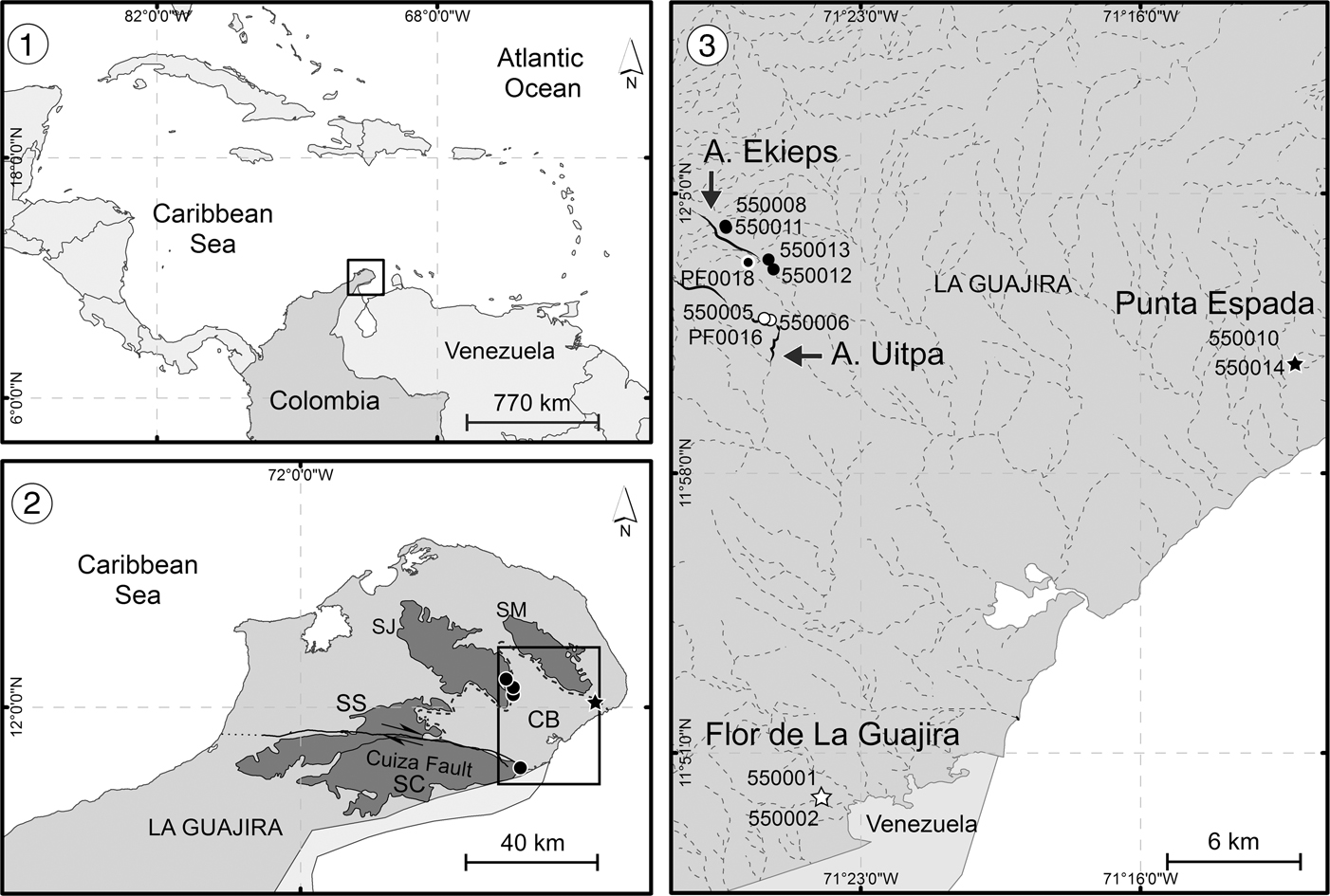
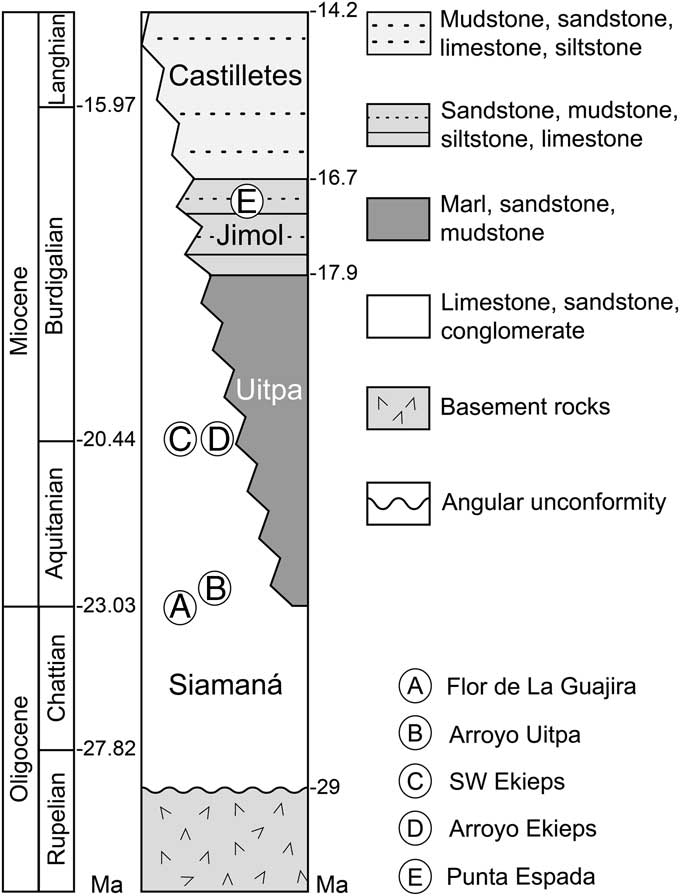
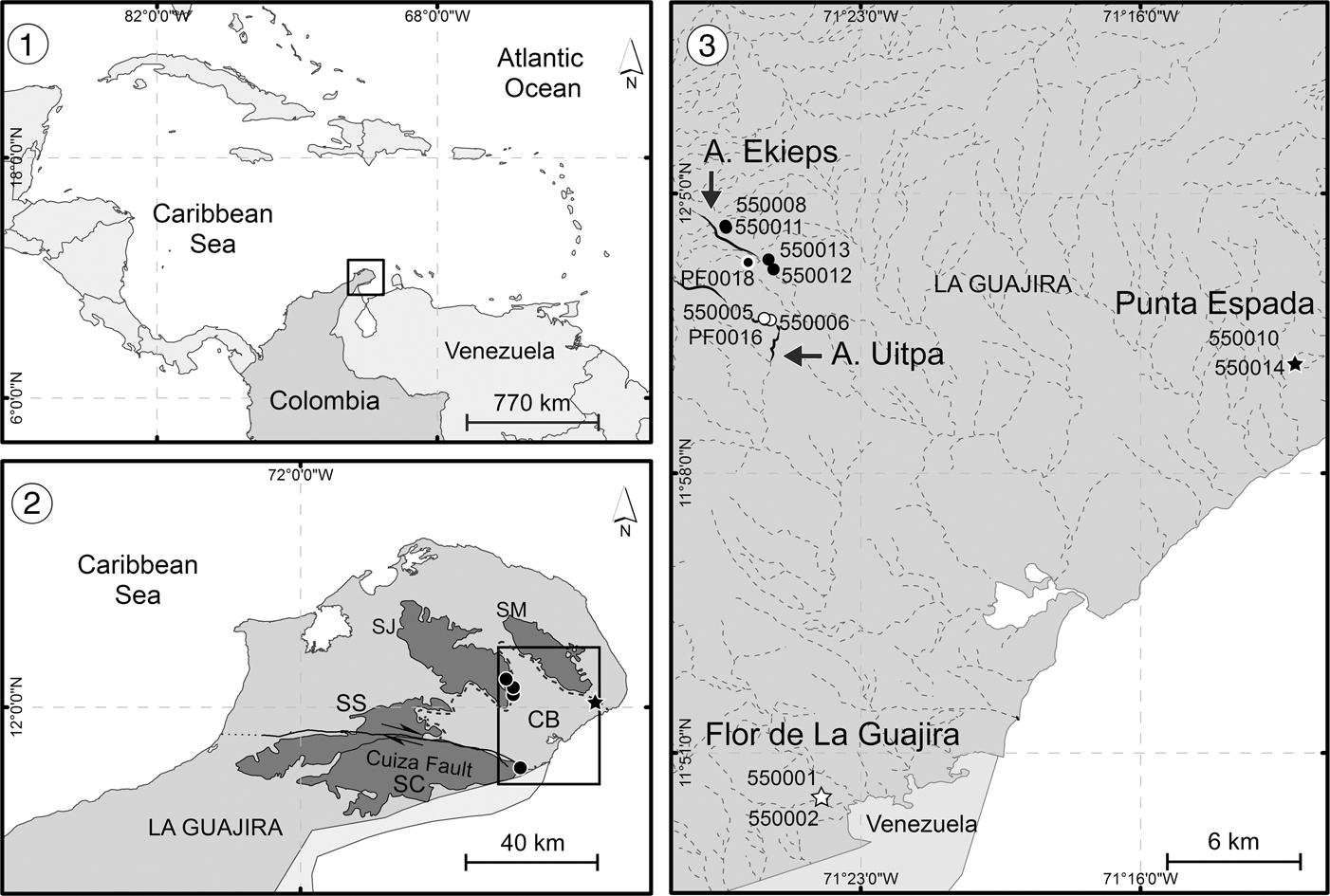
The coral specimens of the present study were collected from the Siamaná and Jimol formations in the Cocinetas Basin, in the La Guajira Peninsula, northeast Colombia (Fig. 1). The Siamaná Formation ranges from the late Oligocene to the early Miocene (Fig. 2) (Teatin, Reference Teatin1991; Silva-Tamayo et al., Reference Silva-Tamayo, Lara, Nana Yobo, Erdal, Sanchez and Zapata-Ramírez2017). The formation is exposed in the remote northeastern foothills of the Serranía de Cocinas, south of Serranía de Jarara and west of Serranía de Macuira (Fig. 1.2). The lower Miocene deposits are characterized by shallow reefal limestones onlapping basement paleohighs (Renz, Reference Renz1960; Lockwood, Reference Lockwood1965; Rollins, Reference Rollins1965; Macellari, Reference Macellari1995). The thickness of the Siamaná Formation is highly variable, ranging from a few meters south of Serranía de la Macuira (Zapata, Reference Zapata2010) to over 240 m near Uitpa (Rollins, Reference Rollins1965) and over 450 m south of Serranía de Jarara (Lockwood, Reference Lockwood1965).
(1) General location of the La Guajira Peninsula along the southern margin of the Caribbean Sea. (2) Location of Cocinetas Basin (CB), flanked by the Serranía de la Macuira (SM), Serranía de Jarara (SJ), Serranía de Simarua (SS), Serranía de Cocinas (SC), and Cuiza fault; the black circles indicate stations from the Siamaná Formation (early Miocene) and the black star indicates station from the Jimol Formation (late early Miocene). (3) Localities and stations: Arroyo Ekieps indicated by black circles; Arroyo Uitpa indicated by white circles with a black border; PF0018 station, corresponding to the SW Ekieps locality, indicated by the black circle with a white border; Flor de La Guajira indicated by the white star with a black border; and Punta Espada indicated by a black star.
The Cocinetas Basin general stratigraphy showing the positions of the localities studied (A–E). Ages and lithological characteristics of the Siamaná, Uitpa, Jimol, and Castilletes formations following Moreno et al. (Reference Moreno2015) and Silva-Tamayo et al. (Reference Silva-Tamayo, Lara, Nana Yobo, Erdal, Sanchez and Zapata-Ramírez2017).
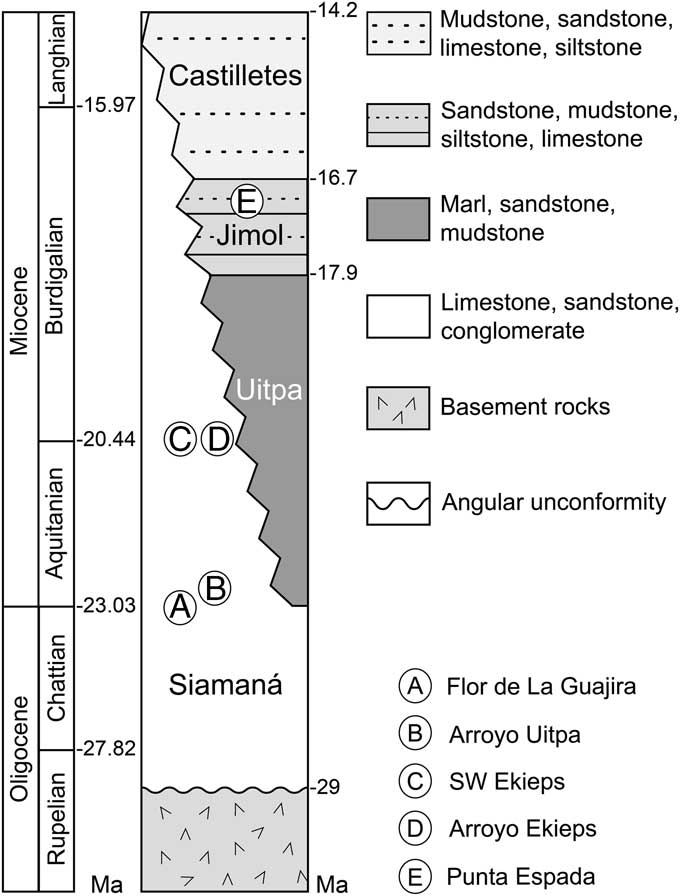
The Siamaná Formation is conformably overlain by the early Miocene Uitpa Formation, which in turn is overlain by the latest early Miocene Jimol Formation (Fig. 2) (Moreno et al., Reference Moreno2015). The Uitpa Formation is composed of deepwater silts and shales, with abundant macrofauna (Carrillo-Briceño et al., Reference Carrillo-Briceño, Argyriou, Zapata, Kindlimann and Jaramillo2016). Fine-grained, calcareous sandstone interbeds are common in the lower and upper parts of this formation (Thomas, Reference Thomas1972). Conformably overlying the Uitpa Formation is the Jimol Formation, which is mainly composed of lithic sandstones and mudstones with high fossil content (Hendy et al., Reference Hendy, Jones, Moreno, Zapata and Jaramillo2015; Moreno et al., Reference Moreno2015). According to Moreno et al. (Reference Moreno2015), the formation comprises shallow marine deposits with hermatypic zooxanthellate corals and was deposited in an inner shelf at less than 50 m depth.
Materials and methods
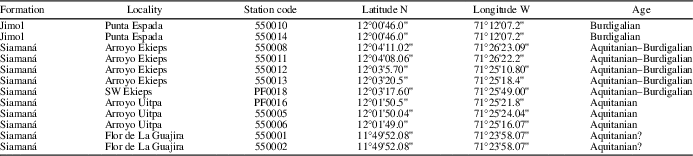
Fossil coral samples were collected in two expeditions carried out in 2011 and 2014, at five localities in the Cocinetas Basin: Arroyo Uitpa, Arroyo Ekieps, SW Ekieps, Flor de La Guajira, and Punta Espada (Fig. 1; Table 1). Samples were collected along 10 m horizontal transects. To increase sampling of taxa, some additional specimens were obtained outside of linear transects. The ages of the units studied in the Siamaná Formation were estimated by Silva-Tamayo et al. (Reference Silva-Tamayo, Lara, Nana Yobo, Erdal, Sanchez and Zapata-Ramírez2017) through 87Sr/86Sr values in fossil coralline algae. The numerical dating was confirmed by biostratigraphic data based on larger benthic foraminifera (Myogypsina, Amphistegina, operculinoids, and archaiasinids) determined by Dr. W. Renema in thin sections from the outcrops. The dating of the Jimol Formation was performed by Moreno et al. (Reference Moreno2015) and Hendy et al. (Reference Hendy, Jones, Moreno, Zapata and Jaramillo2015) through 87Sr/86Sr and biostratigraphy based on mollusk shells.
Coordinates of the stations and locations studied. Station nomenclature follows the STRI procedure: the first two characters correspond to collector and the rest to station code. The ages of the Siamaná Formation were estimated by Silva-Tamayo et al. (Reference Silva-Tamayo, Lara, Nana Yobo, Erdal, Sanchez and Zapata-Ramírez2017) through strontium isotopes; the uncertainty at Flor de La Guajira because to part of the material is reworked. Age of the Jimol Formation was estimated by Hendy et al. (Reference Hendy, Jones, Moreno, Zapata and Jaramillo2015) and Moreno et al. (Reference Moreno2015) by means of biostratigraphic analyses.

All coral samples were cleaned and brushed with water to remove the sediment. Taxonomic identification was guided by the works of Vaughan (Reference Vaughan1919), Coryell and Ohlsen (Reference Coryell and Ohlsen1929), Wells (Reference Wells1956), Frost and Langenheim (Reference Frost and Langenheim1974), Budd (Reference Budd1991), Budd et al. (Reference Budd, Stemann and Stewart1992, Reference Budd, Stemann and Johnson1994, Reference Budd, Romano, Smith and Barbeitos2010), Johnson (Reference Johnson2001, Reference Johnson2007), Johnson et al. (Reference Johnson, Sánchez-Villagra and Aguilera2009), Wallace (Reference Wallace2012), and Huang et al. (Reference Huang, Benzoni, Fukami, Knowlton, Smith and Budd2014). The taxonomic assignment was based on macrostructural features, such as colony shape, septum development, calice size and shape, calicular wall, morphology of the columella, presence/absence of pali and coenosteum characteristics (Budd and Stolarski, Reference Budd and Stolarski2011), and microstructural characters related to septal face granulation (Budd et al., Reference Budd, Fukami, Smith and Knowlton2012). Morphologic investigations were performed with a stereomicroscope under 2x and 4x magnification. Basic morphometric data (Table 2) were measured with a digital caliper. Pictures of colonies were taken with a Canon EOS D60 digital camera. Micromorphological images of some specimens were obtained with a Quanta 400 FEI scanning electron microscope (SEM) after mounting specimens on stubs with double-sided tape or CCC carbon adhesive and sputter-coating with conductive carbon and gold. Thin sections were used to examine corallites in samples with poor preservation of the calicular surface.
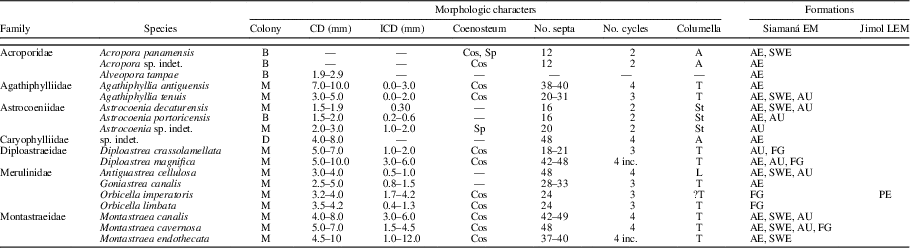
Species list and summary of the main characters used to identify taxa from the Siamaná and Jimol formations. Colony: B=branching; M=massive; D=dendroid. CD=calicular diameter. ICD=intercalicular distance. Coenosteum: Cos=costae present; Sp=spinose. No. cycles: inc.=incomplete. Columella: St=styliform; L=lamellar; T=trabecular; A=absent. In all characters (—) means not determined. Siamaná EM (early Miocene) localities: AE=Arroyo Ekieps; SWE=SW Ekieps; AU=Arroyo Uitpa; FG=Flor de La Guajira. Jimol LEM (late early Miocene) localities: PE=Punta Espada.

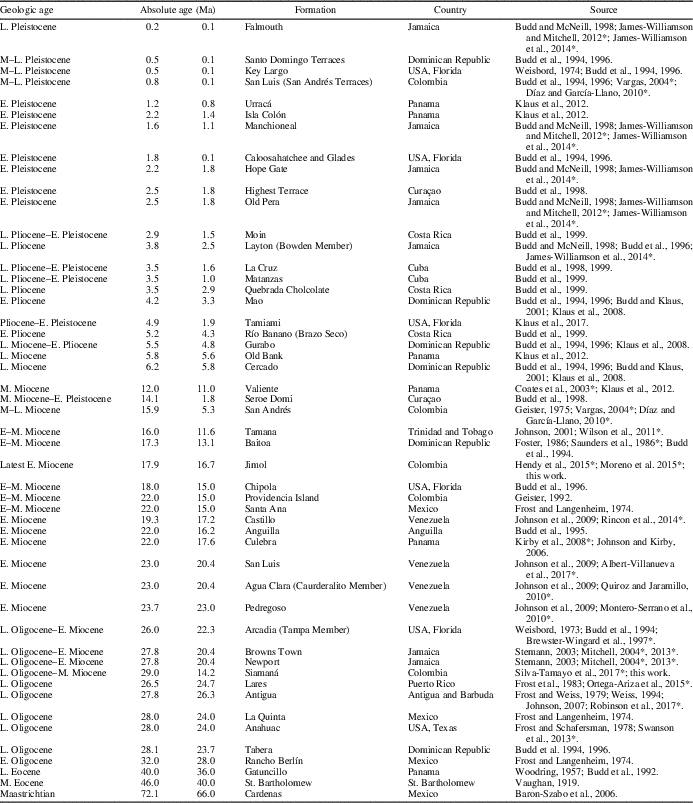
The systematic paleontology is presented in alphabetical order, at both family and genus levels. References for the occurrence information provided on each species for the Caribbean region, such as formation, depositional age, and country, are compiled in Table 3. A total of 273 lots were collected from the Siamaná (240 lots) and Jimol (33 lots) formations. The specimens were classified into two orders (Scleractinia and Anthoathecata: Milleporidae), 12 families, 15 genera, and 26 species. The present work includes seven families (Table 2), and the second part includes the families Mussidae, Pocilloporidae, Poritidae, Siderastreidae, and Milleporidae.

Repositories and institutional abbreviations
The reference collection has been deposited at the Mapuka Museum of the Universidad del Norte, Barranquilla-Colombia, with the repository acronym MUN-STRI followed by the catalog number, which appears in the section of material for each species. The type samples are deposited in the following institutions: The Natural History Museum, London, United Kingdom (NHMUK); U.S. National Museum of Natural History, Washington, USA (USNM); numbers preceded by ‘M’ are from mollusk series.
Systematic paleontology
Class Anthozoa Ehrenberg, Reference Ehrenberg1834
Subclass Hexacorallia Haeckel, Reference Haeckel1896
Order Scleractinia Bourne, Reference Bourne1900
Family Acroporidae Verrill, Reference Verrill1902
Genus Acropora Oken, 1815
Type species
Millepora muricata Linneaus, 1758; by original designation.
Acropora panamensis Vaughan, Reference Vaughan1919
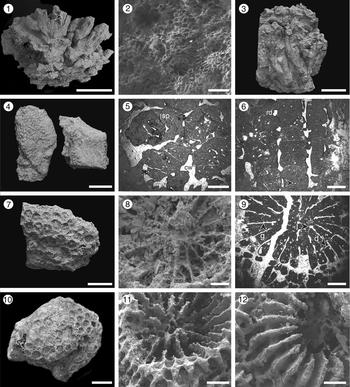
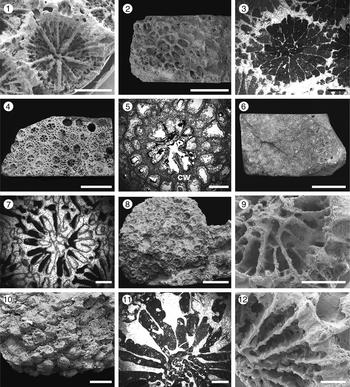
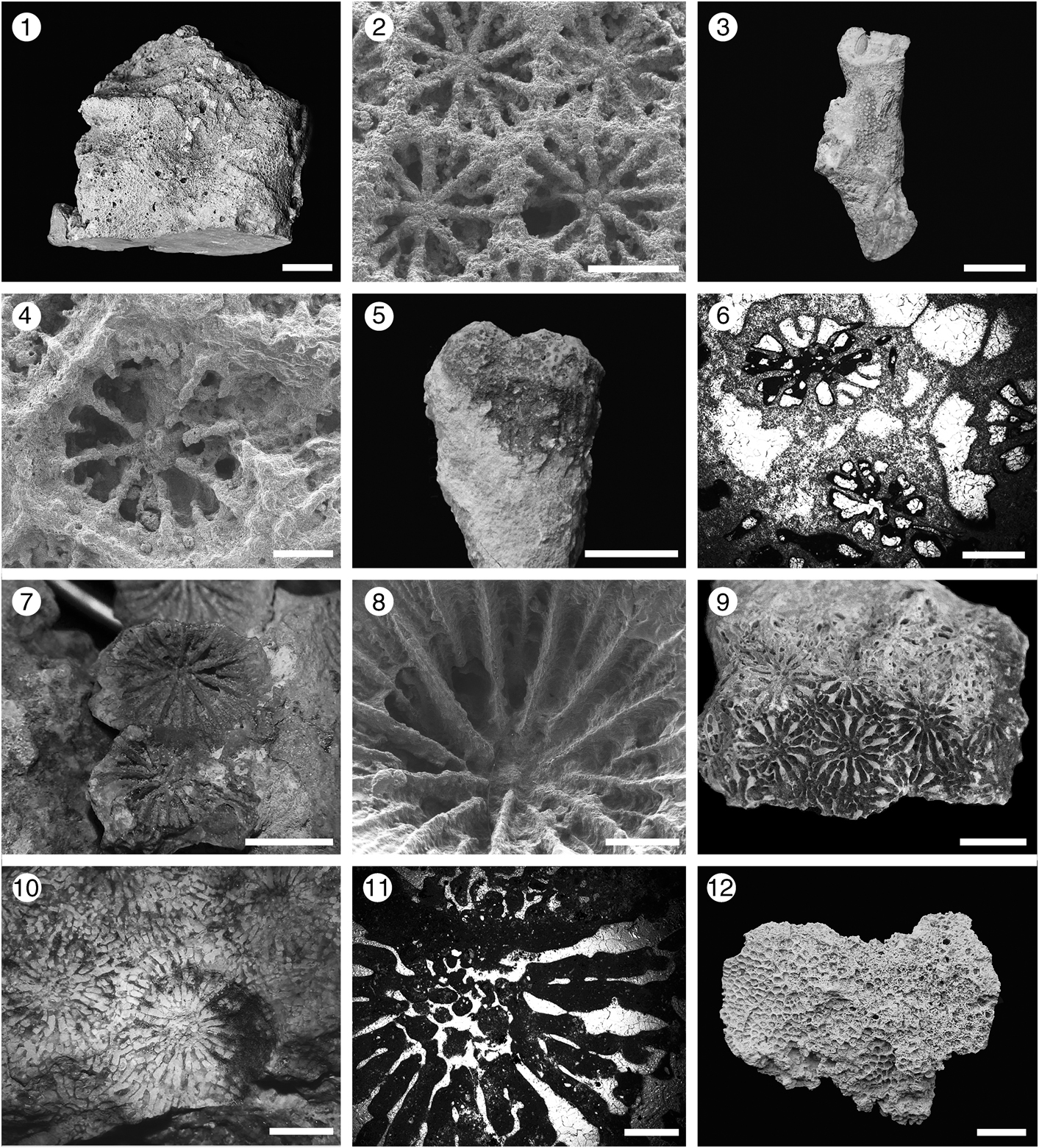
(1, 2) Acropora panamensis Vaughan, Reference Vaughan1919: (1) morphology of the colony (MUN-STRI-17331), showing an axial corallite 1.4 cm in length (black arrow) cut laterally; (2) detail of the corallites, showing the septal arrangement and coenosteum reticulo-costate (MUN-STRI-17327). (3) Colony of Acropora sp. indet. (MUN-STRI-43531). (4–6) Alveopora tampae Weisbord, Reference Weisbord1973 (MUN-STRI-43508): (4) morphology of the colony; (5) transverse thin section showing the calicular wall (cw) and fragments of the septal spines (sp); (6) longitudinal thin section showing the rods of the wall (rd) and insertion of the spines (black arrow). (7–9) Agathiphyllia antiguensis (Duncan, Reference Duncan1863) (MUN-STRI-17309): (7) morphology of the colony; (8) detail of the corallites; (9) transverse thin section showing the (d) endothecal dissepiments, (g) septal granules, and (l) paliform lobes. (10–12) Agathiphyllia tenuis (Duncan, Reference Duncan1863) (MUN-STRI-17275): (10) general view of the colony; (11) detail of the palar crown and granules of the pali and septa; (12) detail of the septa and costae. All specimens are from the Siamaná Formation, Arroyo Ekieps locality. (1, 7) Scale bars=3 cm; (2, 8, 11, 12) scale bars=1 mm; (3) scale bar=4 cm; (4) scale bar=2 cm; (5) scale bar=800 µ; (6, 9) scale bars=600 µ; (10) scale bar=1 cm.

1919 Acropora panamensis Reference VaughanVaughan, p. 480, pl. 141, figs. 1, 1a, b, 2.
1974 in part Acropora panamensis; Reference Frost and LangenheimFrost and Langenheim, p. 188, pl. 56, figs. 4–7, pl. 57, figs. 1–5.
Holotype
USNM M325042, from La Boca Formation, Panama. Middle Miocene.
Occurrence
Late Oligocene to Pleistocene. First occurrences from the late Oligocene in La Quinta Formation, Mexico (Frost and Langenheim, Reference Frost and Langenheim1974); Anahuac Formation, Texas, USA (Frost and Schafersman, Reference Frost and Schafersman1978); Lares Formation, Puerto Rico (Frost et al., Reference Frost, Harbour, Beach, Realini and Harris1983). Late Oligocene–early Miocene in Browns Town and Newport formations, Jamaica (Stemann, Reference Stemann2003). Early Miocene in Culebra Formation, Panama (Johnson and Kirby, Reference Johnson and Kirby2006); Siamaná Formation, Colombia. Middle Miocene in Valiente Formation, Panama (Klaus et al., Reference Klaus, McNeill, Budd and Coates2012). Middle Miocene–late Pliocene in Seroe Domi Formation, Curaçao (Budd et al., Reference Budd, Petersen and McNeill1998). Latest occurrences from the Pleistocene in drilling cores from the Bahamas (Budd and Manfrino, Reference Budd and Manfrino2001).
Description
Corallum cuneiform to ?caespitose in shape. Thick branches of blunt to acuminate tips, 1.0–2.5 cm in midbranch diameter. Multiple axial corallites per branch, hardly distinguishable from radial corallites, 3 mm in outer diameter. Radial corallites nariform, appressed tubular to immersed in shape, calices rounded to slightly oval, 1.0–1.4 mm in diameter, radial spacing of 3.5–3.7 mm, and wall thickness of 1 mm. Both kinds of corallites with three synapticular rings; and septa hexamerally arranged in two cycles, S1 reach the center of the corallite, S2 rudimentary. Columella absent. Corallite wall and coenosteum reticulo-costate sometimes constituted by simple pointed spinules.
Materials
Siamaná Formation, Arroyo Ekieps, station 550013: MUN-STRI-17331, MUN-STRI-17325, MUN-STRI-17327. SW Ekieps, station PF0018: MUN-STRI-37928.
Remarks
Acropora panamensis could be easily confused with A. saludensis Vaughan, Reference Vaughan1919, a species commonly present in the same stratigraphic units (Vaughan, Reference Vaughan1919; Budd et al., Reference Budd, Stemann and Johnson1994). They differ from each other by corallite diameter, smaller in A. panamensis (1.2–1.5 mm) than in A. saludensis (1.8–2.2 mm). In addition, the coenosteum is costulate in A. panamensis and porous in A. saludensis (Budd et al., Reference Budd, Stemann and Johnson1994). The Siamaná samples also share some morphologic characteristics with the genus Isopora; for example, they have two or more axial corallites per branch and cuneiform colonies as reported by Wallace (Reference Wallace1999) and Wallace et al. (Reference Wallace, Chen, Fukami and Muir2007). These characteristics have been also observed in other Caribbean localities (Budd and Wallace, Reference Budd and Wallace2008); however, the coenosteum characteristics define them as Acropora. On the other hand, the Siamaná specimens differ, in part, from the description given by Frost and Langenheim (Reference Frost and Langenheim1974) in the size and number of septal cycles of the leading corallites. In the Siamaná Formation, A. panamensis occurs with Porites baracoaensis Vaughan, Reference Vaughan1919, Montastraea canalis (Vaughan, Reference Vaughan1919), Montastraea cavernosa (Linnaeus, Reference Linnaeus1767), and Colpophyllia willoughbiensis (Vaughan, Reference Vaughan1919), among others.
Acropora sp. indet.
Occurrence
Early Miocene from Siamaná Formation, Colombia.
Description
Corallum plocoid, probably arborescent or corymbose-caespitose. Cylindrical to slightly flattened branches, 6.6–13.0 mm in diameter. One axial corallite per branch, 1.3–1.5 mm in inner diameter, and wall thickness around 1 mm. In some places the corallites are vertically aligned, but this pattern changes to intercalate laterally. Radial corallites spaced 2.4–4.2 mm apart, calices rounded, 0.9–1.0 mm in inner diameter, and wall thickness of 0.7–0.8 mm. Axial and radial corallites surrounded by two synapticular rings; septa hexamerally arranged in two complete cycles; S1 reach the center of corallites, and S2 often half width of S1. Columella absent. Corallite wall and coenosteum reticulo-costate with simple spinules.
Materials
Siamaná Formation, Arroyo Ekieps, station 550011: MUN-STRI-43531, MUN-STRI-43532; station 5500013: MUN-STRI-43533.
Remarks
The samples are broken fragments, most of them without tips, and with poor preservation, limiting the identification to the genus level. Specimens are assigned to Acropora based on the protuberant morphology of corallites, the absence of columella, and the spinose and costate pattern of the coenosteum. Samples of Acropora sp. indet. closely resemble Acropora saludensis; however, the Siamaná specimens do not have the dense and elaborate coenosteum characteristic of this species (Budd and Wallace, Reference Budd and Wallace2008). Specimens were found associated with Porites spp., Montastraea spp., and Siderastrea spp.
Genus Alveopora Blainville, Reference Blainville1830
Type species
Madrepora daedalea Forsskål, Reference Forsskål1775; by subsequent designation (Wells, Reference Wells1936).
Alveopora tampae Weisbord, Reference Weisbord1973
1973 Alveopora tampae Reference WeisbordWeisbord, p. 37, pl. 6, figs. 4–6, pl. 7, figs. 4, 5.
Holotype
USNM 66160, from Arcadia Formation (Tampa Member), Florida, USA. Late Miocene.
Occurrence
Late Oligocene to Miocene. First occurrences in Antigua Formation, Antigua and Barbuda (Johnson, Reference Johnson2007). Late Oligocene–early Miocene in Browns Town and Newport formations, Jamaica (Stemann, Reference Stemann2003); Arcadia Formation (Tampa Member), Florida, USA (Weisbord, Reference Weisbord1973). Early Miocene in Castillo and San Luis formations, Venezuela (Johnson et al., Reference Johnson, Sánchez-Villagra and Aguilera2009); Siamaná Formation in Colombia. Middle Miocene in Baitoa Formation, Dominican Republic (Budd et al., Reference Budd, Stemann and Johnson1994).
Description
Corallum plocoid and columniform. Columns thick of blunt tips, slightly compressed transversely, 2.5–3.5 cm in diameter. Corallites circular to polygonal, 1.9–2.9 mm in diameter, separated by a calicular wall formed of 11–12 rods of 0.3–0.5 mm thickness. Synapticulae linked the rods of the wall. Septal spines thin, irregularly arranged in different levels, sometimes fused in the axis of the corallite.
Materials
Siamaná Formation, Arroyo Ekieps, station 550008: MUN-STRI-43504; station 550011 MUN-STRI-17268, MUN-STRI-43508, MUN-STRI-17274; station 550012: MUN-STRI-43517; station 550013: MUN-STRI-43524, MUN-STRI-17323. SW Ekieps, station PF0018: MUN-STRI-37892.
Remarks
The samples are recrystallized and poorly preserved. However, they are easily distinguishable due to large column thickness and the typical spiny septa and absence of a columella. The genus Alveopora was included in the family Poritidae but later transferred to the family Acroporidae based on molecular analysis and morphological features (Kitano et al., Reference Kitano, Benzoni, Arrigoni, Shirayama, Wallace and Fukami2014). In the Siamaná Formation, Alveopora inhabited patch and fringing reefs in association with Agathiphyllia tenuis (Duncan, Reference Duncan1863), Millepora alcicornis Linnaeus, Reference Linnaeus1758, Porites anguillensis Vaughan, Reference Vaughan1919, P. portoricensis Vaughan, Reference Vaughan1919, Siderastrea siderea (Ellis and Solander, Reference Ellis and Solander1786), and Goniastrea canalis Vaughan, Reference Vaughan1919.
Family Agathiphylliidae Vaughan and Wells, Reference Vaughan and Wells1943
Genus Agathiphyllia Reuss, Reference Reuss1864
Type species
Agathiphyllia explanata Reuss, Reference Reuss1864; by subsequent designation (Vaughan, Reference Vaughan1919).
Remarks
Agathiphyllia, Montastraea, and Antiguastrea show several similar external morphological characters, for which they are often confused, in particular when samples are poorly preserved by effects of diagenetic processes (Neil-Champagne, Reference Neil-Champagne2010). The Agathiphylliids are characterized by rounded corallites, synapticulothecal wall, trabecular columella, and paliform lobes. By contrast, Antiguastrea has circular to polygonal corallites, parathecal wall, and lamellar columella, with no paliform lobes. On the other hand, Montastraea has a septothecal wall, the circular corallites are larger and more exsert than in Agathiphyllia, and the columella is larger and usually trabecular to spongy (Frost and Langenheim, Reference Frost and Langenheim1974; Neil-Champagne, Reference Neil-Champagne2010). The genus Agathiphyllia is globally extinct (Budd, Reference Budd2000).
Agathiphyllia antiguensis (Duncan, Reference Duncan1863)
1863 Astraea antiguensis Reference DuncanDuncan, p. 419, pl. 13, fig. 8.
1919 Cyathomorpha antiguensis; Reference VaughanVaughan, p. 463, pl. 129, fig. 2, pl. 130, figs. 1, 1a, 2, 2a, 3, pl. 131, figs. 1, 1a, b, 2–4, pl. 132, figs. 1, 2, 2a, b, pl. 133, fig. 1.
Holotype
NHMUK R28629, from Antigua Formation, Antigua. Late Oligocene.
Occurrence
Late Eocene to early Miocene. First occurrences in Gatuncillo Formation, Panama (Budd et al., Reference Budd, Stemann and Stewart1992). Early Oligocene in Rancho Berlín Formation, Mexico (Frost and Langenheim, Reference Frost and Langenheim1974). Late Oligocene in Lares Formation, Puerto Rico (Frost et al., Reference Frost, Harbour, Beach, Realini and Harris1983); Antigua Formation, Antigua and Barbuda (Johnson, Reference Johnson2007). Early Miocene in Castillo and San Luis formations, Venezuela (Johnson et al., Reference Johnson, Sánchez-Villagra and Aguilera2009); Siamaná Formation in Colombia.
Description
Corallum massive and plocoid, with extratentacular budding. Corallites rounded to oval in shape, 7–10 mm in diameter. They bear 38–40 septa, hexamerally arranged in four cycles with the fourth one rarely complete. S1 and S2 reach the columella, S3 not always, while S4 has one-fourth the width of S1–2. Septal faces bear pointed granules. Primary and secondary septa bear paliform lobes only observed in transverse section. Trabecular columella, 1.3–3.2 mm in diameter, usually occupying one-third of corallite diameter into a shallow fossa. Synapticulothecal wall and costate coenosteum.
Materials
Siamaná Formation, Arroyo Ekieps, station 550012: MUN-STRI-17304, MUN-STRI-17309; station 550013: MUN-STRI-17328.
Remarks
The samples of Agathiphyllia antiguensis from the Siamaná Formation are poorly preserved and do not conserve either the paliform crown or complete septa. Nevertheless, the synapticulothecal wall is typical of the species. Agathiphyllia antiguensis was a framework component of fringing reefs in the Siamaná Formation, associated with Porites spp., Montastraea spp., and Siderastrea spp., among others.
Agathiphyllia tenuis (Duncan, Reference Duncan1863)
1863 Astraea tenuis Reference DuncanDuncan, p. 421, pl. 13, fig. 11.
1919 Cyathomorpha tenuis; Reference VaughanVaughan, p. 467, pl. 132, fig. 3, 3a, pl. 133, figs. 2, 3, 3a, b.
Holotype
NHMUK R28627, from Marl Formation, Antigua. Miocene.
Occurrence
Late Oligocene to middle Miocene. Oldest occurrences in Lares Formation, Puerto Rico (Frost et al., Reference Frost, Harbour, Beach, Realini and Harris1983) and Antigua Formation, Antigua and Barbuda (Johnson, Reference Johnson2007). Late Oligocene–early Miocene in Browns Town Formation, Jamaica (Stemann, Reference Stemann2003). Early Miocene in the southern Caribbean in Castillo and San Luis formations, Venezuela (Johnson et al., Reference Johnson, Sánchez-Villagra and Aguilera2009); Siamaná Formation, Colombia. Latest occurrences from middle Miocene in Baitoa Formation, Dominican Republic (Budd et al., Reference Budd, Stemann and Johnson1994).
Description
Corallum massive and plocoid, with extratentacular budding. Corallites rounded to slightly compressed in shape, 3–5 mm in diameter. They bear 20–31 septa, hexamerally arranged in three cycles. S1 and S2 reach the columella, while S3 is one-third the width of S1–2. Pali present before S1 and S2, forming two circular crowns encircling a trabecular columella. Faces of septa, costae, and pali finely spinose. Fossa shallow to moderately deep. Synapticulothecal wall. Costae are thick and converge with the adjacent calices.
Materials
Siamaná Formation, Arroyo Ekieps, station 550011: MUN-STRI-17275, MUN-STRI-43509, MUN-STRI-43513; station 550012: MUN-STRI-43518. Arroyo Uitpa, station 550006: MUN-STRI-37877. SW Ekieps, station PF0018: MUN-STRI-37890, MUN-STRI-37893, MUN-STRI-37894, MUN-STRI-37900, MUN-STRI-37901, MUN-STRI-37903.
Remarks
Agathiphyllia tenuis differs from A. antiguensis by the number of cycles and size of the corallites. In the Siamaná Formation, A. tenuis occurs with Porites spp., Montastraea spp., Siderastrea spp., and Colpophyllia as a builder of patch and fringing reefs.
Family Astrocoeniidae Koby, Reference Koby1890
Genus Astrocoenia Milne-Edwards and Haime, Reference Milne-Edwards and Haime1848
Type species
Astrea numisma Defrance, Reference Defrance1826; by original designation.
Remarks
Within the family Astrocoenidae, the specimens of Astrocoenia resemble species of Madracis recorded from the Caribbean Oligocene–Miocene (Table 4) in their corallum shape and characteristic styliform columella. However, Madracis specimens may be distinguished from Astrocoenia by their septal arrangement in groups of six, eight, or 10, a diagnostic characteristic in Madracis spp. (Cairns, Reference Cairns2000).
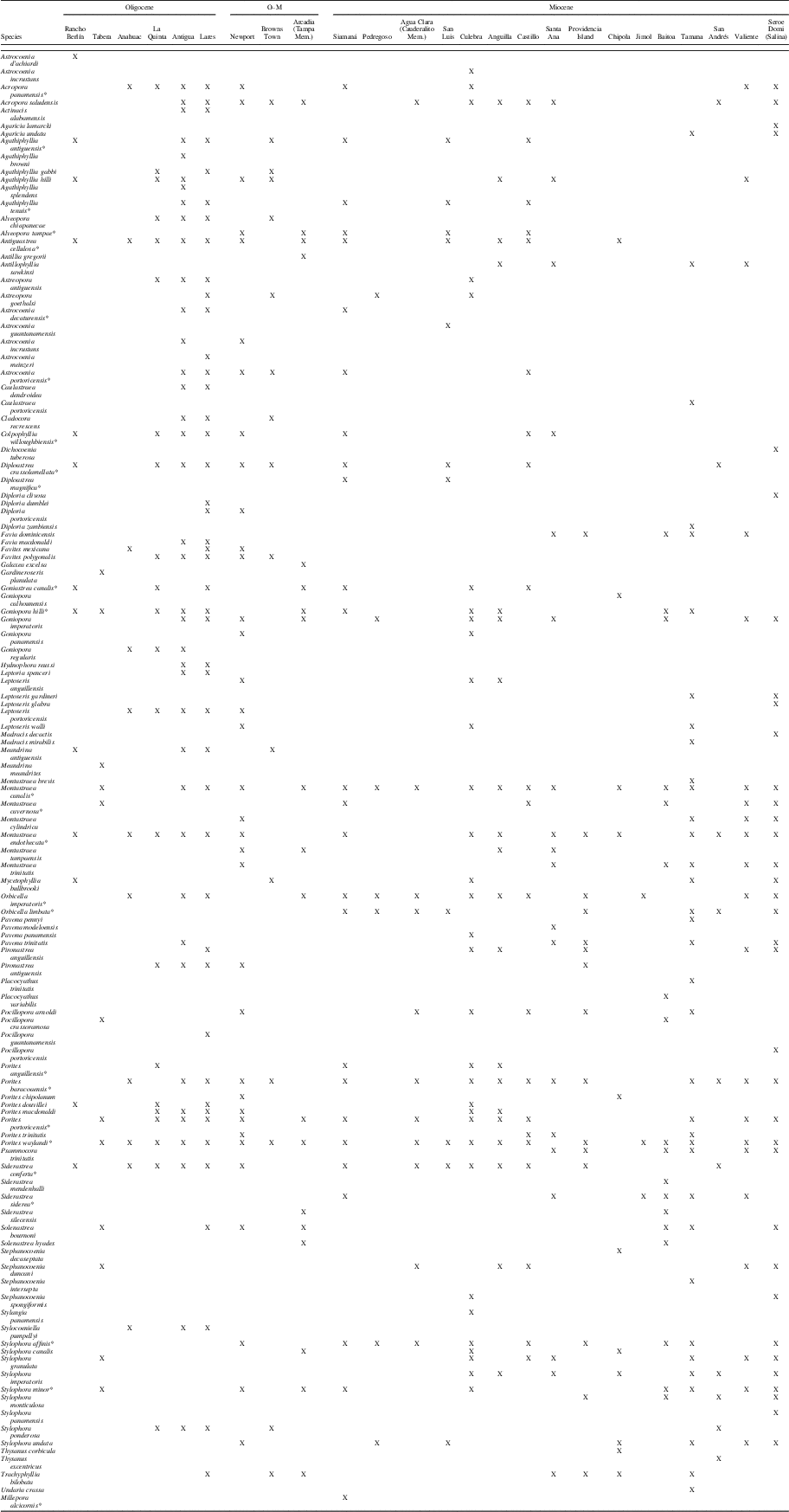
Species occurrences from the Oligocene–Miocene in the Caribbean formations. Species with (*) are recorded in the Cocinetas Basin. Additional information on the geologic formations is listed in Table 3. O–M=Oligocene–Miocene.

Astrocoenia decaturensis Vaughan, Reference Vaughan1919
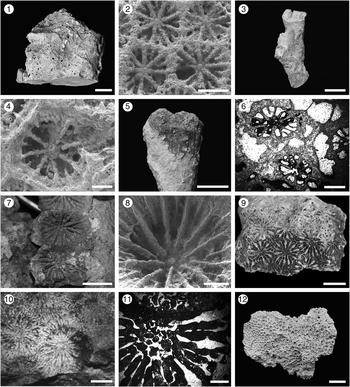
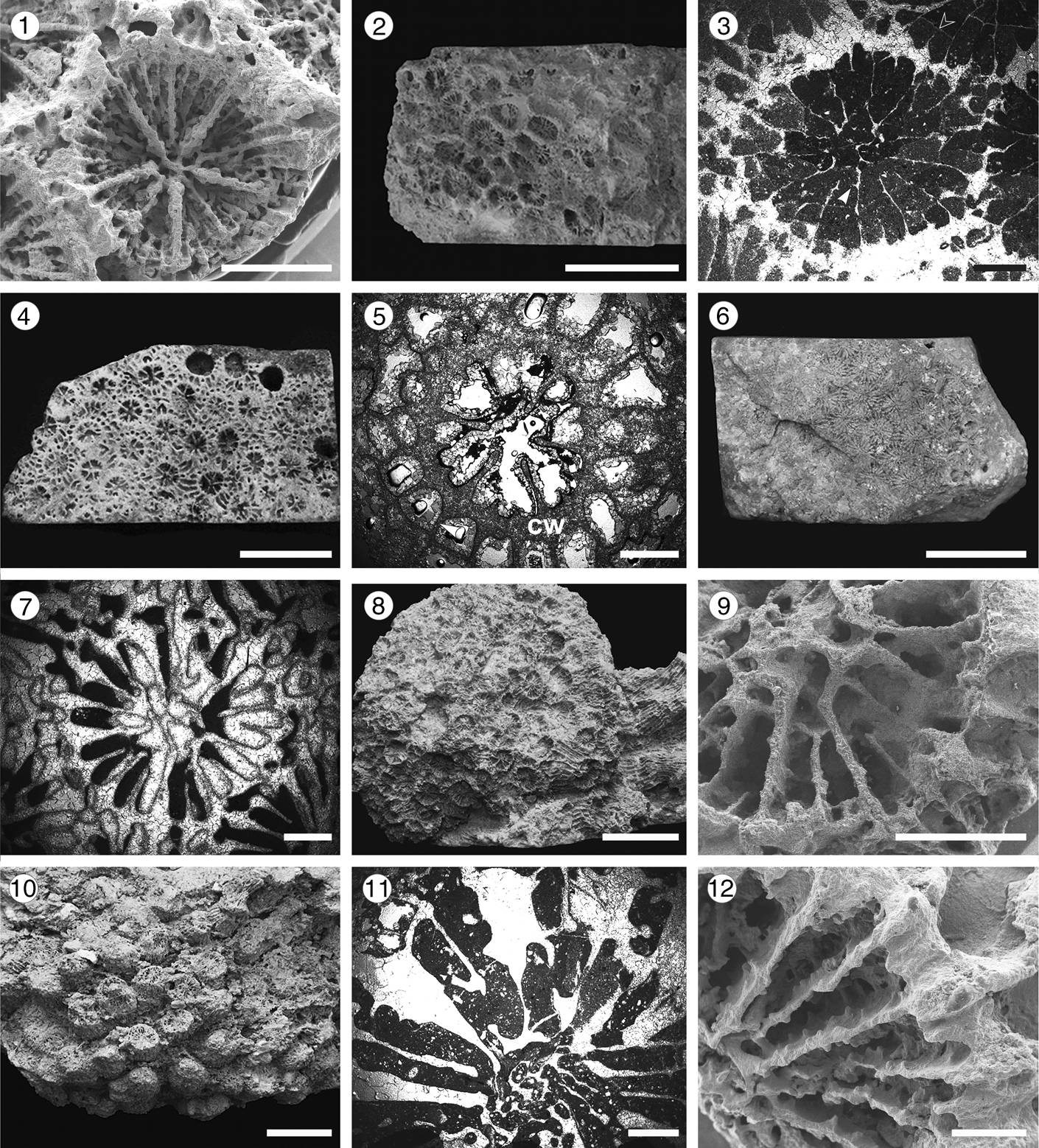
(1, 2) Astrocoenia decaturensis Vaughan, Reference Vaughan1919 from the Siamaná Formation, Arroyo Ekieps (MUN-STRI-17294): (1) general view of the colony; (2) detail of the corallites. (3, 4) Astrocoenia portoricensis Vaughan, Reference Vaughan1919 from the Siamaná Formation, Arroyo Ekieps (MUN-STRI-17311): (3) morphology of the colony; (4) detail of the corallites, septa, and granules. (5, 6) Astrocoenia sp. indet. from the Siamaná Formation, Arroyo Uitpa (MUN-STRI-43497): (5) morphology of the colony; (6) transverse thin section. (7, 8) Caryophylliidae gen. indet. sp. indet. from the Siamaná Formation, Arroyo Ekieps (MUN-STRI-43528): (7) phaceloid corallites; (8) detail of the rudimentary columella and septal granules. (9) Diploastrea crassolamellata (Duncan, Reference Duncan1863) from the Siamaná Formation, Arroyo Uitpa (MUN-STRI-17635), detail of corallites. (10, 11) Diploastrea magnifica (Duncan, Reference Duncan1863) from the Siamaná Formation, Arroyo Uitpa (MUN-STRI-43496): (10) surface of the corallites; (11) transverse thin section showing the columella and thick septal edges. (12) Antiguastrea cellulosa (Duncan, Reference Duncan1863) from the Siamaná Formation, Arroyo Ekieps (MUN-STRI-17224), colony morphology. (1, 12) Scale bars=2 cm; (2, 8) scale bars=1 mm; (3) scale bar=2.5 cm; (4) scale bar=0.5 mm; (5) scale bar=3.5 cm; (6, 11) scale bars=600 µ; (7) scale bar=4 mm; (9) scale bar=7 mm; (10) scale bar=5 mm.
1919 Astrocoenia decaturensis Reference VaughanVaughan, p. 348, pl. 78, figs. 3, 3a, 4, 4a.
Holotype
USNM M324789, from Chattahoochee Formation, Hales Landing, Georgia, USA. Oligocene.
Occurrence
Middle Eocene to early Miocene. First record in ?St. Bartholomew Formation, St. Bartholomew Island (Vaughan, Reference Vaughan1919). Late Eocene in Gatuncillo Formation, Panama (Budd et al., Reference Budd, Stemann and Stewart1992). Late Oligocene in Lares Formation, Puerto Rico (Frost et al., Reference Frost, Harbour, Beach, Realini and Harris1983); Antigua Formation, Antigua and Barbuda (Johnson, Reference Johnson2007). Vaughan (Reference Vaughan1919, p. 205) also recorded it from the “middle Oligocene” in the “base of Chattahoochee Formation,” Georgia, USA; however, Cooke (Reference Cooke1943, p. 81) suggested the name Flint River Formation for this geologic section from the Oligocene. The presence in Siamaná Formation, Colombia, confirms its occurrence in the early Miocene.
Description
Corallum massive, encrusting or columnar, cerioid in form. Columns oval in transverse section of 5 × 4 cm, which can be covered by encrusting layers. Corallites generally pentagonal or hexagonal, 1.5–1.9 mm in diameter, with fine blunt denticles in the calicular edge. Most calices bear 16 septa in octameral arrangement, eight of which reach the styliform columella. They show a thickening close to the columella, forming a palar crown. Remaining septa one-third to one-half the width of the first cycle. Septal margin with beaded teeth, bearing series of five to six in septa of 0.6 mm width. Fossa shallow.
Materials
Siamaná Formation, Arroyo Ekieps, station 550012: MUN-STRI-17294, station 550011: MUN-STRI-37858, MUN-STRI-37863. Arroyo Uitpa, station PF0016: MUN-STRI-37869; station 550006: MUN-STRI-37876, MUN-STRI-37878, MUN-STRI-37880, MUN-STRI-37881. SW Ekieps, station PF0018 MUN-STRI-37905.
Remarks
Although the surfaces of samples are poorly preserved, the denticles in the septa and calicular edge can be distinguished. Astrocoenia decaturensis differs from A. portoricensis by the presence of a well-developed secondary group of septa and the morphology of the colonies. This species was a component of fringing and patch reefs associated with Aniguastrea cellulosa (Duncan, Reference Duncan1863), Porites spp., and Montastraea spp. in the Siamaná Formation.
Astrocoenia portoricensis Vaughan, Reference Vaughan1919
1901 Astrocoenia ornata; Vaughan in Reference SpencerSpencer, p. 497.
1919 Astrocoenia portoricensis Reference VaughanVaughan, p. 350, pl. 76, fig. 4, 4a, pl. 78, fig. 1, 1a.
Holotype
USNM M324785, from Lares Formation, Puerto Rico. Late Miocene.
Occurrence
Oligocene to early Miocene. Oldest occurrences from early Oligocene in Rancho Berlín Formation, Mexico (Frost and Langenheim, Reference Frost and Langenheim1974). Late Oligocene in Lares Formation, Puerto Rico (Frost et al., Reference Frost, Harbour, Beach, Realini and Harris1983); Antigua Formation, Antigua and Barbuda (Johnson, Reference Johnson2007). Late Oligocene to early Miocene in Browns Town and Newport formations, Jamaica (Steman, 2003). Early Miocene in Culebra Formation, Panama (Johnson and Kirby, Reference Johnson and Kirby2006); Castillo Formation, Venezuela (Johnson et al., Reference Johnson, Sánchez-Villagra and Aguilera2009); Siamaná Formation, Colombia.
Description
Corallum branching and cerioid. Branches circular to oval in shape, 1.5–2.0 cm in diameter. Corallites polygonal in shape, 1.5–2.0 mm in diameter. Calicular edges with blunt denticles. Regular calices bear 16 septa in octameral arrangement, eight of them extend to the columella, whereas the rest are poorly developed or rudimentary. Sporadically, bigger corallites, 2.52 mm in diameter, are present with 15–16 septa well developed that reach the columella, while in others the 15–16 are rudimentary. Septal edges with beaded teeth, the last one forming a ?palar crown encircling the styliform columella. Fossa shallow.
Materials
Siamaná Formation, Arroyo Uitpa, station 550005: MUN-STRI-17628. Arroyo Ekieps, station 550012: MUN-STRI-17311.
Remarks
Samples consist of poorly preserved, broken branches. In the Siamaná Formation, Astrocoenia portoricensis was a component of fringing and patch reefs, occurring with Aniguastrea cellulosa, Goniopora hilli Vaughan, Reference Vaughan1919, and Porites spp.
Astrocoenia sp. indet.
Occurrence
Early Miocene in the Siamaná Formation, Colombia.
Description
Corallum massive, ?encrusting, and plocoid. Corallites circular to oval in shape, 2–3 mm in diameter, spaced 1–2 mm apart. They show 20 septa in decameral arrangement; 10 of them reach the columella and the rest extend to half or more of the width of the first cycle. Columella ?styliform. Calicular edges with blunt denticles and spinose coenosteum.
Material
Siamaná Formation, Arroyo Uitpa, station 550005: MUN-STRI-43497.
Remarks
The sample is a poorly preserved colony fragment. Although the sample resembles its congenerics, it differs from Astrocoenia portoricensis and A. decaturensis by have a wider intercalicular space and from A. portoricensis by the corallum morphology, which is massive in the sample reviewed. Astrocoenia sp. indet. occurs with Antiguastrea cellulosa, Diploastrea magnifica (Duncan, Reference Duncan1863), and Porites waylandi Foster, Reference Foster1986.
Family Caryophylliidae Dana, Reference Dana1846
Caryophylliidae gen. indet. sp. indet.
Occurrence
This family has a wide record in the world, from the Upper Jurassic to Recent (Kitahara and Cairns, Reference Kitahara and Cairns2005).
Description
Corallum ahermatypic, dendroid to irregularly shaped. Elongated corallites, trochoid in shape, sometimes free. Asexual reproduction by budding, with one or two daughter corallites rising from the outer margins of parent corallites; parricidal budding may also be present. Calices oval in shape, 6–8 mm in the largest calicular diameter, and 4.5–5.6 mm in the smallest. About 48 septa hexamerally arranged in four cycles, sometimes with additional S5. S1–S2 extended to the calicular center, S3 half or more the width of S1–2, S4 similar to S3, and when present, S5 poorly developed. Septal faces bear rounded granules. Pali and paliform lobes absent. Columella absent or poorly developed, composed by a single blunt element. Granular costae present along the corallite.
Materials
Siamaná Formation, Arroyo Ekieps, station 550012: MUN-STRI-17305; station 550013: MUN-STRI-17327 (Acropora panamensis), MUN-STRI-43525, MUN-STRI-43528; station 550013: MUN-STRI- 37865.
Remarks
Samples are recrystallized or with the skeleton partially dissolved by diagenetic processes, with only the internal mold remaining. Better-preserved specimens with shades of purple. Caryophylliidae samples resemble genus Anomocora in the extracalicular budding, morphology of the corallites, and septal arrangement. The colonies from the Siamaná Formation, however, differ from these because they have up to four generations in a single colony, while in Anomocora the budded corallites detach from the parent before the third generation (Cairns, Reference Cairns2000, p. 127). In addition, the specimens of Anomocora present paliform lobes and trabecular columella (Cairns, Reference Cairns2000). The morphology of the corallites also has a resemblance to the family Flabellidae in the septal arrangement, absence of pali, and rudimentary columella, but this group is exclusively solitary (Wells, Reference Wells1956, p. 432). In the Siamaná Formation, Caryophylliidae colonies are a few centimeters in length and are found in fringing reefs with Acropora panamensis, Alveopora tampae, Astrocoenia decaturensis, Colpophyllia willoughbiensis, and Porites baracoaensis.
Family Diploastraeidae Chevalier and Beauvais, Reference Chevalier and Beauvais1987
Genus Diploastrea Matthai, Reference Matthai1914
Type species
Orbicella minikoiensis Gardiner, Reference Gardiner1904; by original designation.
Diploastrea crassolamellata (Duncan, Reference Duncan1863)
1863 Astraea crassolamellata Reference DuncanDuncan, p. 412, pl. 13, figs. 1–7.
1866 Heliastraea crassolamellata; Reference Duchassaing and MichelottiDuchassaing and Michelotti, p. 180.
1901 Orbicella crassolamellata; Vaughan in Reference SpencerSpencer, p. 497.
1919 Diploastrea crassolamellata; Reference VaughanVaughan, p. 470, pl. 135, figs. 1–5b, pl. 136, fig. 1, 1b, pl. 137, figs. 1–5.
1919 Diploastrea crassolamellata var. nugenti; Reference VaughanVaughan, p. 477, pl. 138, fig. 3, 3a.
Holotype
NHMUK R28616, from Marl Formation, Antigua. Miocene.
Occurrence
Oligocene to early Miocene. First occurrences from early Oligocene in Rancho Berlín Formation, Mexico (Frost and Langenheim, Reference Frost and Langenheim1974). Late Oligocene in La Quinta Formation, Mexico (Frost and Langenheim, Reference Frost and Langenheim1974); Lares Formation, Puerto Rico (Frost et al., Reference Frost, Harbour, Beach, Realini and Harris1983); Antigua Formation, Antigua and Barbuda (Johnson, Reference Johnson2007). Late Oligocene–early Miocene in Browns Town and Newport formations, Jamaica (Stemann, Reference Stemann2003). Early Miocene in the southern Caribbean in Castillo and San Luis formations, Venezuela (Johnson et al., Reference Johnson, Sánchez-Villagra and Aguilera2009); Siamaná Formation in Colombia; until middle Miocene in San Andrés Formation, Colombia (Geister, Reference Geister1975).
Description
Corallum massive and plocoid, with extratentacular budding. Calices slightly exsert and circular in shape, 5–7 mm in diameter, spaced 1–2 mm apart. Calices bear 18–21 septa hexamerally arranged in three cycles; all septa reach the columella and are exsert; the principal septa thicken abaxially. Coenosteum costate. Columella trabecular and wide, 1–2 mm in diameter, occupying one-third of calicular diameter.
Materials
Siamaná Formation, Arroyo Uitpa, station 550005: MUN-STRI-43488, MUN-STRI-17614, MUN-STRI-17617, MUN-STRI-17631, MUN-STRI-17634, MUN-STRI-17635, MUN-STRI-17638, MUN-STRI-43499; Flor de La Guajira, station 550001:MUN-STRI-17187.
Remarks
Diploastrea crassolamellata has a wide morphological variation and can be easily confused with members of Montastraeidae and other species of the genus. It differs from montastraeids by the presence of a synapticulothecal wall at the calices level and synapticulothecate and septothecate below these (Frost and Langenheim, Reference Frost and Langenheim1974, p. 268). Despite the Siamaná samples being poorly preserved, and it not being possible to observe characteristics such as their large septal teeth, D. crassolamellata can be distinguished from D. magnifica by the calicular size, which is usually smaller in D. crassolamellata, as well as by the thickness of the septocostae, which are wider in D. crassolamellata. The species occurs with D. magnifica, Antiguastrea cellulosa, and Porites waylandi.
Diploastrea magnifica (Duncan, Reference Duncan1863)
1863 Astraea crassolamellata var. magnifica Reference DuncanDuncan, p. 417, pl. 13, fig. 3.
1919 Diploastrea crassolamellata var. magnifica; Reference VaughanVaughan, p. 476, pl. 138, figs. 1, 2, 2a.
Hypotype
USNM M325277, from Chattahoochee Formation, Georgia, USA. Early Miocene (Vaughan, Reference Vaughan1919).
Occurrence
Late Oligocene to early Miocene. Oldest occurrence from late Oligocene in Antigua Formation, Antigua and Barbuda (Johnson, Reference Johnson2007). Early Miocene in the southern Caribbean in San Luis Formation, Venezuela (Johnson et al., Reference Johnson, Sánchez-Villagra and Aguilera2009); Siamaná Formation, Colombia. Diploastrea magnifica is globally extinct, and the only living species of the genus is D. heliopora (Lamarck, Reference Lamarck1816) of Indo-Pacific waters (Veron, Reference Veron2000).
Description
Corallum massive and plocoid, with extratentacular budding. Calices circular in shape, 7–10 mm in diameter, spaced 3–5 mm apart. Calices bear 42–48 septa, hexamerally arranged in four incomplete cycles, which extend to the columella. Septocostae thickened close to calicular edge. Trabecular columella, 3–4 mm in diameter, occupying about one-third of calicular diameter.
Materials
Siamaná Formation, Arroyo Uitpa, station 550005: MUN-STRI-17616, MUN-STRI-17618, MUN-STRI-43496; Arroyo Ekieps, station 550013: MUN-STRI-17322; Flor de La Guajira, station 550001: MUN-STRI-17182.
Remarks
Diploastrea crassolamellata var. magnifica was described by Duncan (Reference Duncan1863) and accepted by Vaughan (Reference Vaughan1919) based on a larger size of corallites, less exsert calices, and smaller thickness of the septocostae in the wall. Frost and Langenheim (Reference Frost and Langenheim1974), however, considered the variety indistinguishable from D. crassolamelata. Subsequently, Johnson (Reference Johnson2007) and Johnson et al. (Reference Johnson, Sánchez-Villagra and Aguilera2009) recovered the taxon as Diploastrea magnifica. The Colombian samples are poorly preserved and do not have the external calicular structures. However, they can be identified by the small septal thickness in the wall and the larger corallites. The species was collected in patch and fringing reefs associated with D. crassolamellata, Antiguastrea cellulosa, Porites waylandi, P. baracoaensis, and Alveopora tampae.
Family Merulinidae Verrill, Reference Verrill1865
Genus Antiguastrea Vaughan, Reference Vaughan1919
Type species
Astraea cellulosa Duncan, Reference Duncan1863; by original designation (Vaughan, Reference Vaughan1919).
Antiguastrea cellulosa (Duncan, Reference Duncan1863)
(1) Antiguastrea cellulosa (Duncan, Reference Duncan1863) from the Siamaná Formation, Arroyo Ekieps (MUN-STRI-17224), detail of corallite. (2, 3) Goniastrea canalis Vaughan, Reference Vaughan1919 from the Siamaná Formation, Arroyo Ekieps (MUN-STRI-17332): (2) fragment of the colony; (3) transverse thin section, showing the septal arrangement, dissepiments (black arrow), and septal granules (white arrow). (4, 5) Orbicella imperatoris Vaughan, Reference Vaughan1919 from the Jimol Formation, Punta Espada: (4) fragment of the colony (MUN-STRI-17344); (5) transverse thin section showing the calicular wall (cw), septal arrangement, and costae (white arrow) (MUN-STRI-43539). (6, 7) Orbicella limbata (Duncan, Reference Duncan1863) from Siamaná Formation, Flor de La Guajria (MUN-STRI-17185): (6) colony; (7) transverse thin section showing the septal arrangement. (8, 9) Montastraea canalis (Vaughan, Reference Vaughan1919) from the Siamaná Formation, Arroyo Ekieps (MUN-STRI-17283): (8) fragment of the colony; (9) detail of the columella, septocostae, and septal arrangement. (10, 11) Montastraea cavernosa (Linnaeus, Reference Linnaeus1767) from the Siamaná Formation, Arroyo Ekieps (MUN-STRI-17306): (10) morphology of the colony; (11) transverse thin section. (12) Montastraea endothecata Duncan, Reference Duncan1863 from the Siamaná Formation, Arroyo Ekieps (MUN-STRI-17225), detail of the columella and septal granules. (1, 9) Scale bars=2 mm; (3, 7, 11) scale bars=500 µ; (2, 4, 6) scale bars=1.5 cm; (5) scale bar=600 µ; (8, 10) scale bars=2 cm; (12) scale bar=1 mm.
1863 Astraea cellulosa Reference DuncanDuncan, p. 417, pl. 13, fig. 10.
1919 Antiguastrea cellulosa; Reference VaughanVaughan, p. 402, pl. 98, figs. 3–4a, pl. 99, figs. 1–3a, pl. 100, figs. 1–4a, pl. 101, fig. 2, 2a.
1919 Antiguastrea cellulosa var. curvata; Reference VaughanVaughan, p. 408, pl. 98, fig. 4, 4a.
1919 Antiguastrea cellulosa var. silicensis; Reference VaughanVaughan, p. 408, pl. 101, fig. 1, 1a.
1929 Antiguastrea cellulosa var. curvata; Reference Coryell and OhlsenCoryell and Ohlsen, p. 193, pl. 27, fig. 5.
1992 Antiguastrea cellulosa; Reference Budd, Stemann and StewartBudd et al., p. 585, fig. 7.4–7.6.
2006 Antiguastrea cellulosa; Reference Baron-Szabo, Schafhauser, Götz and StinnesbeckBaron-Szabo et al., p. 1037, fig. 4.2.
Holotype
USNM M324936, from Chattahoochee Formation, Hales Landing, Georgia, USA. Late Miocene.
Occurrence
Upper Cretaceous to early Miocene. Oldest occurrences from Maastrichtian in Cardenas Formation, Mexico (Baron-Szabo et al., Reference Baron-Szabo, Schafhauser, Götz and Stinnesbeck2006). Early Oligocene in Rancho Berlín Formation, Mexico (Frost and Langenheim, Reference Frost and Langenheim1974). Late Oligocene in La Quinta Formation, Mexico (Frost and Langenheim, Reference Frost and Langenheim1974); Anahuac Formation, Texas, USA (Frost and Schafersman, Reference Frost and Schafersman1978); Lares Formation, Puerto Rico (Frost et al., Reference Frost, Harbour, Beach, Realini and Harris1983); Antigua Formation, Antigua and Barbuda (Johnson, Reference Johnson2007). Late Oligocene–early Miocene in Browns Town and Newport formations, Jamaica (Stemann, Reference Stemann2003); Arcadia Formation (Tampa Member), Florida, USA (Weisbord, Reference Weisbord1973). Early Miocene in Anguilla Formation, Anguilla Island (Budd et al., Reference Budd, Johnson and Edwards1995); Castillo and San Luis formations, Venezuela (Johnson et al., Reference Johnson, Sánchez-Villagra and Aguilera2009); Siamaná Formation, Colombia. Middle Miocene in Chipola Formation, Florida, USA (Budd et al., Reference Budd, Johnson and Stemann1996).
Description
Corallum massive and subplocoid, with extracalicular budding. Corallites rounded to polygonal in shape, 3–4 mm in diameter, separated by a furrow of 0.5–1.0 mm. Calices bear about 48 septa hexamerally arranged in four complete cycles. S1 and S2 are thick and reach the columella. S3 about half width of S1–2, S4 half width of S3 or does not extend away from calicular wall. Parathecal wall, formed by dissepiments. Columella lamellar and thin, rises from a shallow fossa.
Materials
Siamaná Formation, Arroyo Uitpa, station 550005: MUN-STRI-17603, MUN-STRI-43490, MUN-STRI-43493, MUN-STRI-17610, MUN-STRI-17615, MUN-STRI-43494, MUN-STRI-17619, MUN-STRI-17620, MUN-STRI-17622, MUN-STRI-17625, MUN-STRI-17629, MUN-STRI-17637, MUN-STRI-17640, MUN-STRI-17600, MUN-STRI-17602, MUN-STRI-43498; station 550006: MUN-STRI-17197, MUN-STRI-17199, MUN-STRI-43500, MUN-STRI-17201, MUN-STRI-43501, MUN-STRI-17202, MUN-STRI-17203, MUN-STRI-37886. Arroyo Ekieps, station 550008: MUN-STRI-17230, MUN-STRI-17224; station 550011: MUN-STRI-17287, MUN-STRI-17261, MUN-STRI-17296. SW Ekieps, station PF0018: MUN-STRI-37902, MUN-STRI-37906, MUN-STRI-37922.
Remarks
Samples moderately preserved, generally with the calicular margin covered by red algae. Several morphologic characters are variable in this taxon: diameter of the corallites ranges between 2 and 6 mm (Baron-Szabo et al., Reference Baron-Szabo, Schafhauser, Götz and Stinnesbeck2006), corallites can be plocoid to cerioid and circular to oval in shape in the same colony, and the corallum can be flat to dome-shaped in the same population (Frost and Langenheim, Reference Frost and Langenheim1974). In the Siamaná Formation, it was found in patch and fringing reefs with Astrocoenia portoricensis, Diploastrea spp., Montastraea spp., Porites spp., and Stylophora affinis Duncan, Reference Duncan1863.
Genus Goniastrea Milne-Edwards and Haime, Reference Milne-Edwards and Haime1848
Type species
Astrea retiformis Lamarck, Reference Lamarck1816; by original designation (Milne-Edwards and Haime, Reference Milne-Edwards and Haime1848).
Goniastrea canalis Vaughan, Reference Vaughan1919
1919 Goniastrea canalis Reference VaughanVaughan, p. 416, pl. 91, fig. 4.
1973 Favites yborensis Reference WeisbordWeisbord, p. 38, pl. 16, figs. 1–3.
Holotype
USNM M324996, from La Boca Formation, Panama. Middle Miocene.
Occurrence
Middle Eocene to middle Miocene. First occurrences from middle Eocene in St. Bartholomew Formation, St. Bartholomew (Vaughan, Reference Vaughan1919). Late Eocene in Gatuncillo Formation, Panama (Budd et al., Reference Budd, Stemann and Stewart1992). Early Oligocene in Rancho Berlín Formation, Mexico (Frost and Langenheim, Reference Frost and Langenheim1974). Late Oligocene in La Quinta Formation, Mexico (Frost and Langenheim, Reference Frost and Langenheim1974); Lares Formation, Puerto Rico (Frost et al., Reference Frost, Harbour, Beach, Realini and Harris1983); Antigua Formation, Antigua and Barbuda (Johnson, Reference Johnson2007). Until early Miocene in Arcadia Formation (Tampa Member), Florida, USA (Weisbord, Reference Weisbord1973). Early Miocene in Culebra Formation, Panama (Johnson and Kirby, Reference Johnson and Kirby2006); Castillo Formation, Venezuela (Johnson et al., Reference Johnson, Sánchez-Villagra and Aguilera2009); Siamaná Formation in Colombia.
Description
Corallum massive and cerioid, with intercalicular budding. Calices highly irregular in shape, polygonal to oval, 2.2–5.6 mm in diameter, spaced 0.8–1.5 mm apart. Calices bear 28–33 septa hexamerally arranged in three cycles. S1 reach the columella, S2 equal to S1 or slightly smaller, S3 half to two-thirds width of S2, sometimes fused to them. Septal faces finely granulated with small rounded granules. Septothecal wall. Paliform lobes developed before ?S1 and S2. Columella trabecular and wide, occupying about one-third of calicular diameter.
Materials
Siamaná Formation, Arroyo Ekieps, station 550013: MUN-STRI-17332.
Remarks
The sample is a single colony fragment recrystallized and poorly preserved. However, the septothecal wall and well-developed paliform lobes are characteristic of G. canalis. In the Caribbean fossil record, Goniastrea can be confused with Favites spp., but the two genera differ by the presence of abortive septa in Goniastrea and a double wall or fused walls in Favites (Frost and Langenheim, Reference Frost and Langenheim1974; Huang et al., Reference Huang, Benzoni, Fukami, Knowlton, Smith and Budd2014). In the Siamaná Formation, it was found in a fringing reef with Acropora panamensis, Acropora sp., and Alveopora tampae.
Genus Orbicella Dana, Reference Dana1846
Type species
Madrepora annularis Ellis and Solander, Reference Ellis and Solander1786; by subsequent designation (Vaughan, Reference Vaughan1919).
Orbicella imperatoris Vaughan, Reference Vaughan1919
1919 Orbicella imperatoris Reference VaughanVaughan, p. 378, pl. 86, figs. 2–5.
1973 Montastrea annularis; Reference WeisbordWeisbord, p. 39, pl. 17, figs. 1–3, pl. 18, figs. 1–3, pl. 19, figs. 1, 2.
1974 Montastrea limbata; Reference Frost and LangenheimFrost and Langenheim, p. 258, pl. 93, figs. 3–6, pl. 94, fig. 1.
Syntype
USNM M324884, from La Boca Formation, Panama. Middle Miocene.
Occurrence
Late Oligocene to Miocene. Oldest occurrences in Anahuac Formation, Texas, USA (Frost and Schafersman, Reference Frost and Schafersman1978); Lares Formation, Mexico (Frost et al., Reference Frost, Harbour, Beach, Realini and Harris1983). Until early Miocene in Arcadia Formation (Tampa Member), Florida, USA (Weisbord, Reference Weisbord1973). Early Miocene in Anguilla Formation, Anguilla Island (Budd et al., Reference Budd, Johnson and Edwards1995); Culebra Formation, Panama (Johnson and Kirby, Reference Johnson and Kirby2006); Agua Clara and Castillo formations, Venezuela (Johnson et al., Reference Johnson, Sánchez-Villagra and Aguilera2009); Siamaná and Jimol formations, Colombia. Middle Miocene in Valiente Formation, Panama (Klaus et al., Reference Klaus, McNeill, Budd and Coates2012); Providencia Island, Colombia (Geister, Reference Geister1992); Pedregoso Formation, Venezuela (Johnson et al., Reference Johnson, Sánchez-Villagra and Aguilera2009). Middle to late Miocene in San Andrés, Colombia (Geister, Reference Geister1975). Latest occurrences from middle Miocene–late Pliocene in Seroe Domi Formation, Curaçao (Budd et al., Reference Budd, Petersen and McNeill1998).
Description
Corallum massive and plocoid, with extracalicular budding. Corallites moderately raised and circular in shape, 3.2–4.0 mm in diameter, spaced 1.7–4.2 mm apart. Calices bear 24 septa, hexamerally arranged in three cycles, sometimes incomplete. A well-developed S1 reaches the columella. ?Trabecular columella, formed by the union of the primary septa. Well-developed costae corresponding to all or almost all cycles. Well-developed endothecal and exothecal dissepiments.
Materials
Siamaná Formation, Flor de La Guajira, station 550002: MUN-STRI- 43534. Jimol Formation, Punta Espada, station 550010: MUN-STRI-17246, MUN-STRI-17247, MUN-STRI-17252, MUN-STRI-17253, MUN-STRI-43536, MUN-STRI-43537, MUN-STRI-17255; station 550014: MUN-STRI-17337, MUN-STRI-17338, MUN-STRI-17339, MUN-STRI-43538, MUN-STRI-17340, MUN-STRI-17341, MUN-STRI-17342, MUN-STRI-17343, MUN-STRI-17344, MUN-STRI-43539, MUN-STRI-17346, MUN-STRI-43540, MUN-STRI-43541, MUN-STRI-17347, MUN-STRI-17350, MUN-STRI-17351.
Remarks
The samples of O. imperatoris from the Siamaná and Jimol formations are poorly preserved and highly recrystallized. Many characters, such as the morphology of the columella, the presence of paliform lobes, and the extension of secondary and tertiary septa, cannot be observed. However, the size and shape of raised corallites, development of the first septal cycle, and number of cycles are diagnostic of the species. This species appears in patch reefs with Pocillopora sp. indet. and Porites waylandi.
Orbicella limbata (Duncan, Reference Duncan1863)
1863 Phyllocoenia limbata Reference DuncanDuncan, p. 433.
1863 Phyllocoenia sculpta var. tegula Reference DuncanDuncan, p. 432.
1864 Plesiastraea ramea Reference DuncanDuncan, p. 39, pl. 5, fig. 1a, b.
1929 not Orbicella limbata; Coryell and Ohlsen, p. 197, pl. 2, fig. 3.
1974 not Montastrea limbata; Reference Frost and LangenheimFrost and Langenheim, p. 258, pl. 93, figs. 3–6, pl. 94, fig. 1.
1991 Montastraea limbata; Reference BuddBudd, p. 41, pl. 18, figs. 1–7, 9, pl. 19, figs. 1–6, pl. 20, figs. 1, 2, 4–6, pl. 21, figs. 1–6, pl. 24, fig. 4, text figs. 3–5, 10, 11, 14, 17.
Holotype
NHMUK R28780, from Yellow Shale, Dominican Republic. Neogene.
Occurrence
Early Miocene to early Pleistocene. First records from early Miocene in Agua Clara, Pedregoso, and San Luis formations, Venezuela (Johnson et al., Reference Johnson, Sánchez-Villagra and Aguilera2009); Siamaná Formation, Colombia. Until the middle Miocene in Tamana Formation, Trinidad and Tobago (Johnson, Reference Johnson2001); San Andrés Formation and Providencia Island, Colombia (Geister, Reference Geister1975, Reference Geister1992; Budd et al., Reference Budd, Stemann and Johnson1994). Middle Miocene–late Pliocene in Seroe Domi Formation, Curaçao (Budd et al., Reference Budd, Petersen and McNeill1998). From late Miocene in Cercado Formation, Dominican Republic (Budd et al., Reference Budd, Stemann and Johnson1994; Budd and Klaus Reference Budd and Klaus2001; Klaus et al., Reference Klaus, Budd and McNeill2008), Old Bank Formation, Panama (Klaus et al., Reference Klaus, McNeill, Budd and Coates2012). From late Miocene–early Pliocene in Gurabo Formation and early Pliocene in Mao Formation, both in Dominican Republic (Budd et al., Reference Budd, Stemann and Johnson1994; Budd and Klaus Reference Budd and Klaus2001; Klaus et al., Reference Klaus, Budd and McNeill2008). Late Pliocene in Quebrada Chocolate Formation, Costa Rica, and until early Pleistocene in Moin Formation, Costa Rica (Budd et al., Reference Budd, Johnson, Stemann and Tompkins1999). Latest occurrences from early Pleistocene in Old Pera Formation, Jamaica (Budd and McNeill, Reference Budd and McNeill1998); Isla Colón Formation, Panama (Klaus et al., Reference Klaus, McNeill, Budd and Coates2012).
Description
Corallum massive and plocoid. Corallites circular in shape, 3.5–4.2 mm in diameter, spaced 0.4–1.3 mm apart. Calices bear 24 septa, hexamerally arranged in three complete cycles. S1 and S2 reach the columella; S3 half width of S2 or little more, occasionally reaching the columella. Paliform lobes present before S1, S2, and S3, in the latter just when they reach the columella. Columella trabecular, 0.7–1.0 mm in diameter. Well-developed costae corresponding to all septa.
Material
Siamaná Formation, Flor de La Guajira, station 550001: MUN-STRI-17185.
Remarks
The sample is a highly recrystallized colony fragment and it is not possible to observe characters typical of the species, such as costae and endothecal and exothecal dissepiments. Despite their similitude in corallite size and number of septal cycles, O. limbata differs from O. imperatoris by the well-developed septal of cycles one and two, the wider trabecular columella, and reduced distance between corallites. According to Budd (Reference Budd1991), the samples described by Frost and Langenheim (Reference Frost and Langenheim1974) as O. limbata from Central Chiapas actually belong to O. imperatoris. In the Siamaná Formation, O. limbata was a component of patch reefs in association with Porites waylandi and Diploastrea spp.
Family Montastraeidae Yabe and Sugiyama, Reference Yabe and Sugiyama1941
Genus Montastraea Blainville, Reference Blainville1830
Type species
Astrea guettardi Defrance, Reference Defrance1826; by subsequent designation (Lang and Smith, Reference Lang and Smith1935).
Remarks
Poorly preserved colonies could be confused with Antiguastrea spp. and Agathiphyllia spp. However, corallites in Montastraea spp. are usually more exsert and have bigger calices and columella. See Remarks under genus Agathiphyllia.
Montastraea canalis (Vaughan, Reference Vaughan1919)
1919 Orbicella canalis Reference VaughanVaughan, p. 389, pl. 94, figs. 1, 1a, 3, 3a, not pl. 94, fig. 2, 2a, pl. 97, fig. 4, 4a.
1919 Orbicella tampaensis Reference VaughanVaughan, p. 390, pl. 95, figs. 1, 3, 3a, not pl. 95, fig. 2, 2a.
1919 Orbicella tampaensis var. silecensis Reference VaughanVaughan, p. 390, pl. 96.
1971 Montastrea cf. costata; Reference WeisbordWeisbord, p. 31, pl. 7, figs. 1–4.
1973 Montastrea cf. tampaensis silecensis; Reference WeisbordWeisbord, p. 50, pl. 22, figs. 1, 2, pl. 23, fig. 1.
1974 Montastrea tampaensis; Reference Frost and LangenheimFrost and Langenheim, p. 253, pl. 91, figs. 1, 2, pl. 92, figs. 1, 2, 4, 6, pl. 93, figs. 1, 2, pl. 94, fig. 2.
1991 Montastraea canalis; Reference BuddBudd, p. 36, pl. 5, figs. 1–8, pl. 6, figs. 1–6, pl. 7, figs. 1–6, pl. 8, fig. 2, pl. 9, fig. 2, pl. 14, fig. 2, text figs. 3–5, 7, 10, 11, 14, 17.
Holotype
USNM M324862, from La Boca Formation, Panama. Middle Miocene.
Occurrence
Late Oligocene to early Pleistocene. Oldest occurrences from late Oligocene in La Quinta Formation, Mexico (Frost and Langenheim, Reference Frost and Langenheim1974); Lares Formation, Puerto Rico (Frost et al., Reference Frost, Harbour, Beach, Realini and Harris1983); Antigua Formation, Antigua and Barbuda (Johnson, Reference Johnson2007). Until early Miocene in Arcadia Formation (Tampa Member), Florida, USA (Weisbord, Reference Weisbord1973). Early Miocene in Tamana Formation, Trinidad and Tobago (Johnson, Reference Johnson2001); Anguilla Formation, Anguilla Island (Budd et al., Reference Budd, Johnson and Edwards1995); Culebra Formation, Panama (Johnson and Kirby, Reference Johnson and Kirby2006); Castillo Formation, Venezuela (Johnson et al., Reference Johnson, Sánchez-Villagra and Aguilera2009); Siamaná Formation, Colombia. Middle Miocene–late Pleistocene in Seroe Domi Formation, Curaçao (Budd et al., Reference Budd, Petersen and McNeill1998). Late Miocene in Cercado Formation, Dominican Republic (Budd et al., Reference Budd, Stemann and Johnson1994); Old Bank Formation, Panama (Klaus et al., Reference Klaus, McNeill, Budd and Coates2012); and until early Pliocene in Gurabo Formation, Dominican Republic (Budd et al., Reference Budd, Stemann and Johnson1994). Late Pliocene in Quebrada Chocolate Formation, Costa Rica (Budd et al., Reference Budd, Johnson, Stemann and Tompkins1999); Mao Formation, Dominican Republic (Budd et al., Reference Budd, Stemann and Johnson1994). Youngest occurrences in Isla Colón Formation, Panama (Klaus et al., Reference Klaus, McNeill, Budd and Coates2012).
Description
Corallum massive and plocoid, with extracalicular budding. Corallites circular to slightly oval in shape, moderately raised, 4–8 mm in diameter, spaced 3–6 mm apart. Calices bear 42–49 septa, hexamerally arranged in four cycles, generally complete. S1, S2, and some S3 reach the columella, S4 half width of S3 or less. Septal faces granulate with spaced pointed granules. Paliform lobes present before S1, S2, and S3, in the latter just when they reach the columella. Trabecular, wide, and raised columella occupies about one-third of corallite diameter. Well-developed costae, mainly in S1, S2, and S3. Dissepiments endothecal and exothecal developed.
Materials
Siamaná Formation, Arroyo Ekieps, station 550008: MUN-STRI-17243; station 550011: MUN-STRI-17283, MUN-STRI-17290; station 550012: MUN-STRI-17307, MUN-STRI-17293, MUN-STRI-17298; station 550013: MUN-STRI-43529. Arroyo Uitpa, station 550016: MUN-STRI-37866, MUN-STRI-37874. SW Ekieps, station PF0018: MUN-STRI-37923, MUN-STRI-37925.
Remarks
The Monstastraea species with four cycles in their septal arrangement show a high morphological similarity; however, M. canalis can be differentiated from M. endothecata Duncan, Reference Duncan1863 and M. cavernosa by its smaller calices and equal costae. In addition, it can be differentiated from M. cavernosa because M. canalis has thicker walls and more closely spaced corallites (Budd, Reference Budd1991, p. 37, 39). Montastraea canalis is a common framework component in reefs. In the Siamaná Formation, it was found in patch reef environments with Porites spp., Siderastrea conferta, Agathiphyllia tenuis, and other Montastraea.
Montastraea cavernosa (Linnaeus, Reference Linnaeus1767)
1767 Madrepora cavernosa Reference LinnaeusLinnaeus, p. 1276.
1901 Orbicella cavernosa; Reference VaughanVaughan, p. 27.
1901 Orbicella braziliana Reference VerrillVerrill, p. 101.
1901 Orbicella cavernosa var. hirta Reference VerrillVerrill, p. 102, 189, pl. 33, fig. 2, 2a.
1991 Montastraea cavernosa; Reference BuddBudd, p. 37, pl. 8, figs. 1, 4, 6, 7, pl. 9, figs. 1, 3–6, pl. 10, figs. 1–6, text figs. 3–5, 7, 10, 11, 14, 17, 19.
Holotype
USNM 36669, from North Rocks, Bermuda. Recent.
Occurrence
Late Oligocene to Recent. Earliest occurrences in Antigua Formation, Antigua and Barbuda (Johnson, Reference Johnson2007). Early Miocene in Castillo Formation, Venezuela (Johnson et al., Reference Johnson, Sánchez-Villagra and Aguilera2009); Siamaná and Jimol formations, Colombia. Until middle Miocene in Chipola Formation, Florida, USA (Budd et al., Reference Budd, Johnson and Stemann1996); Baitoa Formation, Dominican Republic (Budd et al., Reference Budd, Stemann and Johnson1994); Valiente Formation, Panama (Klaus et al., Reference Klaus, McNeill, Budd and Coates2012). Middle Miocene–early Pleistocene in Seroe Domi Formation, Curaçao (Budd et al., Reference Budd, Petersen and McNeill1998). Late Miocene in San Andrés Formation, Colombia (Geister, Reference Geister1975); Old Bank Formation, Panama (Klaus et al., Reference Klaus, McNeill, Budd and Coates2012); Cercado Formation, Dominican Republic (Klaus et al., Reference Klaus, Budd and McNeill2008). Between late Miocene and early Pliocene in Gurabo Formation, Dominican Republic (Klaus et al., Reference Klaus, Budd and McNeill2008). Early Pliocene in Mao Formation, Dominican Republic (Klaus et al., Reference Klaus, Budd and McNeill2008). Late Pliocene in Quebrada Chocolate and Moin formations, Costa Rica (Budd et al., Reference Budd, Johnson, Stemann and Tompkins1999). Early Pleistocene in Isla Colón and Urracá formations, Panama (Klaus et al., Reference Klaus, McNeill, Budd and Coates2012); Hope Gate and Manchioneal formations, Jamaica (Budd and McNeill, Reference Budd and McNeill1998). Recent occurrences in the Greater Caribbean and Brazil.
Description
Corallum massive and plocoid. Corallites circular to oval in shape, 6–7 mm in diameter, spaced apart 2.5–4.5 mm. Calices bear 38–48 septa, hexamerally arranged in four cycles. Primary, secondary, and tertiary septa reach the columella; S4 thin, one-fourth width of S3 or less. Trabecular and wide columella, 1–2 mm in diameter. Paliform lobes absent. Costae developed in all cycles. Endothecal and exothecal dissepiments present.
Materials
Siamaná Formation, Arroyo Uitpa, station 550005: MUN-STRI-43489, MUN-STRI-43491, MUN-STRI-17607. Arroyo Ekieps, station 550012: MUN-STRI-17306, MUN-STRI-17295; station 550013: MUN-STRI-17329. SW Ekieps, station PF0018: MUN-STRI-37907. Flor de La Guajira, station 550001: MUN-STRI-17190; station 550002: MUN-STRI-17192, MUN-STRI-17193.
Remarks
Montastraea cavernosa is similar to M. endothecata and M. canalis but can be differentiated by its calicular diameters, which are of intermediate size. It also differs from M. canalis by having subequal costae, and usually the colonies present a wide variation of intercalicular spaces, even in the same colony, especially at their edges (Budd, Reference Budd1991, p. 39). The samples from the Siamaná Formation are poorly preserved and recrystallized. This species was found in patch reef environments with Porites spp., Siderastrea conferta, Agathiphyllia tenuis, and other Montastraea. At present, M. cavernosa is a common species in the Caribbean, Bahamas, and Florida, living up to 90 m depth, but usually from 12 to 30 m depth.
Montastraea endothecata Duncan, Reference Duncan1863
1863 Astraea endothecata Reference DuncanDuncan, p. 434, pl. 14, fig. 9, pl. 15, fig. 7a, b.
1919 Orbicella cavernosa var. endothecata; Reference VaughanVaughan, p. 384, pl. 63, fig. 1, 1a.
1919 Orbicella bainbridgensis Reference VaughanVaughan, p. 386, pl. 90, fig. 1, 1a–c.
1919 Cyathomorpha roxboroughi Reference VaughanVaughan, p. 461, pl. 129, fig. 1, 1a, b.
1919 Orbicella canalis Reference VaughanVaughan, p. 389, pl. 94, fig. 2, 2a, pl. 97, fig. 4, 4a, not pl. 94, figs. 1, 1a, 3, 3a.
1991 Montastraea endothecata; Reference BuddBudd, p. 40, pl. 1, fig. 4, pl. 5, fig. 7, pl. 8, fig. 5, pl. 14, figs. 1, 3–5, pl. 15, figs. 1–4, pl. 16, figs. 1–6, pl. 17, figs. 1–6, text figs. 3–5, 7, 10, 11, 14, 17.
Holotype
NHMUK R28791, from Nivajè Shale Formation, Dominican Republic. Neogene.
Occurrence
Oligocene to Pliocene. First occurrences from early Oligocene in Rancho Berlín Formation, Mexico (Frost and Langenheim, Reference Frost and Langenheim1974). Late Oligocene in La Quinta Formation, Mexico (Frost and Langenheim, Reference Frost and Langenheim1974); Lares Formation, Puerto Rico (Frost et al., Reference Frost, Harbour, Beach, Realini and Harris1983); Anahuac Formation, Texas, USA (Frost and Schafersman, Reference Frost and Schafersman1978); Antigua Formation, Antigua and Barbuda (Johnson, Reference Johnson2007). Until early Miocene in Browns Town and Newport formations, Jamaica (Stemann, Reference Stemann2003); Providencia Island, Colombia (Geister, Reference Geister1992). Early Miocene in Anguilla Formation, Anguilla (Budd et al., Reference Budd, Johnson and Edwards1995); Chipola Formation, Florida, USA (Budd et al., Reference Budd, Johnson and Stemann1996); Culebra Formation, Panama (Johnson and Kirby, Reference Johnson and Kirby2006); Siamaná Formation, Colombia. Until middle Miocene in Tamana Formation, Trinidad and Tobago (Johnson, Reference Johnson2001); Seroe Domi Formation, Curaçao (Budd et al., Reference Budd, Petersen and McNeill1998); San Andrés Formation, Colombia (Geister, Reference Geister1975); Santa Ana Formation, Mexico (Frost and Langenheim, Reference Frost and Langenheim1974). Late Miocene in Old Bank Formation, Panama (Klaus et al., Reference Klaus, McNeill, Budd and Coates2012). Latest occurrences from early Pliocene in Gurabo and Mao formations, Dominican Republic (Budd et al., Reference Budd, Stemann and Johnson1994; Klaus et al., Reference Klaus, Budd and McNeill2008).
Description
Corallum massive and plocoid. Corallites circular to oval in shape, moderately raised, 5.3–10.0 mm in diameter, spaced 1.4–6.0 mm apart. Calices bear around 48 septa, hexamerally arranged in four cycles. Primary, secondary, and tertiary septa reach the columella; S4 thin and one-third width of S3 or less. Septal faces granulate with spaced and irregularly arranged rounded or pointed granules. Trabecular and wide columella, 2–3 mm in diameter. Septothecal theca. Well-developed dentate costae in S1, S2, and S3, ornate with pointed granules. Endothecal and exothecal dissepiments present.
Materials
Siamaná Formation, Arroyo Ekieps, station 550008: MUN-STRI-17229, MUN-STRI-17225; station 550011: MUN-STRI-17284; station 550011: MUN-STRI-17303. SW Ekieps, station PF0018: MUN-STRI-37926.
Remarks
The samples from the Siamaná Formation are well preserved. Montastraea endothecata was found building fringing systems, associated with Porites spp. It can be differentiated from M. canalis and M. cavernosa due to the presence of bigger corallites, subequal costae, and a thick theca in M. endothecata (Budd, Reference Budd1991).
Discussion
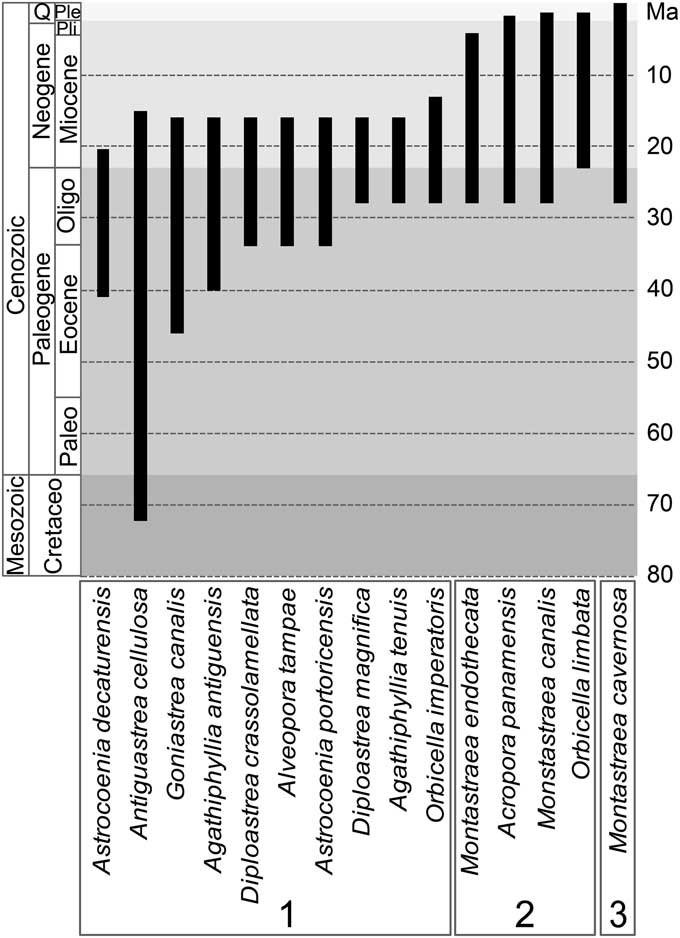
The morphospecies reported in this study were common from the late Oligocene to the early Miocene in the Caribbean region (Budd et al., Reference Budd, Stemann and Johnson1994; Budd, Reference Budd2000) (Fig. 6). Most of them became extinct either at the end of the Burdigalian (Fig. 6, group 1) or in the Pliocene-Pleistocene transition, one of the most critical turnovers for the scleractinian corals in the Caribbean (Budd et al., Reference Budd, Johnson and Stemann1996; Budd, Reference Budd2000; Klaus and Budd, Reference Klaus and Budd2003).
Range chart of first and last occurrences of species recorded in this study in the Greater Caribbean. Box 1: extinct species at the end of the early Miocene and middle Miocene; box 2: extinct species in the late Pliocene and Pleistocene; box 3: extant species. Reference sources of stratigraphic units, ages, and countries are provided in Table 3.
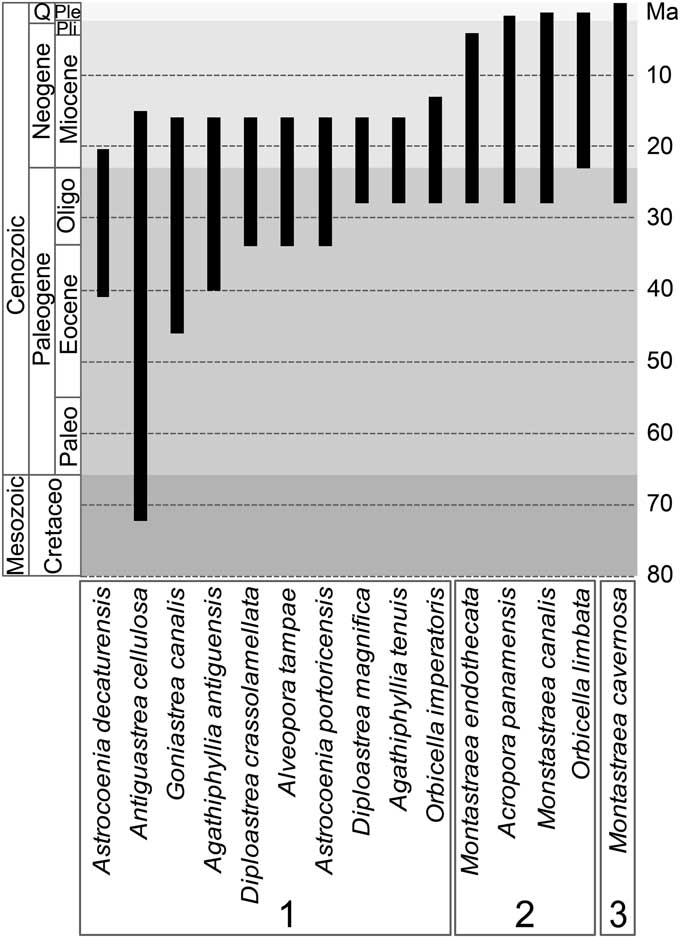
Species such as Agathiphyllia antiguensis, A. tenuis, Antiguastrea cellulosa, Diploastrea crassollamelata, and D. magnifica were considered typical components of the late Oligocene assemblages in the southern Caribbean (Johnson, Reference Johnson2007; Johnson et al., Reference Johnson, Sánchez-Villagra and Aguilera2009). However, several studies have reported these species in early Miocene formations, such as Chipola, Antigua, Arcadia, Santa Ana (Budd et al., Reference Budd, Stemann and Johnson1994), and San Andrés (Geister, Reference Geister1975). In addition, recent stratigraphic studies of the Castillo and San Luis formations of Venezuela, conducted by Rincón et al. (Reference Rincón, Solórzano, Benammi, Vignaud and McDonald2014) suggest an early Miocene age for these units, previously dated as Oligocene. The occurrence of these species in the Siamaná Formation confirms their presence in the early Miocene of the southern Caribbean region.
Although most of the species described have been previously recorded in the early Miocene, the occurrence of Astrocoenia decaturensis in the Siamaná Formation confirms its temporal distribution until the Burdigalian. On the other hand, Orbicella limbata, which has been commonly recorded from the early Miocene in other Caribbean formations, was found in the Flor de La Guajira locality from the Aquitanian; however, the uncertainty in age is due to the material being reworked and it could come from the Chattian beds of the Siamaná Formation.
All analyzed species had previous records in other southern Caribbean formations, mainly in the Valiente and Culebra formations of Panama (Johnson and Kirby, Reference Johnson and Kirby2006; Klaus et al., Reference Klaus, McNeill, Budd and Coates2012) and the Pedregoso, Agua Clara (Cauderalito Member), San Luis, and Castillo formations of Venezuela (Johnson et al., Reference Johnson, Sánchez-Villagra and Aguilera2009).
In addition to the coral fauna described here, in the Siamaná and Jimol formations, morphospecies of the families Mussidae, Pocilloporidae, Poritidae, and Siderastreidae of the order Scleractinia and of the family Milleporidae of the order Anthothecata were found; they will be described in an additional work. However, we can mention the principal patterns observed. Of the total of 116 species of corals from the Oligocene and Miocene recorded in the Caribbean region (Table 4), just 22.4% were observed in the Cocinetas Basin. With the exception of one member of the family Caryophylliidae, the species studied were considered important building components of shallow coral reefs during the late Oligocene in the Caribbean Sea (Johnson et al., Reference Johnson, Sánchez-Villagra and Aguilera2009; Budd, Reference Budd2000), most of them with massive and branching morphologies. The species composition in both the Siamaná and Jimol formations suggests shallow and clear-water environments, with moderate physical disturbance. During the early Miocene, Caribbean coral reefs have been predominantly recognized as patch reefs (Budd et al., Reference Budd, Johnson and Edwards1995; Budd, Reference Budd2000), likely due to environmental changes in the Oligocene–Miocene transition, which inhibited the building capacity of zooxanthellate scleractinian corals (Edinger and Risk, Reference Edinger and Risk1994). However, the coral reef structures from the Siamaná Formation (early Miocene) differ from this general pattern in that well-developed coral formations were common, and Montastraea spp. and Porites spp. were the dominant species in the coral assemblages. By contrast, reefs in the Jimol Formation (late early Miocene) are small structures of low diversity, matching the characteristics of other early Miocene reefs in the region (Budd et al., Reference Budd, Johnson and Edwards1995).
Differences in species composition were also observed in the localities of the Siamaná Formation (Table 2). Arroyo Ekieps was the most diverse in species number and colony morphology, for example, massive and branching to columnar (Alveopora tampae). By contrast, Flor de La Guajira had the lowest species richness with mainly massive colonies. Thus, the reef system in Arroyo Ekieps (Aquitanian–Burdigalian) was better developed, while Flor de La Guajira, estimated to be near the lower Aquitanian boundary, is limited to patch reefs of low diversity. Flor de La Guajira, the oldest locality evaluated in this study, has a prevalent Miocene fauna, including Orbicella limbata and O. imperatoris (Budd, Reference Budd1991; Budd et al., Reference Budd, Stemann and Stewart1992), as well as Montastraea cavernosa, one of the few species to persist through both the Oligocene-Miocene and Pliocene-Pleistocene coral faunal turnover events in the Caribbean.
Here we provide source information for future studies that potentially will help to describe the paleoenvironmental conditions of reef development in the Cocinetas Basin, as well as data to explore morphologic changes in the different species across time and space.
Acknowledgments
This study was supported by Colciencias, project code 7277 569 33195. PF is funded by the scholarship Doctorados en el Exterior 2015-Colciencias. We also acknowledge the partial support of Ecopetrol S.A., Smithsonian Tropical Research Institute, University of Zurich, Universidad del Norte, Universidad de Granada, NSF (Grant EAR 0957679), National Geographic Society, Anders Foundation, 1923 Fund, and G.D. and J. Walston Johnson. Special thanks to J.C. Braga for his guidance, support, and helpful comments on the manuscript and C. Jaramillo for encouraging and supporting the study. We thank T. Stemann and an anonymous reviewer for their valuable comments. We are also grateful to A. Budd for sharing species distribution information, W. Renema for the LBF identifications, V. Pretković for her help in the field, S. Montes for preparing the thin sections, and I. Sanchez for her help with the SEM. Thanks to the ARES team and the Wayúu community for their support and guidance in the field.