Introduction
The aetiology of psychosis involves complex interactions between multiple biological and environmental factors (van Os, Kenis, & Rutten, Reference van Os, Kenis and Rutten2010). Cannabis consumption is a modifiable risk factor associated with psychosis, with a meta-analysis showing a notable contribution of daily use irrespective of the study design (Marconi, Di Forti, Lewis, Murray, & Vassos, Reference Marconi, Di Forti, Lewis, Murray and Vassos2016). A recent multicentre study showed that daily cannabis users had more than three times increased odds of psychosis than never users, with estimates rising to almost five times among daily users of high-potency cannabis [Δ9-tetrahydrocannabinol (THC) ⩾ 10%] (Di Forti et al., Reference Di Forti, Quattrone, Freeman, Tripoli, Gayer-Anderson, Quigley and van der Ven2019). While there is strong evidence on the association between daily use and psychosis, cannabis is neither sufficient nor necessary for the onset of psychosis, reinforcing the multifactorial origin of psychosis and that additional factors might at play. Until now, the biological pathways underlying or interfering with the cannabis–psychosis association remain largely unknown (van der Steur, Batalla, & Bossong, Reference van der Steur, Batalla and Bossong2020). Further research is needed, especially the search for biological factors interacting with the patterns of use that offer the highest hazard.
An increasing body of studies suggests that the immune system is a putative biological factor contributing to psychosis development. Meta-analyses show elevated circulating levels of cytokines across the psychosis continuum, irrespective of pharmacological treatment, with particular attention given to inflammatory cytokines interleukin-6 (IL-6) and tumour necrosis factor-α (TNF-α) (Goldsmith, Rapaport, & Miller, Reference Goldsmith, Rapaport and Miller2016; Park & Miller, Reference Park and Miller2019; Pillinger et al., Reference Pillinger, Osimo, Brugger, Mondelli, McCutcheon and Howes2018; Upthegrove, Manzanares-Teson, & Barnes, Reference Upthegrove, Manzanares-Teson and Barnes2014). Genetic predisposition is supported by genome-wide association studies (GWAS) showing associations between schizophrenia and both the major histocompatibility complex (Ripke et al., Reference Ripke, Neale, Corvin, Walters, Farh, Holmans and O'Donovan2014) and the complement component 4 (Sekar et al., Reference Sekar, Bialas, de Rivera, Davis, Hammond, Kamitaki and McCarroll2016), the two strictly related to immune functions.
The immune system is a biological candidate modifying the cannabis–psychosis association, given the crosstalk between the immune and the endocannabinoid systems (eCS) (Katchan, David, & Shoenfeld, Reference Katchan, David and Shoenfeld2016; Suárez-Pinilla, López-Gil, & Crespo-Facorro, Reference Suárez-Pinilla, López-Gil and Crespo-Facorro2014). The eCS consists of lipid-based transmitters, their enzymes, and receptors. Endocannabinoid receptors are many, but two have been well-characterised: the endocannabinoid receptor types 1 and 2 (CB1R and CB2R) (Katz-Talmor, Katz, Porat-Katz, & Shoenfeld, Reference Katz-Talmor, Katz, Porat-Katz and Shoenfeld2018). These are strategically distributed throughout the body to modulate neuroimmune functions. CB1R, the main target of THC, is abundantly expressed on presynaptic glutamatergic and GABAergic neurons and astrocytes. In contrast, CB2R is predominantly expressed on peripheral immune cells and brain resident microglia (Cristino, Bisogno, & Di Marzo, Reference Cristino, Bisogno and Di Marzo2020). THC is an exogenous agonist of the eCS and the main psychoactive substance in Cannabis sativa. The role of cannabinoids on the immune system is biphasic. Numerous animal and cell-based research show that the immunomodulatory effects attributed to THC and other cannabinoids must be considered in the context of a concentration-dependent activity; both inhibitory and stimulatory actions have been reported depending on the relative concentration of the two main ingredients (THC and the non-psychoactive compound cannabidiol), as well as on the active state of immune cells (Tanasescu & Constantinescu, Reference Tanasescu and Constantinescu2010).
Animal studies suggest that an active immune system modifies the effect of cannabinoids on psychosis. Under a two-hit model, authors showed that repeated cannabinoid exposure during adolescence only elicited schizophrenia-like neurodevelopmental changes in animals with a primed immune system (Dalton, Verdurand, Walker, Hodgson, & Zavitsanou, Reference Dalton, Verdurand, Walker, Hodgson and Zavitsanou2012; Hollins, Zavitsanou, Walker, & Cairns, Reference Hollins, Zavitsanou, Walker and Cairns2016). The results indicated that an antecedent active immune system (first-hit) interacts with subsequent cannabis exposure (second-hit) to increase psychosis development; the synergistic effects lead to schizophrenia-like behavioural and neurobiological changes beyond and above the effect of each risk factor tested alone. However, human studies investigating associations between cannabis, psychosis, and inflammation are rare, and the results are conflicting. An earlier study including a large panel of cytokines found decreased gene expression of two pro-inflammatory cytokines, IL-2 and IL-1α, in the blood of first-episode psychosis patients (FEPp) who were cannabis users v. non-users (Di Nicola et al., Reference Di Nicola, Cattaneo, Hepgul, Di Forti, Aitchison, Janiri and Mondelli2013). Nevertheless, this study was limited by sample size (n < 50), and therefore, no adjustments for confounders were made. Later studies with larger samples were limited to patients with chronic schizophrenia. One study reported no difference in circulating levels of high-sensitive C-reactive protein in patients who were daily users (Fond et al., Reference Fond, Godin, Brunel, Aouizerate, Berna, Bulzacka and Zinetti-Bertschy2016); another study found that cannabis use was a predictor of higher lymphocytes in schizophrenia when compared to patients with a negative urine drug screen (Miller, Buckley, & McEvoy, Reference Miller, Buckley and McEvoy2018). In a more recent study, cannabis use was not associated with total or differential white blood cell count in patients (Goetz & Miller, Reference Goetz and Miller2019). None of the previous studies characterised the pattern of cannabis consumption, and only one adjusted for confounders. It is still unclear if the immune system is a possible mechanism between cannabis and psychosis (i.e. a mediator) or, as suggested by animal models, if an active immune system interacts with cannabis, and thus, modifies the association (i.e. a moderator).
We herein performed a detailed characterisation of different patterns of cannabis use to explore if circulating inflammation mediates or moderates the association between cannabis and psychosis. If inflammation is acting as a mediator, then the association between cannabis and psychosis should occur through inflammation (i.e. cannabis consumption should be associated with increased inflammation, which in turn, should be associated with increased psychosis likelihood). However, if inflammation is acting as a moderator, then cannabis would not be expected to increase inflammation, but a statistical interaction between the two variables would be expected to increase psychosis likelihood beyond their individual effects. We included FEPp to decrease possible confounding related to chronic illness, and community-based controls were recruited to reduce selection bias; systemic inflammation was represented by cytokines of the inflammatory and compensatory systems; adjustments were made for a range of confounders. We inferred that inflammation would significantly interact with cannabis use (especially heavy patterns) to increase the odds of psychosis.
Methods
This study used data available from the Schizophrenia and Other Psychoses Translational Research: Environment and Molecular Biology (STREAM), an incidence and case-sibling-control investigation conducted in the catchment area of Ribeirão Preto, São Paulo, Brazil (April 2012 and March 2015), which integrates the European consortium EU–GEI (Gayer-Anderson et al., Reference Gayer-Anderson, Jongsma, Di Forti, Quattrone, Velthorst, de Haan and Morgan2020). The present investigation is cross-sectional and included only the Brazilian participants, given that cytokine measurement was a specific protocol from Brazil.
We included all eligible patients who made contact with mental health services due to a first-episode of psychosis during the study period. Patients with psychotic symptoms originated from other medical conditions or substance intoxication/withdrawal were excluded. Community-based controls were recruited to ensure the representativeness of the catchment area's population at risk according to the Brazilian Official Census Bureau 2010, stratified by age and gender. Controls with a lifetime history of psychotic symptoms were not included. All the participants aged between 16 and 64 years and were living in the Ribeirão Preto catchment area (Del-Ben et al., Reference Del-Ben, Shuhama, Loureiro, Ragazzi, Zanatta, Tenana, Morgan and Menezes2019). The STREAM also included the unaffected siblings of patients. However, siblings were not included here, given that only 6 out of 76 (7.6%) with cytokine data had a lifetime history of cannabis use, potentially because they were the patients’ caregivers. This study was approved by the local Research Ethics committee (12606/2012), and written informed consent was obtained from all participants.
Sociodemographic and clinical assessment
Trained researchers conducted the sociodemographic and clinical assessment with weekly supervision from the senior staff. Sociodemographic data were obtained using the Medical Research Council Sociodemographic Schedule (Mallet, Reference Mallet1997), and the diagnosis was obtained for all participants using the Structured Clinical Interview for DSM-IV, clinical version (Del-Ben et al., Reference Del-Ben, Vilela, Crippa, Hallak, Labate and Zuardi2001; First, Spitzer, Gibbon, & Williams, Reference First, Spitzer, Gibbon and Williams1997). We used the Nottingham Onset Schedule (Singh et al., Reference Singh, Cooper, Fisher, Tarrant, Lloyd, Banjo and Jones2005) to register the psychosis onset date and pharmacological treatment starting date.
Cannabis and other drugs
We used the Cannabis Experience Questionnaire (CEQmvEU−GEI) to gather detailed information about the consumption of cannabis and other psychoactive drugs (cocaine/crack, inhalants, sedatives, amphetamine, and hallucinogens) (Di Forti et al., Reference Di Forti, Morgan, Dazzan, Pariante, Mondelli, Marques and Murray2009). The questionnaire comprises 16 questions and explores with details the pattern of consumption of each substance. In this study, we included three measures of cannabis use: (a) frequency (less than daily or daily); (b) duration (⩽5 or >5 years); and (c) age at first use (<17 or ⩾17 years); non-users were the reference group. The cut-offs for cannabis duration and age at first use were based on previous studies (Di Forti et al., Reference Di Forti, Morgan, Dazzan, Pariante, Mondelli, Marques and Murray2009; Renard, Krebs, Le Pen, & Jay, Reference Renard, Krebs, Le Pen and Jay2014). For other psychoactive drugs, we considered the lifetime history of use (yes; no). Participants were also asked about alcohol and tobacco consumption during the last 12 months relative to the interview (yes; no) using the Composite International Diagnostic Interview (Robins et al., Reference Robins, Wing, Wittchen, Helzer, Babor, Burke and Towle1988).
Data collection
A total of 431 participants (166 FEPp and 265 community-based controls) gave informed consent for venepuncture. From these, we excluded eight patients and eight controls who were under anti-inflammatory/immunosuppressive drugs at the moment of blood collection or during the past month or those presenting with any chronic/acute medical condition that could potentially influence cytokine levels (detailed previously) (Corsi-Zuelli et al., Reference Corsi-Zuelli, Loureiro, Shuhama, Fachim, Menezes, Louzada-Junior and Del-Ben2020). Five patients and one control did not answer the CEQmvEU−GEI completely and, therefore, were excluded from the analysis.
Cytokines measurement
A panel of cytokines representing the inflammatory [interleukin (IL)-1β, IL-6, tumour necrosis factor-α (TNF-α), and interferon-γ (IFN-γ)] and the compensatory systems [IL-4, IL-10 and transforming growth factor-β (TGF-β)] were quantified in plasma (25 μL) using the Milliplex MAP human cytokine/chemokine magnetic bead panel (EDM Millipore, Billerica, USA). Sample processing and assay protocol were performed according to our recent publication (Corsi-Zuelli et al., Reference Corsi-Zuelli, Loureiro, Shuhama, Fachim, Menezes, Louzada-Junior and Del-Ben2020) and online Supplementary Material.
Statistical analyses
All analyses were run using SPSS version 26.0 (IBM Corp: Armonk, NY, USA). Demographic and clinical data were analysed using descriptive statistics according to sample distribution (Pearson's χ2 for categorical and analysis of variance or Mann–Whitney U test for continuous variables). From a total of 409 participants, body mass index (BMI) data were missing in 48 (11.7%) individuals. To optimise our sample size and take into account BMI as an important confounding variable, we considered a fully conditional specification imputation model performed by predictive mean matching, following Rubin's Rules (Rubin, Reference Rubin1987) (online Supplementary Material).
Cytokine data were natural log-transformed due to positive skewness. Bivariate Pearson's correlation (two-tailed) was performed to analyse cytokines’ intercorrelation. The pro-inflammatory cytokines had medium–high positive correlations with anti-inflammatory cytokines (r: IL-1β and IL-4 = 0.70; IL-6 and IL-10 = 0.52; TNF-α and IL-10 = 0.55; IFN-γ and IL-4 = 0.54; all p < 0.001) (online Supplementary Fig. S1). Considering the positive correlations, we opted to compute a composite z-score (derived from the seven z-scored cytokine values) to represent systemic inflammation. While more accurate methods to identify an active immune state and inflamed subgroups in psychiatry are yet to be discovered, this approach has been used and recommended by others (Miller, Brody, Yu, & Chen, Reference Miller, Brody, Yu and Chen2014; Nusslock et al., Reference Nusslock, Brody, Armstrong, Carroll, Sweet, Yu and Miller2019; Quidé et al., Reference Quidé, Bortolasci, Spolding, Kidnapillai, Watkeys, Cohen-Woods and Green2020), for it diminishes the need to correct for multiple testing and has the advantage of exploring cytokines’ synergistic effects, thus better representing the inflammatory state (Nusslock et al., Reference Nusslock, Brody, Armstrong, Carroll, Sweet, Yu and Miller2019). Each cytokine was positively correlated with the calculated inflammatory composite score (ICS; range r = 0.42–0.63; p < 0.001). TGF-β was the only cytokine correlating with few cytokines at small effects, notably IL-6, TNF-α and IL-10 (r = 0.23, 0.28, and 0.16, respectively), but it correlated with the ICS with a medium effect of 0.42. The small–medium effects might reflect the fact that TGF-β predominantly circulates in an inactive form, pending activation by immune cells; once activated, however, its downstream pathways significantly interfere with the polarisation of T cells, especially when combined with IL-6 (Gao et al., Reference Gao, Gao, Li, Chen, Lu, Tsun and Li2012). Given that theoretical interpretation, we opted to keep TGF-β in our models. The computed ICS was used for all the subsequent analyses.
Differences between FEPp and community-based controls on the computed ICS were tested by analysis of covariance. Confounders included sex, age, ethnicity (white; non-white), years of education (⩽9 years or more), BMI, tobacco smoking and lifetime use of cannabis and other drugs. Correlations between the ICS and pharmacological treatment duration in FEPp were analysed using a bivariate Spearman's test. Correlations between the ICS and the participants’ last use of cannabis were investigated using a non-parametric partial correlation controlling for BMI, analysed separately for patients and controls. Results were considered significant at p < 0.05.
We explored the role of systemic inflammation on the association between cannabis and psychosis using simple mediation and moderation analyses [PROCESS macro v3.5 for SPSS 26; models 4 and 1, respectively (Hayes, Reference Hayes2018)]. The models included a binary outcome (community-based controls = 0; FEPp = 1), dummy coded multi-categorical independent variables (a) cannabis frequency: daily or less than daily; (b) age of onset: <17 or ⩾17 years; (c) duration: ⩽5 or >5 years; reference: non-users, and a continuous mediator/moderator (z-scored ICS). Both unadjusted and fully adjusted models were estimated, the latter including sex, age, ethnicity, years of education, BMI, tobacco smoking and lifetime use of other drugs. For all the analyses, each of the three independent cannabis variables (frequency, age of onset, and duration) was entered separately to avoid multi-collinearity. The variance inflation factor was ⩽2.3 for all variables entered in the models, discarding multi-collinearity. We tentatively explored each cytokine individually in the moderation and mediation analyses, although this was not the primary aim of the study. Statistical significance was set at α < 0.05 (two-tailed). Further details below.
Mediation analyses
Briefly, simple mediation aims to identify potential mechanisms (how) through which the exposure affects the outcome. Because it has been argued that a statistically significant association between an exposure and an outcome is not a precondition to test for mediation (Hayes, Reference Hayes2018), we performed mediation models for all the three cannabis variables. Several effects were calculated from a series of regression analyses: binary logistic regression estimated the relative direct effects (corresponding to Path c′) by testing the effects of cannabis variables on psychosis while controlling for inflammation. The relative indirect effects were constructed from two regression models to investigate if the effects of cannabis on psychosis occur through the mediator. It was estimated as the product of the unstandardised coefficients from Paths a (the effect of cannabis on inflammation; ordinal least squares regression) and b (the effect of inflammation on psychosis while controlling for cannabis; binary logistic regression). A significant indirect effect (a × b) is consistent with a mediation effect. Bootstrapping (5,000 replications) was set to estimate the standard error (Boot SE) and the percentile confidence intervals (95% Boot CIs) of the indirect effects and considered significant when 95% Boot CIs did not contain zero. Bootstrapping has greater statistical power than the Sobel test, and no assumption is made about the sampling distribution of a × b (Hayes, Reference Hayes2018).
Moderation analyses
Moderation investigates under which conditions (when) the exposure affects the outcome. This effect reveals as a statistical interaction between the exposure and the moderator (Hayes, Reference Hayes2018). Using binary logistic regression models, we firstly estimated the unconditioned (independent) effects of cannabis and inflammation on psychosis, first separately and then both in the same model, but without including an interaction term between the two. A final model was run to test the conditioned effects (moderation) by adding an interaction term between the cannabis variables and inflammation, using PROCESS macro. The macro generates the usual regression output in addition to evaluating the effects of the focal predictor at the values of the moderator. Thus, whenever an interaction was found at p < 0.05, we set macro to probe the interaction using analyses of simple slopes to explore how the effect of cannabis varies as a function of the ICS at low, medium, and high values, i.e. at 1 standard deviation (SD) below the mean, at the mean, or at 1 SD above the mean. Because of the binary outcome, PROCESS displays the unstandardised coefficients on a log-odds metric, which were exponentiated to yield the effect on an odds ratio (OR) metric (OR, 95% CI).
Results
The final sample included 409 participants (153 FEPp and 256 community-based controls). Compared with controls, FEPp were more often males, non-whites, had fewer years of study, lower BMI (p < 0.05), with a higher percentage reporting tobacco smoking and lifetime use of cannabis and other drugs (p < 0.001) (Table 1). Among cannabis users, 46 patients (59.0%) and 16 controls (31.4%) were concomitantly tobacco smokers. Patients had a higher frequency of daily cannabis use, longer duration of use and started using cannabis earlier than controls (p < 0.001) (Table 3). The patients’ last use of cannabis was significantly shorter than the controls (mean, interquartile range; in weeks: 19.53, 4.0–260.4 v. 156.24, 26.0–468.6, U = 1375.0; p = 0.003). Further information in Table 1.
Sociodemographic and clinical characteristics of the sample (n = 409)

*Other psychoactive substance including the following, but excluding cannabis: cocaine/crack, inhalants, sedatives, amphetamine, hallucinogens, and alcohol.
a Pearson's χ2 test.
b One-way analysis of variance.
FEPp: first-episode psychosis patients; DUP: duration of untreated psychosis; SD: standard deviation.
Significant results are highlighted in bold.
Systemic inflammation
The ICS was significantly higher in FEPp than controls, even after accounting for several confounders (p < 0.001). Moreover, the ICS was associated with more than a doubling in the odds of psychosis (Table 2). The increased ICS was not correlated with the duration of pharmacological treatment in patients (rho = 0.042; p > 0.05), nor with the participants last use of cannabis (rho, p: FEPp = 0.206, 0.07; controls = −0.05, 0.73; adjusted for BMI).
ICS: mean difference between groups and association with FEPp

A composite z-score was calculated from seven z-scored cytokine values (IL-1β, IL-6, TNF-α, IFN-γ, IL-4, IL-10, and TGF-β; natural-log-transformed before standardisation).
1 Analysis of variance (unadjusted model) or univariate analyses of covariance; 95% confidence interval (95% CI) with Bonferroni adjustment.
2 Binary logisti regression; OR (95% CI): Odds Ratio, 95% Confidence interval . Reference group: community-based controls.
a Adjusted for sex, age, self-reported ethnicity, years of education, BMI, tobacco smoking and lifetime use of cannabis and other drugs (cocaine/crack, inhalants, sedatives, amphetamine, hallucinogens, and alcohol).
Adjusted logistic regression: Omnibus test: <0.001; Nagelkerke R 2: 35%.
FEPp: first-episode psychosis patients; SEM: standard error of the mean; df: degrees of freedom.
Significant results are highlighted in bold.
Mediation analyses
None of the cannabis variables was associated with increased inflammation (PROCESS adjPaths a: >0.05). However, in all the models tested the ICS was significantly associated with increased odds of a psychotic disorder while accounting for the cannabis variables and other confounders (adjPaths b: all p < 0.001), i.e. there was increased odds of psychosis for each SD increase in the ICS. When compared to non-users, significant relative direct effects (Path c′) of daily use (adjOR = 3.58, 95% CI = 1.31, 9.79) and duration of use >5 years (adjOR = 2.55, 95% CI = 1.03, 6.29) on psychosis were observed while controlling for the ICS and other confounders, but this was not found for the remaining cannabis variables. Nevertheless, no significant relative indirect effects (Paths a × b) were observed, thus not supporting a mediating role of inflammation on the cannabis–psychosis association, as indicated by the 95% Boot CIs derived from 5,000 replications containing zero (online Supplementary Fig. S2A–C; Tables S1–3). When exploring the individual cytokines in a unique parallel mediation model, none of the cannabis variables was associated with cytokines’ values, and mediation effects were not supported (as indicated by the 95% Boot CIs containing zero for all the seven cytokines; results not shown).
Moderation analyses
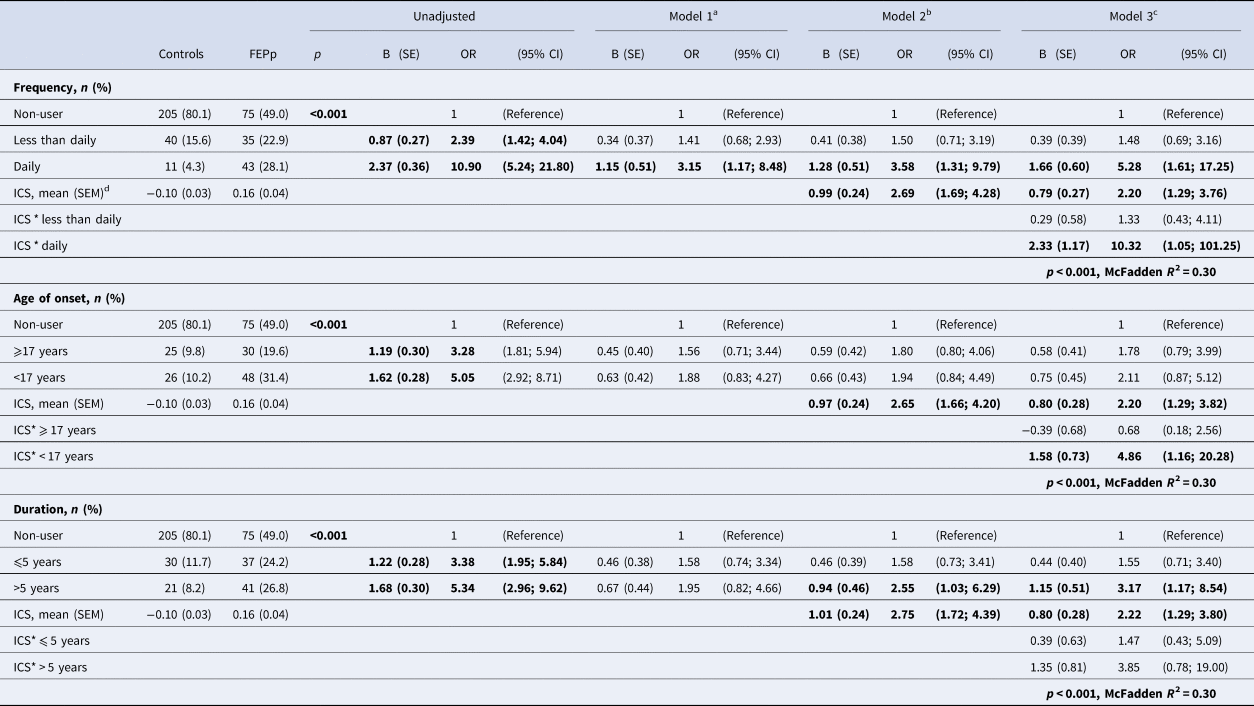
PROCESS moderation analyses, tested by adding an interaction term between the exposure and the moderator, indicated that systemic inflammation functioned as a moderator on the association between cannabis and psychosis. From the fully adjusted binary logistic regression models, both daily use and adolescent-onset interacted significantly with the ICS to increase the odds of psychosis, beyond their individual effects (Table 3). The significant interactions indicate that the effect of these cannabis variables on psychosis varies as a function of the ICS. Probing the significant interactions using PROCESS simple slopes analyses (at −1 SD below the mean, at the mean, and +1 SD above the mean of the ICS) revealed that daily use was only associated with psychosis among subjects reaching medium–high ICS values, in a dose-response fashion, but not among those with low ICS. Likewise, the association between adolescent-onset and psychosis was only found for those reaching high ICS. The adjOR for the ICS* > 5 years of use was slightly higher than the individual effects, but it did not reach statistical significance (Fig. 1a–c). The significant interactions were only found when the cytokines were aggregated in an ICS, and only trends occurred for individual cytokines, namely adolescent use *IL-6, TNF-α, and IL-10; daily use * IL-10 and IL-4 (results not shown).
Simple slopes analyses (PROCESS macro), n = 409. Analyses of simple slopes showing how the effect of cannabis [(a) frequency; (b) age of onset; (c) duration; reference: non-users] on psychotic disorder (y axis) varies as a function of the ICS (moderator; x axis) at low (−1 SD), medium (mean) and high values (+1 SD). The y-axis displays the unstandardised coefficients on a log-odds metric, as suggested by Hayes, Reference Hayes2018. The figures represent the fully adjusted models including the following covariates: sex, age, self-reported ethnicity, years of education, BMI, tobacco smoking and lifetime use of other drugs (cocaine/crack, inhalants, sedatives, amphetamine, hallucinogens, and alcohol). Further details are provided in Table 2 (Model 3) and Methods section. (A) Frequency. Less than daily: adj OR, 95% CI = low: 1.25, 0.45–3.56; medium: 1.48, 0.69–3.16; high: 1.73, 0.68–4.44. Daily use: adj OR, 95% CI = low: 1.43, 0.39–5.31; medium: 5.28, 1.61–17.25; high: 19.30, 2.41–156.02. (B) Age of onset. ≧17 years: adj OR, 95% CI = low: 2.20, 0.73–6.69; medium: 1.78, 0.79–3.99; high: 1.43, 0.48–4.26. <17 years: adj OR, 95% CI = low: 0.88, 0.28–2.77; medium: 2.11, 0.87–5.12; high: 5.10, 1.49–17.29. (C) Duration. ⩽5 years: adj OR, 95% CI = low: 1.24, 0.40–3.86; medium: 1.55, 0.71–3.40; high: 1.92, 0.74–5.00. >5 years: adj OR, 95% CI = low: 1.49, 0.50–4.48; medium: 3.17, 1.17–8.54*; high: 6.69, 1.46–30.88*. Significant results are highlighted in bold. *Duration >5 years: simple slopes analyses are described, but the interaction term did not achieve statistical significance (see Table 2, model 3).

Binary logistic regression. Unconditioned (independent) and conditioned (interaction) effects of cannabis variables and an Inflammatory Composite Score (ICS) on FEP outcome (n = 409)

a Model 1: Binary logistic regression model including a multi-categorical exposure (cannabis frequency, duration or age of onset), a binary outcome variable (FEP; controls = reference), and the following covariates: sex, age, self-reported ethnicity, years of education, BMI, tobacco smoking and lifetime use of other drugs (cocaine/crack, inhalants, sedatives, amphetamine, hallucinogens, and alcohol).
b Model 2: Fully adjusted binary logistic regression model (unconditioned model) including a multi-categorical exposure (cannabis frequency, duration or age of onset), a moderator (ICS), a binary outcome variable (FEPp; controls = reference), and the covariates listed in model 1.
c Model 3: PROCESS macro fully adjusted moderation model (conditioned model) testing the effects of a multi-categorical exposure (cannabis frequency, duration or age of onset), a continuous moderator (ICS), plus an interaction term between the exposure and the moderator (cannabis variables × ICS) on the binary outcome variable (FEPp; controls = reference) adjusted for all the covariates listed in model 1.
PROCESS model summary is provided (p value and McFadden pseudo R 2); McFadden pseudo R 2 values ranging from 0.2 to 0.4 indicate good model fit (MacFadden, Reference McFadden1979).
d ICS: Inflammatory Composite Score calculated from seven z-scored cytokine values (IL-1β, IL-6, TNF-α, IFN-γ, IL-4, IL-10, and TGF-β; natural-log-transformed before standardisation).
FEPp: first-episode psychosis patients; B: unstandardised regression coefficients; OR, 95% CI: odds ratio, 95% confidence interval.
Significant results are highlighted in bold.
Discussion
Our study suggests that systemic inflammation in FEPp might be part of the pathophysiology of psychosis but not explained by cannabis use or other confounders. We also provide initial evidence that an active immune state might moderate the association between cannabis and psychosis, in line with a neurodevelopmental two-hit hypothesis of schizophrenia.
Systemic inflammation
The cells of the immune system transit into different functional states; for example, innate and adaptive immune cells, such as monocytes and T cells, can be polarised towards pro-inflammatory (producing IL-1β, IL-6, TNF-α, and IFN-γ) and anti-inflammatory or immune-regulatory states (producing IL-10, TGF-β, and IL-4). These two immune states are in constant crosstalk, such that the activation of cytokines of the inflammatory system induces a compensatory response to prevent the harmful effects of chronic inflammation (Roomruangwong et al., Reference Roomruangwong, Noto, Kanchanatawan, Anderson, Kubera, Carvalho and Maes2020). In our sample, we found positive correlations between the two inflammatory states, with medium–high effects, and we recently reported that our FEPp sample had increased levels of individual pro- and anti-inflammatory cytokines relative to community-based controls (Corsi-Zuelli et al., Reference Corsi-Zuelli, Loureiro, Shuhama, Fachim, Menezes, Louzada-Junior and Del-Ben2020), which can be interpreted as a sign reflecting an active immune system. This active immune state, represented herein under an ICS, was significantly higher in FEPp relative to controls, was not associated with the duration of pharmacological treatment, and contributed with more than two-fold in the odds of a psychotic disorder. Immune dysregulation in psychosis is supported by GWAS (Ripke et al., Reference Ripke, Neale, Corvin, Walters, Farh, Holmans and O'Donovan2014), with increased circulating cytokines reported in drug-naïve FEPp (Pillinger et al., Reference Pillinger, Osimo, Brugger, Mondelli, McCutcheon and Howes2018) and suggested to precede the onset of psychosis in longitudinal studies (Khandaker, Pearson, Zammit, Lewis, & Jones, Reference Khandaker, Pearson, Zammit, Lewis and Jones2014). Unlike cytokines such as IL-6 and TNF-α, findings from regulatory cytokines investigated concomitantly with pro-inflammatory cytokines are generally fewer in numbers and lack control for confounders (Goldsmith et al., Reference Goldsmith, Rapaport and Miller2016), which we were able to address.
Inflammation as a mediator
Daily cannabis use had the strongest association with FEPp, offering more than three times increased odds of psychosis after adjustment for confounders, in line with findings from a larger multicentre study (Di Forti et al., Reference Di Forti, Quattrone, Freeman, Tripoli, Gayer-Anderson, Quigley and van der Ven2019). Our mediation model revealed that neither daily use nor other cannabis patterns were associated with the ICS, and congruently, an indirect effect of inflammation on the cannabis–psychosis association was not confirmed, thus not supporting a mediating role of inflammation. In the only drug-naïve FEP study available, cannabis use was not associated with increased inflammation (Di Nicola et al., Reference Di Nicola, Cattaneo, Hepgul, Di Forti, Aitchison, Janiri and Mondelli2013), and subsequent investigations in chronic patients had mixed results. Unlike the previous studies, we are the first to use a validated instrument to gather detailed information about different patterns of cannabis consumption and test the mediating role of inflammation on the cannabis–psychosis association during the early stages of psychosis while controlling for a range of confounders. The role of cannabinoids in the immune system is biphasic; although we do not have the exact THC concentration in our sample, we included a daily use measurement, which still did not associate with the increased ICS. The results, therefore, reinforce increased immune activation as a potential feature of psychosis, as suggested by GWAS. However, the mediation analyses and related results should be interpreted primarily as exploratory and with caution, given the cross-sectional design of our study. Longitudinal studies are necessary to delineate the temporal sequence of the variables. Our investigation, nonetheless, provides important insights for future studies.
Inflammation as a moderator
Our findings were more in line with a hypothesis that inflammation moderates the cannabis–psychosis association. A recent systematic review identified few biological factors moderating the association between cannabis and psychosis (van der Steur et al., Reference van der Steur, Batalla and Bossong2020); this review included 56 studies and found evidence for genotypes related to dopamine functioning. Nevertheless, none of the included studies explored associations between cannabis and immune-related variables, which is surprising given the crosstalk between the two systems. To our knowledge, our study is the first to provide initial evidence that immune dysregulation could be a biological factor turning individuals more sensitive to the effects of cannabis on psychosis likelihood.
Even though there is robust evidence on the association between daily cannabis use and psychosis (Di Forti et al., Reference Di Forti, Quattrone, Freeman, Tripoli, Gayer-Anderson, Quigley and van der Ven2019), not all daily users will develop psychosis. The most notable finding that emerged from our study was that both daily and adolescent cannabis use interacted with systemic inflammation to increase the odds of psychosis, such that increased and significant associations with psychosis were only found in those with medium–high systemic inflammation. The interaction ORs were above and beyond the individual estimates and were irrespective of the effect of many confounders listed in our analyses, including tobacco smoking, which is frequently consumed with cannabis (Sideli, Quigley, La Cascia, & Murray, Reference Sideli, Quigley, La Cascia and Murray2020). In the recent multicentre study discussed before, the effect of daily cannabis use on psychosis was unconfounded by tobacco smoking, recreational drugs and other confounders (Di Forti et al., Reference Di Forti, Quattrone, Freeman, Tripoli, Gayer-Anderson, Quigley and van der Ven2019), and a recent meta-analysis of experimental studies showed lower induction of psychotic symptoms by THC among frequent tobacco smokers (Hindley et al., Reference Hindley, Beck, Borgan, Ginestet, McCutcheon, Kleinloog and Howes2020). Meta-analyses of cytokines in FEP show elevated levels of some cytokines irrespective of tobacco smoking, BMI and other confounders (Goldsmith et al., Reference Goldsmith, Rapaport and Miller2016; Pillinger et al., Reference Pillinger, Osimo, Brugger, Mondelli, McCutcheon and Howes2018). We have recently reported increased levels of individual cytokines, such as IL-6, TNF-α, IL-10 and TGF-β, in our studied FEPp sample irrespective of tobacco smoking, BMI and other confounding variables listed in our statistical analyses (Corsi-Zuelli et al., Reference Corsi-Zuelli, Loureiro, Shuhama, Fachim, Menezes, Louzada-Junior and Del-Ben2020). Hence, it is unlikely that the effect of confounders explains the interaction effects reported here; however, our findings require replication in larger datasets, and caution is needed, given that stratifications reduced our sample size, particularly for the daily use × high ICS, as reflected by the wider confidence interval.
While the epidemiological evidence for cannabis age of onset and psychosis is not as strong as it is for daily use, our results suggest that a sensitive period might be important for those with signs of immune activation. Indeed, there are concerns about exposure to cannabinoids during critical periods, given the potential toxic effect of exocannabinoids on the developing brain (Arseneault et al., Reference Arseneault, Cannon, Poulton, Murray, Caspi and Moffitt2002). The eCS is involved in neuroplasticity and neurodevelopment, with rodent models showing that adolescence is a critical period for the eCS development and its interaction with other biological organisations, particularly the immune system (Dunn, Michie, Hodgson, & Harms, Reference Dunn, Michie, Hodgson and Harms2020). Our evidence is in line with a two-hit hypothesis proposed for psychoses, which implies that biologically predisposed individuals are more sensitive to the effects of seconds hits, i.e. environmental insults such as cannabis exposure, with the cumulative effects being more harmful to disease development than the isolated effects (Bergink, Gibney, & Drexhage, Reference Bergink, Gibney and Drexhage2014; van Os et al., Reference van Os, Kenis and Rutten2010). However, the origins of increased inflammation remain obscure.
The exact mechanisms through which an active immune system would turn subjects more sensitive to the toxic effects of cannabis are unknown. However, preclinical research suggests that genetic vulnerability within astrocytes could sensitise the adolescents’ brain to the psychosis effects of THC. By inducing schizophrenia candidate genes selectively in astrocytes, researchers showed that adolescent THC exposure only elicited cognitive impairment and schizophrenia-like neurobiological changes (such as excitation–inhibition imbalance through NMDAR [N-methyl-D-aspartate receptor]and GABA [gamma-Aminobutyric acid] dysfunction) in rodents displaying the astrocytic genetic vulnerability. The reprogrammed astrocytes were genetically more sensitive to immune pathways involving activation of the inflammatory nuclear factor κB signalling and to THC biding on their expressed CB1R (THC's major target). The neurobiological and behavioural changes resulting from the synergistic effect of astrocytic vulnerability and cannabis exposure were prevented by anti-inflammatory treatments (Chen et al., Reference Chen, Zhang, Fan, Teng, Wu, Yang and Chen2013; Jouroukhin et al., Reference Jouroukhin, Zhu, Shevelkin, Hasegawa, Abazyan, Saito and Pletnikov2019). Others have shown that deletion of astrocytic genes prevented the acute effects of THC on cognition (Han et al., Reference Han, Kesner, Metna-Laurent, Duan, Xu, Georges and Zhang2012). In clinical schizophrenia, enrichment in astrocytic genes has been reported in large transcriptomic datasets of post-mortem brains (Gandal et al., Reference Gandal, Zhang, Hadjimichael, Walker, Chen, Liu and Geschwind2018; Toker, Mancarci, Tripathy, & Pavlidis, Reference Toker, Mancarci, Tripathy and Pavlidis2018). Subgroups of psychosis patients with elevated inflammatory cytokines have signs of augmented astrocyte-produced kynurenic acid, an antagonist of the NMDAR that mediates increased midbrain dopamine burst-firing (Kindler et al., Reference Kindler, Lim, Weickert, Boerrigter, Galletly, Liu and Weickert2019; Purves-Tyson et al., Reference Purves-Tyson, Weber-Stadlbauer, Richetto, Rothmond, Labouesse, Polesel and Meyer2019). In view of our findings and the available literature, it is tempting to speculate that a genetically determined primed immune system, expressed as high inflammation, paves the way for later environmental insults, such as cannabis use, which synergise to increase psychosis likelihood.
Strengths and limitations
Firstly, exposure to cannabis was not confirmed by toxicology. Instead, we considered a validated instrument widely used by large epidemiological investigations to collect information on patterns of cannabis and other drugs (Di Forti et al., Reference Di Forti, Quattrone, Freeman, Tripoli, Gayer-Anderson, Quigley and van der Ven2019). As extensively discussed elsewhere (Quattrone et al., Reference Quattrone, Ferraro, Tripoli, La Cascia, Quigley, Quattrone and Di Forti2020), biological measures in urine, blood, or hair samples are not considered the gold standard method, for they only allow testing for recent use and do not inform about use over previous years; moreover, both self-reported and biological data were found to be highly correlated. Secondly, given the low availability of high-potency cannabis in our studied site, we were unable to test the effects based on cannabis potency. Nevertheless, using daily use, we were still able to test exposure to a high quantity of THC. Thirdly, due to sample size, we were unable to stratify our sample further to examine the effect of heavy cannabis use according to its duration or age at first use. Fourth, our patients were not drug-naïve, and we were unable to address the effect of total antipsychotics dose; however, we adjusted for a range of confounders and tested for associations with the duration of pharmacological treatment, which were not associated with inflammation in our FEPp sample. Increased blood inflammation has been detected in drug-naïve FEPp and shown to precede the onset of psychosis. The significant interactions were only found in the aggregated ICS, and we tentatively addressed the effect of individual cytokines in the interaction models, although this was not our primary aim; this should be formally considered in future studies with larger samples. Our data were available from an incidence study; hence, for some participants, the clinical data were not assessed concomitantly to the blood collection. Finally, the cross-sectional nature of our study limits inferences that can be drawn regarding causation, although our design provides important insights to future studies.
Despite such limitations, our study is the first to use a detailed characterisation of different patterns of cannabis to test the role of inflammation on the association with psychosis while adjusting for a range of confounders. We included cytokines representing the inflammatory and the compensatory systems, which the latter had received only scant attention. Finally, we recruited community-based controls according to the Brazilian Census for a representative sample. Replication of our findings in larger prospective cohorts and extension to cellular and genetic immune parameters are warranted.
Conclusion
Our results, although exploratory, suggest that immune dysregulation might be part of the pathophysiology of psychosis. Most interestingly, our findings are in line with a neurodevelopmental two-hit hypothesis of schizophrenia, suggesting that biological predisposition to immune activation (first-hit) modifies the association between daily and adolescent cannabis use (second hits) to increase the likelihood of psychosis, above and beyond their individual effects.
Funding
This work received financial support from the São Paulo Research Foundation – FAPESP, Brazil (grant number 2012/05178-0), the National Council for Scientific and Technological Development – CNPq, Brazil (grant number 476945/2012-7) and the Center for Research in Inflammatory Diseases (CRID grant number 2013/08216-2).F.C.-Z. acknowledges grants from FAPESP (2019/13229-2) and CNPq (142247/2019-7); L.M., D.L.R. and R.S. acknowledge grants from FAPESP (17/13353-0, 2018/07581-2 and 2013/11167-3, respectively); C.M.L. acknowledges a grant from CAPES – Finance Code 001; P.R.M., P.L.-J. and C.M.D.-B. are recipients of fellowships from CNPq. This study received financial support from São Paulo Research Foundation (FAPESP, Brazil; #2012/05178-0; #2019/13229-2), National Council for Scientific and Technological Development (CNPq, Brazil; #476945/2012-7; #142247/2019-7) and Center for Research in Inflammatory Diseases (CRID #2013/08216-2).
Acknowledgements
The authors acknowledge Giuliana Bertozi for the technical support in the cytokine protocol.
Conflicts of interest
None.
Supplementary material
The supplementary material for this article can be found at https://doi.org/10.1017/S0033291721000726