Introduction
FrPC is an umbrella term (Moore and Ellis, Reference Moore and Ellis2008) encompassing the concepts FOF (Tinetti and Speechley, Reference Tinetti and Speechly1989), FSe (Tinetti et al., Reference Tinetti, Richmond and Powell1990), BC (Powell and Myers, Reference Powell and Myers1995), and OE (Yardley and Smith, Reference Yardley and Smith2002). These will be defined shortly in relation to their theoretical underpinnings.
Up to 83% of CDOP experience FrPC's (Zijlstra et al., Reference Zijlstra, van Haastregt, van Rossum, van Eijk, Yardley and Kempen2007b). Whilst FrPC's may encourage caution, when disproportionate to falls risk they may be detrimental, leading to activity avoidance, and social withdrawal (Fessel and Nevitt, Reference Fessel and Nevitt1997). This can result in muscle deconditioning and reduced QoL (Delbaere et al., Reference Delbaere, Crombez, Vanderstraeten, Willems and Cambier2004). Approximately 10% of CDOP have excessive FrPC when compared with their physiological falls risk (Delbaere et al., Reference Delbaere, Close, Brodaty, Sachdev and Lord2010a). FrPC have been highlighted as risk factors for institutional admission (Cumming et al., Reference Cumming, Salkeld, Thomas and Szonyi2000), and guidelines highlight the importance of addressing FrPC in routine screening (Department of Health, 2001). Identifying factors associated with FrPC could inform interventions to reduce these concerns.
A review in the area of psychological factors and their associations with FrPC is warranted for several reasons. Previous reviews have dominantly focused on physical (Scheffer et al., Reference Scheffer, Schuurmans, van Dijk, van Der Hooft and De Rooij2008) or functional factors (Schepens et al., Reference Schepens, Sen, Painter and Murphy2012). Psychological factors associated with FOF among the elderly have been largely neglected (Li et al., Reference Li, Fisher, Harmer, McAuley and Wilson2003). The most recent review (Denkinger et al., Reference Denkinger, Lukas, Nikolaus and Hauer2014) presented a comprehensive list of physical, functional, social, and psychological correlates of FOF. However, detailed discussion of the strength of evidence regarding FrPC and FOF was beyond the scope of their review. Further to this, Denkinger et al. (Reference Denkinger, Lukas, Nikolaus and Hauer2014) did not include all psychological factors (e.g. coping). The present review provides the first comprehensive examination of the literature regarding FOF and FrPC. Further, this paper extends previous reviews by considering how psychological factors mediate the relationship between FrPC and falls.
The review begins by defining relevant terms and discussing theoretical understandings of each separate FrPC construct (i.e. FOF, FSe, BC, OE). The evidence pertaining to psychological factors associated with each construct (i.e. FOF, FSe, BC, OE) is then reviewed. This is done to provide clarity on the evidence base, as research is often conducted in relation to only one concept. This also reflects recommendations for researchers to clearly identify which particular FrPC concept they are considering (Moore and Ellis, Reference Moore and Ellis2008). The limited research exploring mediating effects of psychological factors on the FrPC-falls relationship is also considered.
Community-dwelling older people
CDOP are older persons living in their homes/communal setting without assistance with activities of daily living (ADLs; World Health Organization, 2004). Whilst an older person is often defined as aged 65 years or older, much research into FrPC includes people aged 60 years or older. Therefore this cut-off will be used here, as recommended by Roebuck (Reference Roebuck1979). This equates to a sizeable number of people, for instance approximately 9.5 million CDOP live in the UK (Dunnell, Reference Dunnell2008).
Falls: links with FrPC
A fall is “an unexpected event in which the individual comes to rest on the ground, floor, or lower level” (Lamb et al., Reference Lamb, Jørstad-Stein, Hauer and Becker2005; p. 1619). Approximately 30% of CDOP fall annually (Tremblay and Barber, Reference Tremblay and Barber2006), resulting in disability, morbidity, mortality, and substantial annual costs (e.g. £1.5 billion–US$2.6 billion to UK health services) (Davis et al., Reference Davis, Robertson, Ashe, Liu-Ambrose, Khan and Marra2010). These factors have led to falls-reduction becoming a key government target (Department of Health, 2001).
Falls risk is multifactorial (Gillespie et al., Reference Gillespie, Gillespie, Robertson, Lamb, Cumming and Rowe2003), including extrinsic (e.g. environmental hazards) and intrinsic factors (e.g. psychological factors; Faulkner et al., Reference Faulkner2009). Physical factors such as increasing age (e.g. Rossat et al., Reference Rossat2010), female gender (e.g. Cesari et al., Reference Cesari, Landi, Torre, Onder, Lattanzio and Bernabei2002) and poly-pharmacy (e.g. Riefkohl et al., Reference Riefkohl, Bieber, Burlingame and Lowenthal2003) have been identified as risk factors.
There are mixed findings regarding the relationship between falls and FrPC. The relationship is considered bi-directional (Friedman et al., Reference Friedman, Munoz, West, Rubin and Fried2002); with falls predicting FrPC (e.g. Boyd and Stevens, Reference Boyd and Stevens2009; Delbaere et al., Reference Delbaere, Close, Heim, Sachdev, Brodaty and Slavin2010b), and FrPC predicting falls (e.g. Chou et al., Reference Chou, Chi and Chiu2005; Rossat et al., Reference Rossat2010). However, some studies failed to find significant associations between FrPC's and falls (e.g. Arnold et al., Reference Arnold, Busch, Schachter, Harrison and Olszynski2005), and the relationship may not remain significant after adjusting for influences such as functional ability (Hadjistavropoulos et al., Reference Hadjistavropoulos, Delbaere and Fitzgerald2011). It follows that additional variables may be influencing this relationship.
FrPC: theoretical origins
“FrPC” incorporates four constructs: FOF (Tinetti and Speechley, Reference Tinetti and Speechly1989); FSe (Tinetti et al., Reference Tinetti, Richmond and Powell1990); BC (Powell and Myers, Reference Powell and Myers1995); and OE (Yardley and Smith, Reference Yardley and Smith2002). FrPC have been reported by 3–85% of CDOP (Zijlstra et al., Reference Zijlstra, van Haastregt, van Eijk, van Rossum, Stalenhoef and Kempen2007a; Scheffer et al., Reference Scheffer, Schuurmans, van Dijk, van Der Hooft and De Rooij2008). Varying methodologies and FrPC constructs measured (i.e. FOF, FSe, BC, OE) contribute to this variance.
Distinguishing the FrPC constructs from each other has been problematic, as inter-changeable use of terminology leads to confusion in the literature. Whilst significantly associated, the constructs are distinct (Lachman et al., Reference Lachman, Howland, Tennstedt, Jette, Assmann and Peterson1998). Researchers have been encouraged to specify which FrPC construct they are measuring (i.e. FOF, FSe, BC or OE) to develop clarity within the evidence base (Moore and Ellis, Reference Moore and Ellis2008).
Fear of falling (FOF)
FOF is “a lasting concern about falling that leads to an individual avoiding activities that he/she remains capable of performing” (Tinetti and Powell, Reference Tinetti and Powell1993, p.36). Initially FOF was considered a phobia of walking or standing following a fall (Bhala et al., Reference Bhala, O’Donnell and Thoppil1982; Murphy and Issacs, Reference Murphy and Isaacs1982). However, as subsequent research identified FrPC in people who had never fallen (Arfken et al., Reference Arfken, Lach, Birge and Miller1994), “FOF” was expanded to include non-fallers.
The definition of FOF above acknowledges “avoidance;” a behavioral element, as a dominant feature. This relates to avoidance of activities and community engagement. As “FOF” includes emotional (i.e. anxiety) and behavioral (i.e. avoidance) elements, psychological factors associated with FOF may include emotional states (e.g. anxiety) and behavioral elements (e.g. activity avoidance). Unfortunately, “FOF” is often used to refer to all FrPC, resulting in confusion in the literature (Hadjistavropoulos et al., Reference Hadjistavropoulos, Delbaere and Fitzgerald2011).
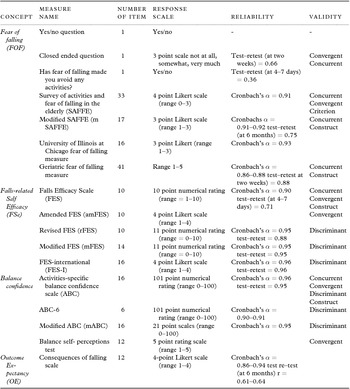
Measures of FOF include single questions (Arfken et al., Reference Arfken, Lach, Birge and Miller1994) which have been criticized for lacking sensitivity (Jørstad et al., Reference Jørstad, Hauer, Becker and Lamb2005), and comprehensive scales assessing fear and activity avoidance which have good psychometric properties (Lachman et al., Reference Lachman, Howland, Tennstedt, Jette, Assmann and Peterson1998). Measures are outlined in Appendix 1.
Fall-related self-efficacy (FSe)
With identification that some concerns about falling were not irrational or disproportionate (defining characteristics of a “phobia;” American Psychiatric Association, 2000), alternative ways of defining FrPC were considered, leading to understanding of FrPC within a self-efficacy deficit model (Tinetti et al., Reference Tinetti, Richmond and Powell1990).
FSe relates to someone's confidence in their ability to undertake ADLs without falling (Tinetti et al., Reference Tinetti, Richmond and Powell1990).
Whilst FOF and FSe are correlated, they measure differing constructs (Li et al., Reference Li, McAuley, Fisher, Harmer, Chaumeton and Wilson2002; Hotchkiss et al., Reference Hotchkiss, Fisher, Robertson, Ruttencutter, Schuffert and Barker2004). FSe has been shown to mediate between FOF and activity engagement (Li et al., Reference Li, Fisher, Harmer and McAuley2005).
FSe is based on self-efficacy theory (SET; Bandura, Reference Bandura1977; Reference Bandura1986). Self-efficacy (SE) is a cognitive mechanism that mediates between thoughts/emotions and actions (Bandura, Reference Bandura1986). It is made up of two components; efficacy expectations (EE) and OE. FSe draws on the EE component, relating to an individual's perception of their ability to undertake an action required to achieve a certain performance (i.e. not falling; Bandura, Reference Bandura1986). These expectancies develop via performance and vicarious experience, verbal persuasion, emotional and physical arousal, and feedback. These influence choices and motivations, from which activity-specific action emerges. OE refers to an individuals’ perception that certain behavior will result in a specific outcome. Historically OE has received little attention in the FrPC literature (Yardley and Kempen, Reference Yardley and Kempen2006) and will be covered later.
Empirical findings suggest that SE plays a pivotal role in affective state regulation (e.g. anxiety; Bandura, Reference Bandura and Schwarzer1992) and avoidance behavior (Myers et al., Reference Myers, Powell, Maki, Holliday, Brawley and Sherk1996). Research suggests, as people perceive inefficacy in their ability to gain a desired outcome, depression may occur (Bandura, Reference Bandura and Dienstbier1991; Olioff and Aboud, Reference Olioff and Aboud1991). Empirically, higher SE has been associated with perseverance in problem-solving (Bandura, Reference Bandura and Schwarzer1992), leading to increased coping responses.
Various measures of FSe have been developed. The Falls-Efficacy Scale-International (FES-I; Yardley et al., Reference Yardley, Beyer, Hauer, Kempen, Piot-Ziegler and Todd2005) has been translated and internationally validated and is acknowledged as the “gold standard” FSe measure, with good psychometric properties (Moore and Ellis, Reference Moore and Ellis2008). Measures are detailed in Appendix 1.
Balance confidence (BC)
BC also draws from the EE component of SET, referring to situation-specific self-efficacy (Powell and Myers, Reference Powell and Myers1995). BC is an individual's belief about their ability to maintain balance whilst performing ADLs. As it relates to the same fundamental construct as FSe (Hotchkiss et al., Reference Hotchkiss, Fisher, Robertson, Ruttencutter, Schuffert and Barker2004), factors associated with BC may be anticipated to be similar to those hypothesized in relation to FSe, including emotional (e.g. depression) and behavioral (e.g. avoidance) factors. Measures of BC aimed to address criticisms of the original FSe measure, which was considered biased towards low-functioning CDOP due to items producing ceiling effects in those who were higher functioning (Powell and Myers, Reference Powell and Myers1995). Measures of BC are reported to have good psychometric properties (Powell and Myers, Reference Powell and Myers1995; Appendix 1).
Outcome expectancy (OE)
OE draws on the component of SET with the same name (i.e. OE), and considers beliefs about anticipated consequences of falling (e.g. social embarrassment; Yardley and Smith, Reference Yardley and Smith2002). Whilst this concept remains largely un-researched, it may be that OE could be associated with similar factors as FSe and BC, as it is also based on SET. The consequences of falling scale (Yardley and Kempen, Reference Yardley and Kempen2006), a measure of OE with good psychometric properties, is detailed in Appendix 1.
Summary
This section outlined the four constructs of FrPC. Whilst FOF has been criticized for lacking theoretical underpinning, FSe built on this limitation, drawing on SET. This incorporated beliefs about one's ability to manage a perceived threat (i.e. falling). BC and OE also draw on SET. BC is considered to measure the same construct as FSe (Hotchkiss et al., Reference Hotchkiss, Fisher, Robertson, Ruttencutter, Schuffert and Barker2004). OE is a newly developing concept, having seen limited utilization in research to date.
Relationships between the constructs are complex, and have generated confusion within the literature, with some researchers using terms interchangeably (Hadjistavropoulos et al., Reference Hadjistavropoulos, Delbaere and Fitzgerald2011). Whilst FOF has been correlated with FSe and BC, they measure distinct constructs (Li et al., Reference Li, McAuley, Fisher, Harmer, Chaumeton and Wilson2002). It is recommended that researchers clarify terminology and ensure measures of FrPC are appropriately and consistently selected (Jørstad et al., Reference Jørstad, Hauer, Becker and Lamb2005; Moore and Ellis, Reference Moore and Ellis2008; Bower et al., Reference Bower, Wetherell, Merz, Petkus, Malcarne and Lenze2014). The FES-I, due to its international validation and theoretical grounding, may bring clarity if employed consistently (Yardley and Kempen, Reference Yardley and Kempen2006).
The following section presents empirical evidence relating to psychological factors associated with FrPC. As researchers commonly only employ one concept of FrPC (e.g. FOF, or, FSE, or BC, or OE), the empirical evidence is presented in relation to individual concepts of FrPC (i.e. FOF, FSe, BC, OE). This reflects calls for empirical clarity by clearly specifying the individual construct from within the umbrella term “FrPC” (Moore and Ellis, Reference Moore and Ellis2008).
Literature search
An advanced search identified relevant papers published up to November 2014-Week 1 using PsycINFO, Ovid Medline, Web of Knowledge, ASSIA and Cochrane Database of Systematic Reviews (CSDR). Search terms included “older people,” “fall,” and derivatives of “concern” (full search term list; Appendix 2). Cross-referencing of reference lists of all selected papers was under-taken to identify additional relevant papers. Inclusion and exclusion criteria were applied to abstracts (Appendix 2). Papers from previous reviews were included. Sixty-two relevant papers were identified.
Associated psychological factors
Due to considerable literature in the area, it was not possible to review each study in detail. However, studies are detailed in Table S1, available as supplementary material attached to the electronic version of this paper at www.journals.cambridge.org/jid_IPG. Studies were reviewed in relation to the FrPC concept measured by the researcher (i.e. FOF, FSe, BC, OE).
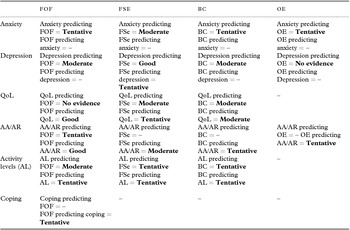
Research has not been conducted into relationships between each psychological factor and each FrPC construct (e.g. OE has not been researched in relation to QoL). Four levels of evidence were used when evaluating the literature: good, moderate, tentative, and none (see Table 1).
Empirical evidence for associations between FrPC constructs and psychological factors

– = relationship not explored in any studies Good evidence = two or more studies show same findings with methodologically strong designs. This includes consideration of power, multivariate analysis and longitudinal designs Moderate evidence = one or more studies show evidence but measures employed were not psychometrically robust, or if only one study was methodologically strong (e.g. well-powered, multivariate analysis, longitudinal designs) Tentative evidence = studies have methodological limitations (e.g. inadequate power, only bivariate analysis conducted) No evidence = no study confirming the association between these variables (Harvey et al., Reference Harvey, Watkins, Mansell and Shafran2004).
Designs and methods
Research into psychological factors associated with FrPC have utilized similar methodologies, and given space constraints, it is not possible to fully describe each study's methodology. However, these are detailed in Table S1, available as supplementary material attached to the electronic version of this paper at www.journals.cambridge.org/jid_IPG. Studies have employed bivariate, multivariate, and qualitative analysis, utilizing cross-sectional and longitudinal designs.
Bivariate analysis considers associations between two variables, exploring correlations between a measure of FrPC and a psychological factor (e.g. anxiety). Often they measure factors cross-sectionally. However, this analysis does not allow for inference of causality, or account for co-correlates potentially influencing relationships. Multivariate analysis is more robust, considering numerous independent and dependent variables (Tabachnick and Fidell, Reference Tabachnick and Fidell2001). Whilst unable to prove causation, multivariate analysis provides greater clarity to relationships between variables as researchers can control for other factors, to see if a specific variable predicts another (e.g. if anxiety predicts FOF when controlling for depression).
Longitudinal studies allow researchers to develop understanding of sequential relationships between variables, and imply causation (e.g. if developing FOF is predicted by depression). These factors result in longitudinal designs being considered the most robust quantitative design (Field, Reference Field2009).
Due to the large literature and space constraints, the greatest focus in this review will be on the most methodologically robust studies. Where there are multivariate analyses and longitudinal designs, there will be greater focus on these studies. However, as noted, all studies are detailed in Table S1, available as supplementary material attached to the electronic version of this paper at www.journals.cambridge.org/jid_IPG. Relationships between each psychological factor and FrPC construct are summarized in Table 1 for clarity.
Anxiety
Fear of falling (FOF)
All nine studies exploring FOF in relation to anxiety found significant positive bivariate associations (e.g. Hellstrom et al., Reference Hellstrom, Vahlberg, Urell and Emtner2009; see Table S1, available as supplementary material attached to the electronic version of this paper at www.journals.cambridge.org/jid_IPG for a full list of studies). However, evidence from more robust research designs is mixed. van Haastregt et al. (Reference van Haastregt, Zijlstra, van Rossum, van Eijk and Kempen2008) found anxiety significantly predicted FOF in multivariate analysis. However, when depression was included, anxiety was no longer a significant predictor. Hull, et al. (Reference Hull, Kneebone and Farquharson2012) found that both anxiety and depression made significant unique contributions to FOF, with depression predicting slightly more variance in FOF compared to anxiety. In contrast, Kempen et al. (Reference Kempen, van Haastregt, McKee, Delbaere and Zijlstra2009) found anxiety did not predict FOF. In the only longitudinal study, Murphy et al. (Reference Murphy, Dubin and Gill2003) found anxiety was not a significant predictor of FOF development.
Whilst anxiety was associated with FOF in bivariate analyses, multivariate analyses did not yield the same support. Positive findings in bivariate analysis may be explained by high co-morbidity between depression and anxiety in CDOP (Adamek and Slater, Reference Adamek, Slater, Berkman and D’Ambruoso2005), as when controlling for depression in multivariate analyses, the relationship between anxiety and FOF was less clear.
Falls related self-efficacy (FSe)
FSe was significantly negatively correlated with anxiety in bivariate analysis (e.g. Miller and Pantel, Reference Miller and Pantel2003; Table S1, available as supplementary material attached to the electronic version of this paper at www.journals.cambridge.org/jid_IPG). The evidence from multivariate analyses is mixed. Two studies (Hull et al. Reference Hull, Kneebone and Farquharson2012; Liu, Reference Liu2014) found anxiety was a significant predictor of FSe. Two studies (Burker, et al., Reference Burker, Wong, Sloane, Mattingly, Preisser and Mitchell1995; Ni Mhaolain et al., Reference Ni Mhaolain2012) failed to find anxiety predictive of FSe. Contrasting evidence from the few robust multivariate studies means further research is required. Longitudinal research designs may help to elucidate the relationship between anxiety and FSe. Whilst empirical evidence outside of the field of FrPC suggests anxiety may be negatively associated with self-efficacy (Bandura, Reference Bandura and Schwarzer1992), evidence supporting this in relation to FSe was unclear.
Balance confidence (BC)
In the only study examining the relationship between BC and anxiety, Hull et al. (Reference Hull, Kneebone and Farquharson2012) found anxiety was a significant predictor of BC in multivariate analysis, such that greater anxiety predicted diminished BC. Further research utilizing longitudinal methods is warranted.
Outcome expectancy (OE)
Hull et al. (Reference Hull, Kneebone and Farquharson2012) found that anxiety made the largest significant unique contribution to OE in multivariate analysis. Increased anxiety was predictive of more negative beliefs about the anticipated consequences of a sustained fall. The dearth of research relating to OE limits firm conclusions, meaning further research is required.
Depression
FOF
Twelve cross-sectional studies reported significant positive bivariate associations between FOF and depression (e.g. Kim and So, Reference Kim and So2013; Table S1, available as supplementary material attached to the electronic version of this paper at www.journals.cambridge.org/jid_IPG). Two studies failed to find significant bivariate associations (Drozdick and Edelstein, Reference Drozdick and Edelstein2001; Miller and Pantel, Reference Miller and Pantel2003). However, their small samples may have limited detection of significant findings (Field, Reference Field2009).
Studies employing multivariate analysis have produced mixed results. Four of the seven studies conducting multivariate analysis found depression significantly predicted FOF (Chandler et al., Reference Chandler, Duncan, Sanders and Studenski1996; van Haastregt et al., Reference van Haastregt, Zijlstra, van Rossum, van Eijk and Kempen2008; Deshpande et al., Reference Deshpande, Metter, Lauretani, Bandinelli and Ferrucci2009; Hull et al., Reference Hull, Kneebone and Farquharson2012). However, Deshpande et al. (Reference Deshpande, Metter, Lauretani, Bandinelli and Ferrucci2009) only found this association with FOF whilst at home, and not with FOF whilst in the community. Chandler et al. (Reference Chandler, Duncan, Sanders and Studenski1996) only found this association in those with a falls history. Three studies found depression did not significantly predict FOF (Arfken et al., Reference Arfken, Lach, Birge and Miller1994; Deshpande et al., Reference Deshpande, Metter, Lauretani, Bandinelli, Guralnik and Ferrucci2008; Kempen et al., Reference Kempen, van Haastregt, McKee, Delbaere and Zijlstra2009). Differing results may relate to Deshpande et al. (Reference Deshpande, Metter, Lauretani, Bandinelli and Ferrucci2009) splitting FOF with respect to different situations (i.e. home, community). FOF at home may be more severe, or have greater personal impact. Additionally, Chandler et al. (Reference Chandler, Duncan, Sanders and Studenski1996) only found significant results in those with a falls history. Failure of other studies to make these distinctions limits comparisons.
Five of six longitudinal studies failed to find depression predictive of FOF development (Murphy et al., Reference Murphy, Dubin and Gill2003; Lach, Reference Lach2005; Reyes-Ortiz et al., Reference Reyes-Ortiz, Ayele, Mulligan, Espino, Berges and Markides2006; Austin et al., Reference Austin, Devine, Dick, Prince and Bruce2007; Chou and Chi, Reference Chou and Chi2008). Whilst Chou and Chi (Reference Chou and Chi2008) found depression predicted FOF, when adjusted for social/independent functioning, this association did not remain significant. Austin et al. (Reference Austin, Devine, Dick, Prince and Bruce2007) found depression was a significant predictor of persistent FOF. However, it was unclear if they adjusted for baseline levels of depression.
Oh-Park et al. (Reference Oh-Park, Xue, Holtzer and Verghese2011) found depression significantly predicted FOF, both transient and persistent. In this study, data were collected every two to three months over two years. As “persistent FOF” was defined as reporting FOF on two or more occasions, the increased data collection points may have increased the likelihood of persistent FOF identification.
In summary, depression was not consistently associated with FOF. Depression did not predict FOF development in five of six longitudinal studies, but was more consistently associated with persistent FOF.
FSe
Significant negative bivariate associations between FSe and depression were identified by Liu (Reference Liu2014) and Tiernan et al. (Reference Tiernan, Lysack, Neufeld, Goldberg and Lichtenberg2014). In multivariate analysis, six out of seven studies found depression negatively predicted FSe (Burker et al., Reference Burker, Wong, Sloane, Mattingly, Preisser and Mitchell1995; Kressig et al., Reference Kressig2001; Miller and Pantel, Reference Miller and Pantel2003; Shin et al., Reference Shin2010; Delbaere et al., Reference Delbaere, Close, Heim, Sachdev, Brodaty and Slavin2010b; Ni Mhaolain et al., Reference Ni Mhaolain2012). These findings support previous findings outside of the FrPC field relating perceived inefficacy to depression (Bandura, Reference Bandura and Dienstbier1991; Olioff and Aboud, Reference Olioff and Aboud1991). In contrast, one study (Hull et al., Reference Hull, Kneebone and Farquharson2012) found depression did not significantly predict FSe.
Tiernan et al. (Reference Tiernan, Lysack, Neufeld, Goldberg and Lichtenberg2014) found that FSe also significantly predicted depression scores among a sample of 44 African American CDOP. However, their small sample limits the generalizability of their findings. Longitudinal research is required to clarify the association between FSe and depression and provide some evidence of causality.
BC
Significant negative bivariate associations between BC and depression were identified in four studies (e.g. Fortinsky et al., Reference Fortinsky, Panzer, Wakefield and Into2009). In multivariate analysis, Kressig et al. (Reference Kressig2001) and Klima et al. (Reference Klima, Newton, Keshner and Davey2013) found depression was a significant predictor of BC. However, both studies were limited by the representativeness of their samples (Kressig et al.’s (Reference Kressig2001) sample was primarily female; Klima et al’s. (Reference Klima, Newton, Keshner and Davey2013) sample was exclusively male). Hull et al. (Reference Hull, Kneebone and Farquharson2012) found that depression did not significantly predict BC. Disagreement among findings as well as the dearth of methodologically robust studies means firm conclusions are limited. Further research is warranted.
OE
In the only multivariate analysis, Hull et al. (Reference Hull, Kneebone and Farquharson2012) found that depression was not a significant predictor of OE. The lack of research relating to OE limits firm conclusions and means further research is required.
Quality of life (QoL)
FOF
All ten studies exploring FOF and QoL found negative bivariate associations (e.g. Chang et al., Reference Chang, Chi, Yang and Chou2010). Three studies found FOF negatively predicted QoL in multivariate analysis (Lachman et al., Reference Lachman, Howland, Tennstedt, Jette, Assmann and Peterson1998; Li et al., Reference Li, Fisher, Harmer, McAuley and Wilson2003; Chang et al., Reference Chang, Chi, Yang and Chou2010). However, when FOF was utilized as the dependent variable in analyses, the findings were non-significant; two studies failed to find QoL predictive of FOF (Arfken et al., Reference Arfken, Lach, Birge and Miller1994; Howland et al., Reference Howland, Lachman, Peterson, Cote, Kasten and Jette1998) in multivariate analysis.
Using longitudinal designs, FOF was negatively predicted by QoL in individuals with persistent FOF (Austin et al., Reference Austin, Devine, Dick, Prince and Bruce2007; Iglesias et al., Reference Iglesias, Manca and Torgerson2009), however, reduced QoL did not predict new FOF development (Austin et al., Reference Austin, Devine, Dick, Prince and Bruce2007). It is unclear if these studies controlled for baseline levels of FOF. In Iglesias et al. (Reference Iglesias, Manca and Torgerson2009), all female sample limits generalization of these findings to men.
Evidence suggests, whilst reduced QoL does not predict FOF development, FOF predicts reduced QoL over time. This highlights the potentially detrimental effect of FOF on QoL for CDOP.
FSe
Four studies found that FSe was significantly positively associated with QoL in bivariate analysis (Lachman et al., Reference Lachman, Howland, Tennstedt, Jette, Assmann and Peterson1998; Huang and Wang, Reference Huang and Wang2009; Hsu et al., Reference Hsu, Alfermann, Lu and Lin2013; Patil et al., Reference Patil, Uusi-Rasi, Kannus, Karinkanta and Sievanen2013). Of the two studies that used more robust multivariate analysis, both found that FSe was a significant independent predictor of QoL (Hsu et al., Reference Hsu, Alfermann, Lu and Lin2013; Patil et al., Reference Patil, Uusi-Rasi, Kannus, Karinkanta and Sievanen2013). Further research employing longitudinal designs would explore whether findings remain significant when controlling for additional variables, and allow an understanding of causality.
BC
Two studies found significant positive bivariate associations between QoL and BC (e.g. Talley et al., Reference Talley, Wyman and Gross2008). Two studies employing multivariate analysis found significant relationships between BC and QoL; Brouwer et al. (Reference Brouwer, Musselman and Culham2004) found physical QoL predicted BC, whilst Davis et al. (Reference Davis, Marra and Liu-Ambrose2011) found BC significantly predicted physical and mental QoL.
The predictive effect of physical QoL on BC may relate to functional ability, with physical QoL relating to physical function and pain. These may impair balance ability, in turn affecting someone's BC. However, the lack of longitudinal designs once again limits the ability to infer causality. Further research may identify if these results are robust and explore possible mediating or moderating factors in the association.
Behavioral factors-activity avoidance/restriction (AA/AR)
Behavioral factors associated with FrPC have been explored from two perspectives; AA/AR and AL. Theoretical understandings of FrPC focus on AA/AR deeming “avoidance” a key component to certain constructs (i.e. FOF).
FOF
Findings suggest that 5–65% of respondents with FOF reported AA/AR due to this fear (e.g. Fletcher et al., Reference Fletcher, Guthrie, Berg and Hirdes2010; see Table S1, available as supplementary material attached to the electronic version of this paper at www.journals.cambridge.org/jid_IPG). This wide range may, in part, be due to variation in measures of FOF (e.g. yes/no responses, Survey of Activities and FOF in the Elderly [SAFFE] subscale).
Six studies found significant positive bivariate associations between FOF and AA/AR (e.g. Bertera and Bertera, Reference Bertera and Bertera2008). Chandler et al. (Reference Chandler, Duncan, Sanders and Studenski1996) only found this in fallers, with results approaching significance in non-fallers. Their small sample may have limited statistical power to detect significant findings (Field, Reference Field2009).
Betera and Betera (Reference Bertera and Bertera2008) found FOF was a significant predictor of AA/AR in multivariate analysis. Using longitudinal designs, Yardley and Smith (Reference Yardley and Smith2002) found FOF was a significant predictor of AA/AR. However, Hadjistavropoulos et al. (Reference Hadjistavropoulos, Martin, Sharpe, Lints, McCreary and Asmundson2007) found FOF was only a significant predictor when combined in a step with FSe, BC, AL, and baseline AA/AR. Yardley and Smith (Reference Yardley and Smith2002) used a self-administered version of the SAFFE, whilst Hadjistavropolous et al. (Reference Hadjistavropoulos, Martin, Sharpe, Lints, McCreary and Asmundson2007) used the interview-administered version. This may explain the different results.
Kempen et al. (Reference Kempen, van Haastregt, McKee, Delbaere and Zijlstra2009) found AA/AR significantly predicted FOF. However, Howland et al. (Reference Howland, Lachman, Peterson, Cote, Kasten and Jette1998) found AA/AR did not significantly predict FOF. Additionally, two longitudinal studies failed to find AA/AR predictive of FOF (Lach, Reference Lach2005; Shimada et al., Reference Shimada, Lord, Yoshida, Kim and Suzuki2007), suggesting AA/AR did not lead to FOF development. Two qualitative studies identified AA/AR in CDOP (Lee et al., Reference Lee, Mackenzie and James2008; Faes et al., Reference Faes, Reelick, Banningh, de Gier, Esselink and Rikkert2010). However, respondents did not relate this avoidance to FOF, rather to other factors (e.g. health status; Lee et al., Reference Lee, Mackenzie and James2008).
Studies demonstrate, whilst FOF and AA/AR may be related, not all individuals experiencing FOF restrict activity. This raises questions about whether FOF “leads to an individual avoiding activities that he/she remains capable of performing” (Tinetti and Powell, Reference Tinetti and Powell1993, p.36), and suggests a more tentative expression of this link (i.e. “may lead to”).
FSe
Five studies found significant negative bivariate associations between FSe and AA/AR (e.g. Jellesmark et al., Reference Jellesmark, Forsyth Herling, Egerod and Beyer2012). Delbaere et al. (Reference Delbaere, Crombez, van Haastregt and Vlaeyen2009) found FSe had a direct effect on AA/AR in a structural equation model. However, Hadjistavropoulos et al. (Reference Hadjistavropoulos, Martin, Sharpe, Lints, McCreary and Asmundson2007) failed to identify FSe as a significant predictor of AA/AR at six-month follow-up. Differing measures of AA/AR may have contributed to contradictory findings. The inconsistent findings mean firm conclusions about associations between FSe and AA/AR cannot be made. Further exploration of this relationship is warranted.
BC
Three studies found significant negative bivariate correlations between BC and AA/AR (e.g. Hotchkiss et al., Reference Hotchkiss, Fisher, Robertson, Ruttencutter, Schuffert and Barker2004). However, Hadjistavropoulos et al. (Reference Hadjistavropoulos, Martin, Sharpe, Lints, McCreary and Asmundson2007) failed to identify BC as a significant predictor of AA/AR at six-month follow-up. This more robust longitudinal design suggests limited evidence that reduced BC leads to increased AA/AR. However, sparse research utilizing the concept “BC” in relation to AA/AR indicates further research is warranted.
OE
Delbaere et al. (Reference Delbaere, Crombez, van Haastregt and Vlaeyen2009) found a strong negative correlation between positive OE and AA/AR. However, in a structural equation model, OE did not have a direct effect on AA/AR. Rather, OE had an effect through FSe. Yardley and Smith (Reference Yardley and Smith2002) found AA/AR was significantly predicted by OE. However, unlike Delbaere et al. (Reference Delbaere, Crombez, van Haastregt and Vlaeyen2009) they did not control for FSe. Differing measures of AA/AR limits cross-study comparisons. The dearth of research relating to OE limits firm conclusions, meaning further research is required.
Behavioral factors– activity levels (AL)
FOF
Eighteen studies explored AL in relation to FOF. Fourteen studies exploring this association found significant negative bivariate correlations (e.g. Doi et al., Reference Doi, Ono, Ono, Yamaguchi, Makiura and Hirata2012). Austin et al. (Reference Austin, Devine, Dick, Prince and Bruce2007) and Reyes-Ortiz et al. (Reference Reyes-Ortiz, Ayele, Mulligan, Espino, Berges and Markides2006) found AL significantly predicted FOF in multivariate analysis, with lower AL predictive of higher FOF. Li et al. (Reference Li, Fisher, Harmer, McAuley and Wilson2003) found membership to a high fear group as opposed to a low fear group, was significantly predicted by lower AL.
Bruce et al. (Reference Bruce, Devine and Prince2002), Doi et al. (Reference Doi, Ono, Ono, Yamaguchi, Makiura and Hirata2012) and Wijhuizen et al. (Reference Wijhuizen, de Jong and Hopman-Rock2007) found FOF significantly predicted AL, with increased activity being predicted by lower FOF.
Four longitudinal studies found mixed results. Murphy et al. (Reference Murphy, Dubin and Gill2003) found sedentary lifestyle significantly predicted the development of FOF. Reyes-Ortiz et al. (Reference Reyes-Ortiz, Ayele, Mulligan, Espino, Berges and Markides2006) found increased church attendance significantly predicted FOF, with increased church attendance associated with lower levels of FOF. However, Austin et al. (Reference Austin, Devine, Dick, Prince and Bruce2007) found reduced physical activity predicted persistent FOF, but not FOF development. Additionally, Hadjistavropoulos et al. (Reference Hadjistavropoulos, Martin, Sharpe, Lints, McCreary and Asmundson2007) found AL were significantly predicted by FOF.
With some studies failing to find significant associations at bivariate level (e.g. Filiatrault et al., Reference Filiatrault, Desrosiers and Trottier2009), and mixed multivariate and longitudinal results, the variation may be explained by widely ranging measures of AL and FOF. This makes findings difficult to compare. Some defined activity in terms of much lower demand activities (e.g. going outside of the bedroom), with others relating this to higher demand activities (e.g. engagement in exercise) resulting in very different meaning of “low activity.”
In Reyes-Ortiz et al. (Reference Reyes-Ortiz, Ayele, Mulligan, Espino, Berges and Markides2006), church attendance may relate to two concepts: AL (practice of attendance) or religion (purpose of attendance). Religion is a suggested coping response to physical and mental health issues in CDOP (Koenig et al., Reference Koenig1992; Musick et al., Reference Musick, Traphagan, Koenig and Larson2000). Therefore, Reyes-Ortiz et al., (Reference Reyes-Ortiz, Ayele, Mulligan, Espino, Berges and Markides2006) may have assessed use of religion appose to physical activity.
Findings partially suggest lower AL were associated with increased FOF. However, differing measures of activity limits comparability of findings. AL was inconsistently associated with development of FOF, but again this may relate to the variance in measures of activity.
FSe
Of the six studies exploring FSe and AL, all found significant positive bivariate associations (e.g. Kumar et al., Reference Kumar, Carpenter, Morris, Iliffe and Kendrick2014). Only Tinetti et al. (Reference Tinetti, Mendes de Leon, Doucette and Baker1994) employed multivariate analysis, where AL remained a significant independent predictor of FSe. However, in longitudinal analysis, Hadjistavropoulos et al. (Reference Hadjistavropoulos, Martin, Sharpe, Lints, McCreary and Asmundson2007) found FSe did not independently predict AL. Lower AL were associated with reduced FSe. However, FSe failed to predict AL. Overall, results should be considered tentative.
BC
Three studies exploring BC in relation to AL found significant positive bivariate correlations (Myers et al., Reference Myers, Powell, Maki, Holliday, Brawley and Sherk1996; Hotchkiss et al., Reference Hotchkiss, Fisher, Robertson, Ruttencutter, Schuffert and Barker2004; Klima et al., Reference Klima, Newton, Keshner and Davey2013). Evidence from multivariate analyses is mixed. Klima et al. (Reference Klima, Newton, Keshner and Davey2013) found that higher AL was significantly independently predicted by higher BC. Brouwer et al. (Reference Brouwer, Musselman and Culham2004) found BC was not significantly predicted by AL. Klima et al.'s (Reference Klima, Newton, Keshner and Davey2013), all male sample limits generalization of their findings to females. Furthermore, a different measure of AL across studies limits the comparability of findings.
Using BC as a predictor variable, Hadjistavropoulos et al. (Reference Hadjistavropoulos, Martin, Sharpe, Lints, McCreary and Asmundson2007) found AL were not predicted by BC. Significant associations were primarily found at bivariate level and the failure to conduct more stringent analysis using standardized measures means results should be interpreted with caution. AL were not consistently associated with, or predicted by, BC. Limited studies measuring BC means further exploration of BC in relation to psychological factors is warranted.
Coping
FOF
Coping has only been researched in relation to FOF. Drozdick and Edelstein (Reference Drozdick and Edelstein2001) found no significant differences in coping responses between fearful and non-fearful fallers. Filiatrault and Desrosiers (Reference Filiatrault and Desrosiers2011) found CDOP with FOF employed significantly more behavioral coping strategies than those without FOF. Whilst FOF predicted behavioral coping in multivariate analysis, FOF did not predict cognitive coping (Filiatrault and Desrosiers, Reference Filiatrault and Desrosiers2011).
Whilst comparisons were made between fearful and non-fearful CDOP, researchers assessed coping with falls (Drozdick and Edlestein, Reference Drozdick and Edelstein2001) or aging (Filiatrault and Desrosiers, Reference Filiatrault and Desrosiers2011). Challenges to coping research are found if researchers do not specify what the respondents are coping with. If researchers want to understand coping with FrPC, it is important they clearly define the stressor as FrPC (Lazarus and Folkman, Reference Lazarus and Folkman1984). The small sample employed by Drozdick and Edlestein (Reference Drozdick and Edelstein2001) may have limited detection of significant between-group differences (Field, Reference Field2009).
The coping measure employed by Drozdick and Edelstein (Reference Drozdick and Edelstein2001) had not been validated on CDOP, and may have lacked sensitivity (Field, Reference Field2009). The measure employed by Filiatrault and Desrosiers (Reference Filiatrault and Desrosiers2011) only contained one scale of cognitive coping opposed to eight behavioral scales, potentially limiting sensitivity in detecting cognitive coping. These limitations mean it is not yet possible to draw firm conclusions about coping with FrPC in CDOP.
Two qualitative studies reported CDOP attempted to cope with FOF by exercising caution, restricting activities and seeking social support (Ward-Griffin et al., Reference Ward-Griffin, Hobson, Melles, Kloseck, Vandervoort and Crilly2004; Huang, Reference Huang2005). CDOP also assigned blame for, and changed their attitudes toward their FOF (Ward-Griffin et al., Reference Ward-Griffin, Hobson, Melles, Kloseck, Vandervoort and Crilly2004; Huang, Reference Huang2005).
The limited participant and setting information in both qualitative studies restricts transferability of data (Williams and Morrow, Reference Williams and Morrow2009). It is important for future research to explore how representative these findings are.
Coping should be assessed in relation to specific events/situations (Lazarus and Folkman, Reference Lazarus and Folkman1984). Therefore, measuring coping in relation to other factors (e.g. falls) means inferences cannot be made about coping with FrPC. Further studies are required to explore these links employing other FrPC concepts (i.e. FSe, BC, OE)
Summary
Research regarding psychological factors associated with FrPC has been dominated by cross-sectional designs predominantly utilizing the concept FOF. Wide use of bivariate analysis means, that in some relationships (e.g. FSe and QoL) the understanding of complex associations between factors is limited. The associations between FrPC constructs and psychological factors are summarized in Table 1. The strongest evidence was found for depression predicting FSe, FOF predicting QoL and FOF predicting AA/AR. Variability in findings limits firm conclusions.
Psychological factors mediating between FrPC and falls
Identifying a constellation of psychological factors does not reflect their impact on the relationship between FrPC and falls. Mediation analysis allows for this relationship to be understood. Employing this analysis, Hsu et al. (Reference Hsu, Alfermann, Lu and Lin2013) found that AL partially mediated the relationship between FOF and health-related QoL, and Wijhuizen et al. (Reference Wijhuizen, de Jong and Hopman-Rock2007) found physical activity mediated the relationship between FOF and falls. However, the latter study has been criticized for finding no main effect of FOF on falls incidence (Lacherez and Wood, Reference Lacherez and Wood2008). In the absence of a main effect, there is no relationship to mediate (Hafeman and Schwartz, Reference Hafeman and Schwartz2008). The limited research into mediation highlights further research is required in this area.
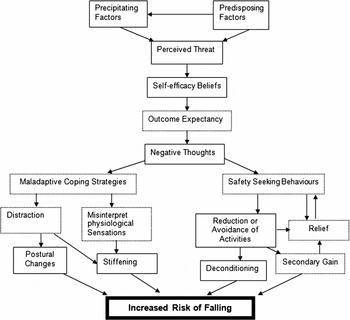
Hull and Kneebone (Reference Hull and Kneebone2007) describe a model of falls risk (Figure 1), which considers these relationships. This highlights factors associated with FrPC leading to increased falls risk, including those they deem to have empirical support (e.g. postural changes) and factors which have received limited empirical attention (e.g. coping).
Hull and Kneebone’s (2007) model of falls risk. Dotted lines indicate limited evidence.

This review explored elements of this model, namely AA/AR and coping. Findings suggested inconsistent evidence of the association between AA/AR and FrPC. This review noted difficulties drawing firm conclusions regarding the relationship between coping and FrPC due to limited number of studies and their methodological limitations. This reflects the uncertainty expressed by the model. Qualitative findings suggested CDOP attempt to cope with FrPC (Ward-Griffin et al., Reference Ward-Griffin, Hobson, Melles, Kloseck, Vandervoort and Crilly2004; Huang, Reference Huang2005). However, generalisability of these results is unclear.
Implications
Future research
Mixed evidence in relation to nearly every psychological factor means further research is required (Drozdick and Edelstein, Reference Drozdick and Edelstein2001). This should seek to clarify associations through consistent measurement of FrPC, with the FES-I being recommended due to its international translation, strong psychometric properties and theoretical underpinnings (Yardley and Kempen, Reference Yardley and Kempen2006; Moore and Ellis, Reference Moore and Ellis2008). Research including other FrPC concepts is also warranted (e.g. OE).
Coping with FrPC has received limited attention and requires continued exploration (Drozdick and Edelstein, Reference Drozdick and Edelstein2001). Gaining clarity on the role of coping, and how this influences outcomes seems pertinent, particularly with the increase in interventions including cognitive coping strategies (Zijlstra et al., Reference Zijlstra, van Haastregt, van Rossum, van Eijk, Yardley and Kempen2007b).
Not all CDOP experiencing FrPC have experienced falls, suggesting the two are not always linked. It would be important to understand which factors contribute to this variation. Factors mediating this relationship could be areas for intervention if adequately understood. Future research may also benefit from multivariate analysis to allow understanding of the complex relationships depicted in Hull and Kneebone's (Reference Hull and Kneebone2007) model. Longitudinal designs would also advance understanding regarding causation.
Clinical relevance
Identifying psychological factors associated with FrPC is important when considering CDOP needs. For example, if anxiety, depression and reduced QoL were associated with FrPC, clinicians may wish to be mindful of these factors during assessment, and when developing individuals’ clinical formulations. The multiple factors associated with FrPC highlights the need for multidisciplinary working to ensure the physical, psychological and social needs of CDOP with FrPC are managed effectively.
In view of the emphasis FrPC has been given in the context of falls prevention (Department of Health, 2001), it is important to explore factors potentially influencing the relationship between FrPC and falls. This may identify factors amenable to change in interventions, and could inform psychologists and other professionals working to reduce falls incidence and FrPC in their clinical work and consultation with other professionals.
In providing targeted, effective interventions to prevent falls and reduce FrPC, this may subsequently address the sequelae of potentially adverse outcomes resulting from falls, including disability, morbidity, and mortality. In finding areas amenable to non-medical interventions, this may provide alternative approaches to reduce the large annual economic cost of falls.
The older adult population is the fastest growing sector of society (Dunnell, Reference Dunnell2008). In order to maintain independence and autonomy in CDOP, it is important to ensure research focuses on factors which can support their continued community presence (Department of Health, 2001). With FrPC being highlighted as a risk factor for admission to an institution (Cumming et al., Reference Cumming, Salkeld, Thomas and Szonyi2000) it is important to address this issue in community populations to avoid admissions.
Theoretical relevance
With many terms used within the arena of FrPC, future research may assist in consolidating and agreeing appropriate constructs to employ. This may assist in identifying which construct is most theoretically relevant and therefore, best to focus on when exploring associated psychological factors. With FOF being criticized for its lack of theoretical underpinning, it may be helpful to consider more soundly based theoretical concepts (i.e. FSe, BC, OE).
Further research may provide clarity to a proposed model of falls risk (Hull and Kneebone, Reference Hull and Kneebone2007), informing theoretical understanding and identifying aspects of these models that are most relevant to clinical practice. This may allow insight into how interventions addressing FrPC and falls may correspond with suggestions in theoretical models. Research could attempt to bridge the gap between theory and practice, highlighting areas to consider in multi-factorial interventions aimed at reducing falls risk.
Conclusion
This review details the associations between FrPC and psychological factors. Whilst often research has been undertaken in relation to the concept FOF, this term lacks theoretical underpinning. Drawing on theoretically grounded terms (i.e. FSE, OE, BC) would allow a stronger, more consistent evidence-base to develop (Moore and Ellis, Reference Moore and Ellis2008).
Whilst many psychological factors have been explored, mixed evidence has been found in their associations with FrPC. Strongest evidence was shown for depression predicting FSe, and FOF predicting QoL and AA/AR. Coping with FrPC has received limited attention to date. Understanding this may inform interventions and clinicians seeking to support individuals reporting FrPC.
Whilst this review listed psychological factors associated with FrPC, future research may advance findings by exploring their mediating role in the relationship between FrPC and falls. Longitudinal designs and multivariate analysis would allow robust understanding to develop.
Conflict of interest declaration
None.
Declaration of authors roles
C. Hughes designed the study, collected the identified papers and wrote the initial draft of the paper. I. Kneebone advised on study design and assisted with writing the paper. F. Jones also advised on design of the study and contributed to the writing of the final paper. B. Brady assisted with the collection of the identified papers, checked the integrity of the literature search and contributed to the writing of the final paper.
Acknowledgments
Thanks are due to Elise Crayton for editorial assistance.
Supplementary material
To view supplementary material for this article, please visit http://dx.doi.org/10.1017/S1041610214002701
Summary table of measures of falls-related psychological concerns

Appendix 2: literature search strategy
Search strategy
An advanced search was conducted to identify relevant papers that were published between no start date and November 2014-Week 1 using PsycINFO, Ovid Medline, Web of Knowledge, ASSIA and CSDR. They were searched using the same strategy. Additionally the reference lists of all selected papers were reviewed to identify any additional relevant papers. Key search terms were chosen by reviewing MeSH headings, and also identifying key words from previous reviews (e.g. Scheffer et al., Reference Scheffer, Schuurmans, van Dijk, van Der Hooft and De Rooij2008). These included words relating to “older people” in order to define the population and “fall,” “fear” and additional related terms (e.g. “efficacy”). Studies were limited to those published in the English language.
MeSH terms and words used to search electronic databases


When limited to those studies published in English and removing duplicates, this reduced the total search to 2,376 papers.
Inclusion/exclusion criteria
Abstracts were read and inclusion and exclusion criteria applied. Papers were included where the authors measured or explored the psychological correlates or themes associated with FrPC in CDOP. These included anxiety, depression, QoL, activity avoidance/restriction and coping. As behavior is considered related to psychological constructs, this is included for the basis of this review. Papers were excluded if they did not address psychological factors, or only addressed physical factors (e.g. balance, gait, age, gender). Papers were also excluded if participants were aged less than 60 years, they were not CDOP (e.g. they were inpatients or resided in a supported care facility such as a nursing home) or the papers were not published in the English language. Intervention studies were also excluded. Application of these criteria to the 2,376 papers identified produced 62 papers for review.