


Introduction
Hallucinations are traditionally a hallmark of psychosis and are defined as perceptions without external stimulation (Laroi, Reference Laroi2012). However, hallucinations can be characteristic of many psychological problems and are also documented in the general population (Johns et al., Reference Johns, Cannon, Singleton, Murray, Farrell, Brugha, Bebbington, Jenkins and Meltzer2004). The psychosis continuum hypothesis suggests that symptoms of psychosis, such as hallucinations, occur on a continuum whereby diagnosed individuals show more severe or distressing symptoms, but the factors explaining the development of psychotic phenomena are the same across the continuum (van Os et al., Reference van Os, Hanssen, Nijl and Ravelli2000). Previous research using hallucination proneness questionnaires such as the Launay‒Slade Hallucination Scale (LSHS; Bentall and Slade, Reference Bentall and Slade1985b) also identify the similarities between proneness scores in factor analysis of clinical samples (Levitan et al., Reference Levitan, Ward, Catts and Hemsley1996) and non-clinical samples (Waters et al., Reference Waters, Badcock and Mayberry2003), offering further support for the psychosis continuum hypothesis.
Recent research has begun to focus on understanding the factors predicting hallucination development in both clinical and non-clinical samples (Johns, Reference Johns2005). One such factor that is well documented as playing a causal role is childhood adversity (Daalman et al., Reference Daalman, Diederen, Derks, van Lutterveld, Kahn and Sommer2012; Larkin and Read, Reference Larkin and Read2008). However, the mechanisms via which trauma leads to the development of hallucinations are less well understood.
One potentially promising candidate mechanism is dissociation. Dissociation is generally defined as the disruption in the ‘normal integration of consciousness, memory, identity, emotion, perception, body representation, motor control, and behaviour’ (American Psychiatric Association, 2013, p. 291). Hallucinations are hypothesized to be dissociated components of the self or ‘compartmentalized’ trauma-related intrusive memories that are experienced and/or interpreted as external and current rather than internal and memory-based, possibly as a result of biased source monitoring/reality discrimination (Longden et al., Reference Longden, House and Waterman2016). There is robust evidence of associations between hallucinations and dissociation in both clinical and non-clinical samples (Pilton et al., Reference Pilton, Varese, Berry and Bucci2015) and some evidence to suggest that dissociation may mediate the relationship between childhood adversity and hallucinations (Perona-Garcelan et al., Reference Perona-Garcelan, Carrascoso-Lopez, Garcia-Montes, Ductor-Recuerda, Jimenes, Vallina-Fernandez, Perez-Alvarez and Gomez-Gomez2012; Varese et al., Reference Varese, Barkus and Bentall2012).
Insecure attachment is another potentially important factor in explaining the association between childhood trauma and vulnerability to hallucinations. Bowlby (Reference Bowlby1969) argued that childhood adversity leads to the development of insecure attachment patterns, which perpetuate into adulthood and increase vulnerability to psychopathology. There are different types of insecure attachment styles. Insecure attachment in adulthood is commonly conceptualized in terms of the dimensions of anxiety and avoidance (Mikulincer and Shaver, Reference Mikulincer and Shaver2012). Individuals with an anxious attachment style tend to fear rejection, yet their cravings for closeness may inadvertently drive others away. Those with avoidant attachment may feel uncomfortable with closeness in relationships and seek to maintain emotional distance. There is evidence of associations between hallucinatory experiences and insecure attachment patterns in both clinical and non-clinical samples (Korver-Nieberg et al., Reference Korver-Nieberg, Berry, Meijer, de Haan and Ponizovsky2015). There is also more recent evidence to suggest that insecure anxious attachment mediates the association between childhood trauma and a number of dimensions of voice-hearing, including voice-related distress (Pilton et al., Reference Pilton, Bucci, McManus, Hayward, Emsley and Berry2016).
Although there is evidence that both dissociation and insecure attachment may be important in explaining the relationship between childhood adversity and hallucinatory experiences, as yet research has not empirically investigated the relative contribution of trauma, dissociation and insecure attachment to explaining hallucinations within a single framework. In this paper, we present a preliminary exploration of hypothesized relationships between childhood adversity, dissociation, insecure attachment and proneness to hallucinations within a non-clinical sample. We tested the following hypotheses:
(i) Childhood adversity will be positively correlated with hallucination proneness.
(ii) Dissociative symptoms will be positively correlated with hallucination proneness.
(iii) Insecure attachment styles will be positively correlated with hallucination proneness: those scoring higher on measures of anxious and avoidant attachment will report higher hallucination proneness scores.
(iv) Together, childhood adversities, dissociative symptoms and insecure attachment styles will predict hallucination proneness.
Method
Participants
Participants were 123 staff and students recruited by poster advertisements placed across a university campus and via a university-based recruitment system where undergraduate psychology students gain course credits for participating in research. Inclusion criteria were: English-speaking, 18 years old or older, and self-reported normal or corrected vision. Exclusion criteria included: self-reported current or previous contact with secondary care psychiatric services and hearing impairment. All inclusion and exclusion criteria were assessed via an online self-report, pre-screening questionnaire.
Measures
Participants completed five self-report questionnaires. Hallucination proneness was assessed using the Launay‒Slade Hallucination Scale (LSHS; Bentall and Slade, Reference Bentall and Slade1985b). This 12-item scale developed from Launay and Slade's (Reference Launay and Slade1981) original questionnaire assesses non-clinical populations’ auditory and visual experiences, vivid mental events and religious-themed hallucinations. The questionnaire has high test‒retest reliability with evidence of improved reliability in measuring constructs captured in the original questionnaire (Bentall and Slade, Reference Bentall and Slade1985b). Cronbach's alpha scores obtained in this study for the LSHS showed good internal consistency (α = 0.80).
History of childhood adversity was assessed using the short form Childhood Trauma Questionnaire (CTQ; Bernstein et al., Reference Bernstein, Stein, Newcomb, Walker, Pogge, Ahluvalia, Stokes, Handelsman, Medrano, Desmond and Zule2003). The CTQ consists of 28 items with subscales measuring: emotional abuse, physical abuse, sexual abuse, emotional neglect and physical neglect. This questionnaire has shown high construct and discriminant validity in non-clinical samples (Bernstein et al., Reference Bernstein, Stein, Newcomb, Walker, Pogge, Ahluvalia, Stokes, Handelsman, Medrano, Desmond and Zule2003). Internal consistency of the CTQ total score in this study was excellent (α = 0.90) with subscale alphas all above 0.7.
The Dissociative Experiences Schedule II (DES II; Carlson and Putnam, Reference Carlson and Putnam1993) was used to measure dissociative symptoms and consists of 28 items in total with three subscales: amnesia, depersonalization/derealization and absorption. In this study, DES II total scores had excellent internal consistency (α = 0.93) with subscales alphas all above 0.7.
The Relationship Scales Questionnaire (RSQ; Griffin and Bartholomew, Reference Griffin and Bartholomew1994) was used to measure attachment styles and participants’ feelings about close relationships over 30 items. Two subscales of insecure anxious and insecure avoidance were used based upon the two factor model proposed by Simpson et al. (Reference Simpson, Rholes and Nelligan1992). Analyses of Cronbach's alpha scores in this study identified good internal consistency of the anxiety measure (α = 0.84) and avoidance measure (α = 0.66).
In order to control for negative affect, participants completed the Positive and Negative Affect Schedule (PANAS; Watson et al., Reference Watson, Clark and Tellegen1988), which contains 10 items assessing negative affect. It has shown high reliability and validity within non-clinical samples with demographic subgroup consistency (Crawford and Henry, Reference Crawford and Henry2004). Good internal consistency for the negative affect subscale (α = 0.86) was apparent within this study. Ethnicity, age and gender information was collected within the online pre-screen.
Procedure
Participants first completed an online pre-screen questionnaire to measure inclusion and exclusion criteria and demographic variables. Those deemed eligible were invited to attend a face-to-face testing session, during which participants completed questionnaires as follows: LSHS, RSQ, CTQ, PANAS and DES II.
Statistical analysis
IBM SPSS Statistics 22 was used for all analyses. Upon checking normality of questionnaire responses the majority of measures were skewed and transformations were unsuccessful. Spearman's correlations were conducted to identify significant correlations between RSQ, CTQ and DES II with hallucination proneness (LSHS). To assess the relationships of childhood adversity, dissociative symptoms and attachment styles collectively, a multiple regression was carried out with bootstrapping.
The DES-II includes a voice-hearing item (item 27), therefore in order to avoid the potential problem of confounding, we carried out all analyses with the DES both with and without this item. As the significance of all of the results was unaffected, we report findings for the complete measure in this paper.
Results
Sample characteristics
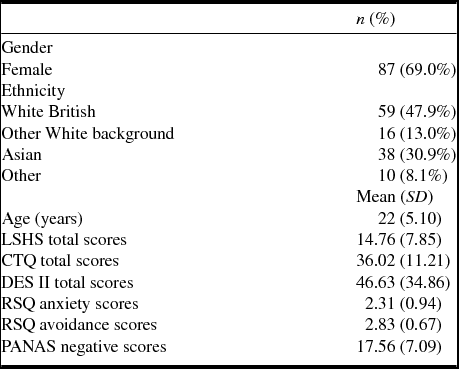
Demographic characteristics are shown in Table 1. The majority of the sample was female, White British, psychology students with an average age of 22 years.
Sample characteristics

Childhood adversity, dissociation, attachment and hallucination proneness
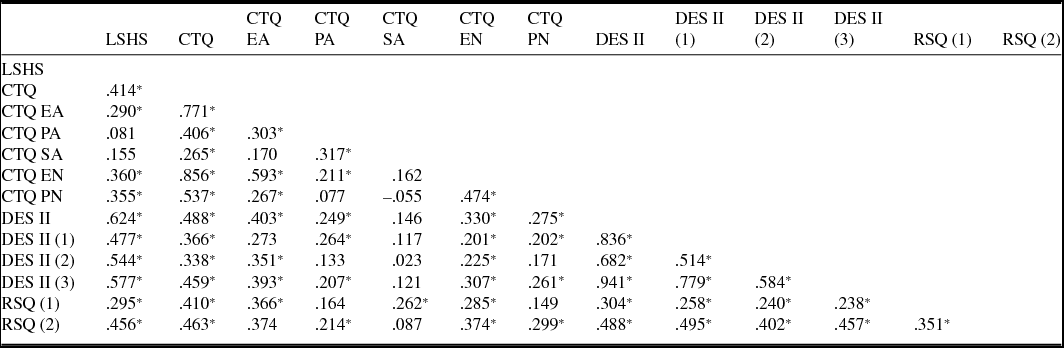
As hypothesized, the CTQ and DES II were significantly positively correlated with the LSHS (see Table 2). These effects were largely replicated with subscales on these measures, with the exception of the physical and sexual abuse subscales of the CTQ. As further predicted, both anxious and avoidant attachment on the RSQ were positively correlated with the LSHS (see Table 2).
Correlational analyses between hallucination proneness, childhood adversity, dissociative symptoms and attachment scores.

LSHS = 1. LSHS total, 2. CTQ EA = CTQ emotional abuse, 3. CTQ PA = CTQ physical abuse, 4. CTQ SA = CTQ sexual abuse, 5. CTQ EN = CTQ emotional neglect, 6. CTQ PN = CTQ physical neglect, 7. DES II = DES II total, 8. DES II (1) = DES II amnesia, 9. DES II (2) = DES II depersonalization/derealization, 10. DES II (3) = DES II absorption, 11. RSQ (1) = RSQ anxious attachment, 12. RSQ (2) = RSQ avoidant attachment. *Significance at p < 0.05.
Confounding variables
Negative affect on the PANAS was positively correlated with LSHS (r (127) = 0.290, p = 0.001). There was no evidence of any gender or ethnic group differences on LSHS scores, but age of participants was negatively correlated to LSHS scores (r (123) = −0.296, p = 0.001), suggesting that younger participants scored higher on hallucination proneness.
Multiple regression predicting hallucination proneness
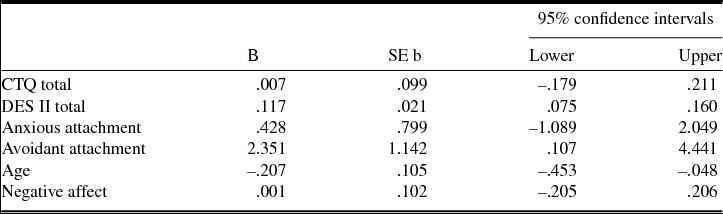
CTQ, DES II total scores and attachment anxious and avoidant scales were all included as predictors in the regression model. We entered total CTQ and DES II scores into the regression as opposed to individual subscale scores, because (with the exception of emotional abuse) total scores were stronger univariate correlates of LSHS. As negative affect and age were shown to have significant relationships to LSHS, these variables were also included in the model. There was evidence that the variables significantly predicted LSHS (F (6,106) = 15.20, p < 0.001) with an adjusted R 2 of 0.432. However, as shown in Table 3, only DES II total and attachment avoidance were significant independent predictors in the model.
Multiple regression coefficients for childhood adversity, dissociative symptoms and attachment scores to hallucination proneness, including confounds of negative affect and age

Discussion
This study aimed to assess the relationship between childhood adversity, dissociative symptoms, and adult attachment styles and their relative contribution to hallucination proneness. In accordance with our hypothesis, correlational analyses showed that those who reported more adverse childhood events were more prone to hallucinations. This supports previous research showing positive relationships between childhood trauma and hallucination prevalence (Janssen et al., Reference Janssen, Krabbendam, Bak, Hanssen, Vollebergh, de Graaf and van Os2004). There were, however, no significant associations between either sexual or physical abuse and hallucination proneness scores. These negative findings may be attributed to the relatively low levels of abuse in the sample and the consequent lack of variance in the data.
In accordance with our hypothesis, participants with higher reported dissociation scores were also more prone to hallucinatory experiences. All of the DES subscales were correlated with hallucination proneness and dissociation, which were also strong significant independent predictors of hallucination proneness. This study adds further support to the body of literature demonstrating associations between dissociation and voices (Pilton et al., Reference Pilton, Varese, Berry and Bucci2015). In support of our hypothesis, those with higher scores on insecure attachment anxiety and avoidant scales were also more prone to hallucinations. Previous research has also highlighted associations between insecure attachment and hallucinatory phenomenon in both clinical and non-clinical samples (Korver-Nieberg et al., Reference Korver-Nieberg, Berry, Meijer, de Haan and Ponizovsky2015). This study additionally suggests that attachment avoidance is a significant independent predictor of hallucination proneness when other potentially important predictor or confounding variables are controlled.
The collective role of trauma, dissociation and attachment in hallucination proneness, suggests that these factors may play a role in explaining the phenomenon and may also have implications for understanding voice-hearing in clinical samples. We have recently developed a model: the Cognitive Attachment model of Voices (CAV), which proposes that experiences of trauma in childhood increases vulnerability to voices by leading to the disruption of the attachment system and the development of subsequent dissociative states in response to stress (see Berry and Bucci, Reference Berry and Bucci2016; Berry et al., Reference Berry, Varese and Bucci2017). Although our model needs to be the subject to further empirical test in clinical samples, findings reported here are in line with hypothesized mechanisms.
There are a number of limitations within this research which must be taken into consideration in interpreting findings. Firstly, participants were self-selected students who are less likely to be representative of the general population. The high incidence of psychology students within the sample may also increase their prior knowledge of testing materials, in turn increasing their social desirability biases within responses (Nederhof, Reference Nederhof1985). Secondly, there were also particular limitations inherent to the measures used. Using the Launay‒Slade Hallucination Scale allowed for the assessment of current hallucinatory experiences, but does not permit elaboration on previous frequency and severity of hallucinatory experiences. The Childhood Trauma Questionnaire does not measure experiences of adult interpersonal trauma and may also be an important predictor of voice-hearing. Thirdly, this study was correlational, not testing hallucination development over time. This limits claims of causality and the direction of findings. Finally, although we controlled for a number of potentially important confounds, we did not control for paranoia, which commonly co-occurs alongside voice-hearing.
Bearing these limitations in mind, findings from this study highlight further support for the potentially important role of attachment and dissociation in understanding voice-hearing phenomena. These associations now need to be explored in clinical samples where people are more likely to experience distressing voices and report previous trauma.
Acknowledgements
We would like to acknowledge all participants who took part in this study.
Conflicts of interest: Katherine Berry, Paul Fleming, Samantha Wong and Sandra Bucci have no conflicts of interest with respect to this publication.
Ethical statement: This study was conducted in accordance with the Ethical Principles of Psychologists and Code of Conduct as set out by the APA (http://www.apa.org/ethics/code/). Ethical approval was provided by the University of Manchester (ref. 15051).
Financial support: This work was unfunded.



Comments
No Comments have been published for this article.