CHD is the most common birth defect, affecting approximately nine in 1000 births.Reference van der Linde, Konings and Slager 1 Although important improvements in survival have been achieved due to medical and surgical advancements,Reference Moons, Bovijn and Budts 2 patients remain at risk for complications and premature mortality. The vulnerability of these patients is not only expressed in physiological terms but also in psychological terms. A meta-analysis has indicated that young people with CHD show more anxiety and depressive symptoms compared with controls.Reference Karsdorp, Everaerd, Kindt and Mulder 3 Moreover, it has been found that half of the CHD population presents with at least one lifetime depressive or anxiety disorder;Reference Kovacs, Saidi and Kuhl 4 however, studies conducted in European countries such as the NetherlandsReference Kovacs and Moons 5 have indicated that adolescents with CHD scored lower on depressive symptoms compared with their peers. Irrespective of these diverging findings, depressive symptoms in cardiac patients require explicit attention from clinicians. Co-morbid depression is a risk factor for poor prognosis and suboptimal functioning in patients with coronary heart disease.Reference Lichtman, Froelicher and Blumenthal 6 More recently, the relationship between depression and adverse cardiovascular events has also been confirmed in patients with CHD.Reference Kourkoveli, Rammos, Parissis, Maillis, Kremastinos and Paraskevaidis 7 The identification of depression, however, poses a substantial challenge for clinicians, as depressive symptoms may not be obvious at the time of consultation with the cardiologist.Although several studies on depression in individuals with CHD have been published, they are mainly cross-sectional in nature. Such studies prevent clinicians from obtaining a thorough understanding of the development, persistence, and consequences of depressive symptoms. Furthermore, research on depressive symptoms is particularly relevant in adolescent and emerging adult patients, as depressive symptoms predict future adjustment problems such as school dropout, unemployment, delinquent behaviour, and ill-being.Reference Lewinsohn, Hops, Roberts, Seeley and Andrews 8 In addition, experiencing depressive symptoms during adolescence increases the risk of experiencing depressive episodes later in life.Reference Harrington, Fudge, Rutter, Pickles and Hill 9 Therefore, the aims of the present longitudinal study were as follows:
-
∙ to compare the prevalence of depressive symptoms at baseline in adolescents with CHD with adolescents from the general population;
-
∙ to investigate the development of depressive symptoms in adolescents with CHD;
-
∙ to assess the persistence of depressive symptoms over time in adolescents with CHD; and
-
∙ to examine the implications of persistent depressive symptoms towards quality of life and patient-reported health.
Materials and methods
Participants and procedure
The present study was a part of the i-DETACH project – Information technology Devices and Education programme for Transitioning Adolescents with Congenital Heart disease – a longitudinal project including four time points with 9-month intervals. Eligible patients were selected from the database of paediatric and congenital cardiology of the University Hospitals Leuven, Belgium. The inclusion criteria for this study were as follows: confirmed diagnosis of CHD, defined as structural abnormalities of the heart and/or the great intrathoracic vessels that are actually or potentially of functional significance;Reference Mitchell, Korones and Berendes 10 aged between 14 and 18 years at the start of the study on 22 October, 2009; last cardiac outpatient visit at our tertiary care centre performed ⩽5 years ago; being able to read and write Dutch; and the availability of valid contact details. Patients were excluded if they had cognitive and/or physical limitations inhibiting them from filling out questionnaires; if they previously had undergone heart transplantation; and if patients and/or their parents did not consent to participate. The patient’s primary heart defect was obtained from medical records and categorised using a modified version of the scheme developed by the CONCOR (CONgenital COR Vitia) project.Reference Van der Velde, Vriend and MMAM 11 The complexity of heart lesions was determined based on Task Force 1 of the 32nd Bethesda conference as simple, moderate, or complex.Reference Warnes, Liberthson and Danielson 12 A total of 498 patients met the inclusion criteria and received a package by surface mail, which included a set of questionnaires, an information letter, an informed consent form, for parents and adolescents, and a pre-stamped and addressed return envelope. The proposed study protocol was approved by the Institutional Review Board of the University Hospitals Leuven, Belgium. This study was carried out in accordance with the 2002 Declaration of Helsinki.
A control group was recruited from high schools. Parents were provided with written information about the research, and were asked for their consent for the adolescents to participate. Control participants were asked to complete questionnaires at T1.
Variables and measurement
Depressive symptoms
Depressive symptoms were measured at all four time points using the 20-item Center for Epidemiologic Studies Depression Scale (CES-D).Reference Radloff 13 The CES-D has adequate psychometric properties about community adolescents and adolescents with CHD.Reference Cohen, Mansoor, Langut and Lorber 14 , Reference Roberts, Andrews, Lewinsohn and Hops 15 Each item asks how often participants experienced symptoms of depression during the past week, using a four-point scale from 0 (seldom) to 3 (most of the time or always). A scale score was calculated by summing all the items (range 0–60), with higher scores indicating more symptoms. Cronbach’s αs, as an index of internal consistency, at T1–T4 ranged between 0.89 and 0.91.
Quality of life
Quality of life was defined as the degree of overall life satisfaction that is positively or negatively influenced by the individual’s perception of certain important aspects of life, both related and unrelated to health.Reference Moons, Van Deyk and Marquet 16 Overall quality of life was assessed at T4 using a linear analogue scale (LAS), which is a vertically oriented line, graded with indicators ranging from 0 (worst imaginable quality of life) to 100 (best imaginable quality of life). Participants were asked to rate their quality of life by marking a point on this scale. Validity and reliability of the LAS in patients with CHD have been detailed previously.Reference Moons, Van Deyk and De Bleser 17
Patient-reported health
We used two instruments to assess patient-reported health at T4. First, we used an LAS similar to that of quality of life, but now graded with indicators ranging from 0 (worst imaginable health) to 100 (best imaginable health). Second, we used the self-reported version for adolescents aged between 13 and 18 years of the Pediatric Quality of Life Inventory (PedsQL). Both the generic and cardiac modules were applied. The PedsQL 4.0™ generic core scales consist of four subscales, measuring physical (eight items), emotional (five items), social (five items), and school functioning (five items). The following five subscales of the PedsQL 3.0™ cardiac module were used: cardiac symptoms (seven items), physical appearance (three items), treatment anxiety (four items), cognitive functioning (five items), and experienced problems in communicating with clinicians (three items).Reference Uzark, Jones, Burwinkle and Varni 18 , Reference Varni, Seid and Murtin 19 Patients had to indicate the degree to which they experienced problems during the past month using a five-point scale ranging from 0 (never) to 4 (almost always). Items were inversely coded, summed across all items of the respective subscales, and transformed to range between 0 and 100, with higher scores indicating better adjustment. Cronbach’s αs at T4 ranged between 0.70 and 0.92.
Statistical analyses
First, to examine differences in T1 scores of depressive symptoms between patients and community adolescents, a paired sample t-test was used. Second, to investigate the development of depressive symptoms, repeated-measures analysis of variance was used. Time×sex and time×disease complexity interaction effects were investigated, possibly revealing different patterns of change in depressive symptoms for boys versus girls and for adolescents with different levels of disease complexity. The design consisted of one within-subjects factor – that is, time – and two between-subjects factors – that is, sex and disease complexity. Pearson’s correlations were computed to examine associations between age and depressive symptoms at each time point.
Third, based on conventional cut-off points for the CES-D,Reference Radloff 13 , Reference Müller, Hess and Hager 20 – Reference Rushton, Forcier and Schectman 22 participants were classified into three categories at each time point: no/minimal (below a score of 16), mild (16–23), and moderate/severe depressive symptoms (24 and above). Although scores of 16 and higher do not correspond to a clinical diagnosis of depression, they suggest the presence of psychological disturbance and indicate the need for further assessment of the patient for depression.Reference Radloff 13 To examine the persistence of depressive symptoms, adolescents with CHD were classified into five groups, depending on the frequency with which they scored 16 or higher on the CES-D over time – that is, zero out of four times (Group 1), one out of four times (Group 2), two out of four times (Group 3), three out of four times (Group 4), and four out of four times (Group 5). Therefore, whereas Group 1 did not have a score of 16 or higher at any time point, Group 5 had a score of 16 or higher at all time points.
Fourth, to examine whether the persistence of depressive symptoms predicted quality of life and patient-reported health at T4, hierarchical regression analyses were performed. In Step 1, sex and symptom persistence were included as predictors. In Step 2, CES-D scores at T4 were included as a predictor to examine whether symptom persistence would remain a unique predictor of quality of life and patient-reported health at T4 when controlling for the level of depressive symptoms at T4. Finally, to provide more insight into membership to these symptom persistence groups, a multivariate analysis of variance was performed with membership to these five groups as a fixed factor, and quality of life and patient-reported health at T4 as dependent variables.
Results
Patient characteristics
A total of 429 patients participated at T1 (86% participation rate), 398 at T2, 366 at T3, and 337 at T4. A total of 296 individuals completed the measures at all four time points and constituted the study sample. When comparing these 296 adolescents with those 133 adolescents who dropped out during the study period, no significant differences at T1 emerged for age (F(1,427)=0.05, p=0.82), disease complexity (χ 2(2)=1.23; p=0.53), or any of the study variables (F(12,397)=0.79, p=0.66). Girls (74%), however, were more likely to continue to participate as opposed to boys (64.6%) (χ 2(1)=4.38; p<0.05).
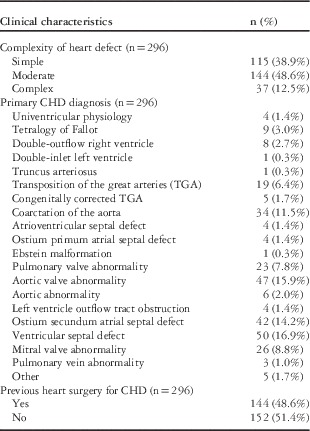
The mean age of adolescents with CHD at T1 was 16.27 years (SD=1.14; range 14–18). There were 148 girls and 148 boys. Virtually all the participants (n=294; 99.3%) lived at home with their parents; 50 adolescents (16.9%) were in a romantic relationship. A total of 282 adolescents (95.3%) attended high school; the remainder of adolescents attended college or university. Table 1 presents the clinical characteristics of the participants. Of these 296 adolescents with CHD, 278 could be matched 1:1 with controls, based on sex and age.
Clinical patient characteristics.

Prevalence of depressive symptoms in patients and community adolescents
At T1, we observed no/minimal depressive symptoms in 77.6% (n=230); mild depressive symptoms in 13.9% (n=41); and moderate/severe depressive symptoms in 8.5% (n=25) of the adolescents with CHD. In the control group, these proportions were 60.1% (n=167), 24.1% (n=67), and 15.8% (n=44), respectively. A paired samples t-test indicated that adolescents with CHD, compared with controls, scored lower on depressive symptoms (M=10.10, SD=8.38; and M=15.64, SD=10.70, respectively; t=6.60, p<0.05).
Depressive symptoms over time
Mean CES-D scores in patients were 10.13 at T1, 9.53 at T2, 10.68 at T3, and 10.48 at T4 (Table 2). These scores remained stable across time as indicated by a non-significant F-value obtained by repeated-measures analysis of variance (F(3,293)=2.20, p=0.09). CES-D scores were significantly higher in girls than in boys at all time points, but were unrelated to disease complexity (Table 2) or age, with Pearson’s correlations ranging between −0.03 and 0.04 (p>0.05). Neither sex (F(3,288)=0.86, p=0.46) nor disease complexity (F(6,576)=0.98, p=0.44) moderated the development of depressive symptoms.
Descriptive statistics and univariate F-values for gender and disease complexity at time points 1–4 (n=296).

CES-D=Center for Epidemiologic Studies Depression Scale
*p<0.05
Persistence of depressive symptoms
Group 1 consisted of 170 patients (57.4%), Group 2 of 50 patients (16.9%), Group 3 of 40 patients, Group 4 of 18 patients (6.1%), and Group 5 consisted of 18 patients (6.1%). Disease complexity (χ 2(8)=9.10; p=0.33) and age (F(4,290)=1.19, p=0.32) were unrelated to membership to these symptom persistence groups. Sex was significantly related to membership to these groups (χ 2(4)=15.78; p<0.05): boys (59.4%) compared with girls (40.6%) were especially over-represented in Group 1.
Implications of persistent depressive symptoms
As can be seen in Step 1 of the hierarchical regression analyses displayed in Table 3, symptom persistence predicted all outcome variables at T4, taking sex into account. Furthermore, symptom persistence remained a significant unique predictor of these outcomes after controlling for CES-D scores at T4. For patient-reported health, physical functioning, and treatment anxiety at T4, symptom persistence was the only unique significant predictor.
Standardised β-coefficients of the hierarchical regression analyses predicting outcomes at time point 4.

CES-D=Center for Epidemiologic Studies Depression Scale; QOL=quality of life
*p<0.05
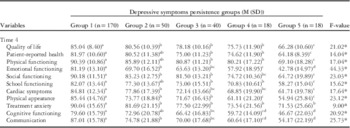
Finally, a multivariate analysis of variance with membership to these five groups as fixed factor resulted in significant mean differences in quality of life and patient-reported health at T4 (F(44,1076.99)=5.50, p<0.05). Table 4 presents follow-up univariate analyses. A clear pattern emerged, with Group 1 – no limited depressive symptoms at all time points – generally showing the most adaptive scores on the outcome measures and Group 5 – mild-to-moderate/severe depressive symptoms at all time points – generally showing the least adaptive scores on the outcome measures. Adolescents in Group 5 also reported significantly more problems on physical, emotional, and school functioning, and scored significantly lower for quality of life and patient-reported health compared with adolescents in Group 4 – mild-to-moderate/severe depressive symptoms at three out of four time points – further emphasising the need for repeated assessments of depressive symptoms.
Univariate ANOVA and post hoc comparisons based upon Tukey’s HSD tests for the five depressive symptoms persistence groups (n=296).

ANOVA=analysis of variance; HSD=honest significant difference
a,b,c,dWithin each row, a group mean is significantly different from another group mean if they have different superscripts; if they share the same superscript, they are not significantly different from one another. Standard deviations are in parentheses
*p<0.05
Discussion
This multi-wave longitudinal study indicated that adolescents with CHD scored lower on depressive symptoms compared with community adolescents. Furthermore, whereas almost 40% of community adolescents scored 16 or higher on the CES-D, roughly 23% of the adolescents with CHD did so. Therefore, in line with other European studies,Reference Kovacs and Moons 5 adolescents with CHD seemed to be “better off” in terms of depressive symptoms. Although such a finding may suggest the presence of denial in adolescents with CHD,Reference Van Rijen, EMWJ and Roos-Hesselink 23 they may experience daily problems differently due to their adaptation to CHD.Reference Fredriksen, Diseth and Thaulow 24 Despite the fact that patients scored lower on depressive symptoms compared with community participants, clinicians need to remain sensitive for persistent depressive symptoms in patients with CHD.Reference Lichtman, Froelicher and Blumenthal 6
Substantial individual differences indeed emerged with respect to the degree to which symptoms persisted over time: 12.2% of the adolescents reported mild-to-moderate/severe depressive symptoms at three or more time points, indicating that depressive symptoms became chronic over time. Previous studies have indicated that many of these patients reporting persistent depressive symptoms are not recognised as such.Reference Kovacs and Moons 5 Consequently, a substantial proportion of patients with clinically significant depression do not receive appropriate mental healthcare treatment.Reference Kovacs, Saidi and Kuhl 4 The American College of Cardiology and the American Heart Association recommend that screening for psychiatric disorders should be undertaken in patients with CHD.Reference Warnes, Williams and Bashore 25 Furthermore, our findings demonstrated that reporting no or only minimal depressive symptoms did not rule out the possibility that depressive symptoms may occur at a later point and persist over time. Therefore, a single screening provides limited insight into chronic depressive conditions.Reference Rushton, Forcier and Schectman 22
The persistence of depressive symptoms uniquely predicted all outcome variables at the final time point, whereas the level of depressive symptoms at this time point failed to uniquely predict patient-reported health, physical functioning, and treatment anxiety. Moreover, for cardiac symptoms and physical appearance, the persistence of depressive symptoms seemed to be the strongest predictor. Collectively, these findings suggest that for patient-reported health and physical or cardiac symptoms, the persistence of depressive symptoms was especially important. Previous studies have already pointed to the co-occurrence of depressive and physical symptoms in patients with CHD.Reference Kovacs, Saidi and Kuhl 4 , Reference Eslami, Sundin, Macassa, Khankeh and Soares 26 Such a finding has clear implications, given that physical symptoms instigate individuals to seek medical care. The present findings suggest that such physical complaints might be influenced by persistent depressive symptoms or by a symptomatic depressive disorder.Reference Rose, Köhler, Köhler, Sawitzky, Fliege and Klapp 27 Indeed, the heart defect does not always constitute the major problem for these patients.Reference DeMaso, Campis, Wypij, Bertram, Lipshitz and Freed 28 Clinicians involved in the care for patients with CHD should be aware of this co-occurrence.
Analyses of variance again emphasised the important role of repeated measurements of depressive symptoms for assessing the persistence of these symptoms. For instance, adolescents with CHD who scored above the cut-off of 16 on the CES-D at all four time points reported significantly more problems on physical, emotional, and school functioning, and scored significantly lower on quality of life and patient-reported health at T4 compared with adolescents who scored above this cut-off at three out of four time points. In other words, experiencing depressive symptoms repeatedly over time seems to be a cumulative process in predicting generic and illness-specific functioning. Therefore, a long-term follow-up of depressive symptoms is warranted to obtain a detailed picture of the persistence of these symptoms. Brief versions of instruments such as the CES-D can be used to screen for clinical depression with no dramatic attenuation in screening efficiency.Reference Roberts, Lewinsohn and Seeley 21
Study limitations
First, this study relied on a self-report questionnaire for assessing depressive symptoms rather than using structured interviews to obtain a depression diagnosis. The CES-D is a well-validated measure, and the cut-off values applied are widely used; however, evidence about the sensitivity and specificity of the CES-D in detecting depressive disorders is mixed.Reference Roberts, Lewinsohn and Seeley 21 , Reference Rushton, Forcier and Schectman 22 Therefore, there is a need for psychiatric interviews for those adolescents with CHD presenting with depressive symptoms. This so-called two-stage procedure for case identification – that is, the use of brief symptom checklists followed-up by psychiatric interviews in identified cases – has been advocated previously.Reference Roberts, Lewinsohn and Seeley 21 , Reference Wang, Hay, Clarke and Menahem 29 Relatedly, although in the present observational study no formal depression treatment was offered to participants, we have no information on whether patients were treated for depression in between time points.
Second, the single-centre setting reduced the generalisability of the findings; however, the proportion of patients with a simple, moderate, or complex heart defect corresponds to reported prevalences in the literature. Furthermore, patients were recruited from the database of one university hospital, but received follow-up at different hospitals across the country. Besides disease complexity, future studies should also include current functional status and physical health as correlates of depressive symptoms.Reference Chen, Liao and Wang 30
Third, 14% of the eligible patients contacted at T1 did not participate, which could be related to depressive symptoms. Therefore, a potential selection bias could not be excluded. Relatedly, some attrition was observed, which could potentially affect study results. Nevertheless, attrition analyses pointed to no systematic pattern in these missing data, and therefore a systematic attrition bias is unlikely to affect the results. Finally, control participants could only be assessed at baseline. Future research should include longitudinal measurements for control participants to investigate whether similar proportions of adolescents without CHD report persistent depressive symptoms as well.
In summary, although depressive symptom rates were lower in patients compared with community adolescents, which might instigate researchers to downgrade the importance of screening for such depressive symptoms in patients, we encourage clinicians to pay attention to persistent depressive symptoms in adolescents with CHD. Such persistent depressive symptoms were found to have important implications for quality of life and patient-reported health.
Acknowledgements
Authors’ Contributions: K.L. carried out all the statistical analyses and drafted the article; J.R., S.A., E.G., L.O., and P.M. critically revised and approved the article; E.G. and P.M. collected the data; and K.L. and P.M. obtained funding.
Financial Support
This work was supported by the Research Fund, KU Leuven, Belgium, through grant OT/11/033.
Conflicts of Interest
None.
Ethical Standards
The authors assert that all the procedures contributing to this work comply with the ethical standards of the relevant national guidelines on human experimentation and with the Helsinki declaration, and have been approved by the institutional ethics committees at KU Leuven.