


While the detrimental effects of elevated blood pressure and LDL cholesterol, smoking and excess weight on CVD risk are widely recognized, less is known about Fe status. In the1980s, Sullivan( Reference Sullivan 1 ) hypothesized that Fe depletion may provide a protective mechanism in preventing heart disease. This hypothesis was based on the fact that increased myocardial failure was seen in Fe storage diseases, and elevated storage Fe was found in men as they aged and in women after menopause.
In theory, Fe may initiate or progress CVD due to its role in the Fenton reaction( Reference Gropper, Smith and Groff 2 ). When transferrin and ferritin become saturated, free Fe (Fe2+) reacts with hydrogen peroxide forming ferric Fe (Fe3+) and free radicals. These free radicals, most notably the hydroxyl radical, initiate tissue damage and lipid peroxidation, causing oxidative damage to the coronary arteries and oxidizing LDL cholesterol, resulting in more coronary damage( Reference Corti, Gaziano and Hennekens 3 ).
A decade after Sullivan's hypothesis was published, results from the Kuopio Ischemic Heart Disease Risk Factor Study in Finland( Reference Salonen, Nyyssonen and Korpela 4 ) found support for the Fe–heart disease hypothesis. In fact, results showed that for men with serum ferritin >200 ng/ml (449·4 pmol/l) there was a 2·2-fold increased risk for myocardial infarction. After 5 years of follow-up, Salonen et al.( Reference Salonen, Nyyssonen and Salonen 5 ) established that their results were still significant. In 1997 Kiechl et al.( Reference Kiechl, Willeit and Egger 6 ) found a significant association between the progression of carotid stenosis and increased serum ferritin levels in both men and women. Nevertheless, there is inconsistent evidence supporting the link between Fe storage and CHD( Reference Sempos, Looker and Gillum 7 – Reference Magnusson, Sigfusson and Sigvaldason 11 ). A literature review( Reference Sempos, Looker and McGee 12 ) showed the majority of cohort studies based on serum ferritin did not find evidence to support the Fe–heart disease hypothesis. However, none of these studies included both African Americans and whites in their sample and few included women.
Since CVD is a leading cause of death in the USA, with CHD accounting for over 425 000 deaths annually( 13 , 14 ), predictive risk equations are useful in health disparities research. The Framingham Heart Study's CHD prediction algorithms provide valid scores for ‘hard’ 10-year risk (myocardial infarction + CHD death, excludes angina pectoris) in both white( Reference Wilson, D'Agostino and Levy 15 , Reference Grundy, Pasternak and Greenland 16 ) and African-American populations( Reference D'Agostino, Grundy and Sullivan 17 ). To our knowledge, there have been no studies published to date which examine the relationship between Fe status and CHD risk using predictive risk equations in a population of low-income, urban African-American and white men and women. It is important to study this population to enhance our understanding of health disparities, especially since African-American men and women have significantly higher Fe stores compared with their white counterparts( Reference Pan and Jackson 18 – Reference Ramakrishnan, Kuklina and Stein 21 ). In addition, if elevated Fe stores increase CHD risk, postmenopausal women may be a greater risk than premenopausal women because of differences in Fe stores after amenorrhoea.
The purpose of the present study was to determine the role of Fe status in the risk for development of CHD. The impact of race, BMI, inflammation, menopausal status and socio-economic status on heart disease risk was also assessed in this low-income urban African-American and white population.
Experimental methods
Background on HANDLS study
The HANDLS study began baseline collection in August 2004 and ended in March 2009, with a total of 3721 participants. This large-scale epidemiological study was designed to examine the influence of ageing, race, sex and socio-economic status on, among many biomarkers, the risk for development of cerebrovascular and cardiovascular disease( Reference Evans, Lepkowski and Powe 22 , 23 ). There were two phases of the baseline study. The first phase was done in the participant's home. The second phase was completed 3 to 10 d later, on mobile medical research vehicles (MRV) located in preselected census tracts where participants resided. The study protocol was approved by the human investigation review boards at both MedStar Health Research Institute and the University of Delaware. All HANDLS participants provided written informed consent and were compensated monetarily. Further detailed information on the study design, participant recruitment and data collected can be found elsewhere( Reference Evans, Lepkowski and Powe 22 , 23 ).
Participants
Only those participants with no missing values with respect to Fe status indicators (serum ferritin, transferrin saturation percentage (Tsat%), serum Fe), fasting blood glucose, systolic blood pressure, HDL cholesterol, total serum cholesterol, C-reactive protein (CRP), BMI and selected demographic variables were included in the analysis. Participants having a prior hysterectomy, a history of coronary artery disease or blockage (self-report), a prior coronary artery bypass surgery or a history of cancer were excluded from the analyses. A total of 1823 participants remained after exclusions (949 men and 874 women).
For descriptive analysis, participants were grouped into six categories in order to assess the differences between race (African American or white) and sex. Males were categorized into two groups by race. Females were categorized into four groups by race and menopausal status. Menopausal status was based on self-report from the medical history questionnaire. These subgroups are referred to hereafter as follows: WM (white male), AAM (African-American male), WF-Pre (white female – premenopausal), WF-Post (white female – postmenopausal), AAF-Pre (African-American female – premenopausal) and AAF-Post (African-American female – postmenopausal).
Medical history
Selected questions from the medical history were reviewed. These questions focused on cardiovascular health, history of certain diseases (cancer, liver), age at the beginning of menopause, information regarding past hysterectomy and smoking status.
Anthropometrics
During the examination phase, fasting participants were weighed (kg) without shoes and coats using a calibrated Health O Meter digital scale. Height (cm) was obtained with the participant's heels and back against a height meter supplied by Novel Products, Inc. These measures were used to calculate BMI with the equation: BMI = weight (kg)/[height (m)]2.
BMI was used to classify participants as normal weight, overweight or obese( 23 ). For the present study the range for underweight (BMI < 18·5 kg/m2) was combined with normal weight (BMI = 18·5–24·9 kg/m2) due to the small number of participants who fell into the underweight category (n 51). Overweight and obese categories were defined as BMI = 25·0–29·9 kg/m2 and BMI ≥ 30·0 kg/m2, respectively.
Socio-economic status
Socio-economic status was determined by educational attainment, poverty status and employment status. These data were collected with the household questionnaire during phase 1. Education was defined as some high school education or less (<12 years); or high school graduate, general educational development or higher education (≥12 years). The poverty-to-income ratio was categorized as either <125 % or ≥125 %. Poverty-to-income ratio was a ratio of household income to the poverty threshold defined by the 2003 US Census Poverty Guidelines( 24 ). Response to employment in the past month was either yes or no.
Blood chemistry and blood pressure
Fasting venous blood specimens were collected from participants during their MRV visit and analysed at the Nichols Institute of Quest Diagnostics, Inc. (Chantilly, VA, USA)( 23 ). Fasting blood results utilized for the present study included measures of plasma glucose (mmol/l), serum cholesterol (mmol/l), CRP (nmol/l) and four indicators for Fe status. Fe values were run as continuous variables in statistical analyses. Indicators included serum Fe (μmol/l), total Fe-binding capacity (TIBC) (μmol/l), transferrin saturation percentage (Tsat% = (serum Fe/TIBC) × 100) and serum ferritin (pmol/l). Plasma glucose, total serum cholesterol, serum Fe and TIBC were assessed using the standard clinical laboratory spectrophotometric assay. Serum transferrin was measured by the fixed-rate time nephelometry methodology and serum ferritin was measured using a standard chemiluminescence assay. High-sensitivity CRP levels were assessed by the nephelometric method utilizing latex particles coated with CRP monoclonal antibodies. Blood pressure was assessed using the Portapres ambulatory heart rate and blood pressure monitor.
CHD risk assessment
The Framingham Heart Study's CHD risk assessment algorithms were used to calculate individual absolute heart disease risk and relative risks compared with a low-risk group. The low risk state was defined according to the Framingham Heart Study and utilizes desirable ranges (separately by sex) for age, serum total cholesterol, HDL cholesterol and blood pressure, as well as non-diabetic and non-smoking status, to determine risk scores( Reference Wilson, D'Agostino and Levy 15 , Reference Grundy, Pasternak and Greenland 16 ).
Statistical analysis
Age, total cholesterol, HDL cholesterol, blood pressure, diabetes and smoking status were used to derive the average 10-year CHD risk score derived from the Framingham Study Coronary Risk Prediction Score Sheets( 25 ). Since risk was derived from disparate score sheets based on the innate risk difference between sexes, statistics were presented within sex categorization. Menopausal status was not employed as an independent variable in the inferential analyses as it was correlated with age (Spearman's ρ = 0·74) and age was a component of the Framingham 10-year CHD risk function.
Descriptive analyses
Descriptive statistics were used to summarize and analyse preliminary associations among CHD risk, demographic characteristics and selected biomarkers. For continuous variables, means and standard errors were presented with significance tests for comparisons, and proportions for dichotomous variables. Comparative risk between the HANDLS baseline and the Framingham Heart Study cohorts was also assessed.
Inferential analyses
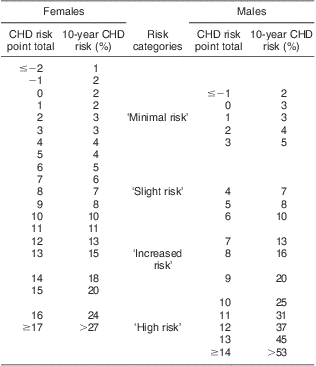
Ordinal logistic regression models were used to analyse and interpret gradients of 10-year CHD risk and associations between baseline serum ferritin controlling for CRP, adiposity and baseline demographic factors. A proportional (cumulative) odds model (POM) was used to analyse four mutually exclusive predetermined divisions of ranked risk derived from the 10-year CHD risk using Framingham Heart Study Prediction Score Sheets (Table 1): (i) minimal (10-year CHD risk ≤5 %); (ii) slight (10-year CHD risk ≤10 %); (iii) increased (10-year CHD risk ≤20 %); and (iv) high (10-year CHD risk >20 %).
Categorized Framingham Heart Study Prediction Score Sheets
| Females | Males | |||
| CHD risk point total | 10-year CHD risk (%) | Risk categories | CHD risk point total | 10-year CHD risk (%) |
| ≤−2 | 1 | |||
| −1 | 2 | |||
| 0 | 2 | ≤−1 | 2 | |
| 1 | 2 | 0 | 3 | |
| 2 | 3 | ‘Minimal risk’ | 1 | 3 |
| 3 | 3 | 2 | 4 | |
| 4 | 4 | 3 | 5 | |
| 5 | 4 | |||
| 6 | 5 | |||
| 7 | 6 | |||
| 8 | 7 | ‘Slight risk’ | 4 | 7 |
| 9 | 8 | 5 | 8 | |
| 10 | 10 | 6 | 10 | |
| 11 | 11 | |||
| 12 | 13 | 7 | 13 | |
| 13 | 15 | ‘Increased risk’ | 8 | 16 |
| 14 | 18 | 9 | 20 | |
| 15 | 20 | |||
| 10 | 25 | |||
| 16 | 24 | 11 | 31 | |
| ≥17 | >27 | ‘High risk’ | 12 | 37 |
| 13 | 45 | |||
| ≥14 | >53 | |||
CHD, ‘hard’ CHD (includes myocardial infarction + CHD death, excludes angina pectoris).
In the analysis, the four risk categories were modelled on cumulative higher risk, and the odds were accumulated over the higher-risk categories. That is, P(Y ≥ high risk), P(Y ≥ increased risk), P(Y ≥ slight risk) and P(Y ≥ minimal risk) will contain three ‘cut-points’ for which the odds represent being at or above that particular cut-point: (i) high risk v. minimal, slight and increased risks; (ii) high and increased risks v. slight and minimal risks; and (iii) high, increased and slight risks v. minimal risk( Reference Scott, Goldberg and Mayo 26 ).
The POM Score Test for the Proportional Odds Assumption was non-significant (male model: P = 0·0875, female model: P = 0·3893); therefore the essential assumption of homogeneity of slopes (the effects) was not rejected and the predictor odds ratios were constant across all cut-points of risk. That is, the predictor odds ratio in the model represents odds ratios obtained from separate binary logistic regressions using the three cut-points of risk. Testing the global null hypothesis for regression coefficients equal to zero (Wald, Score and Likelihood Ratios tests: P < 0·0001) indicated predictors in the fitted model significantly improved fit over the null model. For the male and female models, the significant predictors with odds ratios and 95 % confidence intervals are presented in results. No interactions were significant. Statistical significance was set to a two-tailed P ≤ 0·05. Statistical analyses were performed with the SAS statistical software package version 9·2 (SAS Institute, Cary, NC, USA) and replicated with the IBM SPSS Statistics 19 statistical software package (IBM Corporation, Somers, NY, USA).
Results
Participants
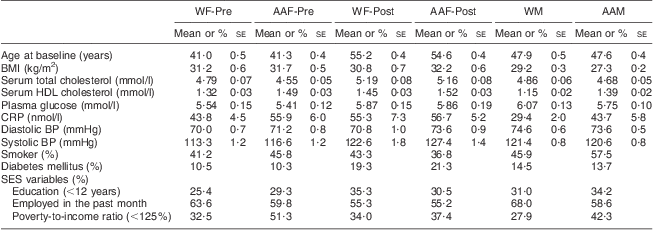
Descriptive statistics, indicators of risk for developing CVD and socio-economic variables are presented in Table 2. According to mean BMI values and regardless of race, the average male was classified as overweight and the average female was obese. Overall, 30·2 % of the sample was classified as overweight and 40·8 % as obese. With the exception of WF-Post (5·19 (se 0·08) mmol/l), mean total serum cholesterol for the participants was below the borderline–high risk range, 5·18 mmol/l, as defined by the American Heart Association (Table 2). Means for CRP were found to be ≥28·6 nmol/l across the entire sample and ranged from 29·4 (se 2·0) to 56·7 (se 5·2) nmol/l. About 48 % of the total population smoked cigarettes, with African Americans having the higher percentage (50·4 %). On average, diabetes afflicted 14 % of the study sample. The highest percentage of individuals with diabetes was found among postmenopausal women (Table 2). Approximately a third of the sample did not complete high school. Nearly 40 % were not employed. Poverty was also a major factor, with 39 % falling below 125 % of the poverty level.
Participant characteristics by race, sex and menopausal status, HANDLS study, Baltimore, MD, USA, 2001–2009
| WF-Pre | AAF-Pre | WF-Post | AAF-Post | WM | AAM | |||||||
| Mean or % | se | Mean or % | se | Mean or % | se | Mean or % | se | Mean or % | se | Mean or % | se | |
| Age at baseline (years) | 41·0 | 0·5 | 41·3 | 0·4 | 55·2 | 0·4 | 54·6 | 0·4 | 47·9 | 0·5 | 47·6 | 0·4 |
| BMI (kg/m2) | 31·2 | 0·6 | 31·7 | 0·5 | 30·8 | 0·7 | 32·2 | 0·6 | 29·2 | 0·3 | 27·3 | 0·2 |
| Serum total cholesterol (mmol/l) | 4·79 | 0·07 | 4·55 | 0·05 | 5·19 | 0·08 | 5·16 | 0·08 | 4·86 | 0·06 | 4·68 | 0·05 |
| Serum HDL cholesterol (mmol/l) | 1·32 | 0·03 | 1·49 | 0·03 | 1·45 | 0·03 | 1·52 | 0·03 | 1·15 | 0·02 | 1·39 | 0·02 |
| Plasma glucose (mmol/l) | 5·54 | 0·15 | 5·41 | 0·12 | 5·87 | 0·15 | 5·86 | 0·19 | 6·07 | 0·13 | 5·75 | 0·10 |
| CRP (nmol/l) | 43·8 | 4·5 | 55·9 | 6·0 | 55·3 | 7·3 | 56·7 | 5·2 | 29·4 | 2·0 | 43·7 | 5·8 |
| Diastolic BP (mmHg) | 70·0 | 0·7 | 71·2 | 0·8 | 70·8 | 1·0 | 73·6 | 0·9 | 74·6 | 0·6 | 73·6 | 0·5 |
| Systolic BP (mmHg) | 113·3 | 1·2 | 116·6 | 1·2 | 122·6 | 1·8 | 127·4 | 1·4 | 121·4 | 0·8 | 120·6 | 0·8 |
| Smoker (%) | 41·2 | 45·8 | 43·3 | 36·8 | 45·9 | 57·5 | ||||||
| Diabetes mellitus (%) | 10·5 | 10·3 | 19·3 | 21·3 | 14·5 | 13·7 | ||||||
| SES variables (%) | ||||||||||||
| Education (<12 years) | 25·4 | 29·3 | 35·3 | 30·5 | 31·0 | 34·2 | ||||||
| Employed in the past month | 63·6 | 59·8 | 55·3 | 55·2 | 68·0 | 58·6 | ||||||
| Poverty-to-income ratio (<125 %) | 32·5 | 51·3 | 34·0 | 37·4 | 27·9 | 42·3 | ||||||
HANDLS, Healthy Aging in Neighborhoods of Diversity across the Life Span; WF-Pre, white female – premenopausal (n 209); AAF-Pre, African-American female – premenopausal (n 341); WF-Post, white female – postmenopausal (n 150); AAF-Post, African-American female – postmenopausal (n 174); WM, white male (n 394); AAM, African-American male (n 555); CRP, C-reactive protein; BP, blood pressure; SES, socio-economic status.
Fe status
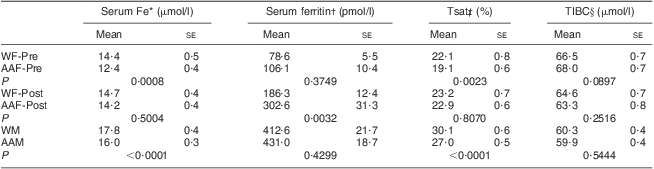
There were statistically significant differences (P < 0·0001) when comparing men and women for all four indicators of Fe status (serum Fe, serum ferritin, TIBC, Tsat%). Men had higher values for all measures except TIBC. There were significant differences between pre- and postmenopausal women for each Fe marker (P < 0·01, serum Fe; P < 0·0001, serum ferritin, TIBC and Tsat%), with postmenopausal women having higher values for all measures except TIBC. However, when assessing racial differences, African Americans had significantly lower serum Fe and Tsat% compared with whites (P < 0·0001).
The mean values of Fe status indicators categorized by group are provided in Table 3. Each group fell within normal reference ranges for all four indicators, with the exception of Tsat% for woman. Both pre- and postmenopausal women had slightly lower values than reference( 27 ). There was a significant difference in serum ferritin levels between the WF-Post and AAF-Post women, with AAF-Post having the higher value. In contrast, among premenopausal women, WF-Pre had significantly higher mean serum Fe and Tsat% than AAF-Pre. Mean serum Fe and Tsat% were significantly higher for WM compared with AAM.
Differences in iron status by race, sex and menopausal status, HANDLS study, Baltimore, MD, USA, 2001–2009
| Serum Fe* (μmol/l) | Serum ferritin† (pmol/l) | Tsat‡ (%) | TIBC§ (μmol/l) | |||||
| Mean | se | Mean | se | Mean | se | Mean | se | |
| WF-Pre | 14·4 | 0·5 | 78·6 | 5·5 | 22·1 | 0·8 | 66·5 | 0·7 |
| AAF-Pre | 12·4 | 0·4 | 106·1 | 10·4 | 19·1 | 0·6 | 68·0 | 0·7 |
| P | 0·0008 | 0·3749 | 0·0023 | 0·0897 | ||||
| WF-Post | 14·7 | 0·4 | 186·3 | 12·4 | 23·2 | 0·7 | 64·6 | 0·7 |
| AAF-Post | 14·2 | 0·4 | 302·6 | 31·3 | 22·9 | 0·6 | 63·3 | 0·8 |
| P | 0·5004 | 0·0032 | 0·8070 | 0·2516 | ||||
| WM | 17·8 | 0·4 | 412·6 | 21·7 | 30·1 | 0·6 | 60·3 | 0·4 |
| AAM | 16·0 | 0·3 | 431·0 | 18·7 | 27·0 | 0·5 | 59·9 | 0·4 |
| P | <0·0001 | 0·4299 | <0·0001 | 0·5444 | ||||
HANDLS, Healthy Aging in Neighborhoods of Diversity across the Life Span; Tsat, transferrin saturation; TIBC, total Fe-binding capacity; WF-Pre, white female – premenopausal (n 209); AAF-Pre, African-American female – premenopausal (n 341); WF-Post, white female – postmenopausal (n 150); AAF-Post, African-American female – postmenopausal (n 174); WM, white male (n 394); AAM, African-American male (n 555).
*Reference value: 10·7–26·9 μmol/l (50–170 μg/dl).
†Reference value: 33–450 pmol/l (≤300 ng/ml (men), ≤200 ng/ml (women)).
‡Reference value: 25–35 %.
§Reference value: 44·8–80·6 μmol/l (240–450 μg/dl).
Fe test reference values adapted from http://www.irondisorders.org/iron-tests ( 27 ) and http://www.amamanualofstyle.com/oso/public/jama/si_conversion_table.html ( 38 ).
CHD risk
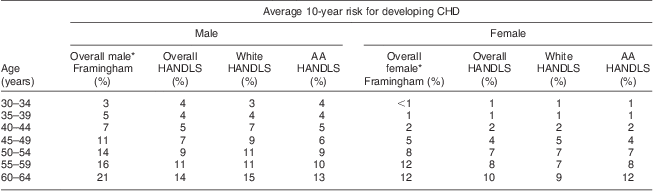
In our sample, the only significant difference in the average 10-year risk and relative risk was between WM and AAM (Table 4). Both 10-year risk and relative risk scores were greater for WM than for AAM. In general, the 10-year risk for men in the Framingham study exceeded that of the male HANDLS study participants. Among the HANDLS men, 10-year risk tended to be higher for white compared with African-American men beginning at 40–44 years of age (Table 5).
Comparison of average 10-year risk and relative risk utilizing the Framingham Heart Study's CHD risk equations, across race by sex and menopausal status of women and within race for women by menopausal status, HANDLS study, Baltimore, MD, USA, 2001–2009

| WF-Pre | AAF-Pre | WF-Post | AAF-Post | WM | AAM | |||||||
| Mean | se | Mean | se | Mean | se | Mean | se | Mean | se | Mean | se | |
| 10-year CHD risk | 2·7a | 0·2 | 2·7a | 0·2 | 7·5b | 0·4 | 7·7b | 0·4 | 8·9 | 0·3 | 7·2 | 0·2 |
| P* | 0·8916 | 0·8225 | <0·0001 | |||||||||
| Relative risk | 1·4 | 0·06 | 1·2 | 0·04 | 1·3 | 0·08 | 1·3 | 0·06 | 1·7 | 0·06 | 1·4 | 0·04 |
| P* | 0·0695 | 0·7984 | <0·0001 | |||||||||
CHD, ‘hard’ CHD (myocardial infarction + CHD death, excludes angina pectoris); HANDLS, Healthy Aging in Neighborhoods of Diversity across the Life Span; WF-Pre, white female – premenopausal (n 209); AAF-Pre, African-American female – premenopausal (n 341); WF-Post, white female – postmenopausal (n 150); AAF-Post, African-American female – postmenopausal (n 174); WM, white male (n 394); AAM, African-American male (n 555).
a,bValues within a row with unlike superscript letters were significantly different for premenopausal v. postmenopausal females of the same race (P < 0·0001).
*Comparison by race for premenopausal women, postmenopausal women and men.
Comparative 10-year risk between Framingham and the HANDLS study sample
| Average 10-year risk for developing CHD | ||||||||
| Male | Female | |||||||
| Age (years) | Overall male* Framingham (%) | Overall HANDLS (%) | White HANDLS (%) | AA HANDLS (%) | Overall female* Framingham (%) | Overall HANDLS (%) | White HANDLS (%) | AA HANDLS (%) |
| 30–34 | 3 | 4 | 3 | 4 | <1 | 1 | 1 | 1 |
| 35–39 | 5 | 4 | 4 | 4 | 1 | 1 | 1 | 1 |
| 40–44 | 7 | 5 | 7 | 5 | 2 | 2 | 2 | 2 |
| 45–49 | 11 | 7 | 9 | 6 | 5 | 4 | 5 | 4 |
| 50–54 | 14 | 9 | 11 | 9 | 8 | 7 | 7 | 7 |
| 55–59 | 16 | 11 | 11 | 10 | 12 | 8 | 7 | 8 |
| 60–64 | 21 | 14 | 15 | 13 | 12 | 10 | 9 | 12 |
HANDLS, Healthy Aging in Neighborhoods of Diversity across the Life Span; CHD, ‘hard’ CHD (myocardial infarction + CHD death, excludes angina pectoris); AA, African Americans.
*Step 9 from http://www.framinghamheartstudy.org/risk/coronary.htmltabl ( 25 ).
Source: Modified based on Coronary Disease Risk Prediction Score Sheet for Men Based on Total Cholesterol Level (http://www.nhlbi.nih.gov/about/framingham/risktmen.pdf) and the Coronary Disease Risk Prediction Score Sheet for Women Based on Total Cholesterol Level (http://www.nhlbi.nih.gov/about/framingham/risktwomen.pdf) in comparison with HANDLS data.
When comparing 10-year risk between the HANDLS and Framingham study samples, the overall risk for women, until age 55 years and older, was similar (Table 5). Then, 10-year risk for all women in the HANDLS study was less than the risk found for the female participants in the Framingham study. Among the HANDLS women, 10-year risk was similar with exception of the oldest age group (60–64 years) where the percentage at risk was higher among the African-American women compared with the white women (Table 5).
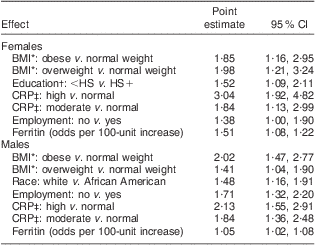
Serum ferritin was associated with 10-year risk for CHD among women in the HANDLS study. For every 10-unit rise in serum ferritin (pmol/l), 10-year CHD risk increased by 5·1 %, and this increase was constant across the entire range of risk, from ‘minimal’ to ‘high’. Those with a higher 10-year risk for CHD were also less educated, unemployed, overweight or obese, and had higher CRP levels (Table 6). It is also important to note that women with high CRP levels and increased BMI had notably higher risk than their counterparts. However, serum ferritin was not associated with CRP in the study sample (r = 0.02, P = 0.31).
Summary table for logistic regression odds ratio estimates for 10-year CHD risk by sex, HANDLS study, Baltimore, MD, USA, 2001–2009
| Effect | Point estimate | 95 % CI |
| Females | ||
| BMI*: obese v. normal weight | 1·85 | 1·16, 2·95 |
| BMI*: overweight v. normal weight | 1·98 | 1·21, 3·24 |
| Education†: <HS v. HS+ | 1·52 | 1·09, 2·11 |
| CRP‡: high v. normal | 3·04 | 1·92, 4·82 |
| CRP‡: moderate v. normal | 1·84 | 1·13, 2·99 |
| Employment: no v. yes | 1·38 | 1·00, 1·90 |
| Ferritin (odds per 100-unit increase) | 1·51 | 1·08, 1·22 |
| Males | ||
| BMI*: obese v. normal weight | 2·02 | 1·47, 2·77 |
| BMI*: overweight v. normal weight | 1·41 | 1·04, 1·90 |
| Race: white v. African American | 1·48 | 1·16, 1·91 |
| Employment: no v. yes | 1·71 | 1·32, 2·20 |
| CRP‡: high v. normal | 2·13 | 1·55, 2·91 |
| CRP‡: moderate v. normal | 1·84 | 1·36, 2·48 |
| Ferritin (odds per 100-unit increase) | 1·05 | 1·02, 1·08 |
CHD, ‘hard’ CHD (myocardial infarction + CHD death, excludes angina pectoris); HANDLS, Healthy Aging in Neighborhoods of Diversity across the Life Span; CRP, C-reactive protein.
*BMI: normal weight, 18·5–25·0 kg/m2; overweight, 25·0–29·9 kg/m2; obese, ≥30·0 kg/m2.
†Education: <12 years, some high school or less education (<HS); ≥12 years, high school diploma or general educational development (HS+).
‡CRP: normal, <9·5 nmol/l; moderate, 9·5–28·6 nmol/l; high, ≥28·6 nmol/l.
Similarly, for every 10-unit rise in serum ferritin (pmol/l), 10-year CHD risk increased by 0·5 % among the men in the HANDLS study. As with the females, this increase was constant across the entire range of risk, from ‘minimal’ to ‘high’. Being overweight or obese, white, unemployed and having a CRP level ≥9·5 nmol/l was also associated with a higher risk for CHD for a man compared with being of normal weight, African American, employed and having a CRP of <9·5 nmol/l (Table 6).
Discussion
Fe status
There were no significant differences in serum ferritin levels between premenopausal women by race. However, AAF-Post had significantly higher serum ferritin levels than WF-Post. This finding was similar to that reported for postmenopausal women examined in the third National Health and Nutrition Examination Survey (NHANES)( Reference Zacharski, Ornstein and Woloshin 28 ).
Serum ferritin levels were not significantly different between men by race. This finding was particularly interesting since previous research with NHANES III data has consistently shown African-American males to have higher serum ferritin concentrations than white individuals( Reference Pan and Jackson 18 , Reference Zacharski, Ornstein and Woloshin 28 ). The difference in findings might reflect the economic status of the populations. Although the NHANES population is representative of the USA, the lower-income participants are not as poor as the majority of HANDLS participants. In addition, Pan and Jackson( Reference Pan and Jackson 18 ) found that non-Hispanic black males were 2·15 times more likely than white males to have increased serum ferritin concentrations with acute inflammation (CRP ≥ 9·5 nmol/l), and 1·81 times more likely without inflammation. Our results show that race is not a significant determinant of mean serum ferritin levels between low-income, urban premenopausal women or men despite the elevated means for CRP found in each of the these four groups (Table 2).
CHD risk
Overall the participants in the HANDLS study had lower CHD risk than those reported for the Framingham study. This finding was somewhat surprising considering the number of risk factors displayed by the study population. However medical advancements in the treatment of elevated serum cholesterol and hypertension may contribute to the lower risk scores. In addition, it is recognized that the Framingham risk score has limitations( Reference Grewal, Anand and Islam 29 – Reference Schlendorf, Nasir and Blumenthal 31 ). For instance, individuals classified at low CHD risk may have subclinical atherosclerosis as determined by carotid ultrasound and are at increased long-term risk for vascular events( Reference Grewal, Anand and Islam 29 ).
Our model also shows the importance of stored Fe in the risk for developing CHD in low-income men and women. These findings are strengthened by the fact that serum ferritin, an acute-phase reactant, was not significantly associated with CRP. To our knowledge the present study is the first one to show significance between serum ferritin levels and CHD in men and women by utilization of the Framingham Heart Study's 10-year CHD risk algorithms.
The significance between serum ferritin and heart disease may be attributed to poor diet quality( Reference Proulx and Weaver 32 ). A diet high in fat and cholesterol, and low in vegetables and known antioxidants, might impact the relationship between serum ferritin and myocardial infarction. Raffensperger et al.( Reference Raffensperger, Kuczmarski and Hotchkiss 33 ) found poor overall diet quality among HANDLS participants. Findings showed large proportions of individuals (n 1990) had low intakes (≤67 % of a nutrient adequacy ratio) of the following antioxidants: vitamin A (67·2 %), vitamin C (56·9 %) and vitamin E (85·3 %). If Fe-mediated oxidative stress is a risk factor for developing CHD, then it seems likely that consuming a diet rich in antioxidants would decrease this risk by protecting the body from toxic free radicals. It is possible that the significance between elevated serum ferritin and CHD risk in the population studied may in part be due to their poor dietary habits.
Raffensperger et al.( Reference Raffensperger, Kuczmarski and Hotchkiss 33 ) also found education to be the most important predictor of nutrient-based diet quality, with higher-educated participants having increased intake of nutrients. Education was a predictor of 10-year CHD risk for females, suggesting the effect of education on CHD risk may also be related to the consumption of a diet low in antioxidant-rich foods.
One limitation is the variability of serum ferritin when inflammation is present. Serum ferritin, an acute-phase reactant, can be elevated due to inflammation, certain types of cancers and liver disease. Inflammation was taken into account by exclusion of individuals who had undergone or were currently being treated for cancer (chemotherapy, biological, radiation) within the past 6 months before recruitment. However, we did not exclude for liver disease. There were twelve individuals with liver cirrhosis (eight men, four women). With the exception of one female, all had serum ferritin within the normal range. Since serum ferritin was not associated with CRP in our sample, any effect this may have caused is most likely of minimal significance.
Research has shown the significant relationship between BMI and heart disease and more recently between inflammation as assessed by CRP and heart disease. These results are particularly important since mean CRP levels for the HANDLS sample was >28·6 nmol/l, indicating considerable inflammation and potential high risk for the development of CVD( 34 ). It should be noted that an elevated CRP can be related to malignant as well as non-malignant factors such as race and ethnicity, statin use, marital status and BMI( Reference Johnson and Master 35 ), as well as dietary factors, such as the consumption of saturated fat at levels >10 % of total energy intake( Reference Arya, Isharwal and Misra 36 ). The explanation for the elevated CRP among HANDLS participants is unknown at this time.
The use of CRP as an independent predictor of increased CHD risk has been recommended by the American Heart Association and the Centers for Disease Control and Prevention( 34 ). A reclassification of risk scores based on varying CRP levels may improve risk prediction outcomes. However, the validity of this approach has yet to be seen( Reference Cushman, McClure and Howard 37 ). If reclassification does improve prediction, a significant amount of individuals in the HANDLS study would move into a higher risk classification due to their high CRP levels (Table 1). This reclassification would most likely change the comparison between HANDLS and Framingham participants (Table 5), and possibly show an overall higher 10-year CHD risk for HANDLS compared with Framingham participants.
Another limitation is participant self-report, which contains an element of error inherent to the data. Data that may have been affected by self-reported answers include questions about coronary artery disease or blockage, prior coronary artery bypass surgery, menopausal status, medical history questionnaires regarding various diseases, and habits such as smoking, as well as information on socio-economic status.
Conclusions
Race was not a significant determinant of mean serum ferritin levels between low-income, urban premenopausal women or men, despite the elevated means for CRP. However, serum ferritin was a significant predictor of 10-year CHD risk in low-income, urban men and women, showing a 0·5 % and 5·1 % increase with each 10-unit increase in serum ferritin (pmol/l), respectively. Furthermore, two previously known heart disease risk factors, a BMI classification of overweight (BMI = 25·0–30·0 kg/m2) or obese (BMI ≥ 30·0 kg/m2) and elevated CRP, were among the most significant predictors of 10-year CHD risk in HANDLS study participants. Race and unemployment were significant predictors for men, while lower education and unemployment status were predictors for women.
Future health disparities research should continue to determine the effect of ethnicity, sex and socio-economic status. In addition, overall diet quality, especially antioxidant levels of individuals with elevated serum ferritin, should be evaluated to see if antioxidant-rich diets impact the risk of developing CHD. The clinical significance of the results remain to be clarified since serum ferritin values within the normal reference range play a significant role in the risk of developing CHD.
Acknowledgements
This work was supported by the Intramural Research Program, National Institute of Aging, National Institutes of Health. There are no conflicts of interest. M.E.O. conceived of and designed the study, conducted the literature review, and prepared the first manuscript draft. M.F.K. contributed to the design of the study, assisted with the interpretation of the data, and made critical revisions of the manuscript for intellectual content. She assisted in editing drafts and reviewing data analyses and interpretation. M.M. created the plan for the analytical approaches, performed all the statistical analyses, drafted the statistical analysis section of the paper, and critically reviewed and edited the results section. C.F. assisted with the final design of the study and contributed to the preparation of the manuscript, focusing on the Fe status measures. A.B.Z. and M.K.E. conceived of and designed the HANDLS study and directed its implementation. They were directly involved in data collection and quality assurance. All authors read and approved the final manuscript.



