INTRODUCTION
Carbon-14 (14C) is a low-energy beta-emitting radionuclide that is produced both naturally and artificially. The natural path is based on the interaction of thermal neutrons and nitrogen-14 atoms in the upper layers of the troposphere and stratosphere: 14N(n,p)14C. About 1.4·106 GBq 14C is produces annually by this reaction, while the total amount of 14C in the atmosphere is estimated at 1.4·108 GBq (IAEA 2004). Nuclear weapons testing led to an almost twofold increase in the concentration of 14C in the atmosphere. According to estimates, 2.2·108 GBq 14C entered the atmosphere in the 1950s and 1960s (IAEA 2004). After acceptance of Partial Nuclear Test Ban Treaty 14C concentration in atmosphere began to decline gradually due to the carbon cycle and is now comparable to pre-test levels ∼ 100 pMC ≈ 226 Bq/kg C (IAEA 2004).
At present, atmosphere discharges from nuclear fuel cycle enterprises are the main anthropogenic source of 14C entering the atmosphere. During the operation of a nuclear reactor, 14C is formed mainly as a result of the interaction of thermal neutrons and 14N, 13C, 17O atoms present in fuel elements, structural materials, moderator and coolant, as well as due to uranium and plutonium ternary fission reactions in nuclear fuel (IAEA 2004). It is estimated that about 1.1·105 GBq/year is released into the atmosphere in gaseous form from all operating nuclear power plants, while about 3.7·105 GBq/year of 14C in both gaseous and liquid form released by spent nuclear fuel reprocessing plants.
In Russia, there are three types of nuclear power reactors: VVER (PWR), FBR and RBMK. In an RBMK 14C is mainly produced in the graphite moderator by 13C(n,γ)14C and 14N(n,p)14C reactions, due to large amounts of impurities. Most of the produced 14C, however, remains in the graphite during the operation of the reactor and is not released to the atmosphere.
Tree rings are a good indicator of the 14C content in the atmosphere due to the process of photosynthesis. The analysis of 14C content in the annual rings of trees located in the vicinity of nuclear facilities allows to perform a retrospective assessment of 14C release and calculate effective doses throughout the entire life cycle of the enterprise. An increased content of 14C was observed after the analysis of tree rings near Paks (Janovics et al. Reference Janovics, Kern, Güttler, Wacker, Barnabás and Molnár2013), Ignalina (Ežerinskis et al. Reference Ežerinskis, Šapolaitė, Pabedinskas, Juodis, Garbaras, Maceika and Remeikis2018), Barseback (Stenstrom et al. Reference Stenstrom, Skog, Thornberg, Erlandsson, Hellborg, Mattsson and Persson1997), and Beloyarsk (Nazarov et al. Reference Nazarov, Kruzhalov, Vasyanovich, Ekidin, Kukarskikh, Parkhomchuk, Petrozhitskii and Parkhomchuk2022) NPPs. The aim of this paper is retrospective annual discharges of 14C by Kursk NPP and effective doses calculation.
SAMPLING AND MEASUREMENTS
Kursk NPP is presented by four RBMK-1000 reactors with an electrical output of 1000 MW. Four reactors were constructed from 1979 to 1986. One of four reactors is permanent shutdown since 2021. The routine release of 14C into the atmosphere is carried out mainly through two ventilation stacks 150 m high and from other organized sources, but with lower concentrations. The sampling site, located 2.7 km west of the geometric center of discharges sources, was defined using long-term meteorological data (Rostekhnadzor 2021). The weather archive since 2006 included more than 50,000 records. The dominant wind direction is east-southeast (Figure 1). Figure 2 presents the location of Kursk NPP and the sampling site.
Wind rose in Kurchatov 2006–2022.

The sampling site and Kursk NPP location (numbers of power units).

The core samples of Pinus sylvestris L. and Populus tremula L., the most representative tree species in the location of Kursk NPP, were sampled using an increment borer at a height of about 130 cm from the soil surface. The age of the trees varied from 50 to 70 years. The annual ring widths on all cores were measured according to standard dendrochronological techniques (Stokes and Smiley Reference Stokes and Smiley1968; Cook and Kairiukstis Reference Cook and Kairiukstis1990; Rinn Reference Rinn1996). We used COFECHA software (Holmes Reference Holmes1983) cross-dating quality control. According to the crossdated series cores were divided into annual rings. Rings of the same age from 10 different individuals were combined into one sample corresponding to a certain year. 14 different samples were selected for analysis. The 14С concentration of a 113-year-old pine tree located in Novosibirsk was used as background (Nazarov et al. Reference Nazarov, Kruzhalov, Ekidin, Vasyanovich, Parkhomchuk, Rastigeev, Kalinkin and Parkhomchuk2021) due to the city of Novosibirsk is located at a considerable distance from the operating nuclear facilities.
During the sample preparation, cellulose was extracted from tree rings by the procedure described in details in (Parkhomchuk et al. Reference Parkhomchuk, Petrozhitskiy, Ignatov, Kuleshov, Lysikov, Okunev, Babina and Parkhomchuksubmitted). In general the procedure consisted in several steps: (1) multistage extraction purification with C2H2Cl2, C2H5OH and distilled water until a colorless solution was obtained; (2) delignification, which was carried out by the catalytic oxidation by H2O2 in an acidic medium with NaWO4 as a catalyst; (3) multistage dehumification with NaOH; and finally (4) acid treatment with HCl for CO2 removal, distilled water rinsing and drying at 70°C with snow-white cellulose obtaining. Then it was subjected to complete combustion and transformation into graphite-like carbon in the absorption-catalytic setup (Lysikov et al. Reference Lysikov, Kalinkin, Sashkina, Okunev, Parkhomchuk, Rastigeev, Parkhomchuk, Kuleshov and Vorobyeva2018), with following measurements of 14C concentration. The measurements were carried out on accelerator mass-spectrometer at the AMS Golden Valley laboratory using the facility from Budker Institute of Nuclear Physics (Parkhomchuk and Rastigeev Reference Parkhomchuk and Rastigeev2011; Nazarov et al. Reference Nazarov, Kruzhalov, Ekidin, Vasyanovich, Parkhomchuk, Rastigeev, Kalinkin and Parkhomchuk2021; Petrozhitskiy et al. Reference Petrozhitskiy, Parkhomchuk, Ignatov, Kuleshov, Kutnyakova, Konstantinov and Parkhomchukforthcoming).
METHODS
The used calculation approach assumes that the concentration of 14C in the annual ring of a tree corresponds to the average annual concentration in the ambient air. The sampling site is expected to have the highest concentration of 14C in the air and, as a result, the highest effective dose.
The 14C air concentration A V (Bq/m3) was calculated using following formula:
 $${A_V} = \Delta pMC\cdot S\cdot{C_{st}},$$
where ΔpMC – difference between measured and background 14C concentration (Table 1);
Concentrations of 14C in tree rings and 12C in air.

S – coefficient between pMC and Bq/kg C. 100 pMC = 226 Bq/kg C;
C st – stable carbon concentration in air. The concentration of stable carbon was determined using carbon dioxide levels in atmosphere (NASA 2023). The carbon dioxide concentration varied from 332 ppm in 1976 to 414 ppm in 2020. The values of C st used in calculations are presented in Table 1.
The estimate of the annual 14С discharge Q (Bq/a) was calculated by formula:
 $$Q = 3.15\cdot{10^7}{A_V}/{G_{n,j}},$$
where 3.15·107 – the conversion factor, s/a;
G n,j – the annual average meteorological dilution factor in the surface layer of the atmosphere at a distance x from the i-th source in the wind direction of the n-th point, s/m3 (Figure 1). For sampling site, the values were calculated for each year, where it possible, by analyzing the meteorological data (Table 2).
Dilution factor values for each year.

The IAEA approach for estimating annual effective doses from 14C releases assumes that all the food consists only of local products and, as a result, there is an equilibrium in the 14С concentration in food, human tissue, and atmospheric air. Then the estimate of the expected annual dose of internal exposure D (Sv/a) from 14С contained in the atmospheric air in the form of carbon dioxide 14СО2 can be obtained by the following formula (IAEA 2001):
 $$D = {A_V}G/{C_{st}},$$
where G – is the effective dose rate factor that relates the annual dose rate (Sv/a) to the concentration of 14C per gram of carbon in people (Bq/g). The dose rate factor recommended for screening is 5.6·10–5 Sv/a per Bq/g (IAEA 2001).
Since ingestion is the primary mode of expose, and the share of consumption of local products does not always exceed the share of imported, it is reasonable to assume that there may not be an equilibrium of 14C. In this case, the expected annual dose of 14C exposure can be calculated using the formula (Kryshev et al. Reference Kryshev, Kryshev, Vasyanovich, Ekidin, Kapustin and Murashova2020):
 $$D = {\varepsilon _{ing}}U{A_V} + {\varepsilon _{food}}\mathop \sum \limits_i {\alpha _i}{R_i}{A_{food,i}},$$
where ε ing = 6.5·10−12 Sv/Bq – dose conversion factor for an adult when inhaling 14C in the form of CO2 (ICRP 2012);
U = 8.1·103 m3/a – respiratory rate of an adult (Pleil et al. Reference Pleil, Ariel Geer Wallace, Davis and Matty2021);
ε food = 5.8·10−10 Sv/Bq – dose conversion factor for dietary intake of 14C for an adult (IAEA 2014);
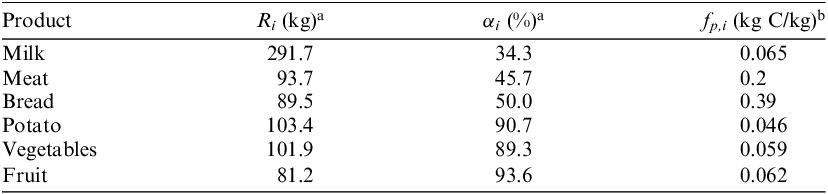
α i – the share of local products in the diet of the population (Table 3);

R i – annual consumption of the product by the population, kg (Table 3);
A food,i – 14C concentration in the local food product, Bq/kg.
The 14C concentration in the food product, based on the balance of 14C between atmospheric air and local plant or animal products, was calculated by the formula:
 $${A_{food,\,i}} = {A_V}{f_{p,i}}/{C_{st}},$$
where f p,i – the share of stable carbon in plant or animal product, kg C/kg product (Table 3).
RESULTS AND DISCUSSIONS
The 14C concentration in tree rings near Kursk NPP are presented in Figure 3. The launch of four RBMK-type reactors was carried out from 1977 to 1986. Graphite stack restoration terms 2013–2019.
14С concentration in tree rings.

In all measured samples, the contribution of emissions from the Kursk NPP to the concentration of 14С in the atmospheric air is visible. The highest annual concentrations are observed during the restoration of graphite stack. This confirms that the main part of the produced 14C remains in the graphite. There is no correlation between annual electricity generation and 14C emissions. The annual discharges and dose calculation results are presented in Table 4.
The values of average annual discharge and effective dose.

Since it is assumed that a major part of 14C released from RBMKs is in 14CO2 form, considering of others chemical forms of 14C is not required. The values of annual discharges vary from 0.4 TBq in 2020 (regular operation) to 9.9 TBq in 2018 during the restoration of graphite stack. The results of effective dose calculation have demonstrated that contribution of inhalation to 14C exposure is about 0.03% while ingestion remains the main way of 14С influence. However, the contribution of background 14C to the annual effective dose is more than 90%, except for the period of restoration of the graphite stack. If we use an approach that considers the actual consumption of products in the Kursk region, the values of annual effective doses are more than 2 times lower than with the conservative approach of the IAEA.
The selection of tree rings from specific years was made to cover both the period of normal operation and the period of restoration of the graphite stack. During normal operation, in our opinion, it is not necessary to consider the tree ring of each year since ΔpMC changes insignificantly. Probably the period of restoration of the graphite masonry requires more detailed consideration. However, in our paper, we demonstrated the scale of 14C release during such process.
CONCLUSION
In this paper, we analyzed the concentration of 14C in tree rings in the vicinity of the Kursk NPP. Accelerator mass spectrometry measurements demonstrated Δ14C excesses in each of the samples, which are due to the operation of four RBMK reactors: from 1.3 pMC in 2020 (normal operation) to 41.6 pMC in 2014 during the restoration of the graphite stack. The assumption that the main part of 14С is emitted as 14СО2 made it possible to perform a retrospective assessment of annual releases and effective doses. The release value ranged from 0.4 to 9.9 TBq. Accounting for real consumed products in the Kursk region reduced the values of annual effective doses by more than 2 times compared to the IAEA approach: 0.17–5.30 μSv (IAEA) and 0.08–2.58 μSv (new approach). Background contribution is the main part of 14C exposure—from 70 to 99%