1. Introduction.
In this article, we compare the behavior of four Germanic languages—German, Dutch, English, and Swedish—with respect to strong-verb paradigm leveling. As a shared development, ablaut alternations were simplified, and as the most extreme simplification, strong verbs have been changing towards the weak conjugation. Nevertheless, we found significant differences across languages, both in the direction of ablaut leveling (section 2) and in the progression of change towards the weak conjugation (section 3). Swedish favors ablaut patterns that keep the preterite (pret) and past participle (PP) vowels distinct, while the other three languages favor a common vowel for both forms.Footnote 1 In class change, the preterite precedes the past participle in German, Dutch, and English. In Swedish, the leveling direction is reversed.
We provide a unified functional explanation for these different patterns (section 4), assuming that the differences in leveling are conditioned primarily by the common denominator of aspectuality. We argue in section 4.1 that Swedish has retained a stronger aspectual distinction between the preterite and the perfect, while in German and Dutch the perfect has been grammaticalized towards general past. In section 4.2, we argue that this functional difference determines different ratios of preterite versus perfect (and thus past participle) frequency of use. We support our claim by a small corpus survey in section 5.1. Token frequency, in its turn, indicates the degree of a form's cognitive entrenchment and thus its susceptibility to analogical leveling. English, in spite of its strong aspectual distinction, behaves similarly to German and Dutch with respect to leveling, which is discussed in section 5.2. Our conclusions are summed up in section 6.
2. Leveling of Preterital Number Ablaut.
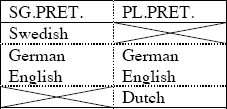
In earlier stages of development, all four languages exhibited preterital number ablaut in the strong verb system, that is, different ablaut vowels appeared in the singular and the plural preterite forms. This distinction by means of qualitative or quantitative ablaut was leveled out in the modern varieties of all four languages. Table 1 illustrates this complex process in a simplified way.
Direction of ablaut leveling in the preterite.
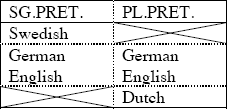
As table 1 indicates, leveling took different directions in each language: Swedish always generalized the vowel of the singular (indicated by the crossed-out cell; see also table 2). Dutch went in the opposite direction extending the vowel of the plural to the singular (table 3). In German, either the singular or the plural forms prevailed, depending on the respective ablaut class (table 4). English behaved similarly to German, except that in some cases the preterite forms were remodeled after the past participle (table 5), which sets English apart from the other three languages.
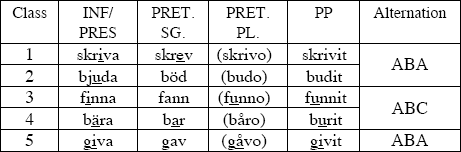
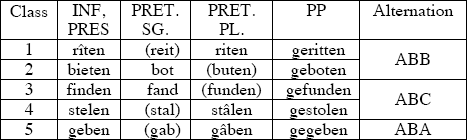
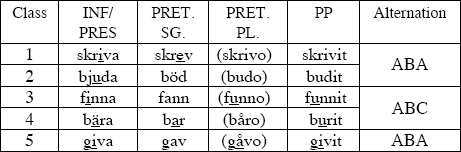
Thus, different alternation types resulted from different leveling directions, as shown by selected examples for each language in tables 2–5.Footnote 2 In Swedish, where the preterite singular forms were generalized throughout (indicated by brackets), for the plural forms the patterns ABA and ABC arose. Both of these patterns—and this is the crucial point—preserve a difference between the preterite and the past participle via ablaut, as shown in table 2 for skriva (see Schmuck 2010).
Grade reduction in Swedish.Footnote 3
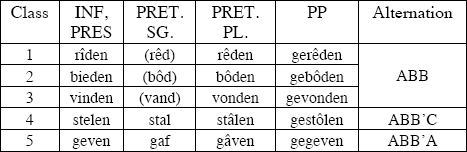
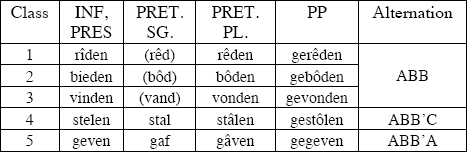
In Dutch, the grade-reduction within the preterite only affected classes 1–3, but not classes 4 and 5, which retain quantitative number ablaut (see table 3). Nevertheless, the generalization of the plural forms in classes 1–3 resulted in the alternation type ABB, that is, the preterite and past participle forms share the same vowel.
Grade reduction in Dutch.Footnote 4
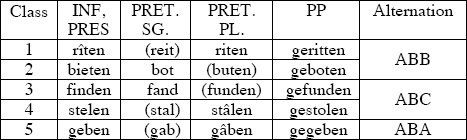
German also strengthened the ABB-type (classes 1, 2), but in the leveling process the patterns ABC (classes 3, 4) and ABA (class 5) emerged as well, as shown in table 4 (see Nübling 1998:188).
Grade reduction in German.
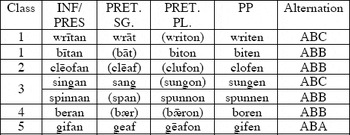
Unlike in Swedish, Dutch, and German, leveling in English was carried out differently within the single ablaut classes, consequently leading to different alternation types within each class (table 5; see Algeo & Pyles 2005:170–176). Thus, some verbs of classes 1 and 3, such as write and sing, generalized their singular forms, while others, such as bite and spin, generalized their plural forms. Verbs from class 2 and 4 mainly reformed their preterites from the past participle. As a result, the alternation types ABB, ABC, and ABA emerged.
Grade reduction in English.

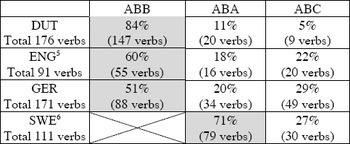
Hence, synchronically we observe the following main differences concerning the alternation types across languages (compare table 6): German, English, and particularly Dutch, strengthened foremost patterns with a common ablaut vowel in the preterite and the past participle (ABB), whereas Swedish lacks this pattern completely. As a specific trait of Dutch, the predominance of ABB results mainly from the extension of the pattern oPRET–oPP (as in trekken–trokk–getrokken) during the leveling process in class 3 (trebling its members from 15% to 45%, see Nowak 2010). The ABB type comprises 51% of German strong verbs (for instance, bieten–bot–geboten ‘bid’), 60% of the ablauting verbs in English (for instance, bear–bore–born), and 84% in Dutch (for instance, binden–bond–gebonden ‘bind’).
Swedish, in contrast, has chiefly strengthened ABA instead (as in skriva–skrev–skrivit ‘write’), accounting for 71% of all strong verbs, and–to a lesser extent–ABC, accounting for 27% (as in springer–sprang–sprungit ‘jump’).
Distribution of the vowel alternation types in Dutch, English, German, and Swedish.Footnote 7

Thus, the main difference between Swedish on the one hand, and Dutch, German, and English on the other, is that Swedish has no ABB alternation type—the type that predominates in the other languages.
3. Inflection Change: Preterite First vs. Past Participle First.
Enger (2010) investigates inflectional class changes in Norwegian and concludes that the change does not affect the entire verb paradigm at once but rather one verb form at a time. Based on our data on the verbal systems, we assume here that the class change proceeds step by step, and address the following questions:
(i) What are the steps?
(ii) Are the steps the same for different languages?
(iii) If the steps are different, what determines the differences in behavior?
We tested the first two points by analyzing historically strong verbs that exhibit weak forms or oscillation between weak and strong forms in part of their paradigm. We did this for the preterite and the past participle forms for all four languages. The main question was whether there were any suspicious gaps in the theoretically possible combinations of nonregularized and regularized forms. Indeed, we found significant gaps for all languages. The existence of verbs with mixed paradigms that contain strong and weak forms in a manner as systematic as this supports the claim that class change of verbs proceeds step by step not only for German and Norwegian (see Bittner 1996, Enger 2010), but also for Dutch, English, and Swedish.
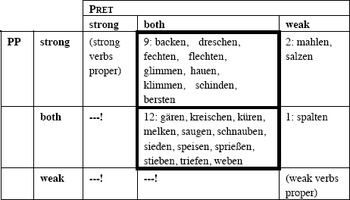
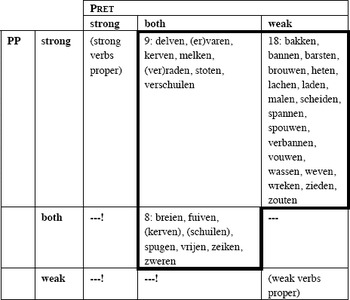
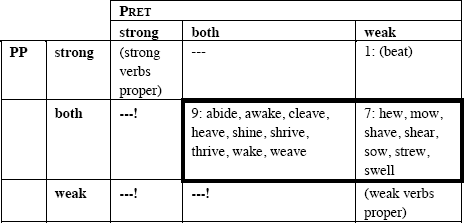
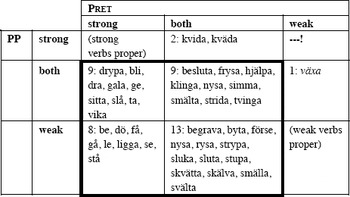
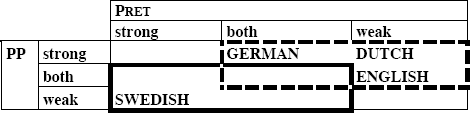
However, the point here is that the gaps we found do not coincide. Swedish behaves remarkably differently from the other three languages. Tables 7–10 show the distribution of mixed paradigms for each language, with black-bordered cells indicating the preferred combination(s) of strong and weak forms. Table 11 contrasts the preferences of the four languages.
German verbs oscillating between strong and weak conjugation.Footnote 8

Dutch strong verbs oscillating between strong and weak conjugation.Footnote 9

English strong verbs oscillating between strong and weak conjugation.Footnote 10
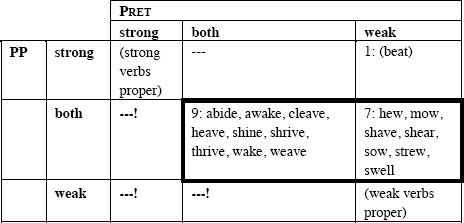
Swedish verbs oscillating between strong and weak conjugation.Footnote 11

Directions of class change in contrast dashed frame: Pret before PP, drawn through frame: PP before Pret.
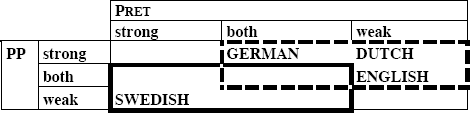
Weakening strong verbs in German, Dutch, and English exhibit weak forms in the preterite rather than in the past participle. Thus, we find German backen–backte–gebacken with a weak preterite and a strong past participle, but not +backen–buk–gebackt with a strong preterite and a weak past participle. This gap holds also for Dutch and English and suggests the order Pret before PP in class change with the past participle as the more stable form.Footnote 12
Weakening strong verbs in Swedish, on the contrary, exhibit weak forms in the past participle rather than in the preterite. We find ligga–låg–legat ‘lie’ with a strong preterite and a weak past participle, but not ligga–+lidde–+legit with a strong past participle and a weak preterite. This suggests the order PP before Pret. Footnote 13 In the next section, we argue for a single factor behind the language-specific differences in ablaut leveling as well as the change towards the weak conjugation. Footnote 14
4. A Functional Approach.
4.1. Aspect.
In addition to the preterite that used to be the general past until the Middle Ages, all four languages have developed a perfect tense out of a resultative construction (have/be+PP). The perfect originally implied perfective meaning, while the preterite typically occurred in all other contexts. However, enormous differences exist regarding the function of the perfect in the Modern Germanic languages.
Initially a resultative, the perfect incrementally increased its functional domain. Starting out as a present tense form, it shifted the focus from the present result to the previous action (see Dentler 1997). Thus, the original present tense form gradually acquired past time meaning and in some languages became a past tense form. In German, followed by Dutch, the grammaticalization process from resultative to perfect and further to general past is most advanced.Footnote 15 The perfect entered the domain of the preterite, retaining only a minimal functional distinction. In oral varieties, the perfect is the preferred past tense. In South German dialects, it even completely took over the function of the preterite (see Dentler 1997 for more references).
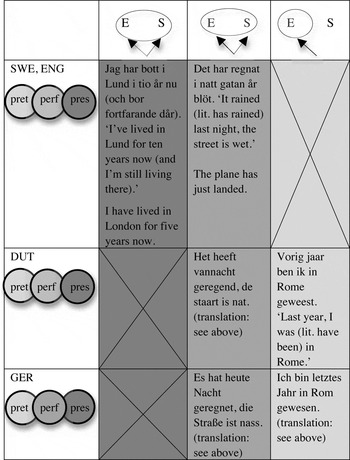
Swedish and English, by contrast, maintained the original aspectual distinction between the two tenses. Here the preterite is still obligatory in several contexts, especially in combination with definite past time adverbials such as Swedish igår, English yesterday (see SAG 4:234–242 §21–24; Rothstein 2005, Biber et al. 1999:6.3.2.3). Figure 1 illustrates the differences in functional extension in detail.
In Swedish, similarly to English, current relevance is the decisive factor for use of perfect: the event time lies in the past, but this event must in all instances be relevant to the moment of speech. Thus, the example Jag har tagit examen 1969 ‘I have taken the exam in 1969’ is ungrammatical in Swedish (and English) though fully acceptable in German and Dutch. However, the same sentence becomes grammatical in Swedish if additional information links the event to the moment of speech, such as så jag har examen enligt det gamla systemet ‘so I have the exam according to the old system’ (see Lindström & Wide 2001). In this respect, English is even more restrictive, and the use of the (present!) perfect is excluded in combination with definite past time adverbials, as in *I have taken the exam in 1969, so I have the exam according to the old system.
According to ANS, there is a tendency in Dutch to use the preterite for durative or iterative events in the past such as vorig jaar fietste opa nog regelmatig ‘last year grandpa still cycled regularly’. The perfect variant vorig jaar heeft opa nog gefietst implies the punctual, perfective reading of een enkele keer ‘only once’ (see ANS:2.4.8.4 ii). However, perfect and preterite are often interchangeable (see ANS:2.4.8.7 i). Thus, in Dutch the perfect is only slightly less grammaticalized than in German. It has not moved through the last stage, that is, it has not acquired the function of general and narrative past—a function quite common for the perfect in spoken (Southern) German (see also Ten Cate 1989). This difference between Dutch and German is illustrated in 1.
- (1)
a.

b.

Functional expansion of the perfect.

As the perfect started out as a resultative and originally had present time reference, it is worth asking if the latter is still available. In Swedish utterances such as Hon har bott i Lund i tio år (see figure 1) which contain the perfect, the moment of speech (and even the future) is included and the present tense form would render the sentence ungrammatical. For German and Dutch, only the present tense is allowed in this context, as in 2a and 3a; otherwise a different reading would be implied, as in 2b and 3b (see Zwart 2008, Ehrich & Vater 1989).Footnote 16
- (2)
a.
b.
- (3)
a.
b.
These examples show that, in losing its present time reference, the perfect in German and Dutch is most advanced on its way towards a clear past tense. Swedish and English differ from German and Dutch in two respects. First, they retain the requirement of current relevance for the perfect. Second, the perfect is still obligatory when referring to ongoing events (as in Jag har bott i Lund i tio år/I've lived in London for 10 years). These differences concerning the functional domain of the perfect and the present tense are illustrated in figure 2 below.
4.2. Category Frequency.
We assume that the aspectual differences between preterite and perfect should be reflected in token frequency ratios of these two categories. For preterite and perfect use in German and English, empirical studies are available. As for German, the perfect is by far the prevailing past tense category, especially in spoken/colloquial language (see, among others, Sieberg 1984, Solms 1984:310f). By contrast, in English the preterite is still much more frequent than the present perfect (see Elsness 2007).
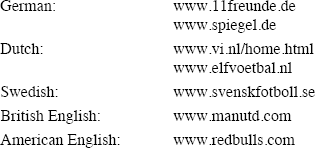
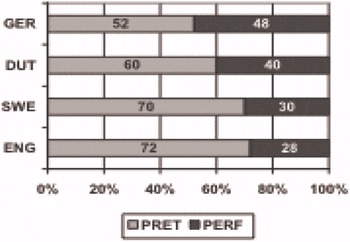
In order to test whether token frequencies also reflect these aspectual differences in Dutch and Swedish, we collected a small sample (approximately 5,000 words for each language) ascertaining the frequency of use of preterite and perfect in the four languages (see figures 3 and 4). To provide a homogeneous database in terms of text type, as well as closeness to oral varieties and survey period, we investigated recorded interviews with native-speaking football players and trainers.
The functional domain of the perfect in German, Dutch, Swedish, and English.

As figure 3 illustrates, preterite and perfect forms are almost equally frequent in German, accounting for 48% and 52%, respectively. In the other three languages, however, the frequency of the preterite forms is higher than that of the perfect forms, at least at first sight: compare 60% versus 40% in Dutch, 70% versus 30% in Swedish, and 72% versus 28% in English.
Frequency of the preterite and perfect (all verbs).

A closer look at the preterite forms in Dutch, and especially German, reveals that the high frequency values of the preterite forms stem mainly from auxiliary verbs in the preterite, such as German sein/Dutch zijn ‘be’, and German haben/Dutch hebben ‘have’. In Dutch, the preterite forms of auxiliaries such as zijn or zullen ‘shall/will’ account for almost 50%, and in German—for 71%. In Swedish and English, in turn, the preterite forms of main verbs (such as say, think) occur slightly more often than those of auxiliaries: 57% versus 43% in Swedish, and 54% versus 46% in English.
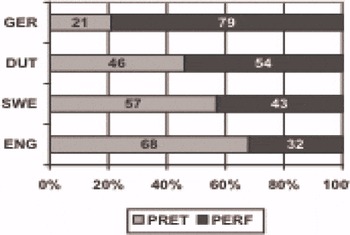
Taking this aspect into account and considering only main verbs, we obtain the ratios presented in figure 4. In the German interviews, the perfect is the predominant past tense category, accounting for 79%. In Dutch, the use of the perfect increases (54%), whereas that of the preterite decreases (46%), albeit less clearly than in German. In Swedish and English, this tendency is not observed at all. The preterite is still the predominant past tense category, with 57% in Swedish and 68% in English.
Frequency of the preterite and perfect (only main verbs).

5. Discussion.
5.1. Unified Explanation for Ablaut Leveling and Class Change.
Category frequency relations are known to be a crucial factor in determining the direction of analogical leveling (see, among others, Bybee 1985, Albright 2008). High frequency of use leads to a high degree of lexical autonomy of forms as it increases their degree of cognitive entrenchment. At the same time, it eliminates their intra-paradigmatic links to other forms of the same paradigm and to parallel forms of other paradigms. This causes token-frequent forms to resist analogical change, while less frequent forms, relying more on intra- and inter-paradigmatic relations, are the first to adopt type-frequent regular patterns.
Swedish has a more prominent aspectual distinction between the preterite and the perfect, which causes higher relative frequency of the preterite forms. This accounts for the different behavior of Swedish. Ablaut leveling in this language always yields a distinct preterite vowel, and strong preterite forms are more resistant to class change than strong past participles.
For German, the expansion of the perfect into preterite domains occurred in the Middle High and Early Modern German periods. Thus, it clearly coincided with ablaut leveling (thirteenth to nineteenth centuries) and, we think, has influenced the direction of leveling towards ABB patterns. Functional expansion leads to an increasing frequency of use, which, in turn, leads to higher cognitive entrenchment compared to the preterite. While in the fourteenth century, the ratio of the perfect compared to the preterite is 39%, by the fifteenth century its use increases to 58% and achieves 75% in the seventeenth century (see Solms 1984). Reconsidering the direction of leveling (see section 2), we notice that whenever one of the preterite vowels (in singular or plural form) is identical to the vowel of the past participle, this vowel is generalized, resulting in an ABB pattern. This holds for ablaut class 1, as in MHG rîten–(reit)–riten–geriten, and 2, as in bieten–bôt–(buten)–geboten. In class 3, the vowel of the preterite singular form prevailed after a long period of oscillation (15th–19th century), resulting in the complex ABC type, as in binden–bant–(bunden)–gebunden. Nevertheless, a general tendency toward identical vowels within the past tenses is observed.
For Dutch, ablaut leveling is morphologically conditioned only in class 3, otherwise it occurs due to phonological change. Unlike in German, in Dutch the preterite plural vowel wins out, following the model of the past participle and yielding ABB. Determining factors—we would suggest—are the increasing frequency of the perfect and the high entrenchment of [o(:)] as past tense marker as a special feature of Dutch strong verbs (see section 2).
In Swedish, the use of perfect is still restricted, and preterite forms, which are more frequent both relative to perfect forms in Swedish and to pretertite forms in German and Dutch, preserve a high degree of entrenchment. As to the direction of leveling, the vowel of the past participle has no influence; quite the contrary, the vowels tend to remain distinct. When we consider ablaut class 3, leveling occurs in favor of the preterite singular, yielding ABC (OSw. binda–bant–(bundu)–bundit); in class 1 and 2, leveling proceeds in the opposite direction from German, resulting not in ABB but in ABA (OSw. skrīva–skrēv–(skrĭvu)–skrĭvit, biūþa–böþ–bŭþu–bŭþit).
Verbs changing class (section 3) follow these tendencies in ablaut leveling. In those languages that prefer ABB patterns (German, Dutch), strong verbs first adopt weak forms in the preterite. This can be ascribed to the same mechanism operating in ablaut leveling. The preterite is a less frequently occurring category than the perfect, and thus, preterite forms are less cognitively entrenched than past participle forms. Hence, weak forms can enter this paradigm slot more easily, just as ablaut is less independent and more prone to leveling in the preterite.
Swedish, however, takes the opposite direction, both in ablaut leveling and in class change. Due to the persistence of the aspectual distinction, the preterite is the better entrenched form. Accordingly, the preterite vowel is not only immune to the influence of the past participle, but the two vowels are formally kept distinct. The same phenomenon underlies class change in Swedish, where strong preterite forms are more resistant to analogical leveling than strong past participle forms. (For similar argumentation based on Norwegian/German data see Enger 2004.)
5.2. English—An Exception to the General Tendency?
English seems to contradict the neat correlation revealed above. Strong verbs show mainly ABB patterns, and in class change the preterite precedes the past participle. Even so, no functional expansion of the perfect can be observed synchronically. However, in case of English, the interaction between different factors must be taken into account. First, in the same period in which number ablaut in English was leveled out (thirteenth to eighteenth centuries), a substantial increase in the use of the perfect is observed as well. This historical perfect expansion reached its summit in the sixteenth to eighteenth centuries, with a ratio of 16.4% in British English and up to 21.7% in American English. Later on, the development was reversed, and the preterite re-established itself in its former domains. By the twentieth century, the ratio of the perfect was reduced to 12.2% in British English, and even more dramatically—to 10.5%—in American English (see Elsness 1997).
Second, due to massive sound change (especially the so-called Great Vowel Shift in the fifteenth century), the whole ablaut system was reshuffled and reorganized during the Middle English period (see Krygier 1994). Not only were the former ablaut classes eroded by analogical changes, but, more importantly, this reorganization led to the integration of a considerable amount of originally weak irregularized verbs (about 30) that imported ABB patterns into the system.Footnote 17 Considering that in Modern English only 91 out of 172 irregular verbs still belong to the strong conjugation, this seems to have been the major factor that possibly explains the predominance of ABB patterns in English.
6. Conclusion.
We have argued that one crucial factor determines both the reorganization of ablaut and the pathways towards the weak conjugation. This factor is the category frequency ratio of preterite versus perfect. A higher category frequency of the preterite relative to the perfect led to a better cognitive entrenchment of the preterite in Swedish, making it more resistant to analogical leveling. By contrast, a higher category frequency of the perfect in relation to the preterite led to a better entrenchment of the preterite in German and Dutch.
The frequency differences, in turn, arise due to a functional factor, namely, the strength of the aspectual distinction between the two tenses. The four languages show different degrees of grammaticalization of the perfect towards a general narrative past tense. If, as in Swedish, a strong aspectual distinction between preterite and perfect is preserved, the preterite has a higher category frequency. If the perfect has developed towards a general past—as in German and Dutch—it is the perfect that is more frequent.
This explains the different behavior of Swedish compared to German and Dutch, namely, the Swedish preference for the pattern ABA in ablaut leveling and the higher stability of Swedish strong preterite forms in class change. German and Dutch provide the mirror image. Here, the functional similarity of perfect and preterite, and the higher relative frequency of the perfect are reflected formally in the preference for ABB patterns and the higher stability of past participle forms with respect to class change. English behaves like German and Dutch with respect to leveling, but it goes along with Swedish as far as the aspectual distinction is concerned. This is mainly due to a former perfect expansion, now obsolete, as well as the disintegration of the former conjugation system through extensive sound change, which led to the integration of a great number of originally weak verbs.
SOURCES