Introduction
Parasitoids in the genus Trichogramma (Hymenoptera: Trichogrammatidae) are important natural enemies of many species of lepidopterous pests and are successfully used in inundative and inoculative biological control program in the world (Hassan, Reference Hassan1993; Smith, Reference Smith1996). Mass rearing of Trichogramma is necessary during the inundative biological control program. Field fitness of Trichogramma wasps is related to the host egg searching and parasitic ability of females. Thus, the study of their mate choice and host discrimination behavior is very crucial for mass rearing and releasing of these parasitoids in biological control program.
Mate finding is influenced by many factors, such as low population densities and their limited ability of dispersal (Hopper & Roush, Reference Hopper and Roush1993; Bellamy & Byrne, Reference Bellamy and Byrne2001). It is known that the chemical cues released by females are important to males in searching for suitable mates (Fauvergue et al., Reference Fauvergue, Hopper and Antolin1995; Bernal & Luck, Reference Bernal and Luck2007). Pompanon et al. (Reference Pompanon, de Schepper, Mourer, Fouillet and Bouletreau1997) studied the substrate-borne pheromone released by Trichogramma brassicae Bezdenko females. This pheromone not only induces T. brassicae male searching in an area where virgin females had walked, but also attracts males from a short distance. Thus it may also increase mating opportunity of virgin females at their emergence sites (Pompanon et al., Reference Pompanon, de Schepper, Mourer, Fouillet and Bouletreau1997). In addition, this pheromone's emission by T. brassicae females is significantly affected by the mating status of females, since the naive males are indifferent to the areas where mated females have walked (Pompanon et al., Reference Pompanon, de Schepper, Mourer, Fouillet and Bouletreau1997). When exposed to conspecific and heterospecific pheromones, Trichogramma semblidis (Aurivillius) males present a clear preference to conspecific pheromones (Dupont et al., Reference Dupont, Allemand and Delpuech2010).
The response of a male to a female is related to his expected benefits and costs (Bonduriansky, Reference Bonduriansky2001). Trichogramma are prospermatogenic species: males have all their spermatozoids mature at emergence and do not produce additional spermatozoids during their adult life (Boivin et al., Reference Boivin, Jacob and Damiens2005; Damiens & Boivin, Reference Damiens and Boivin2005). In order to maximize their expected fertilization success from each mating, males prefer to copulate with the higher quality females, which are associated with high fecundity or low sperm competition intensity (Bonduriansky, Reference Bonduriansky2001). Damiens & Boivin (Reference Damiens and Boivin2006) reported that virgin Trichogramma evanescens Westwood females could store more than 50 sperms when mating first with a virgin male, and when mating with another male after that, the number of sperms contained in the spermathecae is not significantly increased. Thus, for T. evanescens males, selecting the virgin females seems very important for fathering more offspring during their short life span (5.7 days) (Lund, Reference Lund1938).
Host discrimination is a capacity of female parasitoids to distinguish between parasitized and unparasitized hosts, it helps female parasitoids save their eggs and time, and reduce the mortality of their offspring (Bakker et al., Reference Bakker, van Alphen, van Batenburg, van der Hoeven, Nell, van Strien-van Liempt and Turlings1985; Ardeh et al., Reference Ardeh, de Jong and van Lenteren2005). For Trichogramma females, the host egg discrimination capacity is influenced by their oviposition experience: Trichogramma females which had no oviposition experience could not distinguish between parasitized and unparasitized host eggs; however, the experienced females clearly discriminate the parasitized host eggs from the unparasitized ones (Suzuki et al., Reference Suzuki, Tsuji and Sasakawa1984; Miura et al., Reference Miura, Matsuda and Kobayashi1994). Conspecific discrimination behavior means that a female recognizes hosts parasitized by females of the same species, and interspecific discrimination refers to a female ability to distinguish hosts parasitized by females of other species (Mackauer, Reference Mackauer, Mackauer, Ehler and Roland1990). Generally, females could discriminate a previously parasitized host egg because Trichogramma females imprint on their host twice during oviposition, first externally and then internally (Vinson, Reference Vinson1998). And the imprinting that serves as olfactory marks could be perceived by females through antennal drumming and/or ovipositor inserting (Salt, Reference Salt1937; Le Ralec & Wajnberg, Reference Le Ralec and Wajnberg1990).
Trichogramma chilonis Ishii (Hymenoptera: Trichogrammatidae) has been used for controlling several lepidopterous pests on corn, cotton, rice and vegetables (Wührer & Hassan, Reference Wührer and Hassan1993; Chang et al., Reference Chang, Hu, Hsin and Sun2001; Ballal et al., Reference Ballal, Srinivasan and Jalali2009; Preetha et al., Reference Preetha, Stanley, Suresh, Kuttalam and Samiyappan2009). Trichogrammatoidea bactrae Nagaraja (Hymenoptera: Trichogrammatidae) is an important natural enemy of diamondback moth, Plutella xylostella (L.) (Wührer & Hassan, Reference Wührer and Hassan1993; Vasquez et al., Reference Vasquez, Shelton, Hoffmann and Roush1997). Huang et al. (Reference Huang, Chen and Shen2002) have investigated the population dynamics of T. chilonis (= Trichogramma confusum Viggiani) and T. bactrae in the same field in Shenzhen (China) from 15 September 1999 to 15 March 2000, reported that both of these two species could parasitize the eggs of diamondback moth, and the population of T. chilonis is always significant larger than T. bactrae during the investigation period. In addition, these two Trichogramma species used in our experiments were collected from the parasitized diamondback moth egg masses from the same location. Therefore, it is highly likely that T. chilonis males have the opportunity to encounter both T. chilonis and T. bactrae females at the emergence site. However, whether T. chilonis males rely on female sex pheromone for locating mates is unclear. The relationship between female species and mating status and male mate choice in T. chilonis is also unknown. In addition, host eggs which were parasitized by T. bactrae females may be encountered by T. chilonis females. There have been some studies on the oviposition behavior (Suzuki et al., Reference Suzuki, Tsuji and Sasakawa1984; Mills & Kuhlmann, Reference Mills and Kuhlmann2004) and host egg discrimination (Miura et al., Reference Miura, Matsuda and Kobayashi1994; Delpuech & Leger, Reference Delpuech and Leger2011; Delpuech & Delahaye, Reference Delpuech and Delahaye2013) of Trichogramma species. However, there is no report on the interspecific host egg discrimination in T. chilonis.
The objectives of this study were to investigate: (1) whether T. chilonis males rely on female sex pheromone for locating mates; (2) mate choice behavior of T. chilonis males; and (3) host egg discrimination behavior of T. chilonis females.
Materials and methods
Insects
T. chilonis and T. bactrae populations originated from parasitized diamondback moth egg masses (about 200 eggs) collected in April 2009 from cabbage (Brassica oleracea L.) fields near Guangzhou, China. The stock populations were reared on eggs of Corcyra cephalonica (Stainton) (Lepidoptera: Pyralidae) at 25 ± 1°C, 80 ± 5% relative humidity (RH) and a 14:10 (L:D) photoperiod in the laboratory, except some of T. chilonis which used in male mate choice experiment were reared at 18 ± 1°C, 80 ± 5% RH and a 14:10 (L:D) photoperiod. C. cephalonica was reared following the procedure described in Wang et al. (Reference Wang, He, Guo and Luo2012). Eggs of C. cephalonica were collected daily, and were stored at 4°C. The host eggs were killed by UV radiation before parasitoids rearing and experiments. Adults of T. chilonis and T. bactrae were fed with 25% honey–water solution.
To obtain virgin T. chilonis and T. bactrae adults, parasitized C. cephalonica eggs were placed individually in glass vials (10 mm internal diameter, 55 mm internal height; one egg per vial) the day before emergence. After emergence, males and females were sexed and fed with 25% honey–water solution before experiment. Parasitoids used in all experiments were less than 24 h old. All experiments were carried out at 25 ± 1°C, 60 ± 5% RH from 12:00 to 18:00 h and experimental arenas were lighted with a circular LED lamp (400 lux, Micro-shot Technology Ltd., Guangzhou, China) in the laboratory.
Sex pheromone perception by males
Perception of sex pheromone by T. chilonis males was recorded following the approach by Dupont et al. (Reference Dupont, Allemand and Delpuech2010). Cylindrical arena (30 mm diameter, 1 mm height) that was made by drilling a 30 mm diameter hole on a Plexiglas sheet (50 × 50 × 1 mm3) was used as experimental arena. Both of its top and bottom were covered with glass sheets. Each arena was divided into two equal parts by a silicon bar (chemically inert). Two females of same age (a virgin T. chilonis female and a virgin T. bactrae female; or a virgin and a mated T. chilonis female) were introduced into each arena (one female per half of the arena). The mated females were obtained 1 h before experiment. Each female was allowed to walk on half of the arena for 5 min to ensure the pheromone marking of the entire half of the arena (Delpuech et al., Reference Delpuech, Gareau, Terrier and Fouillet1998; Dupont et al., Reference Dupont, Allemand and Delpuech2010). Then, both females and the silicon bar were removed. A virgin male was introduced into each arena by a glass sheet, and its walking path during 5 min was recorded with a digital camera (Model CANON G10, Canon Inc., Tokyo, Japan). Each treatment was repeated 29 or 30 times. The positions of two halves of the arena which were marked by female pheromone were switched after each observation. Time spent by male on each half of the arena was calculated.
Male mate choice
To determine whether male T. chilonis discriminate between females of different species or mating status, glass vials (10 mm internal diameter, 55 mm internal height; closed with cotton balls) were used as experimental arenas. Two experiments were carried out: in experiment 1, a virgin male was placed with a virgin T. chilonis female and a virgin T. bactrae female; in experiment 2, a virgin male was placed with a virgin T. chilonis female and a mated T. chilonis female. Females were introduced first in a random order, and then a male was introduced right after. Observation started as soon as the male was introduced in the glass vial and ended after the first mating happened, or after 10 min if no mating occurred. The mated females were obtained 1 h before experiment by holding a virgin female with a virgin male in a glass vial until copulation was observed. Each female combination was replicated 50 times.
T. chilonis females have different morphological characteristics when they are reared at different temperatures: females reared at 15–20°C have brown metascutellum; however, the ones reared at 25°C have their abdomens in brown, and there is a dull yellow transverse region on the abdomen (Lin, Reference Lin1994). In experiment 1, the parasitoids were reared (rearing method was same as above) at two different conditions in the laboratory, one part of them at 25 ± 1°C, 80 ± 5% RH and a 14:10 (L:D) photoperiod, the other part of them at 18 ± 1°C, 80 ± 5% RH and a 14:10 (L:D) photoperiod. And we could identify them easily with the naked eye during study: the ones reared at 18 ± 1°C were darker than the ones reared at 25 ± 1°C. The mating status of these two kinds of T. chilonis females were distributed randomly. Our preliminary experiment indicated that females mating behavior were not affected by their colors. T. bactrae females can be distinguished easily from T. chilonis females with the naked eye: the former were darker than the latter, both of them were reared at 25 ± 1°C, 80 ± 5% RH and a 14:10 (L:D) photoperiod.
Host egg discrimination
The host (C. cephalonica) egg discrimination ability by experienced and inexperienced T. chilonis females was tested separately in this experiment. Females used in this experiment were fertilized. Each ‘Experienced’ T. chilonis female had one oviposition experience on a host egg 1 h earlier. ‘Inexperienced’ females had no prior experience of oviposition on host eggs. An egg sheet was provided to each T. chilonis female. On each sheet, two groups of six eggs were glued onto cardboard strip. Eggs with the same parasitic status (unparasitized or parasitized by the same species of parasitoids) were glued next to each other (glued in the same group). The two groups of host eggs which have different parasitic status were approximately 1 mm apart. Within each group, each two adjacent eggs were also approximately 1 mm apart (fig. 1). Three different combinations of eggs were used: (1) six unparasitized eggs and six eggs parasitized by T. chilonis; (2) six unparasitized eggs and six eggs parasitized by T. bactrae; (3) six eggs parasitized by T. chilonis and six eggs parasitized by T. bactrae. Both the parasitized and unparasitized eggs were the same age (48 h after being laid by C. cephalonica). The first two combinations were replicated 20 times. The third combination was replicated 12 times. The positions of two groups of eggs in experimental arena were switched after each observation. The parasitized host eggs were obtained before the experiment by leaving about 400 C. cephalonica eggs with 100 T. chilonis or T. bactrae females in a glass tube (23 mm internal diameter, 74 mm internal height) for 12 h until the use of eggs for the experiment (preliminary experiments showed that the percentage of host eggs’ parasitism by T. chilonis and T. bactrae were 71.2 and 87.7%, respectively).
The mode of host eggs arrangement. Each oval indicates a host egg. Different colors (black and white) denote the different parasitic status of host eggs.

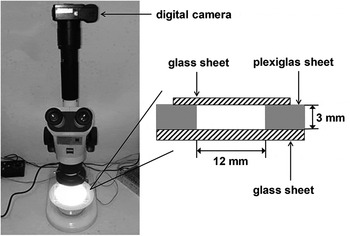
The cylindrical arena (12 mm diameter and 3 mm height) was used as experimental arena. Both the top and bottom were covered with glass sheets (fig. 2). For our experiment, the egg sheet was placed in the center of the experimental arena, and then a mated female (experienced or inexperienced) was introduced by a piece of glass sheet. The female's behavior was immediately video-recorded for 15 min. In this experiment, the digital camera used for recording female's behavior was connected to a dissecting microscope (Zeiss Stemi 2000-CS, Shanghai, China) (fig. 2). Antennal rejection was recorded when a female encountered a host egg, examined its surface with her antennae and moved to another host without parasitizing it. Ovipositor rejection was recorded when a female drilled a host egg but left without laying an egg (Delpuech & Leger, Reference Delpuech and Leger2011; Delpuech & Delahaye, Reference Delpuech and Delahaye2013).
Side view of the experimental arena and digital camera used in the experiment of host egg discrimination.

Statistical analysis
The male mate choice data were compared using chi-square (χ2) test. Paired samples t-test were used to analyze the percentage of time spent by T. chilonis males on either half of the arena in the sex pheromone perception experiments, and the percentage of time spent by T. chilonis females on parasitized and unparasitized host eggs. Wilcoxon signed-rank test was used to compare the T. chilonis female choice (percentage of host eggs parasitized) between parasitized and unparasitized host eggs, and the difference between antennal and ovipositor rejection by T. chilonis females on parasitized host eggs.
In the host egg discrimination experiments, the difference between experienced and inexperienced T. chilonis females in measured variables were compared using independent samples t-test for analyzing the percentage of time spent on parasitized or unparasitized host eggs, and Mann–Whitney U test for analyzing the differences in the percentage of host eggs parasitized by experienced and inexperienced wasps, and the antennal or ovipositor rejection on parasitized host eggs. All statistical analyses were conducted using SPSS version 13.0 (SPSS, Chicago, IL, USA).
Results
Sex pheromone perception by males
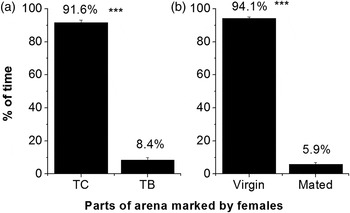
In the first experiment, T. chilonis males spent significantly more time on the half of the arena marked by conspecific females than the half marked by T. bactrae females (t = 28.3, df = 29, P < 0.001) (fig. 3a). In the second experiment, T. chilonis males spent significantly more time on the half marked by virgin T. chilonis females than the half marked by mated T. chilonis females (t = 43.2, df = 29, P < 0.001) (fig. 3b).
Mean percentages (±SE) of time spent by Trichogramma chilonis males on part of the arena marked by sex pheromone from females. (a) Arena marked by virgin T. chilonis female (TC) and virgin T. bactrae female (TB); (b) arena marked by virgin T. chilonis female and mated T. chilonis female.

Male mate choice
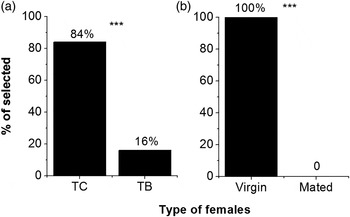
When exposed to virgin females of two different species, T. chilonis males significantly preferred conspecific females to heterospecific females (χ2 = 23.1, df = 1, P < 0.001) (fig. 4a). When exposed to two T. chilonis females of different mating status, all of the T. chilonis males chose to mate with the virgin female (fig. 4b).
Percentage of females chosen by Trichogramma chilonis males. (a) Virgin T. chilonis female (TC) and virgin T. bactrae female (TB). (b) virgin T. chilonis female and mated T. chilonis female.

Host egg discrimination
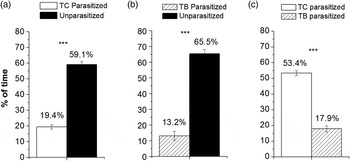
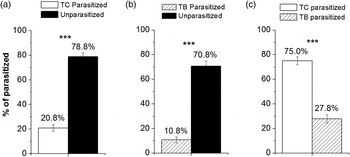
There are no significant differences between experienced and inexperienced females in all measured variables (mean time spent and number of eggs parasitized by T. chilonis females on each group of host eggs, and antennal and ovipositor rejection rate by T. chilonis females on parasitized host eggs; all P > 0.05); thus the results of experienced and inexperienced females were combined. T. chilonis females spent significantly more time (t = −13.0, df = 39, P < 0.001, fig. 5a; t = −9.9, df = 39, P < 0.001, fig. 5b) and parasitized more eggs (Z = −5.4, P < 0.001, fig. 6a; Z = −5.3, P < 0.001, fig. 6b) on unparasitized host eggs than on parasitized ones regardless of the host eggs combinations. When exposed to the two groups of parasitized host eggs, females significantly preferred to stay on (t = 11.6, df = 23, P < 0.001, fig. 5c) and parasitize (Z = −4.1, P < 0.001, fig. 6c) the host eggs which have been parasitized by their conspecific females.
Mean percentage (±SE) of time spent by Trichogramma chilonis females on each group of host eggs. Host eggs combinations are: (a) six T. chilonis (TC) parasitized and six unparasitized; (b) six T. bactrae (TB) parasitized and six unparasitized; (c) six T. chilonis (TC) parasitized and six T. bactrae (TB) parasitized.

Mean percentage (±SE) of eggs parasitized by Trichogramma chilonis females on each group of host eggs. Host eggs combinations are: (a) six T. chilonis (TC) parasitized and six unparasitized; (b) six T. bactrae (TB) parasitized and six unparasitized; (c) six T. chilonis (TC) parasitized and six T. bactrae (TB) parasitized.

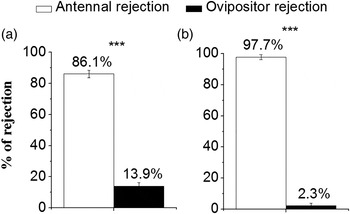
T. chilonis females made significantly more antennal rejections than ovipositor rejections on the parasitized host eggs (Z = −5.0, P < 0.001, fig. 7a; Z = −4.7, P < 0.001, fig. 7b).
Mean percentage (±SE) of antennal and ovipositor rejection by Trichogramma chilonis females on parasitized host eggs. (a) T. chilonis parasitized, n = 34; (b) T. bactrae parasitized, n = 24.

Discussion
Sex pheromones are usually used by male insects to locate and select females (Bonduriansky, Reference Bonduriansky2001). In our studies, T. chilonis males tend to restrict their walking in the area where their conspecific females or virgin females have been walking. Dupont et al. (Reference Dupont, Allemand and Delpuech2010) confirmed that pheromone specificity exists between T. semblidis and T. evanescens: males of each species tend to walk on the part of the arena visited by their conspecific females. In Aphidius ervi Haliday (McClure et al., Reference McClure, Whistlecraft and McNeil2007) and Trichogramma turkestanica Meyer (Martel et al., Reference Martel, Damiens and Boivin2008), males strongly discriminate between virgin and mated females. This phenomenon is due to a post-mating decrease of the sex pheromone, as observed for other parasitoids (McNeil & Brodeur, Reference McNeil and Brodeur1995; Pompanon et al., Reference Pompanon, de Schepper, Mourer, Fouillet and Bouletreau1997). In Trichogramma, sex pheromones are released by females (Pompanon et al., Reference Pompanon, de Schepper, Mourer, Fouillet and Bouletreau1997). They are composed of two putative compounds in T. turkestanica (Van Beek et al., Reference Van Beek, Silva, Posthumus and Melo2005). In T. chilonis, the composition of its sex pheromone is still unknown and needs to be further studied.
To maximize the fertilization success during each mating, T. chilonis males preferred to copulate with conspecific and virgin females. Interspecific mating decreases the fecundity of females and makes males suffer an important loss of time and fertilization opportunity (Stouthamer et al., Reference Stouthamer, Jochemsen, Platner and Pinto2000; Delpuech et al., Reference Delpuech, Dupont and Allemand2010). Although females which copulate with males from a close relative species could be inseminated and use the sperm to fertilize their eggs, the fertilized eggs would not survive (Stouthamer et al., Reference Stouthamer, Jochemsen, Platner and Pinto2000; Delpuech et al., Reference Delpuech, Dupont and Allemand2010). Copulating with a virgin female could father more progeny during the female's first bout of oviposition (Polak et al., Reference Polak, Wolf, Starmer and Barker2001). Thus, it would be detrimental for males to copulate with mated females, since the number of offspring fathered by non-discriminating males would be reduced (Simmons & Siva-Jothy, Reference Simmons, Siva-Jothy, Birkhead and Mǿller1998; Damiens & Boivin, Reference Damiens and Boivin2006). In our experiment, the mated T. chilonis females were obtained 1 h before the experiment. However, the mated females would be varying in their post-mating durations in the field. It is regretful that mated T. chilonis females with different post-mating duration were not studied in male mate choice experiment. In our recent experiment examining male mate choice in the common bed bug, Cimex lectularius L. (Hemiptera: Cimicidae), we found the virgin males could discriminate between virgin females and females mated 1 h, 1 or 3 days earlier; however, they could not discriminate between virgin females and females mated 7 days earlier (Wang et al., unpublished data). Therefore, whether the different post-mating duration affects male mate choice behavior in T. chilonis need to be further studied. In our experiment, copulation was the only measurement of male mate choice. However, Martel & Boivin (Reference Martel and Boivin2011) reported that other factors, such as female rejection and mate competition also affect male's mate selection. Thus, whether these factors affect male mate choice behavior should be further studied.
Recognition of unparasitized hosts from the parasitized ones is an important ability of parasitoid females. It allows parasitoid to avoid involuntary superparasitism. Suzuki et al. (Reference Suzuki, Tsuji and Sasakawa1984) reported that inexperienced T. chilonis females cannot discriminate unparasitized Papilio xuthus L. eggs from the parasitized ones. In our study, both experienced and inexperienced T. chilonis females preferred to spend time on and oviposit in the unparasitized host eggs. However, the ‘inexperienced females’ used in our study were not the real inexperienced ones. In our study, each inexperienced female was supplied twelve host eggs (six unparasitized and six parasitized eggs, or 12 parasitized eggs); in this way if the first oviposition happened, the inexperienced females would become the experienced ones. Thus, no significant difference of host discrimination behavior between experienced females and the ‘inexperienced’ ones. In our experiment, the parasitized host eggs were obtained 0–12 h before experiment; however, in the field, the parasitized eggs would be in any conditions (with different post-parasitization duration) when they were encountered by parasitoids. The time of the previous oviposition (post-parasitization duration) plays an important role in the success of the second oviposition (superparasitism). If both eggs were laid ‘simultaneously’, both of them would have the equal chances to survival. Miura et al. (Reference Miura, Matsuda and Kobayashi1994) reported that the survival rate of offspring laid by a second female T. chilonis in the host egg within 10 min is almost equal as that the first female. As time passed, eggs laid by the previous females would have developed, the response of T. chilonis females to the parasitized eggs would be likely to gradual change. Tena et al. (Reference Tena, Kapranas, Garcia-Marí and Luck2008) reported that Metaphycus flavus (Howard) females often oviposit on parasitized hosts after killing some eggs and larvae laid by themselves or others when they superparasitized. However, whether this infanticide behavior existed in T. chilonis is still unclear. The effect of post-parasitization duration on female host discrimination behavior in T. chilonis should be further studied. In addition, Miura et al. (Reference Miura, Matsuda and Kobayashi1994) reported that female host discrimination of T. chilonis is time-dependent, with greater acceptance of parasitized eggs after 24 h of no exposure to host eggs. In our experiment, we only studied the host discrimination of experienced females after 1 h of no exposure to host eggs. Thus, further studies should be carried out on the host discrimination behavior of experienced females with different post-oviposition duration.
When the T. chilonis females had a choice between host eggs parasitized by conspecific females and eggs parasitized by heterospecific parasitoids (T. bactrae), they preferred to stay on and oviposit in the host eggs which were parasitized by conspecific females. This interspecific host discrimination behavior was rarely observed (Bakker et al., Reference Bakker, van Alphen, van Batenburg, van der Hoeven, Nell, van Strien-van Liempt and Turlings1985; Van Baaren et al., Reference Van Baaren, Boivin and Nénon1994). It has been found mostly when one of the species has a marked competitive advantage (McBrien & Mackauer, Reference McBrien and Mackauer1991; Scholz & Höller, Reference Scholz and Höller1992). In our experiment, we only studied the host discrimination behavior of T. chilonis. The host discrimination behavior of T. bactrae was not researched, thus whether T. bactrae had a competitive advantage over T. chilonis was unclear. Our preliminary experiment indicated that only one T. chilonis adult could successfully emerge from a C. cephalonica egg; therefore, this conspecific superparasitization of T. chilonis would be harmful to their offspring's development. However, this superparasitism could have selective advantages under specific circumstances, such as when the number of unparasitized host eggs is limited, and if the offspring of the second female has high chances of winning the competition against the first larva (Bakker et al., Reference Bakker, van Alphen, van Batenburg, van der Hoeven, Nell, van Strien-van Liempt and Turlings1985). In addition, when a parasitoid finds an egg patch in which most eggs have been parasitized, it might be more favorable for the parasitoid to superparasitize on the parasitized eggs than to leave the egg patch and search for unparasitized host eggs (Bakker et al., Reference Bakker, van Alphen, van Batenburg, van der Hoeven, Nell, van Strien-van Liempt and Turlings1985).
In the host discrimination experiment, we could not assess the reliability of the parasitization of all the hosts prior to the recording of the oviposition behavior of T. chilonis. Since 71.2 and 87.7% of hosts are usually parasitized by T. chilonis and T. bactrae through our procedure, it is safe to say that the majority of eggs identified as parasitized were indeed parasitized. Since a lesser degree of parasitism of the ‘parasitized eggs’ would have led to a higher acceptance by the test female, our results confirm that this methodological limitation was not problematic.
Trichogramma females can perceive the host marking pheromone deposited on the host egg surface with their antennae (Salt, Reference Salt1937). They can also detect the pheromone inside the host eggs by their ovipositor (Le Ralec & Wajnberg, Reference Le Ralec and Wajnberg1990). Our results showed that T. chilonis females made significantly more antennal rejections than ovipositor rejections on the parasitized host eggs. Thus, its host discrimination ability was mainly achieved by antennal perception. However, whether the egg rejection pattern of T. chilonis females would be affected by their post-oviposition duration and host eggs’ post-parasitisation duration should be further studied.
In summary, we found T. chilonis males could discriminate their mates accurately, and it was related to their ability to perceive sex pheromone. For T. chilonis females, they mainly used their antennae to detect the condition of host eggs. These behavior studies were necessary for mass rearing and releasing of T. chilonis in biological control program. However, in order to maximize the success of inundative release of T. chilonis in the field, many further studies should be carried out. Under field conditions, many factors such as ambient temperature, humidity and insecticide residues can influence the oviposition behavior and parasitic ability of Trichogramma (Delpuech & Leger, Reference Delpuech and Leger2011; Wang et al., Reference Wang, He, Guo and Luo2012; Delpuech & Delahaye, Reference Delpuech and Delahaye2013; Wang et al., Reference Wang, He, Zhang, Nian, Lin and Zhao2014). Therefore, further investigations evaluating the effects of environmental factors on the mate choice and host discrimination behavior of T. chilonis would be beneficial for biological control programs using Trichogramma species.
Acknowledgements
We thank Dr Changlu Wang (Rutgers University, USA) for help in preparing the manuscript. This research was supported by National Basic Research Program of China (973 Project, 2013CB127604), Special Fund for Agro-scientific Research in the Public Interest of China (grant no. 201103021) and State Scholarship Fund of China.