I. INTRODUCTION
In recent years, many amorphous and nanocrystalline soft magnetic alloys have been developed for a wide range of applications, which include power transformers, magnetic shielding, electric motors, magnetic field sensors, etc. Reference McHenry, Willard and Laughlin1–Reference Emsley7 In the synthesis of these alloys, early transition metals (e.g., Nb, Ta, and Hf) and glass formers (e.g., B, Si, and Al) are used to improve glass formability and prevent overgrowth of the grains. Reference McHenry, Johnson, Okumura, Ohkubo, Hsiao, Ramanan and Laughlin8–Reference McHenry and Laughlin12 However, precursors such as B, Nb, Ta, and Hf are expensive and make up for more than 70% of the total alloy cost despite their low concentrations. Reference Kopcewicz, Grabias, Latuch and Kowalczyk13–Reference Kopcewicz, Grabias and Latuch15 Attempts to reduce the alloy cost include the development of B-free alloys and substitution of B with B4C.
Previously, Long et al. reported on the development and studies of structural and soft magnetic properties of a B-free Fe-based alloy. Reference Long, Laughlin and McHenry16 In his work, Si and Zr were used as growth inhibitors to result in soft magnetic alloy with ∼10 grain size and 19 W/kg power loss, comparable with the typical power loss of FINEMET alloys. Kopcewicz et al. have also studied this B-free system. Reference Kopcewicz, Grabias, Latuch and Kowalczyk13,Reference Kopcewicz, Grabias and Latuch15 In his report, x-ray diffraction and Moessbauer spectroscopy measurements were used to reveal the amorphous structure of the melt-spun soft magnetic ribbons. Okumura et al. and Zabransky and Jiraskova have explored the idea of substituting B with the significantly cheaper Si and studied the structural and soft magnetic properties of Si-rich FINEMET alloys. Reference Okumura, Laughlin and McHenry17,Reference Zabransky and Jiraskova18 Ramanan and Fish and Donald and Davies investigated the substitution of B with other metalloids and its effects on the onset of crystallization of the materials. Reference Ramanan and Fish19,Reference Donald and Davies20 Kurniawan et al. studied the effect of substitution of B with B4C on the soft magnetic properties of Co-based alloys. Reference Kurniawan, Keylin and McHenry21 While the soft magnetic properties of these B and B4C containing alloys were found to be comparable, the cost reduction was found to be as high as 60%. Chen et al. investigated the magnetic properties of Nd–Fe–B permanent magnets synthesized using B4C precursor, while Sui et al. and Kou et al. studied the effect of C substitution for B in these systems. Reference Chen, Liu, Geng, Zhao and Zhang22–Reference Kou, Sun, Chuang, Grossinger and Kirchmayr25
Another two very expensive precursors are Ta and Hf. Similar to Nb, both Ta and Hf are normally used in soft magnetic nanocomposites as growth inhibitors. Work on Ta- and Hf-containing nanocrystalline FeCo has been reported by Lucas et al. Reference Lucas, Bourne, Sheets, Brunke, Alexander, Shank, Michel, Semiatin, Horwath and Turgut11 It was observed that these alloys exhibit high resistivity, which results in lower power loss. This finding is particularly promising from the standpoint of high frequency switching applications. Other works on Ta- and Hf-containing alloys include a study on thermal stability of nanocrystalline FeCoHfBCu alloys by Iwanabe et al. and a report on the magnetic properties of FeCoNbTaMoB alloy by Um and McHenry Reference Iwanabe, McHenry, Lu and Laughlin9,Reference Um and McHenry26 The high price of Ta and Hf, however, is a bottleneck that hinders their widespread uses in low cost soft magnetic alloys. 27,28
In this work, we report a study of the effects of substituting Ta and Hf with TaC and HfC, respectively, in Fe-based FINEMET and Co-based HTX005 alloys on their soft magnetic properties. The rationale behind this strategy lies on the significantly lower price of TaC and HfC. Thus, we expect a substantial cost reduction resulting from this synthesis route. Coercivity (H c), permeability (μ), power loss (P loss), and saturation magnetization (B s) of these Fe-based and Co-based alloys will be compared. We will also perform thermal annealing on the Fe-based FINEMET alloys and compare the resulting soft magnetic properties with those of the as-cast counterparts. The effects of strain annealing on the Co-based HTX005 alloys will also be investigated. Lastly, a cost analysis on the Fe-based FINEMET and Co-based HTX005 alloys and the resulting cost reduction upon TaC and HfC substitution will be discussed.
II. EXPERIMENTAL DESIGN AND MEASUREMENT
All the soft magnetic ribbons investigated in this work were prepared by melt spinning method using an Edmund Buhler SC Melt Spinner. For all the alloys, 10 g of ingots were prepared by using Edmund Buhler Arc Melter. Details on the synthesis procedure and background theory behind rapid solidification can be found in the literature. Reference McHenry, Willard and Laughlin1,Reference Willard and Daniil3,Reference Kear, Giessen and Cohen29–Reference Fish31 The widths and thicknesses of these soft magnetic ribbons were 1–2 mm and 20–30 μm, respectively. All the melt-spun ribbons have excellent ductility and production yield. Saturation magnetization (B s) and Curie temperature (T C) were measured using a Quantum Design Physical Property Measurement System (PPMS). T C measurement was performed on annealed (FINEMET) and strain annealed (HTX005) alloys. A Walker LDJ Scientific Permeameter was used to measure soft magnetic properties (e.g., H c, μ, and P loss). For soft magnetic properties measurement on FINEMET, 0.5–1 g of soft magnetic ribbons were placed in homemade toroidal core boxes of height, inner and outer diameter of 1, 2 and 2.2 mm, respectively. High purity copper magnet wire was used for primary and secondary windings in these core boxes. 10 cm of HTX005 ribbons were used in low frequency soft magnetic properties measurement using a Walker LDJ Scientific Permeameter. Our homemade strain annealing setup is capable of producing 10 cm of strain annealed ribbon in a single run. With this amount of sample, low frequency permeametry on a flat ribbon (10 cm length) provides more accurate soft magnetic properties than that using a toroidal core box. Crystallization temperature (T x) was obtained from differential scanning calorimetry (DSC) measurement using a PerkinElmer DSC8500 (Waltham, MA) with a heating rate of 20 °C/min. For this measurement, ∼10 mg of ribbon cut into small disks of 5 mm diameter was used.
For both FINEMET and HTX005 alloys studied here, TaC and HfC substituted Ta and Hf, respectively, with an equal mass. Due to only slight differences in molar mass of the pure elements (Ta and Hf) and their carbide counterparts (TaC and HfC), the stoichiometry of the alloys is nearly identical. The procedure for the substitution is the same as that used in prior publication by Kurniawan et al. Reference Kurniawan, Keylin and McHenry21 All FINEMET soft magnetic ribbons were annealed in Argon atmosphere for 15 min at 540 °C, while all HTX005 ribbons were strain annealed in air for 1 hr at 515 °C with an applied strain of 100 MPa. A Thermolyne 21,100 tube furnace was used for heating purpose in both thermal and strain annealing. The prices of the elements and compounds were obtained from www.metalprices.com, www.metal-pages.com, www.ferro-alloys.com and www.alibaba.com. 27,28,32,33 We also take into account the molar mass, purity, and concentration of the precursors in our cost analysis.
III. RESULTS AND DISCUSSION
FINEMET was selected as a Fe-based soft magnetic alloy in this work due to a large number of prior works on this system. Reference McHenry, Willard and Laughlin1,Reference Willard and Daniil3,Reference McHenry, Johnson, Okumura, Ohkubo, Hsiao, Ramanan and Laughlin8,Reference Okumura, Laughlin and McHenry17,Reference Zabransky and Jiraskova18,Reference Um, Johnson, Simone, Barrow and McHenry34–Reference Butvinova, Butvin, Illekova, Svec, Vlasak, Janickovic and Kadlecikova36 The chemical compositions of Fe-based FINEMET-Ta, FINEMET-TaC, FINEMET-Hf, and FINEMET-HfC are Fe71.1Ta3B6.3Si18.5Cu1.1, Fe71.2(TaC)2.8B6.3Si18.6Cu1.1, Fe71.1Hf3B6.3Si18.5Cu1.1, and Fe71.2(HfC)2.8B6.3Si18.6Cu1.1, respectively. Table I summarizes the soft magnetic properties of the as-cast and thermal annealed FINEMET alloys. We observed that the H c, μ, P loss, and B s of all the as-cast FINEMET alloys were comparable and in the same order of magnitude.
Below is a summary of soft magnetic properties of As-cast and thermal annealed FINEMET-Ta, FINEMET-TaC, FINEMET-Hf, and FINEMET-HfC. H max, H c, μ, and P loss were measured using a Walker LDJ Scientific Permeameter at f = 100 kHz and B max = 1 kG. B s was measured using a Quantum Design PPMS at room temperature with an applied field of 5000 Oe.

All the FINEMET alloys show significant changes in their soft magnetic properties upon thermal annealing in Ar atmosphere for 15 min at 540 °C. Compared to their as-cast counterparts, the annealed FINEMET alloys show decrease in H c and P loss, while μ increases significantly, especially in FINEMET-Ta and FINEMET-Hf alloys. It is noteworthy to mention that upon thermal annealing, FINEMET-Ta and FINEMET-Hf generally exhibit better soft magnetic properties than FINEMET-TaC and FINEMET-HfC. These changes reveal magnetic softening of all FINEMET alloys upon thermal annealing, which agrees with previous works by Varga et al., Talaat et al., and Gam et al. Reference Varga, Bakos, Kisdi-Koszd, Zsoldos and Kiss37–Reference Talaat, Ipatov, Zhukova, Blanco, Churyukanova, Kaloshkin and Zhukov39 The significantly lower P loss in all the thermal annealed FINEMET alloys also shows a great promise for high frequency switching applications where reduction in heat loss is beneficial. Reference Leary, Ohodnicki and McHenry2,Reference Yoshizawa and Yamauchi40–Reference Rhen and Roy43
HTX005 was developed by McHenry et al. and shown to have tunable magnetic anisotropy by strain annealing. Reference Leary, Ohodnicki, Mchenry, Keylin, Huth and Kernion44–Reference Chaturvedi, Laurita, Leary, Phan, McHenry and Srikanth48 The applicability of strain annealing technique to induce giant magnetic anisotropy on Co-based alloys has also been reported by Kernion et al. Reference Kernion, Ohodnicki, Grossmann, Leary, Shen, Keylin, Huth, Horwath, Lucas and McHenry49 Several other works have also explored how the tensile stress affects the soft magnetic properties of the materials. Reference Iturriza, Nazmunnahar, Dominguez, González and del Val50–Reference Herzer, Budinsky and Polak54 The chemical compositions of Co-based HTX005-Ta, HTX005-TaC, HTX005-Hf, and HTX005-HfC are Co73.6Mn3.2Fe3.2Ta4B14Si2, Co73.8Mn3.2Fe3.2(TaC)3.8B14Si2, Co73.6Mn3.2Fe3.2Hf4B14Si2, and Co73.8Mn3.2Fe3.2(HfC)3.8B14Si2, respectively. All as-cast HTX005 alloys exhibit H c, μ, and B s of similar values and comparable to each other. It is interesting to note the significant changes in H c, μ, and B s upon strain annealing in air for 1 hr at 515 °C with a strain of 100 MPa. Upon strain annealing, HTX005-Ta and HTX005-Hf exhibit lower H c and μ than HTX005-TaC and HTX005-HfC. This finding shows that carbides substitution results in lower induced transverse anisotropy compared to those of HTX005-Ta and HTX005-Hf. Large induced transverse anisotropy is beneficial for high frequency and sensing applications. Reference Silveyra, Leary, DeGeorge, Simizu and McHenry45,Reference Kurniawan, Roy, Panda, Greve, Ohodnicki and McHenry55 The strain annealed HTX005 ribbons exhibit linear hysteresis loops, shown implicitly here by a reduction in μ. This finding is similar to a prior work by Kernion et al. who investigated the temperature and strain dependence on strain annealed (Co1−x Fe x )89Zr7B4 (x = 0, 0.025, 0.1). Reference Kernion, Ohodnicki, Grossmann, Leary, Shen, Keylin, Huth, Horwath, Lucas and McHenry49
There is a noticeable difference in the thermal stability of Fe-based FINEMET alloys. FINEMET-TaC and FINEMET-HfC crystallize at lower temperature than FINEMET-Ta and FINEMET-Hf. FINEMET-TaC and FINEMET-HfC however, exhibit better magnetic stability at higher temperature as reflected from their higher T C. This observation is similar to a report by Kurniawan et al. where B is substituted by B4C in Co-based alloys. Reference Kurniawan, Keylin and McHenry21 Soft magnetic alloys with higher T C will be beneficial for applications such as magnetic field or current sensors for high temperature environment (e.g., deep drilling, fracking). Reference Kurniawan, Roy, Panda, Greve, Ohodnicki and McHenry55–Reference Slusarek and Zakrzewski58
HTX005-TaC and HTX005-HfC also exhibit lower T x compared to HTX005-Ta and HTX005-Hf. However, T C of HTX005-TaC and HTX005-HfC is lower than those of HTX005-Ta and HTX005-Hf, which is opposite of that observed in FINEMET alloys. Higher T C in HTX005-Ta and HTX005-Hf alloys than in HTX005-TaC and HTX005-HfC also shows a different trend than that reported by Kurniawan et al. who substituted B with B4C in several Co-based alloys. Reference Kurniawan, Keylin and McHenry21
All Ta- and Hf-containing FINEMET and HTX005 alloys have different T x than their TaC- and HfC-containing counterparts. Thus, we conclude that the soft magnetic properties of the thermal annealed FINEMET and strain annealed HTX005 alloys summarized in Tables I and II can be optimized further after adjusting the annealing temperature for their individual crystallization onsets. Another important observation to note is that for all FINEMET and HTX005 alloys, T C is always lower than T x. This means that for applications at high temperature, T C will determine the practical upper limit for the usability of these soft magnets. Reference Iturriza, Nazmunnahar, Dominguez, González and del Val50,Reference Kanada, Kido, Kutsukake, Ikeda and Enokizono51
Below is a summary of soft magnetic properties of As-cast and strain annealed HTX005-Ta, HTX005-TaC, HTX005-Hf, and HTX005-HfC. H max, H c, and μ were measured using a Walker LDJ Scientific Permeameter at f = 400 Hz and H max = 1000 A/m. B s was measured using a Quantum Design PPMS at room temperature with an applied field of 5000 Oe.

Primary crystallization temperatures (T x) and Curie temperatures (T C) of all FINEMET and HTX005 alloys investigated in this work are summarized below. T x was obtained using DSC method with a heating rate of 20 °C/min. A magnetic field of 100 Oe was applied during M(T) measurement on annealed (FINEMET) and strain annealed (HTX005) alloys to obtain T C.

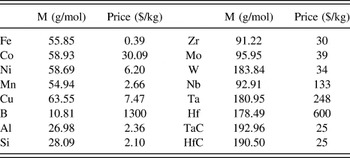
The individual prices of the precursors used in the synthesis are summarized above in Table IV. Among the late transition metals, Co is the most expensive at $30.09/kg, while Fe is the cheapest at only $0.39/kg. 27,28 The most expensive precursor is B at $1300/kg, followed by Hf and Ta. 27,28 B makes up most of the alloy cost in many soft magnetic alloys despite its low concentration.
Below are the molar masses (g/mol) and prices ($/kg) of all the precursors used in the synthesis of FINEMET and HTX005 soft magnetic ribbons investigated in this work. The data presented here are gathered from various sources and compared to each other for consistency. 27,28,32,33,Reference Wieser, Holden, Coplen, Bohlke, Berglund, Brand, De Bievre, Groning, Loss, Meija, Hirata, Prohaska, Schoenberg, O’Connor, Walczyk, Yoneda and Zhu59

Among the growth inhibitors, Nb, Ta, and Hf are the most expensive on this list at $133/kg, $248/kg, and $600/kg, respectively. However, when coupled with their large molar masses, Ta (M Ta = 180.95) and Hf (M Hf = 178.49) exhibit the highest molar price in $/mol unit. On the other hand, TaC and HfC are significantly cheaper at only ∼$25/kg. 27,28,32 These compounds are commonly used for tool bits for cutting applications due to their high hardness and melting points. Reference Emsley7,Reference Emeléus60,Reference Guicciardi, Silvestroni, Pezzotti and Sciti61 The excellent physical hardness of TaC and HfC is similar to that of B4C, which is, a commodity used in bulletproof shield and armor industry. Reference Domnich, Reynaud, Haber and Chowalla62–Reference Niihara, Nakahira and Hirai64
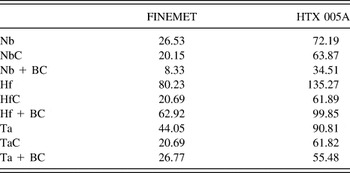
Table V summarizes the alloy costs of Fe-based FINEMET and Co-based HTX005 alloys studied here. 53% cost reduction in FINEMET-Ta can be achieved by substituting Ta with TaC. Substituting Hf with HfC in FINEMET-Hf alloy results in a more dramatic 74% cost reduction. The cost reduction presented here is even larger than that reported in prior study where B is replaced with the much cheaper B4C. Reference Kurniawan, Keylin and McHenry21
The alloy costs tabulated below are obtained by taking into account the price, purity, and concentration of the precursors. These alloy costs are in the unit of $/kg. Alloy costs associated with substituting B with the cheaper B4C are also included here for comparison.

Due to the high price of Co ($30.09/kg), all Co-based HTX005 alloys are generally more expensive than Fe-based FINEMET alloys. The cost reduction associated with the substitution of Ta and Hf by TaC and HfC, respectively, is still significant. For HTX005-Ta alloys, substituting Ta with TaC reduces the cost by 32%, while substituting Hf with HfC in HTX005-Hf results in 54% cheaper alloy. It is also worthwhile to mention that B4C substitution would yield larger cost reduction than TaC substitution in HTX005 alloys. Future works will explore a further cost reduction by combining these substitutions and its effects on the soft magnetic properties of the materials.
From Table V, one can also conclude that in most of Ta- and Hf-containing FINEMET and HTX005 alloys used in this work, TaC and HfC substitution will result in more significant cost reduction than B4C substitution. The reason behind this can be found when one considers the high molar price ($/mol) of Ta and Hf. Due to the very large molar masses of Ta and Hf, the molar prices ($/mol) of these elements match that of B and far exceed the other precursors typically used in the synthesis of soft magnetic materials. On the other hand, Nb (M Nb = 92.91) is a much lighter element than Ta and Hf. For Nb-containing FINEMET and HTX005 alloys, synthesis route involving B4C substitution results in more impactful economic benefit compared to NbC substitution.
IV. SUMMARY
We report a thorough study on substitution of Ta and Hf with TaC and HfC on Fe-based FINEMET and Co-based HTX005 soft magnetic alloys. With the substitution, both Ta- and Hf-containing FINEMET and HTX005 alloys exhibit comparable soft magnetic properties as their TaC and HfC-containing counterparts. Thermal annealing was observed to magnetically soften all FINEMET alloys we investigated here, as reflected from their significantly lower H c compared to the as-cast FINEMET alloys. Moreover, thermal annealing also results in reduced power loss in all FINEMET alloys. The hysteretic behaviors of all HTX005 alloys were altered upon strain annealing and their permeability decreases significantly. In short, thermal annealing and strain annealing can be used to effectively optimize the soft magnetic properties of TaC and HfC substituted FINEMET and HTX005 for the targeted applications.
For both Fe-based FINEMET and Co-based HTX005 soft magnetic alloys studied here, TaC- and HfC-containing alloys exhibit T x and T C different than those of their Ta- and Hf-containing counterparts. Alloys with higher T x and T C will be attractive for use in applications at high temperature. Future works will investigate the effects of TaC and HfC substitution on the atomic structure, grain size distribution, and chemical partitioning in multiphase nanostructures.
Elements such as B, Ta, and Hf exhibit very high price compared to other precursors typically used in soft magnetic alloy synthesis. Combined with their large molar masses, the molar price ($/mol) of Ta and Hf are the highest. Substituting Ta and Hf with TaC and HfC provide an alternative route to reduce alloy cost due to the much lower price of TaC and HfC. Substitution of Ta and Hf with TaC and HfC, respectively, results in up to 74% cost reduction in FINEMET and up to 54% in HTX005. The cost reduction is more significant in Fe-based FINEMET due to the fact that Ta and Hf make up for most of the alloy cost in FINEMET-Ta and FINEMET-Hf alloys. The costs of HTX005 alloys are generally higher than FINEMET alloys due to the high price of Co.
ACKNOWLEDGMENTS
M. E. M and M. K acknowledge the support from the Army Research Laboratory (Contract Number: W911NF-14-1-0184) and M. E. M acknowledges the support from the Wright Patterson Air Force (Contract Number: FA8650-12-D-2225). This report was prepared as an account of work sponsored by an agency of the United States Government. Neither the United States Government nor any agency thereof, nor any of their employees, makes any warranty, express or implied, or assumes any legal liability or responsibility for the accuracy, completeness, or usefulness of any information, apparatus, product, or process disclosed, or represents that its use would not infringe privately owned rights. Reference herein to any specific commercial product, process, or service by trade name, trademark, manufacturer, or otherwise does not necessarily constitute or imply its endorsement, recommendation, or favoring by the United States Government or any agency thereof. The views and opinions of authors expressed herein do not necessarily state or reflect those of the United States Government or any agency thereof.