1. INTRODUCTION
The tension between continuity and change may be one of the most pervasive – and interesting – issues in the historiography of late medieval England. How, historians have asked, could a society have lost between one-third and one-half of its members in the plague that first struck England in 1348–1349 yet still have continued to function? For nineteenth-century historians, the discourse of plague-as-cataclysmic made for a story that was both logical and dramatic: wages rose, serfdom withered and lords cursed their luck. Twentieth-century historians were more circumspect – perhaps, as John Hatcher has argued, to the point where they minimised and hence overlooked the plague's social and economic effects.Footnote 1 In the last few decades, assessments of the plague's impact have become more nuanced. Thus we appreciate that some peasants, especially those who already possessed some capital, fared much better than others in the late-fourteenth and fifteenth centuries. We also recognise that – in theory, at least – men and women may have been affected differently by the social and economic changes wrought by the plague, even if far less consensus exists about the extent and nature of these differences. The so-called ‘golden age’ debate has centred on the issue of whether women's status rose in the post-plague era vis-à-vis that of men.Footnote 2 While this article does not engage with the debate directly, it lends support to those who see little, if any, overall change in gender relations following the plague. Surviving data on post-plague land-holding, I argue, reinforce the view that gender structures proved resilient to demographic upheaval.
In this article, I ask two main questions concerning land-holding and late medieval English peasant women. First, did peasant women – more than men – benefit from greater availability of land in the late fourteenth century? That is, did women control more land – through inheritance, assumption of abandoned tenancies, purchase, and other means – after the plague than they did before? Second, if women's control over land did not increase in any significant way, then why not? Why would we see continuity, in other words, at the very moment when one might expect change? I will suggest that evidence gathered to date – my own and that of other scholars – shows no clear and unequivocal increase in the amount of land controlled by women after the plague. I will propose that this continuity demonstrates the strength of inheritance systems and gendered attitudes toward land-holding and labour in late medieval England. Contemporaries and historians rightly note that the demographic disaster of the fourteenth century created or exacerbated some important changes, yet even the deaths of one-third to one-half of the population could not undermine the heavily gendered nature of land-holding.
One might expect that more property would end up in the hands of women in a period of high mortality as father-to-son transmission was inevitably reduced by deaths of male heirs. Yet, as a number of historians, including Richard Smith, Kim Phillips, John Mullan and Cicely Howell, have observed, women inherited less often than might be expected.Footnote 3 With regard to inheritance patterns on six post-plague manors, for instance, Smith noted that ‘it is … evident that daughters did not inherit in accordance with the opportunities theoretically available to them’.Footnote 4 Instead, nephews, brothers, grandsons, uncles and other male kin benefited disproportionately from increased mortality. As Phillips has remarked, ‘[i]t is as though the waves of death so shocked the populace – both lords and tenants – that male control of property had to be asserted with greater force than ever’.Footnote 5 Most studies to date have examined this phenomenon within a particular manor or region. In the first part of the article that follows, I will show how a similar continuity can be seen throughout fourteenth-century England and within a variety of sources.
Late medieval inheritance customs governing transmission of customary land (land belonging to the landlord and granted to unfree peasants through the manorial court) varied from one manor to another. Some manors practised primogeniture (inheritance by the oldest son), some ultimogeniture (inheritance by the youngest son), and others divided land among all surviving sons. The one thing that almost all had in common was that sons inherited before daughters. The survival of even one son meant that his sisters would not inherit real property on the tenant's death (although these sisters may have been compensated with movable property, through land transactions made prior to the tenant's death, or in some other way). If a tenant had no daughters, the land might pass to a more distant relative, and if none of these could be found then the land would revert to the hands of the lord. Of course, non-customary land could be transferred with fewer community constraints, and families often made use of this freedom to provide for non-inheriting sons and for daughters. But prior to the fifteenth century, land transmitted inter vivos (among the living) was typically smaller in area and importance. As Smith commented more than 25 years ago, the consensus among historians has been to regard inter vivos land transmission as less significant than inheritance postmortem.Footnote 6 It is also quite possible that parents found ways to give their daughters more cash, animals, grain and household items, with the understanding that these daughters would inherit less real property than their brothers. Daughters were seldom left completely penniless and homeless: both male and female adolescents often worked as servants in other households for several years, saving money to contribute toward their future homes and families. The vast majority of late medieval English peasant women married, although most did so in their late teens or twenties, considerably later than noble women.Footnote 7 Unlike couples of elite status, who might live with parents for several years, newly-wed peasants typically set up independent households, to which they brought earnings, goods and lands accumulated during their long periods of adolescence.
Even if a daughter earned some money of her own, inherited movable property and/or married a man with land, however, her own diminished chances of inheriting real property were important, because the relationship to customary land was crucial to the subsistence of the peasantry. A son who inherited enough land to support himself and his family possessed an ongoing means of survival; a daughter who inherited smaller areas of land or movable property could take in whatever it yielded or sell the land for a finite supply of food, but she lacked the same degree of long-term substantial support given to her brother. A daughter who inherited a substantial holding would find her marriage prospects improved. She might even have sufficient assets to forgo marriage, and become a householder in her own right, should she prefer. As such, she would hire and fire servants, make decisions about how to use her land, be responsible for her own debts, and participate more fully in manorial courts (for instance, she would be more likely to stand as pledge, or guarantor, to others, even though her gender still precluded her participation as juror or manorial official). This is not to suggest that married women did not participate in making such decisions along with their husbands. But, as Judith M. Bennett has argued, we must always distinguish between power and authority when considering the medieval peasantry: a married woman might have the informal power to influence her husband's decision, but she lacked the authority to make these decisions in her own right.Footnote 8 Certainly, as noted above, women could and did inherit non-customary land, but this could lack the protection that custom provided: rents could be raised and tenants could be evicted. In a peasant village, the options for an adult woman who did not inherit land were thus limited. She could marry someone with more land, she could try to scrape together a living from poorly paid occupations such as spinning, brewing or laundering, or she could leave her village for a town (most likely, she tried more than one of these strategies at different points in her life-cycle). Women's restricted control over land was thus an important component of the patriarchal structure of late medieval England. Barbara Hanawalt has argued that women's greatest economic significance in late medieval London was as conduits of property, resulting from inheritance laws that were generous to women; here, I suggest nearly the opposite for the countryside: women's economic significance was largely curtailed as a result of an inheritance system that restricted their control over land, the most important resource.Footnote 9
In charting land-holding by peasant women, I am using two main categories of sources: rentals that list tenants alongside the sums of rent they owed, and entry fines (fees for inheritance) recorded in manorial court rolls or accounts.Footnote 10 As with every source, each has shortcomings. But the two have somewhat different lacunae and strengths and thus complement one another well. Rentals provide a series of ‘snapshots' of land-holding in various times and at various places, enabling a quick comparison of the number of tenancies in the hands of women. In addition, rentals typically listed a larger proportion of tenants than did court rolls. Larry Poos and Richard Smith estimated that approximately 40 per cent of landless tenants renting only a cottage or messuage did not appear in manorial court rolls. Most appeared in rentals, however, because by definition these documents served to record all sources of rent income due to the lord.Footnote 11 Since poor widows and single women were particularly likely to escape mention in court rolls, rentals are especially valuable. True, rentals do not usually show subtenants, and women may have been over-represented among those who rented houses and smaller plots of land from those whose holdings were larger (although if anything this might confirm the case that women's entitlement to land was more tenuous than that of men). Moreover the survival of rentals is generally poor, both in quality and quantity, making it difficult to track changes over time within a single manor. For this reason, I have sampled 26 fourteenth-century rentals from both larger and smaller manors in 16 counties throughout England.Footnote 12 Even though gaps in the records mean that I cannot usually trace the same manors throughout the period, it should be apparent from comparing percentages of female-rented land whether women indeed held significantly more property in the post-plague era. Court records of quitclaims (renunciations of land-holding) and land transfers should confirm this picture because, if women benefited disproportionately from increased land availability after the Black Death, we would find them over-represented among land purchasers and among those taking on vacant properties.
Rentals suggest snapshot pictures of the number of tenancies held by women, but they do not consistently record how an individual came to inherit a particular piece of land. Here, entry fines in manorial court rolls and accounts can provide a more dynamic view of the mechanics of inheritance. Postmortem entry fines usually record the name of the deceased, the inheritor and the amount of land inherited. Often, though not always, they specify the relationship between deceased and inheritor. Thus an inheritor might be described as a daughter, son, niece, nephew, aunt, uncle, granddaughter, grandson or cousin. Those in more distant relationships are usually described as a kinswoman or kinsman (indeed, these more general appellations may have been used to describe some of the relationships above, too, depending on jurisdiction). In this article I focus on three series of manorial court rolls – those of Sutton (Lincolnshire), Walsham le Willows (Suffolk) and Wakefield (Yorkshire) – in the periods immediately before, during and after the Black Death.Footnote 13 Because inheritance has interested a number of scholars, however, I am also able to use a good deal of comparative data from other studies. Particularly important for its breadth and scope is the work of Mark Page, Richard Britnell, John Mullan and others on manors from the Winchester estates. For the period between 1269 and 1415, this massive study tracks 17,974 instances of inheritance.Footnote 14 But tenant entry fines are not a perfect source either. As Mullan notes, entry fines were not consistently recorded when widows took over property of a deceased husband (as happened frequently) and, as Poos and Smith caution, premortem transfers intended to serve as inheritances can be hard to distinguish from other transfers.Footnote 15 For these reasons, I have mostly excluded widows from the discussion of entry fines below and have focused on inheritance by sons, daughters and other relatives. Data from rentals and from entry fines in court rolls cannot be compared directly, but when each kind is used on its own terms the emerging patterns are remarkably similar.
2. RENTALS, TRANSFERS AND THE ‘SNAPSHOT’ VIEW OF FEMALE LAND-HOLDING
In this section, I argue that comparing the proportions of tenancies rented by men and by women reveals considerable continuity in female land-holding across the fourteenth century. Although it is possible that the proportion of female tenants increased temporarily in the years immediately following the initial outbreak of the Black Death, the overall picture from a variety of fourteenth-century manors suggests little change in tenancy patterns. A similar continuity exists in the value and quantity of female-held land (as opposed to the raw number of female tenants). While a few women held multiple tenancies and were able to amass considerable holdings, these women were the exception rather than the rule. In addition, women seem to have been more likely to quitclaim (renounce) land and men more likely to take on new land in the post-plague era.
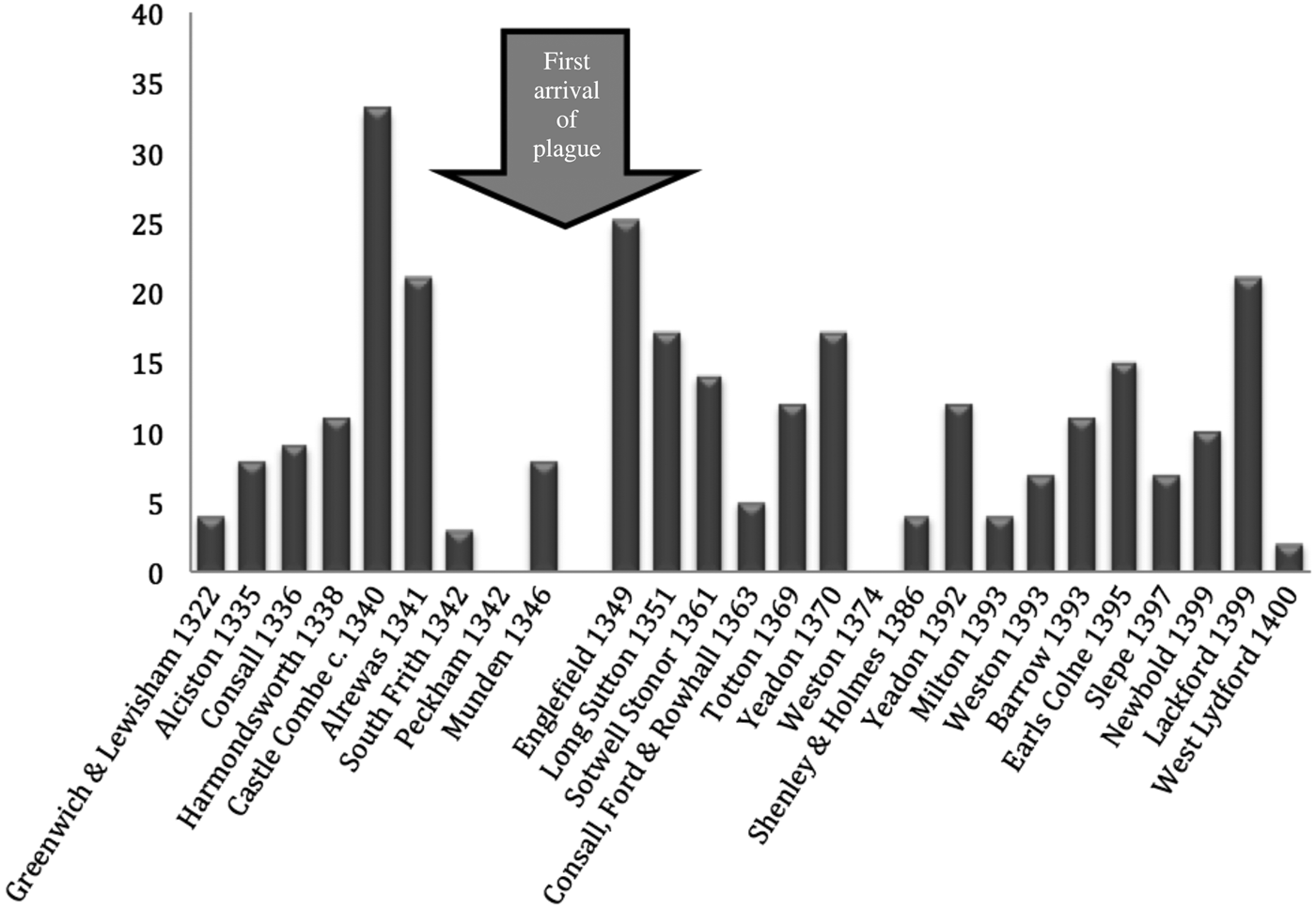
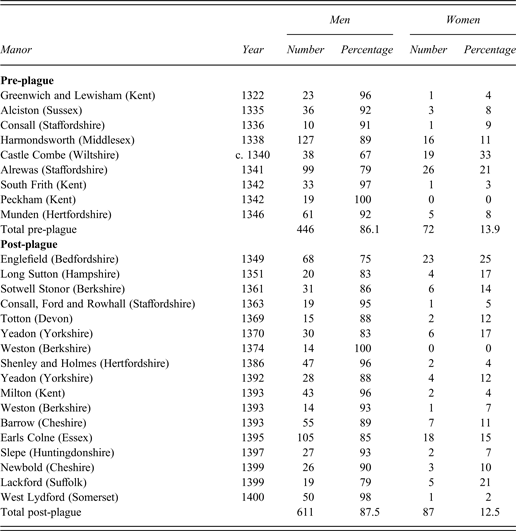
As Table 1 shows, the number of female tenants varied considerably between manors, but the overall proportion of female names among tenants listed in rentals did not increase significantly over the fourteenth century.Footnote 16 In fact, the highest proportion of female-held tenancies comes from the pre-plague period, at Castle Combe (Wiltshire) in c. 1340, where women constituted one-third of the tenants. Combining pre- and post-plague rentals yields no significant pattern either: women's names account for 13.9 per cent of tenants in nine pre-plague rentals and 12.5 per cent in 16 rentals from the second half of the fourteenth century. Organising these data by the percentages of male and female tenants makes it easier to spot patterns – or the absence of patterns – over time. Figure 1 graphs tenants by gender on each manor, although, since some manors contained many more tenants than others, this graph ought to be read in conjunction with the raw numbers in Table 1. Figure 1 makes clearer the considerable variation from one manor to the next, but it also shows no unequivocal trend toward increased (or, for that matter, decreased) female land-holding.
Percentage of female tenants from rentals, 1322–1400. Sources: Greenwich and Lewisham – The National Archives: Public Record Office, United Kingdom (hereafter TNA: PRO) SC 12/9/25; Alciston – TNA: PRO SC 11/639; Consall, Ford and Rowhall – TNA: PRO SC 11/17; Harmondsworth – TNA: PRO SC 11/443; Castle Combe – G. Poulett Scrope, History of the manor and ancient barony of Castle Combe (London, 1852), 146–51; Alrewas – Jean Birrell and Dick Hutchinson, ‘An Alrewas rental of 1341’, Collections for a history of Staffordshire, 4th Series, 20, Staffordshire Record Society, 2004, 59–82; South Frith – TNA: PRO SC 12/9/54; Peckham – TNA: PRO SC 12/9/54; Munden – TNA: PRO SC 11/280; Englefield – TNA: PRO SC 11/57; Long Sutton – F. J. Baigent ed., A collection of records and documents relating to the hundred and manor of Crondal, part 1 (London, 1891), 135–41; Sotwell Stonor – TNA: PRO SC 11/4; Totton – TNA: PRO SC 11/170; Yeadon – G. R. Price, The court rolls of Yeadon, 1361–1476 (Draughton, 1984), 227–35; Weston – TNA: PRO SC 12/5/69; Shenley and Holmes – TNA: PRO SC 11/297; Milton – TNA: PRO SC 11/363; Barrow – TNA: PRO SC 11/888; Earls Colne – available online at http://linux02.lib.cam.ac.uk/earlscolne//survey2/index.htm (accessed 11 March 2013); Slepe – TNA: PRO SC 11/320; Newbold – TNA: PRO SC11/8; Lackford – Mark Bailey ed., The English manor, c. 1200–1500 (Manchester, 2002), 81–4; West Lydford – TNA: PRO SC 11/562.

Tenants by gender from rentals, 1322–1400
Sources: Greenwich and Lewisham – The National Archives: Public Record Office, United Kingdom (hereafter TNA: PRO) SC 12/9/25; Alciston – TNA: PRO SC 11/639; Consall, Ford and Rowhall – TNA: PRO SC 11/17; Harmondsworth – TNA: PRO SC 11/443; Castle Combe – G. Poulett Scrope, History of the manor and ancient barony of Castle Combe (London, 1852), 146–51; Alrewas – Jean Birrell and Dick Hutchinson, ‘An Alrewas rental of 1341’, Collections for a history of Staffordshire, 4th Series, 20, Staffordshire Record Society, 2004, 59–82; South Frith – TNA: PRO SC 12/9/54; Peckham – TNA: PRO SC 12/9/54; Munden – TNA: PRO SC 11/280; Englefield – TNA: PRO SC 11/57; Long Sutton – F. J. Baigent ed., A collection of records and documents relating to the hundred and manor of Crondal, part 1 (London, 1891), 135–41; Sotwell Stonor – TNA: PRO SC 11/4; Totton – TNA: PRO SC 11/170; Yeadon – G. R. Price, The court rolls of Yeadon, 1361–1476 (Draughton, 1984), 227–35; Weston – TNA: PRO SC 12/5/69; Shenley and Holmes – TNA: PRO SC 11/297; Milton – TNA: PRO SC 11/363; Barrow – TNA: PRO SC 11/888; Earls Colne – available online at http://linux02.lib.cam.ac.uk/earlscolne//survey2/index.htm (accessed 11 March 2013); Slepe – TNA: PRO SC 11/320; Newbold – TNA: PRO SC11/8; Lackford – Mark Bailey ed., The English manor, c. 1200–1500 (Manchester, 2002), 81–4; West Lydford – TNA: PRO SC 11/562.
It is possible that there may have been a slight bump in the proportion of female land-holders immediately after the onset of the Black Death, although the numbers are so small as to be suggestive only. Few rentals exist for the immediate plague period; that of Englefield (Bedfordshire), in 1349, is an exception which may allow us an insight into a short-term phenomenon or may be nothing more than a statistical outlier. Englefield is just over halfway in a direct line between Bristol, hit by plague in summer 1348, and London, infected by November 1348.Footnote 17 In the first rent term of 1349–1350, 59 male and 22 female tenants were recorded in Englefield; in the last of four rent periods of 1349–1350, the rental listed 63 male and 23 female tenants. In other words, women held over a quarter of all tenancies, twice as many as the pre-plague average. Perhaps this high number of female tenants in Englefield indeed reflects a temporary post-plague bump that missing records obscure for other places. At Long Sutton (Hampshire), in 1351, the proportion of female tenants was also higher than average, although the small numbers of tenants included in this rental (24 total, including 4 women) should make us cautious about attaching too much weight to it. Even if women held more land than usual in the immediate aftermath of the plague, however, the snapshot data emerging from other rentals show that this situation was probably short-lived. Studies of fifteenth-century rentals have found similarly low numbers of female tenants and again no clear trend toward greater female land-holding.Footnote 18
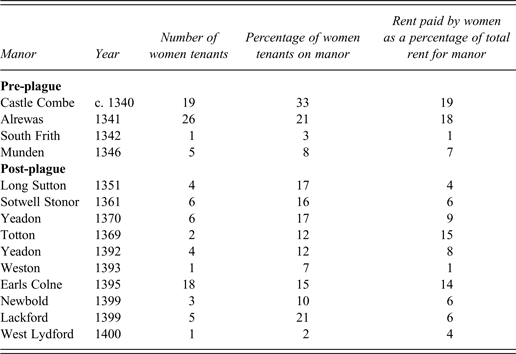
Rental data suggest not only little change in the proportion of female tenants throughout the fourteenth century but also little change in the quantity and value of lands held by each tenant. Few rentals yield complete and legible data on rents and/or areas of tenancies, but I have tried to calculate these nonetheless since they provide a more precise measure of the volume of land in female hands. In particular, I examined whether female tenants – while fewer in number – might nonetheless each hold a significantly larger portion of land than that held by male tenants. Where rentals provide enough detail and clarity to calculate rents, however, the reverse is generally true: women's land-holdings were usually smaller and/or of lesser value than those of men, both before and after the plague.Footnote 19Table 2 compares the percentage of rent paid by women with the percentage of female tenants. In all but two cases, the land held by women was on average either smaller or worth less than that held by men. One important caveat, however, is that these rents include both customary and non-customary land, and the relationship between land and rent varied according to these two modes of tenure. In the four pre-plague manors listed in Table 2 (a very small sample and doubtless skewed by the inclusion of Castle Combe), women's rent averaged about 11 per cent of the total rent paid on the manor, whereas in the 10 post-plague manors women paid around 7 per cent of the rent. In some places, like Earls Colne (Essex), the discrepancy between the number of female tenants and the value of their rent was slight (at Earls Colne it can be attributed largely to the considerable wealth of 1 of the 18 female tenants). However, elsewhere it was more significant: women paid about 6 per cent of the rent at Sotwell Stonor (Berkshire) in 1361, for example, even though they constituted 16 per cent of the tenants. The two exceptions to the pattern whereby women's share of the total rent was lower than their presence among tenants are those of Totton (Devon) and West Lydford (Somerset), containing two women and one woman respectively, and these small numbers of women probably distort the pattern. In West Lydford, for instance, Margaret Gromes paid a total rent of 36s. 1d. for 5 plots of land, while 50 men paid an average of 18s., but it is clear that Margaret's wealth was not the norm among women at West Lydford or elsewhere. It is possible that lower female rents stem from the benevolence of lords toward poorer female tenants, but this seems quite unlikely. No evidence for such mercy exists in the rentals sampled. Rather, lower rents almost certainly reflect smaller tenancies and/or land of lower quality. Here, rental evidence is suggestive rather than conclusive, since rentals seldom stipulated the area of tenancies in a measurable and comparable way. At Alrewas (Staffordshire) in 1341, for instance, some tenants paid rent for assarts, meadows and pieces of land identified by location but not by area. Nonetheless, male tenants at Alrewas were more likely to take on multiple tenancies and to rent land in different parts of the manor. In this pre-plague rental, men rented, on average, 1.22 tenancies, whereas women rented 1.04. Similar discrepancies in the number of tenancies can be found in post-plague rentals, when one might expect to see more signs of those capitalising on demographic decline. At Long Sutton in 1351, men averaged 1.55 tenancies to women's 1; at Yeadon in 1370, men averaged 1.63 tenancies to women's 1.33; and at Earls Colne in 1395, men averaged 1.7 tenancies compared with women's 1.56. I do not want to make too much of these numbers, since some rentals were more specific than others about breaking down the components of a tenant's holding into separate plots. Many rentals were organised according to different parts of the manor, whereas others (especially smaller rentals) were less detailed in their organisation, and a tenant with holdings in more than one part of the manor might only have been listed once. So while these numbers cannot be said to prove that men were more likely than women to hold multiple tenancies, they are nonetheless suggestive. Heriots (payments made on the death of a tenant, usually of the ‘best beast’) and entry fines are less useful for assessing the value of land. In some communities, lords continued to take the best beast, regardless of land quality, while others used cash fines that seem to have been more reflective of the amount (and possibly the quality) of land.Footnote 20
Female tenants and rent paid, c. 1340–1400
Sources: Castle Combe – G. Poulett Scrope, History of the manor and ancient barony of Castle Combe (London, 1852), 146–51; Alrewas – Jean Birrell and Dick Hutchinson, ‘An Alrewas rental of 1341’, Collections for a history of Staffordshire, 4th Series, 20, Staffordshire Record Society, 2004, 59–82; South Frith – The National Archives: Public Record Office, United Kingdom (hereafter TNA: PRO) SC 12/9/54; Munden – TNA: PRO SC 11/280; Long Sutton – F. J. Baigent ed., A collection of records and documents relating to the hundred and manor of Crondal, part 1 (London, 1891), 135–41; Sotwell Stonor – TNA: PRO SC 11/4; Totton – TNA: PRO SC 11/170; Yeadon – G. R. Price, The court rolls of Yeadon, 1361–1476 (Draughton, 1984), 227–35; Weston – TNA: PRO SC 12/5/69; Earls Colne – available online at http://linux02.lib.cam.ac.uk/earlscolne//survey2/index.htm (accessed 11 March 2013); Newbold – TNA: PRO SC11/8; Lackford – Mark Bailey ed., The English manor, c. 1200–1500 (Manchester, 2002), 81–4; West Lydford – TNA: PRO SC 11/562.
Not only did women possess smaller plots of land, but also they were less likely to take on tenancies abandoned after the plague. Data on quitclaims and assumption of new tenancies suggest that women disproportionately surrendered land and men were especially likely to assume it. In Curry Rivel (Somerset) in 1348–1349, for instance, four women surrendered their land to the lord without nominating heirs.Footnote 21 Three of these four were recent widows, one of whom – Lucy, widow of Thomas Knap – relinquished her land ‘by reason of poverty’. In the case of the other two recent widows, the court record specified that they gave up not only their lands but also the crops growing on the land, possibly leaving these women without a source of income. Men, on the other hand, were better positioned to take on extra tenancies after the plague, whether via inheritance, assuming abandoned tenancies, or striking some deal with previous tenants. No men quitclaimed land at Curry Rivel in these years, and men were certainly in the majority of those taking up vacated lands. Of 26 reassigned tenancies from Curry Rivel during the plague years, male tenants took up 18. A further four tenancies went to men who married the widows of the previous tenants, and three more were given to married couples. Only 1 of the 26 tenancies was taken on by a woman on her own. In fact, the process by which particular families were able to raise themselves up socially through purchase of vacant tenancies can be glimpsed in these rolls. Richard Joie the elder, for instance, paid 2s. to marry Edith, widow of Nicholas le Baker, and have entry to her tenement. He paid another 40d. for entry into a cottage with curtilage (the land immediately surrounding) formerly held by John Roules. He also pledged for Richard Joie the younger, who paid 20d. in the same court, to take up a cottage with a close (enclosure) containing one acre of land. And one of the two (listed as ‘Richard Joie’ without further appellation) paid 20d. for an acre of meadow. Within a short space of time, therefore, both Richard Joies were able to capitalise on property left free by others, but women of the manor seem less able to have done so.Footnote 22 Similar patterns can be found elsewhere: of 23 tenements granted by the lord at Elmley Castle (Worcestershire) between 1347 and 1400, 21 went to men and 2 to women.Footnote 23 As Mullan has pointed out, women – especially widows – often relinquished land in the late fourteenth century, and were especially likely to do so following the ‘second wave’ of plague in the early 1360s.Footnote 24 If women were well positioned to gain from land plenitude after the plague, one would expect to see fewer quitclaims by women and more female assumption of vacated tenements at Curry Rivel and Elmley Castle. On the other hand, women on the Winchester manors bought land from non-family members more often in the 1340s than in any other decade between 1320 and 1415. Between 1340 and 1349, women – either individually or with their husbands – bought 19.4 per cent of available lands. By the next decade, however, they constituted only 9.6 per cent of purchasers, and the number of female purchasers declined further thereafter. Moreover, women on the Winchester manors also accounted for a higher proportion (28.1 per cent) of those selling land to non-family members in the 1340s than in any other decade.Footnote 25 If some women were able to buy land in the immediate aftermath of the plague, therefore, they were more than matched by women seeking to sell.
Indeed, if any consistent pattern in female inheritance and land-holding emerges from rentals and from the court roll data on new tenancies and land transfers, it is the lack of consistent pattern. That is, in the proportion of female tenants in rentals, the value of female-held land, and the gender of those assuming new tenancies, we see no clear trend toward either increased or decreased female inheritance. The lack of change in an era when one might expect it raises another – and perhaps more interesting – question: why not?
3. ENTRY FINES AND INHERITANCE BY DAUGHTERS IN THE FOURTEENTH CENTURY
Entry fines in manorial court rolls, recording the death of a tenant and the fee paid for inheritance by his/her heir, similarly show no long-term increase in female land-holding. Again, inheritance after the death of a tenant was not the only way land could be passed from one person to another, but, as discussed below, men outnumbered women in land transactions among the living, too. Entry fine data suggest three main explanations for the relative consistency in female land-holding across the fourteenth century. First, these records attest to the structural power of customs that limited the increase in inheritance by daughters. That is, the system by which sons inherited before daughters meant that little overall change was even possible in the proportion of female-held land.Footnote 26 Second, even before the plague, daughters routinely inherited at a lower rate than entitlement through inheritance would predict – for a variety of reasons, daughters themselves, their families, or manorial officials and communities frequently intervened in the expected inheritance process so that daughters received less land than their theoretical entitlement. Third, despite the greater availability of tenancies during and after the plague, daughters continued to inherit at a rate well below their entitlement. If anything, daughters' assumption of tenancies to which they were theoretically entitled was even lower than usual during the plague years since – as other scholars have observed – distant male relatives inherited in higher numbers at the expense of daughters. As noted above, widows – probably the most significant group of female land-holders – have been omitted from my assessment of the entry fine data since they are not consistently recorded in court rolls. So while the nature of rental and entry fine sources means that they cannot be compared directly, the entry fine data support the rental data in suggesting remarkable continuity in land-holding rates by women across the fourteenth century and help explain the mechanics by which low female land-holding was perpetuated.
To understand the continuity in rates of female tenancy, we must first acknowledge the structural power of the inheritance system itself. A system that sent land to sons before daughters inevitably made female inheritance difficult, and even in the wake of a major demographic crisis, only minimal gains in female land-holding were statistically possible. Historians and anthropologists have used various models to predict the likely gender breakdown of inheriting children in peasant families, often based on complex calculations about the likelihood of children's survival. In the case of post-plague manors, however, we already know the survival rate of sons (since they were first to inherit), so we can use a model that is much more straightforward: in any given manor, brotherless daughters should inherit at about the same rate as sons.Footnote 27 This equation does not take account of different inheritance systems (partible inheritance versus inheritance by a single heir, primogeniture versus ultimogeniture), but nor does it need to, since the number of male or female inheritors does not affect the outcome.
In fact, it is possible that the survival rate for brotherless daughters was a little lower than that of sons because, as I argue elsewhere on the basis of both textual and archaeological sources, the adult sex ratio in late medieval England was perhaps something like 110 to 115 men for every 100 women (or 100 men for every 87 to 91 women).Footnote 28 To account for this possibility of a skewed sex ratio, I have assumed that daughters survived to inherit only 91 per cent as often as sons. The formula for expected inheritance by daughters is thus as follows:
 $$\eqalign{&(1.0[\hbox{tenancies to be inherited}]-[\hbox{inheritance rate of sons}]) \cr & \times ([\hbox{inheritance rate of sons}] \times 0.91[\hbox{sex ratio adjustment}]) \cr &= \hbox{expected rate of inheritance by daughters}.}$$
Two examples will show just how much this expected inheritance model confined the maximum inheritance of daughters. First, if sons inherited tenancies in about two-thirds of all cases (as was the case in the large dataset from the Winchester manors, discussed below), one-third of tenancies would be left unclaimed. If daughters survived at the same rate as sons (that is, 67 per cent of the time), they could inherit, on average, only 67 per cent of the remaining 33 per cent of tenancies – thus 22.1 per cent of the total. And if, as I believe more likely, only 91 women survived to adulthood for every 100 men, brotherless daughters would be eligible for still less: only 20.1 per cent of tenancies. The remaining 13 per cent of tenancies not claimed by either sons or daughters would go to more distant family members. The formula for the expected inheritance rate for daughters in a manor (or collection of manors) in which two-thirds of tenancies were inherited by sons can thus be expressed as follows:
 $$\left( {1-0.67} \right) \times \left( {0.67 \times 0.91} \right) = 0.201{\rm} \left( {{\rm or} \ 20.1 \ {\rm per \ cent}} \right).$$
When sons died in high numbers from plague, more land was available, but this was largely counterbalanced by equally high mortality rates among daughters. A second example will help show that even in circumstances most favourable to inheritance by daughters, the possible inheritance entitlement was less than 23 per cent. This scenario would have occurred if exactly 50 per cent of tenants had no sons and if daughters had taken 50 per cent of the remaining 50 per cent of available land. With adjustment for the skewed sex ratio, the maximum inheritance rate for daughters was 22.8 per cent ([1.0–0.5] × [0.5 × 0.91]). According to my model, when inheritance rates of sons were either above or below 50 per cent, daughters' inheritance rates were inevitably equal to or lower than 22.8 per cent. Even with demographic circumstances most amenable to daughters' inheritance, then, they could inherit little more than one-fifth of tenancies bequeathed postmortem.
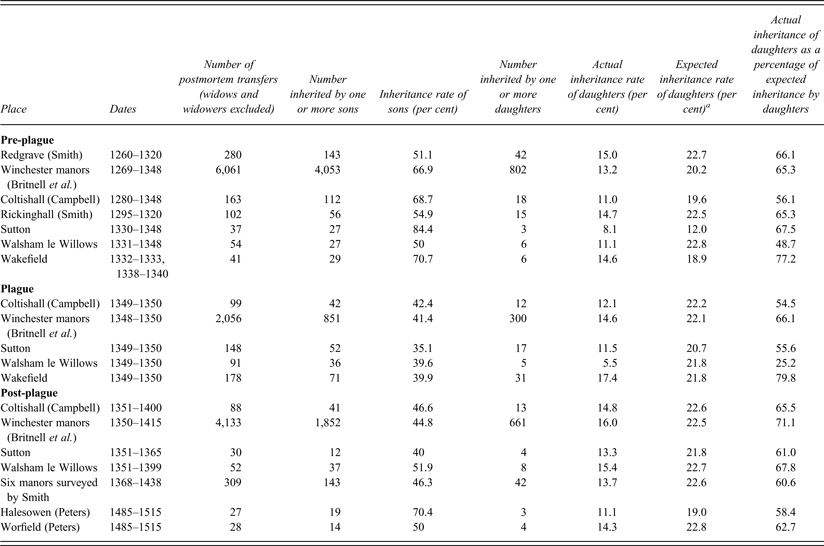
As shown in Table 3, actual inheritance varied considerably from one manor to the next. In 54 cases from Walsham le Willows between 1331 and 1348, sons did inherit in only 50 per cent of instances, leaving 22.8 per cent of tenancies theoretically available to brotherless daughters. The very large dataset for the Winchester manors comes closer to the norm, however: in 6,061 postmortem land transfers prior to the plague, sons inherited in 66.9 per cent of cases. The plague changed the situation only slightly: as Table 3 shows, low inheritance rates by sons in the immediate wake of the plague increased the chances that daughters might inherit, but they did not increase the chances much. Of manors with data for both the pre-plague and plague periods, all expected inheritance rates for daughters rose with the exception of Walsham le Willows, but none was able to rise a great deal because of the limits imposed by the system.
Actual and expected inheritance by daughters from entry fine data, 1260–1515
a Calculated thus: (1.0 – inheritance rate of sons) × (inheritance rate of sons × 0.91). See the text for my reasoning on this adjustment.
Sources: Redgrave – Richard M. Smith, ‘Families and their land in an area of partible inheritance: Redgrave, Suffolk, 1260–1320’, in Richard M. Smith ed., Land, kinship and life-cycle (Cambridge, 1984), 87–134; Winchester manors – John Mullan and Richard Britnell, Land and family: trends and local variations in the peasant land market on the Winchester bishopric estates, 1263–1415 (Hatfield, 2010), 104, 111, Tables 7.1 and 7.5; Coltishall – B. M. S. Campbell, ‘Population pressure, inheritance and the land market in a fourteenth-century peasant community’, in Smith, Land, kinship and life-cycle, 87–134; Rickinghall – Smith, ‘Some issues concerning families and their property in rural England 1250–1800’, in Smith, Land, kinship and life-cycle, 49; Sutton – The National Archives: Public Record Office, United Kingdom DL 30/86/1176-1182 and DL 30/87/1183-1189; Walsham le Willows – Ray Lock ed., The court rolls of Walsham le Willows 1303–50 and 1351–99, Suffolk Records Society, volumes 41 and 45 (1998 and 2002); Wakefield – The Wakefield court rolls series of the Yorkshire Archaeological Society, Second Series, vol. 2 (1348 to 1350, ed. Helen M. Jewell, 1977), vol. 3 (1331 to 1333, ed. Sue Sheridan Walker, 1983), vol. 6 (1350–1352, ed. Moira Habberjam, Mary O'Regan and Brian Hale, 1987), vol. 12 (1338 to 1340, ed. Katherine M. Troup, 1999); six manors surveyed by Smith – Richard M. Smith, ‘Coping with uncertainty: women's tenure of customary land in England, c. 1370–1430’, in Jennifer I. Kermode ed., Enterprise and individuals in fifteenth-century England (Gloucester, 1991), 43–67; Halesowen and Worfield – Christine Peters, ‘Single women in early modern England: attitudes and expectations’, Continuity and Change 12 (1997), 325–45.
A second explanation for the relative continuity in female land-holding is that even before the plague, and even within the narrow limits imposed by the inheritance system, daughters actually inherited more seldom than one would expect. The last column in Table 3 shows the actual inheritance rate by daughters as a percentage of the expected inheritance rate in a range of manors. Much of these data are derived from the work of other scholars, and again the best dataset – by virtue of its size – is that of manors on the Winchester estates. Of 6,061 pre-plague inheritors (excluding widows), 66.9 per cent were sons and 13.2 per cent daughters. In terms of daughters, this number is not nearly as high as we might expect if we were to apply the formula above. Rather than inheriting about 20.1 per cent of tenancies, as one might predict, daughters inherited in 13.2 per cent of cases – thus 65.3 per cent or just under two-thirds of their entitled inheritance. Smaller samples from elsewhere reinforce this pattern. Data from Smith's work on Redgrave and Rickinghall and my work on Sutton find that pre-plague daughters took on between 65 and 68 per cent of their expected inheritances using the formula above. Women took on a still smaller proportion of their entitled tenements when the same formula is applied to Bruce Campbell's work on Coltishall, where pre-plague daughters inherited 56.1 per cent of the tenements one would expect, or my work on Walsham le Willows, where women inherited less than half of their entitled tenements. So, even before the plague, there was quite a gap between theory and practice when it came to inheritance, and daughters took on land considerably less often than their theoretical entitlement.
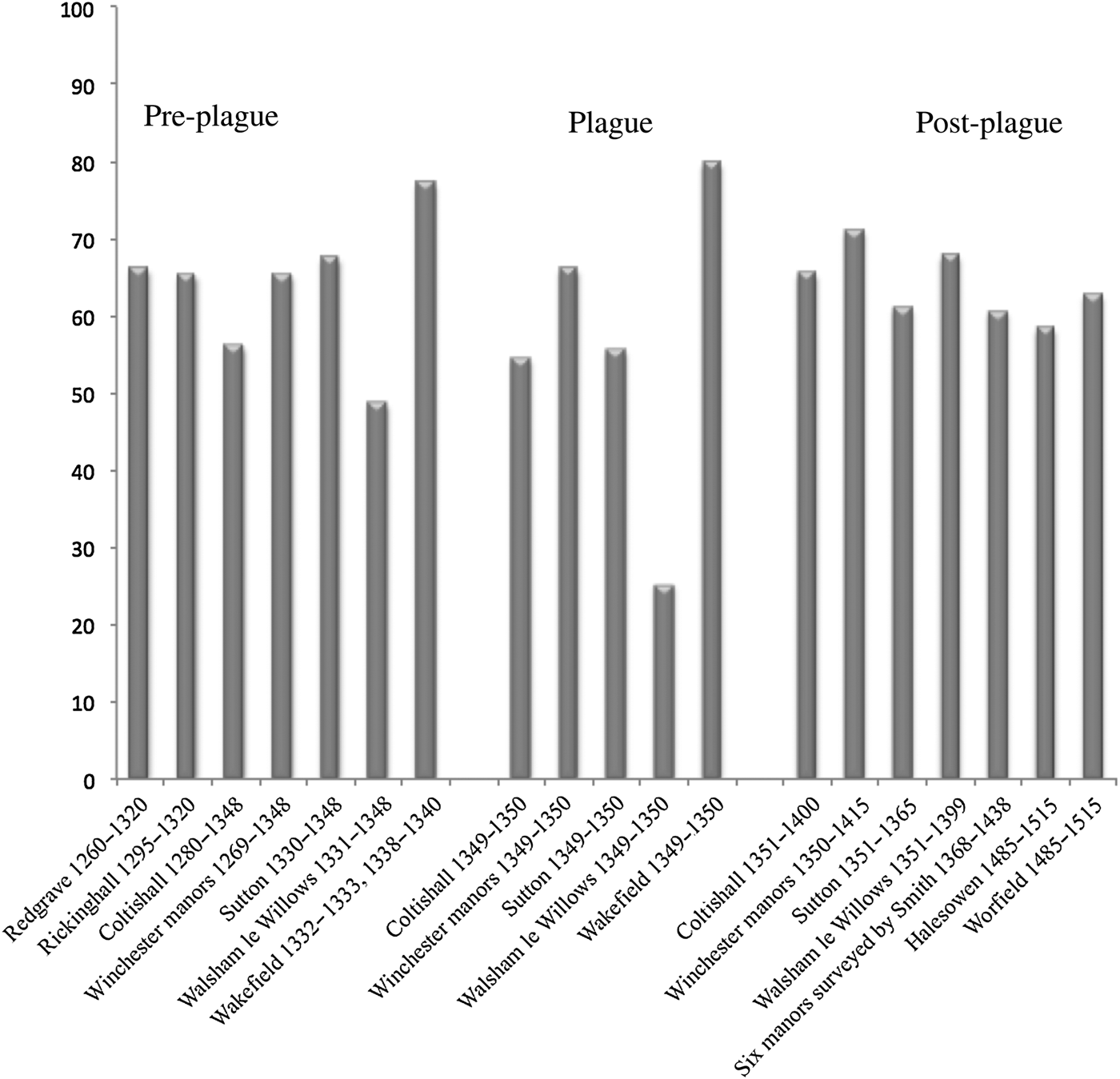
Third, continuity in female land-holding can be explained in part by the fact that very little – if any – increase in female inheritance took place during or after the initial impact of the plague. As the inheritance rate of sons fell – on Winchester manors and at Wakefield and Coltishall from about two-thirds to about two-fifths, at Walsham le Willows from about half to about two-fifths, and at Sutton from 85 per cent to just over one-third – the inheritance rate of daughters ought theoretically to have increased slightly as more land was available. If anything, however, daughters' actual versus entitled inheritance stayed much the same. Figure 2 graphs the percentages of entitled inheritances taken up by daughters before, during and after the plague. While raw numbers of inheritances show more land going to daughters, daughters still did not inherit in proportion to the rate one would expect, given the high mortality of their brothers. If significantly more land was going to daughters during the plague years of 1348–1349, one would expect the plague-era bars on the graph to be at least as high as, if not higher than, those of the pre-plague era.
Actual inheritance by daughters as a proportion of expected inheritance by daughters, 1260–1515. Sources: Redgrave – Richard M. Smith, ‘Families and their land in an area of partible inheritance: Redgrave, Suffolk, 1260–1320’, in Richard M. Smith ed., Land, kinship and life-cycle (Cambridge, 1984), 87–134; Rickinghall – Smith, ‘Some issues concerning families and their property in rural England 1250–1800’, in Smith, Land, kinship and life-cycle, 49; Coltishall – B. M. S. Campbell, ‘Population pressure, inheritance and the land market in a fourteenth-century peasant community’, in Smith, Land, kinship and life-cycle, 87–134; Winchester manors – John Mullan and Richard Britnell, Land and family: trends and local variations in the peasant land market on the Winchester bishopric estates, 1263–1415 (Hatfield, 2010), 104, 111, Tables 7.1 and 7.5; Sutton – The National Archives: Public Record Office, United Kingdom DL 30/86/1176-1182 and DL 30/87/1183-1189; Walsham le Willows – Ray Lock ed., The court rolls of Walsham le Willows 1303–50 and 1351–99, Suffolk Records Society, volumes 41 and 45 (1998 and 2002); Wakefield – The Wakefield court rolls series of the Yorkshire Archaeological Society, Second Series, vol. 2 (1348 to 1350, ed. Helen M. Jewell, 1977), vol. 3 (1331 to 1333, ed. Sue Sheridan Walker, 1983), vol. 6 (1350–1352, ed. Moira Habberjam, Mary O'Regan and Brian Hale, 1987), vol. 12 (1338 to 1340, ed. Katherine M. Troup, 1999); six manors surveyed by Smith – Richard M. Smith, ‘Coping with uncertainty: women's tenure of customary land in England, c. 1370–1430’, in Jennifer I. Kermode ed., Enterprise and individuals in fifteenth-century England (Gloucester, 1991), 43–67; Halesowen and Worfield – Christine Peters, ‘Single women in early modern England: attitudes and expectations’, Continuity and Change 12 (1997), 325–45.
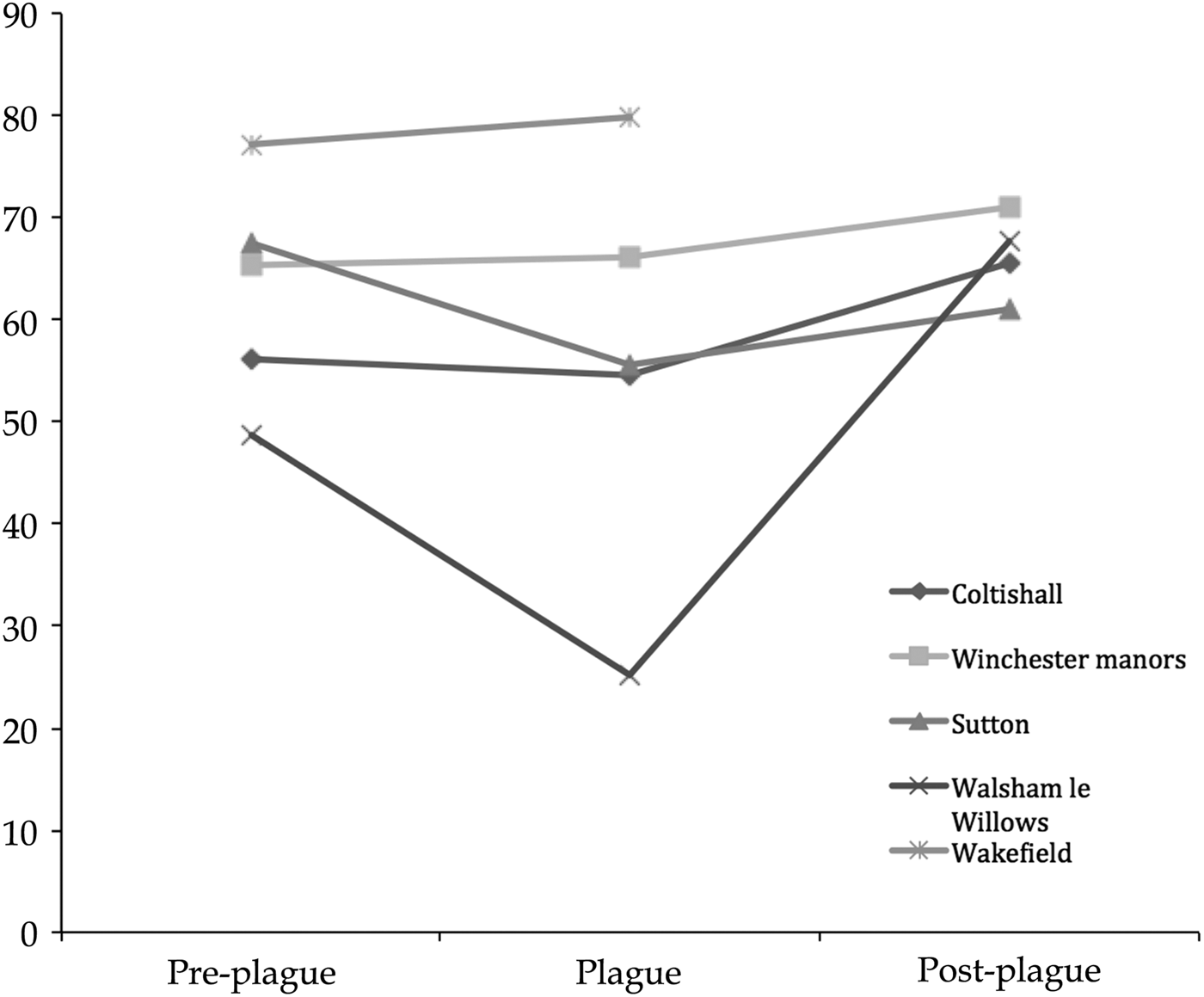
In fact, in three of the five places with data for both the pre-plague and plague years, the actual female inheritance rate as a proportion of the expected inheritance rate fell, by a little or a lot. In Coltishall, the drop was small, from 56.1 per cent to 54.5 per cent. A larger drop can be found at Sutton: in the 148 cases from Sutton in 1349–1350, daughters inherited in 55.6 per cent of the expected cases compared with 67.5 per cent pre-plague. At Walsham le Willows, where female inheritance rates were always low (48.7 per cent of entitlement before the plague), daughters took up only one-quarter of their expected inheritances (25.2 per cent) in the plague years. In the other two places, women's actual inheritance as a proportion of their entitled inheritance increased during the plague years, but only very slightly. On the Winchester estates, women assumed 65.3 per cent of their entitled inheritances prior to the plague and 66.1 per cent during the plague years. Women in Wakefield also slightly increased the rate at which they took up inheritances, from 77.2 to 79.8 per cent.
Little changed once the initial chaos of the plague had passed. Daughters on most manors inherited at somewhere between 60 and 72 per cent of their entitled inheritance rate. Figure 3 shows a mixed outcome for the four jurisdictions with data on daughters' inheritance for the pre- and post-plague eras: Sutton post-plague rates were below their pre-plague levels and Coltishall and Walsham rates were higher. The Winchester manors, with the most data, also show a post-plague inheritance rate by daughters that was higher than their pre-plague rate (65.3 per cent versus 71.1 per cent).Footnote 29 If the post-plague era was indeed a ‘golden age’ for women, however, one might expect this to be reflected in considerably and consistently higher rates of inheritance by daughters. Instead, there was a return to the pre-plague inheritance patterns whereby daughters inherited about two-thirds as often as they were theoretically entitled to do.
Actual inheritance by daughters as a proportion of expected inheritance by daughters in selected jurisdictions. Sources: Coltishall – B. M. S. Campbell, ‘Population pressure, inheritance and the land market in a fourteenth-century peasant community’, in Smith, Land, kinship and life-cycle, 87–134; Winchester manors – John Mullan and Richard Britnell, Land and family: trends and local variations in the peasant land market on the Winchester bishopric estates, 1263–1415 (Hatfield, 2010), 104, 111, Tables 7.1 and 7.5; Sutton – The National Archives: Public Record Office, United Kingdom DL 30/86/1176-1182 and DL 30/87/1183-1189; Walsham le Willows – Ray Lock ed., The court rolls of Walsham le Willows 1303–50 and 1351–99, Suffolk Records Society, volumes 41 and 45 (1998 and 2002); Wakefield – The Wakefield court rolls series of the Yorkshire Archaeological Society, Second Series, vol. 2 (1348 to 1350, ed. Helen M. Jewell, 1977), vol. 3 (1331 to 1333, ed. Sue Sheridan Walker, 1983), vol. 6 (1350–1352, ed. Moira Habberjam). Mary O'Regan and Brian Hale, 1987), vol. 12 (1338 to 1340, ed. Katherine M. Troup, 199.
The overall stability of daughters' actual versus expected inheritances contrasts with the fortunes of other relatives, and other male relatives in particular. As historians have noted, the gap was filled particularly by brothers, grandsons, nephews, uncles, male cousins, or those noted simply as ‘kinsmen’.Footnote 30 Indeed, as Zvi Razi has pointed out for Halesowen (Worcestershire), inheritance of tenancies before the plague occurred primarily along the male line. After the plague, land was still inherited mostly by relatives, but these relatives might be more distant and often had different surnames.Footnote 31 Sisters, granddaughters, nieces, aunts, female cousins and ‘kinswomen’ occasionally took up tenancies, but far less often than male relatives. At Sutton, for instance, male relatives other than sons inherited in 35 per cent of cases – three times as often as daughters – in 1349–1350. Prior to the plague, they had inherited in only 14 per cent of cases, and in the immediate post-plague decades their numbers fell back to 20 per cent. At Walsham le Willows, male relatives other than sons inherited more often than was usual (in 26 per cent of cases) prior to the plague, but their numbers rose further (to 30 per cent) in the plague years and fell to 17 per cent after the plague. Female relatives other than daughters, however, inherited at a fairly consistent rate throughout the fourteenth century. At Walsham le Willows, they inherited in 7 per cent of cases pre-plague and 10 per cent of cases both during and after the plague, while at Sutton, they inherited in 5 per cent of cases both before and during the plague and 13 per cent thereafter.Footnote 32 Similar patterns can be seen in the Winchester manors: whereas brothers, nephews and grandsons inherited in 8 per cent of cases between 1341 and 1348, they inherited in 18 per cent of cases in 1348–1349. Their rates of inheritance remained high: between 1350 and 1415, they continued to inherit 17 per cent of land. Sisters, nieces and granddaughters accounted for 5 per cent of inheritances between 1341 and 1348 but 7 per cent in 1348–1349 and 6 per cent in 1350 to 1415.Footnote 33 The Winchester data used here are not directly comparable with that of Sutton and Walsham le Willows, since they do not include those labelled only as ‘kinsmen’ or ‘kinswomen’ – whom I included in the numbers of male and female relatives inheriting in Sutton and Walsham le Willows – yet the overall patterns are roughly similar: during the plague, especially, distant male relatives inherited more land.
4. CHANGES ENABLING CONTINUITY
Why change inheritance practices by directing more land to distant male relatives at the very time we might expect continuity (which would have resulted in more land to daughters)? The sparse entries in court records offer few clues about the reasons behind these changes, but some may be inferred from context. Much of the reason may have involved the difficulty of finding labour after the plague and the perception on the part of manorial courts and potential heirs that a woman would have a harder time working the land or finding someone else to do it for her. After all, it is seldom clear who actually made the decision that a piece of land should go to a nephew or brother, say, rather than to a daughter. In theory, any variation from custom should have happened only with the general agreement of tenants and the lord. But in the long and chaotic post-plague courts, it is hard to know exactly what happened in practice. Did the daughter herself refuse the land on the grounds that she already possessed all she could handle? Certainly some heirs turned down inheritances, whether on their own initiative or that of others. When John Osbern of Walsham le Willows died – presumably in the first bout of plague that had hit Walsham by June 1349 – he left 2.5 acres to Eleanor, his kinswoman. Eleanor did not initially attend court to take up her inheritance, but when she showed up at the November court she promptly conveyed the property to Nicholas Deneys.Footnote 34 So it is certainly possible that conscious choice by women themselves was responsible for the lower-than-expected rate of female inheritance (although in this particular instance Eleanor was counted as an inheritor since she did receive the property, albeit temporarily). Especially after the plague when land was plentiful, bequests could be more of a burden than a boon, since peasants were required to keep their land clear of weeds and productive. Eleanor, kinswoman of John Osbern, might have recognised that she already had as much land as she could work herself and that her chances of hiring help were slim. Extra land might become, in the terms often used by the court, ‘waste’ or ‘ruined’ or ‘derelict’ – Eleanor herself might be fined for neglecting it and thus might be eager to offload it.
Another possibility, though, is that the jury, manorial officials working on behalf of the lord, and/or the court at large (which effectively meant the most influential peasant men in the village) decided that a male tenant was a better choice. Again, the behind-the-scenes details are not recorded on court rolls so we are left to speculate: did the cousin or uncle of a potential female heir convince others that he was a more suitable tenant, better able to work the land himself or find others to do so? Such an argument might be convincing to a court because an overstretched tenant would allow weeds to grow, which would affect the lands of those nearby. Moreover, a tenant with insufficient resources might not be able to contribute animals to a plough team or pull his/her weight at harvest time. Prior to the plague, tenants whose own labour was insufficient would have had little trouble hiring someone to help out. In an era in which extra labour was in very, very short supply, though, such tenants could be a burden for everyone. So an uncle or male cousin may have had an easier time convincing the community at large that he was better positioned to manage things. Thus one of the plague's effects – the greater availability of land – was counterbalanced by another – the shortage of labour – leaving women in much the same position vis-à-vis access to customary land as they had been prior to the plague.
Lower-than-expected female inheritance rates during the plague might also be explained, in part, by a greater-than-usual absence of women from the countryside. If daughters died in higher numbers than sons from the Black Death, or if they were especially likely to move to towns, fewer would be present to inherit land. Data about gender-specific plague mortality are, however, ambiguous at best. In Italian towns, women seem more likely to have died in the initial onset of the plague but men may have died in greater numbers in subsequent waves.Footnote 35 The same may have been true for England: Sharon N. DeWitte and James W. Wood have shown from archaeological remains that those who were already frail, whether through malnourishment or pre-existing health conditions, were initially more vulnerable to the Black Death. DeWitte's work on the East Smithfield plague cemetery makes a similar point. While considerably more men than women were found at the East Smithfield site, the plague cemetery itself was established once parish and hospital cemeteries were already filled. Women might thus have been over-represented among those dying first and interred in overflowing local cemeteries, leaving more men to face the epidemic as it persisted in the city (and subsequently to be buried at East Smithfield or another of the plague cemeteries). Gender, therefore, might have affected the timing of death but not the overall mortality rate.Footnote 36 Not all agree, however: Jim Bolton has recently argued that men were more susceptible to dying from plague in England.Footnote 37 Thus, while it is possible that low inheritance rates by daughters during the plague years were in part a consequence of high female death rates in the plague's initial onset, this has yet to be proven. A female-led migration to towns in the initial onset of the plague seems even less likely. It is not mentioned by chroniclers cataloguing the social effects of the plague and would seem an odd reaction (albeit in a period of odd reactions) to devastating mortality. Several have argued that women were especially likely to move to towns in the decades after the plague, but by the late fourteenth century – as explained above – daughters' actual versus expected inheritance rates were about the same as their pre-plague levels.Footnote 38 So while a lower inheritance rate during the plague may have resulted in part from an absence of women in the countryside, this was probably less important than concerns about women's access to labour.
A third explanation for the continuity in female land-holding might involve transfer of property in ways other than postmortem inheritance. On the Winchester estates, even pre-plague, daughters were more likely to receive land through inter vivos transactions than to inherit land on a parent's death. Thus parents ensured that their daughters received dowries, as partial compensation for inheritance customs. Even so, about 46 per cent of inter vivos transfers favoured sons and only 29 per cent conveyed property to daughters. Moreover, transfers to sons were often quite large, while daughters were more likely to receive smaller areas.Footnote 39 The same was true in Sutton, both before and after the plague, although not during the plague years themselves. Between 1328 and 1348, daughters in Sutton received land from their parents in 13 inter vivos transfers yet only in 3 postmortem inheritances. Between 1351 and 1365, they benefited from 20 inter vivos transfers yet only 4 postmortem inheritances. During the plague years of 1349–1350, however, inter vivos transfers did not keep pace with changing family circumstances: daughters benefited in these years from 8 premortem transfers but 17 postmortem inheritances. During each period, moreover, sons outnumbered daughters (though not by many) among those receiving premortem bequests. Thus while it is absolutely correct to emphasise the importance of premortem transfers as a way to convey land to daughters, these premortem transfers cannot explain the dip in daughters' inheritance during the plague. The area of land conveyed through inter vivos transactions was, moreover, usually smaller than that conveyed through postmortem inheritance – 142 acres were transferred to daughters through postmortem inheritance in surviving records from Sutton between 1328 and 1365, whereas less than half this area (63 acres) was transferred through inter vivos transactions.Footnote 40 Daughters may well have received more movable property than sons during the plague years (the records are silent on this), but they certainly did not seem to gain a disproportionate amount of real property from inter vivos transfers among family members. Smith has noted that women often benefited from inter vivos transactions involving those outside their families, sometimes holding this land conjointly with their husbands.Footnote 41 However, presumably, this source of land acquisition was not particularly significant, or it would have been reflected in higher rates of female land-holding in rentals.
5. CONCLUSION
Both rentals and entry fine data demonstrate considerable continuity at precisely the moment when one would – in theory – expect considerable change. I suspect that the best explanation for this phenomenon is one expressed amply by others elsewhere: patriarchal structures are complicated, entrenched and interwoven.Footnote 42 The plague disrupted one small strand of late medieval English patriarchy – inheritance by sons – but many other threads nonetheless held the structure in place and directed land toward other men. I doubt that this was a deliberate strategy – that it was a conscious reaction on the part of those male jurors, manorial officials or family members resenting female land-holding, for instance. Rather, I suspect it was a pragmatic response to a situation in which persistent patriarchal expectations meant that most women indeed could not gather the labour needed to manage their land as effectively as more distant male kin. Higher female death rates and transfer of property by other means (like inter vivos transactions) may also have played a role, but the most likely explanation is that women were seriously disadvantaged when it came to hiring workers in the labour-starved economy of the post-plague years. The structures that gendered land-holding as primarily male were thus too complicated and intertwined to be dislodged by massive population loss alone. While much may have changed significantly in the decades following the Black Death of the mid-fourteenth century, ideas about land and gender, I suggest, changed very little.
ACKNOWLEDGEMENTS
I am particularly grateful to Judith M. Bennett, Maryanne Kowaleski, Lluís To Figueras, Jim Skalnik, and the editors and anonymous referees at Continuity and Change for their helpful suggestions and critiques of earlier drafts of this article. The bulk of this research was carried out with the support of a George William Cottrell Jr. Membership in the School of Historical Studies, Institute for Advanced Study, Princeton.