We must learn to live together or most certainly we will soon all die together. Although Star Trek had to entertain or go off the air, we believed our format was unique enough to allow us to challenge and stimulate the audience. Making Star Trek happen was a bone-crusher, and unless it also “said something” and challenged our viewer to think and react, then it wasn't worth all that we had put into the show.Footnote 1
–Gene Roddenberry
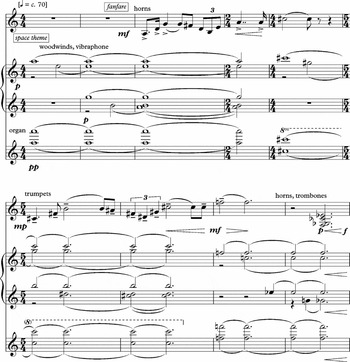
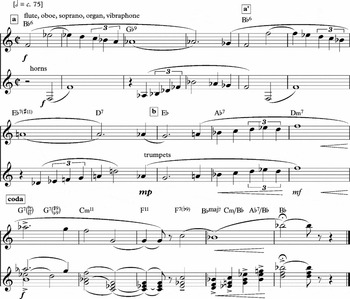
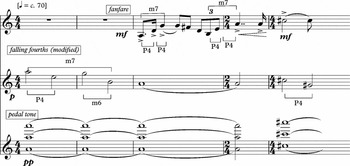
As the series’ herald and brand, the Star Trek title cue articulates the show's driving concern with social progress, an agenda emphasized by the series’ creator and executive producer, Gene Roddenberry.Footnote 2 Composed by Alexander (Sandy) Courage, the cue's initial, multi-octave A, overlaid with cascading fourths and sixths, strongly evokes the open spaces of unknown frontiers (Example 1). Its fanfare, sounded by horns and trumpets, implies nobility, authority, and a resolute gaze into the future, sensibilities likewise affirmed in lead actor William Shatner's voiceover: “Space, the final frontier” (Example 1). The cue's energetic final section, what composer and musicologist Fred Steiner called the “beguine,” picks up the pace with its bounding melody and driving harmonic rhythm (Example 2).Footnote 3 Linked in Star Trek's main title sequence with images of the starship Enterprise plunging headlong through fields of distant stars, the cue paints an aural picture of hope, determination, and victory in the face of long odds. Several Star Trek journalists and scholars have made observations along these lines; musicologist Neil Lerner, for instance, interprets the cue as “part Mahlerian world-weariness, part Coplandesque pastoralism, and part space-age bachelor pad randiness.”Footnote 4 The cue's three musical statements—the space theme, the fanfare, and the beguine—have become essential signifiers of the show, their relevance extending into the ways in which they memorably communicate and illuminate social ideologies central to Star Trek's mission.
Alexander Courage, Composer. Space theme and fanfare from Star Trek's title cue. Holograph full score, Alexander Courage Collection, SC 1995.10, Box 39, Folder 8, “Star Trek: Original Main Title Theme,” Ruth T. Watanabe Special Collections, Sibley Music Library, Eastman School of Music, Rochester, NY. (Transcribed and reduced by author. All examples are in C.)

Beguine from Star Trek's title cue. (Transcribed from holograph full score and reduced by author.)

The title cue has had a lasting influence on the Star Trek franchise and is not only immediately recognizable to Star Trek fans, but also strongly echoed in the structure and feel of subsequent Star Trek television title cues.Footnote 5 Its success stems from both its memorability and its effectiveness in supporting a particular social vision. Roddenberry remarked that Courage's score for the first pilot, including its now-iconic main title cue, “successfully avoided all of the stylizations and other traps of science fiction, [and] successfully blended feelings of past and present and personal identification.”Footnote 6 It presented the optimism in human progress through which the series challenged problematic political stances and social taboos in the United States, celebrating diversity and promoting equality. Roddenberry specifically meant Star Trek to act as a message of progressive social reform, and its title cue reflects that.
Yet the way in which Star Trek ended up engaging with the social upheaval of its time is more complex than Roddenberry either admitted or realized. On the one hand, the series delighted in human difference. Many episodes condemned discrimination according to color or culture, and the series’ mixed-race cast modeled a commitment to a racially inclusive society—hefty statements in a country suffering through a volatile Civil Rights Movement. Female actors held ongoing roles, and several guest actresses portrayed women with high-profile intellectual careers, exemplifying an important tenet in the Women's Movement of this period. Plot points gave opportunities for liberalist commentary on Cold War anxieties and international politics, lingering World War Two wounds, Communist fear, and the ongoing Vietnam War. The series seemed particularly preoccupied with the potential of scientific advancement to unify humanity and optimistic about the greater social and intellectual heights that could be reached through initiatives like the Kennedy-inspired “space race.” In short, Star Trek enthusiastically tore through the contested cultural boundaries of its time by presenting fictional stories with real-world morality claims (a specialty of the science fiction genre). Its positive social vision developed a significant cult following in the late sixties, and especially during syndication in the 1970s, leading to the franchise's later reboot in sequel television shows and films and fueling its continued influence on U.S. identity. As Roddenberry hoped, Star Trek succeeded in “saying something,” dramatizing a progressive view of society and challenging contested social boundaries.
On the other hand, Star Trek simultaneously re-inscribed problematic patriarchal and race-based social hierarchies. The series demonstrated an insistence on traditional white, male leadership that was acceptable and expected from a television series of its time, but which in hindsight illuminates the contrary forces at play in media culture of the second half of the sixties. The liberal humanism to which Roddenberry subscribed encouraged both the celebration of difference and the assimilation of that difference into current norms, creating an inherent tension within his—and within the show’s—agenda.Footnote 7Star Trek, as media scholar and sociologist Daniel Leonard Bernardi has demonstrated, set forth “a universe where whites are morally, politically, and innately superior, and both colored humans and colored aliens are either servants, threats, or objects of exotic desire.”Footnote 8 This view manifests most strongly through the unyielding centrality of Captain James T. Kirk, the series’ white, hyper-masculine protagonist, who maintained continuous and almost exclusive agency throughout the series. As the leader within the Star Trek narrative, he exemplified what was “considered good, desirable, preferable, or normal” in 1960s society.Footnote 9 Kirk provided a positive and socially sanctioned role model for the series’ primarily young, male audience, demonstrating how an enlightened white male might use his privilege for the good of disadvantaged minorities.Footnote 10 At the same time, however, his prominence within the series, coupled with his moral, intellectual, and physical superiority, sets up the Star Trek story as problematically conservative in a series intent on egalitarianism. Star Trek is therefore best understood as operating in the strained area between two conflicting forces: one of progressive social reform, and another of status quo maintenance—the maintenance of white, heteronormative, male social power. The series thus emerges as a document of rupture, a text that enacts the discontinuities in United States society in the late 1960s while at the same time replicating many ideological structures across the divide.Footnote 11
The 1960s was a period of volatile paradigm shifts fueled by promising but difficult social and political events, and Star Trek, conceived as an example of how those shifts could be mediated, wrestled with change in all its creative dimensions, including its title cue. This essay presents the history of the cue's composition, as well as the varied but cohesive meanings that can be located within its musical codes and its narrative structure. It then explores the cue's uses as both framing and connotative material within the series’ soundtrack and, further, its leitmotivic connection to Kirk, ultimately revealing Star Trek's progressive ideologies to be, nevertheless, both white- and male-centered.
Meaning and Ideology in Music for the Screen
One of the primary ways in which the title cue communicates Star Trek's ideologies is through its musical codes. Although instrumental music lacks the communicative specificity of written or spoken language, it nevertheless conveys important information, sometimes more efficiently than text.Footnote 12 Music often only signifies ideas related to an object, such as the songs of the birds that rest within a tree (through musical onomatopoeia) or peaceful reverence in the forest in which it stands (by indicating ideas of spirituality or emotional rest through, for instance, hymnic textures). This signification is “extroversive”: objects or ideas outside of the music itself are referred to through musical codes. When a listener describes a piece of music as militaristic, as a hunting call, as sexually provocative, as “Asian,” or as joyful, she interprets its code, acknowledging the various, sometimes endless, and possibly conflicting meanings that a musical statement can carry.Footnote 13 Such meaning is socially constructed, and the degree to which the listener ascribes these adjectives to the music depends on her “competence,” her ability to recognize the socially agreed-upon meanings inferred by the code, taught to her by experience and repetition.Footnote 14 At the same time, however, her interpretation will be unique; she shares a mutual understanding of the meanings of musical codes with those in her society but also finds in those codes meanings only she hears. This process, the attribution of meaning to musical statements, is essential to film and television, in which the musical soundtrack prompts spectator interpretation of the images on the screen, using musical codes that indicate mood, setting, genre, and character identity.Footnote 15
In aurally influencing spectator interpretation, the soundtrack works in concert with the visual sequence, forging a relationship between what the spectator sees on the screen and what he hears, through which both come to mean something different, and something more, than they would alone.Footnote 16 Film editor and sound designer Walter Murch summarizes: “Despite all appearances, we do not see and hear a film, we hear/see it.”Footnote 17 In other words, spectators draw meaning from a film or television series not from its aural codes or its visual codes separately, but from how these codes work together; if one of these codes changes, the meaning can be thoroughly altered. Whatever codes a visual sequence may present, they resonate with the codes in the soundtrack to create a meaning specific to that pairing. Spectators depend upon this process when interpreting what they see on the screen and over time develop competence in reading not only aural codes, but also audio-visual codes.
Beyond helping the spectator read what is happening on the screen, audio-visual codes communicate to him the show's ideas, both narrative and ideological, fostering an awareness and acceptance of the identity constructions and power relations within the story. Because works for the screen tend to be influenced by aspects of the society that has created them, the ideologies found in U.S. films and television series, and in their music, tend to hold vestiges of the patriarchal, heterosexist, and racist legacies ingrained in our culture.Footnote 18 Orientalist and exoticist codes—for example, those using “ethnic” scales or non-Western instrumentation—objectify the other (often female, but usually feminized regardless)Footnote 19 and mark her as abnormal, telling the spectator against whom he should identify. Musical codes that identify the hero, on the other hand, such as those that employ the physical strength of the Western orchestral brass section and the ordered objectivity of major-key tonicism, are generally reserved for the lead character, male and white, and inform the listener with whom he should identify. In thus locating the self and the other within the narrative, the soundtrack distributes power in a way that communicates the story's fundamental ideologies.Footnote 20
Through its musical codes, Star Trek's title cue demonstrates the series’ basic tenets, most of which revolve around the superiority of the United States and the value system it touted both internally and internationally. The title cue, two-part in structure, consists of three themes: the A section includes the space theme, suspenseful and pointillistic, and the fanfare, pensive but heroic (Example 1). The B section presents the beguine, with its distinctive timbral mix and wide melody (Example 2). Two intervallic motives form the bedrock of these themes: the perfect fourth, lending the cue its openness; and the minor seventh, built from two stacked fourths, creating the cue's sense of reach and its movement towards its figurative (ideological) and literal (tonal) goals. These basic motives convey ideas and aesthetics fundamental to the series: exploration, progress, romance, and heroism.
Developing the Title Cue
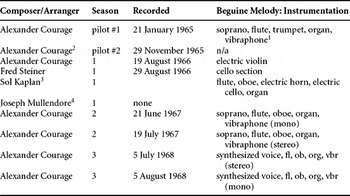
Several versions of the Star Trek title cue exist, differing slightly in orchestration (Table 1). Alexander Courage's original arrangement included textless soprano, flute, trumpet (or oboe perhaps), organ, and vibraphone in the beguine melody, and was used in both of the series’ pilots and in its first season. Season One saw two more orchestrations, one with an electric violin in place of the soprano, and one, by Fred Steiner, with the cello section in that position. Series composers Sol Kaplan and (possibly) Joseph Mullendore also provided orchestrations for this season. Curiously, Courage also composed a much shorter, but ultimately rejected, alternative title cue for the series’ second pilot.Footnote 21
Versions of Star Trek's title cue.

1Even though the series’ scores and AFM musicians’ contract sheets refer to an “organ,” Courage claimed that he used a “primitive early synthesizer.” He did not, however, specify whether he meant an electric organ (variants of which had been in use since the turn of the twentieth century, such as the popular Hammond organ) or an early modular synthesizer (like the Moog, which was in use by the mid-sixties). In addition, Courage indicated in an interview that he used a muted trumpet instead of an oboe in these first recordings, though his Season Two version specifically indicates oboe; it is possible he used oboe in the first season instead, and simply misremembered. Jon Burlingame, TV's Biggest Hits: The Story of Television Themes from Dragnet to Friends (New York: Schirmer Trade Books, 1996), 117; Alexander Courage, interview by Fred Steiner, transcript, 1 April 1982, Fred Steiner Papers, 1975–1981, MSS 2193, “Star Trek Interviews,” L. Tom Perry Special Collections, Harold B. Lee Library, Brigham Young University, Orem, UT.
2Courage's alternative title cue.
3The Star Trek soundtrack recordings do not include a recording of Kaplan's arrangement. Kaplan's version of the cue resides in his collection at the American Heritage Center. Courage, interview by Fred Steiner, transcript; Sol Kaplan, interview by Fred Steiner, transcript, 17 May 1982, Fred Steiner Papers, “Star Trek Interviews,” L. Tom Perry Special Collections, Harold B. Lee Library, Brigham Young University, Orem, UT. Sol Kaplan Papers, 1948–1994, MSS 09853, Box 31, American Heritage Center, University of Wyoming, Laramie, WY.
4The Star Trek soundtrack recordings do not include Mullendore's arrangement, and no score survives; evidence exists in an interview between Steiner and Mullendore, and in Roddenberry's archive at UCLA. Joseph Mullendore, interview by Fred Steiner, transcript, 7 April 1982, Fred Steiner Papers, 1975–1981, MSS 2193, “Star Trek Interviews,” L. Tom Perry Special Collections, Harold B. Lee Library, Brigham Young University, Orem, UT; Ed Perlstein to Shirley Stahnke, “JOSEPH MULLENDORE—‘Star Trek,’” 19 September 1966, Gene Roddenberry Star Trek Television Series Collection, 1966–1969, Collection 62, Box 35, Folder 10, Performing Arts Special Collections, University of California, Los Angeles.
Further, the sound team experimented with the mixes of these recordings, altering volume levels because Roddenberry and Courage could not agree on which instrument should dominate the beguine melody in playback; Courage wanted an even mix of timbres, but Roddenberry preferred the soprano.Footnote 22 This indecision resulted in several versions of the cue being used throughout Season One, differing both in arrangement and mixing. Eventually the creative team settled on Courage's original orchestration with the soprano in the foreground, and Courage composed and recorded an updated version for Season Two that reflected this decision. In the third and final season, according to assistant producer Robert Justman, the creative team replaced the soprano with a synthesized voice in an effort to reduce costs.Footnote 23 The version of the Star Trek main title cue analyzed in this article is the one Courage introduced in the second season, which has become the standard—re-recorded by Star Trek's music supervisor Wilbur Hatch for use in the third season and again in 2006 for the release of the series’ re-mastered DVD collection.Footnote 24
Reading the Codes: The Space Theme and the Fanfare
The title cue's first section, with its space theme and fanfare, places an ideal United States and its values at the center of Star Trek's ideological world, referencing Americanist codes that had become popular in Hollywood scoring over the previous two-and-a-half decades.Footnote 25 (Although the Enterprise crew is nominally multinational, it is better understood as a representation of a united humanity under U.S.-brand democracy and social structure.) Emphasizing the series’ focus on exploration, heroism, and morality, the musical statements Alexander Courage stitched into Star Trek's title cue mark the nation's goals and self-image as positive, promising, and deeply rooted in political and social rightness.
The space theme, with its static but expansive multi-octave pedal tones and its broad, slowly unfolding ninth chords, provides an aural image of open, uncharted territory. Its construction references the pastoral styles of composers Virgil Thomson and Aaron Copland, who in their films, ballets, and orchestral pieces employed a similar scoring, with an emphasis on musical characteristics Lerner identifies as key to the aesthetic: “pedal tones,” “rustic” and “disjunct melodies,” “wind and brass timbres,” “homophonic textures,” “slow to moderate tempi,” “a fondness for fourths and fifths,” and the “repetition of rhythmic and melodic motives.”Footnote 26 Thomson's and Copland's pieces in this style tend to accompany visual works that evoke a nostalgic appreciation of the United States’ idealized, untrammeled rural communities.Footnote 27
In Star Trek's title cue, in which the space theme accompanies visuals of imaginary planets, vast fields of stars, and the Enterprise flying through them, this musical language contributes to the sense of heroic exploration and collaborative accomplishment attributed to the Enterprise crew. In turn, this coding reflects back from the series onto the United States, painting the U.S. as both a land of opportunity and a unified nation in its prime, continually reaching beyond its technological and social boundaries, conquering not only the problems of this world, but those beyond it as well. Appearing in a decade that saw some of the most significant achievements of the space race, this series figuratively placed the United States flag on the moon, an act the U.S. performed in real life just after Star Trek went off the air in 1969. The space theme of the series’ title cue put to music the sense of anticipation felt as NASA sent an increasing number of astronauts past the Earth's atmosphere to what lay beyond.Footnote 28
The cue's fanfare, in a series that exalts scientific progress and U.S.-style peace-keeping and democratizing efforts, goes further to highlight the nation's presumed “nobility and heroism,” its moral superiority, governmental strength, and progressive vision.Footnote 29 Brass signals such as the one found in this cue have been employed militarily or aristocratically, and have come to indicate strict institutional organization and efficiency, the celebration of sovereign individuals or groups, the commencement of official events, the initiation of adventure, and tenacious masculinity.Footnote 30 In some instances the structure and scoring of a fanfare can carry a bucolic quality as well—as when it imitates the echoing calls of hunting horns—referring in the Romantic tradition to the forest, magic, and the sublime.Footnote 31 In the case of Star Trek's fanfare, the short, declarative structure of the signal combines with the timbre of the horns’ initial statement and the trumpets’ echo, creating a hybrid of the military and the magical that evokes the potential of the noble adventurer in the face of unknown frontiers and fantastic quests.
The fanfare is goal oriented, not only in its reference to heroic adventure, but within its musical structure. As with Aaron Copland's Fanfare for the Common Man (1942), which begins with a similar rising line in the brass, stacking a perfect fourth and a fifth, the Star Trek fanfare aims for the octave and arrives. In Star Trek, however, that goal is at first postponed at the minor seventh (with two stacked fourths), and then achieved at the octave and exceeded as the melody stretches to the upper major third. This theme also outlines a dominant seventh chord on A (in its first iteration) and then on C# (in its second). Together with the space theme, it forms a string of unresolved dominant ninth chords, each moving up a major third, refusing to travel to the implied tonic chord (first D, and then F#), providing a sense of direction but never actually arriving as expected. This harmonic structure enhances the feeling of stasis suggested by the space theme—its openness and timelessness—while simultaneously creating a desire to move to resolution.
Many of these ideas are reinforced in William Shatner's voiceover, which describes the crew's mission: “Space, the final frontier. These are the voyages of the starship Enterprise. Its five-year mission: to explore strange new worlds, to seek out new life and new civilizations, to boldly go where no man has gone before.”Footnote 32 This statement summarizes much of what can be read within the space theme and fanfare. When paired with the sequence's visuals and Shatner's voiceover, this section of the title cue can be heard as highlighting the crew members' courage as they set out into the unknown, their innate ability to overcome, their everyman heroism, and the constructive potential of their democratic system and scientifically focused society. Together, the first section's themes declare the series’ fundamental concern with exploration and progress, expressing the show's optimism and belief in humanity.
Reading the Codes: The Beguine
The second half of the title cue, the beguine, takes this optimism and potential and transforms it into forward movement. A jazzy tune along the lines of I Love Lucy's (1951–57) title theme (a television series also produced by Desilu Studios, Star Trek's original production company), the beguine consists of a wide, rolling melody that plays on the minor-seventh interval introduced in the fanfare, but is instead highly directional and dynamic.Footnote 33 Part of its energy comes from the contours of its melody and countermelody, its broad leaps creating a “yearning and striving” that Lerner associates with songs like “Somewhere” from West Side Story (1957) and “Over the Rainbow” from The Wizard of Oz (1939).Footnote 34 Unlike the fanfare's use of the minor seventh, which draws listeners up and leaves them hanging, waiting for resolution, the beguine provides expansive hills, pulling listeners up and dropping them back down, only to be tossed skyward again by the countermelody. This leaping action propels the melody higher and higher (first up to E♭5 and then to F5). Even in the second half of the B section (starting at b), which by contrast with the first half starts low, moves up by step, and ends high, the line rises up to A♭5 before settling on B♭4 (though subsequently jumping an octave to B♭5 at the coda). In this way, the beguine contrasts greatly with the space theme and the fanfare, communicating not only the potential for progress, but progress itself.
The beguine's harmonic and rhythmic drive parallels the exuberance of its melody. The drum set plays a quick, square, bass-snare eighth-note alteration, upbeat and relentless. The trombones and clarinets counter the percussion with syncopated chordal bursts, leading the piece purposefully into the second half of each measure to propel the ensemble forward. Alexander Courage stated that this sense of movement is exactly what he had intended when writing this section of the cue—a forward momentum created by stretching a long, arching melody over a driving accompaniment.
When I was a little kid, and I used to listen to the radio, there was a song by Richard Whiting called “Beyond the Blue Horizon.” And it had a long tune. And underneath this tune they used to have, usually, an accordion player or something like that, going digga-digga-digga-digga, digga-digga-digga-digga, you see. About triple time. So, with this long tune and all of this digga-digga-digga-digga underneath it . . . you know, the train, the train, the train . . . I thought, well, I should have a long theme that goes out into space, and it keeps going out into space. Everything's going to be long, long, long. And, it goes, lyrically as it were (without lyrics), over a fast-moving accompaniment.Footnote 35
“Beyond the Blue Horizon,” with music by Richard Whiting and lyrics by Leo Robin, was premiered in 1930 as part of the score for the musical film Monte Carlo.Footnote 36 The melody of this song's chorus does indeed feel quite broad, with sixteen bars divided into phrases four measures long, and the second and the fourth phrases elided in the middle to give the impression of greater length. The melody's note lengths are extended and its intervals are wide, with a distinctive, upward-soaring major sixth at its start and ever-widening leaps throughout. Its lyrics, too, express the forward movement and sense of travel with which Courage intended to imbue Star Trek's title cue—“Beyond the blue horizon lies a rising sun.” In imitating “Beyond the Blue Horizon,” he took its reference to travel by train and transferred it to travel by starship.Footnote 37 For Courage, the combination of the beguine's expansive melody and driving rhythm signaled the Enterprise's long trek, its five-year mission into outer space.
The beguine achieves this momentum harmonically as well. In the key of B♭, it employs what Courage called “shoulder chords” (showy ninth chords), switching among them regularly and decisively, initially at the start of every two measures, and then with each consecutive bar (Example 2).Footnote 38 There is a strong sense of tension and release, of pulling away and returning in the way the harmony leaves the tonic chord and returns. Most compelling is the beguine's rush to the end through a descending circle of fifths, each chord serving as a dominant (or modal dominant) to the next, propelling the theme forward into the last two measures, with the powerful rising arpeggios creating a finishing stroke—an arrival—that overwhelmingly affirms the tonic. The beguine's harmonic energy, driving rhythms, and expansive melodic leaps transport the spectator from the title sequence into the episode.
The second section of the title cue also designates the United States as a nation making headway with social change. Fred Steiner, in calling this section of the cue a beguine, highlights its intercultural references and underlying sexuality.Footnote 39 As a musical form, the orchestral beguine is a combination of the drum bigin, drawn from West African fertility rituals, and French ballroom dance.Footnote 40 In the early twentieth century, it was made popular in the U.S. by Cole Porter's tune “Begin the Beguine,” premiered in 1935 in the musical theater show Jubilee.Footnote 41 Porter's song, the lyrics of which recall love in the tropics, became a hit after Artie Shaw covered it in 1938, and was kept within the popular consciousness by the continued performances of Frank Sinatra and Ella Fitzgerald, among others.Footnote 42 In short, the term beguine, by the mid-1960s, could easily connote popular jazz and romance.
The B section of Star Trek’s title cue can be considered related to Porter's version of the beguine form. Although it is faster than one might expect, it has a similar syncopated chordal accompaniment, works in some Latin flavor with bongos, and drapes its expansive melodic layers over a driving rhythm section. Steiner's interpretation of the title cue's B section as a beguine, however, is significant beyond simply acknowledging its formal characteristics and providing it with a distinct label—his interpretation also highlights two meanings that can be associated with the piece in reception: cultural hybridity and heterosexual romance.
In fact, the back-and-forth between the soprano's vocalese and the horns’ answering countermelody can be heard as a duet between an amorous couple, with the soprano, of course, as the woman, and the horns, brassy and insistent—already connected through the fanfare with ideas of heroism and power—as the man. This coupling emerges, too, from within the theme's form. Courage divided each of the first two periods into an antecedent and consequent phrase, with the first reaching for the tonic and “coming down” by step to rest on an open cadence. The second responds in kind but ends, instead, with a stronger, closed cadence. In this way, the beguine's basic form draws on musical discourses of gender. In fact, it can be read as flirtation or love-making between a man and a woman, an interpretation suggested even more strongly by the construction of the third period and its play out as the trumpets take over for the horns: if the man has been wooing the woman in the beguine's first two periods, in the third he has convinced her, and their two alternating melodies become one. In such a reading, the final arpeggio, with its thrusting quarter notes, suggests that sexual satisfaction has been reached on the climactic final chord; the soprano's octave jump in the last measure represents the orgasm. (Carmina Burana's “Dulcissime” employs a similar gesture.Footnote 43)
The beguine's lyrics, too, add a romantic and sexual sheen. Roddenberry made use of a rider in the composer's contract that allowed him to add lyrics to the melody, thereby securing for himself half of Courage's royalties from any performance, recording, or sheet music printing of the main title cue. These lyrics (widely regarded as artistically disappointing) color the Star Trek title cue, and the series with it, in a particularly gendered and romantic light.Footnote 44
Beyond the rim of the star light / My love is wandering in star flight / I know he’ll find in star clustered reaches / Love, strange love, a star woman teaches
I know his journey ends never / His star trek will go on forever / But tell him while he wanders his galaxy / Remember / Remember meFootnote 45
This gendered approach to the series and its music is further emphasized by the language the producers used to describe what they wanted from the underscore. Roddenberry asked Courage for “something that had some balls and drive to it,” and assistant producer Justman instructed Steiner, “Don't forget, Fred, balls on the men and tits on the women.”Footnote 46 The beguine, with the above in mind, can be read as highly heteronormative and sexual. Thus, several sub-themes—romance, progress, and social diversity—exist within the beguine, and do, in fact, prove fundamental to the series.
Taken as a whole, then, the topics expressed in the title cue's three themes present an optimistic view of the U.S. as successful in its goals, progressive in its politics, and heroic in its pursuit of morality. At the same time, however, that success is attributed to a nationalistic United States strongly rooted in social tradition and military strength. Through musical codes that connote heroism, exploration, bravery, progress, diversity, and romance, the cue supports the series’ progressive social agenda, but through codes that link these things specifically to heteronormativity, it mitigates the surface intent, grounding the series in traditional power structures.
The Title Cue as Narrative
Star Trek's title cue also announces its collective Hero, one that in fact consists of a number of individuals, groups, and ideas that all rise to prominence at different times and in different ways within the series. Although Roddenberry may have consciously intended humanity generally, and Captain Kirk specifically, to serve as the primary heroes (see the epigraph at the beginning of this essay, Shatner's voiceover, and Roddenberry's lyrics to the title cue), the Hero's identity is in reality more abundant.Footnote 47 In a science fiction story that provides a variety of metaphors and allegories for real life situations, Star Trek's multivalent Hero can be read as social groups or communities—such as humanity as a whole or the U.S. nation in particular—or as ideas fundamental to the series’ make-up: racial and gender equality, U.S.-brand democracy and its post-colonial expansion, and scientific progress. These off-screen concepts are often represented by a number of separate but related heroes that appear within the series, such as the Federation of Planets, the Enterprise, the ship's multiethnic and multi-gendered crew, and, of course, Kirk. At any point in time, the series may refer to or bring into play any number of these heroes, all of whom act as Star Trek's Hero, both separately and simultaneously.
In highlighting this collective Hero, the title cue establishes Star Trek's narrative as a mythic romance. The series follows the story of the Hero from its initial calling, through its struggle and ultimate victory as it stands as a defense against disaster.Footnote 48 Literary theorist Northrop Frye identifies in the structure of the “romance mythos” several phases, including the birth of the hero and the youthful innocence he experiences in his uncomplicated society, the hero's adventure in which he sets out to destroy the monster (the threatening force) that endangers his society, and the successful resistance of the hero and his society to the change the monster puts into play.Footnote 49 This narrative is Star Trek's structure, one focused on the Hero and its society, with the latter worthy of defense and the former capable of providing it.
Within the first few measures of the series’ title theme, Star Trek initiates this narrative framework and beckons its audience to follow along in the current episode's imagined adventure. After sounding this call to adventure, each episode presents an obstacle that the Hero must overcome, one that often overwhelms it morally, intellectually, or physically before it turns the tide and prevails.Footnote 50 In “Tomorrow Is Yesterday” (season one, production number 21 [1:21]), for example, the Enterprise crew, displaced in time, must carefully ensure that their presence on 1960s Earth does not adversely affect the future of their society. In “Who Mourns for Adonais” (2:33), Kirk resists Apollo's command to worship him because humanity has evolved beyond the need for gods (save the “one God” Kirk mentions briefly in a nod to Judeo-Christian viewers). “The Tholian Web” (3:64) places the Enterprise in the clutches of an artifact left by advanced aliens, one that threatens to tear them apart mentally and physically. The crew works together to save Kirk, who has been lost out of phase in an “interdimensional rift.” In each of these episodes, although the crew and their social structure are threatened, the Hero ultimately prevails.
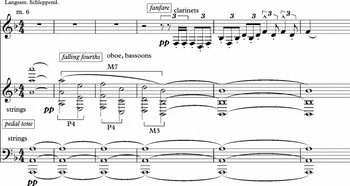
This kind of mythic architecture exists in the structure of a number of late Romantic musical compositions and applies to Star Trek's title cue both because of the tradition of using this style in film and television (certainly practiced by this series’ composers, who were influenced by Wagner, Mahler, Strauss, and the like), and because Courage seems to allude specifically to Gustav Mahler's first symphony (1889). The texture of Star Trek's space theme, with its cascading open intervals over a pedal point on A and layering of the fanfare on top of it, references the opening of Mahler's “Titan” (Examples 3 and 4).Footnote 51 To music theorist Byron Almén, the initial falling fourths in Mahler's symphony (the “theme of fourths”) “can stand for the undifferentiated source from which the hero, the society, the world emerge,” . . . the “first constructive element of culture, dividing the empty octaves into their most fundamental components, the fourth and fifth.”Footnote 52 Mahler creates “Titan’s” hero from raw potential—potential first expressed through this simple but powerful musical motive. The symphony's atmospheric beginning represents the hero's birth and youthful innocence, and its fanfare calls him to action. Its second movement, sprightly and subtitled “set with full sails,” launches the hero on his epic journey. As the symphony continues, Mahler's hero engages in his quest, experiences his final battle, and eventually emerges victorious.Footnote 53
Gustav Mahler, Symphony no. 1, mvt. 1, mm. 6–11 (London: Boosey and Hawkes, 1943). (Reduced by author.)

Star Trek's title cue, mm. 1–5. (Transcribed from holograph full score and reduced by author.)

In referencing the first few measures of Mahler's symphony, as well as key features of the symphony's first two movements, the Star Trek title cue conveys the initiation of the Hero's trial. The space theme, similar to Mahler's falling fourths, provides the original substance from which the Star Trek Hero emerges, and the fanfare beckons the Hero into the unknown. The cue's beguine, dynamic and purposeful, has a similar effect as the second movement of Mahler's symphony, sending the Hero on its way. The narrative present in Star Trek's main title cue anticipates the narrative structure of the entire series.
The Fanfare as Framing Material
The title cue carries its narrative and ideological activity into the show proper as its themes are employed strategically within the underscore. In his book Tuning In (2010), Ron Rodman classifies the television title cue as a framing tool, part of the network of signifiers that helps spectators grasp the structure of the series and of each episode.Footnote 54 The fanfare was particularly useful in this regard, being both distinctive and malleable, and divisible into smaller motivic cells such as the perfect fourth and minor seventh. As such, it became the statement most employed as a framing device, helping the spectator transition into and out of the show's story, negotiating the move between non-program and program space in commercial returns, and bridging between scenes.Footnote 55 In the main title cue and at returns from commercial breaks, the fanfare acts as the primary sonic statement by which the audience recognizes the show's return. As bridge material, it assists in changes between scenes, often accompanied visually by a shot of the Enterprise moving through space, or paired aurally with a voiceover by the captain. In these situations, the fanfare does double duty by simultaneously signifying both the series and its Hero.
Several cues from Sol Kaplan's music for the first-season episode “The Enemy Within” (1:5) demonstrate the framing roles discussed above and the importance of the fanfare within them. Kaplan employed the fanfare in fifteen of the episode's twenty-six music cues, using this theme (and an abbreviation of the space theme with it) to negotiate commercial returns and inter-scene transitions through “fly-ins” and “captain's logs.”Footnote 56
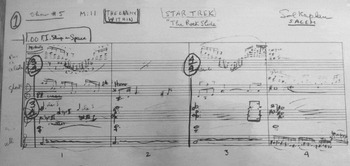
The Star Trek fly-in sequence sonically and visually indicates the show's beginning, a return from commercial break, or a change in scene. These transitions pair the fanfare with a shot of the Enterprise moving through outer space, essentially “flying in.”Footnote 57 There are several such musical cues in “The Enemy Within,” with the episode's initial fly-in occurring at the start of the first cue, M11 “The Rock Slide” (Example 5). This cue quotes the space theme (with an added pentatonic glissando in the piccolo, flute, and celesta) and then presents the horn statement of the fanfare in its original key. It occurs at the very beginning of the episode, even before the main title sequence, and as such is the first moment at which the spectator is aurally cued to the episode's start. A mere four measures (twelve seconds) long, this cue allows for a quick transition into the events that instigate the episode's main conflict—a transporter accident that physically splits Kirk into two versions of himself.
Sol Kaplan, composer. Fly-in sequence from cue M11, “The Rock Slide,” from “The Enemy Within.” Holograph sketch score, Sol Kaplan Papers, 1948–1994, MSS 09853, Box 30, American Heritage Center, University of Wyoming, Laramie, WY.

Fly-in transitions of this sort occur throughout the episode and sometimes preface and underscore voiceovers by Captain Kirk, presented under the guise of captain's logs. (They also echo a similar device found in police dramas, in which episode introductions occur in voiceover narrations.)Footnote 58 In the logs, the captain overlays the cue with his perspective on the current crisis. The cue M24, “Kirk's Log,” from “Enemy Within,” provides an example: “Captain's Log, stardate 1672.1. Specimen-gathering mission on planet Alpha 177. Unknown to any of us during this time, a duplicate of me, some strange alter ego, had been created by the transporter malfunction.” Other crewmembers read from the log in Kirk's stead when circumstances require, such as in cue M52, “Spock Takes Over.” Here, Spock takes on some of the responsibilities of captain and makes note of it for Starfleet records.Footnote 59 Therefore, although the captain's log usually highlights Kirk, and continues to refer to him even when he is absent, it also refers more generally to the position of captain and any character who takes on the role.
The fly-in and the captain's log were employed several times per episode throughout the series’ three seasons, and it became regular practice to pair the image of the ship with a statement of the fanfare.Footnote 60 Music editor Jim Henrikson remarked that using the fanfare in this way was, indeed, standard practice and was done on instruction from the show's producers:
Yep. That was a dictum. That was a—well, a Bob Justman-passed-on dictum. I don't know that it originated with Bob [Roddenberry's assistant producer], but that when we went—they wanted a signature when they were on the exterior of the Enterprise, in most cases. Unless you’re in the middle of a firefight or something, when the cuts were very quick. But if it's a traveling shot of this thing that's going into—going through space, and we’re inside on the bridge, or something, and we’re playing suspense because they’re going—and then we go to the outside, they want some statement or variation of that Star Trek theme; and we can't just play through it and ignore it folks. . . . So all of the bridges and all of the traveling shots. There was a standard thematic thing based on Sandy's [Courage’s] theme, which played under the reading of the Star Trek log, which was a plot device that was used in almost every show, where Kirk reads the Star Trek [star]date.Footnote 61
This type of audio-visual sequence occurs often enough in the original series, and in later Star Trek series and films, to be considered a fundamental framing device within the franchise. As the series progressed, its composers and music editors also employed fly-in and captain's log sequences in the same style as the fanfare, such as the theme Steiner composed for the ship, which inverted the fanfare melody so that the perfect fourths fall (instead of rise) to create a minor seventh.Footnote 62 The fly-ins highlight the ship and its multinational crew as a representation of Star Trek's Hero, and the captain's log marks Kirk as the series’ primary male lead, enacting both the series’ message of social inclusion and its foundation in white, male leadership.
The Fanfare as Referential Theme
The fanfare does not, however, need to work as a framing tool in order to act referentially. It also highlights the position of “captain” more generally and even the ship itself in non-framing sequences. In “The Omega Glory” (2:54), for instance, it accompanies Lieutenant Hikaru Sulu and his command of the bridge—sans fly-in sequence or log—while Kirk, Spock, and McCoy are quarantined on a planet below the ship. In “The Enterprise Incident” (3:59), the fanfare sonically reinforces Lieutenant Montgomery Scott's brief command while Kirk and Spock are held on a Romulan ship under suspicion of espionage. The theme further lionizes Star Trek's Americanist ideals, as in “The Omega Glory,” where the fanfare appears in the underscore as Kirk waxes philosophical about the Constitution of the United States, imploring the Yangs (the episode's white aliens, who practice a democratic political system) to share their enlightenment with the Kohms (the episode's “Asiatic” aliens, who live under a form of Communism):
[The Constitution] was not written for the chiefs or the kings or the warriors or the rich and powerful, but for all the people! . . . “We, the people of the United States, in order to form a more perfect union, establish justice, ensure domestic tranquility, provide for the common defense, promote the general welfare, and secure the blessings of liberty to ourselves and our posterity, do ordain and establish this constitution.” These words and the words that follow were not written only for the Yangs, but for the Kohms as well! . . . They must apply to everyone or they mean nothing!
While Kirk speaks, a cue based on the fanfare builds underneath (cue M32, “Kirk's Philosophy”), emphasizing his heroism and that of the U.S.-style democracy upon which the series’ Federation of Planets was conceived. In this episode, as in others, the white group carries the redemptive philosophy, and the fanfare stresses it. In the end, however, the hero that the fanfare primarily affirms is Kirk.
The Fanfare as Kirk's Leitmotiv
It is not surprising that Star Trek's primary musical theme highlights its main character most strongly. Kirk's centrality within the story comes with a long history of traditional power structures in Western literature and art, in which the white, male hero dominates the story and all within it. As the leader and primary focus of the series, Kirk is the individual with whom the spectator is most meant to identify. He possesses continuous and superior agency, demonstrating many of the characteristics through which men, according to gender scholar Allan G. Johnson, justify their privilege: “Men [especially white men] are assumed (and expected) to be in control at all times, to be unemotional (except for anger and rage), to present themselves as invulnerable, autonomous, independent, strong, rational, logical, dispassionate, knowledgeable, always right, and in command of every situation, especially those involving women. These qualities, it is assumed, mark them as superior and justify their privilege.”Footnote 63Star Trek validates Kirk's position as leader and hero in this way. Even when he displays weakness, such as emotional or physical injury, this struggle becomes part of his narrative of overcoming and his growth as the hero.
Kirk's centrality becomes especially clear through his personal agency in connection with the characters who surround him. Most of his colleagues are humans (or half-humans) othered through ethnicity, race, or gender. Spock is a half-Vulcan, half-human hybrid who, because he isn't entirely human, presents as almost fully alien. Chief Engineer Montgomery Scott is Scottish, Lieutenant Hikaru Sulu is Japanese, Ensign Pavel Chekov is Russian, Yoeman Janice Rand and Nurse Christine Chapel are female, and Lieutenant Uhura is African and a woman. The only other white, un-raced male in the regular crew is secondary lead character Doctor Leonard McCoy, who negatively contrasts with Kirk's personality and upbringing even though he acts as Kirk's confidant: McCoy is a cantankerous southern boy from Georgia, and Kirk is a reasonable man from Iowa, the heartland of the United States.Footnote 64 McCoy is “southerned” enough that Kirk is the only character on the ship who truly represents the U.S. masculine ideal. Kirk is the head of a group of almost fully othered characters, presenting white, male viewers with an image of themselves as benevolent leaders and not oppressors.Footnote 65
Through its use of the fanfare as leitmotiv, the series’ underscoring further marks Kirk as the primary hero.Footnote 66 “The Enemy Within” provides a compelling example of the theme's use in this manner. In this story, a transporter malfunction physically splits Kirk into two separate versions of himself: one driven by aggression and animal instinct and the other struggling with timidity and indecision. A physical battle erupts between the two sides of Kirk's psyche: what some series documents call the “Evil Kirk,” who cannot control his passions, and the “Good Kirk,” who, although beset by serious doubts regarding his own command ability, works in tandem with the ship's doctor and first officer for the good of several crew members stranded on an icy planet below the ship.Footnote 67 To help communicate Kirk's struggle (an inner conflict made external), composer Sol Kaplan employed the fanfare as a leitmotiv. More than just a musical signifier of Kirk's presence, the fanfare in this case reflects Kirk's development, manipulated when necessary to comment on his physical and emotional condition. As the events of the episode challenge and transform his inner self (or selves), the fanfare transforms with him. This theme, heroic, strong, and masculine, indicates Kirk's moral, intellectual, and physical superiority; as he struggles, it is modified to match.
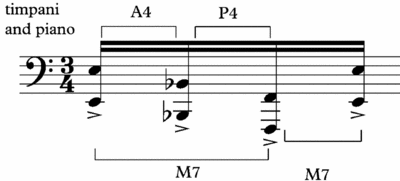
Kaplan transforms the fanfare into several versions for Good Kirk and Evil Kirk. Evil Kirk has two themes: an angry rhythmic explosion based on the fanfare's initial minor seventh figure (Example 6 : Evil Kirk “A”) and an ominous chromatic theme based on the general contour of the fanfare melody (Example 7 : Evil Kirk “B”). The first Evil Kirk theme is a one-beat, four-sixteenth-note motivic cell, and closer inspection reveals it as a modified inversion of the fanfare's initial rising fourths. Here, however, the intervals descend and the first widens to a tritone, transforming the minor seventh figure to a major seventh and enhancing the line's dissonance. Percussive and performed in the lower ranges of the timpani and piano, it provides an aggressive sonic burst that echoes Evil Kirk's volatile temper. Kaplan easily inserts this statement, brief and full of kinetic fury, into the score as necessary.
Evil Kirk “A” from cue M13, “The Evil Kirk,” from “The Enemy Within.” (Transcribed from holograph sketch score by author.)
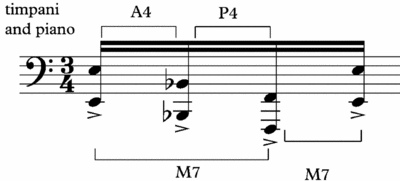
Evil Kirk “B” from cue M14, “Alter Ego,” from “The Enemy Within.” (Transcribed from holograph sketch score by author.)

The second Evil Kirk theme is much longer and more melodic. The tune reaches at first for the fanfare's initial minor seventh but falls short, landing on the tritone instead. As the theme progresses, it continues to deviate from the original fanfare, at first at least attempting its contour, but then diverging fully in a winding tumble of eighth notes. Although this theme lacks the force of the first Evil Kirk theme, its failed imitation of the original fanfare, with occasional tritones and major sevenths, aurally depicts the character's twisted persona. It is a dysphoric line written for the dark woodiness of the bass clarinet, its chromatically altered intervals sounding “out of tune.”Footnote 68 These two themes for Evil Kirk, one kinetic and hostile, and the other sinister and dark, each in their own way emphasize Evil Kirk's deviance from the captain's normally whole and balanced character.
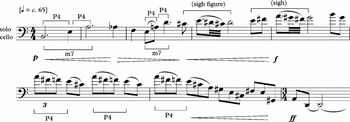
Kaplan's theme for Good Kirk, on the other hand, affirms the captain's more sensitive nature and expresses his current vulnerability (Example 8). This version of Kirk, who demonstrates thoughtfulness and concern for others (although without the drive and determination he possesses when whole), is more in line with the best of humanity that Star Trek was attempting to portray. The Good Kirk theme reflects this stance, remaining more closely aligned with the original fanfare through its fidelity to the fanfare's perfect-fourth and minor-seventh intervals. Although rhythms and pitches are altered as the melody progresses, the Good Kirk theme avoids the tritones and major sevenths found in either of the Evil Kirk themes. Performed by a solo cello, it is slow, thoughtful, soft, and tender. Its sigh figure—an ornamented pianto, or falling minor second, often associated with lamentation—punctuates Good Kirk's sense of loss.
Good Kirk theme from cue M53, “Help Me,” from “The Enemy Within.” (Transcribed from holograph sketch score by author.)

As Evil Kirk and Good Kirk struggle with each other, with Good Kirk slowly gaining strength and Evil Kirk ultimately succumbing to his fears, their respective themes evolve with them. The Good Kirk theme, transferred to the brass, attains force, and the Evil Kirk themes are deprived of their hostility, assigned to higher-pitched instruments—the soprano clarinet instead of the bass clarinet, for example. In fact, once the two Kirks are reunited through a bit of ingenious transporter manipulation, the original fanfare is proclaimed loudly in a celebratory trumpet call (cue M63, “One Captain Kirk”).
Kaplan's use of the fanfare as a leitmotiv for the captain gives the spectator privileged access to the emotional state of the two Kirks as they struggle within themselves and with each other. Kaplan is not the only Star Trek composer to employ the fanfare in this way when scoring Kirk. Gerald Fried, in his score for “The Paradise Syndrome” (3:58), uses the fanfare to indicate the captain's bewilderment when he realizes he has amnesia. The fanfare enters quietly, faint and insecure as Kirk tries to remember who he is, and the spectator, who of course knows Kirk's true identity, becomes aware that his memories are resting just beyond reach. This use of the fanfare as leitmotiv for Kirk is not uncommon within the series, with composers retooling the theme to connote the emotional struggles of the show's leading man.Footnote 69
This leitmotivic treatment marks Kirk as the Star Trek hero with the most depth. The transformation of the fanfare theme as Kirk encounters new physical and emotional challenges encourages the spectator to pay particular attention to his personal development above all others’, a tendency compounded by the series’ hierarchy of power and agency, which already places Kirk at the top. Through Kirk and his musical portrayal, the series’ three seasons consistently promote this patriarchal, racially conservative stance, demonstrating that although Roddenberry and his team ostensibly supported progressive liberal social change in terms of gender and race, they were in fact also resisting that change and its consequences.
A Series on the Edge
Kirk's centrality, musical and otherwise, is one manifestation of the tension in the series between its progressive intentions and its innate conservativism. Neither stance, however, negates the other: Star Trek mobilized its liberal agenda even while maintaining aspects of the status quo. Although the series demonstrated a special regard for racial diversity and gender equality (among other concerns of the day), it concurrently showed preference to white, heteronormative, American men. Female characters, for instance, were marginalized and romanticized: although their careers as military personnel and as intellectuals within the series were notable, their positions rarely extended far beyond what was acceptable at the time. Further, their presence primarily served romantic ends, and they were consistently marked as love interests through their scoring.Footnote 70Star Trek created a fantasy world in which intergalactic politics, starships, alien worlds, and outer space itself placed the white male in the dominant position.
Therefore, although the title cue highlights Star Trek's socially concerned agenda by beckoning both the show's characters and its audience into humanity's “final frontier,” the ways in which its scoring centers the white male undermines its intent. This emphasis calls into question the series’ treatment of its others—its women, raced humans, and aliens—especially in terms of how their identities are expressed musically. Further research regarding this phenomenon in the Star Trek franchise as a whole, particularly in light of how its films, television series, and other media incarnations address social and political change, has the potential to illuminate how changes in discourse occurred over time, as the franchise adjusted its approach to race, gender, class, and international politics through the decades between the sixties and now. Star Trek's title cue, and its use within the original series, brings into focus an ideological rupture, the fault lines of which stretched both forward and backward in time, giving us a glimpse of the tensions at the series’ heart.