There are strong evidences in the literature that caregivers can experience even greater distress than patients themselves. This is especially true in the case of childhood cancer (Vrijmoet-Wiersma et al., Reference Vrijmoet-Wiersma, van Klink, Kolk, Koopman, Ball and Maarten Egeler2008). The diagnosis of cancer in a child is often a devastating blow to parents and can create an instant crisis in the family. Families are often dubbed “the hidden sufferers” because family members have their own and the patient’s emotions to deal with (Houtzager, Grootenhuis, & Last, Reference Houtzager, Grootenhuis and Last1999; Pai & Kazak, Reference Pai and Kazak2006; Vrijmoet-Wiersma et al., Reference Vrijmoet-Wiersma, van Klink, Kolk, Koopman, Ball and Maarten Egeler2008).
Overall, studies on parents’ reactions to childhood cancer have identified high levels of anxiety, depression, psychological distress (e.g., posttraumatic stress symptoms) and other disturbances such as fear of recurrence or extensive worry (Bruce, Reference Bruce2006; Grootenhuis & Last, Reference Grootenhuis and Last1997; Packman, Weber, Wallace, & Bugescu, Reference Packman, Weber, Wallace and Bugescu2010; Taïeb, Moro, Baubet, Revah-Lévy, & Flament, Reference Taïeb, Moro, Baubet, Revah-Lévy and Flament2003; Vrijmoet-Wiersma et al., Reference Vrijmoet-Wiersma, van Klink, Kolk, Koopman, Ball and Maarten Egeler2008; Wakefield, Mcloone, Buto, Lenthen, & Cohn, Reference Wakefield, Mcloone, Butow, Lenthen and Cohn2011). Although psychological distress among these parents has been shown to decrease as a function of time since the child’s cancer diagnosis (Pai et al., Reference Pai, Greenley, Lewandowski, Drotar, Youngstrom and Peterseon2007), a subgroup of parents reports a high level of psychological distress even after the end of the child’s treatment (Bruce, Reference Bruce2006; Vrijmoet-Wiersma et al., Reference Vrijmoet-Wiersma, van Klink, Kolk, Koopman, Ball and Maarten Egeler2008). In survivorship period, parents still have to handle the risk of relapse and they often report increased levels of worry and fear of recurrence (Klassen et al., Reference Klassen, Raina, Reineking, Dix, Pritchard and O’Donnell2007; Manne, Reference Manne2005). Moreover, for some of them, the cancer experience is so demanding that it could have caused marital or family strains (e.g., due to economical or occupational difficulties, changed family roles) which might increase distress (Hovén, von Essen, & Norberg, Reference Hovén, von Essen and Norberg2013; Long & Marsland, Reference Long and Marsland2011; Pai et al., Reference Pai, Greenley, Lewandowski, Drotar, Youngstrom and Peterseon2007).
All these previous studies have been helpful in quantifying parents’ distress and some of the dimensions of their experiences and reactions, both during the illness and once the treatment has ended. However, it is worth remembering that this is just one side of the coin.
Qualitative research has further explored the lived experience of parents over the course of their child’s cancer, and this approach has provided new and very interesting insights in this field. In this sense, Wong and Chan (Reference Wong and Chan2006) found four emerging topics when describing parents’ coping experiences: 1) shock and denial, 2) establishing the meaning of the situation, 3) confronting the reality and 4) establishing a new perspective. In a similar study, Woodgate (Reference Woodgate2006) found that the main theme emerged when exploring families’ experiences of childhood cancer was “life is never the same”. Similarly, Yeh (Reference Yeh2003) found one main category among parents: “coming to terms as parents”. That is, to develop their ability to endure the stress of caring for a child with cancer. These studies are very helpful in clarifying the experiences of parents since they include some non-stressful consequences of having a child who has experienced cancer. Therefore, awareness is growing that such life-threatening event can be a catalyst for growth and positive change too.
Generally, the identification of positive consequences from adversity has been termed as benefit finding (Michel, Taylor, Absolom, & Eiser, Reference Michel, Taylor, Absolom and Eiser2010). This is defined as: the fact to find benefits (or positive consequences) in personal, social, psychological and/or spiritual domains, after having suffered a trauma or having experienced a highly adverse situation (Kinsinger et al., Reference Kinsinger, Penedo, Antoni, Dahn, Lechner and Schneiderman2006). Although traditional psychology has been mainly focused on negative psychological impact after traumatic events, recently, with the rapidly increasing literature on positive psychology, more attention is paid to positive reactions and personal strengths in the face of stressful events (Alisic, van der Schoot, van Ginkel, & Kleber, Reference Alisic, van der Schoot, van Ginkel and Kleber2008; Joseph & Linley, Reference Joseph and Linley2006; Seligman & Csikszentmihalyi, Reference Seligman and Csikszentmihalyi2000).
Consequently, a growing body of research on survivors of childhood cancer has documented the presence of benefit finding among this population including both parents and patients (Castellano-Tejedor, Blasco-Blasco, Pérez-Campdepadrós, & Capdevila-Ortís, Reference Castellano-Tejedor, Blasco-Blasco, Pérez-Campdepadrós and Capdevila-Ortís2014; Castellano, et al., 2015; Currier, Hermes, & Phipps, Reference Currier, Hermes and Phipps2009; Michel et al., Reference Michel, Taylor, Absolom and Eiser2010). In the case of patients, recent studies show that suffering cancer during childhood might enhance psychosocial function in survivorship (Servitzoglou, Papadatou, Tsiantis, & Vasilatou-Kosmidis, Reference Servitzoglou, Papadatou, Tsiantis and Vasilatou-Kosmidis2009). In the specific case of parents of children with severe illnesses, there is some suggestion that they experience lasting benefit from the experience as well. Hungerbuehler, Vollrath, and Landolt (Reference Hungerbuehler, Vollrath and Landolt2011) reported that parents of youth with chronic illness show a moderate degree of growth after their child’s diagnosis. Barakat, Alderfer, and Kazak (Reference Barakat, Alderfer and Kazak2006) have reported specifically on benefit finding in parents of childhood cancer survivors. In their sample of more than 100 mothers and fathers of adolescent cancer survivors, they found that 90% of mothers and 80% of fathers reported at least one positive consequence due to the child’s cancer disease, whereas almost 50% of them reported four or more positive consequences. Specific and most highlighted consequences were: 1) changed perspectives in life, 2) better relationship with other people and 3) increased empathy. Similarly, Michel et al. (Reference Michel, Taylor, Absolom and Eiser2010) have reported that parental benefit finding was positively related to how much they felt their child’s prior cancer diagnosis and treatment affected their lives.
Despite previous findings, most research has focused on the negative impact of childhood cancer on the family system, and little research has explored the existence of benefit finding among parents of childhood cancer survivors (Ljungman et al., Reference Ljungman, Cernvall, Grönqvist, Ljótsson, Ljungman and von Essen2014). Additionally, studies on how different variables occurring during treatment can be related to distress or benefit finding in survivorship among this sample of parents are scarce (Ljungman et al., Reference Ljungman, Cernvall, Grönqvist, Ljótsson, Ljungman and von Essen2014; Manne, Reference Manne2005). Thus, more research is needed to add to the existing knowledge.
For all these reasons, the present cross-sectional descriptive study is aimed to explore the lived experienced in a sample of parents of childhood cancer survivors asking about two specific moments:
-
a) Retrospectively, during treatment period: cancer-related distress, social support, optimism and coping in the worst case scenario self-identified during that period.
-
b) Currently, at cancer survival: cancer-related distress, general stress, and perceived positive (benefit finding) and negative consequences.
Besides, possible associations between parents’ variables related to reactions during treatment and cancer-related distress after treatment will be explored (controlling confounders related to child’s demographics and medical variables).
Methods
Study design
Cross-sectional descriptive study. Data collected during survival period was related to retrospective variables such as: perceived social support, optimism, distress and coping in the worst situation; and current variables such as: general stress, distress regarding cancer and benefit finding in the aftermath of cancer. The present study is part of a bigger research project that consisted in the development of a resilience framework in childhood cancer (Castellano, Reference Castellano2011; Castellano et al., 2014).
Ethical considerations
The whole study was carried out at the University Hospital Vall d’Hebron, Paediatric Oncological & Hematological Department. Ethical approval was obtained from the hospital ethics committee board. Informed consent was obtained before participation from each participant after they received an information sheet and oral explanations about the aims and characteristics of the study. This research complies with the Helsinki Convention norms and its subsequent amendments.
Participants
Recruitment and sampling
Eligible participants were recruited after adolescent cancer survivors were identified from the RNTI-SEOP (Peris-Bonet et al., Reference Peris-Bonet, García, Muñoz and Pardo2007), a hospital-based central registry for all pediatric oncology centers and geographic areas of Spain. Participants included 41 parents of childhood cancer survivors.
Inclusion criteria for adolescent survivors required that: (a) adolescents had been diagnosed with cancer (excluding central nervous system tumors in order to reduce bias due to possible cognitive impairment) after the age of 8, (b) to be 13–20 years old at the time of the study (both included), (c) to be off-treatment ≥1 year at the time of the study, and (d) to have a follow-up appointment at the reference hospital between May 2009-May 2010.
Parents’ inclusion criteria were: (a) be living at home together with their child with cancer and (b) voluntarily agree to participate in the study. The exclusion criteria for parents were: (a) parents themselves or their children were suffering from an existing mental health difficulty or a learning disability, prior to their child’s diagnosis with cancer, and (b) participants not able to understand and speak fluent Spanish. Only one parent for each survivor included was assessed (the main caregiver, self-identified).
Measures
All measures were collected in the same assessment period.
Measures related to retrospective data
Measures related to the current situation
Perceived social support. In order to achieve a quick and easy to answer instrument to assess self-perceived social support throughout cancer treatment (from diagnosis to survival), three ad hoc numeric scales were designed. These scales included the three dimensions of social support (emotional, informative and instrumental) and were pilot tested before starting the current research to ensure their comprehensibility and suitability. In the first item, the parent was requested to consider to what extent he/she has received emotional support from each of the people listed: partner/husband/wife, relatives, friends, physician, nurse and others (specifying). Responses ranged from 0 = Nothing at all to 10 = Very much. The second item was answered in the same scale response but it was aimed to assess instrumental support. Finally, the last item was aimed to assess informative support.
Optimism
To measure the general predisposition toward optimism or expectations of positive results, the LOT-R (Scheier, Carver, & Bridges, Reference Scheier, Carver and Bridges1994) was used in its Spanish adaptation (Otero, Luengo, Romero, Gómez, & Castro, Reference Otero, Luengo, Romero, Gómez and Castro1998). The LOT-R was administered in situational format, asking respondents to focus at the most difficult situations throughout the oncological treatment. In our study, Cronbach’s Alpha of the scale was .78, suggesting the scale has an acceptable level of internal consistency.
Cancer-related distress
To assess cancer-related distress parents were requested to think back and focus on the difficult times throughout hospitalization and firstly, to rate to what extent they experienced distress (degree of distress), with responses ranging from 0 = Nothing at all, to 10 = A lot. Secondly, they were requested to rate their self-perceived effort to overcome or cope with that situation in the same 10-point scale response.
Coping
Coping was assessed with the situational version of the COPE (Carver, Scheier, & Weintraub, Reference Carver, Scheier and Weintraub1989). This time limited-version serves respondents to indicate the degree to which they actually did have each possible response during a particular period of time (in this case, the hospitalization of their child). The COPE is a self-report checklist inventory that consists of 60 items scored on a 4-point Likert scale (ranging from 1 = I usually don’t do this at all to 4 = I usually do this a lot), which assesses the use of 15 coping strategies in dealing with stress (Carver et al., Reference Carver, Scheier and Weintraub1989). Higher scores indicate higher use of these coping strategies. The strategies could be collapsed into 3 basic coping styles: engagement, disengagement and help-seeking (Gutiérrez, Peri, Torres, Caseras, & Valdés, Reference Gutiérrez, Peri, Torres, Caseras and Valdés2007). The COPE provides normative data (Crespo & Cruzado, Reference Crespo and Cruzado1997). Cronbach’s Alpha ranged between 0.84 and 0.81 for engagement and help-seeking respectively, to 0.69 for disengagement.
Measures related to the current situation
Demographics
Age, gender, educational attainment and employment status was collected for all participants. As possible confounders, several variables concerning their children were collected and considered for statistical analyses (child’s age, gender, diagnosis, time elapsed since diagnosis and sequelae at survival).
General perceived stress
The Perceived Stress Scale (PSS) was used to measure how controllable and unpredictable people viewed their lives, as an important component of the experience of stress. In this study the 14 items version was employed. The PSS-14 asks participants to rate their stress over the past month (Cohen, Kamarck, & Mermelstein, Reference Cohen, Kamarck and Mermelstein1983), with 7 items negatively stated (items 1, 2, 3, 8, 11, 12 & 14) and 7 items positively stated (items 4, 5, 6, 7, 9, 10 & 13). The response set ranges from 0 = Never to 4 = Very often. Positively stated items are reverse coded before items are summed with higher scores indicating more perceived stress. Scores for the 14-item form range from 0 (no self-perceived stress) to 56 (maximum self-perceived stress). The authors recommend the cut-off point ≥30 to consider the existence of significant stress (Cohen & Williamson, Reference Cohen, Williamson, Spacapam and Oskamp1988). The PSS-14 has adequate psychometric properties (Remor, Reference Remor2006) and it has an easy and rapid administration (<10 minutes). In our sample, Cronbach’s Alpha was .82.
Cancer-related distress
To assess persistence of cancer-related distress in survivorship a 3-item numeric scale was developed to screen: 1) degree of worry, 2) frequency of thought (frequency of worry) and 3) interference of these worries in the parents’ daily routines (day-to-day distress). Items were the following: 1. How concerned are you regarding your child’s cancer currently? (From 0 = Not at all to 4 = A lot), 2. How much do you think about your child’s cancer currently? (From 0 = Never to 4 = A lot (several times per day) and 3. How much distress would you say you experience currently related to the oncological experience? (From 0 = Not at all, to 4 = A lot).
Positive and negative consequences
Perceptions of positive and negative consequences in survivorship with regard to the whole oncological experience were asked by means of a semi-structured interview based on two items: 1.Which would be for you the most negative consequences of having had a child with cancer at present? And 2.Despite everything, do you consider you have obtained something good from the oncological experience you have been through? Answers were transcribed literally and lately categorized as: 1) only positive consequences are reported, 2) only negative consequences are reported, 3) positive and negative consequences are reported and 4) no consequences (neither positive, nor negative) are reported. In this article, we use the term benefit finding to refer to any perceived positive changes, posttraumatic growth, or the perception of certain positive aspects from having a child who had survived cancer.
Procedure
Parents eligible for the study were contacted via telephone by a qualified researcher in psychology. In this initial contact, they were informed about the purpose of the study and asked for participation. If they agreed to participate, an assessment appointment was scheduled. The assessment was conducted by the main researcher of the study, in a hospital office for a 45-minute session. Once participants came to the assessment appointment, the psychologist provided oral and written information about the study and informed consent was obtained before starting the assessment. The whole assessment lasted one unique session about one hour and a half. The order of the questionnaires was as follow: demographics, PSS-14, current cancer-related distress, perceived social support during cancer, cancer-related distress during cancer, LOT-R, COPE and benefit finding.
Data analyses
All analyses were carried using SPSS version 19. This study provides descriptive statistics (mean, standard deviation, range, median, frequencies and percentages) about participants’ demographics and variables assessed. To examine differences between groups, non-parametric (χ2 and Mann-Whitney U tests) and t Student tests for independent samples were performed. Parental narratives related to positive and negative consequences were collected and literally transcribed and then, categorized and coded in parallel by two experts in traumatic stress and chronic diseases using a content analysis approach with no previous theoretical framework. Categories were compared between the two experts and a consensus was reached between them. A final categorization was used to generate dichotomous variables (presence vs. absence of positive and negative consequences) in order to perform non-parametric (Mann Whitney’s U) score comparisons with the rest of the variables included in this study (current and past cancer-related distress, optimism, coping, general stress and perceived social support). Analyses were controlled for possible confounders; specifically, variables concerning children: child’s age, gender, diagnosis, time elapsed since diagnosis and sequelae at survival performing preliminary bivariate analyses. A 95% confidence interval was used for all analyses and effect size (Cohen’s d and r values) was indicated when significant differences were reached.
Results
Participants’ characteristics
Of the 93 potential participants identified, 46 (49.5%) were not reached due to incorrect or missing contact information, 6 (6.4%) declined to participate, and the remaining 41 (44.1%) participated in the study.
No differences were noted between parents who participate and those who declined on child’s age, gender, diagnosis, sequelae or time since completion of medical treatment.
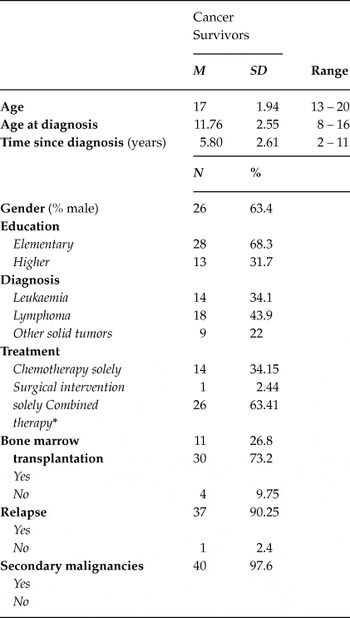
Table 1 shows the demographical and clinical characteristics of the adolescent survivors.
Sample characteristics (N = 41)

* Including: chemotherapy + radiotherapy, chemotherapy + surgical intervention, chemotherapy + surgical intervention + radiotherapy, radiotherapy + surgical intervention.
At the time they were interviewed participants ranged between 23 and 62 years old (M = 46.43, SD = 7.16). All participants except one were birth parents to the children. We counted on the participation of 8 males (19.5%) and 33 females (80.5%). All the males that participated had a full-time job (n = 8, 100%). Among them, 4 (50%) had a degree equal or lower to school graduate, secondary school or similar degrees; 3 cases (37.5%) had completed their secondary school degree or higher; finally, 1 case (12.5%) had completed his University degree. In mothers’ case, most of them were working (n = 22, 66.6%), either full-time job (n = 15) or half-time job (n = 7). The rest were homemakers (n = 7, 21.21%), or in unemployment (n = 3, 9.09%) and only 1 mother was incapable and was not working (3.03%). Regarding their educational degrees, 1 woman (3.03%) had not cursed any degree, though she was able to read and write correctly, 5 women (15.5%) abandoned their degrees before completing the primary school, in 10 cases (30.3%) women had completed primary school, 13 women (39.3%) had completed secondary school or similar, and only 4 women (12.2%) had finished University degrees. Descriptive results concerning the children of these parents were the following: mean age was 17 years old (SD = 1.94, range 13–20), age at diagnosis was 11.76 years old (SD = 2.55, range 8–16), time elapsed since diagnosis was 5.8 years old (SD = 2.61, range 2–11), 63.4% (n = 26) were males, 34.1% (n = 14) had leukemia, 43.9% (n = 18) lymphomas and 22% (n = 9) other solid tumors. Concerning sequelae, in an 8-point Likert scale, adolescents scored M = 1.02, SD = 1.06 (range 0–5).
Descriptive outcomes
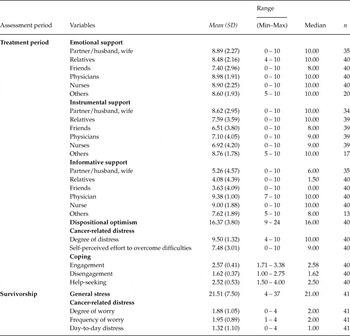
Results regarding objective 1 –to explore and describe parental reactions to childhood cancer throughout the oncological experience (during treatment period and at survival) are displayed in Tables 2 and 3.
Descriptive results (N = 41)

Positive and negative consequences of having a child who has survived cancer (N = 41)

Treatment period
During treatment, social support was described as high, especially for emotional and instrumental domains. Medians were above 8 except for some specific cases (e.g., informative support). The highest score for emotional support was referring to support received from healthcare practitioners; physicians (M = 8.98, SD = 1.91) and nursing staff (M = 8.90, SD = 2.25) and the partner (e.g., husband, wife; M = 8.89, SD = 2.27). An equivalent amount of emotional support was offered by sentimental partners (M = 8.89, SD = 2.27) and extended family members (M = 8.48, SD = 2.16).
In the case of the instrumental support, parents especially stressed the support received from their partners, family members (median = 10), healthcare practitioners (median = 9) and from other people such as teachers, social workers and colleagues from work (n = 17, 42.5%).
Finally, informative support came mainly from healthcare practitioners (physicians and nursing staff; median = 10) and barely nothing from other significant ones (such as friends, relatives or the couple). In some cases (n = 13, 32.5%), parents expressed to receive useful information from teachers, volunteers, friends of the family or parents of other patients in the same situation.
Dispositional optimism referred to difficult situations during cancer was medium (mean scores around the cut-off point of 16) with 43.9% cases (n = 18) scoring lower than 16 points, which could be interpreted as “pessimistic” individuals.
Previous social support and optimism outcomes are coherent with scores obtained in cancer-related distress variables which showed very high values for degree of distress in difficult situations during treatment (median = 10), and very high scores on self-perceived effort to overcome such situations (median = 9).
Finally, the most used coping styles during cancer treatment were engagement (M = 2.57) and help-seeking (M = 2.52). According to the qualitative interpretation of the questionnaire, these scores indicate that parents use “quite a lot” such coping styles (maximum score = 4). Disengagement was the less preferred coping style among this sample (M = 1.62).
No differences were found for any of these outcomes considering parental gender or different characteristics of the children (age, gender, diagnosis, sequelae and time elapsed since diagnosis).
Survivorship period
General stress among parents was low (M = 21.51) given that just 14.6% of them (n = 6) scored higher than 30 (cut-off point to screen clinical significant stress).
Once the treatment has ended, cancer-related distress showed medium-to-low scores (median between 1 and 2 in a maximum of 4 points). However, 24.4% of parents (n = 10) had scores ≥3 in degree of worry (“quite a lot” and “a lot”), 26.9% (n = 11) scores ≥3 in frequency of thought (“a lot of times (once per day)” and “a lot (several times per day”) and 19.5% (n = 8) reported that these worries interfered their daily routines “quite a lot” (score = 3) or “a lot” (score = 4).
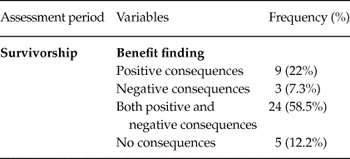
Twenty-four parents (58.5%) stated to find both positive and negative consequences related to the cancer their children have suffered (see Table 3). However, only 22% of them (n = 9) reported just positive consequences.
Similarly to what happened before, no significant differences were found considering parental gender and children’s variables (age, gender, diagnosis, sequelae and time elapsed since diagnosis).
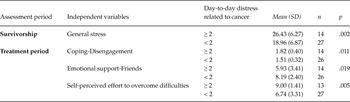
Concerning objective 2 –to explore and describe possible associations between parents’ reactions and variables during treatment, and cancer-related distress at survival– results are displayed in Table 4.
Significant differences between groups considering day-to-day distress related to cancer (N = 41)

Parents scoring higher in self-perceived general stress are also experiencing significantly higher day-to-day distress related to the cancer experience (t (39) = 3.393, p = .002, IC 95% 3.01 – 11.91, Cohen’s d = 1.13, r = 0.49).
Additionally, those parents who used in a greater extent disengagement coping strategies during the treatment period, are now experiencing significantly higher distress (t (38) = 2.667, p = .011, IC 95% 0.07 – 0.55, Cohen’s d = 0.86, r = 0.39). Similarly, those reporting higher efforts to overcome difficulties during cancer, reported higher day-to-day distress once it ended (t (37,7) = 3.019, p = .005, IC 95% 0.74 – 3.75, Cohen’s d = 0.98, r = 0.44).
Contrarily, those parents who received higher emotional support, specifically, from friends, reported lower day-to-day distress in survivorship (t (38) = –2.451, p = .019, IC 95% –4.13 – 0.39, Cohen’s d = 0.88, r = 0.40).
All these results were not related to children’s confounders or parental demographics.
Discussion
The present study was aimed at assessing the lived experience in a sample of parents of childhood cancer survivors. Moreover, this research delves into the literature by providing data examining both negative and positive consequences in fathers of childhood cancer survivors. Our results highlight that there is a considerable amount of persistent distress among these parents at cancer survivorship but also, most of them reported positive consequences altogether with the negative ones. As McKenzie and Curle (Reference McKenzie and Curle2012) have stated in their model, “the end of treatment is not the end” and parents suffer high levels of distress even once cancer treatment has ended. However, there is some research suggesting that this experience can be also a catalyst for growth and positive consequences (Ljungman et al., Reference Ljungman, Cernvall, Grönqvist, Ljótsson, Ljungman and von Essen2014).
As reported by previous studies (Barakat et al., Reference Barakat, Alderfer and Kazak2006; Bruce, Reference Bruce2006; Vrijmoet-Wiersma et al., Reference Vrijmoet-Wiersma, van Klink, Kolk, Koopman, Ball and Maarten Egeler2008), a child diagnosed with cancer adds incredible stress to the family system. The stress of parents can come from very different sources. They have to witness the suffering of their child, they might reside for months in the hospital (sometimes, in a foreign city or region), they might leave behind their remaining children, their homes, their jobs, etc. Moreover, they are expected to manage their child’s complex needs and health specifications inside and outside the hospital. Usually, the process of treatment is described as “getting through” (McKenzie & Curle, Reference McKenzie and Curle2012) and it is managed with the outpouring of social support offered by relatives, friends and healthcare practitioners. Additionally, parents have to constantly adjust their coping strategies and mobilize their resources according to the changeable characteristics of the cancer experience.
In our study, we have found these high levels of distress during the treatment period, as well as high self-reported efforts to overcome difficult situations occurring during the hospitalization. However, parents referred to have received a high amount of social support (emotional, informative and instrumental) from very different sources. In this sense, social support seems to help to maintain some sort of normality and balance between normal life and life at the hospital. These could explain the satisfactory levels of optimism found in our sample. Very related to these outcomes are coping styles displayed among our sample. There are scarce studies exploring such issues in a sample of parents of adolescent survivors of childhood cancer, but our results are in line with Bruce (Bruce, Reference Bruce2006), Long and Marsland (Long & Marsland, Reference Long and Marsland2011) and Ljungman and colleagues (Ljungman et al., Reference Ljungman, Cernvall, Grönqvist, Ljótsson, Ljungman and von Essen2014) research.
Most parents have reported to use engagement coping and help-seeking strategies to overcome difficulties. Some parents recognized to use psychological defenses such as denial and avoidance when coping with the distress of cancer. However, this disengagement style was clearly less preferred in our sample, similar to what happens in general population and other clinical samples (Grootenhuis & Last, Reference Grootenhuis and Last1997; Gutiérrez et al., Reference Gutiérrez, Peri, Torres, Caseras and Valdés2007; Pai et al.; 2007). Avoidance strategies seem to be linked to the concept of positive mental attitude trying not to think about the terrible things that could have happened (Carver et al., Reference Carver, Scheier and Weintraub1989; Phipps, Steele, Hall, & Leigh, Reference Phipps, Steele, Hall and Leigh2001). However, a restricted use have been described as adaptative, whereas an extended use could be related to worse mid-long term adjustment (Horowitz, Reference Horowitz, Hamilton and Warburton1979; Phipps et al., Reference Phipps, Steele, Hall and Leigh2001).
At the end of treatment, parents might usually find themselves balancing emotions that life is normal again and yet it is not going to be as it was before cancer (McKenzie & Curle, Reference McKenzie and Curle2012). Parents seem to coincide about the lasting impact of cancer being part of their lives for the foreseeable future (McKenzie & Curle, Reference McKenzie and Curle2012). Several parents have reported to be unprepared for the end since they feel non-confident managing the unknown, dealing with fears of relapse and certain sense of being less controlled compared to when they had their children hospitalized (Barakat et al., Reference Barakat, Alderfer and Kazak2006; Bruce, Reference Bruce2006; McKenzie & Curle, Reference McKenzie and Curle2012). In addition, social support diminishes and parents have to adjust once again their coping strategies to the requirements of the new situation. This could explain why some cancer-related distress is still present (degree of worry, frequency of thought and interference of distress in daily life), as well as general stress, even if scores are low-to-medium.
Our study has built on earlier investigations by further examining positive and negative consequences of having a child who has suffered from cancer. In this sense, we have found that 22% of our sample reported positive consequences and this percentage reaches almost 60% when considering those who reported some negative consequences too. We believe these results support the use of a positive psychology framework for understanding effects of a child’s cancer diagnosis on parents (Castellano et al., 2014). To date, only a few studies have examined paternal benefit finding from having their child survive cancer (Barakat et al., Reference Barakat, Alderfer and Kazak2006; Michel et al., Reference Michel, Taylor, Absolom and Eiser2010). Therefore, more research is needed to clarify these findings. Although quantitative research is helpful in many ways, qualitative or mixed-methods research is needed to better understand how individuals experience traumatic events and how they can derive benefit from such situations.
When exploring how treatment experiences can influence cancer-related distress in survivorship, we have found parents who were recently more distressed, were those who received less social support, used more disengagement coping and referred higher efforts to overcome difficulties during treatment. These same parents showed higher scores on general stress too. Besides, these results were not influenced by child’s sequelae at survival or the rest of possible confounders from children.
These findings raise interesting questions regarding the assessment and management of distress and coping among parents during active cancer treatment. It is still unclear if these responses resolve on their own over time (Pai et al., Reference Pai, Greenley, Lewandowski, Drotar, Youngstrom and Peterseon2007) or if they are predictable of later distress or adjustment difficulties (Kazak, Boeving, Alderfer, Hwang, & Reilly, Reference Kazak, Boeving, Alderfer, Hwang and Reilly2005). As our results have shown, despite the child has survived cancer, parents’ still report cancer-related distress and it cannot be attributed to late-effects or cancer sequelae. There is a body of scientific literature examining the relationship between demographic and disease variables with these variables (Barakat et al., Reference Barakat, Alderfer and Kazak2006). However, we did not find such associations in our study. Thus, it is important to acknowledge that other variables occurring during treatment have revealed as related explicative factors of persistent distress. In summary, parents who feel more disconnected helpless are those at risk for persistent cancer-related distress at cancer remission. These results suggest that health professionals working within the field of pediatric cancer (that is to say, oncologists, hematologists, nurses, assistant nurses, psycho-oncologists etc.) have a key role by carrying out different actions within a multidisciplinary approach: 1) supporting parents and helping them to adjust and cope with the variable and continuous demands of cancer at different stages, 2) fostering relatedness and social support (specially from friends and their close social circles), 3) anticipating end of treatment (when appropriate) by involving parents in conversations about reduced medical support, adjusting family roles, balancing emotions, designing a contingency plan, etc.
Cancer affects not just those who have the disease but also their caregivers and families. However, parents are sometimes “hidden sufferers” because the identified patient in pediatric oncology is typically the child. Thus, assessments of parents’ distress and adjustment to the process should be broadened and they should be screened routinely and offered evidence-based psychosocial care when needed, specifically at standard milestones (i.e., diagnosis, beginning of treatment, discharge, relapse, etc.). This is totally applicable in the case of parents attending to follow-ups or outpatient consultation too.
Moreover, very few studies have examined both positive and negative effects of long-term cancer survivorship on the family. Most studies that have addressed this topic have focused on psychological distress and maladaptative reactions. Thus, little research has been carried out considering both positive and negatives experiences as a result of childhood cancer in the family. This is relevant because it could be a valuable resource for psychosocial interventions favoring the strengths and own resources of parents to adjust. Although quantitative research is helpful in examining overall levels of negative and positive reactions to childhood cancer among parents, qualitative research is necessary to better understand how individuals experience the potentially traumatic event and what kind of consequences they derived from it. To our knowledge this is one of the scarce research studies addressing this issue.
Finally, we believe a verifiable theoretical framework for further investigation is necessary –preferably based on mixed-methods approaches–, to describe and explain parental experiences during and at the end of treatment for cancer.
A more-in-depth qualitative methodology would have been desirable to clarify the issues raised in our research. Additionally, our sample size is limited and some assessment tools were created ad hoc, which could limit generalization. A multicentric design recruiting higher sample size is desirable for further studies. Despite this limitation, it is important to highlight that the hospital in which the present study has been carried out is a reference hospital for pediatric cancer in our country and patients’ are coming from very different regions. Similarly, most of research in pediatric psycho-oncology has small sample sizes since fortunately prevalence of pediatric cancer is low compared to adult cancers. Finally, there were substantially more mothers than fathers included in the study which may hamper the generalization of results too.