When Hurricane Harvey made landfall in Texas on August 25, 2017, thirty-three trillion gallons of rain fell along the Gulf of Mexico; 19 million gallons fell in Texas alone.Reference Isidore1 Approximately sixty counties in Texas were declared disaster areas by the Federal Emergency Management Agency (FEMA),2 with densely populated Harris County, and the city of Houston within it, particularly affected.3 While storms such as Harvey are costly, common, and consequential2–Reference Leaning and Guha-Sapir4 empirical evidence on how to mitigate the impact of disasters on community-dwelling but medically vulnerable older adults remains lacking.Reference Cherry, Brown and Marks5–Reference Tanji, Sugawara and Tomata8
Examining health service provision after a disaster through the lens of home health care is an important avenue to address and improve health for older adults. This is especially true because older adults receive the highest amount of home health care by far—over 80% of all home health care service utilization is by adults age 65 and older.9 By being present in clients’ homes, home health providers learn the ins and outs of their clients’ daily lives, schedules, and personal needs in a contextualized way that other health care providers do not. Studies have found that older populations are not well prepared to address the health risks that occur during disasters.Reference Ashida, Robinson and Gay10, Reference Wyte-Lake, Claver and Dobalian11 Perhaps more than any other health care provider, home health professionals may have a unique opportunity—and challenge—to support their clients through a disaster.
Because of their critical role, home health services are intended to continue in the event of a disaster. However, studies examining this are lacking,Reference Wyte-Lake, Claver and Griffin7 and there is a need for a clear understanding of how these health care providers function during a disaster. Data that explain how health care infrastructure, such as home health care, operates during a crisis—currently lacking in the scientific literature—is increasingly needed. This study evaluated events that occurred just before the deadline of the implementation of the Emergency Preparedness Rule (EPR). The EPR went into effect in November 2016, with an implementation date of November 2017.12, 13 It was created to address breakdowns in patient care, inconsistent standards of response, and varying levels of preparedness after recent disasters among health care agencies.Reference Malik, Lee and Doran14–Reference Teperman16 The Centers for Medicare and Medicaid Services (CMS) required that all providers participating in Medicare and Medicaid, including home health agencies, must demonstrate that they have an emergency preparedness plan in place.17 An emergency plan is mandated to contain several core aspects and must be based on an all-hazards approach that can address any event that occurs with specific policies and procedures. It also must have a communication plan and a training and testing program designed to assess the plan. Prior to the development of the EPR, the status of health care agency emergency preparedness was both unregulated and unknown. Therefore, the goal of this study was to characterize emergency preparedness and service disruptions in home health care agencies and to identify how home health agencies continued to provide support to their clients in the response and recovery period after a major disaster.
METHODS
This descriptive exploratory study used structured interviews conducted with home health agencies in the Houston, Texas area.
Data Source and Sample
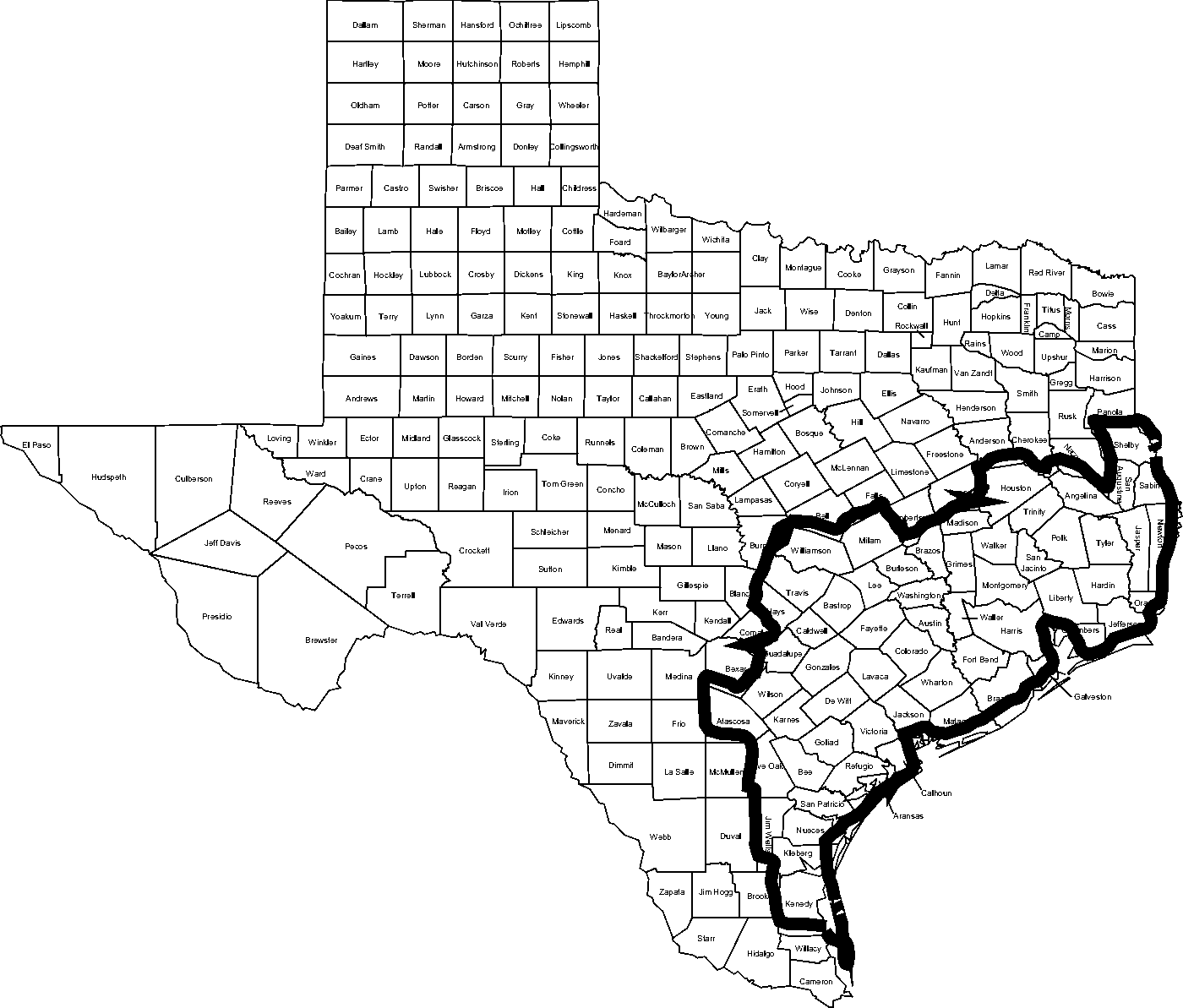
Home health agencies located in communities affected by Hurricane Harvey were sampled. Affected communities were defined as counties in Southern coastal Texas identified in the Harvey FEMA disaster declaration and their immediately adjacent counties. Forty-eight of the 254 counties in Texas fell in this affected category (Figure 1). Of the 2619 home health agencies identified in Texas, 1008 were located within the 48 affected counties. Agencies were randomly sampled from an online open database of all home health agencies registered with Medicare.18 From the total population of 1008 agencies, a randomized sample of 277 agencies was generated with an online randomization tool that had a 5% margin of error (see Figure 1).
Texas Counties Affected by Hurricane Harvey Included in Sampling Frame

We contacted each of the 277 agencies selected to participate in the study by telephone during the period from February 22, 2018, through May 16, 2018. Attempts to reach agencies were made up to 5 times. Of the 277 agencies selected for inclusion, 24 had nonworking numbers, 5 were closed, and 3 were not serving clients. All 32 of these agencies were excluded, leaving 245 agencies operating at the time of the study. A total of 122 agencies participated in the study, representing a 50% response rate of our targeted sample.
Survey Instrument
Structured interviews were conducted via telephone with a questionnaire developed a priori (see Supplementary Appendix). The 17-item questionnaire was designed to measure home health agency service disruption and emergency preparedness activities. Two experts in the field of emergency preparedness reviewed each item for content validity. The questionnaire was then pilot-tested among a group of academic researchers familiar with survey development.
Data Collection
Agencies were contacted via telephone. The purpose of the study was explained and verbal participation was requested by a member of the staff who was knowledgeable about how the agency responded to Hurricane Harvey. Calls were typically forwarded to administrative or nursing staff. The interview questions were read verbatim. Each interview was conducted by a trained member of the study team and lasted approximately 3 to 5 minutes. In the event that the agency preferred to complete the questionnaire at their convenience, the study team sent an e-mail with a link to the survey, which was housed in Qualtrics. If respondents chose to provide additional information, these comments were noted as supporting material, but were not formally recorded verbatim.
Interviewers documented the responses to the questions with Qualtrics software. Neither the home health agency’s name nor any other identifying information were associated with the recorded data. To track which agencies completed the study, each agency was assigned a code that corresponded to the completed data to the Medicare dataset of home health agencies. This data were kept secure and was only accessed on password-protected computers.
Data Analysis
Descriptive and bivariate statistics were generated. Two-way tables with measures of association were completed for all variables. Data were evaluated with both the Pearson chi-square and Fisher exact test. All analyses were conducted with STATA version 14.1 (College Station, Texas). Open-ended responses were grouped into relevant categories and reported to add nuance to the descriptive results.
Ethical Approval
The data collected in this study were related to organizational functioning during the course of Hurricane Harvey and its aftermath. No information was collected about health care clients. As such, the University of Michigan Institutional Review Board deemed this study exempt.
RESULTS
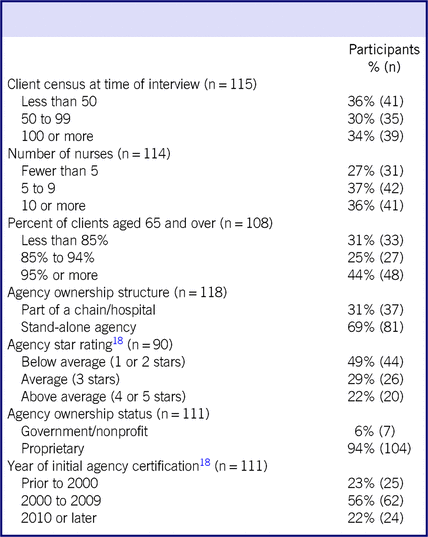
A total of 122 home health agencies participated in the study (see Table 1 for sample characteristics). The agencies in this sample largely serve older adult clients; 44% of respondents indicated that at least 95% of their clients were 65 years old or older. Two-thirds of the agencies (66%) had 99 or fewer clients, and a majority (64%) had 9 or fewer nurses on staff. Three-quarters (76%) of the agencies had received their agency certification prior to 2010. Most (69%) classified themselves as a single agency that was not a part of a chain or owned by another organization. Half of the agencies in the sample had a CMS health care quality star rating of 3 or higher.18
Study Characteristics

Overall Results
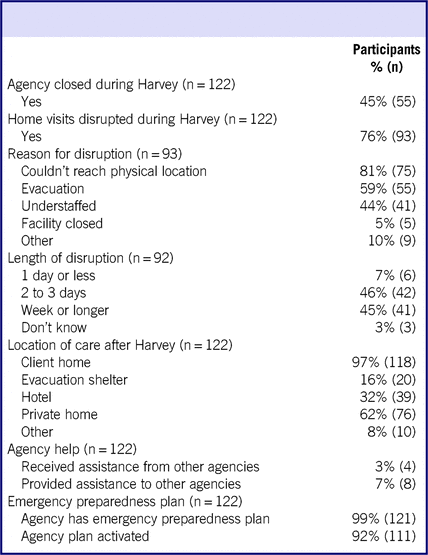
Three-fourths of agencies reported that home visits were disrupted in the time period after Hurricane Harvey. The length of time that visits were disrupted varied widely; 7% said home visits were disrupted for a day or less, and 45% said that the disruption lasted 1 week or longer. Difficulty reaching the physical location, clients who had already evacuated, and agencies being understaffed were the most common reasons for disruption in care. See Table 2 for a summary of survey results.
Summary of Survey Results

Home visits were most likely to be disrupted because agency staff was physically unable to reach their clients (81%) or because the area was impacted by evacuations (59%). Only 5% of agencies reported that client visits were disrupted by closure of the physical location of the agency. When agency staff were able to resume care, nearly all (97%) reported that they were able to resume care for at least some of their clients directly in the client’s home. However, only 31% of agencies indicated they were able to see all of their clients in their homes after the storm; 66% noted that while they saw some of their clients in their own homes, they also had to see clients who had relocated to other locations, including private homes such as those of friends or neighbors (62%), hotels (32%), and evacuation shelters (16%).
Nearly all (99%) of the agencies reported that they do have an emergency preparedness plan. Of these, nearly all (92%) activated the plan in response to Hurricane Harvey. Only 3% reported that their agency received outside assistance, and 7% reported that they provided assistance to another agency.
Open-ended Results
The survey contained a field for the interviewer to capture additional comments by participants during the interview.
Multiple agencies reported that they contacted clients in advance of the storm to assess health needs, give health and preparedness education, and provide reassurance. Calling clients in advance was part of many agencies’ emergency preparedness plans.
We called all of them and stayed in close contact and we wanted to let them know that they were okay and had food and water that they needed. (Facility 2191)
As part of [our] emergency preparedness plan, [our] agency called people in advance and walked through a series of questions. (Facility 2277)
Advance care was one method of meeting clients’ needs.
We attempted to move visits up before the storm whenever possible. There were only two or three patients that we couldn’t see in advance—they were wound care patients. In that instance, we provided extra training to their caregivers so that care was disrupted as little as possible. (Facility 2324)
Some agencies transferred clients to local hospitals or to emergency departments.
This agency served an area that was under a mandatory evacuation and so they did receive assistance from outside agencies [particularly hospitals], where they transferred patients in advance of the storm. (Facility 2373)
We had quite a few patients that had to relocate outside of our service area because they lost everything and we discharged them to another agency. Most of these people haven’t been able to move back yet. (Facility 2397)
[We] had to evacuate one [who was on IVs] to the hospital. (Facility 1689)
A number of people [voluntarily] evacuated before the storm to another location [ie, Dallas].: : : [we] stayed in touch throughout the storm and did have to call emergency services to have some patients rescued. (Facility 2277)
Agencies also instructed clients to call 211, a nationwide service that provides information and referrals to health, human, and social service organizations and is designed to operate throughout a disaster.
We made sure that we called everyone, that they had access to 211, that they had somewhere to go. (Facility 2416)
We called our patients in advance, made sure they were prepared. [We] made sure that they were registered with 211. (Facility 2504)
Clients were dispersed throughout the Houston area and beyond. Although some agencies reported contacting clients prior to the storm to ask about their physical location during and after the storm, this was not always successful. Many clients were lost to follow-up for a period of time, some permanently.
There are still patients that are displaced and some people don’t want us to come because their homes are a mess. (Facility 1612)
We took a big hit on people that had to move out of the region because of homes being flooded, but we worked to find them other placement. (Facility 2458)
Lots of our patients evacuated prior to the storm—we had a nurse on call 24 hours a day during the storm to handle emergencies; that person fielded phone calls. We had very few patients left immediately after the storm because lots of people left. (Facility 2380)
Some of our patients were disrupted for months and we kept trying to find them, without success. (Facility 1729)
Several agencies did not provide services at all for a period of time.
We closed the office from August 25 to September 8. Home visits were shut down between August 28 and September 8, 2018. (Facility 2458)
Being able to see patients was really based on the area they were located—[location redacted] was not as bad, but we couldn’t, for example, get to [location redacted]. We were closed and evacuated : : :. [all staff], but we forwarded our phone to an answering service so that patients could get in touch with us, we directed to 911. (Facility 2470)
However, geographic proximity to client homes allowed visits to continue even while offices were closed.
While the office was closed, the nurses were still able to see patients who lived near to them. (Facility 1981)
DISCUSSION
This study examined service disruption and emergency preparedness among Houston-area home health agencies in the immediate aftermath of Hurricane Harvey. This study found that although preparedness actions were implemented by the majority of respondents, significant disruption in normal patterns of health care provision of home health agencies occurred. While most agencies (99%) had an emergency preparedness plan in place, significant breakdowns in care still occurred: 76% of agencies reported a disruption in services and 55% of agencies reported being closed for some period of time. Agencies reported that key challenges to providing care were understaffing related to the storm and associated staff evacuations, closures of agencies and dispersion of clients to unknown locations, and difficulty reaching the physical locations of clients because of the storm and its resultant damage. While many agencies contacted clients in advance of the storm or reported staying in regular contact with them, it is not known how they would have gotten to the client during the storm or in the poststorm period had the client had a health issue requiring a home visit.
Both nurses and their clients evacuated to areas around Texas and beyond. A particular challenge, especially for agencies with large client rosters, was to keep track of the locations of their clients or to transfer them to other sources of care. This can be a lengthy and time-consuming process that requires close communication with other agencies and with the clients themselves. Once it became clear Hurricane Harvey was expected to make landfall, the limited time before storm impact prevented a clear understanding of the new locations of clients. A clear tracking system and communications with other agencies established prior to an event are important considerations for future planning activities. For this particular storm, the implementation of provisions in the emergency preparedness plans, such as providing needed care in advance and encouraging clients to call 211 for non–life threatening emergency information needs, was an important stopgap while normal systems were not functioning. The phone service 211 is a potential avenue for emphasis in emergency planning. The 211 hotline was heavily used during and after Hurricane Harvey: 51 596 unique callers requested service referrals due to the effects of the storm.19
The additional anecdotes shared by respondents at the end of the interview provided nuanced insight to the study results and shed light on the issues that agencies faced as well as the strategies that they employed to allow client care to continue. Respondents’ comments supported the finding that the closing of the physical agency location was not a key factor for visit disruption, but, rather, issues with staffing and locating clients were of greater concern. One respondent noted that even though the office was closed for 2 days, on-call nurses still were able to continue visits in the response period. Another noted that when the office was closed they were still able to provide telephone support to clients. The existence of data available through electronic medical records also allowed 1 agency to continue to provide services even though the office was closed. Advance care was discussed. Studies of advance care in dialysis prior to Hurricane Sandy reported decreased emergency department visits and hospitalizations,Reference Lurie, Finne and Worrall20 suggesting that effective advance care interventions might be an avenue to incorporate into planning.
A surprising result was the limited reported support between agencies—other than transferring clients to other agencies if clients left the service area. Health care coalitions exist for this specific purpose. These coalitions consist of a network of health care organizations and providers that work together through coordinated emergency preparedness and response to reduce illness, injury, and loss of life in the event of an emergency or disaster. Health care coalitions share resources and information and support health care organizations during emergency response and recovery. However, a National Academies of Medicine report found that few health care coalitions included home health agencies.Reference Davis, Reeve and Altevogt21 This valuable resource appears underutilized, with only 1 mention about home health agencies in the National Academies of Medicine report, which referred to applying for CMS regulatory waivers after Hurricane Harvey.22 A well-established and healthy connection between organizations prior to the storm, with health care coalition involvement, could lead to improved outcomes in future disasters.
The majority of clients served were older adults, most of whom live with 1 or more chronic diseases. The repercussions of a disaster for older adults can be severe, as older adults are particularly vulnerable to hazards associated with disasters such as loss of electricity, adverse changes in nutrition, and perhaps most importantly, temporary but extended loss of social support.Reference Klinenberg6, Reference Bell, Abir and Choi23–Reference Cherry, Sampson and Galea25 While disaster response planning focuses on immediate needs related to the event, which vary with every disaster but typically last hours to days, for older adults the effects of a disaster and the disruptions in care that accompany them can have much longer-lasting health effects.
Policy Implications
This study evaluated events that occurred just before the November 2017 deadline for the implementation of the EPR and provides one of the first policy-relevant, evidence-based updates to this rule. The implementation of the EPR is an important start to prepare home health agencies in the event of an emergency or disaster. An important future consideration is the need for evaluation of the effectiveness of emergency response plans that were activated after Hurricane Harvey and other recent disasters. Evidence that can lead to validated interventions and metrics to address home health care coordination in disaster preparedness and response are needed and should be conducted in an ongoing fashion. The presence of a plan does not mean that zero service disruptions will occur. Rather, these service disruptions should be expected to some degree, and quantifying them, as we have done in this study, can allow for learning from them to better prepare for the next disaster. Finally, federal, state, and local partnerships that strengthen health care infrastructure and support communities to prepare for—and become resilient to—disasters are still needed.
Limitations
This aim of the study was to gain a greater understanding of the ways that home health agencies function during a disaster and to identify gaps in service provision. This study was a brief survey of 1 specific recent disaster. Broadening this study to include other disasters could lead to more robust and generalizable results. Further, a lack of client data that could shed light on the consequences of the closures is a limitation of this study.
CONCLUSION/IMPLICATIONS
Along with over 68 reported direct deaths3 and billions of dollars in damage, Hurricane Harvey caused long-lasting health system infrastructure disruption and damage. This study provides data from 1 major disaster that can inform future studies examining the relationship between disruption in service provision and long-term health outcomes in populations in need of home health services. While the CMS Emergency Preparedness Rule is undoubtedly a much-needed step forward to ensuring safer and higher quality health care during a disaster, the effective deployment of emergency preparedness plans remains a challenge.
Acknowledgements
Research reported in this publication was supported by the National Institute on Aging of the National Institutes of Health under award number K23AG059890 (Bell, PI). The content is solely the responsibility of the authors and does not necessarily represent the official views of the National Institutes of Health.
Supplementary Material
To view supplementary material for this article, please visit https://doi.org/10.1017/dmp.2019.27.