Introduction
Nowadays assisted reproductive technology is widely used worldwide to give a chance for the infertile couples to be genetically (biological) parents. This goal was achieved through in vitro fertilization (IVF) and intracytoplasmic sperm injection (ICSI) procedures (Ozturk et al., Reference Ozturk, Korkmaz, Bucak, Kalyan and Topraggaleh2023).
Besides all the promising, this technique was accompanied by the accelerated risk of twins (∼20-fold), or triplets or more (400-fold) (Martin and Welch, Reference Martin and Welch1998). One option to avoid this problem was choosing the best embryo for transfer. Single embryo transfer (ET) reduces the risk of multiple pregnancies (Adamson and Norman, Reference Adamson and Norman2020), and embryo selection has been done mainly based on cleavage rate and morphology assessment (Kovacs and Matyas, Reference Kovacs and Matyas2021). Morphological embryo selection has been done from the first day of IVF (Kovacs and Matyas, Reference Kovacs and Matyas2021).
One of the big challenges has been the best time for ET. In general, it has been accepted that blastocysts are more qualified for implantation compared to day 2 or day 3 ET (Maheshwari et al., Reference Maheshwari, Hamilton and Bhattacharya2016). While it increased the chance of a healthy singleton live birth, it also raises more concerns regarding the elevated risk of being large for gestational age, preterm birth, monozygotic twins and congenital anomalies, compared with earlier stages (Maheshwari et al., Reference Maheshwari, Hamilton and Bhattacharya2016). Also, there are concerns regarding extended embryo culture (the in vitro culture) that may interfere with the normal in vivo processes such as crucial genome reprogramming events (Haaf, Reference Haaf2006; Reik et al., Reference Reik, Dean and Walter2001).
For many years, it was thought that fresh IVF/ICSI cycles were accompanied by better outcomes, but with the improvement in the frozen embryo transfer (FET) results, there was a greater tendency toward FET (Roque et al., Reference Roque, Haahr, Geber, Esteves and Humaidan2019). In Europe, more than 190,000 cycles per year account for FET (De Geyter et al., Reference De Geyter, Calhaz-Jorge, Kupka, Wyns, Mocanu, Motrenko, Scaravelli, Smeenk, Vidakovic and Goossens2020). The ‘Freeze-all’ protocol, which is the elective frozen embryo transfer (eFET), has emerged recently following the hypothesis that controlled ovarian stimulation (COS) may have adverse effects on the endometrium and disrupt the embryo–endometrium interaction (Roque et al., Reference Roque, Haahr, Geber, Esteves and Humaidan2019). So it is recommended not only when there is a risk for OHSS but also to improve the ART outcomes (Shapiro et al., Reference Shapiro, Daneshmand, Garner, Aguirre and Ross2008). Some studies showed no significantly higher clinical and ongoing pregnancy or lower miscarriage rate in the Freeze/All-ET group in the normal-responder patients (Shapiro et al., Reference Shapiro, Daneshmand, Garner, Aguirre, Hudson and Thomas2011). As well as the day of the transfer (Hatırnaz and Pektaş, Reference Hatırnaz and Pektaş2017), the other challenge that must be answered is the controversy of the freeze and fresh transfer.
Still, the main embryo selection relies on the cleaved embryo morphological evaluation (Li et al., Reference Li, Parmegiani, Yang, Vajta and Li2023), and its value is to some extent questionable, as the human embryonic genome activation (EGA) does not occur until the 4–8-cell stage (Goszczynski et al., Reference Goszczynski, Tinetti, Choi, Hinrichs and Ross2021). Day 4 embryos, having passed the cleavage stage and relying on their own gene expression, are more developed compared with day 3 embryos. On the other hand, day 4 embryos do not face the issues associated with blastocyst freezing (day 5 embryos) (Li et al., Reference Li, Hwu, Lee, Li and Lin2018), such as potential loss during extended culture and having no embryos available for transfer after five days. They also benefit from shorter exposure to an unnatural environment (Kaartinen et al., Reference Kaartinen, Kananen, Tomás and Tinkanen2017). In the present study, chemical pregnancy rates (PRs) were compared between fresh and frozen-thawed FET cycles, focusing on transfers of 3-day and 4-day embryos derived from antagonist-regulated cycles based on embryo morphology.
Material and methods
This study was approved by the Research Ethics Committee of Esfahan University of Medical Sciences, Isfahan, Iran (IR.MUI.REC.1402.031).
Study’s patients
This study was a retrospective study conducted on 1000 infertile couples. These patients were referred to the tertiary infertility center of the Shahid Beheshti Hospital, undergoing ICSI cycles between 2019 and 2022. The inclusion criteria were as follows: The mean age for women was less than 38, and for men, less than 45 years old, primary infertility, endometrial thickness between 6 and 7 mm on the day of transfer, having a 3- or 4-day ET, transferring with a 3- or 4-day frozen embryo, having 1 and 3 embryos for transfer. The mean age of women above 38 and men over 45 years, endometrium size less than 6 mm at the time of transfer, sperm sources from other than ejaculation (testis or epididymis), transfer more than 3 embryos and 5-day ET were excluded from the study.
According to the transferred embryos, the 10 study groups were 1) fresh day 3 embryo, grade A-B, 2) fresh day 3 embryo, grade C, 3) fresh day 4 embryo, grade A-B, 4) fresh day 4 embryo, grade C, 5) frozen day 3 embryo, grade A-B, 6) frozen day 3 embryo, grade C, 7) frozen day 4 embryo, grade A-B 8) frozen day 4 embryos, grade C, 9) frozen day 3 embryos that were transferred on day 4, grade A-B, 10) frozen day 3 embryos that were transferred on the 4th day, grade C.
Data of each case consisted of age, duration of infertility, age of the transferred embryo, grade of the transferred embryo, fresh or frozen transfer, number of transferred embryos and the results of chemical pregnancy, 15 days after transfer.
The ovarian stimulation protocol
All patients underwent the multiple-dose GnRH-antagonist-COH protocol, with 300 IU of rFSH; Cinnal-f (Cinnagen, Tehran, Iran) started on the second day of menstrual cycles. Patients were monitored by vaginal ultrasonography. Once the dominant follicle had reached a size of 13–14 mm, GnRH-antagonist (Cetrotide: Serono international A, Geneva, Switzerland) was initiated, and the rFSH continued up to the day of the ovulation trigger. When at least one follicle with a mean diameter of 18 mm was observed, 10,000 hCG IU (PD preg: Pooyesh Darou, Tehran, Iran) was injected 36 hours before oocyte retrieval.
In all groups, endometrial thickness and serum estradiol levels were measured on the day of hCG injection. Oocyte retrieval was done using a 17-gauge needle under vaginal ultrasonography guidance, and then intra-cytoplasmic sperm injection (ICSI) was performed.
After injection, embryos were cultured in a petri dish (SAGE1-Step, CooperSurgical Fertility Companies) until day 3 or 4, at 37°C incubators (Personal MultiGas CO2 incubator, APM-30D, ASTEC, Japan), with a mixture of 6% CO2, 5% O2 and 89% N2.
Embryo transfer or embryo freezing
Depending on the patients’ condition and the infertility center policy, the embryos were transferred on day 3 or day 4 (endometrium between 6 and 7 mm), but in some patients who had uterine problems or required additional surgeries for ET, or in the cases of higher risk for ovarian hyperstimulation (OHSS), embryos were frozen.
Embryo freezing
Vitrification-warming was done with a ready-to-use kit (RapidVit™ Cleave, RapidWarm™ Cleave, Vitrolife), according to the manufacturer’s instructions.
Embryo grading
Embryo morphology scoring was done by the two embryologists on days three and four of the development under an inverted microscope (Nikon, Tokyo, Japan) (400× magnification).
Day 3 embryo grading was done according to the criteria previously published by Gardner, including cell number, regularity of the blastomeres, the amount of fragmentation rate of cleavage and presence or absence of multinucleation (Sanchez et al., Reference Sanchez, Seidler, Gardner, Needleman and Sakkas2017). The embryo was graded A, B, C and D, according to the mentioned criteria.
Day 4 embryo grading (good, fair, poor) was done according to the 2011 ESHRE Istanbul Consensus for D4 embryos (based on embryo compaction) (Alpha Scientists in Reproductive Medicine and ESHRE Special Interest Group of Embryology, 2011). Initially, the day 3 embryos had 4 classes, and the day 4 embryos had 3 classifications. We merged “A and B” as a group (good quality embryos) and graded “C and D” into one group (poor quality) for the day 3 embryos. Also, for day 4 embryos, we merged “good and fair” to good quality. Accordingly, we had two main morphological classifications: good and poor-quality embryos on day 3 and day 4. Based on this, top-quality embryo day 3 is defined as embryos with eight regular cells and lower than 10% fragmentation, and top-quality embryo day 4 as the morula stage with fully compacted blastomeres (Figure 1).
(A) a good quality embryo on day 3, (B) a fair quality embryo on day 3, (C) a poor-quality embryo on day 3, (D) a good quality embryo on day 4, (E) a fair quality embryo on day 4, (F) a poor-quality embryo on day 4.

Embryo transfer
Embryos were transferred under ultrasound guidance using a Labotect catheter (Labor-Technik Göttingen GmbH, Göttingen, Germany) or a Cook (Sydney, Australia) catheter, 72 hr after oocyte retrieval. Usually, two embryos were transferred in each ICSI–ET (embryo transfer) cycle, and excess embryos were cryopreserved. The institute policy for the number of embryos for transfer was based on some criteria; for example, 1) patient age: women of advanced reproductive age or those with certain fertility issues may be allowed more than one ET to increase the chances of success. 2) Previous IVF history: If a patient has had unsuccessful previous IVF cycles, doctors may decide to transfer more embryos in subsequent attempts. 3) Endometrial thickness and quality: the condition of the uterine lining is critical for implantation. A thicker, well-prepared endometrium may suggest that transferring a single embryo may be more appropriate, while a less optimal environment might lead clinicians to transfer more embryos. 4) Medical history: conditions such as polycystic ovary syndrome (PCOS) may influence the number of embryos that should be transferred, as well as the other criteria (embryo quality, number of embryos, hormonal levels, etc.).
Endometrial preparation protocol for frozen embryos
Endometrial preparation was done using oral estradiol valerate (Aburaihan, Iran) in a fixed dose of 2 mg (thrice a day) from the second day of the menstruation cycle. During the estrogen phase of hormone replacement therapy (HRT) cycles, the endometrium thickness was checked via ultrasonography before FET. When endometrium thickness of 7-11 mm was achieved, then 100 mg of progesterone in oil (Aburaihan, Iran) was administered IM daily. ET was done after three days.
Statistical analysis
Different descriptive variables were presented as mean ± SD. The Kruskal–Wallis test was run to compare mean values (number of embryos transferred, age and duration of infertility, etc.). A chi-square test was run to assess the difference in the causes of infertility and chemical pregnancy rate in the different groups: day of transfer (3 or 4), embryo quality (good or poor) and fresh or FET transfer. More analysis was done using binary logistic regression to evaluate the influence of different ET protocols on chemical PRs. In the model, the dependent variable was the occurrence of chemical pregnancy (coded as a binary outcome: yes/no), while the independent variables included the day of embryo freezing (day 3 or day 4) and the day of transfer. Statistical Package for Social Sciences version 11.0 (SPSS, USA) was used for data analysis, and P < 0.05 was statistically significant.
Results
For decision-making, which ET may be accompanied by a higher positive pregnancy rate, the objectives were the relationship between 3-day embryos or 4-day, fresh or frozen, good or poor quality, the number of transferred embryos, the female and male age, duration and cause of infertility, with chemical pregnancy.
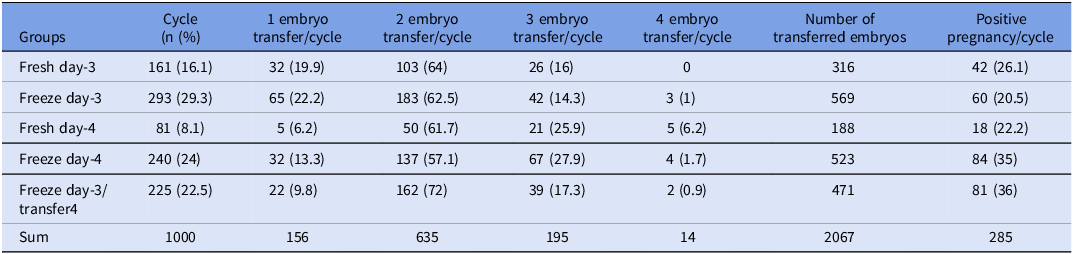
The general description of all cycles is presented in Table 1. All cycles were stimulated using the antagonist protocol. During these 36 months, 2,067 embryos were (matched our criteria) transferred throughout 1000 cycles (1, 2, 3 and 4 embryos/cycle). These cycles consisted of 242 fresh (24.2%) and 758 FET (75.8%) cycles, which resulted in 24.1% and 30.5% positive chemical PRs, respectively (285 cycles).
Descriptive characterization of total cycles (without considering the embryo quality)

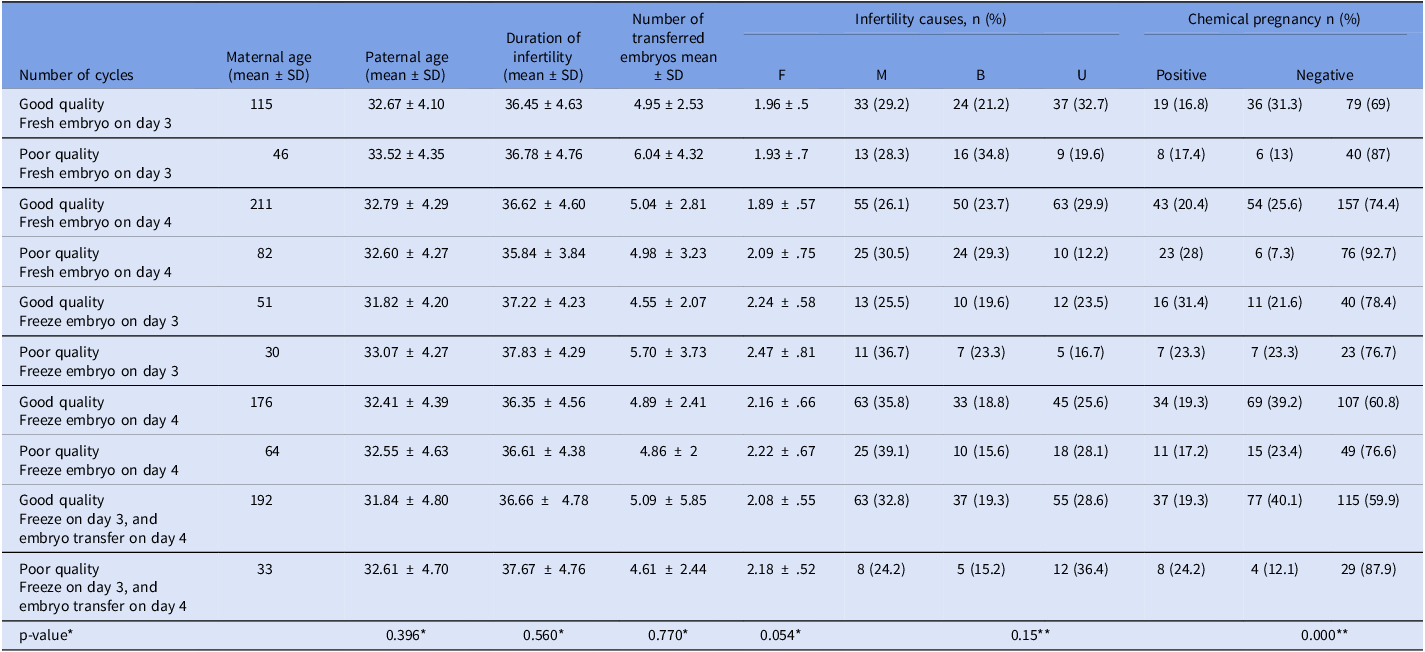
Patients’ demographic characterizations, in detail, are presented in Table 2, as mean ± SD or number (percent). The Kruskal–Wallis test showed no significant differences, in the demographic characterizations, consisting of maternal or paternal age, duration of infertility and number of transferred embryos. Also, there was no significant difference in the cause of infertility among different groups (Chi-square test).
Patients’ demographic characterizations (mean± SD, and n (%)), in the different groups

* Kruskal–Wallis test; There were no significant differences, in the demographic characterizations, consisting of maternal, or paternal age, duration of infertility, and number of transferred embryos among different groups.
** Chi-square test; there was no significant difference in the cause of infertility among different groups. The differences in the chemical pregnancy rate were significant.
The mean age was 32.49 ± 4.44 for female and 36.61 ± 4.54 for male patients, with a mean infertility duration of 5.03 years. Causes of infertility were female factor (31%), male factor (21.6%), both of them (20.7) and unknown cause (26.7). The mean ET was 2.07 (±0.63) per cycle.
PRs varied from 7.3% (in the poor/fresh/day 4) to 40.1% (in the good/freeze day 3/transfer day 4), which the difference was significant.
The results of the Chi-square test showed no significant differences in the chemical pregnancy related to the number of transferred embryos (when it was considered as a categorical variable) (p = 0.55).
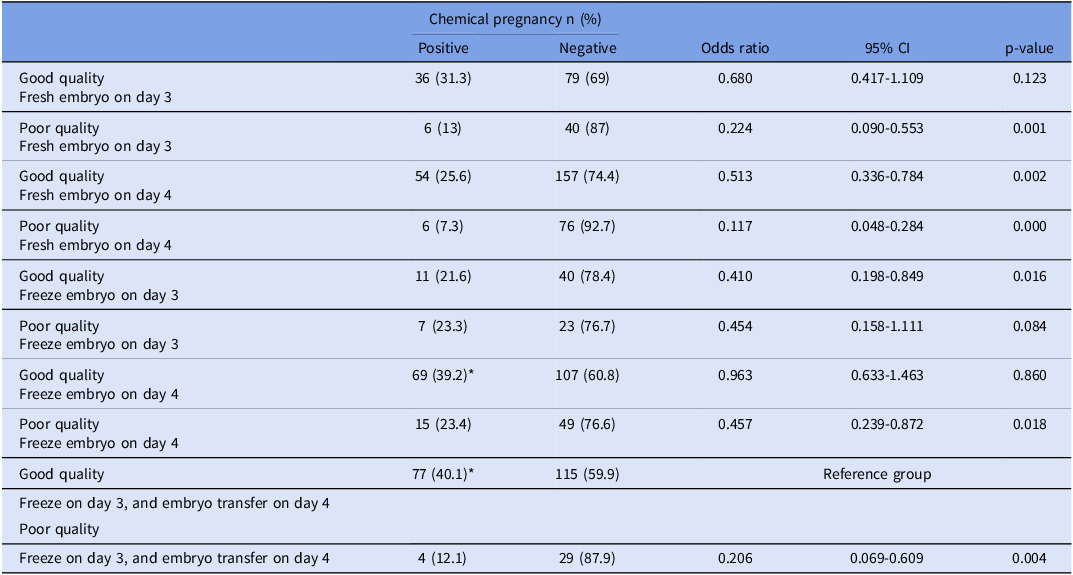
The results demonstrated that the day of transfer (3 or 4), embryo quality (good or poor) and fresh or FET transfer were independently associated with chemical pregnancy (Table 3). The transplantation of good-quality frozen embryos on day 3 and subsequently transferred on day 4 was associated with a significantly higher chemical pregnancy rate (40.1%). Also, transferring good-quality frozen embryos on day 4 was accompanied by a chemical pregnancy rate of 39.2% (OR = 0.963; 95% CI: [0.633-1.463]; p < 0.860). In contrast, transferring poor-quality fresh embryos on day 4 results in a significantly lower chemical pregnancy rate (OR = 0.117; 95% CI: [0.048-0.284]; p < 0.001).
Logistic regression analysis of the embryo stages affecting the chemical pregnancy

* Logistic regression analysis: The transplantation of good-quality frozen embryos on day 3 and subsequently transferred on day 4 was associated with a significantly higher chemical pregnancy rate (p ≤ 0.05). Also, transferring good-quality frozen embryos on day 4 was accompanied with the second higher chemical pregnancy rate (p > 0.05).
Discussion
The study aimed to compare the chemical PRs between fresh ET and FET on day 3 (cleavage) and day 4 (murola) of development. For this purpose, the data of the 2,067 transferred embryos were analysed. The mean ET was 2.07 (±0.63) per cycle.
The results showed no significant differences in the demographic characterizations; female or male age, duration, number of transferred embryos and cause of infertility among different groups. Of all patients, 31% were female factor, 21.6% were male factor, 20.7% were both of them and 26.7% were unknown causes.
The results showed that the lower pregnancy rate was recorded when a poor/fresh/day 4 embryo was transferred, and a higher rate was recorded when a good embryo quality was frozen on day 3 and transferred on day 4 (4% compared to 40.1%, respectively). This rate was very near to the results of transferring the good quality freeze embryo on day 4 (the second highest pregnancy rate). These data confirmed the importance of embryo quality in the success rate, as well as demonstrated that the day 4 transfer (morula/compact) can improve embryo selection compared with the day 3 ET.
Some studies were done to compare the cleavage-stage versus blastocyst ET, as well as the different grades of embryo quality (Blake et al., Reference Blake, Proctor, Johnson, Olive, Farquhar and Lamberts2005; Ozgur et al., Reference Ozgur, Berkkanoglu, Bulut, Humaidan and Coetzee2015; Wang et al., Reference Wang, Zhao, Ma, Zhu and Wang2021). The timing of embryo development and the number of blastomeres on a specific day are critical indicators of embryo competence and the potential to initiate a viable pregnancy (Yang et al., Reference Yang, Peavey, Kaskar, Chappell, Zhu, Devlin, Valdes, Schutt, Woodard and Zarutskie2022). In one study it was shown that early cleavage (within 25 hours post-insemination) correlates with higher pregnancy and implantation rates. Couples producing early-cleaving embryos had significantly better outcomes compared to those with only non-early-cleaving embryos, suggesting timing influences developmental competence (Fenwick et al., Reference Fenwick, Platteau, Murdoch and Herbert2002). The timing of embryonic cleavage, particularly the first zygotic cleavage, is a significant predictor of embryo quality. Early-cleaving embryos (those that divide sooner after fertilization) have been associated with higher developmental potential and better implantation rates. For instance, research indicates that embryos that cleave within 30 hours post-insemination display lower apoptotic cell ratios and higher rates of development to the blastocyst stage compared to those that cleave later (Lechniak et al., Reference Lechniak, Pers-Kamczyc and Pawlak2008).
One of the techniques that has played a key role in assessing the developmental dynamics of human embryos and improved embryo selection is time-lapse imaging (TLI) (Porokh et al., Reference Porokh, Kyjovska, Martonova, Klenkova, Kuruczova, Stepanova, Otevrel, Kloudova and Holubcova2023). Kinetic events were precisely timed, and the correlation of these timings and intervals to blastocyst formation, implantation, live birth and time to pregnancy has been shown in previous studies (Castelló et al., Reference Castelló, Motato, Basile, Remohí, Espejo-Catena and Meseguer2016; Ebner et al., Reference Ebner, Oppelt, Radler, Allerstorfer, Habelsberger, Mayer and Shebl2017). Providing unique information regarding the cleavage process, as well as morphological and structural modifications, helps the embryologist to select the embryos with high implantation potential (Simionescu et al., Reference Simionescu, Maftei, Anton, Valeanu and Doroftei2016). It was shown that the specific timing of cleavage divisions and blastocyst formation can serve as predictive markers of successful pregnancy outcomes, so there may be no need for an extended culture (Cruz et al., Reference Cruz, Garrido, Herrero, Pérez-Cano, Muñoz and Meseguer2012).
Also, it was shown that a significant proportion of Day 2 early-cleaving embryos contained four or more blastomeres, which was linked to higher PRs when transferred. Additionally, embryos with fewer than 20% fragmentation were more likely to be viable. The presence of irregular or unevenly sized blastomeres can affect developmental outcomes, but early-cleaving embryos tend to tolerate such irregularities better than late-cleaving ones. This suggests that not only the number but also the quality and timing of cell division play crucial roles in determining embryo competence (Lechniak et al., Reference Lechniak, Pers-Kamczyc and Pawlak2008). Moving forward, transferring morula-stage embryos provides an additional layer of evaluation regarding embryo quality based on developmental timing and morphokinetics, allowing for better selection processes in clinical practice.
A logical basis for the blastocyst culture is a higher synchrony between uterine and embryonic development and the opportunity for self-selection of viable embryos. However, there was a controversy regarding the true clinical benefits since the initial blastocyst culture (in 1998). When the policy is blastocyst transfer, it raises the probability of having no embryos for transfer or freezing (Blake et al., Reference Blake, Proctor, Johnson, Olive, Farquhar and Lamberts2005). In one systematic review, in 2005, the researchers concluded there was no difference in live birth or pregnancy outcomes of day 2 to 3 ET with day 5 to 6 embryos (Blake et al., Reference Blake, Proctor, Johnson, Olive, Farquhar and Lamberts2005). The result was controversial with the frozen embryo, when the results showed a significantly higher live birth rate and birth weight after a single vitrified blastocyst good quality ET (day 5, 6) compared to a single cleavage-stage embryo (day 3) (Wang et al., Reference Wang, Zhao, Ma, Zhu and Wang2021). When there was no significant difference in birth weight, with a single poor-quality day 5 or 6 ET compared with a single good-quality cleavage embryo (day 3), the researchers concluded that embryo quality must be fully considered when the clinical outcomes are assessed after blastocyst transfer versus cleavage stage ET. We also considered the quality of transferred embryos, and the results are behind morula stage transfer, which were frozen on day 3 of development, as well as on day 4. From the start of the IVF program, embryos were commonly transferred at the pre-zygote or cleavage stages. Genome activation occurs at the 4–8-cell embryo stage, and early embryo quality scoring has not accurately predicted future embryo growth potential.
As the day 2 and day 3 embryo scoring is accompanied by poor prediction of growth potential, three or four embryos are routinely transferred on average. In advanced age (>40 years), even more embryos may be placed into the uterus (Tao et al., Reference Tao, Tamis, Fink, Williams, Nelson-White and Craig2002a). This has raised concerns regarding multiple pregnancies, which are accompanied by elevated risks of obstetric and neonatal complications (Ma et al., Reference Ma, Peng, Hu, Wang, Xiong, Tang, Tan and Gong2022). SET helps to reduce the risk of multiple pregnancies in ART programs (Cutting, Reference Cutting2018).
An approach for this aim is blastocyst culture, which allows for the best embryo selection for ET with lower aneuploidy rates (self-selection) (Fragouli and Wells, Reference Fragouli and Wells2011; Glujovsky et al., Reference Glujovsky, Retamar, Sedo, Ciapponi, Cornelisse and Blake2022). Furthermore, blastocyst transfer is accompanied by more uterine and embryonic synchronicity and higher implantation rates (Glujovsky et al., Reference Glujovsky, Retamar, Sedo, Ciapponi, Cornelisse and Blake2022). If a patient has no healthy blastocysts on day 5 or 6, transferring blastocysts may increase the risk of cycle cancellation (Zhang et al., Reference Zhang, Wang, Zhang and Zhou2021). Very little attention has been paid to the morula/compact stage as a transfer option in ART. Some priorities have been mentioned in the embryo selection for the morula/compacted embryos compared to the earlier cleavage stages. Besides the activated embryonic genome, they are in a further advanced stage (the compaction stage) compared to earlier cleavage stage embryos. The literature referred to some other priorities in selecting morula/compact embryos, including assessing the proportion of blastomeres undergoing compaction, embryo morphology, quality on days 2 and 3, and fragmentation levels, which collectively indicate better developmental potential compared to earlier cleavage stages (Tao et al., Reference Tao, Tamis, Fink, Williams, Nelson-White and Craig2002b), which may still rely on maternal mRNAs for developmental guidance. In a previous study, it was highlighted how the EGA impacts cell fate decisions within the morula. EGA influences cell fate decisions within the morula through transcriptional activity and external factors that guide differentiation into trophectoderm and inner cell mass (ICM) during this stage. Morula self-correction ability is consistent with findings that embryos can compensate for developmental errors. The study discusses how embryos at this stage can undergo reparative processes, enhancing viability and adaptability, which are vital for later stages of development. The findings suggested that transferring morula-stage embryos, which have successfully undergone EGA, may lead to improved implantation rates and pregnancy outcomes in ART (Coticchio et al., Reference Coticchio, Lagalla, Sturmey, Pennetta and Borini2019).
However, we did not compare the day 5 embryo with the day 4, but previous results showed that the implantation rate will be reduced if the blastocysts are cultured until day 6 and recommended that longer culture must be avoided (Poulsen et al., Reference Poulsen, Ingerslev and Kirkegaard2017). In this regard, the results from one study showed that day 4 transfer patients had significantly higher implantation rates compared with day 3 transfer; it’s that the number of ETs was significantly lower on day 4 compared to day 3 (Pantos et al., Reference Pantos, Makrakis, Chronopoulou, Biba, Perdikaris and Dafereras2008; Tao et al., Reference Tao, Tamis, Fink, Williams, Nelson-White and Craig2002b). A similar study also reported that day 4 morula embryo transfer (MET) provided a flexible, easier and applicable method for ET, routinely, when compared to day 5 blastocyst embryo transfer (BET) (Li et al., Reference Li, Hwu, Lee, Li and Lin2018).
Besides embryo quality and day of development, other criteria that played an important role in PRs was frozen ET versus fresh ET. The results of this study focused on the outcomes of freezing embryos. Many studies have investigated the success rate of frozen compared to fresh embryos. The results of one study by Wirleitner et al., Reference Wirleitner, Schuff, Stecher, Murtinger and Vanderzwalmen2016 showed the same live birth rate and implantation rates after fresh or frozen good-quality blastocysts transfer, but the results were significantly higher for the freeze and thawed lower-quality blastocysts compared to the fresh group. They concluded that clinical results for non-top-quality or delayed blastulation will be improved by the ‘freeze-all’ strategy. The authors referred to prolonged culture, as well as endometrium receptivity after vitrified/warmed ET, while there is no additional hormonal stimulation. (Wirleitner et al., Reference Wirleitner, Schuff, Stecher, Murtinger and Vanderzwalmen2016). However, there is a controversy in the results of fresh vs. FET (Matorras et al., Reference Matorras, Pijoan, Perez-Ruiz, Lainz, Malaina and Borjaba2021; Zhang et al., Reference Zhang, Xiao, Zhang, Wang, Wu, Peng and Wang2018), synchronization between endometrial receptivity and embryo development is one of the most common hypotheses referred to in the previous research that concluded frozen embryos increased the chance of success (Shapiro et al., Reference Shapiro, Daneshmand, Garner, Aguirre and Ross2008; Zhang et al., Reference Zhang, Xiao, Zhang, Wang, Wu, Peng and Wang2018). Also, it showed that elevated levels of progesterone, on the day of the trigger, will be ameliorated following the FET cycle. This level of progesterone can negatively affect the live birth rate (Healy et al., Reference Healy, Patounakis, Connell, Devine, DeCherney, Levy and Hill2016; Zhang et al., Reference Zhang, Xiao, Zhang, Wang, Wu, Peng and Wang2018).
Data from logistic regression showed the highest chemical pregnancy rate when the embryos were frozen on day 3 (and transferred on day 4) and frozen on day 4 compared to the other groups (marked by a star in Table 3). The impact of embryonic stage and transfer day on pregnancy outcome was evaluated in the cryopreservation programs, and there was no distinct result. In one study, in 2003, the outcomes of transfer embryos that were frozen at the zygote, day 2 and 3 embryo developmental stages were compared. The results showed that, although different developmental stages play an important role in post-thaw survival, there were no significant differences in clinical PRs, implantation rates, delivery rates, or birth rates after FET (Salumets et al., Reference Salumets, Tuuri, Mäkinen, Vilska, Husu, Tainio and Suikkari2003). Many of the comparisons focused on blastocyst stages (day 5 and day 6), while fewer studies were conducted on day 4 or the morula stage. In one study, cryopreservation of morulae (day 4) was compared with blastocysts (day 5), and the results showed that the post-thawing survival rate was correlated with the volume of the blastocoele. They concluded that a large blastocoele increases cryodamage because of ice crystal formation (Vanderzwalmen et al., Reference Vanderzwalmen, Bertin, Debauche, Standaert, van Roosendaal, Vandervorst, Bollen, Zech, Mukaida, Takahashi and Schoysman2002). Embryos in different stages of development have special characterization regarding the permeation of cryoprotectants and so experience different dehydration levels during the cryoprotectant agent exposure.
Conclusion
The chemical PRs of day 4 ET (which were frozen on day 3, and day 4) showed that embryos at the morula/compact stage are good candidates for ET. The validity of this needs to be confirmed by further investigation.
Acknowledgements
The authors thank Mrs. Nasrin Bagheri, Mrs. Fatemeh Parsa, Mrs. Zahra Hosseini and also all the members of the Clinical Center for Infertility, Shahid Beheshti Hospital, Isfahan, Iran, for their kind help and valuable support.
Funding statement
Not applicable.
Competing interests
There is no any conflicts of interest to be declared.