1. INTRODUCTION
The literature on economic growth of the past 30 years has greatly emphasised the importance of institutions for international trade, asserting their dynamic role in the regulation of everyday life and social and economic relations. And even though the effect of institutions on markets and merchant behaviour is not always easy to assess,Footnote 1 there is a consensus amongst economic historians that their existence can reduce uncertainty by providing ‘a stable (but not necessarily efficient) structure to human interaction’.Footnote 2
More recently, this debate has been further fuelled by Oscar Gelderblom's book Cities of commerce: the institutional foundations of international trade in the Low Countries, 1250–1650.Footnote 3 Observing that pre-modern Europe was ‘a patchwork of local and regional jurisdictions, each with its own legal tradition’ that could create hindrances for traders, the author partly relates the economic success of the Low Countries to its cities’ capacity to shape rules and institutions.Footnote 4 This meant that ‘the cities’’ legal autonomy actually made it easier for municipal governments to adapt institutional arrangements to the needs of international traders’, and that this phenomenon created the necessary conditions for the successful commercial and economic growth of places like Bruges, Antwerp and Amsterdam.Footnote 5 In a sense, Gelderblom supports the notion that cities that fostered effective institutions and organisations to regulate commerce and solve conflicts would overtake others, thus allowing them to move centre stage in European trade. This hypothesis, however, has begun to be debated and challenged.Footnote 6 Guillaume Daudin, for instance, compared the Flemish-Dutch case with other European settings to conclude that competition between Italian city-states might have had the opposite effect, leading to the ‘demise of the whole system’, and that for a later period London had become ‘the dominant centre of institutional development’ without being in a domestic urban competition.Footnote 7 Nevertheless, one must not ignore the fact that places like Bruges did have an ‘open immigration policy’ and ‘networking institutions’, which might have provided the city with economic advantages for traders.Footnote 8
Bearing in mind Gelderblom's hypothesis and the ongoing debate over these issues, many fundamental questions arise. Were there significant differences in rules, laws and institutions between one place and another in late medieval western Europe? Were merchants more successful in their demands in places where urban legal autonomy predominated in comparison with countries where the judicial system seemed more centralised, for instance, under the authority of the king and parliament? Did the merchants’ methods of conflict management and their expectations of judicial effectiveness abroad vary from one country to another?
Bearing these questions in mind, this article aims at contributing to this debate by examining the processes of conflict management in late medieval western Europe seen from the perspective of the Portuguese merchants. Rather than looking at laws and institutions alone, it thus reverses the approach by investigating how merchants protected their interests, what problems they normally faced, and what strategies they adopted to solve them. In the end, it relates Portugal's commercial expansion in the Middle Ages to conflict management procedures by asking the following question: taking into account the type of dispute, the conflict management strategies adopted by traders, and the different rules and institutions at play in western Europe, is it possible to confirm the existence of any link between the cities’ institutional arrangements and the merchants’ choice of markets? To do this, I use 382 records from England, Flanders, Normandy and Portugal, consisting of safe-conducts, petitions and trial cases in urban and central courts.Footnote 9 Their combined analysis gives a holistic view of the rules, institutions, agents and strategies affecting merchants in western Europe. Flanders and England were two of the most important commercial destinations for the Portuguese merchants during the late Middle Ages and, for that reason, they are examined as the main objects of analysis.Footnote 10 Select examples from Normandy are also included, because of the level of detail in certain cases of conflict management.
Following the introduction (part 1), this article is divided in six parts. Part 2 briefly presents Portugal's process of commercial expansion and examines the mechanisms of protection adopted by merchants in foreign markets. Part 3 covers the nature of conflicts and examines their type, predominance and variation over time. Part 4 analyses courts and procedures to understand how merchants managed their conflicts and how they interacted with judicial institutions. Part 5 investigates laws, agents and the speed of the judicial procedures to see the major differences from one region to another. Part 6 introduces the concept of commercial diplomacy as a method of conflict management and dispute resolution. Despite the existence of rules and institutions abroad that allowed foreign mercantile conflicts to be managed locally, this article emphasises that royal correspondence and embassies served to accelerate legal procedures, as well as to exert pressure on and influence the outcome of ongoing investigations and trials. Finally, part 7 presents the main conclusions.
2. FOREIGN TRADE AND PROTECTION
In the later Middle Ages, Portugal was a relatively small kingdom (one million inhabitants), with no more than two to three important ports for international trade: Lisbon (50,000 residents); Porto (fewer than 10,000); and Tavira (7,000).Footnote 11 Although just a fraction of the population worked in maritime occupations, foreign trade played a very important role in the kingdom's economy and finances, especially in the late fifteenth century, representing a substantial portion of the crown's receipts.Footnote 12 This was possible because of Portugal's strong shipbuilding industry and shipping services, its market- and export-oriented rural economy, and the kingdom's geostrategic positioning at the intersection of the northern European, Atlantic, Mediterranean and African trading routes.Footnote 13 Understanding the construction and development of this economic system also implies an analysis of how merchants organised and protected themselves, and how they approached institutions.
Portugal's first steps towards commercial expansion were taken in the late twelfth century, but it was only in the fourteenth century that the kingdom's foreign trade grew significantly.Footnote 14 The reasons behind this boost in Portugal's foreign trade are diverse: they include the merchants’ initiative in obtaining safe-conducts and their participation in the negotiation of privileges and treaties in foreign territories; the settlement of colonies of traders in Harfleur and Bruges; the similar settlement of Italian merchant colonies in Lisbon; the development of socio-economic networks; and the beginning of the fifteenth-century overseas expansion.Footnote 15
Inevitably, long-distance trade implied interaction between different people, services, regulations and institutions, which might have differed from place to place, and often the knowledge of different languages and customs. For newcomer merchants, a foreign market could seem like a different universe. That is why historians have often stressed the importance of organisations like the nation (a community of merchants from the same geographical area, in this case Portugal) and the feitoria (an official Portuguese trading station or ‘factory’ established overseas) in the regulation of commerce and intra-group conflicts.Footnote 16 In most situations, these served as intermediaries between the merchant and the market, represented the communities’ interests before a foreign authority, and acted as referees in disputes within the nation. For Oliveira Marques these could serve ‘to protect the merchants from the uncertainty and the randomness of laws they barely knew’, and to defend themselves from ‘the adverse power of a strange and, sometimes, xenophobic world’.Footnote 17 The Portuguese, however, did not establish these institutions and organisations in all western European countries, nor were the laws of foreign lands as random and uncertain to them as one might think.
While developing their commercial network in western Europe, the existing sources suggest that the Portuguese merchants invested considerably in their protection, and in the security of their investments. By the end of the thirteenth century, for instance, they submitted to their king a proposal for the establishment of a bourse, which would serve to secure their activity against shipwrecks, privateering, jettison, bad weather and other unforeseen events.Footnote 18 Outside Portugal, their strategy included the acquisition of safe-conducts and the negotiation of privileges and commercial treaties with foreign rulers. In England, for instance, the Portuguese merchants obtained dozens of safe-conducts and letters of protection from the English rulers throughout the thirteenth century.Footnote 19 These documents quickly became core documentation for merchants to safeguard themselves and their commodities in foreign lands, and although they did not prevent quarrelsome events, the documents were an important tool in case a problem should emerge. On a few occasions, merchants protested before the judicial authorities of foreign countries that their nationals had attacked them even though they were in the possession of valid safe-conducts, which ought to have allowed them the necessary rights of protection and safe passage.
Other strategies included the negotiation of commercial treaties and privileges containing prerogatives on legal rights and procedures. The commercial agreements negotiated by the Portuguese in 1309 and 1341 with the king of France, and in 1353 with the king of England, were drafted with both the economic and the legal aspects of trade in mind. Nearly half of the articles inscribed in the privilege of 1309 contain information about local procedures to resolve conflicts. These include stipulations about the jurisdiction of each court (linking the type of crime to the court responsible for judging it), the formation of mixed juries (specifying the type of crime that should be judged by a mixed jury and how to select such a mixed jury)Footnote 20 and information on how to deal with commercial debts (indicating the responsibilities of the local bailiff for this matter).Footnote 21 Although it is difficult to gauge the extent to which these privileges worked in terms of protection, merchants invoked them whenever they thought local authorities were not taking their rights and privileges into consideration.Footnote 22 This procedure of seeking protection and privileges says much about the merchants’ commercial aspirations in western Europe: they looked for tax exemptions, but more often for promises of protection against the seizure of ships and persons.Footnote 23
Apart from the safe-conducts and commercial treaties, trade relations were also regulated by ordinances of countries or cities. In England, the Carta mercatoria of 1303, issued to most European merchants, ensured them freedom of trade and protection under the law of the realm, and contained detailed information about the taxes and tolls foreign merchants should pay or were exempted from.Footnote 24 Besides the rights and obligations inscribed in the Carta mercatoria, this charter provided guidelines and instructions for alien merchants on the question of who would solve their problems and under which laws, in the event of a conflict. On this, the Carta mercatoria indicated that trials ought to be conducted ‘according to law merchant’ (secundum legem mercatoriam) and that, in all cases involving foreign merchants, except for those that might include the death penalty, the jury of inquest would be mixed: that is, it would be composed equally of native Englishmen and foreign merchants ‘of language’.Footnote 25
How effective in protecting merchants were the safe-conducts, the commercial agreements and the Carta mercatoria? The examination of the safe-conducts requested by the Portuguese in England and Flanders reveals two interesting aspects: firstly, they obtained most of these letters in England; secondly, the majority of them were issued before the fifteenth century (143 before the 1400s, and just 3 during the 1400s).Footnote 26 Although the Portuguese reduced their presence in English markets in the fifteenth century, this diminution alone cannot explain the drop in the number of safe-conducts in England from this period.Footnote 27 When we take into consideration the safe-conducts issued, the rise in piratical attacks in the English Channel, and the difficulties posed to seafarers during periods of war,Footnote 28 it becomes clearer as to why the Portuguese requested so many safe-conducts before the 1400s, but also as to why they stopped seeking them: it is likely that merchants considered those letters ineffective, since they failed to protect them from pirates and privateers.Footnote 29 Keechang Kim points out another valid hypothesis for this general phenomenon: if in the beginning merchants tended to travel to England to secure the necessary liberties and to develop their commercial activities on their own, from a certain point in time this practice fell into disuse as they began to rely more heavily on resident agents abroad, rather than travelling with their commodities.Footnote 30 In England, however, the Portuguese never settled a permanent colony in any of its port towns, nor do they seem to have hired agents on a regular basis as they did in Flanders.Footnote 31 In fact, only in 1498–1499, as part of a long running dispute over foreign brokers in the city of London, did the Portuguese elect a named broker.Footnote 32
As for the Carta mercatoria of 1303 and its reference to the lex mercatoria, these were never directly mentioned by the Portuguese in any known trial. In fact, law merchant was not a codified body of laws, but a customary law for merchants and commercial transactions;Footnote 33 and it should be considered ‘as a method of decision-making rather than as a list of rules’.Footnote 34 Furthermore, as recent research shows, ‘the concept of a universal medieval maritime law created by autonomous merchants and composed of their customary rules’ must be treated with special care.Footnote 35 Its existence as a non-state legal code in the Middle Ages is nowadays considered as relatively implausible.Footnote 36 Before we take a look at how merchants managed their conflicts to see if they used mercantile custom as source of law, let us examine the nature of the disputes in which they were involved.
3. THE NATURE OF CONFLICTS
For this study, I have gathered 382 records from Flanders (49.2 per cent) and England (40.4 per cent), while the rest (10.4 per cent) concern Normandy and Portugal.Footnote 37 Less than a third of the records are from the 1200s (3.4 per cent) and 1300s (27.5 per cent), making the 1400s (69.1 per cent) the century with the most sources available.Footnote 38 Although there are fewer records on conflicts in the fourteenth century than there are for the fifteenth century, one should perhaps refrain from claiming that the 1400s were more problematic for merchants than the preceding century. Europe's political and economic situation shifted in the fifteenth century, and so did its trading networks and the nature of conflicts. Moreover, this is also a feature related to the survival of sources. Notwithstanding these remarks, what type of problems did the Portuguese merchants normally face in long-distance maritime trade?
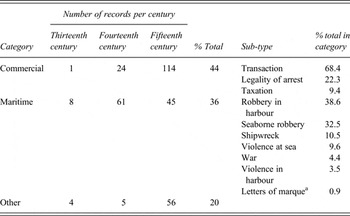
In order to show the challenges merchants faced in maritime trade I grouped the conflicts in which they were involved into three categories (commercial, maritime and other) and their respective subtypes, and divided them by century (Table 1).
Records of conflicts involving Portuguese merchants in north-western Europe, 1250–1500, by category and sub-type

a A letter of marque was a royal charter authorising a person to capture a ship or make prizes on a given enemy. It was normally issued as reprisal to compensate the holder of the letter of marque from a previous attack. See René de Mas Latrie, ‘Du droit de marque ou droit de représailles au Moyen Âge’, Bibliothèque de l’École des chartes, 6e série, tome II (1866), 529–77; Thomas K. Heebøll-Holm, Ports, piracy and maritime war: piracy in the English Channel and the Atlantic, c. 1280–1330 (Leiden, 2013), 134–40.
Sources: Jacques Paviot ed., Portugal et Bourgogne au XVe siècle (1384–1482): recueil de documents extraits des archives bourguignonnes (Paris, 1995); Jacques Paviot ed., ‘Les Portugais à Bruges au XVe siècle’, in Arquivos do Centro Cultural Calouste Gulbenkian, Volume XXXVIII (Paris, 1999), 1–122; Robert van Answaarden ed., Les portugais devant le Grand Conseil des Pays-Bas (1460–1580) (Paris, 1991); The National Archives, Kew, London, SC8 (‘Ancient Petitions’); Calendar of the Close Rolls in the Public Record Office; Calendar of the Patent Rolls in the Public Record Office.
The first impression that we have is that the sources available are unbalanced in terms of temporal distribution, making it difficult to identify properly radical continuities and changes over time. There are, however, three aspects immediately highlighted by Table 1. The first is the predominance of commercial disputes (44 per cent), especially in the fifteenth century. Most cases in this category refer to situations that occurred during the transaction process, owing to merchandise not paid for, or complaints about the quality of the goods. But they also include a good number of problems related to the legality of arrests or taxation issues. In the autumn of 1408, for example, the water bailiff of Sluys condemned two Portuguese with the payment of a £10 penalty for unloading figs without passing through customs.Footnote 39 The predominance of commercial conflicts is not entirely surprising, since merchants’ activity implied negotiation, the exchange of commodities, and the circulation of money, making it easy for breaches of contract to occur. Secondly, the number of maritime conflicts is very high (36 per cent). In relative terms, this value indicates that pirates and privateers ruined a reasonable amount of business transactions, but also that merchants and shippers were easy prey to the circumstances of war and violence at sea.Footnote 40 Notwithstanding the existing safe-conducts and commercial treaties, these situations remained relatively common. The peak of these attacks was reached during the second half of the fourteenth century, especially at times of intense military confrontation between England and France in the context of the Hundred Years’ War. Thirdly, there is a reasonably high percentage of sources related to disputes (20 per cent) in which we know little about the cause of ligation.Footnote 41 In October 1489, for example, Jean Faex and Afonso Leitão were summoned to appear before the Great Council of Mechelen to settle a case, but the document lacks information about the dispute and its judicial consequence.Footnote 42
Who were the nationals involved in the disputes with the Portuguese? There is a very interesting contradiction regarding the origin of the sources and the nationality of the individuals involved in these conflicts. Although this study uses fewer English (40.4 per cent, and mostly for the fourteenth century) than Flemish sources (49.2 per cent, and especially for the fifteenth century), most of the disputes involving the Portuguese were against the English (42.1 per cent), followed by the Flemings (28.8 per cent), the Italians (9.8 per cent),Footnote 43 the Spanish (5.6 per cent),Footnote 44 the French (5.3 per cent)Footnote 45 and, to a lesser extent, traders from Zeeland, Holland, Denmark and the German Hanse (8.4 per cent). If one were to link nationalities with a type of conflict, the English would be associated with robberies, the Flemings with commercial disputes, the Italians with breaches of contract, and the Castilians with situations of violence prompted by the Castilian-Portuguese political animosity of the last quarter of the fourteenth century and first three decades of the fifteenth century.Footnote 46 What is noteworthy about these percentages is the high number of conflicts between the Portuguese and the English. Despite the Carta mercatoria of 1303, the commercial agreement of 1353 and the Anglo-Portuguese perpetual alliance sealed by the Treaty of Windsor of 1386,Footnote 47 the English pirates and privateers took their job as important auxiliaries to the royal navies during wartime very seriously, and their attacks on the Portuguese disturbed the normalcy of long-distance trade on more than one occasion.Footnote 48
4. COURTS AND PROCEDURES
Where did merchants go to settle their disputes? What procedures did they adopt? Merchants could appeal to a variety of courts, depending on the place and type of conflict, the origin of the person involved, and the legal privileges of their community in different parts of western Europe. In most cases, the first step would be to present the case before port authorities and local courts.Footnote 49 This was, however, a multi-layered system and the appeal process could send the case to central or supreme courts.
The Flemish judicial system is a good example of this. In Bruges, for instance, merchants brought their cases before the bench of aldermen in the local court (the Vierschaar). From there, the Burgundian judicial system allowed individuals to appeal to the higher levels of the administration of justice. Up until the 1440s, regional courts known as Chambers du Conseil or Raadkamers, in Flanders, Brabant and Holland, examined appeals against sentences of the local courts. After that period, this task was performed by the Grote Raad (the Great Council), which gradually became the central supreme court.Footnote 50 These judicial layers, composed of local, urban and central institutions, were not that different in England and Normandy. Following the procedure presented before the local judges, merchants could appeal to central courts. In England, they petitioned the king and parliament, whereas in Normandy their appeals were submitted to the Parlement de Paris and, depending on the type of dispute, sometimes to the Cour des Aides.Footnote 51 In fact, in late medieval Normandy, foreigners seemed to have always preferred the sentences pronounced in appeal, in Paris, rather than in local courts.Footnote 52 At the very bottom of this layered judicial system was the merchant nation's own mechanism of conflict management, whenever authorised by royal or ducal powers. In Flanders, for example, the Portuguese obtained such a privilege from the duke of Burgundy only in 1438.Footnote 53 The consuls of the nation of Portugal could, therefore, examine the disputes within their community to reach a verdict.
From the existing sources is it possible to say that these institutions were fair in their rulings? As other studies show, merchants often contested courts’ methods and results, accusing them of being biased and unfair.Footnote 54 In Flanders, appeals were not uncommon, but their number was not substantially high. From 1467 to 1469, for example, the Portuguese took part in at least 42 cases, of which just 14.3 per cent constituted situations of appeal. Furthermore, most of these appeals to the magistrates of Bruges are related to cases that had been tried by the Portuguese nation, which might indicate that traders often disagreed with the decisions of their fellow merchants or were just prepared to try their hand with a different jurisdiction.Footnote 55 The extent of their dissatisfaction with the Portuguese nation's judicial rulings and the effectiveness of its legal power is impossible for us to determine, since the fifteenth-century records of the nation are lost. The nation had, however, the possibility to enforce its authority within the community every time a member posed a threat to its socio-economic equilibrium. In June 1467, the Portuguese nation warned the merchant João Vasques that he would be expelled if he ever entered into another contract that could be harmful for the entire community.Footnote 56 Alas, we do not know what type of contract Vasques had made to infuriate the Portuguese consuls in Bruges.
Cases tried locally were normally resolved by a mixed jury.Footnote 57 The Carta mercatoria of 1303 and the commercial privilege of 1309 granted by the French king to the Portuguese merchants established in Harfleur explain which cases could be tried by a mixed jury and how should they be constituted.Footnote 58 The first step would be for merchants to submit freely their case to the urban magistrates. In April 1435, Michiel de Jonckheere and Pedro Eanes ‘freely submitted their case’ to the aldermen of Bruges, the cause of dispute being a debt of £24 and 12s. for cloths of Courtrai and Wervick that the first allegedly sold to the latter.Footnote 59 The magistrates would then allow the parties to elect the members of the mixed jury that would examine their case and present the composition of the jury for approval.Footnote 60 The rules allowed for the makeup of a mixed jury to be altered if one of the members had to abandon his functions or if his suitability was called into question.Footnote 61 Although the members of the mixed jury were the ones responsible for examining the cases, they would regularly communicate information about the ongoing investigation to the urban magistrates.Footnote 62 In the end, if the ruling was challenged by any of the involved parties, the urban magistrates could force them to accept the decision of the mixed jury.Footnote 63 In theory, this was the easiest, the fastest and the cheapest way of settling a dispute.
5. LAWS, AGENTS AND THE SPEED OF JUSTICE
Not all the disputes were settled by mixed juries and, sometimes, there were, indeed, specific codifications of laws invoked during trials. These cases constitute, however, the exception and not the rule.
Beyond the Carta mercatoria of 1303, there is not a single reference to a lex mercatoria in any of the court proceedings involving the Portuguese in western Europe. Mercantile custom and trial by mixed jury was thus the norm, rather than the use in court of a purportedly universal legal code compiled for or by merchants. On some occasions, nonetheless, the magistrates, the rulers or the merchants specified which laws they were following. In the early fifteenth century, in a case opposing a Portuguese merchant and shipmaster to an English trader, concerning certain covenants between the parties that were not respected by the latter, the king ordered his officials to resolve the matter ‘according to the law and custom of this realm’.Footnote 64 This ‘law and custom’ was, traditionally, based on mercantile custom that would thus create jurisprudence. A good example of this is the way in which the municipality of Porto in 1432 resolved a problem with Catalan traders who wished to export dried fish. Unable to find written ordinances on this matter, the urban council summoned the elderly merchants to question them if foreign merchants would be allowed to buy large quantities of this commodity for export in Porto.Footnote 65 Their (positive) answer was recorded by the aldermen and henceforth transformed into a rule, meaning that past mercantile experiences could act as source of custom and authority.
Quoting laws in general was not common practice amongst merchants. One of the few exceptions was registered in the records of the Parlement de Paris in the 1380s, in an action brought by the Portuguese against the French merchants, questioning the legality of a letter of marque.Footnote 66 This matter began in 1380, in Lisbon, when some Portuguese allegedly robbed grain and cloths from merchants of Amiens and Abbeville. Unable to recover their commodities, they brought their case before the Parlement in order to obtain a letter of marque, which was granted by the king. In the possession of such letters, the French attacked and robbed certain Portuguese merchants who were in Harfleur before February 1384.Footnote 67 Considering the seizure as unjust, the Portuguese hired a lawyer and appealed to French justice. While presenting the case, the lawyer of the French merchants listed a whole series of situations to denigrate the Portuguese: that in Portugal the French were subject to high tax levies, whereas in France the Portuguese were exempt from taxation; that justice was ineffective in Portugal, and that the Portuguese were, in the context of the Hundred Years’ War, England's allies. What followed was the reply of the Portuguese lawyer. First, he mentioned that the letter of marque was against divine law, civil law and canon law. Second, he noted that the letter of marque was only valid if both rulers accepted it, and the Portuguese king never recognised its legitimacy. Third, it was said that the French should appeal to the Portuguese court rather than taking the law into their own hands. Legal arguments notwithstanding, the Portuguese case was rejected by the French court, which determined that they ought to receive compensation only if the merchants of Amiens and Abbeville were paid £3,441 4s. – the money they had lost in Lisbon. Although the letters of marque were often contested, and their effectiveness questioned because of the hindrances caused to international trade, rulers and merchants continued to adopt them.Footnote 68
The previous cases present two uncommon circumstances: the invocation of the law, and the presence of a lawyer. Since most cases were examined by mixed juries, the presence of legal counsellors was needed less. The committee investigated the case according to custom and ruled accordingly. However, even in those types of situations merchants often relied on proctors, agents or intermediaries to go before the court. In Flanders, for instance, the Portuguese relied heavily on intermediaries for trading and legal counsel. Besides the members of the Portuguese nation, a few Flemish hostellers (the van Aertrijcke, the de Wachetere and the van der Mersch, for example) specialised in welcoming the merchants of Portugal and their commodities, but also in performing brokerage and acting as expert witnesses in cases related to unsuccessful commercial transactions.Footnote 69 In addition to providing accommodation for traders, storage room for their commodities and mediation with local authorities, hostellers would often appear standing surety to the merchants of Portugal.Footnote 70
The role of hostellers as intermediaries was, therefore, fundamental for the success of foreign merchants’ transactions and for managing disputes. As Olivia Remie Constable points out, the hostellers were ‘both a point of common understanding across cultures and mediation between them’.Footnote 71 However, there were three further advantages to the utilisation of intermediaries. Firstly, they could stand surety on the merchants’ behalf and allow them to keep on moving around and trading. Secondly, these intermediaries were often gifted in the art of dealing, knowing well the institutions and the procedures. Thirdly, they knew the language well. Although Latin and, to some extent, French, functioned as universal languages, merchants could be required to produce written accounts of their demands in the local vernacular.Footnote 72
In England, this was not the case. The lack of a fully-established community of Portuguese traders living in Bristol, London or Southampton worked against the development of agency relations, or the utilisation of resident intermediaries in ports and courts in England. The absence of intermediaries might, perhaps, explain why some cases took so long to settle and why some merchants ended up destitute in the process of seeking compensation for losses.Footnote 73
Did mixed juries and intermediaries allow merchants to enjoy speedy justice? The whole idea of the existence of special courts and trial procedures for alien merchants was to provide fast and effective legal remedies. Indeed, the author of the late thirteenth-century treatise The mirror of justices states that ‘speedy remedy should be provided from day to day for foreign plaintiffs in fairs and markets in the court of piepowder according to the law merchant’.Footnote 74 Similarly, in Bruges, the oldest by-laws from the late twelfth century stipulated that the schepenen (the aldermen) should rule within three days in cases involving foreign merchants.Footnote 75
Most cases, of course, were not ruled within three days. But very few remained in court for over a year. In fact, fewer than ten cases among those analysed here seem to have been left unsolved for over twelve months. Some of the longest disputes in court were recorded in England, but the cases that took the longest appear to have been rare judicial anomalies. For example, in 1318, Porto merchant Martim de Bek complained to the king that the English plundered his salvaged goods after his ship, the Jesus Christ, sank off the Isle of Wight. The king opened an investigation, but the case seems to have remained unsolved for at least six years.Footnote 76
The cases that took the longest to come to a conclusion reveal some of the institutional obstacles merchants could face. For instance, in 1436, Vasco Rodrigues's vessel was seized by the English to take troops to the duchy of Aquitaine, but he was captured and imprisoned by the French for three years in La Rochelle.Footnote 77 After he escaped, he travelled to London to seek compensation for his losses and for the three years he had spent in prison, so he petitioned the king and parliament.Footnote 78 On 8 April 1441, the king granted him 300 pounds payable within three years out of customs and subsidies in the port of London. However, the authors of the warrant omitted to specify which particular set of customs and subsidies should pay this compensation.Footnote 79 After petitioning the king again, on 10 June a new grant gave clear indication that the money was to be drawn from the customs and subsidies on wool and wool-fells in the port of London. Perhaps unable to remain in England for much longer, on 27 December Vasco Rodrigues sold his right to receive this recompense to John Melburn, a merchant of London. All in all, Vasco Rodrigues lost years of his life because of the Anglo-French conflict and sluggishness of the English judicial system in this case.
This was, however, quite an exceptional case. Whenever conflict resolution was taking longer than expected, rulers often demonstrated their concern by requesting that the culprits should be arrested and brought before the king and council ‘with all speed’.Footnote 80 The 66 English records examined for the fifteenth century indicate that nearly one third of the disputes were solved within 60 days. In Flanders, for the same period, 56 out of 220 records indicate that sentences were given normally within two months.Footnote 81 The need for a speedier resolution was also expressed by the magistrates of Bruges, who usually wished to ‘hear the witnesses at once’, and demonstrated concern about the condition and perishability of commodities under dispute. For instance, in April 1475, a Portuguese and a Flemish merchant filed a complaint regarding an order of 130 cases of sugar. Considering the perishability of the commodity, the magistrates decided to order the sale of the sugar, with the cash from the sale ultimately reverting to the winner of the dispute.Footnote 82 However, there were also cases in Flanders that lingered unsolved for several years, whereas others were solved in less than a week.Footnote 83 The reasons for those delays were diverse and could include changes in the composition of the mixed jury, the time needed to summon witnesses or to receive witness reports from foreign countries, and challenges against the decisions of the mixed jury and the court.
The Flemish case that took the longest to solve fits these categories.Footnote 84 In 1473, Álvaro Dinis and his partner, António Fernandes, insured the Santa Maria da Luz, laden with sugar and salt, with coverage for potential losses caused by mishaps at sea, with a premium of up to £800. The contract was celebrated with the Genoese Lazaro Lomellini, who acted as insurer. On 22 February, while crossing the Bay of Biscay, a storm damaged one of the vessel's masts and Pedro Lourenço, the shipmaster hired by Álvaro Dinis, was forced to seek shelter in Laredo, in Cantabria. In possession of a letter of marque, the Basque Juan de Aróstegui seized the commodities on board the Santa Maria to compensate for a previous piratical attack by the Portuguese Pedro de Albuquerque in Malaga, who had allegedly robbed Aróstegui's ship, which was prepared for the war against the Muslims in southern Iberia. Unhappy with the situation, Álvaro Dinis and his partner, António Fernandes, decided to activate the insurance, but Lomellini and his associates refused to compensate them for their losses, arguing that the seizure of commodities was valid. After several months of sessions in the court in Bruges, Álvaro Dinis and António Fernandes appealed to the Great Council of Mechelen arguing that the insurance covered any kind of risk or danger (riscum, periculum et fortunam) that the ship and commodities could face during their journey. Moreover, they declared that the Santa Maria had not committed any wrong (delict, malfait, fraude ou decepcion) that might justify the seizure in Laredo. In response, Lomellini and his associates argued, once again, that Juan de Aróstegui was in possession of the necessary legal documents to seize Dinis's assets, and that this was enough to void the insurance contract. The sentence, which came after almost two years, was favourable to the defendant: Álvaro Dinis and António Fernandes were never compensated for their losses.Footnote 85
All things considered, the legal mechanisms and the time taken to resolve a dispute did not differ that greatly between England and Flanders. In Flanders, however, the Portuguese had two main advantages in comparison with other parts of Europe where they traded. The first was the nation's legal capacity to resolve disputes quickly within the community. The second was the existence of agents and intermediaries, like the Flemish hostellers, who stood surety for merchants and acted as legal counsellors and representatives on many occasions. One must, nonetheless, take into account the effectiveness of the legal system with respect to the type of dispute under scrutiny: in England, most of the cases were related to illegal seizures of ships and commodities, whereas in Flanders they were composed mostly of commercial conflicts. The first were examined by the king and parliament, while the second went to the local magistrates of Bruges. In Flanders, the Portuguese had to deal with fewer layers of administration, meaning that local magistrates would be in better position to hear and resolve cases more quickly than the king and parliament in England.
There is yet another set of elements worth considering in the examination of conflict management, especially in cases related to repeated offences and when valuable cargoes were at stake: the role of kings, ambassadors and royal correspondence.
6. COMMERCIAL DIPLOMACY
In which kinds of situation did kings interfere in conflict management? Was their interference effective in speeding up litigation? In almost every situation, royal intervention in conflict management was a bottom-up process initiated by merchants or towns that came in the shape of correspondence or embassies. Normally, these interventions were requested by merchants or urban councils to tackle continuous threats to international trade, to exert pressure on foreign courts, or to speed up judicial procedures. It is not entirely possible to say how many times this occurred in practice, since most of the correspondence has disappeared, and we are left with no more than two dozen references to direct royal interference in ongoing litigation.
The easiest way for rulers to intervene in foreign judicial procedures was through correspondence. Through these letters, they could demand restitution and protection for their merchants or support the legal claim of one of their subjects. In 1344, for example, several Portuguese merchants were robbed in Brest and local justice, either deliberately or not, was far from effective on the issue. Warned, the king of Portugal wrote a letter to his English counterpart demanding justice and protection for his merchants, to which Edward III responded in a positive manner.Footnote 86 The merchants were compensated and given further protection.
Personalised letters of support on behalf of troubled merchants were also very common, and might have helped speed up judicial procedures. In 1388, when the English refused to compensate the merchant João Gomes, he petitioned the king of England with a letter of support from the Portuguese king. Richard II's response was immediate, requesting his officials to ‘paier sanz delay ou difficultee’ the amount owed to Gomes.Footnote 87 Following the alleged robbery of commodities belonging to a William Myrresson in Lisbon, a little more than a decade later, in 1399, it was then Richard II who was the sender and João I the receiver of correspondence owing to this case pending in Portugal. An interesting feature of this example is that Richard II sent not one but two letters to Portugal on the same subject: the second was addressed to Queen Philippa of Lancaster, his cousin, possibly to persuade her to exert pressure on her husband the king to hasten the judicial procedures.Footnote 88 A third example from the fifteenth century shows how effective royal correspondence could be. In 1407, a vessel belonging to João Pinhel, laden with salt and other commodities en route to Middelburg, was robbed off Guernsey, and Pinhel was incarcerated for 11 days. He informed the king of Portugal about this wrongdoing, who immediately sent a letter in Latin to the English ruler demanding the restoration of the stolen goods. In response, the king of England contacted his chancellor informing him that the criminals should be compelled to restore the goods or their value to the petitioner ‘with his costs and damages’. The most notable feature of this letter, however, is the king's notion that lengthy judicial procedures could bring ruin to a petitioner. Thus, his letter asks the chancellor to consider that Pinhel had spent nine months in England on this matter, and that he had no means to support himself there any longer.Footnote 89
The second most common and most effective means of royal intervention in foreign judicial matters was through the crown's official representatives. Not many maritime conflicts motivated the presence of ambassadors, but there were a few that put to the test the effectiveness of institutions and politico-diplomatic relations. In the late fourteenth century, following a string of attacks on Portuguese vessels in the English Channel that nearly paralysed Portugal's foreign trade to north-western Europe, King João I sent his ambassador Pedro Eanes to England to request the end of the attacks and to demand justice and compensation for the losses.Footnote 90 The English ruler conceded almost every demand except one. João I proposed to leave his ambassador Pedro Eanes, who had a degree in law, in England to act as prosecutor on the pending cases between the English and the Portuguese merchants, but this request was denied. Henry IV's reply to João I's demand is succinct, but it is likely that he considered Pedro Eanes's presence as prosecutor in England as an encroachment on the powers of England's judicial institutions. However, the fact that the Portuguese king entertained this option suggests it is possible that his merchants were struggling to get justice done in England.
What can be said about commercial conflicts involving the king of Portugal as merchant? The kings of Portugal had a long tradition of shipping commodities to northern European markets, thus reverting profits to their royal houses. In 1384, a ship belonging to the regent João de Avis en route to Middelburg was captured in England by some Englishmen.Footnote 91 Upon receiving a letter confirming that the ship belonged to the king of Portugal, Richard II ordered its immediate release. But not all cases were resolved that easily. In 1471, the privateering actions of Thomas Neville, the ‘Bastard of Fauconberg’, led to an open confrontation with Portugal when he took 12 Portuguese ships as prizes.Footnote 92 What followed was an intense exchange of correspondence and a dance of ambassadors between Portugal and England, but the English hesitated in compensating the Portuguese. After all possibilities of judicial and diplomatic resolution were exhausted, King Afonso V (r. 1438–1481) declared war on England and ordered the expulsion of the whole English community residing in Portugal.Footnote 93 The English ruler immediately sent another embassy to Portugal to stop the conflict from escalating, to negotiate compensation for the damages and losses, and to renew the Anglo-Portuguese alliance.Footnote 94
Political diplomacy was the last step in conflict resolution, but one necessary whenever merchants felt that traditional approaches had failed them. Although the kingdom of Portugal sent diplomatic correspondence and embassies to Burgundy and France on other occasions to discuss matters related to its merchants, the most problematic issues that the Portuguese had were with England.Footnote 95 This was in large part a result of England's attempts at controlling the English Channel during the Hundred Years’ War, and of the buccaneering spirit of English seafarers.
7. CONCLUSION
In this article I have examined protection mechanisms, rules and institutions, merchants’ disputes, conflict management strategies and commercial diplomacy to address three fundamental problems regularly discussed by economic historians. My aim was to see if there were significant differences in rules, laws and institutions between one place and another in late medieval western Europe; if merchants were more successful in their demands in places where urban legal autonomy predominated in comparison with countries where the judicial system seemed more centralised; and if the merchants’ methods of conflict management and their expectations of judicial effectiveness abroad varied from one country to another. Let us examine the conclusions and hypotheses relating to each of these problems.
The first concerns the merchants’ perception of institutions and the strategies they adopted. The examination of the empirical data suggests that despite the dangers and difficulties merchants faced in long-distance trade in the late Middle Ages, neither violence nor the differences in the law seem to have stopped them from travelling far and wide. And even if European markets might each have specific jurisdictions and legal traditions for resolving disputes,Footnote 96 there is little evidence that this ever become an insuperable obstacle for merchants. Hence the relationship that I established between the acquisition of safe-conducts and the rise in cases of violence at sea; or the valorisation of protection as part of merchants’ strategy of governance of trade and protection.Footnote 97 Moreover, it is not obvious that merchants ever experienced major difficulties in overcoming what might have been ‘a patchwork of local and regional jurisdictions, each with its own legal tradition’.Footnote 98 It is true that in late medieval western Europe, mercantile conflicts were not resolved by a universal lex mercatoria, but custom did not diverge so greatly from one market to another.Footnote 99 Even today, it is argued, despite ‘wide and strong differences among national legal systems and between separated legal areas (common law and civil law), merchants and enterprises of all countries have developed a high degree of uniformity in commercial contract practices’.Footnote 100 This uniformity is so wide and generalised with respect to matters of legal resolution that legal and economic historians refer to it as a ‘new lex mercatoria’. That ‘private system of transnational governance’ is held to consist of ‘a-national’ principles of contract plus a system of private ‘courts’ used to organise and regulate cross-border commercial exchange.Footnote 101 Some commentators on modern international law run the risk of oversimplification in emphasising some points of contact with the past, referring for example to a time when medieval merchants relied on ‘arbitration and ad hoc quasi-private tribunals’, but also ‘used a mixture of private and public legal institutions’ to settle disputes.Footnote 102
The second and third points under discussion in this article represented attempts to explore the contrasts between urban legal autonomy and centralised judicial systems through the analysis of mercantile disputes, and the merchants’ expectations of judicial effectiveness. The evidence showed that in most cases rulers and urban magistrates had real concerns about speedy justice, and that the real advantage of urban courts may not necessarily have been found in the court itself, but in the surrounding ‘infrastructures’. In the case of Flanders, for example, the Portuguese benefited greatly from the local and alien intermediaries at their disposal. Hostellers and other agents were instrumental in managing trade, but also in managing conflicts, since they bridged any gap that might have existed between the merchant and the local law. This gap could also be filled, exceptionally, by the agents of the crown, who acted as legal representatives of the merchants in certain maritime legal disputes.Footnote 103
All things considered, it is not possible to confirm the existence of any link between the cities’ institutional arrangements and the merchants’ choice of markets. In fact, English and Norman judicial institutions seem to have been as effective as the Flemish in the way conflicts were managed, examined and resolved. The most significant difference lies in the typical type of conflict in each region, rather than in the judicial procedure itself. Thus, future research on this topic is greatly needed, especially a global analysis of conflict management in commercial cities in the Mediterranean and western Europe. One must, therefore, take into account other factors such as demand, business opportunities and commercial privilege. When the Emperor Maximilian offered trading privileges to the Portuguese who wished to come to Antwerp, at a time of great turmoil in Flanders, they did not hesitate to abandon Bruges immediately.Footnote 104 This commercial privilege represented an institutional advantage over other markets for it allowed merchants to have territorial privileges (such as houses, warehouses, churches), commercial privileges (such as rights of freely entering, remaining in and leaving specified ports), and jurisdictional privileges (such as rights of judging their own nationals) in a foreign territory.Footnote 105 But, again, ‘privilege’ seems to have been the keyword, rather than anything else, measured in terms of the economic advantages merchants could have for trading in a specific territory.
Fifteenth-century Lisbon, for instance, grew to become one of the most important European commercial gateways and its institutions and officials were not known for being models of transparency and effectiveness. The English, the North Germans and the Flemish merchants, amongst others, frequently complained to the Portuguese king about delays in justice and abuses from customs officials.Footnote 106 And yet Lisbon rose to become the powerful centre of a world empire in the early sixteenth century, controlling Euro-African and Asian trade and negotiating trade monopolies. In this late medieval society of socio-economic inequalities, it was commercial privilege rather than competition that prompted growth. There were similarities in the past with the English merchants in Antwerp, the North Italians in Portugal, the Germans in Venice, the Venetians in Constantinople and the Pisans in Alexandria.Footnote 107 In the long run, of course, the story would be very different, as some states started to become handicapped by their ineffective institutions.
ACKNOWLEDGEMENTS
This Special Issue is the outcome of a seminar on ‘Merchants and Commercial Conflicts in Europe, 1250–1600’, held at the IEM (Institute of Medieval Studies) of the Nova University of Lisbon, on 4 October 2013. I wish to thank all those who participated in the discussion, the former director Amélia Aguiar Andrade and the institutions that supported the meeting (IEM and Fundação para a Ciência e a Tecnologia). I am enormously indebted to the editorial board of Continuity and Change for their corrections and suggestions – in particular, to Chris Briggs and Julie Marfany. Thanks also go to the journal's referees for their thoughtful comments. I thank also Wendy R. Childs and Peter Spufford for responding to some questions that I had on English trade, traders and legal system. I received very interesting comments and suggestions on a previous version of this article from George Bryan Souza, Greg Barrett and José Miguel Zenhas Mesquita, whom I thank. Special thanks go to Margaret M. Condon for her help and generosity. As usual, any errors that remain are mine.