INTRODUCTION
Several taxonomic revisions concerning family status of the Ancyrocephalidae sensuBychowsky & Nagibina, 1978 were required within the Dactylogyrinea since the classification of Monogenea proposed by Bychowsky (1937). Based on morphological data, Kritsky and Boeger (1989) chose a scenario of the Dactylogyridae, including 9 subfamilies, i.e. the Dactylogyrinae, Ancyrocephalinae, Linguadactylinae, Linguadactyloidinae, Hareocephalinae, Heterotesiinae, Ancylodiscoidinae, Pseudodactylogyrinae and Anacanthorinae, and the status of the Pseudomurraytrematidae within the Dactylogyrinea was confirmed as previously suggested by Beverley-Burton (1984). However, both terminology the Ancyrocephalidae sensuBychowsky & Nagibina, 1978 or the Ancyrocephalinae sensuKritsky & Boeger, 1989 within Dactylogyridae have been applied in the recently published systematic and phylogenetic studies (Klassen, 1994a,b; Lim, 1998; Mollaret et al. 2000; Mollaret et al. 2000; or Kritsky and Boeger, 2002; šimková et al. 2003; Plaisance et al. 2004; Plaisance et al. 2005; respectively).
Phylogenetic analyses using molecular data also indicate unnatural features of the Ancyrocephalidae sensuBychowsky & Nagibina, 1978 and moreover, a polyphyletic origin of the Ancyrocephalinae sensuKristky & Boeger (1989) (šimková et al. 2003; Plaisance et al. 2005). The status of several genera within the Dactylogyridae has been questioned, i.e. Haliotrema (Klassen, 1994a,b; Kritsky and Boeger, 2002), and recent re-descriptions indicate a division of Haliotrema species parasitizing Chaetodontidae into 3 genera based on the morphological characters, molecular phylogenetic analyses and host specificity (Plaisance and Kritsky, 2004; Plaisance et al. 2005).
Dactylogyrus (Dactylogyrinae) includes more than 900 nominal species (Gibson et al. 1996). This high diversity can be partially explained by the diversity of their cyprinid hosts which represent the most diverse family of freshwater fish (Helfman et al. 1997). Based on analyses of small subunit of rDNA (SSU) from central European Dactylogyrus species, colonization and diversification of these dactylogyrids appear to follow a pattern of dispersal history and migration routes of cyprinid fish from eastern Asia to Europe (šimková et al. 2004). The phylogeny of Dactylogyrus resulted in 3 lineages where the first represented species from Asian Cyprinus carpio and Carassius auratus (Cyprininae), originating from Asia and considered to be the plesiomorphic host group for Dactylogyrus. The second included Dactylogyrus species from Gobio species (Gobioninae), Pseudorasbora parva (Rasborinae) and Ctenopharyngodon idella (Cyprininae), all representatives of East Asia fauna introduced or distributed by natural migration to Europe. The third corresponded to Dactylogyrus species from European Leuciscinae, Alburninae and Barbus barbus, with the centre of speciation in Siberia (Durand et al. 2002). The aims of this study were to investigate phylogenetic relationships between selected subfamilies of the Dactylogyridae sensu Kritsky & Boeger, 1989 using the D1-D3 domains of large subunit of rRNA gene, of representatives of the Pseudodactylogyrinae, Ancyrocephalinae, Ancylodiscoidinae and Dactylogyrinae subfamilies, and to evaluate the status of the Ancyrocephalinae sensuKritsky & Boeger (1989). Consideration is also given to the phylogenetic relationships within Dactylogyrus (Dactylogyrinae): speciation and diversification of these dactylogyrids are discussed.
MATERIALS AND METHODS
Parasite collection and identification
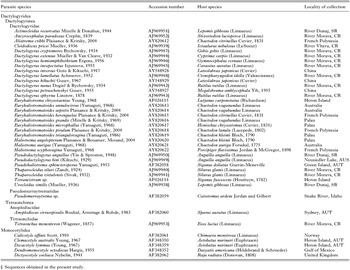
Fifteen species of Monogenea belonging to the Dactylogyridae and 1 species belonging to the Tetraonchidae were collected from gills of their respective hosts (Table 1). Parasite determinations were performed based on the hard parts of the parasite haptor and reproductive organs, according to Gusev (1985). After species determination, the same parasite specimens were stored in absolute ethanol SPECTRANAL (Allied-Signal, Riedel-de Haën, Seelze, Germany) at 4 °C for molecular analysis.
Table 1. Species details and Accession numbers of sequences used in phylogenetic analyses (CR – Czech Republic, SR – Slovak Republic, AUS – Austria, AUT – Australia.)

Molecular analyses
Individual parasites were removed from ethanol and placed in 0·5 ml tubes containing 7·5 μl of lysis buffer (proteinase K 20 μg/ml, Tween 200·45%, Igepal CA630 0·45% in Tris-HCl 10 mM, EDTA 1 mM, pH 8·0). Tubes were incubated at 55 °C overnight, then for 10 min at 95 °C to inactivate proteinase K. Partial LSU rRNA gene region was amplified using primers C1 and D2 (Hassouna et al. 1984). Each amplification reaction contained 5 μl of lysate, 1×PCR buffer (Bioline), 1·5 mM MgCl2, 300 μM dNTPs, 1 μM each primer and 1 U Taq polymerase (Bioline) in a total volume of 20 μl. Partial LSU rRNA gene region was amplified by 35 cycles of 1 min at 94 °C, 1 min at 50 °C, 2 min 30 sec at 72 °C. PCR products were excised from agarose gels (Geneclean III, Bio 101) and cloned using pGEM-T Vector System (Promega). Inserts from 3 clones per species were purified (QIAprep, Qiagen) and sequenced using plasmid and internal primers in both directions. Sequencing was carried out using Big Dye version 3.1 and an ABI377 DNA Sequencer (Applied Biosystems). Sequences were assembled using Sequencher software (Gene Codes Corp.) and deposited in GenBank, DDBJ and EMBL databases under Accession numbers AJ969938–AJ969953 (Table 1).
Phylogenetic analyses
Sequences of 19 species of monogeneans belonging to the Dactylogyridea and 8 species belonging to the Monocotylidea were retrieved from GenBank (Table 1). Nucleic acid sequences were aligned using CLUSTAL X (Jeanmougin et al. 1998) using default parameters, and later refined by eye using BioEdit (Hall, 1999). All analyses were carried out using only positions that were unambiguously alignable across all taxa. Two data sets were analysed. The alignment was performed separately for each data set. The first phylogenetic analyses were performed including species of Dactylogyridea, which were polarized using the Monocotylidea as outgroup. The second phylogenetic analyses were performed using only species of Dactylogyridea and 2 representatives of the Tetraonchidae (Anoplodiscus cirrusspiralis and Tetraonchus monenteron) were used as outgroups to root the representatives of the Dactylogyridae. ModelTest (Posada and Crandall, 1998) was used to select the best appropriate evolutionary model. Maximum likelihood (ML) based on ML distances using the parameters obtained from ModelTest were conducted in PAUP*4b10 (Swofford, 2002). A search for the best ML tree was performed using branch-swapping algorithm (TBR, tree bisection reconnection). Distance trees were generated with neighbour-joining (NJ) algorithm based on distances selected by ModelTest and performed in PAUP*4b10 (Swofford, 2002). Support values for internal nodes were estimated by bootstrap re-sampling (Felsenstein, 1985). One hundred replicates for the ML and 1000 replicates for the NJ based on ML distances were calculated. A branch-swapping algorithm NNI (nearest neighbour interchange) was applied for the ML bootstrap. Maximum parsimony (MP) analysis was performed using heuristic search with stepwise random addition sequence on unweighted parsimony informative characters. One thousand bootstrap replicates were calculated using the TBR branch-swapping algorithm. Finally, Bayesian analyses (BI) were conducted using the program MrBayes 3.1 (Ronquist and Huelsenbeck, 2003). We specified for both datasets a Tamura Nei (TrN) model with invariable sites and a gamma distribution for variable rate sites. This model was selected using the previously determined model of nucleotide evolution by the hierarchical likelihood ratio tests (using ModelTest). Starting trees were randomly chosen. Four Monte Carlo Markov chains were run for 1000000 generations at the default temperature (0·2), trees being sampled every 100 generations for a total of 10000 trees in the initial sample. The burn-in asymptote was estimated by plotting the number of generations against the log likelihood scores for the saved trees. The posterior probability of the phylogeny and its branches was determined for all the trees left in the plateau phase with nearly the best ML scores. Four replicates of these Bayesian runs were conducted as described to insure convergence of the posteriors. Tree topologies resulting from NJ, ML, MP and Bayesian analyses were statistically compared using the Shimodaira and Hasegawa test implemented in PAUP*4b10.
RESULTS
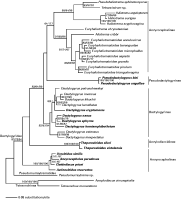
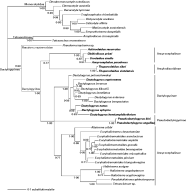
The new partial LSU sequence length varied from 640bp (Tetraonchus monenteron) to 944bp (Actinocleidus recurvatus). An unambiguous alignment including all analysed species of the Dactylogyridea and Monocotylidea spanned 432 positions (see Table 2 for the number of conserved, variable and parsimony informative characters). The TrN+I+G model (Tamura Nei model including the proportion of invariable characters and the heterogeneity rate approximated by a gamma distribution) was selected by the ModelTest and the information about the parameters of the model are shown in Table 2. The NJ analysis on ML distances (TrN+I+G parameters) was performed, and a distance tree is illustrated in Fig. 1. Eight species of Monocotylidea were used for rooting the trees. Topology of the best ML tree was similar to the topology of the NJ tree. The MP analysis provided 16 equally parsimonious trees with 1207 steps (CI=0·397, RI=0·703). The strict consensus tree displayed similar topology to the NJ and ML trees. The consensus tree obtained from BI analysis is shown in Fig. 3. No statistically significant difference among the tree topologies based on NJ, ML, 16 equally parsimonious trees (MP) and the tree obtained from BI analyses was found using the Shimodaira-Hasegawa test implemented in PAUP*4b10 (P>0·05).

Fig. 1. Neighbour-joining tree based on TrN distances, including the proportion of invariable characters and gamma distribution, inferred from analysis of partial large ribosomal subunit rDNA of 43 Monogenea species (Polyonchoinea). The numbers along branches indicate bootstrap percentages resulting from different analyses in the order: NJ/MP/ML. BP values lower than 50 are given as ‘-’. Species of Dactylogyridae collected from the fish with European distribution excluding imported fish are shown in bold.
Table 2. Information about the data sets used in the analyses (The numbers of conserved (C), variable (V) and parsimony informative (PI) characters are shown. Pi – proportion of invariable sites, α – rate heterogeneity approximated by a gamma distribution.)

The Dactylogyridea was split into 2 clades in all analyses (Figs 1 and 3). Both the Tetraonchinea and Dactylogyrinea were supported with either strong or moderate bootstrap values. Within the Dactylogyridae, 2 clades appeared with either moderate or low bootstrap proportions (BP) or moderate Bayesian posterior probabilities from the first analyses (Figs 1 and 3). The clade with low support included 2 well-supported subgroups: the Ancylodiscoidinae species and the freshwater species of the Ancyrocephalinae. The clade with moderate support included 3 clades the Dactylogyrinae, Pseudodactylogyrinae and marine species of Ancyrocephalinae.

Fig. 2. Neighbour-joining tree based on TrN distances, including the proportion of invariable characters and gamma distribution, inferred from analysis of partial large ribosomal subunit rDNA of 35 species of Dactylogyridea. The numbers along branches indicate bootstrap percentages resulting from different analyses in the order: NJ/MP/ML. BP values lower than 50 are given as ‘-’. Species of Dactylogyridae collected from the fish with European distribution excluding imported fish are shown in bold.

Fig. 3. Consensus Bayesian topology for 43 Monogenean species based on partial large ribosomal subunit rDNA sequences. The species of Monocotylidea are outgroups. Numbers along branches indicate Bayesian posterior probabilities. Branch lengths are proportionally drawn, as indicated by the scale at the bottom left, according to the average number of expected DNA substitutions per site among all trees sampled after the burn-in period. Species of Dactylogyridae collected from the fish with European distribution excluding imported fish are shown in bold.
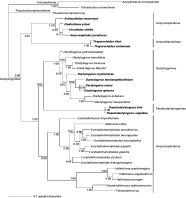
The second data set excluded the monocotylidean species and provided a clearer resolution between selected genera and species within the Dactylogyridae (Figs 2 and 4). Two representatives of the Tetraonchidae (Anoplodiscus cirrusspiralis and Tetraonchus monenteron) were used as outgroups to root trees. An unambiguous alignment including only species of the Dactylogyrinea and Tetraonchinea spanned 437 positions (see Table 2 for the number of conserved, variable and parsimony informative characters). Again, the TrN+I+G model was selected as the best model for the analysed data set (the parameters of the model are shown in Table 2). The topology of the NJ tree based on ML distances (Fig. 2) was similar to the ML tree. Four equally parsimonious trees with 938 steps (CI=0·465, RI=0·689) resulted from the MP analysis. The strict consensus tree was in agreement with the both the ML tree and NJ tree on ML distances. The consensus tree obtained from BI analysis is shown in Fig. 4. No significant difference among the tree topologies based on NJ, ML tree, 4 equally parsimonious trees (MP) and the tree obtained from BI analyses was found using the Shimodaira-Hasegawa test implemented in PAUP*4b10 (P>0·05).

Fig. 4. Consensus Bayesian topology for 35 species of Dactylogyridea based on partial large ribosomal subunit rDNA sequences. The species of Tetraonchinea are outgroups. Numbers along branches indicate Bayesian posterior probabilities. Branch lengths are proportionally drawn, as indicated by the scale at the bottom left, according to the average number of expected DNA substitutions per site among all trees sampled after the burn-in period. Species of Dactylogyridae collected from the fish with European distribution excluding imported fish are shown in bold.
The monophyletic origin of the Dactylogyridae was supported by moderate bootstrap values or high Bayesian posterior probabilities in all performed analyses (Figs 2 and 4). The freshwater Ancyrocephalinae appeared to form a monophyletic group sister to the Ancylodiscoidinae and a clade including the Dactylogyrinae, Pseudodactylogyrinae and marine species of the Ancyrocephalinae. However, this clade was supported by moderate or low bootstrap values. Using BI analysis, the Ancylodiscoidinae species and the freshwater species of the Ancyrocephalinae clustered together similarly as in the analyses of the first data set. The Dactylogyrinae formed a monophyletic group based on moderate to strong bootstrap values and represented a sister group to a clade including the Pseudodactylogyrinae and marine species of the Ancyrocephalinae. The Ancyrocephalinae were divided into 2 well-supported clusters, separating species of Euryhaliotrema, Euryhaliotrematoides and Aliatrema from the remaining species of marine Ancyrocephalinae.
The relationships within Dactylogyrus appeared better resolved in the analyses of the reduced data set (only Dactylogyridea) (Figs 2 and 4). Three subgroups of Dactylogyrus species were recognized, but their relationship remained unresolved. The first subgroup included Dactylogyrus extensus and Dactylogyrus inexpectatus from Cyprinus carpio and Carassius auratus, both cyprinids of Asian origin. The second subgroup included Dactylogyrus species from Chinese fish species together with Dactylogyrus lamellatus from Ctenopharyngodon idella which also originated from Asia. The third subgroup included Dactylogyrus hemiamphibothrium from Gymnocephalus cernuus (Percidae) and 2 Dactylogyrus species from European Cyprinidae, namely Dactylogyrus nanus and Dactylogyrus sphyrna. The phylogenetic position of Dactylogyrus cryptomeres, a specific parasite to Gobio species seems to be unresolved (Fig. 2). However, using BI analysis this species clustered together with the Dactylogyrus species of the first and second subgroups (Fig. 4).
DISCUSSION
SSU and LSU data are widely applied to infer phylogenetic relationships within the Platyhelminthes (e.g. Littlewood et al. 1999a, 1999b; Olson and Littlewood, 2002). Within the Monogenea, sequences of ribosomal subunits are widely used to infer phylogenetic relationships at the level of families and subfamilies (šimková et al. 2003; Plaisance et al. 2005) or also to investigate evolutionary associations between parasites and their hosts (Desdevises et al. 2002; šimková et al. 2004).
Based on the results of the analyses displayed here, the status of the Ancyrocephalidae sensuBychowsky & Nagibina (1978) should be rejected, and the results of Kritsky and Boeger (1989), indicating both polyphyletic and paraphyletic features of the family, are confirmed. The present study includes members of several subfamilies of the Dactylogyridae and confirms the monophyly of this family as suggested by Kritsky and Boeger (1989) using morphological characters. Similar results have been found in phylogenetic studies based on molecular data (šimková et al. 2003; Plaisance et al. 2005). Nowadays, the Dactylogyridae includes 9 subfamilies, but some subfamilies such as the Ancyrocephalinae were found as unnatural due to lack of synapomorphies (Kritsky and Boeger, 1989). Members of the Ancyrocephalinae represent a widely distributed group of parasites with their presence on many different families of freshwater and marine fish living on or in different continents or seas (Lim, 1998; Kohn and Cohen, 1998; Kritsky and Boeger, 2002).
A polyphyletic origin of the Ancyrocephalidae and Ancyrocephalinae was shown by šimková et al. (2003) and Plaisance et al. (2005), when partial sequences of SSU or combined SSU, LSU and 16S rDNA sequence data set (Plaisance et al. 2005) were used to infer phylogeny within the monophyletic Dactylogyridae. However, considering the analyses of Plaisance et al. (2005) only marine Ancyrocephalinae were represented by 3 different sequences including SSU, LSU and 16S rDNA but all European Ancyrocephalinae and Dactylogyrinae were only represented by SSU data in the combined analyses. The present study, however, investigates the phylogenetic relationships within the Dactylogyridae including LSU data of both European and marine Ancyrocephalinae. Moreover, Dactylogyrus species from the fish of both European and Asian origin were included. We confirm that the Ancyrocephalidae sensuBychowsky & Nagibina, 1978 is a group of polyphyletic origin as revealed from the analyses of both šimková et al. (2003) and Plaisance et al. (2005). Those previous studies, when data for European Ancyrocephalinae were restricted to SSU sequences, showed the Ancylodiscoidinae to be a well or moderately supported sister group to freshwater Ancyrocephalinae. Our analyses provide similar insights only when using Bayesian analyses for both data sets. However, when applying other methods of phylogenetic reconstruction, the position of the freshwater Ancyrocephalinae, Actinocleidus, Ancyrocephalus, Cleidodiscus, and Urocleidus, as a sister group to the Ancylodiscoidinae is only weakly supported using the full-data-set. In the reduced data set, the Ancylodiscoidinae appear at the base of a clade-clustering species of the Dactylogyrinae and Pseudodactylogyrinae and the marine species of Ancyrocephalinae, supported by moderate bootstrap values.
Previous studies documented 3 subgroups within Ancyrocephalinae using the analyses of SSU (šimková et al. 2003; Plaisance et al. 2005) and 2 subgroups using the combined data (Plaisance et al. 2005). Three groups are also identified within the Ancyrocephalinae in the present study: the first including freshwater Ancyrocephalinae, the second including Euryhaliotrematoides species, Aliatrema cribbi and Euryhaliotrema chrysotaeniae, and the third including Haliotrema species, Pseudohaliotrema sphincteroporus and Tetrancistum sp., all parasites of reef-associated fish species. Both data sets (i.e. the first analyses including the Monocotylidea as outgroup and the second analyses using Tetraonchinea to root the representatives of Dactylogyrinea) demonstrate a similar relationship between tropical and subtropical Ancyrocephalinae, e.g. butterflyfish ancyrocephalids and Pseudohaliotrema and Tetrancistrum, with the butterflyfish ancyrocephalids being a group of paraphyletic origin as previously presented by Plaisance et al. (2005).
The monophyletic origin of the Dactylogyrinae is confirmed in this study. However, we only included representatives of Dactylogyrus in our analyses. The genera with low numbers of species, Acolpenteron, Pseudoacolpenteron and Pellucidhaptor, members of Dactylogyrinae (Beverley-Burton, 1984; Gusev, 1985), and their phylogenetic relationships with Dactylogyrus or members of Ancyrocephalinae were not analysed until today and could be potentially included when investigating the status of Dactylogyrinae in the future. Several analyses in previously published studies supported a clade formed by the Dactylogyrinae and Pseudodactylogyrinae (see Plaisance et al. 2005), but, based on the present larger data set, the relationships between the Dactylogyrinae, Pseudodactylogyrinae and the species of marine Ancyrocephalinae appeared to be unresolved, similar to what it was shown from the analyses of SSU (šimková et al. 2003). Nevertheless, we can conclude that the monophyletic origin of the Dactylogyrinae and Pseudodactylogyrinae is confirmed by the results provided by all those studies.
The process of speciation and diversification within Dactylogyrus has been analysed by šimková et al. (2004) based on the SSU and ITS1 of 51 species parasitizing cyprinid fish of Central European rivers. Three lineages were distinguished and sympatric intrahost speciation was proposed as the mode of species diversification within this genus. Our analysis on the reduced data set suggests that partial LSU might also represent a suitable marker to resolve the phylogeny of the genus. Corroborating the results of SSU (šimková et al. 2004), 3 lineages were recognized within Dactylogyrus, albeit their relationships remain unresolved. However, the Bayesian analysis using the reduced data set suggests a moderately supported clade for the first and third Dactylogyrus lineages (Dactylogyrus of Cyprinus carpio and Carassius auratus and European Dactylogyrus respectively). Two Dactylogyrus species specific to Cyprinus carpio and Carassius auratus form a well-supported clade. Those Asian cyprinids were hypothesized as a plesiomorphic host group for Dactylogyrus species by šimková et al. (2004). However, this fact is not supported by bootstrap proportions in the present analyses. Additional Chinese Dactylogyrus species were included in the present analyses, i.e. D. inversus and D. kikuchii from perciform fish Lateolabrax japonicus (Lateolabracidae, Perciformes) and D. petruschewskyi from Megalobrama amblycephala (Cultrinae, Cyprinidae). Chinese Dactylogyrus, not available for the SSU analysis, cluster together with Dactylogyrus lamellatus from Ctenopharyngodon idella which originated from the East Asia and was later introduced to Europe (Winfield and Nelson, 1991). The position of Dactylogyrus cryptomeres from Gobio gobio is not clearly resolved. The majority of species belonging to Gobioninae both originated and are widely distributed in Eastern Asia, even if Gobio gobio displays a continuous distribution in Europe and northern East Asia and probably dispersed by natural migration into Europe (Winfield and Nelson, 1991). In the present analysis the third lineage includes Dactylogyrus of European Leuciscinae (Dactylogyrus nanus can be found potentially on 4 host species and D. sphyrna on 9 host species, šimková et al. unpublished), and Dactylogyrus hemiamphibothirium, a parasite species of percid species. This supports the results of šimková et al. (2004) obtained from the analyses of SSU, a well-supported monophyletic group including a wide range of European Dactylogyrus species parasitizing Leuciscinae, Alburninae, Gymnocephalus cernuus of Percidae and Barbus barbus of Cyprininae which interconnected by origin and/or migration routes (for molecular phylogeny of Cyprinidae and its biogeographical implications see Tsigenopoulos and Berrebi, 2000; Cunha et al. 2002; Durand et al. 2002). Moreover, the present analysis suggests the independent secondary colonization of perciform fish species by Dactylogyrus species in both Europe and Asia. In conclusion, the phylogeny inferred from the partial LSU rDNA supports the hypothesis that colonization of Dactylogyrus parasites follows the pattern of dispersal history and diversification of their host family from Asia to Europe (šimková et al. 2004).
The authors would like to thank Markéta Ondračková and Radim Blažek from the Institute of Botany and Zoology, Masaryk University, Brno, Czech Republic for help with parasite collection; Jean-François Martin from the Centre de Biologie et de Gestion des Populations, Montpellier, France, for help with Bayesian analyses. I.M. was funded by Marie Curie Individual Fellowship No. QLK5-CT-2001-51038. A.š. was founded by the Grant Agency of the Czech Republic No. 524/03/P108. This study was also supported by the Research Project of Masaryk University, Brno No. MSM 0021 622 416.