From middle childhood, most peer interactions take place in group contexts (Brown, Reference Brown, Feldman and Elliott1990; Cairns & Cairns, Reference Cairns and Cairns1994; Rubin, Bukowski, & Bowker, Reference Rubin, Bukowski, Bowker, Bornstein and Leventhal2015). Peer groups are often formed based on mutual attractions and activities among children with similar interests and characteristics (Rubin et al., Reference Rubin, Bukowski, Bowker, Bornstein and Leventhal2015). Once formed, peer groups play an important role in individual social, school, and psychological adjustment (Brown, Reference Brown, Feldman and Elliott1990). Peer group influence may be increasingly evident from early adolescence when adolescents attempt to pursue their independence from the family (Steinberg & Silverberg, Reference Steinberg and Silverberg1986). Adolescents tend to pay close attention to their group members’ behaviors and opinions as social references (Bagwell, Coie, Terry, & Lochman, Reference Bagwell, Coie, Terry and Lochman2000). Peer groups may affect individual development through various processes (Brown, Reference Brown, Feldman and Elliott1990; Rubin et al., Reference Rubin, Bukowski, Bowker, Bornstein and Leventhal2015). Some of the processes, such as social learning and mutual support, may be similar to those in dyadic relationships with friends, although these processes in the group context may occur in a complicated manner beyond the dyadic level (Cairns & Cairns, Reference Cairns and Cairns1994). The influence of peer groups may also involve norm-based group processes, such as within-group assimilation and regulation in group activities and group-reputational effects (Brown, Reference Brown, Feldman and Elliott1990; Harris, Reference Harris1995; Rubin et al., Reference Rubin, Bukowski, Bowker, Bornstein and Leventhal2015). Adolescents may learn and modify their behaviors according to group standards and expectations (Cairns & Cairns, Reference Cairns and Cairns1994). Thus, peer groups are a significant socialization agent in adolescent development (Kindermann & Gest, Reference Kindermann, Gest, Bukowski, Laursen and Rubin2018).
The significance of peer groups for adolescent development has been demonstrated in empirical studies. For example, affiliation with aggressive groups not only increases one's own antisocial behaviors but also contributes to later peer rejection, learning problems, and school dropout (Ellis & Zarbatany, Reference Ellis and Zarbatany2007; Low, Polanin, & Espelage, Reference Low, Polanin and Espelage2013). In contrast, belonging to well-functioning groups, such as prosocial groups or academically oriented groups, is related to desirable outcomes, such as peer acceptance and high academic motivation and achievement (Chung-Hall & Chen, Reference Chung-Hall and Chen2010; Kindermann & Gest, Reference Kindermann, Gest, Bukowski, Laursen and Rubin2018). Relative to aggressive, prosocial, and academic-oriented groups, groups that are relatively higher on depression (or “depressive groups” in a short form used in this paper) have received inadequate attention in research. As one of the salient psychological problems in adolescence, depression is associated with negative adjustment, such as peer victimization and academic difficulties (Liu et al., Reference Liu, Bullock, Coplan, Chen, Li and Zhou2018). Moreover, depression may be contagious among adolescents, not only in dyadic friendships (Prinstein, Reference Prinstein2007; Stevens & Prinstein, Reference Stevens and Prinstein2005), but also in group networks (Conway, Rancourt, Adelman, Burk, & Prinstein, Reference Conway, Rancourt, Adelman, Burk and Prinstein2011; Van Zalk, Kerr, Branje, Stattin, & Meeus, Reference Van Zalk, Kerr, Branje, Stattin and Meeus2010). Nevertheless, little is known about the implications of affiliation with depressive groups for adolescent adjustment in broad domains.
According to the developmental cascade framework (e.g., Masten & Cicchetti, Reference Masten and Cicchetti2010), changes in one system or domain may spread to other systems (e.g., peer groups to individuals) or other domains (e.g., depression to social and school performance) over time. Researchers have examined how depression in friendships and peer networks may affect individual depression (the “peer contagion” effect; Conway et al., Reference Conway, Rancourt, Adelman, Burk and Prinstein2011; Prinstein, Reference Prinstein2007; Van Zalk et al., Reference Van Zalk, Kerr, Branje, Stattin and Meeus2010). However, little research has been conducted to examine cascading effects in development across social systems and domains. Therefore, in the present study, we sought to examine how group-level depression would predict adolescents’ adjustment in social and school domains beyond the contagion effect. The study would help us better understand the comprehensive role of depressive groups in adolescent development and provide valuable information for designing prevention or intervention programs to reduce adolescent problems.
Depressive Groups as a Developmental Context
Peer groups with relatively high levels of depression may affect adolescent functioning through the social-cognitive processes within and outside of the group. The exposure to relatively frequent depressive symptoms of peers in the group, including maladaptive interpersonal styles such as negative feedback seeking (Joiner & Timmons, Reference Joiner, Timmons, Gotlib and Hammen2009), is a stressful experience. Moreover, displaying pessimistic thinking styles and helpless behaviors may be the group norm for corumination (Rose, Reference Rose2002). Corumination and interaction, featuring excessive talking about their negative emotions and experiences, in depressive groups make group members overly speculate on problems, focus on personal failures, and dwell on negative affect (Rose, Carlson, & Waller, Reference Rose, Carlson and Waller2007). The group context may also reinforce individual helpless behaviors in social and academic settings (Nolen-Hoeksema, Girgus, & Seligman, Reference Nolen-Hoeksema, Girgus and Seligman1992). Consequently, the experiences in depressive groups may increase adolescents’ tendency to develop social problems. Moreover, pessimistic thinking styles and negative emotions in group interactions may undermine adolescents’ academic motivation and performance on academic tasks (Schwartz, Gorman, Nakamoto, & Toblin, Reference Schwartz, Gorman, Nakamoto and Toblin2005).
The social environment outside depressive groups may also have adverse effects on adolescent development due to several reasons. Depressive peer groups typically have a negative social reputation, and peers outside the groups may judge individuals within these groups negatively and act less friendly toward them (Kindermann & Gest, Reference Kindermann, Gest, Bukowski, Laursen and Rubin2018; Zhao, Chen, Ellis, & Zarbatany, Reference Zhao, Chen, Ellis and Zarbatany2016). The negative reputation of depressive groups may increase the risk of peer victimizations for members of these groups (Sweeting & West, Reference Sweeting and West2001). Passive and helpless behaviors that members of a depressive group display may indicate its incapability of defending each other, which makes the members particularly vulnerable to bullying (Hodges, Boivin, Vitaro, & Bukowski, Reference Hodges, Boivin, Vitaro and Bukowski1999). Relatedly, because depressive adolescents are likely to form groups with similar peers due to their difficulties getting into other groups (Borelli & Prinstein, Reference Borelli and Prinstein2006), affiliation with depressive groups may further restrict the interaction of the group members with more socially adaptive peers and reduce their opportunities to learn appropriate social skills (Zhao et al., Reference Zhao, Chen, Ellis and Zarbatany2016), which eventually may lead to increased adjustment problems.
Affiliation with Depressive Groups and Adjustment in Chinese Adolescents: The Present Study
Most Chinese adolescents are affiliated with a peer group (Chen, Chang, Liu, & He, Reference Chen, Chang, Liu and He2008). Researchers have found that affiliation with academically oriented and high-achieving groups contributes to children's positive social and psychological adjustment in China (Chen et al., Reference Chen, Chang, Liu and He2008). However, there is no research on the effects of depressive groups on individual adjustment in Chinese adolescents. It is unclear whether and how affiliating with depressive groups is associated with adolescents’ social and school adjustment. To fill this gap, we conducted the current longitudinal study to examine relations between group-level depression and individual-level adjustment in Chinese adolescents.
In Chinese, and perhaps other East Asian, societies, adolescents’ psychological wellbeing has traditionally been neglected because it may not have evident effects on collective functioning (Chen, Reference Chen and Bond2010). Displaying individual negative feelings is often considered inappropriate because it may disrupt social harmony (Luo, Reference Luo1996). Whereas peer groups mainly serve as a context for the development of autonomy based on individual needs in Western societies (Rubin et al., Reference Rubin, Bukowski, Bowker, Bornstein and Leventhal2015), the primary function of peer groups in China is to help children and adolescents learn social standards and socially appropriate behaviors (Chen et al., Reference Chen, Chang, Liu and He2008). Depressive groups may be viewed as particularly abnormal and deviant in the Chinese context (Liu et al., Reference Liu, Bullock, Coplan, Chen, Li and Zhou2018). Nevertheless, it has been found that, compared with their Western counterparts, adolescents in China displayed equal, or even higher, levels of affect disturbances including depression (e.g., Chen, Rubin, & Li, Reference Chen, Rubin and Li1995; Zhong et al., Reference Zhong, Ding, Chen, Li, Xu, Tong and Zhu2013) and that Chinese adolescents with emotional problems tend to form networks and groups (e.g., Liu & Chen, Reference Liu and Chen2003). The negative perceptions of and reactions to depressive groups from peers and teachers likely constitute an adverse social environment for adolescent development. Therefore, we expected that group-level depression would positively predict peer victimization and learning problems, and negatively predict social competence, peer preference, school competence, and academic achievement.
We were interested in gender differences. Previous research showed that girls appeared to be more susceptible to the peer influence of depressive symptoms in dyadic friendships and peer networks and that the peer effects of depressive symptoms were stronger for girls than for boys (Conway et al., Reference Conway, Rancourt, Adelman, Burk and Prinstein2011; Stevens & Prinstein, Reference Stevens and Prinstein2005). For example, due to gender-stereotypical ideologies, emotion expression may be regarded as more acceptable in girls than in boys in Asian societies (e.g., Fischer & Manstead, Reference Fischer, Manstead and Fischer2000; Way, Reference Way2013). As a result, compared with boys, girls are more likely to engage in corumination and are more emotionally involved in relationships with peers in the group (Rose & Rudolph, Reference Rose and Rudolph2006; Way, Reference Way2013). In addition, girls tend to be socially oriented and more identified with the group than boys (Chen & Liu, Reference Chen, Liu and Cicchetti2016; Han & Li, Reference Han and Li2009; Maccoby, Reference Maccoby1998). Therefore, we expected in this study that group-level depression would make greater contributions to social and school adjustment in girls than in boys.
Methods
Participants
The participants in the present study came from five schools, including two middle schools and three high schools in two cities in Southeastern China. The five schools were regular public schools that served students in their geographic area, and the students came from the residential area near the schools. The initial sample included 1,507 students (703 boys) in Grade 7 (mean age = 13.32 years, SD = .51) and Grade 10 (mean age = 16.32 years, SD = .54). The students were mostly from families with middle socioeconomic status in regions. In the sample, 74.8% of the fathers and 79.3% of the mothers had a high school or lower education, and 25.2% of the fathers and 20.7% of the mothers had a college or higher education. Based on a scale of monthly family income ranging from 1 (5,000 yuan or below) to 10 (above 40,000 yuan), the average monthly family income was 3.68 (approximately 11,700 yuan or US $1,832, SD = 2.31). The parental educational levels and family income in this sample were similar to those reported for the general population in the regions (Bureau of Statistics of Huangshan, 2017; Bureau of Statistics of Suzhou, 2017). Most of the participants (94%) were from intact families. Due to the “one-child-per-family” policy that was implemented in the late 1970s, 90% of the participants were the only child in the family; others had one or more siblings. The demographic variables had no significant effects on the variables or the relations in the study.
From the original sample, 1,430 students, including 430 students (228 boys) in middle schools and 1,000 students (444 boys) in high schools, participated in a follow up study one year later. Students who participated in the follow-up study and those who did not participate did not differ on the study variables. The data for this study were drawn from a larger project on socioemotional development and social relationships in China.
Measures
Peer groups
The Social Cognitive Map procedure (SCM) developed by Cairns et al. (Reference Cairns, Gariepy and Kindermann1991) was used to identify participants’ naturally existing peer groups. Participants were asked, “Do you have a group that you often hang around with in your class? Who are these people?” They also were asked to report other groups of students in their class who hung around together. Reports from all participants were aggregated to construct a cooccurrence matrix that contained the number of occasions that any two children were nominated into the same group. Each participant's group membership was determined by the frequencies of nominations with every other student in the class. Then, a cut-off point of .40 for the correlation was employed to determine whether group-membership profiles of the two participants were similar and whether they should be assigned to the same group. Participants who were affiliated with more than one group were assigned to the group for which they received the most nominations. The SCM has been shown to be a valid procedure in identifying observed peer associations in previous research (e.g., Chen et al., Reference Chen, Chang, Liu and He2008; Zhao et al., Reference Zhao, Chen, Ellis and Zarbatany2016). In the present study, the SCM procedure identified 252 groups, with sizes ranging from 3 to 16 members (Mean = 5.47, SD = 2.26). There were 100 all-boy groups, 133 all-girl groups, and 19 mixed-gender groups. Consistent with the procedure used in previous studies (e.g., Chung-Hall & Chen, Reference Chung-Hall and Chen2010), group-level depression was calculated by averaging the depression scores of the group members.
Depression
Participants’ depression was assessed by administering a 13-item Chinese measure adapted from the Children's Depression Inventory (CDI; Kovacs, Reference Kovacs1992; Liu et al., Reference Liu, Chen, Coplan, Ding, Zartany and Ellis2015). Each of the items provides three alternative responses (e.g., “I feel like crying every day,” “I feel like crying most days,” and “I feel like crying once in a while”) from which the participant chooses one that best describes him or her in the past 2 weeks. The participants’ responses were scored from 0 to 2. The items center on a given thought, feeling, or behavior associated with depression such as self-deprecation, reduced social interest, anhedonia, fatigue, and self-blame. Following the procedure outlined by Kovacs (Reference Kovacs1992), the average score of the items was computed, with higher scores indicative of greater depression. The mean depression score was .46 (SD = .29) in both waves in this study (scores ranged from 0 to 1.86), which was similar to those in other studies (e.g., Liu et al., Reference Liu, Chen, Coplan, Ding, Zartany and Ellis2015). This measure has been shown to be reliable and valid for Chinese adolescents (e.g., Chen, Liu, Ellis, & Zarbatany, Reference Chen, Liu, Ellis and Zarbatany2016; Liu et al., Reference Liu, Chen, Coplan, Ding, Zartany and Ellis2015). The internal reliabilities of this measure were .80 and .81 at Times 1 and 2, respectively, in this study.
Social competence
We assessed participants’ social competence using a peer assessment measure adapted from the revised class play (RCP, Masten, Morison, & Pellegrini, Reference Masten, Morison and Pellegrini1985). Participants nominated up to three classmates who could best play the role if they were to direct a class play. Subsequently, nominations received from all classmates were used to compute each item score for each student. As suggested by Terry and Coie (Reference Terry and Coie1991), both same-sex and cross-sex nominations were allowed. Item scores were standardized within the class to adjust for differences in the number of nominators. There were 12 items in the measure assessing various aspects of social competence (e.g., “Makes new friends easily,” “Helps others when they need it”). The measure has proved to be reliable and valid for Chinese children (e.g., Chen, Rubin, & Sun, Reference Chen, Rubin and Sun1992). The internal reliabilities of the measure were .88 and .88 at Times 1 and 2, respectively, in this study.
Sociometric nominations
Participants were asked to nominate up to three classmates with whom they most liked to be and three classmates with whom they least liked to be (positive and negative nominations). As suggested by other researchers (e.g., Coie, Terry, Lenox, Lochman, & Hyman, Reference Coie, Terry, Lenox, Lochman and Hyman1995), both same-sex and cross-sex nominations were allowed. The nominations received from all classmates were totaled and then standardized within each class to allow for appropriate comparisons. Positive and negative nominations received from peers indicated how a child was liked and disliked by peers in the class. Following Coie, Dodge, and Coppotelli's (Reference Coie, Dodge and Coppotelli1982) procedure, an index of peer preference, indicating the overall likability of the child in the class, was formed by subtracting negative nomination scores from positive nomination scores. This procedure has been shown to be valid for Chinese adolescents (e.g., Chen et al., Reference Chen, Liu, Ellis and Zarbatany2016).
Peer victimization
Peer victimization was assessed using a nomination measure (Schwartz et al., Reference Schwartz, Gorman, Nakamoto and Toblin2005). Participants were asked to nominate up to three classmates to fit each of four descriptors (e.g., “Is pushed or hit by other kids,” “Gets picked on or teased by other kids”). Nominations received from all classmates were used to compute each item score for each participant. The item scores were summed and standardized within the class to form an index of peer victimization. The measure has been shown to be reliable and valid for Chinese adolescents (e.g., Liu et al., Reference Liu, Bullock, Coplan, Chen, Li and Zhou2018). The internal reliabilities of the measure were .74 and .73 at Times 1 and 2, respectively, in the present study.
Teacher ratings
The head teacher for each class was asked to complete a TeacherChild Rating Scale [T-CRS], adapted from Hightower et al. (Reference Hightower, Work, Cowen, Lotyczewski, Spinell, Guare and Rohrbreck1986). The teacher was asked to rate each participating student in the class on a 5-point scale (1 = not at all, 5 = very well) about how well each item described the student. The items in the measure assessed participants’ school competence (e.g., “Participates in class discussion,” “Copes well with failure”) and learning problems (e.g., “Has difficulties in learning academic subjects,” “Is poorly motivated to achieve”). The teacher rating scores were standardized within the class to control for the teacher's response style and to allow for appropriate comparisons. The T-CRS has been shown to be reliable and valid for Chinese adolescents (e.g., Chen et al., Reference Chen, Liu, Ellis and Zarbatany2016). Internal reliabilities were .90 and .82 at Time 1, and .88 and .88 at Time 2 for school competence and learning problems, respectively, in this study.
Academic achievement
Information on academic achievement in three main subjects, Chinese, mathematics, and English, was obtained from the school records. The scores of academic achievement were based on objective examinations conducted by the school. The aggregated score of grades in these subjects has been shown to be a valid measure of academic achievement for adolescents (Liu et al., Reference Liu, Bullock, Coplan, Chen, Li and Zhou2018). In the present study, scores on Chinese, mathematics, and English were significantly correlated (r = .33–.50, ps < .001). Following the procedure in previous studies (e.g., Chen et al., Reference Chen, Chang, Liu and He2008; Liu et al., Reference Liu, Bullock, Coplan, Chen, Li and Zhou2018), scores on the three subjects were averaged and standardized to form a single index of academic achievement in the present study.
Procedure
The participants completed a measure of peer group networks at Time 1. In addition, at both times, the participants were group-administered peer assessment measures of social competence and victimization, a sociometric nomination measure of peer acceptance and rejection, and a self-report measure of depression. Teachers rated each participant in the class on his or her school competence and learning problems. Data on academic achievement were obtained from the school records. Extensive explanations were provided to participants during the collection of data. The study was approved by the institutional review board. Participants were recruited through the school. The researcher described the study, explained the procedure, and answered questions in each class. Then, all students were invited to participate in the study with no criteria for exclusion. The participation rate was approximately 90% at each time. Written consent was obtained from all participants and their parents. The first wave of the data was collected in May 2016, and the followed-up data were collected one year later.
Results
Descriptive Data
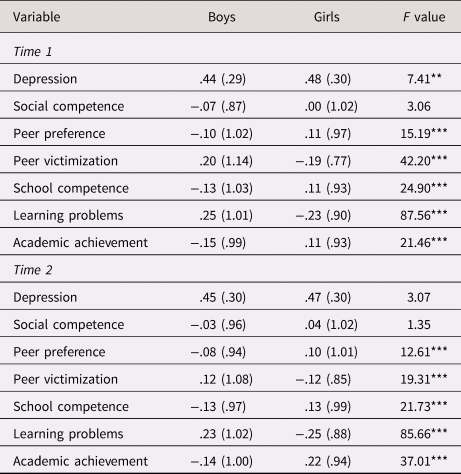
We conducted a multivariate analysis of variance (MANOVA) to test the effects of gender and grade on the variables. A significant effect for gender was found, Wilks Λ = .88, F (14, 1290) = 12.82, p < .001, η2 = .12. No significant effect for grade was found, Wilks Λ = .99, F (14, 1290) = 1.26, p > .05, η2 = .01. Follow-up univariate analyses indicated that compared with boys, girls had higher scores on peer preference, school competence, and academic achievement, and lower scores on peer victimization and learning problems at both waves. Girls also had higher scores on depression at Time 1. Descriptive statistics are presented in Table 1.
Means and standard deviations of variables

Note: Standard deviations are in parenthesis. **p < .01 ***p < .001.
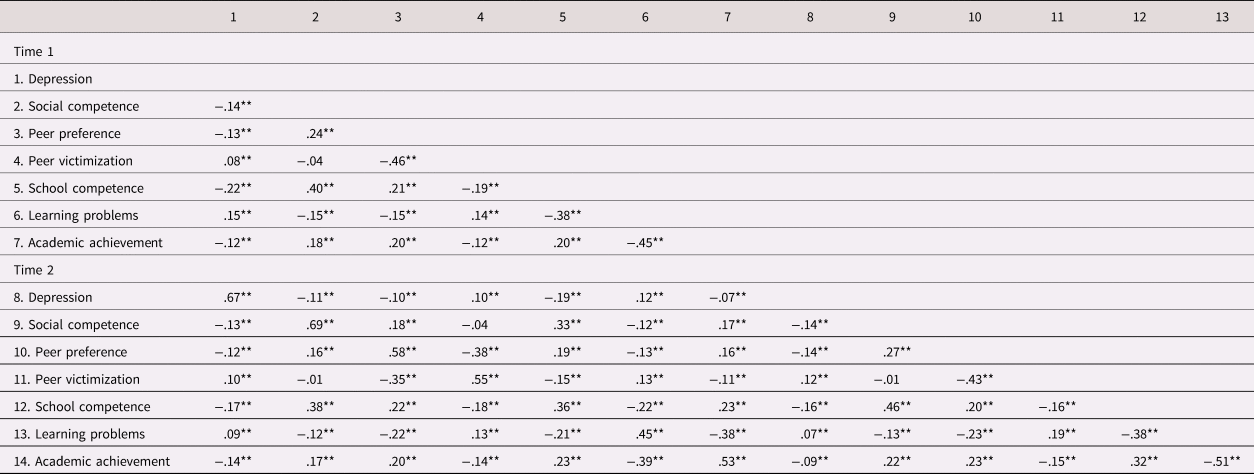
Inter-correlations among the variables are presented in Table 2. The magnitudes of the correlations among the adjustment variables were moderate, suggesting that these measures tapped different but overlapping aspects of social and school adjustment. The intraclass correlation (ICC), which indicated the proportion of the between-group variance relative to the total variance, was .09 for depression. The individual-group correlation (between each participant's score and the average scores of group members, Kindermann, Reference Kindermann1993) on depression was .50 (p < .001). Correlations between group-level depression and other group-level variables were from −.29 (school competence) to .05 (peer victimization), p < .05.
Correlations among variables at Time 1 and Time 2

*p < .05 **p < .01.
Effects of Group-Level Depression
Two-level hierarchical linear modeling (Raudenbush & Bryk, Reference Raudenbush and Bryk2002) was used to examine the effects of Time 1 group-level depression on Time 2 individual depression (the contagion effect) with gender and Time 1 individual depression controlled and on Time 2 adjustment outcomes (the cascading effect) with gender, corresponding Time 1 adjustment variable, and Time 1 individual depression controlled. We also estimated the effects of Time 1 group-level depression on Time 2 adjustment outcomes with gender, Time 1 individual adjustment, and both Time 1 individual depression and Time 2 individual depression controlled, and the results were similar. We reported the results below with Time 2 depression not controlled because including Time 2 depression as a predictor was against temporal precedence. Preliminary analyses showed nonsignificant main effects or moderating effects for grade, so grade was not included in all the models. Group gender (0 for male and 1 for female), representing the gender-related feature of the group, was controlled as a Level 2 predictor (gender was not included in Level 1 analyses because of the lack of within-group variability). Following Chen, Chang, He, & Liu's (Reference Chen, Chang, He and Liu2005) procedure, the 19 mixed-gender groups were coded according to the predominance of the gender in the group (8 male groups, 11 female groups). As suggested by Hofmann and Gavin (Reference Hofmann and Gavin1998), Time 1 adjustment variable and Time 1 depression were group mean centered. We also calculated r ES, that is, the correlation equivalent of the significance level (tail probability), as the effect size for multilevel analysis (Cohen, Reference Cohen1988).
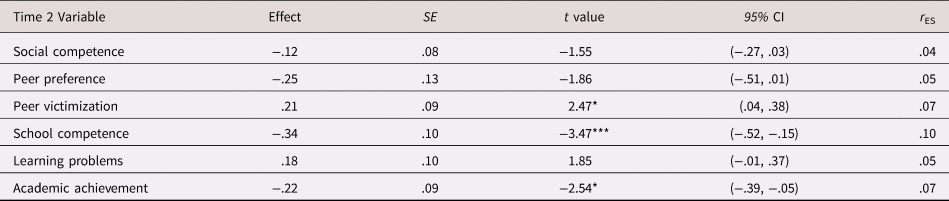
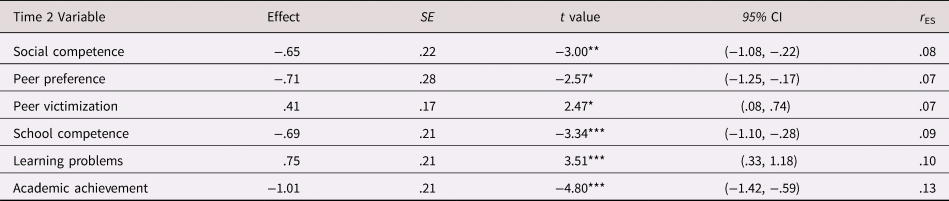
At the within-group individual-level, Time 1 individual depression positively predicted Time 2 depression, b = .66, SE = .02, t = 27.32, p < .001, r ES = .60. Time 1 group-level depression also predicted Time 2 individual depression, b =.70, SE = .04, t = 16.36, p < .001, r ES = .41, with gender and individual Time 1 depression controlled. The main effects of Time 1 individual depression and Time 1 group-level depression on Time 2 adjustment are presented in Table 3 and Table 4, respectively. The results indicated that after controlling for gender, the corresponding Time 1 individual adjustment, and Time 1 individual depression, Time 1 group-level depression negatively predicted Time 2 social competence, peer preference, school competence, and academic achievement. Time 1 group-level depression also positively predicted Time 2 peer victimization and learning problems. As such, the results indicated that affiliation with more depressive groups was associated with more social and academic problems.
Relations between Time 1 depression and Time 2 adjustment variables at within-group individual levels

Note: Gender, corresponding Time 1 adjustment variable, and Time 1 group-level depression were controlled. *p < .05 ***p < .001.
Effects of Time 1 group-level depression on Time 2 adjustment variables

Note: Gender, corresponding Time 1 adjustment variable, and Time 1 individual depression were controlled. *p < .05 **p < .01 ***p < .001.
Additional analyses were conducted to test the potential interaction effects. A significant interaction between group gender and group-level depression was found in predicting academic achievement, b = 1.06, SE = .42, t = 2.52, p < .05. To understand the nature of the interactions, we conducted the simple slope tests separately for boys and girls. The results indicated that the Time 1 group-level depression was negatively associated with Time 2 academic achievement for both boys and girls, but the association was stronger for boys, b = −1.61, SE = .32, t = −5.04, p < .001, than for girls, b = −.55, SE = .28, t = −1.98, p < .05.
Discussion
Developmental researchers have recently been interested in the implications of internalizing problems among peer groups for individual development (Van Zalk, Van Zalk, & Kerr, Reference Van Zalk, Van Zalk and Kerr2011; Zhao et al., Reference Zhao, Chen, Ellis and Zarbatany2016). Limited research in Western societies has shown that peer group-level depression may affect the adjustment of group members (Conway et al., Reference Conway, Rancourt, Adelman, Burk and Prinstein2011; Van Zalk et al., Reference Van Zalk, Van Zalk and Kerr2011). The present study revealed the contagion of group-level depression to individual members, which was consistent with the literature (e.g., Conway et al., Reference Conway, Rancourt, Adelman, Burk and Prinstein2011). Moreover, the results showed that group-level depression positively contributed to later peer victimization and learning problems and negatively contributed to later social competence, peer preference, school competence, and academic achievement, beyond the peer contagion, in Chinese adolescents. Relative to the within-group individual-level relations, group-level depression predicted later adjustment more evidently and consistently across domains. The results indicated that depressive peer groups had unique contributions to the development of adjustment difficulties in social and school areas and highlighted the importance of peer group contexts for understanding individual maladaptive functioning.
The adverse broad effects of depressive groups on adolescents’ development may occur through several mechanisms. As indicated earlier, the exposure to relatively frequent depressive symptoms of peers in the group is a stressful experience (Joiner & Timmons, Reference Joiner, Timmons, Gotlib and Hammen2009). Moreover, depressive groups serve as a social context, with maladaptive group norms such as pessimistic thinking (Stevens & Prinstein, Reference Stevens and Prinstein2005) and helplessness (Agoston & Rudolph, Reference Agoston and Rudolph2013), that facilitates the development of adjustment problems through coruminations and learning observations (Rose, Reference Rose2002). The cognitive, affective, and behavioral group norms not only make adolescents susceptible to internalizing symptoms, but also create difficulties for their peer interaction and learning (Conway et al., Reference Conway, Rancourt, Adelman, Burk and Prinstein2011; Krygsman & Vaillancourt, Reference Krygsman and Vaillancourt2017; Schwartz et al., Reference Schwartz, Gorman, Nakamoto and Toblin2005).
Moreover, depressive groups are likely to have negative reputations among peers outside the groups, which may be especially the case in China because peer groups are expected to be socialization forces for children and adolescents to learn socially desirable behaviors and perform on school tasks (Chen et al., Reference Chen, Chang, Liu and He2008; Luo, Reference Luo1996). The negative reputations of the groups may restrict group members’ opportunities to interact with and learn from competent peers in the school (Zhao et al., Reference Zhao, Chen, Ellis and Zarbatany2016) and elicit negative reactions of adolescents in the groups such as social dissatisfaction and distress (Chen & Liu, Reference Chen, Liu and Cicchetti2016). As a result, the experiences in depressive groups may serve to maintain and exacerbate adolescents’ adjustment problems over time.
We found that gender moderated the associations between group-level depression and academic achievement. Group-level depression was a greater risk factor for low academic achievement in boys than in girls, which was inconsistent with our expectation. Several explanations may be offered for this finding. Acknowledging and expressing depressive feelings may be viewed by others as more abnormal for boys than for girls, due to gender-stereotypical expectations (e.g., Chen & He, Reference Chen, He, Roopnarine and Gielen2004; Maccoby, Reference Maccoby1998). Thus, male depressive groups may receive more negative social evaluations, which interfere with school performance for boys in the groups (Young & Sweeting, Reference Young and Sweeting2004). It was found in Chinese adolescents that depression positively predicted internet addiction in boys, but not in girls (Liang et al., Reference Liang, Zhou, Yuan, Shao and Bian2016). It is possible that adolescent boys in depressive groups play online games together and use it to cope with depression. If this were the case, it is understandable that addiction to online games of boys in these groups causes decline in academic achievement (Whang, Lee, & Chang, Reference Whang, Lee and Chang2003). In addition, relative to boys, girls had higher academic achievement, which might serve as a protective factor that buffered against the negative effect of depressive peer groups (Liu & Iwamoto, Reference Liu and Iwamoto2006).
The results of the present study indicate that membership of depressive groups is a risk factor for developing adjustment problems in multiple domains among Chinese adolescents. The results may have practical implications for designing peer group-based educational and prevention and intervention programs. Professionals and parents should pay particular attention to peer groups of adolescents who display depressive symptoms. It may be an effective strategy to help the adolescents to change their group dynamics such as coruminations in addition to work with them at the individual level (e.g., Rose et al., Reference Rose, Carlson and Waller2007).
Several limitations and weaknesses in this study should be noted. First, we did not examine group processes in the study. For example, based on the literature (e.g., Rose & Rudolph, Reference Rose and Rudolph2006; Rubin et al., Reference Rubin, Bukowski, Bowker, Bornstein and Leventhal2015; Sweeting & West, Reference Sweeting and West2001), we discussed the influence of group depression in terms of corumination and group reputational effects. It has also been argued that peer groups may contribute to individual development through norm-based group processes that are beyond those in dyadic relationships, such as within-group mutual regulation and other dynamic interaction in various group activities (Brown, Reference Brown, Feldman and Elliott1990; Cairns & Cairns, Reference Cairns and Cairns1994; Harris, Reference Harris1995; Rubin et al., Reference Rubin, Bukowski, Bowker, Bornstein and Leventhal2015). Behavioral observations of depressive groups will likely provide valuable information on how members in these groups interact with each other and with out-group peers and how the peer experiences contribute to individual development. It will be important to conduct observational and other types of studies to explore the processes.
Second, the influence of peer groups on individual development often occurs in combination with other social factors (e.g., Chen et al., Reference Chen, Chang, He and Liu2005). For example, supportive parenting may serve to buffer against the negative effects of depressive groups. Thus, it will be interesting to investigate how the functioning of depressive groups and parenting interact in predicting adolescents’ social and school adjustment.
Third, the focus of this study was on contributions of depressive groups to individual adjustment. Research has shown bi-directional relations between adolescents’ depressive symptoms and affiliation with maladaptive peers (e.g., Fergusson, Wanner, Vitaro, Horwood, & Swain-Campbell, Reference Fergusson, Wanner, Vitaro, Horwood and Swain-Campbell2003; Hankin et al., Reference Hankin, Young, Abela, Smolen, Jenness, Gulley and Oppenheimer2015; Rudolph et al., Reference Rudolph, Lansford, Agoston, Sugimura, Schwartz, Dodge and Bates2014). It will be interesting to study the developmental mechanisms of depressive groups involving group formation (e.g., selection based on homophily, Kandel, Reference Kandel1978; Kindermann & Gest, Reference Kindermann, Gest, Bukowski, Laursen and Rubin2018) and socialization at the same time. Relatedly, different aspects (e.g., depression, aggression, social competence) of the peer context may contribute to individual development in a joint and interactive manner. Researchers should explore in future research how different group characteristics work together in predicting individual developmental outcomes.
Finally, no Western sample was included in this study. We used the Western literature (e.g., Van Zalk et al., Reference Van Zalk, Kerr, Branje, Stattin and Meeus2010) mainly as a background for the discussion of peer group socialization. In general, our results appear to be consistent with the literature. However, the specific results might not be directly comparable with Western findings because there is virtually no existing research on effects of group-level depression on social and school adjustment. Thus, the present study needs to be replicated in other countries, including North America. Despite the limitations, the results of this study constitute a significant contribution to our understanding about the potential risk of affiliation with depressive groups in Chinese adolescents.
Acknowledgments
We are grateful to the children and teachers for their participation. We also thank Kai Xie (University of Virginia) for programming a software for data input and processing and Michael Rovine (University of Pennsylvania) for offering suggestions about data analysis.
Financial Support
This research was supported by a research grant from the Center for the Study of Contemporary China at the University of Pennsylvania, awarded to Lingjun Chen.