





1. Introduction
The discovery of a new population of wide, eccentric neutron star(NS)-main-sequence(MS) binaries by Gaia has opened a novel window to binary evolution. In Gaia Data Release 3, astrometric orbital solutions revealed dozens of solar-type stars wobbling under the gravity of unseen companions of mass
 $M_{\rm comp}\sim1.3-1.8\,M_\odot$
- consistent with NS rather than white dwarfs (WDs). Follow-up spectroscopy confirmed 21 NS–MS binaries in the Galactic field (El-Badry et al. Reference El-Badry, Rix, Latham, Shahaf, Mazeh, Bieryla, Buchhave, Andrae, Yamaguchi, Isaacson, Howard, Savino and Ilyin2024). These systems have orbital periods
 $P_\mathrm{orb}$
of roughly 200 to 1,000 days and surprisingly high eccentricities (
 $e\simeq0.2-$
0.8), in stark contrast to the nearly circular orbits of typical NS (as millisecond pulsar or MSP)-WD binaries of similar period, discovered through radio astronomy (Manchester et al. Reference Manchester, Hobbs, Teoh and Hobbs2005). Moreover, a few primaries show unusual characteristics (e.g. Lithium-enhancement and low metallicity), hinting at exotic formation channels. These findings challenge the long-held assumption that Roche-lobe overflow (RLOF) in binary stars leads to prompt orbital circularization (Hut Reference Hut1981), an assumption that underpins most binary evolution models (Hurley et al. Reference Hurley, Tout and Pols2002). If mass transfer can occur while the orbit remains eccentric, the future evolution of these NS–MS binaries could differ substantially from the standard picture of NS recycling.
In this contribution, we provide an overview of key results on the future evolution of Gaia’s NS–MS binaries, emphasising the contrast between eccentric mass transfer vs usual assumption of artificial circular RLOF outcomes. We limit our scope to the essential findings, which serve as a conceptual teaser, while deferring detailed modelling aspects to forthcoming journal article(s). In particular, we focus on how each Gaia binary will likely end up as a NS–WD system (rather, a radio pulsar–WD pair), and how the nature of mass transfer influences the final orbital and stellar properties. We also connect our predictions to the observed population of Galactic pulsar–WD binaries, which comprises
 $\sim$
130 systems in the field, to see which, if at all, evolutionary channel (eccentric vs. circular) is actually responsible for their formation.
2. Methods
To assess whether the Gaia NS–MS binaries can be produced through isolated binary evolution, we first performed a population synthesis using the open-source binary evolution code POSYDON (Andrews et al. Reference Andrews, Bavera, Briel, Chattaraj, Dotter, Fragos, Gallegos-Garcia, Gossage, Kalogera, Kasdagli, Katsaggelos, Kimball, Kovlakas, Kruckow, Liotine, Misra, Rocha, Souropanis, Srivastava, Sun, Teng, Xing, Zapartas and Zevin2024). We explored a broad range of initial conditions and physical assumptions (e.g. star formation history, metallicity, NS natal kicks, common envelope prescriptions) to search for progenitor binaries that would evolve into systems matching the observed Gaia sample (i.e. a
 $\sim1.3-1.8\,M_\odot$
NS with a
 $\sim$
1
 $M_\odot$
companion in a wide,
 $P_\mathrm{orb}\sim10^3$
d, eccentric orbit).
To predict the future evolution of each Gaia NS–MS binary, we carried out detailed binary stellar evolution calculations using the MESA stellar evolution code (Paxton et al. Reference Paxton, Bildsten, Dotter, Herwig, Lesaffre and Timmes2011). We initialized 1-D stellar models for each of the 21 Gaia systems. The
 $M_\mathrm{comp} \approx0.9-1.8\,M_\odot$
companion stars (using their estimated masses, orbital periods, eccentricities, and metallicities from the Gaia observations) and evolved them together with a
 $1.3-1.8\,M_\odot$
NS using MESA’s binary module. We incorporated several important physics updates: (i) an eccentric mass-transfer prescription based on Sepinsky et al. (Reference Sepinsky, Willems, Kalogera and Rasio2009) and Rocha et al. (Reference Rocha, Hur, Kalogera, Gossage, Sun, Doctor, Andrews, Bavera, Briel, Fragos, Kovlakas, Kruckow, Misra, Xing and Zapartas2025), which allows non-conservative mass transfer to occur when the star overflows its Roche lobe near periastron and tracks the resulting changes in orbital separation a and eccentricity e due to mass and angular momentum loss; (ii) an enhanced magnetic braking torque for cool stars, using prescriptions calibrated to recent models of stellar wind braking (Garraffo et al. Reference Garraffo, Drake, Dotter, Choi, Burke, Moschou, Alvarado-Gómez, Kashyap and Cohen2018), in place of the standard over-simplified magnetic braking law Gossage et al. (Reference Gossage, Kalogera and Sun2023); and (iii) a state-of-the-art pulsar spin evolution module that follows the NS’s spin-up due to accretion torques and spin-down due to magnetic dipole radiation (Chattopadhyay et al. Reference Chattopadhyay, Stevenson, Hurley, Rossi and Flynn2020; Chattopadhyay et al. Reference Chattopadhyay, Stevenson, Hurley, Bailes and Broekgaarden2021). We analyse the result of each binary under two limiting assumptions for the mass-transfer at RLOF: the standard, fully circularised orbit versus an eccentric orbital mass transfer case. By comparing these two scenarios for each system, we aim to bracket the extremes of how the Gaia binaries might evolve: from no circularization (fully eccentric mass transfer) to complete circularization at RLOF. In all cases, the mass-transfer rate is limited by the Eddington accretion rate onto the NS (we also explored super-Eddington accretion in test runs, but found it did not qualitatively change the outcomes, so we focus on the Eddington-limited results). We evolve each binary until the donor star has lost its envelope and becomes a compact remnant (WD), and the NS’s accretion and spin-up episode has ceased.
3. Results and Implications
3.1 Past with POSYDON
Even under optimistic assumptions, we found that isolated binary evolution produces Gaia-like NS–MS systems in at most about 1.5% of simulations. However, this negligible formation rate should be taken with a grain of salt. This is because while the relative rates of Gaia-like NS–MS systems are rare compared to the general NS–MS population that become NS–WDs, the normalized rates, if a continuous star formation rate is taken is consistent with the detections. Intriguingly, our synthetic populations also indicate that the majority of “canonical” NS–WD binaries (the tight MSP–WD systems commonly observed) arise from a common envelope (CE) phase shortly after the NS’s birth. In other words, unstable mass transfer is a key ingredient in the standard formation of MSP–WD binaries – a process the Gaia systems appear to be avoiding in their future. While the time evolution from zero-age-main-sequence to canonical NS–WD formation appears to occur at a shorter timescale, owing to the fact that after NS forms in those cases, the companion evolving star appears to fall in the mass range of 2-8
 $M_\odot$
, much more massive than the Gaia NS’s sun-like companions. We defer further discussion of these formation aspects to future work, and proceed with the assumption that regardless of their origin, the Gaia binaries will evolve in isolation going forward.
3.2 Evolutionary fate with MESA
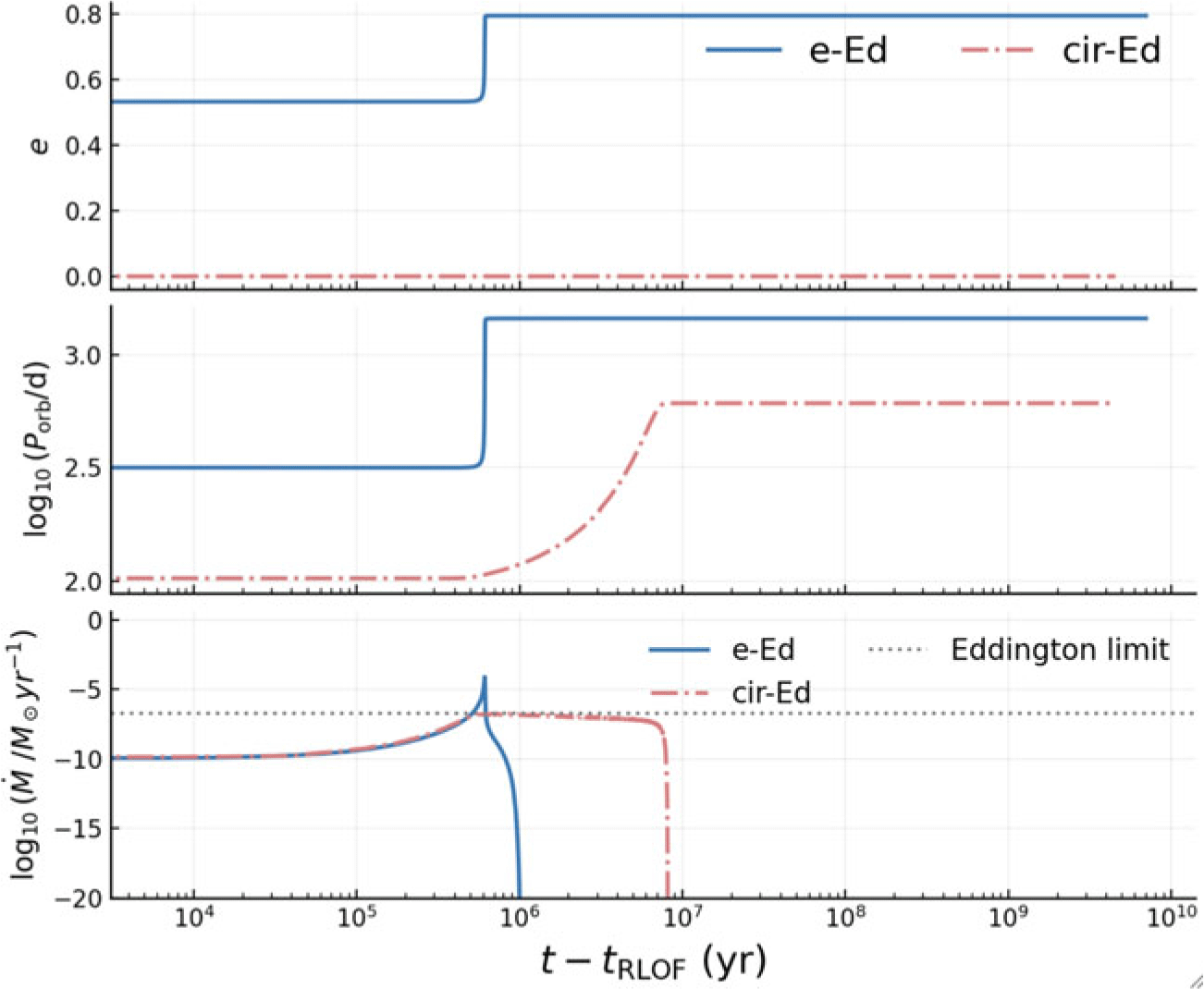
All 21 Gaia NS–MS binaries ultimately evolve into NS–WD binaries in our simulations, but the mass-transfer mode leads to two distinct evolutionary outcomes. Figure 1 illustrates a representative example of the time evolution under each scenario, and the key differences are summarized below:
Time evolution of key binary and stellar properties for Gaia NS–MS J1553-6846 with the NS mass at 1.323
 $M_\odot$
, companion of 1.04
 $M_\odot$
,
 $P_\mathrm{orb}=310.17\,d$
,
 $e=0.5314$
at solar metallicity comparing the evolution for Eddington-limted circular (cir-Ed, pink) and eccentric (e-Ed, blue) mass transfers. Panels from top to bottom show: (a) orbital eccentricity e; (b)
 $log_{10}(P_{\rm orb}/{\rm d})$
; (c) mass-transfer rate log
 $_{10}(\dot M/M_\odot\,\mathrm{yr}^{-1})$
. All quantities are plotted versus time since RLOF,
 $t - t_{\rm RLOF} (yr)$
.

Orbital evolution: Under eccentric mass transfer, the orbit expands significantly during mass exchange–typically the final orbital period is about
 $3-4$
times the initial
 $P_\mathrm{orb}$
(for most systems). The eccentricity e often remains high and in some models even increases slightly. By contrast, in the circular RLOF scenario, the orbit initially shrinks when mass transfer begins (as the orbit circularizes and mass-ratio effects drive tightening) but then widens gradually during the prolonged mass-transfer phase. Final orbital periods in the circular cases are usually only about
 $1.5$
times the initial period (and in a few cases the orbit ends slightly smaller than initially). All circular-case outcomes, of course, end with
 $e\simeq0$
. The eccentric-transfer cases terminate as NS–WD binaries of substantial eccentricity (often
 $e\sim0.3-0.8$
, roughly
 $1.5\times$
the initial e). In both scenarios, we find that the loss of orbital angular momentum is governed almost entirely by mass loss (and the associated tidal coupling) during and around the mass-transfer phase. Magnetic braking of the orbit and gravitational wave radiation are essentially negligible contributors in these wide, long-period systems. In the eccentric models, each periastron mass-loss burst removes a chunk of angular momentum, driving the orbital expansion. In the circular models, the continuous mass outflow carries away angular momentum. Our calculations confirm that tides plus mass loss account for the orbital evolution, whereas classical braking torques (strong in short-period compact binaries) do not play a significant role.
Mass-transfer duration and rate: In the eccentric channel, mass transfer occurs in brief bursts at periastron. We find high peak mass-transfer rates of order
 $\dot{M}\sim10^{-5}-10^{-4}\,M_\odot\,\mathrm{yr}^{-1}$
at burst peak, but these intense episodes are short-lived, with the effective mass-transfer phase lasting
 $\lesssim10^6$
yr before the donor detaches from its Roche lobe. In contrast, the circular RLOF cases exhibit a relatively steady mass-transfer rate around
 $\dot{M}\sim10^{-6}\,M_\odot\,\mathrm{yr}^{-1}$
, persisting for a much longer period–up to
 $\sim10^7$
yr–as the donor star is gradually stripped. Thus, eccentric mass transfer is intense but short, whereas circular mass transfer is gentler but sustained.
White Dwarf Remnants: In all simulations, the companion star ultimately loses its hydrogen-rich envelope and becomes a WD. However, the core composition of the WD differs by scenario. In every eccentric run, the donor’s envelope is shed relatively early (on the first ascent giant branch), leaving behind a low-mass helium (He) WD (He core that never grew beyond
 $\approx0.3\,M_\odot$
). In the circular RLOF runs, some donor stars have time to evolve further and ignite helium before the envelope is fully removed. We find that 9 out of the 21 systems in the circular scenario develop carbon–oxygen (CO) cores, ending as higher-mass CO WDs (0.35-0.55
 $M_\odot$
). The threshold for forming a CO WD in our models is a core mass
 $\gtrsim0.45\,M_\odot$
at the end of mass transfer, which typically occurs in systems with initially longer periods or more massive companions (allowing the donor to reach the He-burning stage during the extended mass-transfer). Notably, those circular-track donors that form CO WDs sometimes undergo late helium shell flashes and thermal pulses, creating loops in the Hertzsprung-Russell diagram (potentially observable as transient flashes by the Rubin observatory Ivezić et al. Reference Ivezić2019). Such thermal pulses do not occur for the progenitors of He WDs.
3.3 Connection to Pulsar White Dwarfs
A primary motivation of this study is to determine whether the Gaia-discovered NS–MS binaries are progenitors of the Galactic MSP–WD systems observed to date. Galactic radio surveys have detected of nearly a couple of hundred MSP–WD binaries in the field (excluding globular clusters). Almost all of these systems have circular or very low-eccentricity orbits, consistent with expectations for binaries that experienced long, stable phases of Roche-lobe overflow (Bhattacharya & van den Heuvel Reference Bhattacharya and van den Heuvel1991; Kiziltan & Thorsett Reference Kiziltan and Thorsett2010). However, our POSYDON experiments already hint that many canonical NS–WDs may instead form through CE evolution rather than exclusively via stable mass transfer, consistent with growing theoretical (MacLeod & Ramirez-Ruiz Reference MacLeod and Ramirez-Ruiz2015) and observational (Yang et al. Reference Yang, Han, Zhou, Jing, Chen, Wang, Li, Wang, Wang, Ge, Guo, Li, Shao, Liu, Su, Hou, Huang, Jiang, Jiang, Sun, Wang, Wang, Wang, Wang, Wang, Wang, Wang, Xu, Xu, Xu, Yan, Yan, You, Yu, Yuan and Zhang2025) indications of significant pulsar recycling during the CE. While CE NS recycling has been studied by Chattopadhyay et al. (Reference Chattopadhyay, Stevenson, Hurley, Rossi and Flynn2020); Chattopadhyay et al. (Reference Chattopadhyay, Stevenson, Hurley, Bailes and Broekgaarden2021) in the contexts of double-NS and NS-black-hole systems, a full population synthesis of NS–WD binaries–the largest observed class of binary pulsars–has yet to be carried out. Our initial POSYDON results provide a first indication of the importance of unstable mass transfer in producing MSPs. However, in our forward evolution of the 21 Gaia NS–MS systems, regardless of the mass-transfer prescription, the subsequent RLOF is stable. This leaves a degeneracy: prolonged, stable mass transfer under the circularized-at-RLOF assumption also produces MSPs in circular NS–WD binaries.
The pulsars in these systems are typically fast-spinning MSPs (periods of a few-30 milliseconds), and their WD companions span a range of masses–often
 $\sim0.2-0.3\,M_\odot$
He WDs, but also many in the
 $\sim0.4-0.5\,M_\odot$
range, indicating CO-core WDs in some cases. Observationally, there is a noted trend that pulsars with more massive WD companions tend to have slightly longer spin periods, whereas those with very low-mass He WDs are among the fastest-spinning MSPs. This empirical correlation has been discussed in previous population studies (e.g., Kiel et al. Reference Kiel, Hurley, Bailes and Murray2008; Kiziltan & Thorsett Reference Kiziltan and Thorsett2010) and is generally interpreted as an imprint of how much accretion-driven spin-up the NS received: systems that produced heavy WDs likely experienced a shorter, late Case B RLOF phase (spinning the pulsar up moderately), whereas those with lighter WDs underwent longer Case A/B mass transfer and spun the pulsar up more fully.
Our circular RLOF models naturally reproduce these characteristics of the Galactic MSP–WD population. In the circular scenario, about half of the Gaia binaries produce low-mass He WDs and half produce higher-mass CO WDs; correspondingly, we find that NS spin periods are shorter for the He-WD cases and somewhat longer (tens of ms) for the CO-WD cases, matching the observed trend. The final orbital periods in the circular models (typically a few hundred days) and their tight orbital circularization are also fully consistent with known MSP binaries. In fact, some of the longer-period MSP–WD systems observed (with
 $P_{\rm orb}\sim200-800$
d) could be direct analogues of the outcomes we predict under the circular channel. We conclude that stable, circular RLOF is the evolutionary route that links the Gaia NS–MS binaries to the majority of pulsar–WD systems in the field.
The eccentric mass-transfer channel does not appear to produce systems that match the typical observed pulsar-WD binaries. An eccentric mass-transfer outcome would be a wide binary (hundreds to thousands of days) with significant eccentricity (
 $e\sim0.3-0.7$
), hosting a mildly recycled pulsar (spin periods of tens of ms to
 $0.1-1$
s) and a low-mass He WD. Such a system would resemble an intermediate pulsar–slower than a MSP but spun up relative to a young pulsar–in a wide, eccentric orbit. These are observationally quite rare. In fact, no known Galactic field pulsar-WD binary has an eccentricity above
 $0.1$
, except those in which the pulsar is young (not recycled) or the companion is not a WD (e.g., high-eccentricity pulsar B1913+16 has an NS companion Hulse & Taylor Reference Hulse and Taylor1975; eccentric PSR J1903+0327 turned out to have a main-sequence companion Champion et al. Reference Champion, Ransom, Lazarus, Camilo, Bassa, Kaspi, Nice, Freire, Stairs, van Leeuwen, Stappers, Cordes, Hessels, Lorimer, Arzoumanian, Backer, Bhat, Chatterjee, Cognard, Deneva, Faucher-Giguère, Gaensler, Han, Jenet, Kasian, Kondratiev, Kramer, Lazio, McLaughlin, Venkataraman and Vlemmings2008). The absence of eccentric MSP-He WD binaries could indicate that the eccentric mass transfer channel is a very minor contributor to the pulsar population–either because it seldom occurs (owing to the rarer occurrence of Gaia-like systems in the first place as predcited by POSYDON), or because the resulting pulsars are hard to detect. Selection effects likely play a role: a pulsar with spin period
 $P_{\mathrm{spin}}\sim0.1-1$
s in a year-long eccentric orbit is difficult to identify in standard radio pulsar searches due to acceleration/sampling issues. Searches sensitive to long-period binaries have only recently improved (e.g., targeted Fast Fourier Transform algorithms and timing of candidates), and a few long-period MSPs have been found (e.g., the
 $P_{\rm orb}\sim669$
d MSP 0407+1607 Lorimer & Freire Reference Lorimer and Freire2005). But a truly eccentric MSP binary would require careful acceleration or jerk searches (e.g., Bagchi et al. Reference Bagchi, Lorimer and Wolfe2013). It is conceivable that some mildly recycled pulsars in eccentric orbits are lurking undetected in radio surveys due to these challenges (see also Chattopadhyay et al. Reference Chattopadhyay, Stevenson, Hurley, Bailes and Broekgaarden2021). Additionally, the lifetime of a partially recycled pulsar may be shorter–if its magnetic field does not decay as much, its spin-down age could be relatively small, making it a dim radio source after a few
 $\times10^7$
yr. All these factors suggest that even if the Gaia binaries do follow the eccentric mass-transfer route, the resulting pulsars would form a small and elusive subpopulation of Galactic pulsars.
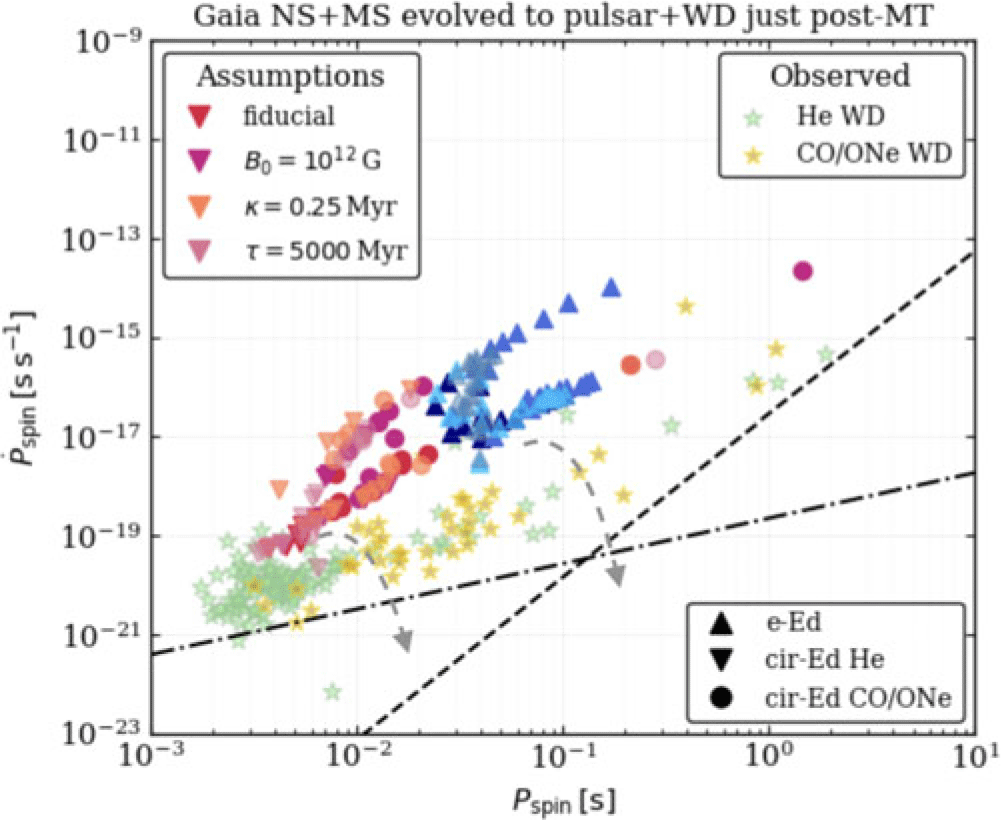
Figure 2 illustrates the recycled pulsars formed from the evolution of 21 Gaia binaries into NS–WD systems, for two stable mass-transfer cases–circularised at RLOF and eccentric–each evaluated with four different pulsar model variations, compared against the observed radio pulsar-WD systems.
Spin-period
 $P_\mathrm{spin}$
versus spin-down rate
 $\dot{P}_\mathrm{spin}$
right at the end of stable mass transfer (MT) for four representative pulsar models around “fiducial” (initial
 $P_\mathrm{spin}=50\,$
ms, initial surface magnetic field
 $B_0=10^{11}\,$
G, magnetic field decay timescale
 $\tau=$
1000 Myr, magnetic field decay mass scale
 $\kappa=0.025\,$
Myr), and the following three with
 $B_0=10^{12}\,$
G,
 $\kappa=0.025\,$
Myr,
 $\tau=$
5000 Myr and all other parameters remain identical to fiducial (in different colour shades) chosen to maximise differences. Each model has 21 Gaia systems, e-Ed (blue, upright triangle, only has He WDs) and cir-Ed (pink, inverted triangle for He WD and circle for CO WD). The radio pulsar observations are depicted as green star (He WD) and gold star (CO/ONe WD). The grey arrows show the eventual time evolution of the pulsars since mass transfer that takes them towards the radio-quiet ‘death valley’ bordered by the two pulsar ‘Death Lines’.

It is worth noting that our eccentric mass-transfer modelling assumes an extreme limit: mass is transferred in sharp bursts at periastron, with effectively no mass flow during the rest of the orbit (a delta-function approximation). In reality, if a binary’s eccentricity is not too high (say
 $e\lesssim0.3-0.4$
), tidal interactions may enforce partial circularization or phase-dependent mass transfer spread around periastron passage rather than instantaneous bursts. For those few Gaia systems with moderate eccentricities, our eccentric model might therefore overestimate how discontinuous the mass transfer is. A phase-dependent prescriptions by Hamers & Dosopoulou (Reference Hamers and Dosopoulou2019)–could yield somewhat different outcomes, potentially reducing eccentricity growth or allowing longer-lived transfer even in an eccentric orbit. Improving eccentric RLOF modelling is thus an important future step in refining predictions for the lower-eccentricity cases.
4. Conclusions and Future Work(s)
We have investigated the evolutionary fate of the newly discovered Gaia NS–MS binaries, emphasizing the impact of eccentric versus circular mass transfer on the formation of pulsar-WD binaries. Our findings can be summarized as follows.
Gaia binaries as a rarer subpopulation: Population synthesis with POSYDON indicates that Gaia-like NS–MS systems arise infrequently in isolated evolution–at most
 $\leq1.5\%$
under optimistic assumptions–and their normalized numbers are nonetheless consistent with current detections under a continuous star-formation history. Crucially, our synthetic populations suggest that the majority of canonical MSP–WD binaries are produced by unstable mass transfer leading to a CE episode that both circularizes the orbit and recycles the NS: brief but efficient CE-mediated accretion spins up the NS, setting the observed MSP periods and helping shape the MSP mass and luminosity distributions. In this sense, CE recycling emerges as a primary pathway to the Galactic MSP–WD population. Whereas, the Gaia NS–MS binaries appear to avoid a CE phase and, in forward evolution, undergo prolonged, stable RLOF–still capable of producing circular MSP–WDs, but likely contributing only a minority of systems given their rarity and the selection biases against discovering long-period, eccentric progenitors (
 $P_\mathrm{orb}\sim$
hundreds of days). Their wide, often eccentric orbits nonetheless provide a valuable laboratory for testing mass-transfer physics outside the CE channel.
Mass-transfer geometry matters: The mode of mass transfer leaves distinct imprints on the final binary. Eccentric mass transfer tends to produce wide, eccentric NS-He WD binaries with only mildly recycled pulsars, whereas circularized RLOF yields tighter (albeit still wider than the initial orbit), circular NS–WD binaries with fully recycled pulsars (often with CO-core WDs). The latter outcome closely resembles the bulk of observed Galactic MSP–WD binaries, suggesting that most MSP–WDs originate from the sustained, circular channel. In both eccentric and circular cases, orbital changes are dominated by mass and angular-momentum loss tied to the mass-transfer process itself. Neither magnetic braking nor gravitational radiation plays a significant role at these long orbital periods. This highlights how wide Gaia-like systems evolve under different physics than compact binaries.
Neutron star accretion and spin-up: Because of the limited duration and the fact that mass transfer in eccentric runs is highly super-Eddington only for short intervals (with most of the transferred mass lost from the system), the NS accretes relatively little in the eccentric mass transfer case–typically only a few
 $\times10^{-2}\,M_\odot$
in total. Consequently, the NS’s spin period only decreases to
 $P_\mathrm{spin}\sim50-100$
ms (a partially “recycled” pulsar). In some extreme eccentric cases the final spin could be hundreds of milliseconds or even approaching 1 s, i.e., only mildly recycled. On the other hand, in the circular RLOF channel the NS accretes approximately an order of magnitude more mass–about
 $10^{-1}\,M_\odot$
–owing to the longer-lasting, Eddington-limited accretion. This is sufficient to spin the NS up to millisecond periods. In our models, final spin periods of
 $P_{\rm spin}\approx 3-30$
ms are achieved in the circular cases (making the NS a fully recycled MSP). We note that these spin outcomes depend somewhat on assumed neutron-star birth spin and magnetic-field decay parameters, but across a broad range of plausible pulsar parameters, the trend holds: only sustained accretion can produce an MSP, whereas bursty periastron accretion yields a slower pulsar.
This work has focused on forward evolution given the Gaia-observed initial conditions. An equally important open question concerns their origin. Preliminary population-synthesis experiments with POSYDON show that the “standard” CE channel cannot readily account for them. Possible alternative formation routes include dynamical exchanges, disrupted triples, or other non-standard channels. We are actively exploring these scenarios. A forthcoming detailed paper will present a comprehensive synthesis of both formation and evolution, showing how unstable mass transfer produces the majority of MSP–WD binaries, while the Gaia sample represents outliers from a rarer channel.
In conclusion, Gaia’s NS–MS binaries serve as a natural experiment probing how mass transfer operates in eccentric binaries and how such systems may connect young neutron-star binaries to recycled pulsar-WD systems. Incorporating eccentric mass-transfer physics and pulsar spin evolution into binary models already yields testable predictions. With future Gaia data releases and upcoming pulsar surveys (e.g. SKA, MeerKAT), we will be able to confirm whether eccentric NS–WD systems populate the Galaxy in measurable numbers, or whether efficient tidal coupling typically drives them onto the circular recycling track. Together, these efforts will help build a unified evolutionary picture for NS binaries in our Galaxy, from formation to final MSP–WD outcomes.
 M⊙
 M⊙
 Porb=310.17d
 e=0.5314
 log10(Porb/d)
 10(M˙/M⊙yr−1)
 t−tRLOF(yr)
 Pspin
 P˙spin
 Pspin=50
 B0=1011
 τ=
 κ=0.025
 B0=1012
 κ=0.025
 τ=

 Open access

