In the case of miniatures, in contrast to what happens when we try to understand an object or living creature of real dimensions, knowledge of the whole precedes knowledge of the parts. And even if this is an illusion, the point of the procedure is to create or sustain the illusion, which gratifies the intelligence and gives rise to a sense of pleasure which can already be called aesthetic on these grounds alone.
Claude Lévi-Strauss, ‘The Science of the Concrete’
Whether we think of an aria as a ‘miniature’ or not, the analyst’s temptation to synecdoche is ever-present: great arias can, at times, stand for great operas or their composers, just as great composers have stood for their epochs. While monumentalising the composer is now passé, the lapidary quality of a much-loved aria still invites singular attentiveness. When the arias and operas are not canonic familiars, however, their distillatory comfort is denied us – we must instead view the piece from less customary perspectives.
In the eighteenth century, the Italian operatic canon was, it seems, literary rather than musical: it was Metastasio. Thus while Rousseau advised young composers seeking inspiration to ‘prend le Métastase & travaille’, Charles Burney felt his ‘musical annals’ were completed only by study of Metastasio’s letters.Footnote 1 But the narrative of literature’s pre-eminence over music is, of course, not so simple, as the story of an aria from Metastasio’s most celebrated opera, Artaserse, might show. Here I want to discuss not that invitation to virtuosity, ‘Vò solcando un mar crudele’, Leonardo Vinci’s original setting of which (for Rome in 1730) was still admired at the end of the century.Footnote 2 If ‘Vò solcando’ might suggest that aria settings – and indeed operas – could achieve something like canonic status in the period, another from the opera offers a more complicated view.
Metastasio’s ‘Per quel paterno amplesso’, set by Vinci (like ‘Vò solcando’) for his primo uomo, Giovanni Carestini, in the role of Arbace, was heavily altered for Johann Adolf Hasse’s setting of the opera, which premiered in Venice less than two weeks later with Metastasio’s dear friend, Farinelli, as the primo uomo:
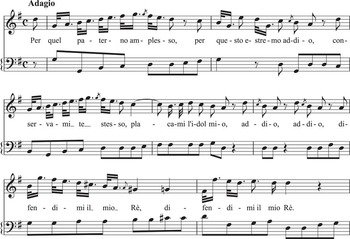
Farinelli’s preference for playing galant lovers may well have prompted the shift in textual emphasis from senatorial concern for king and state to focus on the beloved.Footnote 3 Although one might also note that Vinci’s setting, with a double interpolated ‘addio’ after ‘l’idol mio’, lingering on an imperfect cadence as his thoughts (and gaze?) turn to his lover, shows how neatly a composer could manipulate textual focus if he chose (Ex.1).
Leonardo Vinci, Artaserse (1730), ‘Per quel paterno amplesso’, bb. 5–11.

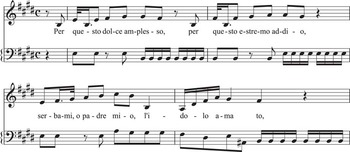
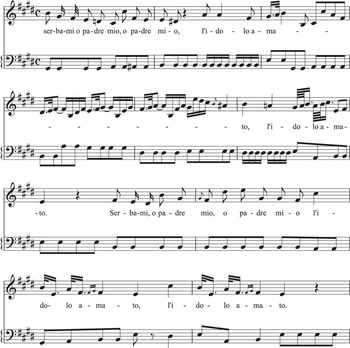
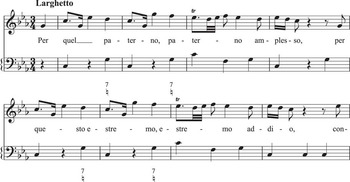
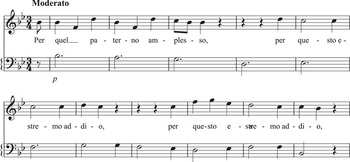
This momentary hiatus in Vinci’s setting only serves to emphasise the aria’s real point, however, which is Arbace’s resolve to relinquish life, love and good name rather than unmask the father who has betrayed him. It is surely for this reason that Vinci’s and Hasse’s settings both adopt a dignified common time adagio and (initially) predominantly conjunct vocal lines. Hasse may well have known Vinci’s setting of the opera, as Reinhard Strohm has suggested;Footnote 4 in this aria, it is notable that he also adopted the lombard rhythm that suffuses Vinci’s setting. But while for Vinci the ubiquity of the rhythm in the vocal line conveys something of the stately French overture, for Hasse its more fleeting appearance on ‘quel’ and ‘questo’ seems an aberration that suggests perhaps a catch in Arbace’s throat – a tremor disrupting the otherwise steady stepwise motion of the opening vocal bars, as son (metaphorically) embraces father (Ex. 2). It hints, perhaps, not just at the emotion of this ‘final embrace’ but also at the struggle Arbace has undergone in the preceding recitative, first repudiating his father and then seeking his forgiveness. Indeed, while the aria’s text emphasises Arbace’s relationship with his ‘l’idolo amato’ through the line’s culminatory role in the first stanza, Hasse’s setting places increasing stress on ‘o padre mio’. While its first appearance sits almost unnoticed in a conjunct ascending line, subsequent iterations draw attention to the phrase via its harmonic placement (on the dominant), text repetition and irregular phrasing, with leaps variously onto ‘o’ or ‘pa-’ (Ex. 3). Arbace’s ‘l’idolo amato’ may receive more musical space, occupying the melismatic, cadential role, but the unstable references to his father suggest he occupies at least as much room in Arbace’s thoughts.
Johann Adolf Hasse, Artaserse (1730), ‘Per questo dolce amplesso’, bb. 7–10.
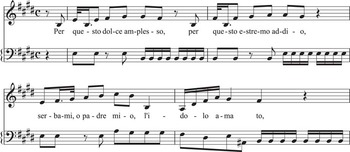
Johann Adolf Hasse, Artaserse (1730), ‘Per questo dolce amplesso’, bb. 20–29.

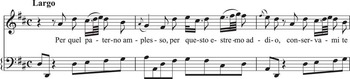
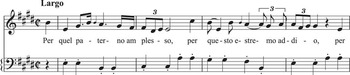
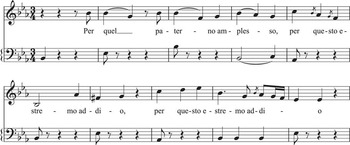
Such care over characterisation may explain why Hasse’s aria, rather than Vinci’s, attained lasting popularity; it even appeared in bowdlerised English form in the early twentieth century as ‘In this last caress’ (by Henry Geehl), in which a heavenly father replaces an earthly. A concern with patrilineage is evident in other ways too. The opening to Hasse’s (and perhaps sometimes Vinci’s) aria seems to have inspired a number of subsequent composers, even though the text they set was Metastasio’s original. Thus Carl Heinrich Graun in 1743 (Ex. 4), Domingo Terradellas in 1744 (Ex. 5), Baldassare Galuppi in 1749 (Ex. 6), and J.C. Bach in 1760 (Ex. 7) all open with versions of the falling motif on ‘questo’ and sometimes on ‘quel’.Footnote 5
Carl Heinrich Graun, Artaserse (1743), ‘Per quel paterno amplesso’, bb. 7–9.

Domingo Terradellas, Artaserse (1744), ‘Per quel paterno amplesso’, bb. 11–18.

Baldassare Galuppi, Artaserse (1749), ‘Per quel paterno amplesso’, bb. 17–20.

Johann Christian Bach, Artaserse (1760), ‘Per quel paterno amplesso’, bb. 2–11.

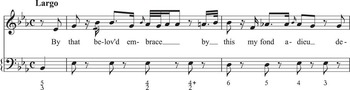
Bach, indeed, draws out Hasse’s hints at Arbace’s disquiet, making the ‘catch’ in the throat audible through insertion of a quaver rest after ‘quel’ and then repeating the falling motif on ‘paterno’. Thomas Arne, though setting the text in English translation in 1762, caught this spirit through similar breathless phrasing and ornamental delicacy (see Ex. 8; also later following Vinci’s model by playing on the rhetorical and emotional power of a lingering ‘addio’/‘adieu’). Demonstration of the almost formulaic status of the falling motif might be found in the young Mozart’s version of this aria in c.1766 (Ex. 9). He used the requisite fall in an arrangement which implies knowledge of Bach’s aria as well as Hasse’s, but the smoothness of the line – evenly paced crotchets – suggests he failed to grasp their dramatic point. On the other hand, his juxtaposition of the falling motif on ‘Per quel paterno’ with the pointedly static first setting of ‘per questo estremo addio’ suggests he was well versed on the meaning of the aria as a whole – and the underlying tension it contained.
Thomas Arne, Artaserse (1762), ‘Per quel paterno amplesso’, bb. 5–6.

Wolfgang Amadeus Mozart, Artaserse (1766), ‘Per quel paterno amplesso’, bb. 1–11.

The reserved and at times stately qualities of settings of Metastasio’s aria (and its variant text) may have reflected not just the situation of the character, Arbace, but also the performance style of that character’s most celebrated interpreter, Farinelli. For Farinelli, whom even the admiring Burney conceded was ‘as motionless as a statue’ when singing, the oft-adopted role of misunderstood, selfless young hero seems to have been designed to mitigate his studied inability to act.Footnote 6 Hasse’s careful delineation of Arbace’s emotional turmoil in his setting may thus have compensated for Farinelli’s limitations. Certainly, the singer’s admiration for the aria (and its message) seems to be attested by his use of it in his nightly performances for the depressive Philip V of Spain, from 1737 to 1746.
The notion that Farinelli’s fame, as much as Hasse’s compositional felicity, might have prompted later imaginings of the aria is not unreasonable: as Reinhard Strohm and Hilary Poriss have both pointed out, singers readily adopted arias associated with more famous predecessors, hoping the lustre of past glory would burnish their performances and win audience respect by association.Footnote 7 Composers, too, reimagined some of these famous arias in instrumental arrangements.Footnote 8 Why should similarities between different settings of the same text not also be seen as a demonstration of consanguinity? Metastasio’s ‘Per quel paterno amplesso’, with its tight containment of filial disquiet, offered the perfect vehicle for composers (and, no doubt, performers) to test their own patrilineal strivings.
Like other miniatures, then, eighteenth-century arias might take on a talismanic life of their own. In the process, they allow us to glimpse not so much a truth about the author or work, as the multifaceted ways in which opera could make meaning in the period.