Successfully negotiating developmental transitions related to achievement, affiliation, and identity during the emerging and young adult period has been associated with life course decline in substance use outcomes (Schulenberg, O'Malley, Bachman, & Johnston, Reference Schulenberg, O'Malley, Bachman, Johnston, Settersten, Furstenberg and Rumbaut2005). The parenthood transition is exemplary in its positive impact, and has been specifically linked with declines in alcohol use during emerging adulthood (EA; Bachman et al., Reference Bachman, Wadsworth, O'Malley and Johnston1997, Reference Bachman, O'Malley, Schulenberg, Johnston, Bryant and Merline2002). Becoming pregnant is an especially important predictor of the cessation of alcohol use among women (Bachman et al., Reference Bachman, O'Malley, Schulenberg, Johnston, Bryant and Merline2002).
From the life course perspective, the established protective impact of parenthood and other important role transitions may be characterized as a potential “turning point” in the life course, as measured by a discontinuity, or substantial decline, in negative behaviors and functioning (Elder & Caspi, Reference Elder, Caspi, Bolger, Caspi, Downey and Moorehouse1988; Rutter, Reference Rutter1996; Schulenberg et al., Reference Schulenberg, O'Malley, Bachman, Johnston, Settersten, Furstenberg and Rumbaut2005). However, the developmental timing of the parenthood transition is a critical source of diversity in the impact of parenthood on discontinuity of alcohol use. Adolescent parenthood has a particularly distinct impact on the life course because adolescents are often unprepared for the financial and psychosocial responsibilities that are associated with parenthood. As a result, teen parenthood, compared to adult parenthood, may not impart the same beneficial effect on reductions in alcohol use. Although small sample studies of adolescent mothers suggest that they reduce their drinking when pregnant (Gilchrist, Gillmore, & Lohr, Reference Gilchrist, Gillmore and Lohr1990; Kaiser & Hays, Reference Kaiser and Hays2005), Gilchrist, Hussey, Gillmore, and Lohr (Reference Gilchrist, Hussey, Gillmore and Lohr1996) found that adolescent mothers' use of alcohol rose during the first year of parenthood. Moreover, a follow-up study of the same sample of adolescent mothers showed that their alcohol use did not decline during EA (Gillmore, Gilchrist, Lee, & Oxford, Reference Gillmore, Gilchrist, Lee and Oxford2006). However, Gillmore and colleagues (2006) did not consider the effect of early parenthood on adolescent fathers' alcohol use, nor did they directly compare adolescent parents' alcohol use trajectories with those of nonparents or parents who delayed parenthood until EA.
Whether becoming a parent during adolescence, compared to adulthood, is associated with a true “turning point” in alcohol use is reflected in the relative magnitude and persistence of change in substance use after the parenthood transition across adolescent and older parents (Rutter, Reference Rutter1996). To date, few studies have examined change in alcohol use during the adolescent parenthood transition, and none to our knowledge has compared the relative direction, magnitude, and persistence of change in alcohol use outcomes across groups of nonparents, adolescent parents, and emerging adult parents (Gilchrist et al., Reference Gilchrist, Hussey, Gillmore and Lohr1996; Gillmore et al., 2006).
This study builds on prior research by examining the impact of the developmental timing of parenthood on discontinuity in emerging adult alcohol use trajectories using a latent growth framework. A growth curve model framework offers an optimal means of examining discontinuity in life course alcohol use patterns from an early adolescent developmental point through EA. Further, this study's model examines the long-term impact of parenthood from a developmental point prior to pregnancy through several years after giving birth. We used an added slope factor to best assess both the direction and magnitude of emerging adult change in alcohol use from the time point corresponding to individuals' transition to parenthood (Singer & Willett, Reference Singer and Willett2003). Differences in the rate of change in emerging adult alcohol use among adolescent parents compared to emerging adult parents are also examined. This is done to determine whether adolescent parents' emerging adult alcohol use trajectories differ meaningfully from their peers who delay parenthood until adulthood, and their peers who are not parents.
This study also extends our understanding of parenthood effects on growth in adult alcohol use by examining gender differences in parenthood-related alcohol use outcomes. Gender is a particularly salient source of heterogeneity in the adolescent and young adult course of alcohol use. Females consume less alcohol than do their male peers during adolescence, and are less likely to show the same frequency and acceleration in problem drinking over the course of adolescence and EA (Chassin, Pitts, & Prost, Reference Chassin, Pitts and Prost2002; Jackson, Sher, Gotham, & Wood, Reference Jackson, Sher, Gotham and Wood2001; Wallace et al., Reference Wallace, Bachman, O'Malley, Schulenberg, Cooper and Johnston2003). In addition, females may be more likely to alter or stop their drinking in response to parenthood because limiting alcohol use is socially sanctioned for mothers in the interest of their social and reproductive roles (Jaffee, Caspi, Moffitt, Taylor, & Dickson, Reference Jaffee, Caspi, Moffitt, Taylor and Dickson2001; Woodward, Fergusson, & Horwood, Reference Woodward, Fergusson and Horwood2006). However, whether fathers, and particularly young fathers, respond to the social pressures of parenthood by “maturing out” of frequent drinking is far less clear from the minimal research on substance use and either early or normative fatherhood. Although Bachman and colleagues (Reference Bachman, Wadsworth, O'Malley and Johnston1997) found that parenthood predicted adult declines in both frequency of drinking and heavy drinking, fathers' decline in heavy drinking was better explained by marriage than by parenthood. This pattern of findings reflects a more equivocal relation between parenthood and discontinuity in alcohol use among males compared to females. Therefore, gender was considered as a potential moderator of the impact of early parenthood on adverse emerging adult outcomes.
In addition to the role of parenthood we also consider the co-occurring influence of marriage on adolescent parents' emerging adult drinking patterns. Current research affirms that marriage is related to a protective reduction in the frequency of drinking during emerging and later adulthood regardless of whether timing of parenthood is premature or normative (Bogart, Collins, Ellickson, Martino, & Klein, Reference Bogart, Collins, Ellickson, Martino and Klein2005; Leonard & Rothbard, Reference Leonard and Rothbard1999; Martino, Collins, & Ellickson, Reference Martino, Collins and Ellickson2004; Miller-Tutzauer, Leonard, & Windle, Reference Miller-Tutzauer, Leonard and Windle1991; Temple et al., Reference Temple, Fillmore, Hartka, Johnstone, Leino and Motoyoski1991), although this relation is not consistently shown in both genders (Leonard & Rothbard, Reference Leonard and Rothbard1999). Moreover, the protective impact of marriage on adult drinking patterns extends to high-risk populations with preexisting alcohol problems or disorders (Chilcoat & Breslau, Reference Chilcoat and Breslau1996). Accounting for the simultaneous influence of marital status on changes in alcohol consumption is therefore important to accurately detect parenthood-related changes in emerging adult alcohol consumption among adolescent parents, who are at risk for substance use problems, as well as older parents.
Selection Into Early Parenthood and Continuity in Alcohol Use
From a life course perspective the social influence of the parenting role transition on decline in alcohol use is likely qualified by preexisting personality and psychological characteristics that contribute not only to selection into an early parenthood transition, but also to continuation of alcohol use (Elder & Caspi, Reference Elder, Caspi, Bolger, Caspi, Downey and Moorehouse1988). Consistent with this notion, recent research links adolescent alcohol use and conduct problems with selection into early parenthood as well as with high levels of adult alcohol use and alcohol use disorders (Deal & Holt, Reference Deal and Holt1998; Dearden, Hale, & Woolley, Reference Dearden, Hale and Woolley1995; Jaffee et al., Reference Jaffee, Caspi, Moffitt, Taylor and Dickson2001; Stouthamer-Loeber & Wei, Reference Stouthamer-Loeber and Wei1998; Woodward & Fergusson, Reference Woodward and Fergusson1999; Woodward et al., Reference Woodward, Fergusson and Horwood2006; Zocolillo, Meyers, & Assiter, Reference Zocolillo, Meyers and Assiter1997). It is noteworthy, therefore, that although Jaffee (Reference Jaffee2002) systematically examined the impact of selection factors and early parenthood on mental health outcomes of young parents and nonparents, no prior studies have examined the simultaneous impact of alcohol-use related selection factors on the incidence of early transition to parenthood and adverse adult alcohol use outcomes.
Familial Risk for Continuity in Adverse Emerging Adult Alcohol Use Outcomes
The current study models the selection effect of a key predictor of adverse adult alcohol use outcomes, family history density of alcoholism (FHD), on both the likelihood of adolescent parenthood and elevated alcohol use during adulthood among adolescent parents. To date, FHD has not been considered in studies of adolescent parenthood, but parents' alcohol disorders and misuse of alcohol have been associated with adolescent pregnancy (Chandy, Harris, Blum, & Resnick, Reference Chandy, Harris, Blum and Resnick1994; Hillis et al., Reference Hillis, Anda, Dube, Felitti, Marchbanks and Marks2004). In addition, it has been well established as a source of intergenerational risk for adolescent and adult alcohol use problems (Chassin, Curran, Hussong, & Colder, Reference Chassin, Curran, Hussong and Colder1996; Chassin, Rogosch, & Barrera, Reference Chassin, Rogosch and Barrera1991). We therefore chose FHD as a key selection factor in this study's selection model because we expected that it would transmit risk for youths' early transition to parenthood as well as for adverse adult alcohol use outcomes.
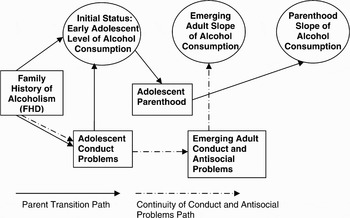
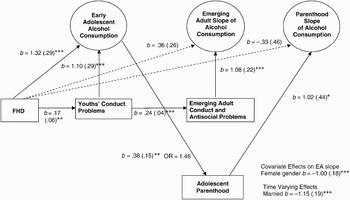
This study's model posits that FHD transmits risk for selection into early parenthood and adverse alcohol use outcomes through dual mediation pathways (see Figure 1). These pathways model the indirect effects of FHD on emerging adult alcohol use through (a) the effect of continuity in adolescent and emerging adult conduct problems on emerging adult alcohol use among all participants and (b) the effects of early adolescent alcohol use and a developmentally premature transition to parenthood on emerging adult alcohol use among parents. Thus, as shown in Figure 1, this dual pathways model effectively examines the effects of FHD mediation paths on trajectories of alcohol use both before and after the parenthood transition using two slope factors (i.e., the emerging adult slope and the parenthood slope).
The theoretical model. Early risk and continuity in emerging adult alcohol consumption trajectories among parents: the effects of timing of role transition, family history of alcoholism, and conduct problems.

We first hypothesize that FHD is related to developmental continuity in adverse emerging adult alcohol use trajectories via its link with continuity of conduct problems during adolescence and adulthood (see Figure 1). This hypothesis receives a wealth of support in the literature, as prior research not only suggests genetic links between early conduct problems and adult alcohol use disorders (Krueger et al., Reference Krueger, Hicks, Patrick, Carlson, Iacono and McGue2002; Zucker et al., Reference Zucker, Wong, Clark, Leonard, Schulenberg and Cornelius2006), but also shows that adolescent and emerging adult conduct problems mediate links between parental alcohol problems and adult alcohol use problems (Chassin, Pitts, DeLucia, & Todd, Reference Chassin, Pitts, DeLucia and Todd1999). This mediation path extends prior research showing that adolescent parents' early conduct problems predict their poor mental health in adulthood within an emerging adult model (Jaffee, Reference Jaffee2002). However, our model more specifically accounts for the impact of conduct problems on emerging adult alcohol by linking adolescent and emerging adult conduct problems as predictors in a longitudinal model.
We also examine the potential for FHD to predict adolescent parenthood through its associations with adolescent conduct problems and substance use (see Figure 1). Adolescent substance use has been directly linked with the incidence of teen pregnancy and parenthood (Kellogg, Hoffman, & Taylor, Reference Kellogg, Hoffman and Taylor1999). Furthermore, we expect that FHD transmits risk for an early transition to parenthood through its direct association with high levels of adolescent alcohol use and its indirect association with adolescent alcohol use via co-occurring conduct problems (Curran et al., Reference Curran, Stoltenberg, Hill, Mudd, Blow and Zucker1999; Johnson & Pickens, Reference Johnson and Pickens2001; Stoltenberg, Mudd, Blow, & Hill, Reference Stoltenberg, Mudd, Blow and Hill1998). This hypothesis is based on prior research showing that children with conduct problems are more likely to become adolescent parents because of their propensity to participate in risky sexual behaviors and to use drugs and alcohol (Bardone, Moffitt, Caspi, Dickson, & Silva, Reference Bardone, Moffitt, Caspi, Dickson and Silva1996; Crockett, Raffaelli, & Shen, Reference Crockett, Raffaelli and Shen2006; Woodward, Fergusson, & Horwood, Reference Woodward, Fergusson and Horwood2001; Woodward & Fergusson, Reference Woodward and Fergusson1999; Woodward et al., Reference Woodward, Fergusson and Horwood2006). More specifically, Woodward and Fergusson (Reference Woodward and Fergusson1999) showed that adolescent substance use mediated the impact of early conduct problems on the likelihood of adolescent parenthood in a birth cohort sample of female adolescents. Researchers propose two underlying mechanisms of this mediation relation. Youth with a propensity toward deviance may show increases in a variety of risky behaviors, including substance use, sexual risk taking, and norm violations (Donovan & Jessor, Reference Donovan and Jessor1985). Alternatively, the pharmacologic effects of drugs and alcohol facilitate sexual activity, and thus, teen pregnancy (George & Stoner, Reference George and Stoner2000). Consistent with prior research and the above hypotheses, this study models both the direct effect of adolescent substance use and the indirect effect of conduct problems via adolescent alcohol use, on risk for early parenthood (see Figure 1).
Finally, our dual pathways model posits that adolescent parenthood is a mediator of FHD risk for increased emerging adult alcohol consumption (see Figure 1). We therefore hypothesize that the impact of early parenthood on adverse growth in alcohol consumption is not fully explained by FHD selection risk. Rather, we argue that adolescents' developmentally premature experience of the social responsibilities, and pressures of early parenthood contributes directly to added growth in alcohol consumption after the parenthood transition.
Current Study Aims
The first purpose of the current study is to consider whether parenthood-related discontinuity in emerging adult alcohol use trajectories is moderated by developmentally premature timing of parenthood. Regarding this aim, we hypothesize that adolescent parenthood is not related to decline in emerging adult alcohol use, as is typically the case, owing to (a) early developmental timing of the parenthood role transition and (b) preexisting risk characteristics of adolescent parents that select them into their early parenthood role.
The second aim of this study is to consider whether familial risk for selection into early parenthood (i.e., FHD) transmits risk for continuity in adolescent parents' emerging adult alcohol use trajectories. To address this aim, we test a dual pathways model of the selection risk of FHD on adverse emerging adult trajectories via developmental continuity in conduct problems and via the mediation of an early transition to parenthood. Direct effects of the dual pathways model are depicted in Figure 1.
Methods
Sampling
Participants were from a longitudinal study of the intergenerational transmission of alcohol disorders (Chassin et al., Reference Chassin, Curran, Hussong and Colder1996). To date, fives waves of data have been collected from three generations of individuals (adolescents, their parents, and children of the adolescents). Data on 454 adolescents (mean age = 13.22 years, range = 10.5–15.5) and their parents were collected at the first wave; 246 had at least one biological alcoholic parent who was also a custodial parent (COA) and 208 were demographically matched adolescents with no biological or custodial alcoholic parents (controls). Adolescents and their parents were reinterviewed annually twice (Waves 2 and 3) and completed two 5-year follow-up assessments (Waves 4 and 5): once during early EA (age range = 18–23 years) and again during late EA (age range = 22–30 years). Sample retention has averaged more than 90% since the advent of the study and has been unbiased by gender and ethnicity, although somewhat more COAs than controls were lost at Waves 4 and 5, χ2 (1, N = 454) = 5.45 at Wave 4 and = 4.12 at Wave 5 (both p < .05).
Age-eligible biological siblings (aged 18–26 years by Wave 4) were invited to participate in the study at Waves 4 and 5. A total of 376 age-eligible siblings were interviewed at least once; 327 siblings (median age = 22) were interviewed at Wave 4 and 350 siblings (median age = 27) were interviewed at Wave 5. Combining original adolescent participants and their age-eligible siblings, the Wave 4 sample consisted of 734 participants, the Wave 5 sample consisted of 762 participants, and 830 participants completed at least one assessment.
Participants in the current study
A sample of 664 participants was selected for this study, representing 80% of the original adolescent and sibling sample. Of the 20% (n = 166) of participants who were not selected for this study, 4% (n = 24) were excluded because they did not provide at least one report of alcohol consumption between ages 11 and 30. The remaining 16% (n = 142) of excluded participants were parents who did not provide information on their first-born children's age. Therefore, their age at the parenthood transition could not be calculated and their data could not be used in the study analyses. Overall, excluded participants (n = 166) were more likely to be parents χ2 (1, N = 752) = 168.91, p < .001, but did not differ from the selected sample with respect to gender, age, ethnicity, mean FHD score or average alcohol consumption (aggregated over Waves 1–5). Excluded participants who were parents represented 40% (142 of 357) of parents in the emerging adult sample. Compared to selected parent (n = 215), excluded parents (n = 142) were more likely to be male, χ2 (1, N = 358) = 10.05, p < .01, were slightly younger than selected parents at Wave 5 (F = 6.58, p < .05), but did not differ from selected parents with respect to FHD score or average alcohol consumption (aggregated over Waves 1–5).
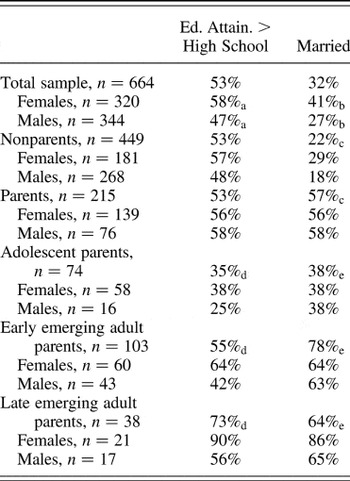
Slightly less than half (48%) of the selected sample was female, most were European American (71%), and 24% were Hispanic. Most of the sample (81%) graduated from high school and more than half of the sample (53%) attained more than a high school education. Thirty-two percent of the sample were married and not subsequently divorced between ages 18 and 30.
Table 1 summarizes sample sociodemographics by sample, gender, and parental status. As shown in Table 1, female participants were more likely to attain more than a high school degree, less likely to report holding a managerial or professional position during EA and more likely to be married by EA (all ps < .05 by chi-square difference tests).
Demographic information by gender and parental status

Note: Educational attainment was measured by the last available emerging adult report. Married status indicates being married at some point during the study's longitudinal window and not subsequently divorced within the same longitudinal window. Values with the same subscript letter indicate significant chi-square differences between groups at alpha p < .05. Between gender differences within subsamples were not examined.
Recruitment
COA families were recruited using court records, health maintenance organization questionnaires, community telephone screening, and hospital referral. Children between the ages of 10.5 and 15.5 years, who lived in Arizona, were born of Hispanic or non-Hispanic Caucasian parents, spoke English, and had no cognitive limitations that would preclude interview were recruited. Direct interview was used to confirm that a biological and COA met Diagnostic and Statistical Manual of Mental Disorders—Third Edition (DSM-III; American Psychiatric Association, 1980) criteria for lifetime alcohol abuse or dependence. The resulting alcoholic sample had rates of other psychopathology similar to rates reported for a community-dwelling alcoholic sample (Helzer & Pryzbeck, Reference Helzer and Pryzbeck1988). However, those who refused participation were more likely to be Hispanic, suggesting some caution in generalization.
Reverse directories were used to locate control families in the same neighborhood as COA participating families. Controls were screened and recruited via telephone interviews. Recruited controls matched COAs in ethnicity, family structure, age (within 1 year), and socioeconomic status (using the property value code from the reverse directory). Interview data confirmed that neither biological nor COAs met DSM-III criteria (or Family History Research Diagnostic Criteria [FH-RDC]; Endicott, Andreason, & Spitzer, Reference Endicott, Andreason and Spitzer1975) for lifetime alcohol abuse or dependence. Further details of sample recruitment are provided in Chassin, Barrera, Bech, and Kossak-Fuller (Reference Chassin, Barrera, Bech and Kossak-Fuller1992).
Interview procedures
Data were collected with computer-assisted interviews either at families' homes or at the university. To minimize contamination, family members were interviewed individually on the same occasion, by different interviewers when possible. When a family moved out of state, an interviewer from a nearby university administered a shortened version and the diagnostic interview was done by telephone, or the entire interview was done by telephone if no nearby interviewer was available. Interviewers were unaware of the family's group membership. To encourage honest responding, we reinforced confidentiality with a Department of Health and Human Services Certificate of Confidentiality. To maximize privacy, participants had an option to enter their responses on the keyboard rather than verbally.
Measures
Alcohol consumption
At each wave, participants reported their frequency of past year alcohol consumption of beer/wine and hard liquor (two items; responses range from 0 = never to 7 = everyday) and their quantity of beer/wine and hard liquor consumption (two items ranging from 1 = one to 9 = nine or more drinks per occasion). Alcohol consumption scores were computed by averaging cross products of quantity and frequency of beer/wine and hard liquor. Alcohol consumption scores were log transformed and multiplied by 10 to reduce skewness and facilitate interpretation. Average alcohol consumption was lowest during adolescence (ages 11–14: M = 2.25, SD = 3.45) and highest during early EA (ages 19–22: M = 7.14, SD = 4.59).
Alcohol consumption outcomes were modeled as a function of age group. Because sparse data was available for continuous age measurement, participants' alcohol outcomes were grouped, or banded in accord with five 3-year age bands. The age bands selected corresponded to the early to late adolescent period (ages 11–14, ages 15–18), the early to late emerging adult period (ages 19–22, 23–26) and the young adult period (ages 27–30). The proportion of observations that was nonmissing across all age band periods was more than 50% (i.e., 53%); thus facilitating increased power relative to the alternative of using a deletion procedure (Graham, Taylor, & Cumsille, Reference Graham, Taylor, Cumsille, Collins and Sayer2001).
First-child indicators
First-child indicators were used to define participants' age band at transition to parenthood (i.e., adolescent parent, early emerging adult parent, or late emerging adult parent). Three dummy-coded first-child indicators were computed from parents' self-reports of their age and the age of their children at study Waves 4 and 5. First-child indicators were used as both time-varying covariates, and parenthood slope predictors in growth models.
Slightly less than one-third of the current emerging adult sample (32%; n = 215) were parents, including 43% of the females (n = 139) and 22% of the males (n = 76). Nearly all of the parents reported living with their children as emerging or young adults (94%). Average age of participants at birth of their first child was 20.53 (SD = 2.64), which is well below the current US national average of first pregnancy (age 25; Martin et al., Reference Martin, Hamilton, Sutton, Ventura, Menacker and Kimeyer2007). However, there was a considerable range in age at transition to the parenthood role (i.e., from 13 through 28). Slightly more than one-third of sample parents (35%) had their first child during adolescence, 47% had their first child during early EA (ages 19–22), and 18% had their first child during later EA (ages 23–28). Three participants (1%) had their first child after age 26, but before their Wave 5 interview. Therefore, these participants were considered late emerging adult parents for the current study analyses.
As shown in Table 1, parents were more likely than nonparents to be married by EA. Adolescent parents were less likely to attain more than a high school education by EA than either early or late emerging adult parents. Adolescent parents were also less likely to be married during the longitudinal period of this study compared to early or late emerging adult parents (all ps < .05 by chi-square tests).
Risk factors
FHD
FHD scores were created by evaluating history of alcoholism in participants' parents and grandparents. Participants' parent(s)' lifetime DSM-III diagnosis of alcohol abuse and dependence was assessed using the Diagnostic Interview Schedule Version III (Robins, Helzer, Croughan, & Ratcliff, Reference Robins, Helzer, Croughan and Ratcliff1981). Lifetime alcoholism diagnoses for the noninterviewed parents' of participants were established by spouses' reports using FH-RDC criteria (Endicott et al., Reference Endicott, Andreason and Spitzer1975). Participants' grandparents' alcohol abuse or dependence diagnosis was established using FH-RDC criteria based on participants' parents' reports at Wave 2 and Wave 4. A grandparent was considered to have a positive diagnosis of alcoholism if he/she met the FH-RDC criterion based on reports from either parent. To create the FHD score each relative was assigned a weight based on their familial relatedness and alcoholism status (Stoltenberg et al., Reference Stoltenberg, Mudd, Blow and Hill1998; Zucker, Ellis, & Fitzgerald, Reference Zucker, Ellis, Fitzgerald, Babor, Hesselbrock, Meyer and Shoemaker1994). The overall mean of 0.45 (SD = 0.39), indicated that participants averaged one alcoholic relative, but they varied from zero (N = 195, FHD score = 0) to six alcoholic relatives (N = 3, FHD score = 2). Prior studies of these participants show that COAs have higher FHD scores than non-COAs, and there is minimal overlap between COAs and non-COAs in their FHD scores (Chassin, Flora, & King, Reference Chassin, Flora and King2004).
Conduct and antisocial problems
Self-report measures of conduct and antisocial problems were selected for this study with the aims of maximizing available data observations, providing longitudinal consistency, and providing valid and reliable measurement over the adolescent and emerging adult course. Parent reports were not combined with adolescent and emerging adult reports in this study because confirmatory factor analyses did not support creation of latent composites. However, it should be noted that in preliminary analyses, use of parent reports of conduct problems resulted in the same pattern of findings as derived with use of self-reports.
Participants' self-reports of adolescent conduct problems were measured using a set of 12 items with a 5-point response scale from the Child Behavior Checklist (CBCL; Achenbach & Edelbrock, Reference Achenbach and Edelbrock1981). The 12 selected conduct problem items were common to the externalizing spectrum of all CBCL forms used during the adolescent and emerging adult longitudinal window of the study, and were selected because of developmental appropriateness and consistency across waves of data collection. Sample items include “argues a lot,” “mean and cruel to others,” and “stole things.” The earliest available youth report of conduct problems (i.e., between ages 11 and 18) from Waves 1 to 4 was used to measure target participants' adolescent conduct problems. All items were reverse coded. The average adolescent conduct problem score was 1.56 (SD = 0.48). Adolescent reports of conduct problems were highly correlated with adolescent reports of the total set of externalizing items (r = .90, p < .001) and moderately correlated with parent reports (r = .43, p < .001) on the same measure. In addition, adolescents' conduct problems score were concordant with their reports of antisocial problems on semistructured diagnostic interview (r = .33, p < .001). Alpha reliability was good over the first three waves (α = .76–.84).
During EA (ages 19–26) participants' self-reports of their conduct and antisocial problems were measured with 21 items using a 5-point Likert scale comprising both overt conduct problems and covert deviant behaviors that are more common during EA. Emerging adult reports of conduct problems were garnered from Wave 4–5 data. The earliest available participant report of emerging adult conduct problems was used in every case. Emerging adult overt conduct problems were measured using the same 12 items that were used to assess conduct problems during adolescence. Slight modifications were made to the wording of two items to ensure the items were developmentally appropriate for emerging adults at Waves 4 and 5. Specifically, “truant, skips school” was changed to “skipped or ditched work or school” and “disobeys at school” and “disobeys at home” were consolidated into a single item, “disobeys rules.” Nine additional items were used to assess covert antisocial problems. Four items were derived from studies of young adult problems behavior and adolescent delinquency (Huizinga, Finn Aage, & Wylie, Reference Huizinga, Finn Aage and Wylie1991; Jessor & Jessor, Reference Jessor and Jessor1981) and five were created for this study. Sample items include “providing false information on applications” and “harass someone.” The average emerging adult conduct and antisocial problems score was 1.31 (SD = 0.32). Emerging adult conduct and antisocial problems scores were correlated with Wave 5 reports of antisocial personality problems (r = .33, p < .001) on semistructured diagnostic reports. Alpha reliability on this measure was good at Waves 4 and 5 (α = .73–.78).
Covariates
Marital status
At Waves 4 and 5, participants reported whether they were married, and if so, at which age they first became married as well as whether they had ever been divorced or separated. To account for the impact of marriage on young adult alcohol use trajectories, we used four dummy-coded time-varying covariates representing whether a participant was in an intact marriage during each age-band interval.
Educational status
Educational status was chosen as a measure of socioeconomic status because prior research has shown that is the most sensitive and stable indicator of socioeconomic risk/protective status for use in adolescent health research (Krieger, Williams, & Moss, Reference Krieger, Williams and Moss1997; Williams & Collins, Reference Williams and Collins1995). Both participants and their parents' educational attainment was coded from emerging adult-report questions at Waves 4 or 5, depending on availability of the data. Parental education was measured as a mean of participants' parents' educational status. Both participant and parental education were coded in six categories: 1 = 8th grade or less, 2 = some high school, 3 = GED or high school graduate, 4 = vocational/technical school degree or some college, 5 = college degree, and 6 = graduate school.
Data analytic strategy
We used latent growth curve modeling in a structural equation framework (Willett & Sayer, Reference Willett and Sayer1994) to describe change in alcohol consumption across five age bands from adolescence through the young adult period. Latent growth analyses modeled two random latent factors: initial status and the emerging adult slope. The initial status factor measured early adolescent level of alcohol consumption. The emerging adult slope factor measured rate of change in alcohol consumption from adolescence through young adulthood. The emerging adult slope factor loading of alcohol consumption at ages 11–14 was set to 0, the second factor loading was set to 1, and the remaining three factor loadings were allowed to vary. This modeling approach provides the most parsimonious estimate of true change in alcohol consumption over the adolescent through young adult period (McArdle & Hamagami, Reference McArdle, Hamagami, Geert and Mos1991).
The impact of becoming a parent on alcohol consumption trajectories was modeled using three design strategies. First, alcohol consumption outcomes were regressed on time-varying first-child indicators to measure the effect of having a child on average alcohol consumption during the age interval when participants became parents. Second, additional change in alcohol use trajectories subsequent to having a child was measured using an added random slope, “the parenthood slope” (Muthén & Muthén, Reference Muthén and Muthén2006). Linear time scores were used to anchor measurement of parenthood-related change in alcohol consumption after the parenthood transition. For example, a participant who had a child at age 16 (age band 15–18 years) would receive time scores of 0, 1, 2, and 3 at age bands 15–18, 19–22, 23–26, and 27–30, respectively. The parenthood slope therefore measured added change in alcohol consumption after the parent transition above and beyond the typical growth in alcohol consumption that was measured by the emerging adult slope factor. Third, to measure the impact of timing of parenthood on relative change in alcohol consumption after the parent transition, the parenthood slope was regressed on first child indicators for early EA (ages 19–22) and late EA (ages 23–26). The adolescent parent transition point was thus used as a reference group. Therefore, the intercept of the parenthood slope was an estimate of added growth in alcohol consumption after the adolescent parent transition over above emerging adult growth in alcohol consumption. Effects of the first child indicators represented differences in emerging adult parents' growth in alcohol consumption after the parent transition relative to adolescent parents' growth in alcohol consumption.
The time-varying effect of marriage on alcohol consumption patterns was estimated by regressing observed alcohol use outcomes for late adolescence (ages 15–18) through young adulthood (ages 27–30) on four time-varying marriage indicators. Use of time-varying marriage indicators yielded a single randomly varying parameter representing the time-varying effect of marriage across all time points. In addition, participants' gender and participants' FHD score were entered as covariates on the initial status and emerging adult slope of alcohol consumption. Further, participants' educational attainment was entered as an emerging adult slope predictor. Preliminary model testing established that the educational level of participants' parents and participants' racial/ethnic background did not affect either level or change of substance consumption, and thus, these covariates were dropped from final models.
A series of nested multigroup models were used to examine gender differences in the effects of timing of parenthood, and covariates on alcohol use outcomes. The significance of gender differences in path estimates were tested by constraining each path of interest to be equal across groups and computing the difference in the likelihood ratio between a constrained model and an unconstrained model. Calculation of likelihood ratio differences were based on loglikelihood values (−2 log likelihood difference; Muthén & Muthén, Reference Muthén and Muthén2006).
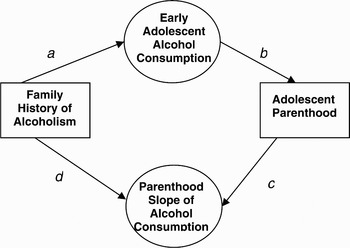
Structural path analyses embedded in the latent curve models were used to assess the mediation of FHD effects on both emerging adult growth and parenthood-related growth in alcohol consumption (see Figures 1 and 2). Results of the mediation models provided estimates of the direct effect of FHD on Mediator 1 (Path a), the direct effect of Mediator 1 on Mediator 2 (Path b), the direct effect of Mediator 2 on the outcome (Path c), and the direct effect of FHD on the outcome (Path d). The product of coefficients method was used to obtain mediation (i.e., indirect) effects by multiplying direct effects a, b, and c (MacKinnon, Lockwood, Hoffman, West, & Sheets, Reference MacKinnon, Lockwood, Hoffman, West and Sheets2002). Statistical significance of mediation effects was appraised by considering the joint significance of direct a, b, and c paths, as well as the significance of indirect effects. We chose to use joint significance as a test of the mediated effect because MacKinnon and colleagues (Reference MacKinnon, Lockwood, Hoffman, West and Sheets2002) found that tests of joint significance provide an optimal combination of power and Type I error rates when bootstrapping is not possible. In addition, we calculated indirect effects to facilitate interpretation of mediation path results.
A mediational path with two mediators.

The multivariate-delta method was used to ascertain the significance of indirect effects by calculating the ratio of the mediation effect by its standard error (abc/SEabc; MacKinnon, Lockwood, & Williams, Reference MacKinnon, Lockwood and Williams2004). Because the distribution of the product of coefficients is typically nonnormal and asymmetrically skewed, we estimated asymmetric confidence limits of single mediator indirect effects using upper and lower critical values for the distribution of the product of two random normal variables (Mackinnon et al., Reference MacKinnon, Lockwood and Williams2004; Meeker, Cornwell, & Aroian, Reference Meeker, Cornwell and Aroian1981). Using this method, if 0 was not in the 95% interval of the upper and lower confidence limits, we concluded that the mediation effect was statistically significant. We also measured the size of each mediation effect using the ratio of the absolute value of the mediation effect (|abc|) to the absolute value of the total effect of FHD on the outcome (|abc| + |d|), as recommended by Mackinnon and colleagues (MacKinnon, Reference MacKinnon2008). The resulting proportion corresponds to the proportion of the total effect that is mediated by the mediator of interest.
Robust full information maximum likelihood estimation was used for all analyses. Use of robust estimation facilitates the most accurate estimation of standard errors in the presence of nonnormally distributed data (Yuan & Bentler, Reference Yuan and Bentler1998). Full information maximum likelihood estimation provides unbiased parameter estimates in the presence of missing data under missing at random conditions (Schafer & Graham, Reference Schafer and Graham2002). To account for interdependency in the data resulting from use of sibling participants, standard errors were corrected using the complex procedure described by Muthén and Muthén (Reference Muthén and Muthén2006).
The likelihood ratio, comparative fit index (CFI) and root mean square error of approximation (RMSEA) were used to examine the fit of preliminary growth models. The CFI and RMSEA provide practical indices of model fit that are not as sensitive to sample size as the likelihood ratio. Nonsignificant likelihood ratios, CFI values of .95 or higher, and RMSEA values of .05 or less indicate that a model shows a close fit to the observed data.
Results
Change in alcohol consumption: Unconditional models
An initial set of unconditional latent growth models was used to establish average level and rate of growth in alcohol consumption across the overall developmental period (ages 11–14 through ages 27–30). Participants' alcohol consumption increased between adolescence and young adulthood (mean emerging adult slope = 2.91, SE = 0.25, p < .001), although the pattern of slope loading values indicated a slow decline of alcohol use after the early emerging adult period (ages 19–22). Change in alcohol consumption varied significantly across individuals (s 2 slope = 3.32, SE = 0.84, p < .001). Fit indices showed that the alcohol consumption models fit the data well, χ2 (7) = 14.54, p < .001; CFI = .97; RMSEA = .04.
The impact of becoming a parent on alcohol consumption trajectories
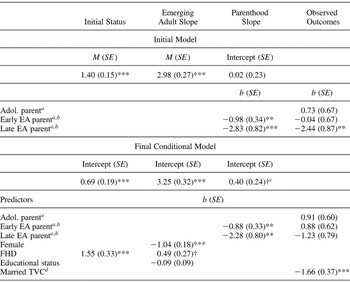
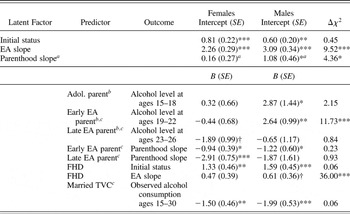
The next analysis examined the impact of the parenthood transition on change in alcohol consumption using an added parenthood slope with no covariates (see initial model results in Table 2).Footnote 1 An added parenthood slope was used to measure added growth in alcohol consumption after the parenthood transition. In addition, first-child indicators were used to specify the impact of age of transition to parenthood on both level of alcohol use during the transition, and differences in the rate of alcohol consumption after the transition (on the parenthood slope). Becoming a parent during the early or late EA was associated with a decline in alcohol consumption relative to becoming a parent during adolescence (early EA: b = −0.98, p < .01; late EA: b = −2.83, p < .001). Becoming a parent during late EA was also associated with lower levels of alcohol consumption at the transition to parenthood (b = −2.44, SE = 0.87). By contrast, adolescent parenthood was associated with no additional growth in emerging adult alcohol consumption (intercept of parenthood slope = −0.02, p > .05). The emerging adult slope of alcohol consumption remained positive and significant in this model (mean emerging adult slope = 3.04, p < .001).
Discontinuity in alcohol consumption trajectories as a function of timing of the parenthood transition: Latent factor means and covariate effects

Note: FHD, family history density of alcoholism; Early EA, aged 19–22; Late EA, aged 23–26.
aThree first child indicators were used to estimate level differences in alcohol consumption at the interval when participants became parents.
bTwo first child indicator variables were used to estimate parenthood slope differences between the two emerging adult groups and adolescent parents.
cThe parenthood slope intercept corresponds to the estimate of the conditional mean of the parenthood slope for adolescent parents.
dRandomly varying time varying covariate (TVC) effect of married status on four observed outcomes (adolescence through young adulthood alcohol consumption).
† p < .10. **p < .01. ***p < .001.
Early parenthood effects on growth in alcohol consumption with FHD and covariates conditioned in the model
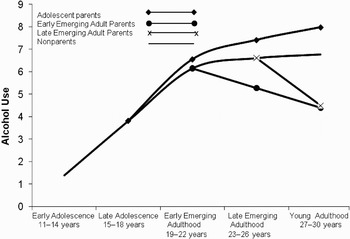
The impact of timing of parenthood on emerging adult growth in alcohol consumption conditioned on FHD and covariates was examined next in the final hypothesized model. These effects and corresponding standard errors are summarized in Table 2 and trajectory differences by parent age group are depicted in Figure 3. As shown in Table 3, timing of parenthood differences on emerging adult alcohol consumption remained significant with risk and covariates included in the model. Conditional models indicated that adolescent parents showed marginal added growth in alcohol consumption (intercept of parenthood slope = 0.40, p < .10) over and above average emerging adult growth in alcohol use among nonparents (intercept of emerging adult slope = 3.25, p < .001). By contrast, early emerging adult parents (b = −0.88, p < .01) and late emerging adult parents (b = −2.28, p < .01) showed significant declines in alcohol consumption after the parent transition.
A comparison of emerging adult alcohol consumption trajectories by parental status and age at the birth of the first child.

Gender moderation of the effects of timing of parenthood and covariates on emerging adult alcohol consumption trajectories

Note: All chi-square differences represent the change in the chi-square value from a 1 degree of freedom change in the corresponding model. EA, emerging adulthood. FHD, family history density of alcoholism. The effects of educational status are not included in this final model because of small, non-significant effects.
aThe parenthood slope intercept corresponds to the estimate of the conditional mean of the parenthood slope for adolescent parents.
bTime varying covariate effect.
cTwo first child indicators were used to estimate differences in change in alcohol consumption after the parenthood transition as a function of timing of parenthood. Resulting effects represented estimated age-related differences in the parenthood slope from the mean of the parenthood slope for adolescent parents.
† p < .10. *p < .05. **p < .01. ***p < .001.
As indicated in Table 2, females showed a slower emerging adult rise in alcohol consumption (b = −1.04, p < .001) than did males. Participants' with higher FHD showed higher levels of adolescent alcohol consumption (b = 1.55, p < .001) as well as marginally faster growth in alcohol consumption during EA (b = .49, p < .10). In addition, getting married was associated with a significant time-varying decrease in alcohol consumption (b = −1.66, p < .001).
Gender differences in the impact of timing of parenthood on emerging adult alcohol consumption
Gender moderation of the effects of timing of parenthood, FHD, and marital status on emerging adult alcohol consumption trajectories was examined next in multigroup analyses. Educational status was not considered in final models of gender differences because educational status effects were null. Regression coefficients, corresponding standard errors and chi-square differences resulting from nested model comparisons are summarized in Table 3.
Adolescent fathers showed significantly greater growth in alcohol consumption after the parent transition than did adolescent mothers, Δχ2 (1, N = 644) = 4.36, p < .05. Adolescent fathers showed an added rise in alcohol consumption after the parent transition (intercept of parenthood slope = 1.08, p < .05), whereas adolescent mothers did not show significant added growth in alcohol use after the parenthood transition (intercept of parenthood slope = 0.16, p > .05). Further, although chi-square difference tests did not support gender moderation, adolescent fathers showed a significantly higher level of alcohol use when they became parents (b = 2.87, p < .05), whereas adolescent mothers did not (b = 0.36, p > .05).
The effect of becoming a parent during early EA on level of alcohol consumption differed significantly across genders, Δχ2 (1, N = 644) = 11.73, p < .001. Early emerging adult fathers reported a higher level of alcohol consumption during the parenthood transition (b = 2.64, p < .01) compared to their male peers, but emerging adult mothers did not report significantly higher alcohol consumption than other female participants (b = −0.44, p > .05). However, gender did not moderate the impact of early emerging adult parenthood on growth of alcohol consumption. As shown in Table 3, becoming a parent during early EA was related to a decline in alcohol use among both mothers and fathers.
Gender did not moderate effects of becoming a parent during late EA on either level of alcohol use in late EA, or trajectories of alcohol use after the parent transition. It is noteworthy, however, that late emerging adult mothers showed a marginally lower level of alcohol use during late EA than did other female participants (b = −1.89, p < .10), as well as a significant decline in alcohol use after the parent transition compared to adolescent mothers (b = −2.91, p < .001). By contrast, late emerging adult fathers did not show a significantly lower level of late emerging adult alcohol use compared to males in the sample (b = −.65, p > .05) or significant change in alcohol use after the parent transition compared to adolescent fathers (b = −1.87, p > .05).
Multigroup analyses also affirmed that males showed a faster rise in emerging adult alcohol use, Δχ2 (1, N = 644) = 9.52, p < .001, compared to females. Further, FHD had a greater effect on emerging adult alcohol consumption among males than among females, Δχ2 (1, N = 644) = 36.00, p < .001, and the effect of marital status on growth in emerging adult alcohol use did not differ by gender.
Mediation of the impact of family history of alcoholism on adolescent parenthood
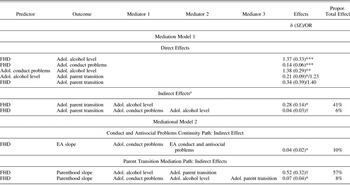
Preliminary analyses showed that FHD was associated with a higher likelihood of premature transition to parenthood (b = 0.69, SE = 0.34, p < .05). Adolescents from high FHD families were two times more likely to become parents during adolescence than the rest of the sample. Mediation of the impact of FHD on an adolescent transition to parenthood was examined in a structural path model. Table 4 presents the direct and indirect effects and corresponding standard errors of this mediation model on adolescent parenthood. The impact of FHD on early parenthood was mediated by two paths: one through adolescent conduct problems and alcohol consumption and another through adolescent alcohol consumption only. Specifically, high FHD predicted high levels of adolescent conduct problems, which was associated with high adolescent alcohol consumption. In turn, higher consumption of alcohol during adolescence increased risk for premature transition to parenthood (indirect effect = 0.04, p < .10). Although this indirect effect was marginal, all direct effects in the path were significant, thus supporting the hypothesis of mediation. In addition, FHD was indirectly related to early parenthood through increased adolescent alcohol consumption (indirect effect = 0.28, p < .05). With mediators in the model, the effect of FHD on likelihood of adolescent parenthood was diminished to nonsignificance, thus supporting mediation hypothesis. The indirect effect of FHD on adolescent alcohol consumption represented a greater proportion of the total effect of FHD on adolescent parenthood (41%) than the indirect effect of FHD on conduct problems (6%).
Mediation models: Mediation of the impact of FHD on the transition to parenthood and continuity in alcohol consumption

Note: FHD, family history density of alcoholism. The direct effects for Mediational Model 2 are depicted in Figure 4.
aOne-tailed tests of significance were used for indirect effects.
† p < .10. *p < .05. **p < .01. ***p < .001.
Mediation of the impact of family history of alcoholism on continuity in alcohol consumption
We next evaluated the mediation of FHD by adolescent parenthood on continuity in emerging adult consumption. As a first step, we examined unconditional direct effects of FHD on growth in emerging adult alcohol consumption. In this unconditional model, FHD was associated with added growth in emerging adult alcohol consumption (b = 0.64, p < .05). However, FHD was not significantly related to added change in alcohol consumption after the parenthood transition.Footnote 2
Next, mediation of the effect of FHD on both emerging adult growth in alcohol consumption and parenthood-related growth in alcohol consumption was examined in a single model. Table 4 presents indirect effects, corresponding standard errors, and mediation proportions of the total effects. Direct effects are depicted in Figure 4.
The mediation of the impact of family history density of alcoholism (FHD) on continuity in emerging adult alcohol consumption trajectories among parents: regression and odds ratio (OR) estimates.

Consistent with hypotheses, continuity in conduct problems from adolescence through EA mediated the effect of FHD on risk for faster growth in emerging adult alcohol consumption (indirect effect = 0.04, p < .05). Further, as shown in Figure 4, the direct effect of FHD on emerging adult alcohol consumption was reduced to nonsignificance in this mediation model (b = 0.36, p > .05), thus supporting mediation hypotheses.
FHD also transmitted risk for added growth in parenthood-related alcohol consumption via the mediation of early transition to parenthood. Mediation of FHD on added parenthood-related growth in alcohol consumption was established in two paths: one through adolescent alcohol consumption and early parenthood (indirect effect = 0.52, p < .10), and the other through adolescent conduct problems and alcohol consumption as well as early parenthood (indirect effect = 0.07, p < .05). Although the mediation effect through adolescent alcohol consumption and early parenthood was marginal, all direct effects in this mediation path were significant, which supported mediation. Most notably, early transition to parenthood was related to significant added growth in emerging adult alcohol consumption (b = 1.02, p < .05). The mediation path linking FHD, adolescent alcohol consumption, adolescent parenthood, and growth in alcohol consumption represented 57% of the total effect of FHD on growth in alcohol consumption, and mediation through adolescent conduct problems, adolescent alcohol consumption, and adolescent parenthood represented 8% of the total effect.
Discussion
Life course research describes the impact of the parent role transition on discontinuity in adult alcohol use (Bachman et al., Reference Bachman, Wadsworth, O'Malley and Johnston1997, Reference Bachman, O'Malley, Schulenberg, Johnston, Bryant and Merline2002). The current study informs this research by demonstrating that the developmental timing of parenthood has a critical effect on role-related discontinuity in alcohol use. That is, although emerging adult parents showed an expected decline in alcohol consumption after the parenthood transition, adolescent parents' alcohol consumption increased after the parenthood transition. This pattern of findings illustrates that discontinuity in alcohol use after the parent transition is qualified by the developmental timing of parenthood.
The current study incorporated two design strategies to improve current understanding of how developmental variation of the timing of parenthood affects emerging adult alcohol use (Gillmore et al., Reference Gillmore, Gilchrist, Lee and Oxford2006). First, we explicitly measured change in alcohol use related to the parenthood transition over and above developmental change in alcohol use by (a) incorporating a nonparent comparison group within the model and (b) measuring added change in alcohol consumption that was related to individuals' age of transition to parenthood. Use of these measurement strategies ensured confidence in our interpretation of parenthood related effects on alcohol use trajectories. That is, by using two slopes we delineated parenthood-related growth (or decline) in alcohol use over and above typical developmental growth in alcohol use, which was exemplified by nonparent alcohol use trajectories. Thus, we are confident that our finding that adolescent parents showed adverse emerging adult trajectories relative to other parents in the sample was not a simple result of the fact that their age of parenthood coincided with a developmental rise in alcohol use. Given that the typical developmental rise in alcohol use was accounted for in the study model, we know that adolescent parents in our sample showed a more adverse pattern of alcohol use throughout EA than their peers. Second, we examined the simultaneous and potentially confounding influence of marital status on change in alcohol use at every age interval and found that parenthood-related change in alcohol consumption was not better explained by the influence of marriage.
Continuity and gender in adolescent parents' drinking trajectories
Our study findings imply that adolescent parenthood is not typically related to a protective turning point in emerging adult drinking patterns. Rather, parenthood enhanced adolescent parents' life course continuity in adverse drinking patterns. Specifically, adolescent fathers drank more than their peers when they became parents, and parenthood was related to an adverse rise in their alcohol use compared to nonparent males and early emerging adult fathers, thus illustrating a persistent high-risk trend among adolescent fathers. Adolescent mothers showed a somewhat different pattern of continuity. Although they did not show significantly higher rates of alcohol use during late adolescence when they became parents, they showed the same rise in emerging adult alcohol use as nonparents, with no change in alcohol use after the parent transition.
Study findings highlight important gender differences in adolescent parents' life course drinking patterns. Our study was one of the first to examine drinking patterns of adolescent fathers, and of importance, our results suggest that adolescent fathers are at particularly high risk for adverse adult alcohol use patterns compared to both their nonparent peers and their peers who became parents. This effect may be related to several processes that were not directly examined in this study. For example, elevated drinking may be one response to the stress of parenthood responsibilities that are undertaken at a developmentally premature point. Because adolescent parents may lack the psychosocial maturity necessary for meeting the demands of a young infant and the myriad of responsibilities that come with children, they may use alcohol as a way of dealing with the resulting stress. In addition, increased drinking may also be related to the consequences of forestalled educational and occupational opportunities that result from early parenthood (Fergusson & Woodward, Reference Fergusson and Woodward2000; Moffitt, Reference Moffitt2002). These forestalled opportunities may leave these adolescent parents embedded in a social context in which alcohol use is more frequent.
The fact that adolescent mothers' substance use trajectories were not altered by the parenthood transition could be related to multiple factors. First, from a gender difference perspective, because mothers are likely to spend more time than fathers in childrearing tasks, they may have less opportunity to engage in alcohol use, resulting in a stronger adverse effect of early parenthood for males than females. However, the female within-gender pattern reflects stability of drinking patterns after the parenthood transition, which does not necessarily support motherhood-related changes in drinking among adolescent mothers. More than likely, therefore, this pattern reflects unexamined heterogeneity in alcohol consumption among adolescent mothers after the parent transition (Oxford et al., Reference Oxford, Gilchrist, Morrison, Gillmore, Lohr and Lewis2003). Parenthood may engender different effects on adolescent mothers depending on unexamined contextual, relationship, and individual difference factors. For example, the drinking patterns of marital partners and peers, and the intrusion of stressful life course events (i.e., job or financial loss) or challenges in attaining educational and career goals potentially affect life course heterogeneity in drinking related to early timing of parenthood (Leonard & Das Eiden, Reference Leonard and Das Eiden1999; Temple et al., Reference Temple, Fillmore, Hartka, Johnstone, Leino and Motoyoski1991). Future research examining the influence of marital relationships and stressful life events on the drinking patterns of adolescent parents would aid in clarifying sources of heterogeneity in these life course processes.
Gender differences in early emerging adult parents' alcohol consumption trajectories
Gender moderation models also revealed that early emerging adult fathers (aged 19–22) drank more than other males during early EA, although early emerging adult mothers showed no difference in their drinking level compared to other females at the same age. High alcohol consumption among early emerging adult fathers reflects the potential role of alcohol use in the likelihood of fathering a child during the early emerging adult period. Less clear, however, is why early emerging adult mothers' level of alcohol use did not differ from other females at the same age. This null finding may be related to a diverse pattern of behavioral responses to planning parenthood and childbearing among early emerging adult mothers. However, further research using multiple short-term observations during the parenthood transition will aid in clarifying the differential impact of childbearing and the parenthood transition on changes in level of alcohol consumption among early emerging adult mothers and fathers. Our study design was not conducive to estimating short-term level shifts in alcohol use occurring prior to or during pregnancy, or immediately after childbirth because data collection was not scheduled around these life course events.
Disentangling selection and social influence effects within a family history model
This is the first study to link FHD with risk for both adolescent parenthood and adverse alcohol use outcomes in a life course model. The FHD risk model contributes to current understanding of both selection and social influence risk on adolescent parenthood-related mental health outcomes (Hotz, McElroy, & Sanders, Reference Hotz, McElroy, Sanders and Maynard1997; Jaffee, Reference Jaffee2002). First, we found that FHD was an important source of selection risk for adolescent parenthood. Second, we found the negative impact of FHD on emerging adult alcohol use after the parent transition was partially explained by the mediating influence of an adolescent parent transition. Third, given that adolescent timing of parenthood influenced emerging adult drinking patterns with FHD controlled, our results suggest that the effect of timing of parenthood on alcohol consumption was not better explained by a confounding influence of FHD. Thus, adolescent parenthood contributed to additional social risk for adverse alcohol use outcomes after parenthood over and above the selection risk transmitted by FHD on increased emerging adult alcohol consumption. These findings inform current understanding of the adverse mental health outcomes of a premature transition to parenthood and highlight the need for further study of risk for substance use disorders among young parents from alcohol-disordered families.
Youths' continuity in conduct problems, from adolescence through EA, also mediated FHD risk for growth in emerging adult alcohol use. This finding is consistent with current literature supporting familial links in the co-occurrence of antisocial and alcohol use problems and disorders (Krueger et al., Reference Krueger, Hicks, Patrick, Carlson, Iacono and McGue2002). Including this mediational path in our study model accounted for the impact of an important life course risk factor for adverse adult alcohol use levels that was also indirectly related to adolescent parenthood. As a result, our causal inferences regarding the specific impact of adolescent parenthood on emerging adult alcohol use were strengthened.
Study results also affirm current understanding of behavioral risk for both adolescent pregnancy and adverse alcohol use outcomes (Chassin et al., Reference Chassin, Pitts and Prost2002; Jaffee, Reference Jaffee2002; Miller-Johnson et al., Reference Miller-Johnson, Winn, Coie, Maumary-Gremaud, Hyman and Terry1999; Woodward & Fergusson, Reference Woodward and Fergusson1999). We found that youths' early adolescent alcohol consumption and conduct problems mediated FHD risk on likelihood of early parenthood. It is noteworthy, however, that early adolescent alcohol consumption explained 41% of the effect of FHD on adolescent parenthood, whereas the mediation effect of adolescent conduct problems on adolescent parenthood represented a smaller proportion of this mediated path (i.e., 6%). These findings underscore the importance of alcohol use as a risk factor for adolescent parenthood (Woodward & Fergusson, Reference Woodward and Fergusson1999; Woodward et al., Reference Woodward, Fergusson and Horwood2006). As suggested in prior research, adolescent alcohol use may relate directly to adolescent parenthood and premature pregnancy through its disinhibitory effects, and may also represent one indicator, along with conduct problems, of a risk-taking propensity that raises the likelihood of unplanned parenthood.
The life course salience of conduct problems in not only the prediction of early parenthood, but the consistency of adverse alcohol consumption patterns was underscored in this study. In accord with prior research, presence of adolescent conduct problems was an important source of risk for early parenthood because of its relation to another risky behavior, alcohol consumption (Luster & Small, Reference Luster and Small1994; Zocolillo et al., Reference Zocolillo, Meyers and Assiter1997), thus highlighting the broad social risk associated with youths' early conduct problems. Moreover, as our study model shows for the first time, youths' conduct problems are also a marker of the persistence of antisocial problems and elevated drinking during the emerging adult period. Thus, preexisting conduct and antisocial problems more than likely have an interactive influence on adolescent parents' adult mental health and parenting outcomes that were not examined in the current study. As highlighted in recent research, further consideration of the important influence of externalizing risk on young parents' adaptation, marital relations, and parenting is sorely needed (Florsheim, Moore, Zollinger, MacDonald, & Sumida, Reference Florsheim, Moore, Zollinger, MacDonald and Sumida1999).
Limits
A few limits of the current study are worth noting. High-risk parents were overrepresented in this sample owing to the fact that the sample was derived from a study that oversampled children of alcoholics. Consistent with this, the average age of parents at birth of their first child was lower than is the national norm. As shown previously by Jaffee (Reference Jaffee2002), emerging adult mothers share a higher risk background than mothers who delay childbearing. Thus, results of this study are not fully generalizable to the larger population of adult parents. In addition, the sample size of male parents and complexity of the model prohibited testing gender moderation of FHD selection risk on conduct problems and propensity for early parenthood in the dual pathways model. Finally, given that the parenthood transition period for parents involved in this study spanned more than 10 years, there is a potential for societal–cohort effects to have affected differences in alcohol trajectories over time. That is, gradual increase in the intensity of public health efforts to encourage youth to avoid alcohol use during pregnancy may have had an impact on relations between parenthood and change in alcohol trajectories.
This study's risk model excluded some known risk factors for early parenthood and problem drinking in adulthood owing to data and modeling constraints. For example, characteristics of parent–adolescent relationships and timing of pubertal status were not considered in the model, although these factors have been linked with incidence of early motherhood (Woodward et al., Reference Woodward, Fergusson and Horwood2001). Moreover, the time-varying and interactive influences of marital partners' drinking status as well as educational and occupational status on parents' drinking patterns were not considered, although research supports the importance of these influences on life course alcohol use patterns (Leonard & Das Eiden, Reference Leonard and Das Eiden1999; Temple et al., Reference Temple, Fillmore, Hartka, Johnstone, Leino and Motoyoski1991). Future research with a larger sample of adolescent parents that examines the influence of these factors on life course drinking patterns would further inform this study's risk model.
Directions
An important implication of this study's finding is that adolescent parents' increased drinking may transmit to the next generation. Although prior research affirms that children of adolescent parents are at increased risk for mental health and substance use problems, less is known about the mechanisms by which this added risk is transmitted (Fergusson & Woodward, Reference Fergusson and Woodward1999; Jaffee, Reference Jaffee2002). Our findings suggest that problematic alcohol use may be transmitted in families of adolescent parents, and that the social experience of adolescent parenthood further raises risk for the intergenerational transmission of alcohol use problems. That is, increased drinking among adolescent parents may affect their parenting effectiveness and emotional availability to their children (Chassin, Pillow, Curran, Molina, & Barrera, Reference Chassin, Pillow, Curran, Molina and Barrera1993; King & Chassin, Reference King and Chassin2004; Rutherford, Cacciola, Alterman, McKay, & Cook, Reference Rutherford, Cacciola, Alterman, McKay and Cook1997). These mechanisms (as well as the elevated history of familial alcoholism) could contribute to the transmission of risk for drinking to the next generation.
Our study findings point to the need for further study of substance use patterns, problems and disorders among young parents with a history of familial alcoholism (i.e., high FHD). Further research devoted to understanding the precursors and consequences of substance use disorders among high-risk young parents from alcohol disordered families will inform substance use prevention and intervention programming in many ways. For example, identifying mechanisms of substance use problems among young parents with high FHD will inform potential targets of substance use intervention. Second, examining potential mechanisms of transmission of substance use problems in families of young parents with high FHD will inform salient targets of adolescent substance use prevention programming.