Introduction
Depression is the most common psychological disorder affecting about 350 million people worldwide (WHO, 2017a, b). It is the leading neuropsychiatric cause of burden of diseases globally and is projected to be overall, the second leading cause of burden of diseases by 2020 (GBD, 2013). Depression substantially impairs quality of life, social functioning, and workforce participation among people with the disease, their family members, and their communities (GBD, 2013; Whiteford et al., Reference Whiteford, Ferrari, Degenhardt, Feigin and Vos2015). In Nigeria, studies have estimated that about 5–6% of the community and 10–20% of primary care attendees have clinical depression (Abiodun, Reference Abiodun1993; Gureje, Reference Gureje2002; Amoran et al., Reference Amoran, Lawoyin and Lasebikan2007; Adewuya et al., Reference Adewuya, Atilola, Ola, Coker, Zachariah, Olugbile, Fasawe and Idris2018). It is estimated that over 70% of those with depression in the low and middle-income countries (LMICs), including Nigeria, do not get treated (Thornicroft et al., Reference Thornicroft, Chatterji, Evans-Lacko, Gruber, Sampson, Aguilar-Gaxiola, Al-Hamzawi, Alonso, Andrade, Borges and Bruffaerts2017).
Integrating treatment of depression and other common mental disorders into the primary care system is largely seen as the best way to scale up services in LMICs (Oladeji et al., Reference Oladeji, Kola, Abiona, Montgomery, Araya and Gureje2015; Lund, Reference Lund2018). The Primary care centres (PHCs) are expected to offer the first health contact to rural communities, provide comprehensive, continuous, and coordinated services for persons with health conditions, and have the capacity to refer to a higher level promptly. However, most primary care providers often do not have the expertise to diagnose and manage depressed patients.
There is growing evidence for the effectiveness of psychological treatments for depression when adapted to non-specialized settings and delivered by appropriately trained and supervised lay health workers in primary care in sub-Saharan Africa (Chibanda et al., Reference Chibanda, Mesu, Kajawu, Cowan, Araya and Abas2011, Reference Chibanda, Weiss, Verhey, Simms, Munjoma, Rusakaniko, Chingono, Munetsi, Bere, Manda and Abas2016). The WHO's current effort is the mental health gap (mhGAP) programme (WHO, 2010) which utilizes the collaborative stepped care (CSC) model (Bower et al., Reference Bower, Gilbody, Richards, Fletcher and Sutton2006) to deliver psychological and pharmacological interventions in non-specialized settings. In this model, the mental health specialist is expected to provide training and supervision for the primary care staff as well as providing a higher level of care for those patients in need. In Nigeria, there are less than 300 mental health specialists to a population of about 100 million people with practically all of them working in the tertiary health institutions in the cities. Sustaining the delivery of mental health services at the primary care level will, therefore, depend not only on the qualitative training and supervision offered by the specialist to the primary care workers but on enhancing facilitators and removing the barriers to collaborative mental health delivery at the primary care level.
Earlier works already identified the major barriers to delivery of mental health services in the PHC to include heavy workload, work-force shortage, lack of evidence-based management practice and guideline, heavy medication cost, and poor adherence to intervention (Abas et al., Reference Abas, Baingana, Broadhead, Iacoponi and Vanderpyl2003; Adewuya et al., Reference Adewuya, Adewumi, Ola, Abosede, Oyeneyin, Fasawe and Idris2017). As part of the Mental Health in Primary Care pilot project (MeHPriC-P), we developed and tested a CSC intervention package which included case detection, treatment, follow up, and pro-active mobile telephony supported adherence management. In this paper, we described the processes involved in the development and feasibility assessment of the intervention.
Methods and results
General approach
Our approach was based on the recommendations of the Medical Research Council framework for the development and evaluation of complex interventions (Craig et al., Reference Craig, Dieppe, Macintyre, Michie, Nazareth and Petticrew2008). The framework recommended a phased development process consisting of modelling/theoretical development as the first stage, to be followed by formative work, piloting, and lastly evaluation. In developing the intervention, we were guided by the need to have an intervention that is (1) based on published evidence from LMICs, particularly sub-Saharan Africa; (2) brief, low cost, easily integrate-able into the routine primary care practices, and deliverable by primary care workers in collaboration with mental health specialists; and most specifically (3) would not require recruitment of additional staff.
Stage 1: Modelling/Theoretical development
Objective
The objective of this stage was to determine the components of the intervention based on a review of existing evidence/practices.
Methods
In the first step, current evidence regarding care models, contents and delivery systems of effective depression interventions within the LMICs were reviewed. The review explored both psychological and pharmacological interventions, and the use of mobile technology to aid adherence to interventions. The documents reviewed included the ‘mhGAP intervention guide’ and its supplementary ‘mhGAP evidence-based recommendations’ (WHO, 2010); Cochrane reviews and other meta-analysis; and large individual randomized controlled trials (RCTs) conducted in the last 10 years from LMICs. The mhGAP-IG has been developed for use in non-specialized health-care settings. In a flow-chart format, it details how to assess, decide, and manage common mental health conditions. The depression module also specified how to identify (and later refer for expert management) cases of bipolar depression, depression with psychotic symptoms, and suicidality. In the second step, we distilled the available evidence to identify the common practice elements across the interventions and came up with a list of viable options available for each stage. The third step involved the presentation of this list to an expert panel (n = 13) made of local mental health researchers, psychiatrists, psychologists, public health, and primary care physicians. The experts first independently score each of the options for effectiveness (how clinically effective they think the intervention will be), feasibility (how practicable will it be to implement the intervention in the Nigerian primary care system), and acceptability (the appropriateness of the intervention and its fit with the local habits). Each is scored on a 5-point scale. For example, perceived effectiveness is scored as 1-not effective at all, 2-a little bit effective, 3-neither effective nor ineffective, 4-fairly effective, 5-very effective. The aggregated top three scored options in each section were listed and later discussed by the expert panel. The agreement was by consensus.
Results
The major expert panel decisions included.
(1) Screening: all adults (including women in the perinatal period) should be screened; the patient health questionnaire (PHQ-9) (Kroenke et al., Reference Kroenke, Spitzer and Williams2001) to be used as screening instrument; and the CHEWs as the cadre of workers to conduct the screening
(2) Intervention: The components of the integrated intervention should include preliminary psychosocial intervention, low-intensity psychotherapy, antidepressants and possible referral to the mental health team. The preliminary psychosocial intervention was to be provided for all cases of depression (mild to severe), in accordance with the mhGAP-IG and include psychoeducation, reducing stressors, and promoting functioning in daily activity and community life. For the low-intensity psychotherapy, while Cognitive Behaviours Therapy (CBT) and Interpersonal Therapy (IPT) were given serious considerations, the Primary Care version of Problem Solving Therapy (PST-PC) was chosen based on its brevity, ease of understanding, best alignment with the orientation of the primary care workers, and recent evidences from LMICs especially sub-Saharan Africa showing its comparable effectiveness with the other two psychotherapies (Chibanda et al., Reference Chibanda, Mesu, Kajawu, Cowan, Araya and Abas2011, Reference Chibanda, Weiss, Verhey, Simms, Munjoma, Rusakaniko, Chingono, Munetsi, Bere, Manda and Abas2016). The PST-PC (Hegel et al., Reference Hegel, Barrett, Oxman, Mynors-Wallis and Gath1999) differed from the original PST in three ways. First, it is briefer and easy to apply in the busy and time-constrained primary care settings with the first session lasting about one hour and subsequent sessions about 30 min (instead of about 2 h for every session for the original PST). Second, the tone of instruction is simple, making it easy for non-mental health specialists to be trained to administer. Third, it allows the patients to rapidly apply problem-solving skills in their everyday life. This is because, rather than building problem-solving skills in stages across treatment sessions as in the traditional model of treatment, in the PST-PC, the skills are introduced beginning from the first session and reinforced across subsequent sessions. It was agreed that 6 weekly sessions for the main treatment and 4 fortnightly booster sessions subsequently (making 10 sessions over a period of 14 weeks) will constitute the full treatment. Individual therapy model was also preferred over group therapy. It was agreed that PST will be offered to those with mild-moderate depression (PHQ-9 score 10–15), pregnant or newly delivered mothers and those not wanting medications. The PST was to be delivered by the staff nurse/midwife or the CHO as the case may be in the PHC. Amitriptyline which was recommended by mhGAP-IG and the only antidepressant on the Nigerian Essential Drug List was the antidepressant of choice. Antidepressant was to be prescribed solely by the primary care physicians and reserved only for those with severe depression (PHQ-9 score above 15) and mild-moderate depression not responding to or refusing PST-PC.
(3) Referral, supervision and follow up: Cases not responding to a combination of psychological and drug treatments, depression with psychotic symptoms or high risk of suicide were all to be referred to the secondary or tertiary facility for mental health specialist review. The mental health specialist was also to provide clinical supervision and training for the primary care workers. Patents were to be followed up weekly for the first 3 weeks, fortnightly for 8 weeks and monthly thereafter.
This stage took place between May and July 2013 and produced the initial draft of the intervention component and delivery process.
Stage 2: Formative work
Objective
The objective of this stage was to consult with local stakeholders on the practical application and feasibility of the proposed intervention and amend the intervention accordingly.
Methods
The first step here involved group interview with possible beneficiaries of the intervention who were clients with clinical depression (n = 20). The discussions centered around their understanding of their symptoms, and their views about possible interventions and management. The second step consisted of a collection of consultation meetings (a total 12 meetings held) with different cadre of health workers including primary care physicians (n = 30), nurses (n = 40), midwives (n = 20), community health officers-CHOs (n = 35), community health extension workers-CHEWs (n = 30) and social workers (n = 10). In the group discussions, a member of the project team would introduce the draft planned intervention, present each of the core components with examples, and then generate discussion on its perceived usefulness, feasibility, and possible improvements and modifications. Noting the earlier views of the potential beneficiaries (depressed clients), the health workers then deliberated on how best to integrate the intervention package into their routine work, and their understanding of their role in the stepped care model.
Results
Majority of the depressed clients (a) opposed reflagging at every PHC visit;(b) would want a written depression information pamphlet in local language that could be taken home; (c) would want the interventions to be delivered to be in line with their religious beliefs and (d) would appreciate reminders for their appointments.
The major decision by the health workers include.
(a) Case detection: The health workers were unanimous as to the difficulty of screening every adult patient in the PHC for depression with the PHQ-9 citing heavy patient load and inadequate personnel. The consensus was splitting the assessment into two stages (red-flagging and further evaluation). At the ‘Red-flagging’ stage, only the three major criteria of depression (depressed mood, loss of interest/pleasure and decreased energy) will be assessed with answers in yes or no format. Only those with Yes to at least two of the three criteria will now be eligible for ‘Further evaluation’ using the standard PHQ-9 scale. While all new adult attendee of the PHC will undergo reflagging, old cases would only be asked the red-flagging questions once in 3 months. While the CHEW handles the reflagging, further evaluation will be done by the attending nurse/midwives. For diagnosis and decision making, patients scoring 10 or more on PHQ-9 would be asked specifically about symptoms of bipolar depression, psychotic depression, and suicidality as outlined in the mhGAP-IG depression module. A written algorithm or a decision-making tree should be constructed for clarity. There was a demand that a ceiling of responsibility to be established at the assessment and diagnosis stage with cases of depression with psychosis or high suicidal risk to be immediately referred to the mental health facilities. It was decided that cases of mild depression (PHQ-9 score 5–9) should be offered psychoeducation and have a repeat assessment 2 weeks after to assess for persistence or possible resolution of symptoms.
(b) Intervention: While the health workers agreed that the preliminary psychosocial intervention should be provided for all cases of depression (mild to severe), it was argued that it would be more impactful if the information were included in a pamphlet, in a graphical format, that could be handed to the clients. It was also suggested that the information should be arranged as key points in a checklist format. Religious themes (e.g. attendance of church, mosque, and other religious gatherings) were suggested to be added to the functioning in the community roles as this is observed to be the most visible and reliable measure of social interaction and community involvement in this environment. It was agreed that the CHEWs and CHOs should lead the delivery of the preliminary psychosocial intervention. The delivery of PST-PC (and its booster doses) was deemed to be feasible. The language was deemed simple enough, but there were suggestions for more pictures in the manual to guide the therapist and the patients. All psychiatric labels were to be removed and more religious idioms used. This was deemed necessary because of the high level of stigma attached to mental health problems, the well-known somatization of psychological symptoms and a high level of religiosity amongst the Nigerian (and other African) population. It was agreed that there should be a formal assessment after the 3rd and the 6th sessions to determine if there are symptoms reduction. While those with improvement will continue with the PST-PC alone, those without improvement will be commenced on antidepressants in addition to continuing the PST-PC. It was suggested that those prescribed antidepressants from the beginning should also be assessed after 6 weeks and those without improvement (should be supplemented with PST-PC. Fluoxetine was adopted as an alternative antidepressant to those having side-effects or contra-indication to amitriptyline.
(c) Referrals, supervision and follow up: To be referred to the mental health team are those found to have developed a high risk of suicide, psychotic depression and those without remarkable symptoms resolution after 12 weeks of treatment (either PST-PC/antidepressant alone or combined).
(d) Adherence: It was suggested that a pro-active adherence management would be best with the use of SMS, voice prompts and voice calls if necessary. It was agreed that SMS reminder would be sent 24 h before every appointment schedule and a phone call would be made if two appointments are missed. A centralized and automated service was suggested.
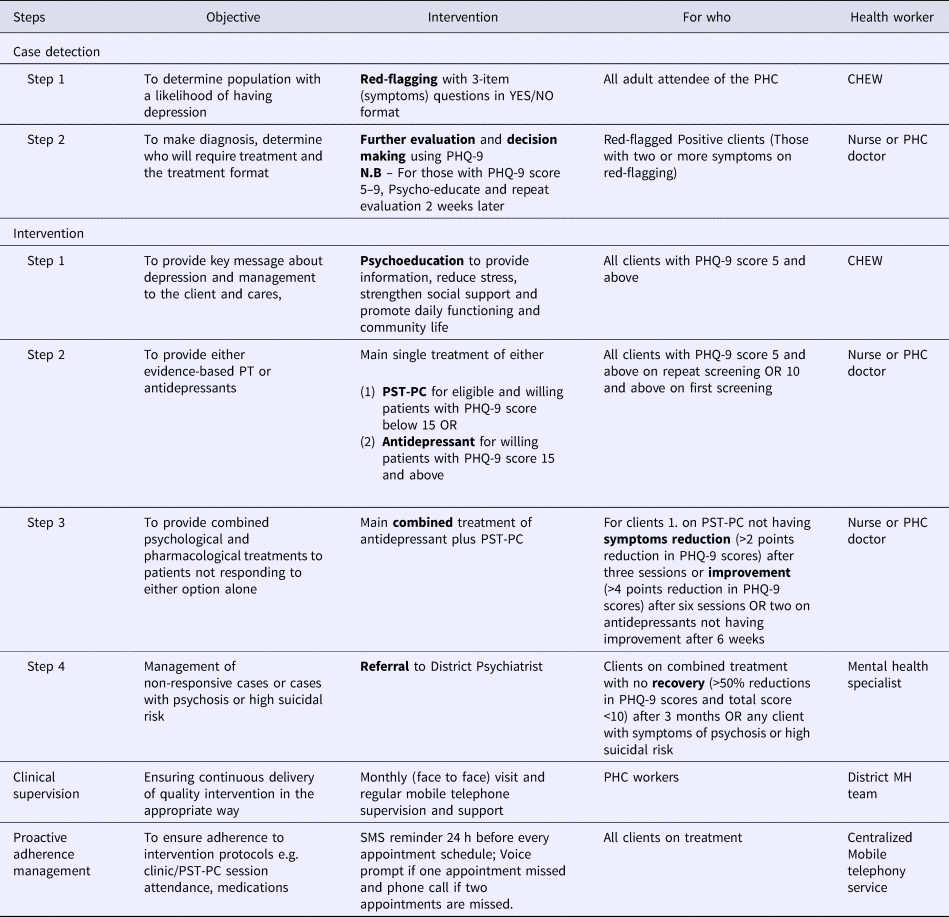
This stage produced an amended draft of the intervention ready for pilot testing. The formative work lasted for 3 months (August–October 2013). The various suggestions at the formative phase were used to further amend the intervention component as shown in Table 1.
The components of the draft Intervention for primary care management of depression.

The important steps and landmarks are in bold.
Stage 3: Piloting
Objective
The objective of the piloting stage was to test the feasibly and acceptability of the specific components of the proposed intervention and have an initial assessment of the ability of the intervention to change depression outcome.
Methods
This stage involved pilot testing of the amended intervention draft in four randomly selected primary care facilities in Lagos, Nigeria. It lasted for 9 months (November 2013–July 2014).
Setting
Lagos state with a population of about 15 million has about 200 government-owned PHCs with about 3–4 PHCs located in each of the 57 Local Council Development Areas (LCDAs) of the state. One PHC per LCDA was designated as a ‘Comprehensive PHC’ (CPHC) having the full complement of about three PHC doctors, 10 Nurses/midwives, five Community Health Officers (CHOs), five Community Health Extension Workers (CHEWs), and three Pharmacy technicians.
Training
After the institutional and staff consents were obtained, all the health staff of the four selected CPHCs received training in delivering the intervention. The mhGAP training guide (WHO, 2017a, b) was culturally adapted and contextualized for the development of the training protocol. The training needs of the local workforce and the health system were considered. Some changes were made to make it relevant to the Nigerian environment. The training which consisted of didactic lectures, clinical demonstration and role plays was as an initial 5-days workshop and a 1-day refresher course 2 weeks later. While the training of the PHC workers (nurses/midwives, CHOs/CHEWs) was focused on case detection and psychological intervention, the PHC doctors’ training was more focused on formal diagnosis and treatment of depression with an emphasis on principles of use of antidepressants, side effects, follow-ups, and referrals. Training in the assessment of suicidal risk was emphasized for everyone. Training was standardized with the use of video/audiotapes. In all, 11 PHC doctors, 42 nurses/midwives, and 38 CHEWs/CHOs were trained.
Intervention delivery
For 6 months the health workers delivered the intervention in the four CPHCs with the aid of manualized intervention materials including intervention manual for staff (detailing the detection, management, referral steps, rationale, and procedures), psychological therapy workbook for both staff and patients and psychoeducation brochure. An automated mobile telephony support service was set up for the four CPHCs. Recruitment of patients was for 3 months while each patient had at least 3 months treatment period. Each of the four CPHC was to be visited once a month throughout the piloting stage.
Evaluation
Evaluation of this stage was done at the 3rd month post-intervention. The evaluation includes fidelity assessments, a list of process indicators, and feasibility assessments. The evaluation was done separately by (a) a five-man expert group of external and independent health evaluators not part of the project; (b) health workers and (c) depressed clients.
(a) Fidelity assessment was conducted by expert evaluators using objective methods (videotaping and audiotaping) and subjective methods (provider self-report - intervention checklists & encounter logs and clients self-report-questionnaire and patient exit interviews). The assessments covered intervention delivery (whether the core treatment interventions and assessment of response to treatment are as specified in the guideline), intervention enactment (whether the patient is enabled to engage in the treatment recommendations in daily life) and intervention receipt (whether there is concordance of patient and provider understanding of the problem and/or the treatment recommendations?). Each of the three elements was rated for presence (yes or no) and for degree of presence using a rating scale ranging with 1 – strongly disagree (0%), 2 – disagree (25%), 3 – Neither agree nor disagree (50%), 4 – agree (75%) and 5 – strongly agree (100%). An acceptable level of 75% (4-Agree) and above was set.
(b) A list of process indicators was generated by the expert evaluators while the patient clinical outcome was evaluated at 3 months post-intervention. This includes case detection and treatment options, intention delivery indicators, supervision indicators, and mobile telephony component indicators.
(c) Feasibility assessment ratings were done by the health workers, the depressed clients, and expert evaluators. While all the three groups rated on the perceived simplicity/complexity of intervention, the health workers and the depressed clients rated on the perceived acceptability (of content and mode of delivery) and usefulness of the intervention. Finally, the expert evaluators rated on facilitation strategies (strategies to ensure the delivery of intervention or training were as uniform as possible) and quality of delivery (whether the intervention is delivered in a way appropriate to achieving what it was intended). All ratings were on a scale of 1–5 with scoring from most undesirable (1 or 0%) to most desirable (5 or 100%).
Results
For the 3 months recruitment period, 3318 adult cases were attended to in the four CPHCs.
(a) Process Indicators: The process indicators are illustrated in the flow diagram (Fig. 1). Out of the 3318 cases seen, 1433 were positive at red-flagging and at further evaluation, 432 cases had clinically significant depression (PHQ-9 score 10 and above). Although 367 had mild depression (PHQ-9 score 5–9) at first evaluation, only 203 had persistent mild depression at repeat assessment 2 weeks later after psychoeducation. Using the mhGAP-IG guidelines, 20 cases were immediately referred to the mental health facilities including those with symptoms of bipolar depression, psychotic depression, and high suicidal risk. A total of 304 were commenced on PST-PC and 285 on antidepressant immediately. For those on PST-PC, 282 (92.8%) completed the first three sessions and 255 (83.9%) completed all the six sessions. The average length of first session of PST-PC was 72 min and subsequent sessions were 34 min. While a total of 89 (29.3%) that started on PST-PC had antidepressants added after six sessions, a total of 35 (12.3%) of those that started on antidepressants had PST-Pc added after 6 weeks. Nearly all (95.2%) of the trained nurses were delivering the intervention. The average number of visits by mental health team was once in 2 months with each visit lasting about 150 min. On the average, a client receives about six SMS, two voice prompts and two voice calls per month.
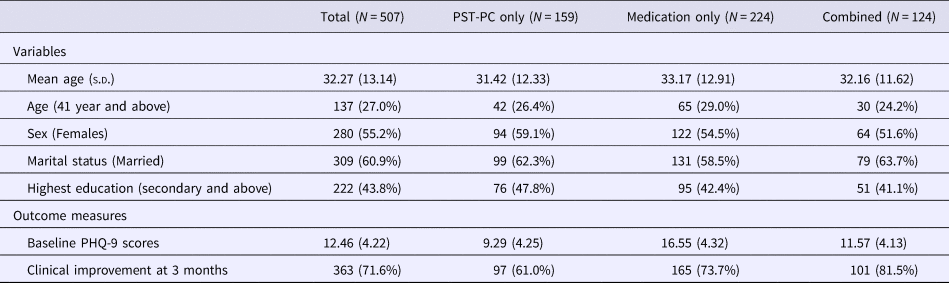
(b) Clinical outcome measure: Table 2 showed the sociodemographic details of the 507 with outcome measures after 3 months of intervention. We adopted the widely accepted clinically significant improvement on the PHQ-9 definition of >50% decline from baseline plus post-treatment score below 10 (McMillan et al., Reference McMillan, Gilbody and Richards2010). Results showed that on the whole 363 (71.6%) achieved clinical improvement after 3 months (61.0% for PST-PC only, 3.7% for antidepressants only and 81.5% for combined antidepressants and PST-PC).
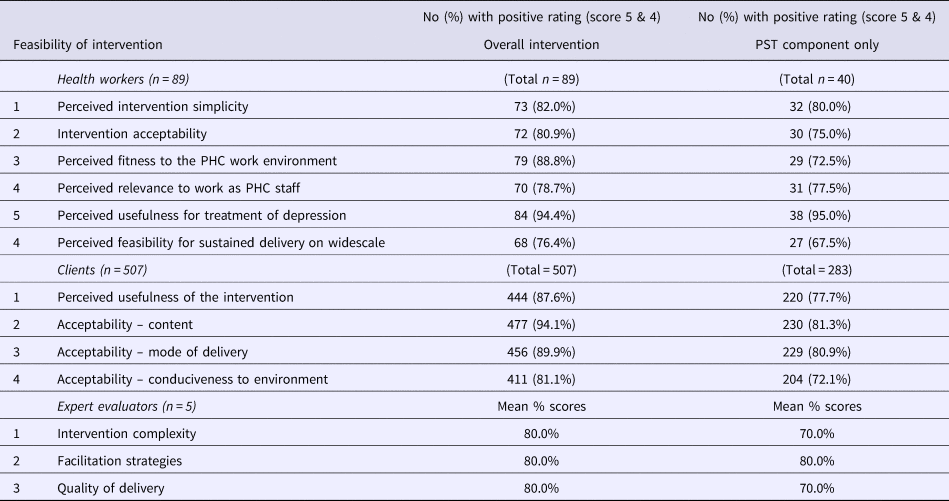
(c) Feasibility assessments: Table 3 showed the results of the feasibility assessments. The research team earlier had a consensus that an intervention component with endorsement from more than 70% of the evaluators will be judged ‘feasible’ While over 80% of the health workers perceived the intervention to be simple, acceptable, and fit for the PHC work environment, over 75% perceived it relevant to their work at PHC. The item with least positive rating (of 67.5% for PST-PC component and 76.4% for overall intervention) was perceived feasibility for sustained delivery of the intervention. Nearly every health worker endorsed the usefulness of the intervention for treatment of depression. The clients also largely perceived the intervention to be useful and the content, mode of delivery and conduciveness to environment acceptable. On all the indices, the PST only components score slightly lower than the overall components. The average scores by the expert evaluators were 80% for either intervention complexity, facilitation strategies or quality of delivery.
(d) Mobile telephony component: While practically all the clients agreed that mobile telephony component was very helpful, some modifications were suggested. A large proportion of the clients preferred that SMS and the voice prompts to be in their local language. It was generally agreed that the best time to receive reminder SMS of a clinic/PST session is between 7 and 8 pm of the preceding evening. Over half of the clients advocated for general depression advice as SMS once in a week with Sunday around 5 pm suggested as the best time for this. There were questions of how to handle those missing appointments despite phone calls. It was agreed that a home visit by a community health worker or social worker should be reserved for this group of clients.
Flow chart of the pilot intervention process.

Outcome measures after 3 months of intervention

Feasibility assessment of the intervention

Discussion
We have systematically developed and tested the feasibility of a complex intervention for the management of depression in the primary care in Nigeria using the recommended framework while flexibly incorporating lesson learnt from each stage into the next. Delivering efficacious intervention for depression in LMICs will require a package that can be easily integrated into the primary care services bearing in mind the workload, personnel competence, and the environmental factors.
Our developed intervention package consisted of a 2-staged screening with the first stage consisting of 3-item questions that could be completed within a few seconds. Although we did not test the psychometric properties of this 3-item questionnaire, it is similar to the PHQ-2 (Kroenke et al., Reference Kroenke, Spitzer and Williams2003) which had been reported to have a 97% sensitivity and 67% specificity in adults. Most of the health workers were of the opinion that the use of this rapid screener extensively saved time at the ever-busy PHCs. It also aligned with our quest for an intervention package that will not require recruitment of additional staff for delivery. We had earlier validated the PHQ-9 as a useful instrument in primary care in Nigeria (Adewuya et al., Reference Adewuya, Ola and Afolabi2006). We incorporated assessments for Mania, psychosis, and suicidal risk in the second step of screening to allow for immediate determination of cases to be referred to the mental health specialist.
Based on the consultation with the stakeholders, we made a one-page leaflet for the psychoeducation. However, we insisted that the psychoeducation must still be delivered verbally with the leaflet handed to the patient to take home. We also developed a 5 min group health-talk version to be delivered in the waiting room before being attended to by the doctor/nurse.
Although, it could be argued that the assessment of patients on PST-PC after only three sessions seemed precipitous as improvement may not be seen that early, we felt it would be necessary to identify early those who may not respond to PST-PC only and offer them antidepressants in combination with PST-PC early enough. We believe that those without improvement after six sessions of PST-PC or 6 weeks of antidepressants deserved to have a combination of both treatment and those without recovery after treatment for 3 months should be referred to the mental health specialist. As expected, the mobile telephony component was well received by the clients, and, with the clients’ suggestions, substantial modifications were made to the delivery of the mobile telephony services. The 6.9% lost to follow up after 3 months of treatment in our study is within the expected range in this environment. We hypothesized that the mobile telephony component contributed to the high level of client retention.
Our model is similar to earlier attempts at CSC management of depression in Nigeria (Gureje et al., Reference Gureje, Oladeji, Araya and Montgomery2015), South Africa (Honikman et al., Reference Honikman, van Heyningen, Field, Baron and Tomlinson2012), Asia (Shinde et al., Reference Shinde, Andrew, Bangash, Cohen, Kirkwood and Patel2013) and Europe (Wernher et al., Reference Wernher, Bjerregaard, Tinsel, Bleich, Boczor, Kloppe, Scherer, Härter, Niebling, König and Hüll2014). Many depression treatment guidelines all over the world have endorsed this stepped care principle like the NICE guideline in the UK (NICE, 2010, 2011), the Dutch multidisciplinary guideline (Spijker et al., Reference Spijker, van Vliet, Meeuwissen and van Balkom2010). The most notable initiative is the implementation of the Improving Access to Psychological Therapies programme (Griffiths and Steen, Reference Griffiths and Steen2013), for which stepped care underpins the organizational structure.
The specific facilitators identified by our study were; the introduction of the red-flagging stage which saves time and allows focusing screening only on those with high probability of having symptoms of depression; the adoption of brief, easily understood and delivered psychological therapy and; the incorporation of culture-specific themes in the intervention. The specific barriers identified were; time constraints in the PHC and perceived rapid changes in most government policies.
Overall, we have developed an integrated intervention package using recommended guidelines, encompassing a review of current literature, expert opinions, consultation with local stakeholders, and end users. Our intervention package was deemed not only acceptable to the clients and health workers but relevant, useful, and with the high feasibility of delivery by the health workers. One important advantage of our developed intervention is that no new staff is needed to be recruited to deliver the intervention. We have gone further to test the clinical effectiveness of our developed intervention package and its mobile telephony component in a RCT.
Acknowledgements
We acknowledge the immense help and contribution of the primary care health workers and clients who participate in this project.
Author ORCIDs
Abiodun O. Adewuya http://orcid.org/0000-0002-7611-6953.
Financial support
This work was supported by the Grand Challenges Canada (GCC). The Grant number GMH 0084-04.
Conflict of interest
None.
Ethical standards
The authors assert that all procedures contributing to this work comply with the ethical standards of the relevant national and institutional committees on human experimentation and with the Helsinki Declaration of 1975, as revised in 2008.