Introduction
Parasitic plants constitute ∼1% of all plant species described, and contribute with a small – although unmeasured – part of the above-ground biomass in their ecosystems (Pennings & Callaway Reference Pennings and Callaway1996). Historically, great attention has been given to the economic losses that parasitic plants cause for agriculture (Musselman Reference Musselman1980) and the wood industry (Geils & Hawksworth Reference Geils, Hawksworth, Geils, Cibrián Tovar and Moody2002). However, research beginning a few decades ago has shown that parasitic plants could also be considered keystone resources or structures in several natural ecosystems worldwide, performing at least one of the following roles: (1) killing dominant hosts and promoting non-hosts’ diversity (reviewed in Pennings & Callaway Reference Pennings and Callaway2002); (2) providing food (Watson Reference Watson2001) and shelter (Cooney et al. Reference Cooney, Watson and Young2006) for a number of animal species; and (3) increasing the non-hosts’ establishment through the production of a nutrient-rich litter (Bardgett et al. Reference Bardgett, Smith, Shiel, Peacock, Simkin, Quirk and Hobbs2006).
Despite their biological importance, parasitic plants have been overlooked in studies that have estimated the above-ground biomass stock and leaf-litter in tropical systems (March & Watson Reference March and Watson2007). For mistletoes, parasitic plants of the Santalales that parasitize branches of trees and shrubs (Nickrent et al. Reference Nickrent, Malécot, Vidal-Russel and Der2010), research has been conducted to estimate the percentage of infected hosts, as well as the infection load (number of mistletoes per host), using such predictive variables as height and diameter of the host canopy (Aukema & Martínez Del Rio Reference Aukema and Martínez Del Rio2002). However, such studies overlook the fact that some shrubby mistletoes vary in size by several orders of magnitude, both within species as they grow (Bilgili et al. Reference Bilgili, Ozturk, Coskuner, Baysal, Serdar, Yavuz, Eroglu and Usta2018) as well as between species (Kuijt Reference Kuijt2009). Therefore, developing predictive biomass models involving mistletoes is essential to understanding their importance.
In general, the biomass of terrestrial woody plants can be estimated using a model that includes the diameter of the plant at breast height (dbh) as the main predictive variable (Nogueira et al. Reference Nogueira, Fearnside, Nelson, Barbosa and Keizer2008). This is also used for lianas (Gehring et al. Reference Gehring, Park and Denich2004). For mistletoes, Miller et al. (Reference Miller, Watling, Overton and Sinclair2003) used a model based on a modified ellipsoid equation to account for the major and minor dimensions of the canopy, plus height, to calculate volume for Amyema miquelii (Loranthaceae) in Australia. March & Watson (Reference March and Watson2007) used the same equation, slightly modified, to correlate volume with leaf biomass of the same species with high predictive power. Neither of these studies, however, were focused on estimating mistletoe biomass beyond the host scale.
In biomass studies, estimates based on allometric models are preferable because they allow the expansion of study areas without the disturbances caused by destructive sampling (Gehring et al. Reference Gehring, Park and Denich2004). Simple allometric models are most commonly employed because they use stem diameter data or percentage coverage to predict biomass (Smith & Brand Reference Smith and Brand1983). Thus, estimating mistletoe biomass using allometric models becomes important because: (1) such plants may constitute a temporary but important carbon stock in natural or anthropogenic systems; (2) biomass can be a more effective predictor than can intensity of infection or the percentage of infected hosts of the resource profile available to a diverse array of organisms (dispersers, pollinators and herbivores), and (3) it is directly related to litter biomass, which is an important source of nutrients for plant communities on poor soils (March & Watson Reference March and Watson2007, Ndagurwa et al. Reference Ndagurwa, Ndarevani, Muvengwi and Maponga2016).
The objective of the current study was to construct allometric models for biomass estimation of Psittacanthus plagiophyllus in a savanna enclave located in the western part of the state of Pará, Amazonia, Brazil. Our hypothesis is that the biomass of P. plagiophyllus can be explained by the biometric patterns of the host plant. To test this hypothesis, we determined (1) the total biomass (vegetative and reproductive parts) of P. plagiophyllus, (2) the set of variables that best describe allometric biomass models of the species, and (3) the biometric patterns from the host trees. Finally, we compared the biomass estimate of P. plagiophyllus for the savanna under study with the total above-ground tree biomass to identify the relevance of this mistletoe species in both the biological and the biomass stock context.
Methods
Study area and species
This study was conducted in a fire-prone savanna enclave located at Alter do Chão (2°31'S, 55°00' W), Pará, Brazil. The soil is sandy (>90% sand) and poor in nutrients (Lloyd et al. Reference Lloyd, Domingues, Schrodt, Ishida, Feldpausch, Saiz, Quesada, Schwarz, Torello-Raventos, Gilpin, Marimon, Marimon-Junior, Ratter, Grace, Nardoto, Veenendaal, Arroyo, Villarroel, Killeen, Steininger and Phillips2015). Mean annual temperature is 27.5°C and mean annual rainfall exceeds 2000 mm. Climate is seasonal, with a rainy season between January and May and a dry season between June and December. The study area covers around 10 000 ha and houses 35 permanent plots from the PELD-Western-Pará Biodiversity Program (PPBio/POPA). Each plot is divided into four parallel transects, oriented north-south, 250 m long and 50 m apart (Magnusson et al. Reference Magnusson, Lima, Albernaz, Sanaiotti and Guillaumet2008).
Psittacanthus has a hemiparasitic habit, obtaining water and minerals through the haustorium. The genus occurs in the Caribbean and from Mexico to central and south-eastern Brazil (Kuijt Reference Kuijt2009). Infection incidence can exceed 70% (López de Buen et al. Reference López de Buen, Ornelas and García-Franco2002). Adult individuals of Psittacanthus are shrubby and vary widely in size from a few centimetres to about 1–3 m in crown diameter, as well as woodroses (a proliferation of the host tissue at the point of mistletoe attachment), that can measure up to 20–30 cm in diameter (Kuijt Reference Kuijt2009).
Psittacanthus plagiophyllus Eichler, the focus of the current study, has a single haustorium and can be found in several states of north and north-east Brazil, as well as in Ecuador, Guyana, Peru, Suriname, French Guiana and Venezuela (Kuijt Reference Kuijt2009). In our study site, P. plagiophyllus was only found parasitizing cashew trees (Anacardium occidentale L.) (Fadini & Lima Reference Fadini and Lima2012), but parasitism of other host species is reported from other parts of the species range (Kuijt Reference Kuijt2009). Locally, flowers of the species are visited by 10 species of hummingbird (S. Castro, pers. comm.), and their fruits are mainly consumed by the plain-crested elaenia (Elaenia cristata, Tyrannidae) (Fadini et al. Reference Fadini, Gonçalves and Reis2010).
Field collections
Fieldwork was performed between July and September 2016, in two phases, the first being a sample to define an appropriate allometric equation for mistletoe biomass and the second, to estimate the biomass of the hosts present in the PPBio permanent plots nearby. In the first phase, 35 adult mistletoes (with either reproductive structures or their scars) were manually removed from 13 randomly selected host trees at three sites outside the savanna plots, but close to them (600–1000 m). We chose these sites because we conduct long-term studies of mistletoes and their hosts inside the permanent plots (Fadini & Lima Reference Fadini and Lima2012) and, therefore, we avoided disturbing them. For each host, we counted all the mistletoes present and, for the biomass sample, we selected a few (1–3 per tree) for destructive sampling. Overall, we attempted to retrieve a selection of individuals representative of the sizes found in the field, distributed throughout the tree crowns and from all heights.
For each mistletoe, we measured the broadest and narrowest width (cm) of the haustorium, and the width (cm), breadth (cm) and vertical depth (cm) of the whole plant. In addition, we visually estimated the percentage of mistletoe plant covered by leaves in four classes: from 1 (1–25%) to 4 (76–100%). In the laboratory, we weighed plants and dried them at 70°C in an oven for 48 h. Next, we weighed them again, and separated the leaves, central (including the woodrose) and peripheral stems (<10 mm), fruits and flowers.
The second phase took place in 13 PPBio permanent plots, with choice of plots based on annual fire occurrence data from the last 20 y (A. P. Lima, unpubl. data). All hosts >2 m tall were sampled along 20 m of each transect, totalling 80 × 250 m (2 ha per plot) (see Fadini & Lima (Reference Fadini and Lima2012) for a similar procedure). We measured the crown diameter (m) and height (m) of host trees with the aid of a graduated stick and a measuring tape, respectively. The presence of infection, along with the number and size of mistletoes were recorded for each reproductive individual or those bearing the scars of reproductive structures. Mistletoe size variables were the width (cm), breadth (cm) and vertical depth (cm) of the whole plant, as well as the percentage of mistletoe plant covered by leaves (as above).
Biomass allocation
We evaluated changes in mistletoe biomass allocated to leaves or stems with linear regression on a log-log scale, where b is the slope. We placed stem biomass on the x-axis and leaf biomass on the y-axis. Thus, if b <1, leaf biomass decreases disproportionately in relation to stem biomass. If b >1, leaf biomass increases disproportionately in relation to stem biomass. If b = 1, growth of the two is directly proportional. We tested the difference between calculated b and expected b (b = 1) values with a paired t-test, replacing values in the equation and solving it for the estimated leaf biomass values.
Adjusting biomass models
Before working with the allometric models, we created two variables derived from the literature: the ellipsoid equation and the leaf volume index (LVI). The ellipsoid equation was used by Miller et al. (Reference Miller, Watling, Overton and Sinclair2003) to estimate the volume of the mistletoe Amyema miquelii in Australia, while March & Watson (Reference March and Watson2007) added a metric for the percentage of mistletoe plant covered by leaves (as above) to the formula to produce the LVI and estimate the biomass for the same species. In Equation 1, a, b and c are width, breadth and vertical depth of the whole plant, respectively.
 $$Leaf{\mkern 1mu} Volume{\mkern 1mu} Index{\mkern 1mu} (LVI){\mkern 1mu} = {\mkern 1mu} {{\rm{1}} \over {\rm{6}}}{\mkern 1mu} \times {\mkern 1mu} \pi {\mkern 1mu} \times a{\mkern 1mu} \times {\mkern 1mu} b{\mkern 1mu} \times {\mkern 1mu} c{\mkern 1mu} \times \% {\mkern 1mu} leaves$$
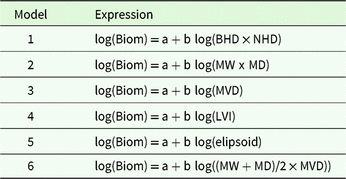
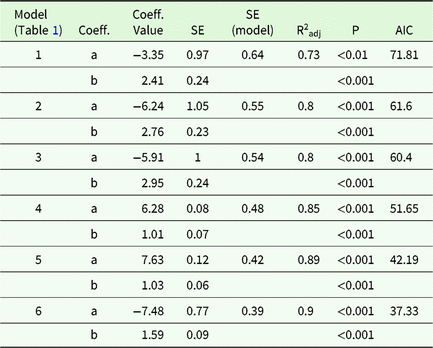
We created predictive models of mistletoe dry biomass using a set of explanatory variables (Table 1). There is no consensus in the literature as to whether allometric relationships should be analysed with linear regressions or robust regressions (Müller et al. Reference Müller, Schmid and Weiner2000). We therefore opted for the most commonly undertaken form of analysis. Data were log-transformed, and models were hierarchically ranked using the standard error (SE), the coefficient of determination (R2) and the Akaike Information Criteria (AIC). The best model (lower SE, higher R2 and lower AIC) was chosen and we back-transformed to the original data format for plot checking. Due to the lack of fit of the model to values representing large mistletoes, we fitted a new model to the data with a non-linear regression through an iterative process, using the Gauss–Newton algorithm. Initial parameters were estimated using the log-log model. We used the non-linear model for in-field mistletoe biomass estimates.
Allometric models to estimate biomass of Psittacanthus plagiophyllus in the Alter do Chão savanna, Amazonian Brazil. Biom = total dry biomass; BHD = broadest haustorium diameter; NHD = narrowest haustorium diameter; MW = mistletoe width (cm); MB = mistletoe breadth (cm); MVD = mistletoe vertical depth (cm); LVI = leaf volume index

Mistletoe–host relationship and in-field biomass estimates of mistletoes and trees
After obtaining in-field mistletoe biomass estimates per host, the relationship between host size and mistletoe biomass was tested using two sets of linear regression models: (1) for all host individuals above 2 m tall and (2) only for infected hosts. We log-transformed biomass to meet the homogeneity and normality assumptions for residuals before performing tests. We also used regression models to estimate parasite load, considering the square root-transformed values of parasite load as a dependent variable.
We compared the mistletoe biomass estimates (ind. ha−1) (using data from the 13 study plots) with the tree above-ground biomass measured on seven of these plots. These data, which include trees larger or equal to 5 cm at 30 cm of the soil height (dsh30), were collected by V. Corrêa and are available through the ForestPlots.net platform (Lopez-Gonzalez et al. Reference Lopez-Gonzalez, Lewis, Burkitt and Phillips2011) upon request with the authors. The model used to calculate tree biomass (Rezende et al. Reference Rezende, Vale, Sanquetta, Figueiredo Filho and Felfili2006) took into consideration dsh30 and height. Descriptions of the data include mean ± SD.
Results
Biomass allocation
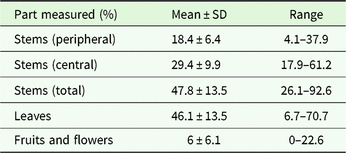
Total dry biomass of mistletoes collected in the field (n = 35) was 32.4 kg (range = 0.0282–6.48 kg per host). Mean dry biomass was 43.8% ± 8.2% (range = 20.4–61.5%) of the total wet biomass (Table 2). Biomass allocation between stems and leaves was very similar, with a small amount of biomass allocated to reproductive structures (Table 2). Biomass allocation for the central stems was, on average, 60% greater than for the peripheral stems. A disproportionate decrease in leaf investment relative to that for stems was found as the plant grew (P < 0.001).
Percentage of total dry biomass allocation by the mistletoe Psittacanthus plagiophyllus (n = 35) collected in the Alter do Chão savanna, Pará, Brazil

Allometric models
The allometric models used for estimating the total P. plagiophyllus biomass are given in Table 3. All predictive variables had a significant positive relation with mistletoe dry biomass (P < 0.01 or P < 0.001). The model using haustorium diameter had the lower predictive value. Models that used width, breadth or vertical depth as predictors had similar predictive values. The model using (width × breadth)/2 × vertical depth as a single predictor (model 6 in Table 3) was the most appropriate to describe the data, using our criteria (lower SE, higher R2 and lower AIC).
Allometric models tested to estimate Psittacanthus plagiophyllus biomass based on 35 individuals collected in the Alter do Chão savanna, Amazonian Brazil

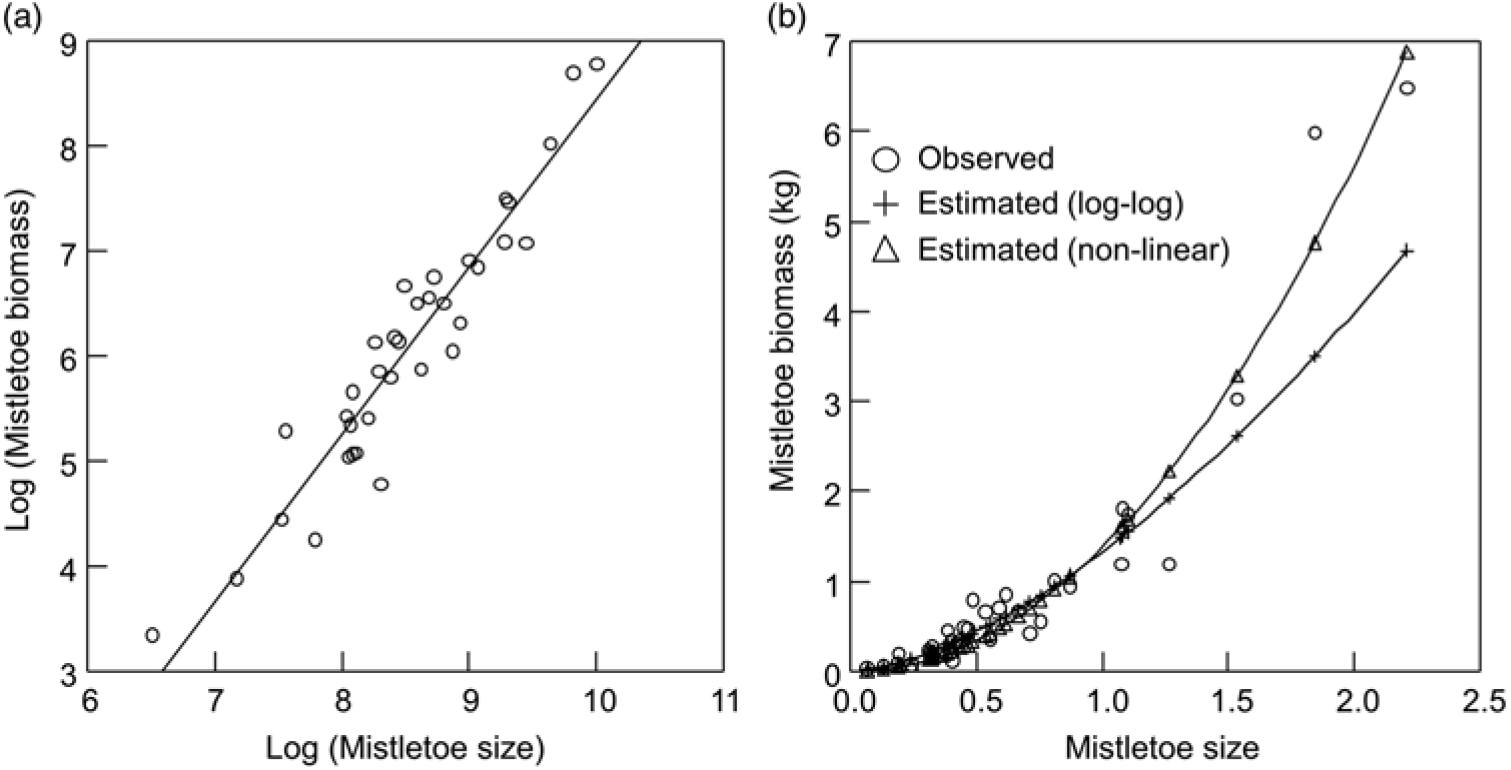
Log-transformed size values were linearly related to log-transformed biomass in model 6 (Figure 1a). The log-log model provided a good fit for mistletoes smaller than 1 kg, but underestimated the biomass of larger individuals (>1 kg). Therefore, we used a non-linear model instead. The non-linear model (biomass = 0.000011 × ((width + breadth)/2 × vertical depth) 2.025) provided a good estimate of mistletoe biomass and was better than the log-log model for estimating in-field biomass of plants larger than 1 kg (Figure 1b).
Graphical representation of the allometric relationships between size ((width + breadth)/2 × vertical depth) and the biomass of the mistletoe Psittacanthus plagiophyllus for the best model obtained in Table 2 (r2 = 0.9). Graph with axes log-log transformed (a); comparison between the log-log model transformed back to the original data and the non-linear model estimated by trial and error (b).

Parasite load and in-field mistletoe biomass
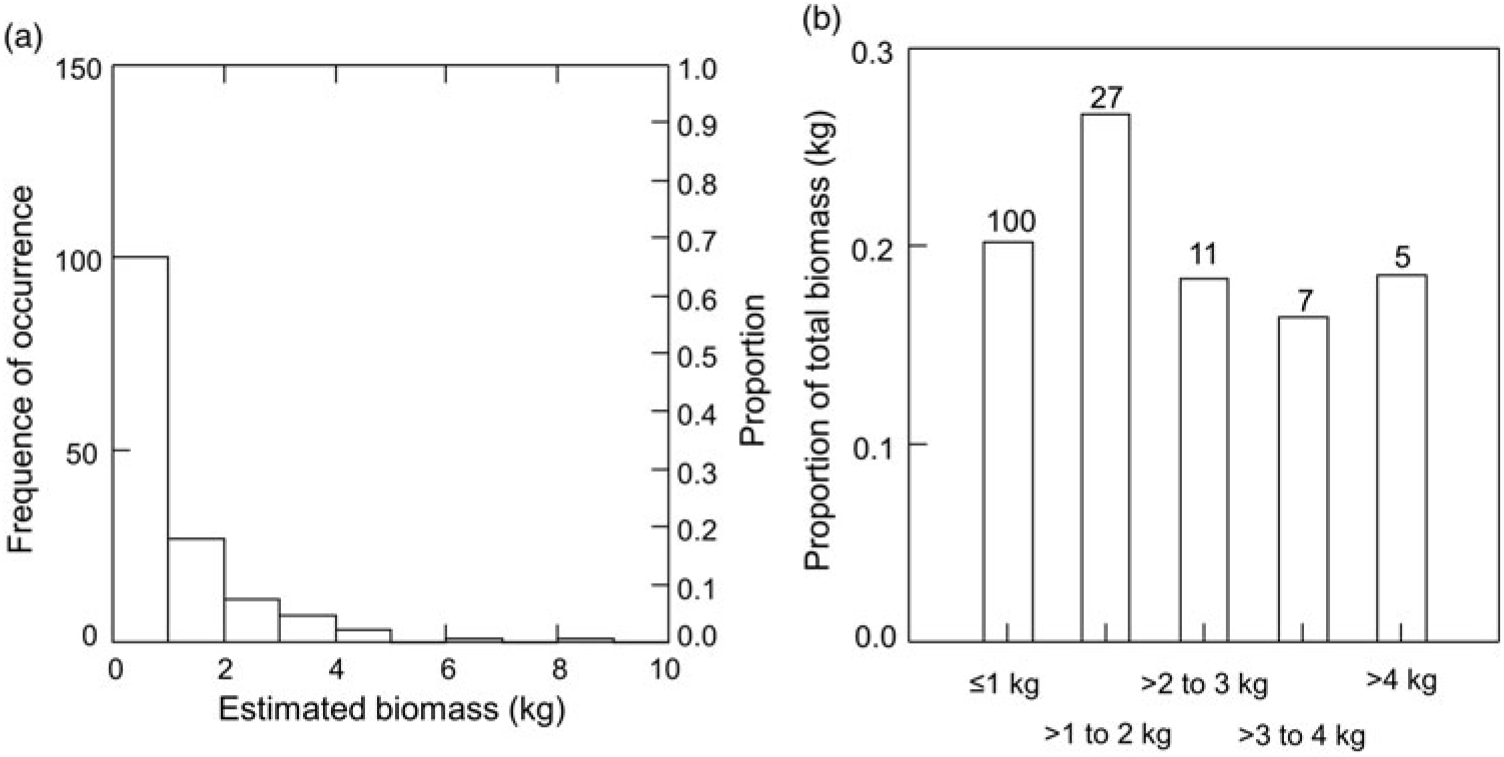
A total of 342 host trees were recorded in the 26 ha sampled (13.1 ± 8.3 ha−1). The number of hosts varied from 2.5 to 35.5 ha−1, and the percentage of infected hosts ranged from zero to 44% of the available trees. We recorded 150 mistletoes in 51 host trees over 16 ha. Estimated dry biomass ranged from 0.0084 to 8.8 kg per individual mistletoe plant. The number of infections per host tree varied from one to 16, and estimated mistletoe dry biomass ranged from 0.0244 to 21 kg per host. Approximately 70% of the individuals were <1 kg (Figure 2a), but represented only 20% of estimated total dry mistletoe biomass (Figure 2b).
Histogram of dry biomass frequencies estimated for 150 Psittacanthus plagiophyllus individuals on 26 ha of the Alter do Chão savanna, Amazonian Brazil (a). Proportion of mistletoe infections distributed in each biomass class (b). The numbers above the bars correspond to the total number of individuals in each class.

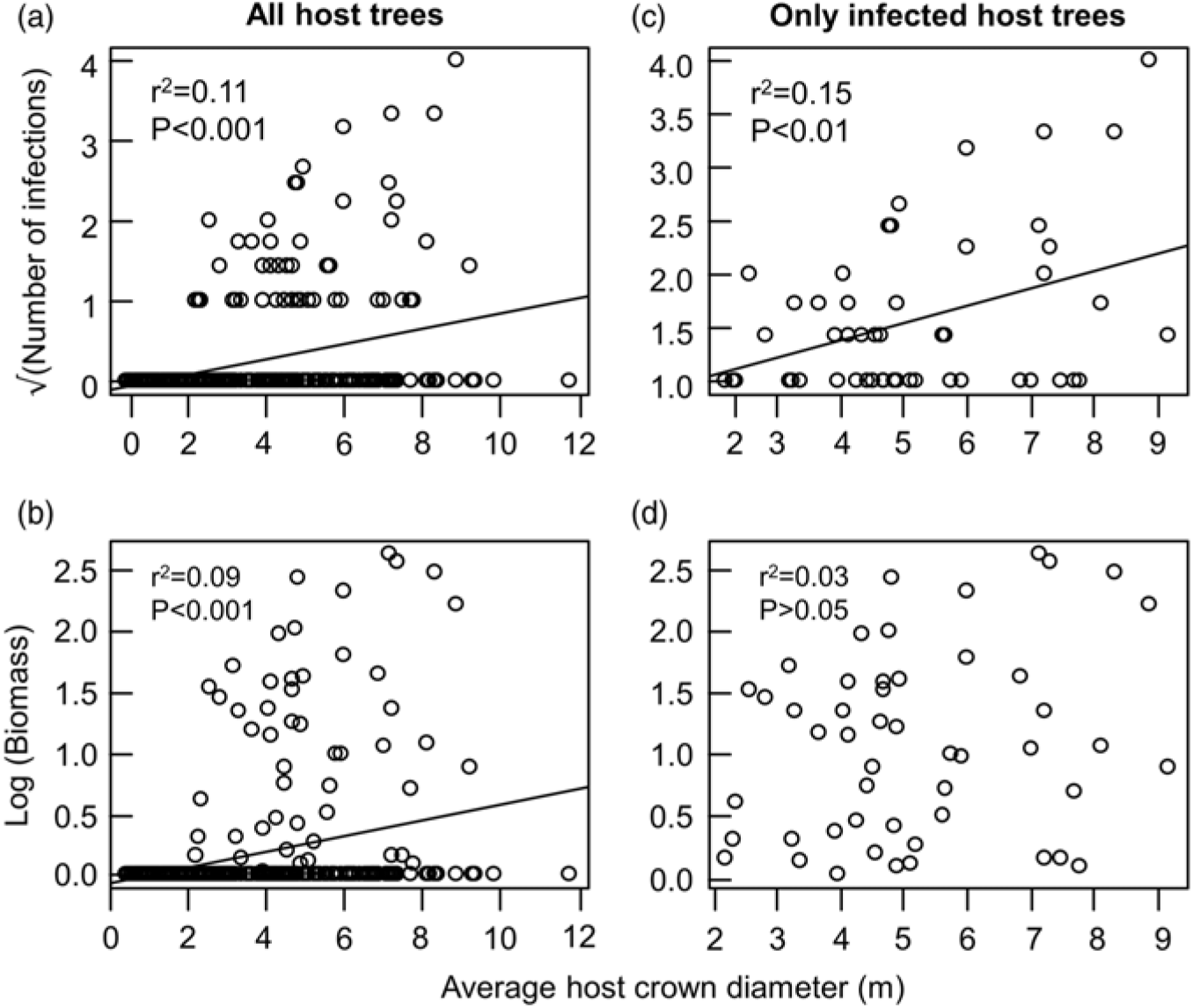
When considering all host trees (both infected and non-infected), parasite load and estimated dry biomass had a positive, but weak relationship with host biometry (Figure 3a, b). After removing the non-infected hosts, a significant (but weak) relationship was retained only for the mistletoe load data, but not for the biomass (Figure 3c, d).
Regression of number and estimated dry biomass of Psittacanthus plagiophyllus parasitizing Anacardium occidentale compared with host biometry in the Alter do Chão savanna, Amazonian Brazil. The r2 and P values are given for all potential hosts (342 trees) (a, b); and only infected hosts (51 trees) (c, d). Axes were transformed to minimize discrepancies in relation to the assumptions of homogeneity and normality.

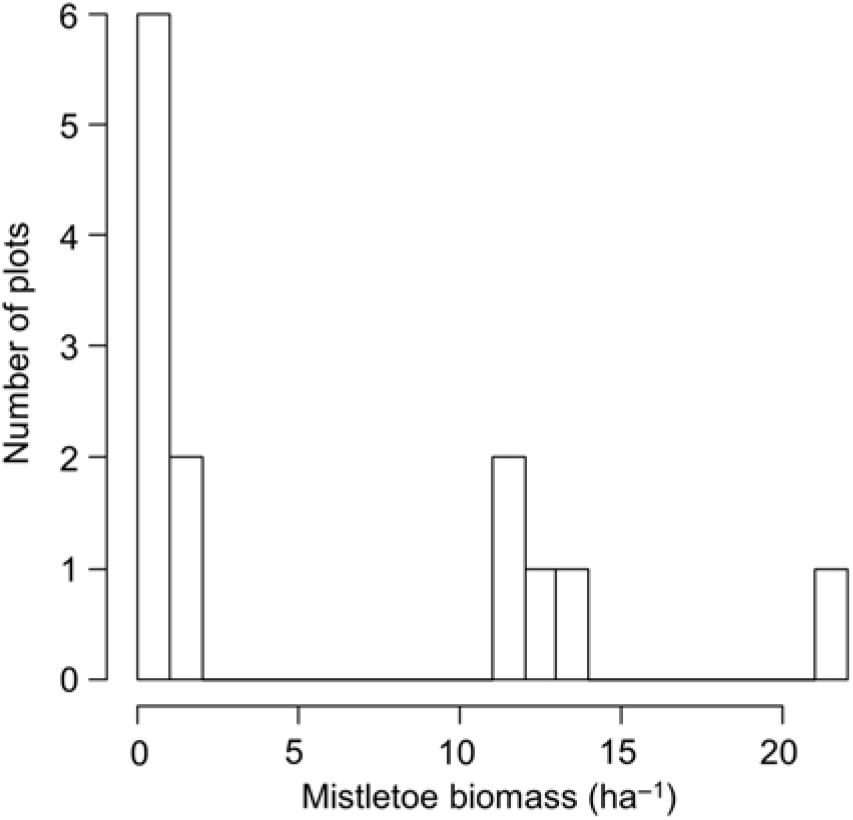
Estimated P. plagiophyllus dry biomass at the landscape level ranged from 0.5 kg to 22 kg ha−1 (Figure 4). This maximum is equivalent to 0.07–0.15% of the total above-ground tree biomass (dsh30 ≥5 cm) estimated for the sampled plots used for comparison (range = 14.2–30.6 Mg ha−1).
Histogram of frequency of estimated Psittacanthus plagiophyllus biomass in 26 ha (13 plots) of the Alter do Chão savanna, Amazonian Brazil.

Discussion
Biomass allocation
Despite the evident presence of woody structures in such mistletoe genera as Psittacanthus (Vázquez-Collazo & Geils Reference Vázquez-Collazo, Geils, Geils, Cibrián Tovar and Moody2002), Amyema, Peraxilla, Alepis (Patel Reference Patel1991) and Erianthemum (Dzerefos et al. Reference Dzerefos, Witkowski and Shackleton2003) among others, their role as a temporary biomass stock is poorly documented. On one hand, by analysing plant biomass as separate components, we showed that the stems are as important as leaves in above-ground biomass stock for the studied species. Stems can stock biomass for longer periods than do leaves and, when decomposing, can liberate the nutrients more slowly and over a longer period (Koukoura et al. Reference Koukoura, Mamolos and Kalburtji2003). On the other hand, depending on the temporal turnover of leaves and reproductive structures (which is unknown for this species), they would gain more relevance for the overall mistletoe biomass over time (March & Watson Reference March and Watson2007, Ndagurwa et al. Reference Ndagurwa, Ndarevani, Muvengwi and Maponga2016). In summary, mistletoe stems would retain biomass in the above-ground compartment for a long time, while leaves, flowers and fruits are released more frequently into the soil.
Although the proportions of biomass allocated to stems and leaves are similar, their relative importance changes as the plant grows. Larger individuals invest disproportionately more in stems than in leaves, which means greater production of support and protection structures rather than in purely photosynthetic structures. This reduces the relative growth rate of individual plants as they mature, but may increase the chance of survival in the face of disturbances such as fire (Fadini & Lima Reference Fadini and Lima2012). Anthropogenic fires, with a mean fire return interval of 1–3 years, which kill the smallest mistletoe individuals, often affect the study area. The investment in twigs and haustoria (woodroses) increases the resistance to the flames, probably because it protects the endophyte, increasing the chance of post-fire regrowth (Fadini & Lima Reference Fadini and Lima2012).
Allometric models
Construction of allometric equations based on canopy diameter and depth is sufficient to produce satisfactory explanatory correlations with biomass, especially for species with a ball-shaped canopy, which is common for many species of Phoradendron and some species of Psittacanthus (e.g. P. nodosissimus). Such measurements can be easily and precisely obtained either from the ground or via aerial images (Barbosa et al. Reference Barbosa, Sebastián-Gonzáles, Asner, Knapp, Anderson, Martin and Dirzo2016). However, in the current study, the quality of fit increased when Leaf Volume Index (LVI) and ellipsoid were used as predictors. A similar result was obtained by March & Watson (Reference March and Watson2007), who used LVI to estimate leaf biomass for the mistletoe Amyema miquelii in Australia. Therefore, including vertical depth of the individual improved the model considerably and appears to be essential for estimating biomass of mistletoes with irregular crowns, which is the case of P. plagiophyllus in this study.
After the model was chosen and we back-transformed values to the original scale, adjustment was poor for larger mistletoes, which is a drawback, because they constitute 70% of the above-ground mistletoe biomass. We corrected the fit using a non-linear model; which worked well for our data, but we recognize that it loses predictive power. Therefore, we recommend sampling more large mistletoe individuals to correct the model for that size range.
Parasite load and mistletoe in-field biomass
For parasite load, host size was a poor in-field predictor of P. plagiophyllus biomass (r2 = 0.09), indicating that larger (and older) mistletoes do not necessarily parasitize larger hosts. Low r2 values were also reported in previous studies, when correlating the number and volume of mistletoe plants in host trees with their heights and basal diameters (Overton Reference Overton1994). This indicates that, to accurately estimate P. plagiophyllus biomass, and probably other mistletoe species, it is necessary to conduct in-field measurements as well as removing some individuals to develop an appropriate allometric model.
Using the best allometric model, we found a population structure with few large and many small individuals (inverted-J), which is typical among plants in general and among mistletoes in particular (Norton et al. Reference Norton, Ladley and Owen1997). This pattern suggests that populations of P. plagiophyllus are self-sustaining, except in places with high burning frequencies, where they are fully consumed by fire (Fadini & Lima Reference Fadini and Lima2012). At the other extreme, in areas without fire for at least 10 years, the biomass of P. plagiophyllus is also low (data not shown). This is because, under such conditions, host populations (A. occidentale) are being replaced by other tree species (R. Fadini, unpubl. data), leading to the death of this nearly host-specific mistletoe as a consequence.
Our estimates of biomass at the landscape scale gave very low values. Similar results were also found for tree epiphytes compared with total forest ecosystem biomass in tropical forests of Taiwan and Costa Rica, respectively (Hsu et al. Reference Hsu, Horng and Kuo2002, Nadkarni Reference Nadkarni1984). However, just like them, mistletoes provide a nutrient-rich litter throughout the year in various parts of the world (March & Watson Reference March and Watson2007, Ndagurwa et al. Reference Ndagurwa, Ndarevani, Muvengwi and Maponga2016), suggesting that they may have a greater role in nutrient cycling dynamics within the ecosystem than in its standing biomass.
Final considerations
Like lianas, mistletoes frequently reduce host growth and survival of their hosts (Reid et al. Reference Reid, Yan and Fittler1994), while at the same time storing biomass. Therefore, understanding the balance between gains and losses of biomass is fundamental to understand the extent to which the role of mistletoes is beneficial or harmful at the individual scale. At the other extreme, by killing or reducing the performance of their hosts, mistletoes could facilitate the establishment of non-hosts through a top-down effect, increasing plant diversity locally and, therefore, having a positive effect at the community scale (Press & Phoenix Reference Press and Phoenix2005). Indeed, the whole picture of mistletoes seems to be more complex than previously considered, and research on their role at distinct spatial scales in temperate zones is decades ahead in comparison to tropical regions (Watson Reference Watson2001, Reference Watson2009). Here we propose that a large advance would occur if we consider mistletoes as a biomass compartment instead of as individual counts. While counts are sufficient to understand the epidemiological aspects of mistletoes, they are not for understanding their biological roles in ecosystems.
Finally, our study provides insights on the importance of mistletoes in the poorly known and threatened Amazonian savannas (Carvalho & Mustin Reference Carvalho and Mustin2017). By increasing habitat heterogeneity in very localized spatial scales, mistletoes (and parasitic plants in general) enhance species diversity of several ecological groups, such as: vertebrates that depend on their flowers or fruits (reviewed in Watson Reference Watson2001), epigeic arthropods and non-host plants that feed on their litter, and insectivore birds that feed on the arthropods (Mellado et al. Reference Mellado, Hobby, Lázaro‐González and Watson2019). Therefore, mistletoes, and P. plagiophyllus in particular, could exert large and disproportionate impacts on a variety of ecosystem attributes despite their low abundance, and contribute to the maintenance and restoration of key ecological functions.
Acknowledgements
This study is part of the PELD-POPA (CNPq/CAPES/British Council-Newton Fund, process no. 441443/2016-8). We thank the Coordenação de Aperfeiçoamento Pessoal de Nível Superior (CAPES) for the scholarship granted to the first author, for allowing free access to bibliographic material through the Portal de Periódicos CAPES and for financing the 1st Scientific Publication Workshop of PPGBEES through the PROCAD-AM (Edital no. 21/2018, process no. 88887.200472/2018-00). We appreciate the help of our field assistant, Mr Laudelino S. Vasconcelos, and the technical support of Arlison B. Castro. Amanda Mortati, Leidiane Leão, Igor Kaeffer, Flávia Costa, David Watson and an anomymous reviewer made valuable comments on the earlier versions of the manuscript. Adrian Barnett helped with the English.