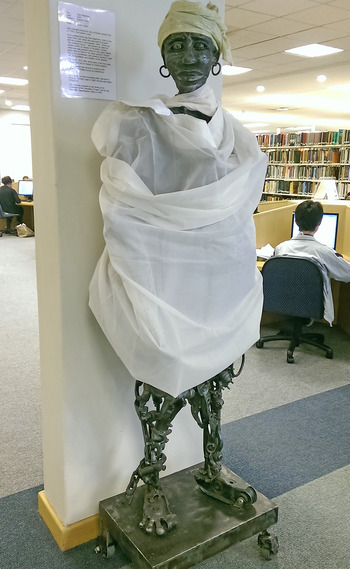
Six African students enact a somber, silent dance. They stage a series of striking images at the base of South African artist Willie Bester's sculpture Sara Baartman, in the Chancellor Oppenheimer Library at the University of Cape Town (UCT). Their faces and bodies smeared with black paint, the students articulate their protest of Sara Baartman in explicitly racial terms, aligning their critiques of economic, colonial, and racial oppression under the sign of blackness.Footnote 1
In March 2015, the students uploaded to the Facebook group “UCT: Rhodes Must Fall” a recording of their theatrical protest.Footnote 2 In a published statement, their spokesperson proclaimed the statue to be evidence of how “the black body has been exoticized and fetishized in a pornographic fashion.”Footnote 3 The sculpture, they asserted, did not do justice to the traumatic legacy of Sara Baartman, a woman from southern Africa who was exhibited in Europe as an ethnological spectacle and whose image has become synonymous with African abjection. The students’ symbolic enactment animated the intersections of several interlocking political crises in South Africa: the persistence of economic and racial inequality well into the postapartheid era, and the attendant unfreedom of the “born-free” generation; the decolonization movement of #RhodesMustFall (#RMF); and, the resurgence of student political action modeled on South Africa's Black Consciousness movement (BCM) of the 1970s.Footnote 4 Their critique interpreted Bester's Sara Baartman as an injurious representation of the black female body, one that perpetuated past violence enacted on her person.
The protests’ emphasis on Baartman's representation—important though it was—overlooked the dense entanglement of Baartman's legacy with performance, theatre, and spectacle. Whenever Sara Baartman is remembered and reassembled, her life, body, and memory remain “a spectacle or theater, the product of dramaturgy,” to borrow Achille Mbembe's phrasing.Footnote 5 Indeed, since her recuperation within the academy in the late 1970s, Sara Baartman has been reanimated in countless theatricalized scenarios.Footnote 6 Her image circulates through proliferating discourses that situate her as a paradigmatic effigy of various historical abuses, ranging from the physical violence enacted upon her person to the epistemic violence of racial and sexual subjugation.Footnote 7 Baartman therefore arrives on the historical stage as a distinctly theatricalized figure of racial injury, insistently appearing in what Saidiya Hartman terms “scenes of subjection.”Footnote 8 Narratives of Sara Baartman's life and afterlives trace a spectacular series of events: her transportation from southern Africa to London in 1810; her display in England and France as the “Hottentot Venus”; her trial before London's Chancery Court to determine whether she was enslaved or free; the circulation of her image throughout Euro-American popular culture; her premature death and the subsequent dissection of her body as a scientific specimen; and many other scenes animating her manifold afterlives. Such traumatic scenes of subjection have been remixed and reassembled in biographies, documentary films, commercial film, theatrical and dance productions, and in numerous pieces of visual and performance art.Footnote 9 Such scenes reanimate historical fragments, attempting to reconstitute Baartman's absent presence. Therefore, reincarnations of Sara Baartman function as what Joseph Roach terms “effigies”—replacement objects that “fill[ ] by means of surrogation a vacancy created by the absence of an original.”Footnote 10 The many racial effigies of Sara Baartman give materiality to the ubiquitous but often invisible residuum of historical traumas visited on Baartman and, metonymically, on colonized and racialized persons of Africa and the black diaspora.
The 2015 UCT protest of Sara Baartman conflated these many historical traumas as singularly “black.” Yet, we might wonder, when do such effigies do justice to histories of violence, and when do they reify past traumas? When Sara Baartman reappears on the historical stage, whose histories and whose memories are effigied, or “bodied forth”?Footnote 11 Considering the 2015 UCT protest of Sara Baartman as an injurious representation of blackness, what racial traumas do her many effigies reanimate and/or redress?
As a polyvalent assemblage of racial effigies, Sara Baartman both is and is not black. Despite her broadly circulated figurations as a symbol of black female subjection, many different racial groups claim Baartman as a symbol of their traumatic pasts, troubling the determinacy of claims to her racial belonging. She is variably reanimated as Coloured, “Hottentot,” Khoekhoe, Khoisan, African, brown, and black.Footnote 12 The charged racial complexities haunting Sara Baartman, staged in spectacular scenes of her subjection, are densely imbricated with performance. Her manifold racial identities and identifications are bodied forth across many racial effigies.Footnote 13 The pervasive figuration of Sara Baartman as determinately black animates the fraught contiguities between racialization and pain. Simultaneously, contention over Baartman's racial identity marks the manifold ways that blackness can subject nonwhite others within the shifting racial orders of global modernity. Engaged through her many racial effigies, which extend from her 1810 exhibition in London through the 2015 UCT student protest of her likeness, Baartman figures as a charged locus for historical traumas of global white supremacy, a shared legacy violently obscured by contestations over her racial belonging. These entangled histories of trauma invite a reassessment of political claims to blackness and injury on a global scale.
Transoceanic Scenes of Subjection
Sara Baartman's voice is absent from the archive, which does not offer any account authored by her hand. Nor could Baartman's body, mutilated postmortem in the name of nineteenth-century racial positivism, provide any racial “truth.” Rather, Baartman's sole “speech” reaches us through the mediations of white ventriloquizers—an interview conducted with Baartman through two Dutch interpreters, transcribed in official reports and the London press during the 1810 trial investigating her potential slave status in postabolition Britain.Footnote 14 These early inscriptions position Baartman as the subject of interest, discursively and theatrically represented, claimed and constructed from the outside. In the absence of any evidence of Baartman's speech, others fashion effigies that speak for and through her silent, iconic figure.
These scenes of subjection reanimate Baartman within three prevailing metanarratives:
-
1. A scene of enslavement, failed emancipation, and the unfreedom of racial injury. Enter Sara Baartman, an African woman transported to London where she appears in an ethnological display of her African difference. Antislavery activists mobilize the writ of habeas corpus to obtain her freedom.Footnote 15 The magistrate presiding over the case proclaimed its purpose: “The object of the Court is … to ascertain how far the exhibition gives her pain as a sentient being.”Footnote 16 The scene is a struggle over possession of her body, staged between her exhibitors and antislavery activists—a scene of antagonism that echoes the meaning of habeas corpus: “you shall have the body.” Who shall have her body? Can her body ever be free, or free of pain?
-
2. A scene of subjection to Western science and its apparatuses of epistemic violence. An African woman displayed in public in England and France as the “Hottentot Venus” fascinates the European public. She stands in for exotic and erotic Africa, marked by the difference of darkness, her relatively large posterior, and rumors about her unusual genitalia. She dies in Paris, where Napoleon's surgeon dissects her body in the name of scientific knowledge. A French museum displays her remains until 1982, extending her ethnological exhibition nearly 170 years after her death.Footnote 17 Baartman's subjection to the apparatuses of white, Western science produce spectacular knowledge of her postmortem body. Who shall have and produce knowledge of her body? What violence does such knowledge produce?
-
3. A scene of subjection and tenuous redemption. European colonialisms decimate the Khoekhoe, known during this period as “Hottentots.” They survive on the margins of South African society during apartheid and through the postapartheid era. Under apartheid, the Khoekhoe were classified as “Coloured,” a racial group comprising the formerly enslaved and indentured peoples of South Africa. A movement forms to repatriate the remains of a Khoekhoe woman, Sara Baartman, to her homeland in the Eastern Cape. She becomes a symbol of South African national healing, Coloured racial redemption, and Khoekhoe ethnic reparation. In 2002, her remains are reinterred at a memorial site in Hankey, South Africa. Where does she belong? What group(s) may claim her belonging? Whose injuries does her repatriation redress?
Many of the dramaturgical roles that Baartman embodies remain constant across these scenes: she is an African woman; she is repeatedly silenced and spoken for; and she is a contested figure and a paradigmatic subject of colonization, enslavement, racialization, sexualization, and objectification. Yet, Sara Baartman's racial identity eludes any singular claim or identification. Though the London exhibition of the “Hottentot Venus” presented Baartman as “a most correct and perfect Specimen of that race of people,” it remains unclear what “race of people” Baartman bodies forth.Footnote 18 African? Khoekhoe (i.e., “Hottentot”)? Coloured? Black?
The enduring confusion over Sara Baartman's racial identity generates ongoing political contestations over claims to her racial belonging and racial injuries. To an audience in the Global North, such competing claims are likely confusing as she appears throughout US American scholarly literature as axiomatically black, animated primary through the first two scenes of her enslavement and her subjection by Western science.Footnote 19 Two texts exemplify the academic inscriptions of Baartman's blackness: Sander L. Gilman's “Black Bodies, White Bodies” and Hershini Bhana Young's Haunting Capital.Footnote 20
In Gilman's landmark essay, Baartman's subjection to Western science and its apparatus of epistemic violence positioned Baartman as the paradigmatic black female body within the Euro-American white–black racial binary. Gilman famously claims, “Sara Baartman's sexual parts, her genitalia and her buttocks, serve as the central image for the black female throughout the nineteenth century.”Footnote 21 As Zine Magubane observes, Gilman's figuration of Baartman circulates widely through poststructuralist racial discourses, which often take Baartman as an archetypal figure of the racial trauma enacted at the violent intersections of dominant forces of white supremacy, patriarchy, colonization, enslavement, and Western science.Footnote 22 Gilman's essay and its broad circulation generate an indexical Sara Baartman, which functions as the effigy of black female subjection.Footnote 23 Ironically, in this figuration, the social construction of Baartman's blackness—and the blackness of her historical injuries—becomes absolute.
In Young's Haunting Capital, this indexical Sara Baartman reappears. Young traces the circulation of the suffering black body beyond the circuits of the triangular trade, enlisting Baartman as a transhistorical diasporic symbol of the “underrecognized injury of the black body.”Footnote 24 Baartman acts as the ghostly link between transatlantic scenes of subjection, the common tissue connecting African diasporas and transnational blacknesses.Footnote 25 The figure of Sara Baartman stands in for a genealogy of racial injury in which Baartman's body and black female pain collapse into each other. Following Gilman, Young situates nineteenth-century French discourse on “Hottentot” sexuality adjacent to the sexual violence performed on captive black women in Europe and the United States. Though intended as a gesture of solidarity, this framing compresses the manifold violences on nonwhite women in the circum-Atlantic world into a singular icon of black female subjection. Paradoxically, these mobilizations assert, Sara Baartman represents the essence of social constructions of black femininity. Baartman thus becomes a vessel for the pain of black subjects in the present—in Sadiah Qureshi's astute analysis, Baartman has become a “cipher” whose “minimal presence [is] enough” to encapsulate the transhistorical persistence of black pain, particularly that borne by black women.Footnote 26
In such effigies of Baartman as a paradigmatic figure of racial subjection, Baartman becomes black through the iterability of her representation as a symbol of black pain. Baartman insistently manifests what Saidiya Hartman terms “the spectacular character of black suffering.”Footnote 27 Throughout the Global North, scholars and artists reanimate Baartman as a transhistorical embodiment of the “social struggle” of black-and-white racial histories wherein blackness, suffering, and performance become tightly entangled.Footnote 28 Baartman circulates within Euro-American academic discourse as an effigy of blackness and of black injury, demonstrating the durability of the suffering black body as a transhistorical signifier of subjection—a figure circulated through the transatlantic traffics of slavery and its afterlives.Footnote 29 Yet, we might wonder whether and how such traffics continue in the present. When her pained body reappears at sites beyond the black Atlantic world, whose scenes of “social struggle” are (re)staged?
Whereas Baartman may appear axiomatically black within the Global North, the determinacy of Baartman's blackness fractures when approached from the Global South. To wit, Global North theorists often conflate Baartman's exhibition as the “Hottentot Venus” with the later effigies of the “Black Venus” animated by Charles Baudelaire, Josephine Baker, and many others.Footnote 30 In contrast to the collapse between “Hottentot” and “Black” Venuses, it is crucial to remember that the colonialist term “Hottentot” has long functioned as a derogatory signifier for nonblack indigenous peoples, especially the Khoekhoe, whose “yellow” or “brown” skin positioned them in shifting relations with blackness and whiteness. In contrast to present-day genealogies of transhistorical black subjection, Baartman's exhibition as the “Hottentot Venus” enacted a spectacle of the exoticism of the Khoekhoe people, a scene of racial injury effaced by emphasis on Baartman's blackness. Thus, claims to Baartman as singularly black perpetuate a global disparity in power in which racial theories from the Global North overwrite local social relations in the Global South, occluding particular histories, social formations, and racial injuries.Footnote 31
If we consider Baartman's exhibition as a scene of Khoekhoe subjection, other genealogies of racial injury, colonial violence, and abusive labor practices become apparent. In the Cape Colony, the racial subjections of nonwhite peoples into colonial social orders and exploitative capitalist systems of labor—namely, slavery and indenture—were not strictly black and white affairs. Rather, Cape slavery and indentured servitude centered on the Indian Ocean, conscripting captive laborers from the Indian subcontinent, Southeast Asia, Indonesia, and Mauritius.Footnote 32 In addition to the Cape Malay slaves who were brought to the colony from the Indian Ocean littoral, the Dutch and British slave trades also transported captive black Africans from Angola, Mozambique, and Madagascar to the Cape.Footnote 33 Simultaneously, seventeenth- and eighteenth-century Dutch colonists inflicted genocidal violence on the indigenous Khoekhoe, with colonial raiding parties massacring Khoekhoe beyond the colonial frontier.Footnote 34 The surviving Khoekhoe were incorporated into the exploitative inboek (peonage) labor system within the colony, which established forms of indentured labor in which the white colonists subjected the Khoekhoe through colonial projects to discipline them into “civilisation.”Footnote 35 Through generations of cohabitation under structures of enslavement, indenture, and postemancipation racialized labor systems, these various peoples—Cape Malay, Khoekhoe, captive and free blacks—formed a single racial category designated as “Coloured” under colonial and apartheid regimes; this category also enfolded many nonblack indigenous peoples.Footnote 36 The South African Coloured communities inhabit an uneasy racial status in South Africa, where they are doubly marginalized—they remain, per Mohamed Adhikari, “[n]ot white enough, not black enough.”Footnote 37 Though white colonial projects subjected black, Coloured, and Khoekhoe peoples to similar processes of racialization and colonial violence, these peoples and their historical oppressions were not the same.
South African author and theorist Zoë Wicomb differentiates these racial categories—black and Coloured—by analyzing how the “terms of injury” and the affect of “shame” relate to Baartman's representation.Footnote 38 For Wicomb, Baartman's dominant function as a “black woman as icon of concupiscence” engages a discourse on black injury; in contrast, Wicomb traces how Baartman's ambivalent signification of “[C]olouredness” and its associations with miscegenation within the black–white racial binary also marks Coloured identity as the bearer of racialized shame.Footnote 39 In contrast to political claims of determinate racial identities, Wicomb demonstrates how Baartman may be understood to be black and Khoekhoe and Coloured, with significantly different racializations—and particular racial traumas—attending upon each racial belonging. Though the South African BCM of the 1970s asserted that nonwhite peoples shared oppressions in common, the similarities between such historical injuries cannot be retroactively made identical without reperforming the epistemic violence of effacement.Footnote 40 Moreover, in the postapartheid era, the cohesion of nonwhite peoples under the signifier of “black” solidarity has fractured. South Africa's nonblack, nonwhite subjects have contested the alignment of nonwhite peoples as “black.” Claims to “black” solidarity are tenuously bound to their reperformance in the present. The efficacy and justice of such solidarities depends on whose racial claims—and whose racial injuries—are disavowed in the name of politicized “black” identity.Footnote 41 Contemporary South African mobilizations of solidarity under the sign of Black Consciousness raise pressing questions. Who may claim solidarity with whom? On what terms? At what epistemic costs?
The particular histories of Khoekhoe and Coloured subjection and the crucial linkages between Coloured captivity and Khoekhoe indenture remain, for the most part, forgotten. These forgettings are exacerbated by the globalizing dominance of racial projects that reproduce the black–white binary. The enduring racial affects and effects of their colonial subjection—injury, shame, and ressentiment—trace an entanglement that cannot be reduced to “black pain.” Here, entanglement signifies what Sarah Nuttall calls “a condition of being twisted together or entwined, involved with; it speaks of an intimacy gained, even if it was resisted, or ignored or uninvited.”Footnote 42 Recuperating the entanglements of Khoekhoe, Coloured, and black histories uncovers the oft-ignored intimacies of racial and colonial violence that link several scenes of subjection. These entangled histories constitute, in Rey Chow's terms, “the linkages and enmeshments that keep things apart; the voidings and uncoverings that hold things together.”Footnote 43 Baartman's legacy remains bound up in the interlaced historical threads of colonization and enslavement. Thus, Baartman's many racial effigies do not signify any singular racial trauma but rather body forth multiple racial injuries across manifold scenes of subjection, past and present, that give the lie to exclusive claims about her racial belonging.
Sara Baartman and the Stigmatic Cut
Despite the entanglement of Baartman's manifold racial histories and traumas, in contemporary discourse, Baartman insistently reappears as “black.” Yet, neither Sara Baartman nor her pain were strictly black; rather, she was a figure onto whom social discourses about blackness, femininity, and injury were inscribed. Such inscriptions were not merely effected through textual discourses, but were staged theatrically across repeated scenes that performatively forged Baartman as black.
The performativity of Baartman's blackness may be traced to her ethnological display in London in 1810, where we may apprehend how Sara Baartman becomes black. Baartman's blackness was not an ontological given—an essential biological fact of skin, hair, and bone, readily apparent to her gawking spectators. Crucially, Baartman was never exhibited nude before the public; rather, her blackness was performed into being.Footnote 44 Baartman's body was tactfully concealed from her audience, eliciting the white audience's imagination of her corporeality—and of her flesh, its shape, and its color. As noted in affidavits in the Chancery Court trial regarding her display in London, Baartman was
cloathed in a dress resembling her complexion which is very dark and her dress was so tight that her shapes above and the enormous size of her posterior parts are as visible as if the said female were naked and the dress is evidently intended to give the appearance of her being undressed.Footnote 45
Neither was her face revealed; instead, it was painted in a fashion alluding to early travel writings on the Khoekhoe, though “exaggerated almost to the point of becoming a mask” (Fig. 1).Footnote 46 Baartman's black face paint summons other theatrical resonances, namely the blackface mask.Footnote 47 Exaggerated and blackened, the mask appears as a liminal theatrical device, neither–nor yet both–and a Khoekhoe traditional mask and a blackface mask. It appeared simultaneously as what Richard Schechner might call not a Khoekhoe mask yet not-not a Khoekhoe mask; not a blackface mask, yet not-not a blackface mask.Footnote 48 The theatricality of Baartman's display presented her as an effigy of phantasmatically indeterminate “race”—potentially both–and yet neither–nor a “Hottentot” and a “black” woman in the audience's imagination. Her body concealed and her face masked in black face paint, the ethnological exhibition of Baartman was carefully stage-managed theatre; her racial identity, a painstakingly fashioned dramaturgy.
Frederick Christian Lewis's advertisement for “Saartjee, The Hottentot Venus” at Piccadilly Circus, London. Published 14 March 1811, by S. Baartman. Source: Lewis Delin et. Sculp. 1811. “Saartjee, The Hottentot Venus.” In Lysons, Daniel. Collectanea. © British Library Board. c.103.k.11 vol. 1, part 2, p. 104.

The exhibition deployed familiar theatrical techniques of appearance and disappearance, revelation and concealment to entice and to fascinate British and French spectators. Though several European writers refer to her face as “very dark,” they also describe her skin tone as “yellowish-brown,” which signified her racial status as a “Hottentot” rather than a black “Negro.”Footnote 49 The discrepancy suggests how Baartman's mask and costuming invited spectators, who did not see Baartman's body, to imagine her as “black.” Later imaginations and representations of Baartman as “black” were always already premised on the slippage between her putatively “real” racial markings and her theatrical representation within a crafted mise-en-scène.
In Paris in 1815, the connection between spectatorial hermeneutics and the corporeality of blackness recurred. A French spectator of Baartman's Paris exhibition interpreted her black Khoekhoe face paint as cicatrices, or scars:
Ah! Messieurs quelle terrible Vénus! … elle a une figure plate et carrée, et d'horribles cicatrices sur la joue, faite avec de la poudre à canon, en forme d'enjolivements.
[Ah! Sirs, what a terrible Venus! … she has a flat and square face, and horrible scars on her cheek, done over with cannon powder to embellish them.]Footnote 50
Playing on the polyvalence of the “terrible Venus” as simultaneously terrifying and terrific, the reviewer's ironic tone effects several inversions. Paradigmatically, the white powder makeup [poudre] of a classical “Venus” transforms into black cannon powder [poudre à canon] that masks the visage of the “Hottentot Venus.” In this account, Baartman's yellowish-brown skin becomes black, her black mask becomes a lattice of black scars; Baartman becomes black insofar as her flesh appears to be scarred, her “black” skin taken to be a skein of wounds.Footnote 51
This confusion of artifice for reality makes apparent the conflation between Baartman's physical body and her indexical black body that, in Harvey Young's terms, “shadows or doubles the real one.”Footnote 52 The virtual tissue limning these two bodies is a scar—both a stigma and a cut inscribing blackness and social injury through the white imagination of a physical wound. As Erving Goffman notes, the concept of a “stigma” derives from an ancient Greek practice of marking bodies as different:
stigma … refer[s] to bodily signs designed to expose something unusual and bad about the moral status of the signifier. The signs were cut or burnt into the body and advertised that the bearer was a slave, a criminal, or a traitor—a blemished person, ritually polluted, to be avoided, especially in public places.Footnote 53
As Goffman theorizes, the “stigma” has transformed from literal scarification into a mark of social differentiation, in which those individuals marked by a stigma take on a virtual “spoiled identity” of “undesired differentness.”Footnote 54 To white audiences entranced by her terrific and terrifying presence, Baartman appeared as the tantalizing opposite of a desirable Venus, manifesting instead a “terrible Venus” unfit for white desires. In this libidinal economy of racialization, Baartman's skin becomes a scar demarcating her as absolutely not white, not beautiful, not worthy of desire. Put differently, Baartman becomes black through the white imagination of her body as scarred, cut, wounded, injured.
Indeed, postmortem, the white imagination of Baartman's body as cut would be performed in actuality, as her body was dissected in the production of Western scientific knowledge. Baartman's racialization as black occurs through the entanglement of scars, imagined and corporeal. Therefore, the fact of Baartman's blackness is performative, iterated recursively through a hail of cuts. Baartman's blackness materializes what Fred Moten terms “the massive discourse of the cut,” in which the “cut” figures both as a traumatic wound and a condition of possibility.Footnote 55 Moten theorizes the “cut” as a line of flight immanent in blackness whereby he recuperates the gaps—or “breaks”—between discursive binaries that historically have overdetermined blackness. Centrally, Moten responds to Hartman's theorization of “scenes of subjection” by returning to another “terrible spectacle”—the “horrible exhibition” of violence enacted on Frederick Douglass's Aunt Hester.Footnote 56 Moten's return to this violent enactment—and to Hartman's refusal to reproduce it in her text—traces the paradoxical persistence of such scenes, to their insistent return despite repeated repressions, and to the ongoing reproduction of such traumatic spectacles. Critically, through the “cut,” Moten traces the ontology of black performance through the imbrication of reproduction and disappearance, asserting that black performance cannot but disappear and reproduce itself at the same time.Footnote 57 In summoning Moten alongside Sara Baartman, however, I want to complicate the categories of “reproduction” and “disappearance,” particularly insofar as they figure in relation to performances of racialization and the “cut.” If black performance reproduces blackness while simultaneously making it disappear, then what else disappears with the performance? If the “cut” of blackness is always already a “sexual ‘cut’” that restores a maternal link to material kinship, then is the mother figure of black injury (i.e., Sara Baartman) necessarily black herself?Footnote 58 Or, might Baartman's blackness be (re)produced through the disappearance of her other racial histories, their particular wounds, and their affective matrices?
It is in this disjuncture between performance's reproduction and disappearance—wherein what is reproduced is not necessarily what disappears—that we may apprehend Baartman's blackness as a paradigmatic materialization of social constructions of “race.” Though the stigmatic cut performs Baartman's blackness into being, the discursive cut that marks Baartman as black also severs her from the racial matrices of Khoekhoe-ness and Coloured-ness, both of which are haunted by historical injuries of racialization and attendant after-affects. In their reproduction of Baartman's blackness, contemporary scholars and artists perform a cut that cuts more than one way—it rends open a pained space as a condition for the possibilities of black agency in theory and practice; yet, it also cleaves Baartman from her other significations and from other claims to her racial iconicity. Lacking any evidence of Baartman's experience of her own pain, her likeness serves as a medium for racial injuries. She becomes the injured racial body, her injuries taken as undeniably black through reiterated acts of interpretation that insist upon the blackness of her pain. How might we apprehend Baartman's Khoekhoe pain as irreducible to black pain? With these questions in mind, let us return to the 2015 student protest of Willie Bester's Sara Baartman at the University of Cape Town.
Sara Baartman Must Fall?
“Black Pain Matters Too.”Footnote 59 In the early months of 2015, students participating in the #RhodesMustFall (#RMF) campaign at the University of Cape Town (UCT) articulated this claim in protest of the persistent racial injuries and unfreedoms endemic to postapartheid South Africa.Footnote 60 The claim “Black Pain Matters” aligned #RMF with Steve Biko's 1970s South African BCM, pan-African struggles for decolonization, and the contemporary US American #BlackLivesMatter (#blm) movement.Footnote 61 #RhodesMustFall traced the intersections among global processes of antiblack racism, institutional discriminations against nonwhite UCT students, and postapartheid entrenchments of racialized economic inequalities. Centrally, the #RMF student protests performed black solidarity through public actions against a statue of white supremacist and colonialist Cecil John Rhodes on the UCT campus. However, the statue of Cecil John Rhodes was not the only object of the #RMF protests. UCT students also staged their resistance against endemic modes of unfreedom by protesting the installation of Bester's Sara Baartman sculpture.
The Sara Baartman protest performance was recorded on video and disseminated on Facebook.Footnote 62 In the video, six nonwhite UCT students—three male and three female—march stoically up the alabaster steps and into the UCT library, moving deliberately past the registration desk and to the Sara Baartman installation. Their bodies, smeared with black paint and clothed only in spare white fabrics and metal chains, summon a singular conception of “blackness” metonymically linked to the enslavement of markedly blackened bodies. The three women kneel in front of the Sara Baartman sculpture; they bow their heads to the ground, their wrists crossed above their heads as though they were shackled. A solo male performer rises to the front, thrusting his clenched fists, in a controlled yet violent motion, in toward his own torso. He paces among his three female coperformers, stopping to enact theatrical violence against each of them. He grasps a long metal chain, wrapping it first around his legs and then his neck before collapsing to the ground, signifying his strangulation by an external force.Footnote 63 The students conclude their protest by concealing Bester's effigy of Sara Baartman in white fabrics as a refusal of his right to represent her (Fig. 2).
Willie Bester's Sara Baartman sculpture after the #RMF protest performance. The photograph was taken on 10 October 2015. Source: Photo courtesy of AbdulRauf Adediran.

Many viewers of the performance on the UCT: Rhodes Must Fall Facebook page expressed their approbation: the video was viewed more than sixteen thousand times, received nearly six hundred Likes, and was shared over two hundred times. Tellingly, one viewer attempted to enter the video into the intercultural performance art canon, tagging it: “@Coco Fusco.”Footnote 64 Meanwhile, several commenters expressed confusion, wondering whether the students were protesting the sculpture as other #RMF participants had protested the Rhodes statue. For instance, Motlalepula Phukubje explained that the sculpture gave her pride since Bester, who was categorized as Coloured under apartheid, had fashioned an artwork that commented critically upon the sexualization and objectification of Baartman.Footnote 65 She wrote,
People have a problem with the piece which isn't even that explicit since it is made out of scrap metal pieces but meanwhile on their cellphones are naked women. I just dont get it maybe someone can explain to me.Footnote 66
Commenter Sipho L'Avenir Pamla responded the next day to affirm the #RMF movement's black solidarity:
We're emancipating ourselves. We are mourning and dealing with centuries of slavery and we see it fit to take such action. You don't get it? That's okay. Have a cup of tea and take a seat. Several if you will. It is not for you.Footnote 67
Pamla's allusions to emancipation and slavery attest to the legibility of transatlantic black injury as well as to the exclusionary claim to such racial injury: “It is not for you.” Phukubje responded quickly, affirming her own blackness as well as her support of black solidarity while reiterating her critique:
i am a hundred percent behind the emancipation of the black man, I was asking that someone take their time to explain to me why the piece is offensive because I am black, I am for radical change I love my race but I am not offended by willie bester's work.Footnote 68
Though the commenters enunciated contrasting interpretations of the statue, they both evinced clear positions of political agreement: they were both black; for both of them, the “black man” remains enslaved and must be emancipated; and, for both, Sara Baartman remains a paradigmatic figure of black abjection. Thus, both commenters begged the question of Baartman's racial identity, assuming her to be unquestionably black.
Other commenters expressed such confusion about the role of blackness in the performance, questioning the black paint adorning the performers’ bodies. One conversation aptly summarized the debate:
Chase Rhys: very serious question to the actors/conceptualizers—why did you darken your skin?Footnote 69
Sipho L'Avenir Pamla: I am not a contributing artist, but I imagine it was intended to emphasize that this is a ‘black thing’.Footnote 70
Chase Rhys: what do you mean by this is a “black thing”? I understand the whole movement right now includes all non-white races as Black. but THIS piece specifically is about a Khoi woman—a brown woman—the performers are black, theres no need to “emphasize” their blackness—their natural skin colour is suffice and would have been aesthetically appropriate and more accurate. and I need to hear their explanation for painting their skin black for this piece.Footnote 71
Rhys criticized the performers for a central gesture of their performance of black solidarity: blackening their brown skin and thus masking Baartman's Khoekhoe and Coloured identities. Rhys named the epistemic violence performed by solidarities that require the disavowal of one mode of identification (i.e., Khoekhoe) in order to align oneself with a broader identity (i.e., blackness), an exchange and substitution that necessarily forgets and forgoes the complexities of entangled racial histories. Commenter Adedoyin Kifler Kassim was more direct in his critique, asking, “did they just paint them selves black with ash to look all bamboozooled”?Footnote 72 Citing Spike Lee's 2000 film, Bamboozled, Kassim identified the specter of spectacular blackface performance haunting both the 2015 #RMF protest and Baartman's ethnological display via her “not-not” blackface mask. Because of the performers’ application of black paint on their faces and bodies, the protest's emphasis on “blackness” was apparent, though its political intents were not. Moreover, Kassim's association of the performance with Bamboozled signals the potential for the #RMF protest to (re)spectacularize black pain. As Rhys noted, the piece raised questions about Baartman's racial identities as well as the purpose of the protest; these questions were unresolved for some spectators.
Perhaps in response to the social-media confusion, the #RMF protestors published a written explanation of their performance:
We reject her presentation in the library, we reject that her standing naked commemorates her and retains her dignity. Further we see no difference in the racist, sexist methods used by the French and British in the freak show attraction than her presentation in the UCT Oppenheimer library. … There are Particular ways in which Saartjie Baartmans spirit and legacy can be contextualised and respected. Thus in our climactic end we Draped her and covered her hoping to show these violence's inflicted on the black body and psychology still continue and we will not stop until we decolonise the black body and mind! Footnote 73
Ernie Koela, acting as spokesperson for the performance, emphasized Baartman's blackness without addressing other claims to her racial belonging. Koela did not respond to questions of blackface in the protest, instead insisting on Baartman's blackness and her function as an effigy of injuries “inflicted on the black body and psychology.” To the protestors, the sculpture summons Baartman-as-abject, wounded by the imperialist and scientific gazes of the West as well as the racial traumas of transatlantic slavery. Protesting such discursive violence, the students concluded their performance by wrapping Sara Baartman in white fabric, concealing the “black body” from view.
The performance explicitly gendered the students’ articulation of black redemption, entangling their protest of black pain with the masculine defense of the ostensibly vulnerable female “black body.” In the protest's concluding scene, a nonwhite South African male resisted colonization of “the black body” by cloaking Baartman's figure in modest attire, thereby making the appropriate public appearance of Baartman the primary grounds of their political contest.Footnote 74 Koela's invocation of “dignity” and “respect,” in addition to the emphasis on the inanimate sculpture's “naked”-ness, summoned a logic of gender and class respectability. The protestors’ theatrical “re-fashioning” of Baartman by a “black” South African male unwittingly risked restaging a central scene of Baartman's subjection, in which a “free black” man from the Cape Colony, Hendrik Cesars, acted as stage manager and master of ceremonies for Baartman's display in London.Footnote 75 In 2015, as in 1810, a redemptive (post)colonial masculinity spoke for a passive female figure and costumed her displayed body. Ironically, the protestors’ reclamation of Sara Baartman inscribed her within yet another of what Patricia Hill Collins terms “controlling images” of racialized representation: they asserted the respectability of black femininity insofar as the “black woman” appears as a desexualized matriarch adorned with a doek (headscarf).Footnote 76 The UCT student protest therefore did not oppose any and all effigies of Baartman but rather some allegedly disrespectful representations of her. The protestors proclaimed the sculpture undesirable not because it was black—which it is not—but rather because, in their estimation, it symbolized blackness as simultaneously injured and injurious, as both a manifestation of racial trauma and a traumatizing object.Footnote 77
The performance evoked the historical wounds visited on black(ened) bodies, turning to a circum-Atlantic imaginary that articulates racial identities and injuries in black and white. However, the protest's claim to Baartman as a paradigmatic symbol of black pain reperformed an iterative “exscription” that writes out of history the peoples, identities, and traumas that exceed the binary terms of white supremacy and black injury.Footnote 78 The protest apparently could not identify—nor identify with—racial traumas visited on nonblack bodies. Though the #RMF protest performance against Bester's Sara Baartman claimed Baartman as a representative figure of the injured black body, it also effaced Baartman's polyvalent racialization in South Africa as black, Khoekhoe, and Coloured. In South Africa, “Black Pain Matters Too,” a resistant claim of #RhodesMustFall, does not merely oppose the dominance of white supremacy. The claim simultaneously prioritizes black pain over the injuries of oppression borne by South Africa's many racial groups, perpetuating the opacity of South Africa's historical formations of enslavement, colonial violence, and subjection, and marking the tenuousness of oppositional politics drawn in black and white.
Moreover, the protestors failed to interrogate their own investment in the conflation between blackness and injury—a collapse between “race” and politics of ressentiment that entrenches globalizing neoliberal identity politics and masks South African racial histories that exceed the black–white binary. The protests name blackness as what Wendy Brown terms a “state of injury,” thereby “fix[ing] the identities of the injured and the injuring as social positions, and codif[ying] as well the meanings of their actions against all possibilities of indeterminacy, ambiguity, and struggle for resignification or repositioning.”Footnote 79 The #RMF claim to Baartman as black fixes blackness as the marker of her racial injury, asserting blackness, Coloured-ness, and Khoekhoe-ness as mutually exclusive. With cruel irony, this contemporary scene of Sara Baartman's subjection stages the complexities of South African racial histories, the entanglements of different racial injuries, and the inscription of blackness as the dominant marker of racialized pain. The student protest articulated an awareness of the potential for black art to wound and for traumatic scenes to repeat ad infinitum; yet, the protestors apparently lacked any investment in the potentials for art to heal and to transform. Rather, they attempted to remake the sculpture into a respectable representation by concealing its “naked” form.
Still, Sara Baartman is not merely a representation, injurious or otherwise. It is a physical effigy, a material thing, and it warrants consideration as such. Bester's Sara Baartman is a study in the materialization of irony, made manifest in its assemblage of scrap-iron parts that reconstitute Baartman's body.Footnote 80 Bester—who says, “I don't accept the word ‘coloured’. … I feel better when someone refers to me as ‘so-called’”Footnote 81 —intended his Sara Baartman sculpture “to raise consciousness about the dehumanizing aspects of South African colonial history,” which imposed particular violence on the Khoekhoe population and forged the racial orders governing Coloured-ness.Footnote 82 Installed in the shadow of the library's Science and Engineering section, Sara Baartman acts as a protest against Baartman's dismemberment in the name of Western science, standing as a defiant reminder of the violent, dehumanizing potential of Western apparatuses of knowledge. Indeed, the sculpture directly references the infamous plaster cast of Baartman's body, which remained on public display in Paris's Musée de l'Homme until the 1970s. However, rather than mimetically reproducing “Sara,” as many Baartman effigies attempt, Bester's Sara Baartman stands an exaggerated six feet in height, looming over the foyer. This Baartman, in her obvious constructedness, confounds claims to her “natural” and essential being. As Janell Hobson notes, the sculpture is a posthuman assemblage of parts that reanimates both Baartman and the proliferating discourses on her, giving the lie to their claims of wholeness.Footnote 83 Thus, the Baartman sculpture bodies forth several effigies of Sara Baartman, ranging from a regal “African Queen” to an icon of racial abjection.Footnote 84 The sculpture, in its incompleteness and multiplicity, animates not only Baartman's being but also her perpetual becoming through successive “re-memberings.”
Though the #RMF protest remembers Baartman as black and positions Bester's Sara Baartman as an agent reinjuring and recolonizing the “black body and mind,” Bester's statue also bodies forth Baartman as slyly resistant and racially indeterminate. Bester's Baartman further comments ironically on its precedent effigies through its material construction—as Rosemarie Buikema observes, this “Sara Baartman” is an apparent construction of found objects, each indexing multiple circulations, materials, and bodies that coalesce into her singular form.Footnote 85 Sara Baartman reassembles Sara Baartman in the present as a protest of past abuses, hauntingly incomplete yet enduring in her assemblage of found metal parts. The sculpture is a “maniacally charged” locus, visually and materially re-membering Baartman in the present by channeling manifold memories of her histories and figurations.Footnote 86 Though each encounter with Sara Baartman animates an ephemeral re-membering, the sculpture remains in situ, insistently reproducing and reanimating Baartman.
Crucially, the iron constituting Sara Baartman’s assembled body casts her racialization in doubt. Is she the “yellowish-brown” of the “Hottentot Venus”?Footnote 87 Is she the “black” of the “Black Venus”? Bester's sculpture provokes these questions without offering determinate answers—she may be black, Coloured, or Khoekhoe, or any combination of her potential racial identities. The sculpture allows Baartman to evade the either–or quandaries haunting essentialist racial discourses—she needn't be Khoekhoe, Coloured, or black, for she may be any and all of them as she is re-membered to be. Rather, the sculpture summons histories of Khoekhoe subjection as well as black abjection, bodying forth the oft-forgotten continuities and commonalities of black and nonblack South African injuries under manifold structures of white supremacy. Her “race” does not sediment as a fixed identity, but remains inherently relational, animated indeterminately in encounters between the statue and its spectators.
Sara Baartman reanimates the racially polyvalent “terms of injury” and “shame” that haunt Baartman's representation.Footnote 88 Bester's sculpture transforms Baartman effigies, to borrow Tavia Nyong'o's terms, “from racist kitsch to racial kitsch.”Footnote 89 In other words, Bester reconstructs “Sara Baartman” from a flattened and hardened object of subjection into a complex affective and material thing that might offer many different racialized persons “a way out of scapegoating” through “transformations of [their] shame.”Footnote 90 Bester's sculpture situates Baartman as a figure that slips beyond scapegoating, one that does not identify any particular figures who may be culpable or innocent of Baartman's dehumanization and her attendant mediation of racialized “shame.” Instead, Bester's Sara Baartman bodies forth the entanglements of plural affective histories—of injury, shame, ressentiment—born out of past scenes of subjection and borne by nonwhite bodies in the present. Sara Baartman enlivens these multiplicitous, entangled histories without claiming any singular or essential racial identity, identification, or history in Baartman's name. Ironically, in its performance of racial injuries as densely entangled, the sculpture stages the very work of transracial solidarity to which the student protest aspired. In contrast, the protestors’ claims to black racial pride and dignity—manifest in the white sheet draped across the statue—flattens the statue's materiality and its plural transmissions of meaning behind a singularly white wall of fabric. The protest resists the statue's transformation of racial shame, insisting that Bester's Sara Baartman is merely racist kitsch, an injurious manifestation of black abjection. The whiteness of the white sheet, under the claim of “dignity,” conceals the complexities of southern African racial histories in the name of blackness.
Coda: Sara Baartman, after the Fall
As of April 2017, Bester's Sara Baartman remained in the UCT Library; the fabrics draping the statue had not yet come down. The University of Cape Town, which installed the sculpture in 2002, maintains possession of Sara Baartman; university officials elected not to intervene in the student protest. The UCT Library did not remove the sculpture. Rather, it posted a placard next to Sara Baartman:
UCT Libraries is aware that the Sara Baartman sculpture has been covered. The SRC [Student Representative Council] has indicated that this is an initiative to create awareness around art work [sic] at UCT. (Fig. 3)
Posting at the Chancellor Oppenheimer Library at the University of Cape Town, to the right of Willie Bester's Sara Baartman. Source: Photo courtesy of AbdulRauf Adediran.

Thus, the UCT Library explicitly acknowledges the student protest of Bester's statue in the name of “awareness”—an invitation to “awareness” premised on the concealment of the artwork in question that tacitly authorized and legitimized the protest. In contrast, in May 2016, Willie Bester spoke out against the protest, calling the student action “pure hooliganism.”Footnote 91 However, Bester does not maintain possession of the sculpture, nor can he directly intervene; Sara Baartman is now subject to the university's care. Despite Bester's opposition to the #RMF protest of Sara Baartman, the statue still stands as a polyvalent effigy of Baartman and her legacy. It remains an object of political interest—it has since been re-fashioned by UCT students who have cloaked the statue in a black shawl and a pink doek (headscarf) that conceal the sculpture from view.Footnote 92 These student engagements with the sculpture resituate Sara Baartman in a familiar role—a spectacularized yet silent object, animated from the outside by political contests, ideological debates, and possessive investments.
A final scene to this drama occurred offstage and dallied with the obscene. On 25 April 2015, a month after the UCT Library protest, the plaque memorializing Sara Baartman's grave in Hankey, South Africa, was vandalized with white paint. The gravesite, which has been a public memorial since 2002, remembers Baartman as an ethnically Khoekhoe woman restored to her homeland. No one has been arrested yet for the crime, nor has any party claimed responsibility. Public speculation has sought to place blame on one of two parties: on the #RMF protests for a series of similar paint-based vandalism of apartheid and colonial statuary; or, on unknown white reactionaries acting in retribution.Footnote 93 The potential suspects of the crime were all either black or white, each party having plausible reasons to whitewash Baartman's ancestral gravesite that situates her as determinately Khoekhoe. In the aftermath, Khoekhoe leaders decried the vandalism, claiming that the memorial “brought us dignity.”Footnote 94 The claim of Khoekhoe dignity resonates, echoing the #RMF protestors’ claim that proper representation of Baartman would restore the dignity to the exoticized and eroticized black body. Ethnic dignity and racial injury persistently reappear, braided together in painful entanglements through the spectral presence of Sara Baartman.
Though these contestations over race, injury, and affect may appear to be particular to southern Africa, the protest performance against Sara Baartman and the vandalization of the Baartman memorial in Hankey raise queasy questions regarding racial injuries and the racialization of pain globally. Conflations between black Atlantic slavery and colonial violence facilitate analyses of intersecting oppressions; as Yvette Abrahams asserts, “Sara Bartman's fate becomes a lot easier to understand if one begins from the point of view that she was a slave.”Footnote 95 Similarly, as the #RMF protests attest, Baartman's legacy may be easier to understand if one views her as determinately black. Nevertheless, we should be wary not to allow the temptation of easier claims to lead us to facile understandings. Particularly when racialized images circulate globally via social-media platforms, the interpretation of nonwhite bodies through dominant grids of racial intelligibility is all too easy. Within such instantaneous global circulations, the #RMF protest of Sara Baartman may be easily interpreted as an affirmation of transnational black solidarity; yet, the racial complexities of the statue and the contestations over Baartman's legacy in South Africa trouble such easy global conceptions of racial justice.
As it stands, Sara Baartman indexes yet another series of objectifications and injurious acts, traced through its ongoing subjection to competing political and racial claims. Baartman's gravesite similarly traces the symbolic violence attendant on discordant claims to racial injuries. Considered alongside Baartman's many historical scenes of subjection, these present-day events demonstrate how racial claims to the primacy of some particular pain may also injure others. Moreover, they reperform the mutually exclusive “cut” that severs claims to blackness from other identities, even when such claims are voiced in solidarity. In all, the events surrounding the #RMF protest of Sara Baartman signal the urgency of antiracist solidarities that attend to the plural, entangled histories of injury and oppression.