INTRODUCTION
An important question addressed by researchers of African American representation is whether gains in descriptive representation are offset by losses in substantive representation. Some research finds that creating majority-minority districts can result in less substantive representation for Blacks (Cameron et al., Reference Cameron, Epstein and O'Halloran1996; Overby and Cosgrove, Reference Overby and Cosgrove1996; Lublin Reference Lublin1997). On the other hand, Kenneth Shotts (Reference Shotts2002, Reference Shotts2003) argues that racial redistricting has actually increased the fraction of liberal representatives from the South, producing more liberal national policy outcomes. Others contend that majority-minority districts lead to the articulation of minority interests (Whitby Reference Whitby1997; Canon Reference Canon1999).
To elect more minorities to Congress, majority-minority districts have been created by “packing” some districts with minority voters. Packing has led to the “bleaching” of surrounding districts, and research has found that this process decreases substantive representation for Blacks in two ways. First, these overwhelmingly White districts tend to elect conservative Republican members who are more likely to oppose Black interests in Congress—electoral effects (Cameron et al., Reference Cameron, Epstein and O'Halloran1996; Hill Reference Hill1995; Lublin Reference Lublin1997). And second, returning incumbents, especially Democrats, with fewer Black constituents become less responsive to Black interests—representation effects (Overby and Cosgrove, Reference Overby and Cosgrove1996). Thus, creating majority-minority districts to elect minority members to Congress may produce the undesired side effect of electing a Congress more inclined to vote against minority interests.
We approach, from a different angle than previous research, the question of whether gains in descriptive representation for African Americans result in losses in substantive representation. By looking at how the presence of African Americans has changed Congress over time, we assess the long-term impact of electing more African Americans to Congress on substantive representation. Specifically, we content analyze House floor debates on civil rights legislation, dating back to 1957, first to see if Black members use different arguments than White members when debating civil rights legislation, and second, if there are differences, to see whether Black members have influenced how White members talk about civil rights over time. It is possible that electing more Blacks to Congress will raise the profile of Black policy preferences and increase White members' awareness of these preferences, even as more conservative members are elected. The continuing and increasing presence of Black members may eventually cause White members to vote on and speak about different issues—issues that might never have been raised by non-Black members.
The literature on Black representation has focused on the immediate impact of majority-minority districts on Black interests. Redistricting in 1992 created fifteen new African American majority districts and nine new Hispanic majority districts.Footnote 2 Studies that find a decrease in substantive representation have examined data from the first Congress after the new districts were created. Charles Cameron et al. analyze roll-call data from the 103rd Congress (1993–1994) and conclude that “maximizing the number of minority representatives does not necessarily maximize minority representation, as measured by roll-call voting behavior” (Reference Cameron, Epstein and O'Halloran1996, p. 810). Marvin Overby and Kenneth Cosgrove (Reference Overby and Cosgrove1996) also use data from 1993 to show that returning incumbents who lost Black constituents after 1992 redistricting became less responsive to Black interests. David Lublin (Reference Lublin1997, chapter 6) analyzes data from 1991 to 1993 and argues that majority-minority districts may leave minorities with less influence over members in other districts, and may even lead to the election of more conservative Republicans to Congress. In essence, research has found that creating majority-minority districts to elect minorities to Congress has resulted in immediate losses in substantive representation.
David Canon (Reference Canon1999) uses data that are also primarily from the 103rd Congress. His research challenges the perspective that Blacks are worse off after racial redistricting. He goes beyond roll-call vote analysis to test the impact of Black representatives in Congress by examining floor speeches, bill sponsorship, leadership positions, as well as roll-call votes. His results indicate that Black representatives are more likely to reflect Black interests. This suggests that creating majority-minority districts provides a payoff by increasing the number of individuals in Congress interested in Black issues, who then pursue those interests through a variety of activities.
Our research complements Canon's work by examining the influence of Blacks on floor speeches over a longer time period, focusing specifically on civil rights. We examine the possibility that short-term losses in substantive representation turn into long-term gains. If Black members are able to change debates in Congress, change will most likely occur over a period of years rather than immediately. If the decrease in substantive representation that other researchers have identified is merely a short-term decrease, then increasing the number of Blacks in Congress may be worth the temporary decrease in substantive representation. We ask the question: Are African American members making Congress more responsive to African American interests over time? More specifically, we want to know if the presence of Black members in Congress is changing the behavior of White members. If the answer is yes, then increasing the number of Black members may have a long-term positive impact on how well Congress responds to Black interests. Before we can test if Black members are changing how White members talk about civil rights, we first need to determine if Black and White members use different arguments.
THE INFLUENCE OF COLLEAGUES
Much of the theoretical literature on representation revolves around the extent to which historically disadvantaged groups are represented and how they are represented (Dovi Reference Dovi2002). Virginia Sapiro's (Reference Sapiro1981) reworking of Hannah Pitkin's (Reference Pitkin1969) understanding of descriptive representation led to considerable scholarship arguing that the underrepresentation of women and minorities is problematic for democratic theory (Dovi Reference Dovi2002). Anne Phillips identifies four arguments justifying the need for descriptive representation: (1) minority members are needed to act as role models; (2) minority members provide compensation for past injustices; (3) minority members expand the public policy agenda; and (4) minority members reenergize democracy with the inclusion of new groups (cited in Dovi Reference Dovi2002). However, theorists are equally quick to point out that the diversity within these historically underrepresented groups creates tension over the question of whose interests are actually represented. Some use this ingroup diversity as justification for an all-White or all-male legislature, with the realization that some within the disadvantaged group are better represented by someone outside of the group. This argument, of course, could also be turned on its head to justify an all-minority or all-female legislature.
Much of the extensive literature on representation has looked at dyadic (or direct) representation, where members of Congress are supposed to vote in accordance with the substantive preferences of their constituents. Failure to do so by the representatives indicates a lack of substantive representation for not having expanded the public policy agenda. Studies of minority representation in Congress have also followed in this tradition of looking for dyadic representation, focusing on Blacks and to some extent Hispanics. These studies primarily look for a relationship between the roll-call voting records of members of Congress and the minority composition of their districts. In studies of Black substantive representation, researchers use or develop some index to capture Black interests and to look for some relationship between their interests and the percentage of Blacks or of the Black voting-age population in the district (Cameron et al., Reference Cameron, Epstein and O'Halloran1996). Researchers posit that substantive representation occurs when districts with more minority constituents are represented by legislators who tend to vote in the interests of minorities.
Finding that percentage Black in the district does not have a statistically significant impact on a member's roll-call support for Black interests, however, does not necessarily mean that substantive representation is not occurring. Black and White members may be voting in favor of Black interests, regardless of the size of their minority populations—Blacks may be receiving substantive representation, and the minority composition of the district could be insignificant. Carol Swain (Reference Swain1993, p. 17) found this result among Democrats—White Democrats were equally supportive of Black interests, regardless of the number of Blacks in their districts. There are several possible explanations for why percentage Black in the district does not help explain roll-call support for Black interests. One is that civil rights is an issue on which members' positions are predisposed by their region, party, ideology, or some other variable. A second possible explanation is that Black members of Congress have persuaded many of their White colleagues to support legislation that helps Black communities. A third possible explanation is that the roll-call scores analyzed—for example, Americans for Democratic Action (ADA) scores and Leadership Conference on Civil Rights (LCCR) scores—cover many issues for which there is no significant difference between Black and White interests (Canon Reference Canon1999). According to David Canon (Reference Canon1999), an additional explanation is that there is a selection bias in the roll-call votes examined caused by the limited type of legislation likely to receive a floor vote. Bills on racial issues that are more extreme, on either end of a spectrum, are unlikely ever to make it out of committee (Canon Reference Canon1999, pp. 174–175). Finally, the proportion of bills dedicated to racial issues remains quite small, which precludes roll-call votes from being related to the percentage of Blacks in a district (Canon Reference Canon1999).
Members of Congress face pressure from many sources, with constituencies being just one of many. Another source of influence on members of Congress is their colleagues (Cherryholmes and Shapiro, Reference Cherryholmes and Shapiro1969; Kingdon Reference Kingdon1989). John Bibby quoted one member as saying, “I think that the other members are very influential, and we recognize it. And why are they influential? I think because they have exercised good judgment, have expertise in the area, and know what they are talking about” (Bibby Reference Bibby1983, p. 22). Our research explores how Black members have influenced White members in the area of civil rights. In response to a question on whether women and minorities have influenced Congress, one member says,
Sometimes _______ makes so much sense. She brings to the debate … a dimension that nobody else can bring. And she usually gets people to vote the right way, embarrasses them to vote the right way or at least makes those who vote the wrong way feel bad about it. I'm thrilled at what she's doing. I mean … thank God she's here. Her dealings with minorities, people who are poor…. If she wasn't [here] a lot of the things she brings up wouldn't be touched or said.Footnote 3
The first step in determining if African American members are changing their colleagues is to find if there are differences in behavior between Black and White members. A body of scholarship has taken this step, and our research complements and builds on these previous studies. In her study on African American representation, Swain (Reference Swain1993) concludes that party, rather than race, primarily determined support for Black interests in the 100th Congress. She does not ask, however, if Anglo members have changed as more African American members enter the House. Kenny Whitby (Reference Whitby1997) answers the question, Does the race of the member matter? by using LCCR scores as the dependent variable and regressing it on the party of member, race of member, urban percentage of district, and region of member. Two models are used: one for final-passage votes and the other for amendment votes. Whitby finds that race has period effects, especially for the amendment model. Therefore, race matters most during the amending stage when proposals to gut civil rights bills are more likely to be offered. Lublin (Reference Lublin1997) uses Poole and Rosenthal's NOMINATE scores to test the proposition that Black and Latino members of Congress will act differently than White representatives. He finds that Blacks are the most liberal compared to Northern Democrats, Southern Democrats, and Republicans. Canon (Reference Canon1999) finds that Black members are more likely to pursue Black interests compared to their White colleagues. After examining Poole and Rosenthal's NOMINATE scores and other interest group scores (ADA, ACU, AFL-CIO), Katherine Tate (Reference Tate2003, p. 80) concludes that Black members are more liberal in their voting behavior. She also shows, however, that the opinion of Black members is not monolithic, especially in the areas of trade and crime.
Building from Canon's research, we turn to the broader question of whether the presence of Black members changes the behavior of White members. Karen O'Connor and Jeffrey Segal (Reference O'Connor and Segal1990) pursue a similar objective in their study of the impact of Supreme Court Justice Sandra Day O'Connor on her male colleagues in the Supreme Court on sex discrimination cases. Richard Fox (Reference Fox1997) also investigates how the presence of women in campaigns changes the behavior of their male challengers. Dena Levy et al. (Reference Levy, Tien and Aved2001) analyze House floor debates on the Hyde Amendment to see if women cause men to change the way they talk about abortion. We content analyze House floor debates on civil rights legislation to see if Black and White members use different language and if Black members have altered the debate on civil rights in Congress.
HOUSE FLOOR DEBATE
Few if any congressional scholars argue that members are persuaded during floor debates on controversial or important issues. Woodrow Wilson long ago remarked that Congress on the floor is “Congress on public exhibition, whilst Congress in its committee-rooms is Congress at work” (Reference Wilson1956, p. 69). However, members still consider their floor remarks to be important enough that they reserve the right, if granted permission, to revise and extend their own remarks before they are printed in the Congressional Record. They can correct technical, grammatical, and typographical errors, as well as expand their statements. These changes, however, are distinguished by a different typographical style in the Congressional Record. Floor deliberation allows members to educate other members and the public about the consequences of proposed legislation. It allows members to speak directly to the public (through C-SPAN and the Congressional Record) and to give different descriptions and images of a single policy issue. How an issue is framed can influence the legislative outcome of the issue. Some supporters have tried to frame civil rights legislation as a moral issue, arguing that supporting civil rights legislation is the right thing to do. Some opponents of civil rights legislation have tried to frame the issue as one of reverse discrimination, claiming civil rights legislation discriminates against Whites. Frank Baumgartner and Bryan Jones (Reference Baumgartner and Jones1993) explain the importance of “issue framing” to policy outcomes:
Competing images may emerge from a given set of conditions, especially when policy makers believe that different policy outcomes will follow from different understandings of what the facts mean. So images, or popular and elite understandings of public policies, are an integral part of the political battle. Competing participants attempt to manipulate them to suit their needs
(Baumgartner and Jones, Reference Baumgartner and Jones1993, p. 28).Democratic theorists have also noted the value of debate (see Lynn Sanders Reference Sanders1997 for an exception). Amy Gutmann and Dennis Thompson (Reference Gutmann and Thompson1996) provide four reasons for valuing debate: (1) debate provides more legitimacy to outcomes; (2) it gets participants to consider viewpoints different from their own; (3) it helps define the scope of the disagreement, which may help resolve conflicts; and (4) it also increases the chances of reaching reasonable policy outcomes. According to proponents of deliberative democracy, how “members vote on roll calls may be important, but the words they speak are equally important. Speeches can change debates, agendas, and even preferences” (Canon Reference Canon1999, p. 36). Some researchers have used remarks by senators to help construct ideology measures for the senators (Hill et al., Reference Hill, Hanna and Shafqat1997). In essence, what members say on the House floor is important. Their speeches define the policy issue and inform the public and other members about the consequences of their actions, which ultimately affects legislative outcomes. Speeches provide insight into a member's preferences on any given issue, which otherwise are masked when looking only at a floor vote. Two members may vote the same way on a piece of legislation, but the one who takes the time to speak on the floor about the issue may have a greater degree of interest in it than the one who remains silent (Canon Reference Canon1999).
Rather than rely on voting alone—the typical measure of floor participation—Richard Hall (Reference Hall1996) broadens the measure of floor participation to include the other activities in which a member can engage, such as amending pending legislation and debating on the floor. Hall argues that floor participation reveals the intensity of a legislator's preferences. This is because participation, including debating, is not a costless activity. Members need to be sufficiently informed on a given bill before being willing to speak on the floor. Time and resource constraints are also likely to limit the number of pieces of pending legislation that a member will be sufficiently prepared to talk about. Hence, if a member does participate, it is likely to be on an issue of potentially considerable interest to the member's constituents. This likelihood provides an opportunity to link debate to participation and to representation.
One of the challenges of using roll-call data is that a yea or nay vote does not tell us anything about the relative intensity of Black or White legislators' preferences (Hall Reference Hall1996). Indeed, it is probable that if a Black representative succeeds in changing the behavior of a White representative, this will have occurred at a stage not easily observable. However, willingness to participate on the floor by debating does tell us something about the intensity of the preferences of the participants, which may in turn yield insight into how to effect change among those who are bystanders to the debate.
When members are debating, they are also providing substantive representation. Heinz Eulau and Paul Karps (Reference Eulau, Karps, Eulau and Wahlke1978) astutely point out that substantive representation includes different activities. Members of Congress may respond to constituents in matters of policy, service, allocation, and symbolism. Most studies on substantive representation of minority interests have focused on substantive policy representation (Cameron et al., Reference Cameron, Epstein and O'Halloran1996; Epstein and O'Halloran, Reference Epstein and O'Halloran1999; Hero and Tolbert, Reference Hero and Tolbert1995; Lublin Reference Lublin1997; Welch and Hibbing, Reference Welch and Hibbing1984; Whitby Reference Whitby1997). We build on this previous research by looking at the symbolic aspect of representation. When legislators participate in public debate they are actively participating in representation (Mansbridge Reference Mansbridge1999).
DATA AND METHODS
By examining the behavior of White members over time as the number of Blacks in Congress increases, we empirically test whether the increasing presence of Blacks alters the way Whites talk about civil rights. We selected major federal civil rights legislation to look for the influence of African Americans on the legislative process. Much of the previous research on African American interests in Congress has focused on civil rights. Merle Black (Reference Black1978, p. 440) shows a transformation of White support for civil rights in the South from 1957 to 1975. In analyses of civil rights roll-call votes by nonsouthern Whites, Francine Sanders (Reference Sanders1997) finds that support varies by the perceived costs of the bill to nonsouthern Whites. She also finds that the changing public mood or general ideology of the country has little influence on support for civil rights among Republicans in Congress, but does influence the support for civil rights among nonsouthern Democrats. Civil rights legislation is appropriate legislation to analyze because it covers an issue where there is wide agreement among African American members and constituents. If Blacks are having an impact on issues where they are in wide agreement, then civil rights legislation would be the appropriate place to look for that impact.
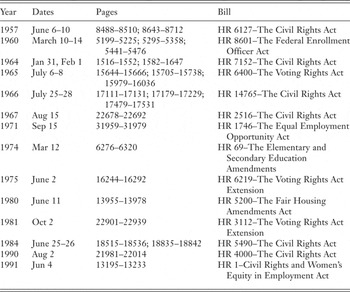
We content analyzed House floor debates on major civil rights legislation from 1957 to 1991. For each year, we selected every debate listed under the heading “Civil Rights” in the annual Congressional Quarterly Almanac.Footnote 4 We analyzed twelve different debates spanning thirty-four years, and made inferences from the debates about the influence of Black members in Congress (see Appendix for a list of bills analyzed). We counted the number of sentences of each member speaking on the floor, and recorded the speaker's name, party, and position on the legislation. We began with eighteen categories both in support of and in opposition to civil rights legislation. We then grouped the eighteen categories based on similar themes, which left us with five broad categories of arguments: moral, constitutional, placating, systemic, and legal. Sentences were coded into one of these categories, if appropriate. Short sentences (two- or three-word sentences) and other sentences that could not be appropriately placed into one of the five categories were not coded.
Members making moral arguments in support of civil rights legislation argued for the need to provide all citizens with equality and justice, that the time had come for civil rights, that it was necessary to fight intentional discrimination, and that civil rights was important for the United States' leadership role in the international community. In contrast, members who used moral arguments to oppose civil rights legislation emphasized the individual's right to freedom of expression, and that it was inappropriate for Congress to respond to public riots and demonstrations with legislation. Members making constitutional arguments in support of civil rights legislation argued it was appropriate for the federal government to intervene in the area of civil rights, whereas their opponents argued strongly for constitutional integrity and against central governmental interference. Members from both sides used placating arguments by claiming the impact of the legislation would be minimal and asking for forbearance from the other side. For example, supporters of civil rights legislation would say, “This bill only represents a basic minimum,” whereas opponents would agree that while legislation might be necessary, the specific bill on the floor was not the answer to societal problems. Members on both sides of the debates also used systemic arguments that claimed civil rights would best be addressed by fixing economic problems plaguing the nation and ending the breakdown of the family. Finally, members in support of civil rights legislation drew on legal arguments, claiming new laws were necessary to fix societal problems; while members opposed to the legislation claimed such laws already existed and creating new laws would only benefit lawyers.
Several issues must be dealt with when using content analysis. One of the most important issues for content analysis is content validity, and another is intercoder reliability. How do we know that we are actually measuring what we claim to be measuring? We evaluated our data for face validity and hypothesis validity. Face validity is a comparatively weak measure of validity, but it is necessary to establish. It essentially means that our categories appear to measure the concepts we are trying to measure. Hypothesis validity is more difficult to establish, as it requires that the measured variables are related to other measured variables as hypothesized (Weber Reference Weber1990).
We believe our categories have face validity because the sentences we coded in each category appear to be capturing that concept. Some examples help illustrate our coding schema and its validity. The following sentence was coded as a moral argument in opposition to civil rights legislation: “While the pattern of southern living has been segregated, there has nevertheless been mutual understanding of and respect for the problem of each race on the part of the other” (Elliot Reference Elliot1957, p. 8676). In contrast, the following sentence was coded as a legal argument in support of civil rights legislation: “Clearly, Congress must act to restore the protection enjoyed by all Americans prior to these Supreme Court rulings” (Pelosi Reference Pelosi1990, p. 21991). During the early modern civil rights debates, members of Congress used arguments about how other nations viewed the United States as one reason to support civil rights, while those who opposed the legislation claimed that there were more serious concerns than the threat of communism. These claims were coded as moral arguments, since members were clearly using the threat of international condemnation as a reason to support or oppose the legislation. The following sentence illustrates this coding: “The enactment of this civil rights legislation will also be a great step forward in our fight against Communism and the Communist tyranny” (Curtin Reference Curtin1960, p. 5348). In contrast: “How can the adoption of the method of communism and fascism save or perpetuate a democratic form of government?” (Rogers Reference Rogers1957, p. 8674).
We were also able to establish hypothesis validity, as many of the hypothesized relationships (discussed below) were supported by the data. Our major task was to determine whether the increased presence of Blacks would gradually change the content of debate over time. The data also revealed that, as expected, Black members and White members use different arguments. These and other results are presented in detail below. They all support the validity of our data collection method.
Reliability is also an important issue for content analysis. Content analysis is a slippery method. It may be difficult to be impartial when coding text, and one person may read a passage differently than another person. Having more than one person code the floor statements helps increase confidence in the coding. We determined intercoder reliability by having an impartial research assistant code two of the debates we had coded, and then we checked to see how similar our results were. For each category of argument for and against civil rights legislation that we coded, we produced correlation coefficients. Of the eleven correlations computed, all but one were statistically significant at the 0.05 level. Three of the correlation coefficients were higher than 0.80, and six were higher than 0.50.Footnote 5 Though not perfect, this degree of intercoder reliability gave us some confidence that our results were not based on one person's biased reading of the floor debates.
To control for alternative explanations for differences and changes between Black members and other members, we controlled for region, ideology, and party of the member, public mood, as well as percentage Black in the district. One important alternative hypothesis that had to be controlled for was that any changes found in the way White members debate civil rights legislation were the result of changing public opinion and public discourse on civil rights. Indeed, complicating research on civil rights legislation is the evolution of the civil rights debate in public over time. Early debates focused on the most fundamental of civil rights issues—such as voting rights and establishing the basic idea that all individuals have equal rights. The debates in the 1970s, however, shifted from creating legislation to protect civil rights to fairly distributing education funds and ensuring fair housing is available to all. Later debates again changed focus by attempting to rectify harmful Supreme Court decisions that many members believed turned back the clock on civil rights. Though all the bills we analyzed were civil rights bills, their changing content potentially confounds our ability to isolate the impact of Black members on their White colleagues.
During this time period, public debate on civil rights outside of Congress changed considerably (Carmines and Stimson, Reference Carmines and Stimson1989). To what extent were White members changing how they debate civil rights as a result of the presence of Black members, and to what extent were they changing how they debate as a response to shifts in public opinion and public debate? Did the shift in debate witnessed in the House merely reflect change occurring in the larger public, or was it the result of the presence of African Americans participating in the House debates? We use James Stimson's (Reference Stimson1999) public-mood variable to control for the changing external environment, and we use percentage Black in the district as an additional control for public opinion. These two variables provide a control for the change in how the public views civil rights issues. While it would have been preferable to have a measure of how the country's position on civil rights evolved, we could not find comparable questions during the time period of our study (1957 to 1991).Footnote 6
RESULTS
Content analysis provides us with insight into how issues, such as civil rights, are debated and decided. By examining the nature of the debate about civil rights, we learn how the presence of African Americans affects the issues that are emphasized in the debate. It is necessary to first establish that WhiteFootnote 7 members and Black members of Congress talk differently about civil rights before testing to see if the presence of Blacks changed how others talk about civil rights. Do Blacks use different arguments than others? The simple answer is yes. Our results suggest that Blacks use considerably different types of arguments than others when discussing civil rights.
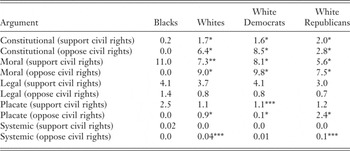
Blacks were more likely to use moral arguments—“civil rights legislation simply must be passed, it is the right thing to do”—while others were more likely to base their support on constitutional arguments. Black members averaged 11 sentences of moral arguments per speech compared to an average of 7.3 for other members (see Table 1). The opposite is true for the use of constitutional arguments in floor speeches. In this case, Whites averaged 1.7 sentences of constitutional arguments per speech compared to 0.2 sentences for Blacks. Here is an example of an African American member using moral arguments in his floor speech in 1957:
The reason that we are here today seeking relief on the Federal level is because the offending States are not protecting the right to vote on the part of these people to whom I have referred. They do not want that kind of States' rights because they know that once full participation of the ballot is in the hands of all the people they will have to, of course, answer to all the people as it relates to matters in which they express an interest here in Washington
(Diggs Reference Diggs1957, p. 8705).Black and White Differences in Debating Civil Rights: Average Number of Sentences per Speaker by Debate Category

Source: Congressional Record
Note: Values show the average number of sentences spoken per speaker for each category. *p < 0.01; **p < 0.05; ***p < 0.10
In contrast to Representative Diggs's (D-MI) concerns about the disenfranchised in moral terms, Representative Boyle (D-IL) espouses a typical constitutional argument. He argues:
If you want to be honest and if you want to talk about this bill, you have to talk about it in connection with the guaranties of the 15th amendment. You all know the rights created by the 15th amendment have corresponding duties which devolve upon everybody
(Boyle Reference Boyle1957, p. 8693).It is important to note that other kinds of arguments are being made by both groups, though at a much more similar rate. Whites were just as likely as Blacks to use placating arguments—“this bill represents a bare minimum”—and legal arguments—“it is up to Congress to correct the backwards trend of the Supreme Court decisions.” The least used argument by either group was the systemic argument. This seldom-used argument suggests that neither Blacks nor others believed that economic corrections or welfare reform were the answer to pressing civil rights needs (see Table 1). Is there a difference between Black members and White Democrat and White Republican members? In Table 1 the differences between Black members and White members are the same, regardless of the party of the White members. Blacks are more likely to use moral arguments than White Democrats and White Republicans.
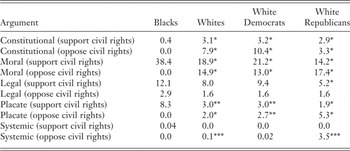
The results in Table 1, based on average number of sentences spoken, could be related to some speakers being more long-winded than others. A member who uttered three “moral” sentences in a one-hundred word speech would be coded as having more moral sentences than another member who spoke two moral sentences in a five-sentence speech. Table 2 controls for the differences in the number of sentences spoken by the different members of Congress by reporting the proportion of the arguments in each category for White and Black members, which is a better reflection of what kind of arguments are being used by each group. For Blacks, the results in Table 2 confirm the findings in Table 1 that Blacks rely on moral arguments. Of all sentences spoken by Blacks, 38.4% were coded as moral arguments. Legal arguments were the next highest category of debate for Blacks, with 12.1% of sentences. For Whites, Table 2 shows there was fairly equal support of and opposition to civil rights legislation, and much of it was couched in moral terms. Of all sentences spoken by Whites, 26.5% were in opposition to civil rights legislation and 33% in support of it. The greatest proportion of sentences spoken by Whites in any of the five categories was in the moral category: 18.9% in support of and 14.9% in opposition to civil rights legislation. Table 2 also shows that Whites use a greater proportion of constitutional arguments than do Blacks, both in favor of and in opposition to civil rights (confirming Table 1). Comparing Black members to White Democrats and White Republicans shows that the differences in language used continue to be significant (last two columns in Table 2).
Black and White Differences in Debating Civil Rights: Proportion of Sentences by Racial Group by Debate Category

Source: Congressional Record
Note: Values show the proportion of sentences spoken by each group for each category. *p < 0.01; **p < 0.05; ***p < 0.10
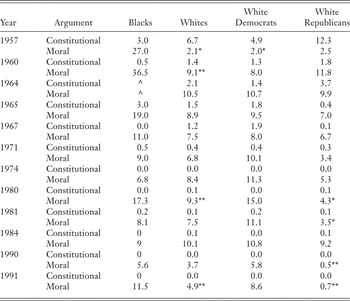
Given the evolving nature of the national civil rights debate, it is important to examine the patterns of debate over time. It is possible that the differences among Blacks and others that appear in the aggregate (Table 1) mask changes that occurred as the debate over civil rights evolved with the changing needs of those protected by the legislation. Indeed, the results from Table 3 indicate that the differences in average number of sentences (constitutional and moral) used by Blacks and others diminish over time and with the exception of 1980 and 1991, are not statistically significant after 1960. Table 3 shows that Blacks were consistent in their use of moral arguments over constitutional arguments, and that over time Whites shifted from making constitutional arguments to moral arguments. This supports the hypothesis that the presence of Blacks in Congress changed how White members debated civil rights legislation. It should be noted that in some years the sample size is small due to the small number of African American representatives participating in the floor debates (see Table 4 for exact number of speakers). Regardless, the pattern is striking—the marked differences found in 1957 and 1960 are not quite as extreme in later time periods. It seems Blacks and Whites were giving different reasons to support or oppose civil rights legislation in the 1950s–1960s. These differences largely disappear by the 1970s. However, if party is taken into consideration, there are differences between Black members and White Republican members starting in 1980 and continuing through 1991.
Comparing Black and White Members Over Time: Average Number of Constitutional- and Moral-Based Sentences per Speaker Supporting Civil Rights

Source: Congressional Record
Note: Values show the average number of sentences spoken per speaker for each category.
∧ = No members making floor statements
*p < 0.01; **p < 0.05; ***p < 0.10
Comparing Black and White Members by Decade: Percentage of All Debaters Who Use Moral and Constitutional Arguments

Source: Congressional Record
Note: Total raw counts in parentheses. Some cells have only five observations.
* Chi-square statistically significant at 0.05 (two-tailed).
** Chi-square statistically significant at 0.05 (one-tailed).
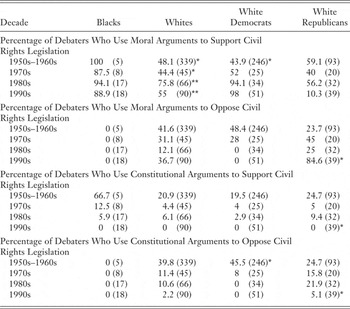
To further see if there are period effects, we collapse the data into four time periods: the 1950s–1960s, the 1970s, the 1980s, and the 1990s. We have at least two debates from each period, and for the 1950s–1960s and 1980s, we have three debates each. To get a better sense of the tone and mood on the House floor, we shift our focus from average number of sentences used to the percentage of debaters who used constitutional and moral arguments both in favor of and in opposition to civil rights legislation. A large number of debaters using moral arguments suggest a more acrimonious debate.
Results in Table 4 show that a large percentage of Blacks consistently used moral arguments to support civil rights legislation throughout the five decades of debate (as in Table 3). In the early period, the 1950s–1960s, 100% of Black debaters used a moral argument at some point in their speeches. The smallest percentage of Blacks using moral arguments occurred in the 1970s when 87.5% of Black speakers used a moral argument in their speech. The pattern among non-Black members shows a shift away from constitutional arguments toward moral arguments. In the 1950s–1960s, 48.1% of non-Black debaters based their supportive arguments on moral grounds. However, there is a constant upward trend peaking in the 1980s when 75.8% used moral arguments. This trend among White members is the result of White Democrats using moral arguments to support civil rights legislation.
Whites became less likely to use moral arguments when opposing proposed civil rights legislation. In the 1950s–1960s, 41.6% of Whites used moral arguments against civil rights. This percentage decreased to a low of 12.1% in the 1980s. There was an upsurge in these arguments in the 1990s, driven by White Republicans, which reflects the era when affirmative action dominated civil rights debates. Congress was trying to reverse a series of Supreme Court cases that were considered harmful to civil rights. However, the opponents of the time focused on what they claimed to be mandatory quotas. Those in opposition to civil rights legislation strenuously argued it was causing reverse discrimination (a moral argument). This in turn explains the sudden increase in the percentage of speakers using moral arguments to oppose civil rights legislation. It is possible that Whites saw the success of the Black strategy of supporting civil rights legislation on moral grounds, and thus Whites co-opted the strategy. White representatives, in their opposition to civil rights legislation, argued that it actually deprived their White constituents of civil rights. Table 4 also shows that this use of moral arguments to oppose civil rights in the 1990s was driven completely by White Republicans—84.6% of White Republicans used these arguments in the 1990s compared to 23.7% in the 1950s–1960s.
For constitutional arguments, we observe the same pattern for Blacks and Whites. The greatest percentage of speakers using constitutional arguments (both pro and con) was in the 1950s and 1960s. Over the next three time periods, the percentage diminished across all groups, regardless of party. It is tempting to argue that these results suggest that Blacks influenced others, causing a shift away from constitutional arguments. However, it is just as likely that the shift reflects changes in the public discourse on civil rights. In the early years, Whites (southerners) argued that civil rights legislation was a federal intrusion on states' rights. However, after the initial landmark civil rights bills were passed, the debate shifted away from the question of the appropriateness of the role of the federal government in these issues. Thus, no longer did members of Congress (or the public) question the role of the federal government in protecting civil rights. By the 1990s the metaphoric shoe was on the other foot, and the opposition was now arguing for legislation to protect Whites from discrimination. This interpretation is borne out by the decrease in usage of constitutional arguments by those in opposition to the legislation as well as those in favor of it. Those opposed to the legislation no longer found the role of the federal government a compelling argument because it was no longer questioned that the federal government would act with regard to protecting civil rights. Below we test to see if Whites changed the way they debated civil rights legislation while controlling for external shifts in mood and opinion.
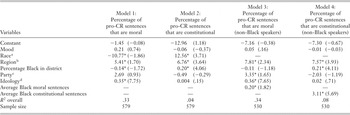
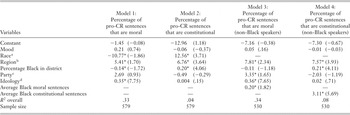
We use regression analysis to control for the alternative hypothesis. Our focus remains primarily on the moral arguments in support of civil rights legislation because we know from our comparison of means that Blacks remained relatively constant in their usage of this approach, while there is considerably more variance among the non-Black debaters. Thus, if Blacks are having any influence over their colleagues, it will be with these kinds of arguments. In the first two models, we examine if the differences identified above between Black and other members still hold after controlling for constituency, public mood, region, party, and member's ideology. The percentage of each speaker's total sentences containing moral references in support of civil rights legislation is our dependent variable in the first model. And the percentage of sentences containing constitutional arguments for each floor speaker in support of civil rights legislation is our dependent variable in the second model. Our independent variables are political party and adjusted ADA scores Footnote 8 as measures of member ideology, Stimson's mood variable to capture public sentiment over time,Footnote 9 percentage of Blacks in each speaker's district, a dummy variable for the southern region, and a dummy variable for the race of the representative.
The data for the members speaking on the floor were collected over time (1957–1991), making them pooled cross sections of time series data. With pooled data, the likelihood of having heteroskedasticity in the error term and autocorrelated errors is increased (Pindyck and Rubinfeld, Reference Pindyck and Rubinfeld1991). Heteroskedasticity and autocorrelation do not bias estimated coefficients, but they do tend to make the coefficients less efficient and invalidate statistical significance tests and confidence intervals. Heteroskedasticity is more likely with pooled cross-sectional data because there may be variance between cross-sectional units and between several time points within each cross-sectional unit. Autocorrelation is more likely with pooled cross-sectional data because of the time-series element of the data. Stimson (Reference Stimson1985, p. 919) states that heteroskedasticity and autocorrelation are “inherent” in pooled cross sections of time series data. When either heteroskedasticity or autocorrelation is present in the model being estimated, an alternative estimator to ordinary least squares (OLS) regression should be used. Thus, it was not a surprise when visual inspections of the OLS residuals from four models we constructed revealed nonconstant variance. When deciding which alternative estimator to use, an important consideration is whether the data are time series dominant (T > N) or cross-section dominant (N > T). Stimson (Reference Stimson1985, p. 926) writes that “cross-sectional dominance simultaneously minimizes the threat of autocorrelated errors … and maximizes the possibility of bias from the specification of unit effects,” and recommends that an error-components model be used when N > T. Since our data are cross-sectional dominant (we have N = 387 different members over T = 12 different debate years, i.e., N > T), we use an error-components model as our estimator.
Table 5 presents the error-components model results. The results provide further evidence that Black members are making a difference in Congress—the first two models (columns one and two) indicate that Black members make different arguments when supporting civil rights. Speeches by Black members focus more on moral arguments than speeches by other members, ceteris paribus (see model 1, Table 5). Specifically, Black members' average use of moral sentences is almost 11% higher than that of other members. When it comes to making constitutional-based arguments in support of civil rights, Black members use fewer of these arguments (see model 2, Table 5). On average, the percentage of sentences that contain constitutional-based arguments is roughly 13% less for Black members, holding all else constant. These results reflect our earlier findings and indicate that Black representatives use significantly different arguments than other members when debating civil rights.
Error-Components Model of Black Influence in Congress on House-Floor Civil Rights (CR) Debates, 1957–1991
Sources: Percentage Black population as reported in Almanac of American Politics and Congressional District Data Book.
Note: T values are in parentheses. R2 = coefficient of multiple determination.
a Dummy variable coded 0 if representative is Black and 1 if not.
b Dummy variable coded 0 if representative from the South and 1 if not, where South = Alabama, Arkansas, Florida, Georgia, Kentucky, Louisiana, Mississippi, N. Carolina, Oklahoma, S. Carolina, Tennessee, Texas, and Virginia.
c Dummy variable coded 0 if representative is a Republican and 1 if a Democrat.
d Ideology variable is measured with adjusted ADA scores (range = 0–100), where higher scores are more liberal.
* Statistical significance at 0.05 one tail; **statistical significance at 0.10 one tail
Another noteworthy result in Table 5 is that the sign for percentage Black in the district is positive for constitutional arguments and negative for moral arguments. This means that members with more Black constituents are less likely to use moral arguments in support of civil rights and more likely to use constitutional arguments. This result is counter to the expectation that as the Black population increases across districts so should support for civil rights in moral terms. The reason for this result could lie in the time frame that the data are from. V. O. Key (Reference Key1949) argues that in the 1940s, White tolerance toward Blacks decreased in areas where the concentration of Blacks was higher. The significance of the South dummy variable at the 0.01 level in model 2 and its failure to reach statistical significance at that same level in model 1 confirm this speculation. Members outside of the South are more likely to use constitutional arguments in support of civil rights legislation. With fewer Blacks in their districts (and more tolerant Whites), these nonsouthern members are more likely to voice support for a federal solution to the civil rights issue, and just as likely to voice moral arguments in support of civil rights. Moral support for civil rights legislation in the South (a less tolerant environment) is probably more defensible than supporting a federal solution.
The question that cannot be answered from either model 1 or model 2 is whether Black representatives are changing how other representatives debate on the House floor. While we have considerable evidence that Blacks and non-Blacks use different language, we have yet to answer the question of whether representatives are influenced by their colleagues, and not just by external events, such as constituents and changing public sentiment. The extent to which we find evidence of such influence speaks directly to the conflicting perspectives about the impact of majority-minority districts. To address this question, we excluded all Black speakers from the two models and added an independent variable that captures Black influence on floor speech.Footnote 10
The dependent variables in models 3 and 4 are the same as in the earlier models. Model 3 includes a new independent variable that captures the average number of supportive moral arguments used by Blacks. In model 4, the additional independent variable is the average number of supportive constitutional (instead of moral) arguments used by Blacks. Thus, in model 3 we test the hypothesis that, ceteris paribus, as Blacks speak more in moral terms so will Whites. The results provide support for this hypothesis. There is a positive and statistically significant relationship at the 0.05 one-tail level between the use of moral arguments by Blacks in support of civil rights and the use of moral arguments by other members in support of civil rights (model 3, Table 5). In other words, the independent variable capturing Black influence is statistically significant at the 0.05 one-tail level. In addition, ideology, region, party, and the size of the district's Black population are statistically significant, but in the unexpected direction for the latter (see our earlier discussion for an explanation). Finally, in model 4 the dependent variable is the percentage of constitutional arguments used in support of civil rights legislation by non-Black members. Our independent variables are similar to the independent variables in model 3—instead of the average number of supportive moral sentences spoken by Blacks, we use the average number of supportive constitutional sentences spoken by Blacks. Again, results show that as Black members make more constitutional arguments in support of civil rights, so do other members, holding all else constant (model 4, Table 5). Here the independent variable on Black members' influence is again significant at the 0.05 one-tail level.
Also worth noting in models 3 and 4 is how White members respond to Black constituents. Percentage Black in the district is positive, significant in model 4 at the 0.01 level; and negative, just missing significance in model 3 at the 0.10 one-tail level, indicating that White members with more Black constituents tend to use more constitutional arguments and fewer moral arguments when talking about their support of civil rights legislation. White members seem to be more willing to show support for civil rights to their Black constituents using constitutional arguments rather than moral arguments.
DISCUSSION
Does race matter? Our research answers yes, in two ways. First, our findings show that Black and non-Black members do behave differently, confirming previous research findings. Our results show that Black members and White members of Congress use different types of arguments when debating civil rights on the House floor—Blacks tend to talk about civil rights more in moral terms, and Whites tend to talk about it more in legal terms. Black members, therefore, are bringing something different to the debate on civil rights than other members. Indeed, Tate (Reference Tate2001, Reference Tate2003) finds that Black constituents are more satisfied with Black members—our findings provide an example of why this is so. Second, on the question of whether Black members are influencing White members, our findings show that Blacks have influenced how Congress talks about civil rights. These results have important implications for the majority-minority district debate. Over the course of thirty-four years (1957–1991) of civil rights floor debates, when Black members have spoken more in moral terms, ceteris paribus, other members tend to as well. The same can be said for when Blacks make constitutional arguments in support of civil rights. Breaking data on White members down by party shows that differences between Black members and White Democrats in the language used to debate civil rights have decreased over time. In the 1950s and 1960s, Blacks and White Democrats used significantly different arguments. By 1991, these differences largely disappeared, while differences between Black members and White Republicans became greater.
Critics may point out that the causal direction of influence runs two ways. Whites may be influencing Blacks as well as the other way around. Undoubtedly this occurs on some level. However, results in Tables 3 and 4 show that Blacks have been fairly consistent in their use of moral arguments and that Whites have increased their use of moral arguments over the same time period. There is enough evidence in these civil rights debates to support the hypothesis that Blacks are influencing and changing Congress, at least in how civil rights legislation is debated.
A next step in our research agenda is to examine whether or not White members' voting preferences are changed by the presence of Black members. A good example of this is the well-known story of Senator Carol Moseley Braun (D-IL) who was successful in getting the Senate to defeat the Daughters of the Confederacy's renewal of their patent on the Confederate flag insignia. The measure was seen as an uncontroversial amendment introduced by Senators Jesse Helms (R-NC) and Strom Thurmond (R-SC), until Braun brought attention to it. Braun was able to get twenty-seven senators to switch their votes on the amendment, which was defeated by a 75-to-25 vote. Braun was the only African American senator at the time. Without her presence and action, it is unlikely the Senate would have defeated or even deliberated over the amendment.
Our results suggest that electing Blacks to Congress matters because Black members have influenced how other members speak about civil rights over the last forty some years. Though influence does take time, Black members are making a difference. Some White members understand the effects of minority representation in Congress:
The members of Congress we have that are women and minorities are very much needed because they bring a perspective that needs importantly to be heard here. They tend to always ensure, whether it's a highway, census, or an education bill, that the constituents in this country that are made up of minority groups are not tossed aside and that their point of view, their issues are raised.Footnote 11
Indeed, our results suggest there are long-term gains in Black substantive representation that need to be considered when looking into the effects of creating majority-minority districts to elect more minority members to Congress.
APPENDIX
Civil Rights Floor Debates Analyzed

Source: Congressional Record