Introduction
Mung bean (Vigna radiata (L.)), also called green gram, is one of the important legume crops in India, grown in rainy, post rainy winter and spring seasons in different parts of the country. India is the leading producer of mung beans, produces about 1.5–2.0 million tonnes annually (Tiwari and Shivhare, Reference Tiwari and Shivhare2017) and contributes about 54% of the world's production (Hanumantharao et al., Reference Hanumantharao, Nair and Nayyar2016). Mung bean is a protein-rich staple food that contains 24–25% protein, a significant amount of carbohydrate (54–56%), dietary fibre, minerals, vitamins and also contains polyphenols, flavonoids, and amino acids and carotenoids (Gopalan et al., Reference Gopalan, Ramasastri and Balasubramanian1989). However, its postharvest losses showed more significant losses qualitatively and quantitatively due to insect damage. Mung bean is susceptible to infestation; nearly 65 different insect species attack this crop both in the field and during storage, which is prolific, breeds rapidly and causes severe deterioration (Raghu et al., Reference Raghu, Kumar, Gowda, Manjunatha and Alur2016). Callosobruchus maculatus Fabricius (Coleoptera: Chrysomelidae: Bruchinae) is the most common harmful bruchid species that damages mung beans during storage. Other species such as Callosobruchus chinensis (Linnaeus), Callosobruchus analis (Fabricius) and Callosobruchus phaseoli (Gyllenhal) also infest stored mung bean in India (Lohar, Reference Lohar2001; Sarkar et al., Reference Sarkar, Panda, Yadav and Kandasamy2020).
An estimate revealed that the postharvest losses of mung beans were about 40–50% due to insect damage during storage (Gosh and Durbey, Reference Gosh and Durbey2003). Postharvest life of mung beans also deteriorated due to excessive moisture, fungi, humidity and temperature. Infestations commence in the field when the pods are still maturing and are carried to storehouses. The population of insects rapidly multiplied manifold during unprotected storage, resulting in considerable damage (Swella and Mushobozy, Reference Swella and Mushobozy2007). Even undetectable levels of two pairs of adult insects per tonne of grains could result in 100% damage within 6 months, and infestations are often difficult to detect at harvest (Emery and Nayak, Reference Emery, Nayak and Bailey2007). Indigenous methods such as treating with mud, vegetable oils, turmeric powder and plant essential oils used at an on-farm small-scale level are not suitable for long-term storage of legumes. In large-scale storage, using insecticides and fumigants is sometimes necessary to control insect growth, but these techniques are severe human health hazards (Vales et al., Reference Vales, Rangarao, Sudini, Patil and Murdock2014). The storage methods such as earthen bins, metal bins, drums, cotton bags, polypropylene bags and jute bags can also not control the total multiplication of insects during long-term storage (Yadav, Reference Yadav, Asthana and Ali1997).
Hermetic storage is a viable alternative to synthetic pesticides in controlling stored product insects. It is not harmful to environment, human health and is sustainable in hot and humid climates (Murdock et al., Reference Murdock, Margam, Baoua, Balfe and Shade2012). A hermetic modified atmosphere (MA) storage system decreases oxygen (O2) and increases carbon dioxide (CO2) levels due to the respiration of living organisms in the sealed storage (Kandasamy, Reference Kandasamy2017). As a consequence of the reduction of available O2, the regular respiration rate is hindered, thereby; reducing the overall metabolic activities of living organisms (Kandasamy et al., Reference Kandasamy, Moitra and Mukherjee2015). The stored grains' shelf life prolongs and maintains the product quality as the insects living in an airtight environment use limited oxygen. Consequently, the insects stop feeding, become inactive and eventually die due to asphyxiation or desiccation (Freitas et al., Reference Freitas, Faroni and Sousa2016; Williams et al., Reference Williams, Murdock, Kharel and Baributsa2016).
Different hermetic storage options such as silo bags, cocoons, metal silos, plastic silos, hermetic bags, GrainSafes and plastic containers are used worldwide for commercial and small-scale storage (Chigoverah and Mvumi, Reference Chigoverah and Mvumi2018; Walker et al., Reference Walker, Jaime, Kagot and Probst2018). Promoting hermetic bags in African countries has increased awareness, recognized by national governments, agencies and farmers. Besides, different brands of hermetic bags, such as Purdue Improved Crop Storage (PICS) bags, GrainPro SuperGrain bags, ZeroFly, Ecotact, AgroZ and AgroZ Plus bags, were introduced on the global market, and these bags are effectively used to store the cereals, pulses, spices, coffee and cocoa (Murdock et al., Reference Murdock, Margam, Baoua, Balfe and Shade2012; Baoua et al., Reference Baoua, Amadou, Lowenberg-DeBoer and Murdock2013; Moussa et al., Reference Moussa, Abdoulaye, Coulibaly, Baributsa and Lowenberg-DeBoer2014).
Hermetic bags are a type of multilayer coextruded, more rigid plastics with deficient oxygen and water vapour transmission properties; thus, they have a great potential in controlling stored product insects and enhancing the postharvest life of the food grains (Likhayo et al., Reference Likhayo, Bruce, Tefera and Mueke2018). Recently, researchers are testing the possibility of different hermetic bags for long-term storage of various commodities such as cowpea (Baoua et al., Reference Baoua, Margam, Amadou and Murdock2012; Murdock et al., Reference Murdock, Margam, Baoua, Balfe and Shade2012; Moussa et al., Reference Moussa, Abdoulaye, Coulibaly, Baributsa and Lowenberg-DeBoer2014), pigeon pea (Vales et al., Reference Vales, Rangarao, Sudini, Patil and Murdock2014), maize (De Groote et al., Reference De Groote, Kimenju, Likhayo, Kanampiu, Tefera and Hellin2013; Williams et al., Reference Williams, Baributsa and Woloshuk2014; Walker et al., Reference Walker, Jaime, Kagot and Probst2018), wheat (Martin et al., Reference Martin, Baributsa, Huesing, Williams and Murdock2015), cassava chips (Hell et al., Reference Hell, Ognakossa and Lamboni2014), Hibiscus sabdariffa grain (Amadou et al., Reference Amadou, Baoua, Baributsa, Williams and Murdock2016) and groundnuts (Baributsa et al., Reference Baributsa, Baoua, Bakoye, Amadou and Murdock2017). Hermetic storage of mung beans is hardly found in the available literature. This gap has prompted the formulation of the present study on the effectiveness of hermetic SuperGrain bags for controlling damage caused by bruchids (C. maculatus Fabricius) during the long-term storage of mung beans and for evaluating the quality of the stored product.
Materials and methods
Raw materials
The study was carried out at the Department of Farm Structures, College of Agricultural Engineering and Technology, Dr Panjabrao Deshmukh Krishi Vidyapeeth (PDKV), Akola, Maharashtra, India (Latitude 20.7°N and Longitude 77.07°E). Mung bean, cultivar NVL-1, was procured from a local farmer cum vendor at Pahadpur village, Akola. The experiments were conducted at ambient temperature (26 ± 2°C) and 50 ± 5% RH for 180 days. The mung bean was cleaned manually, graded using a sieve, removed foreign matters and sun-dried to 13.29% moisture content on a dry basis (db). A digital moisture meter (Model: 6005/40472, Osawa Industrial Products Pvt. Ltd., Haryana, India) was used to measure the moisture content, which is expressed on a dry basis.
Storage bags
The hermetic bag of the brand ‘GRAINPRO SuperGrain Bag (SGB)’ was selected for this study. GrainPro packaging combines an inner bag with an outer protective bag. The inner bag is a multilayer polyethylene film sandwiched together with a thickness of 78 μm, and the outer bag is a standard woven polypropylene (WPP) or jute bag (Baoua et al., Reference Baoua, Amadou, Lowenberg-DeBoer and Murdock2013). Hermetic SuperGrain bags have extremely low gas permeability (≤4 cc m−2 day−1) and sound water vapour barrier (≤5 g m−2 day−1) properties (GrainPro, 2018). WPP bag, a conventional packaging material, was used as a control. Polypropylene is a thermoplastic resin produced by the polymerization of propylene. WPP is polypropylene strips/threads that have been woven in two directions (warp and weft) to create a light but heavy-duty and robust material. SuperGrain bags were supplied by the Pest Control India Private Limited, Bangalore, India and WPP bags were purchased from a local trader at Akola.
Bruchids culture development
Bruchids (C. maculatus F.) were obtained from naturally field infested mung beans. The population was multiplied by rearing in plastic containers covered with delicate mesh lids to give proper ventilation. The cultures were maintained at room temperature (25°C) and 50 ± 5% RH with indirect outdoor window lighting. The emerged adult bruchids were used to infest mung beans after a generation time of 42–45 days. The mating pairs of newly emerged adult bruchids were separated based on the morphological characters and transferred to the respective treatments using fine brushes.
Experimental arrangement
The experiments were designed with four treatment combinations employing SGBs infested with adult bruchids (SGB-I), SGBs natural field infested (SGB-N), WPP bags infested with adult bruchids (WPP-I) and WPP bags with natural area infested (WPP-N). A completely randomized design was used and replicated three times. The main blocks correspond to the storage conditions (SGB and WPP bags), and the sub-blocks represent the storage periods (60, 120 and 180 days). In this experiment, nine bags were prepared in each treatment combination and used a total number of 36. Infestation level, seed weight loss, seed damage and moisture content were measured at 60 days intervals. Three bags were taken from each treatment combination on the 60th day of storage, measured by the above-said parameters, and removed these bags from the experiment. A similar procedure was followed on the 120th and 180th days of storage. There was no significant insect development in the SGBs under the same experimental conditions; hence, we selected a 60-day interval. Seed colour, hardness, crude protein and fat contents were analysed before and after 180 days of storage.
Bagging, sealing and storage
All the bags were examined for sealing and stitching defects to use high-quality bags. The storage bags (SGB and WPP bags) were filled with 5 kg of cleaned and graded mung bean and 25 pairs of adult bruchids transferred into infested treatment bags. The bruchids were gently mixed with the mung bean before sealing the bags and removed excess air from the SGBs by pressing them down as per the manufacturer's instructions. The bags were sealed with an automatic multi-purpose sealing machine (Model AMS-100A, Print Packaging Systems, Mumbai, India). The WPP bags were closed by twisting the loose end, tying tightly with sisal twine, and keeping unprotected control. The bags were arranged treatment-wise and kept in the laboratory at room temperature (26 ± 2°C, RH: 50 ± 5%) for 180 days.
Gas analysis
Gas concentrations (oxygen and carbon dioxide) in the treatments were measured every 15 days using a portable gas analyser (Model 902D, Dual Trak, Systech Instrument, USA) fitted with a 20-gauge hypodermic needle probe. For gas sampling, small holes were made on the surface of the outer woven layer of SGBs at the top, middle and bottom. The inner bag was punctured with a gas analyser needle probe through the holes. After gas sampling, the holes in the outer bags and needle punctures in the inner bag were sealed with adhesive pads. Subsequent gas samplings were performed from the same spots by lifting and replacing the pads. The WPP bags do not require any hole and seal.
Analysis of infestation level
The bags were opened after gas analysis as per the experimental plan (60 days interval) to determine the bruchids infestation level. The mung bean was thoroughly mixed, and three samples of 1 kg each per bag were withdrawn, each selected randomly. Each sample was sieved with a 2 mm mesh size to separate bruchids and counted live and dead adults.
Determination of seed damage and weight loss
Seed damage and weight loss of the stored mung bean were determined as described by De Groote et al. (Reference De Groote, Kimenju, Likhayo, Kanampiu, Tefera and Hellin2013). A sub-sample of 1000 seeds was taken in triplicate from each 1 kg sample and sorted into insect-damaged (including hole, cavity, broken) and undamaged ones. The percentage of seed damage and weight loss was calculated using the following expressions:


where N d is the number of insect-damaged seeds, N u is the number of undamaged seeds, W d is the dry weight of insect-damaged seeds (g), and W u is the dry weight of undamaged seeds (g).
Measurement of moisture content
The moisture content of the mung bean (% db) was determined at a time interval of 60 days using a digital moisture testing machine (Model: 6005/40472, Osawa Industrial Products Pvt. Ltd.) as the procedure described by the manufacture.
Colour analysis
The colour of the mung bean samples was measured using Ultra Scan VIS Hunter Lab (Hunter Associates Laboratory Inc., Reston VA, USA) during storage. A glass cell containing mung beans was placed in the light source and enclosed using a cover plate. The colour parameters, L* (lightness coefficient, ranging from 0 (black) to 100 (white) on a vertical axis), a* (red (+ve) and green (−ve) on a horizontal axis) and b* (represents yellow (+ve) or blue (−ve)) were recorded. Total colour change (ΔE) was calculated as follows (Kandasamy and Mukherjee, Reference Kandasamy and Mukherjee2019):

Where L f and L s are the brightness values of mung bean before and after storage, respectively; a f and a s are the hue values of mung bean before and after storage, respectively; b f and b s are the chroma values of mung bean before and after storage, respectively.
Hardness analysis
Hardness is a measure of the degree of softening. The material is compressed to rupture, and the compressive force depends on the hardness of the material (force ∝ hardness) (Kandasamy and Mukherjee, Reference Kandasamy and Mukherjee2019). Thirty mung beans without any cracks were selected from each treatment to determine the hardness and placed in the hardness tester (Analog, Germany) and pushed its plunger against the grain. The applied force was measured at the first rupture of the grain as the yield point (N).
Crude protein and fat content analysis
The mung bean's crude protein and crude fat content were estimated according to AOAC (2011) by the micro-Kjeldahl method and standard extraction method, respectively. A SOCS plus extractor (Pelican, India) was used for extraction and petroleum ether as an extraction solvent. The experiments were triplicates at the end of 6 months storage period.
Statistical analysis
The data obtained from treatments and storage times were analysed by one-way analysis of variance (ANOVA) test in Excel using QIMacros software (http://www.qimacros/hypothesis-testing/one-way-anova). The significance was defined at the 5% level to test the difference between the average values.
Results
Oxygen and carbon dioxide concentration
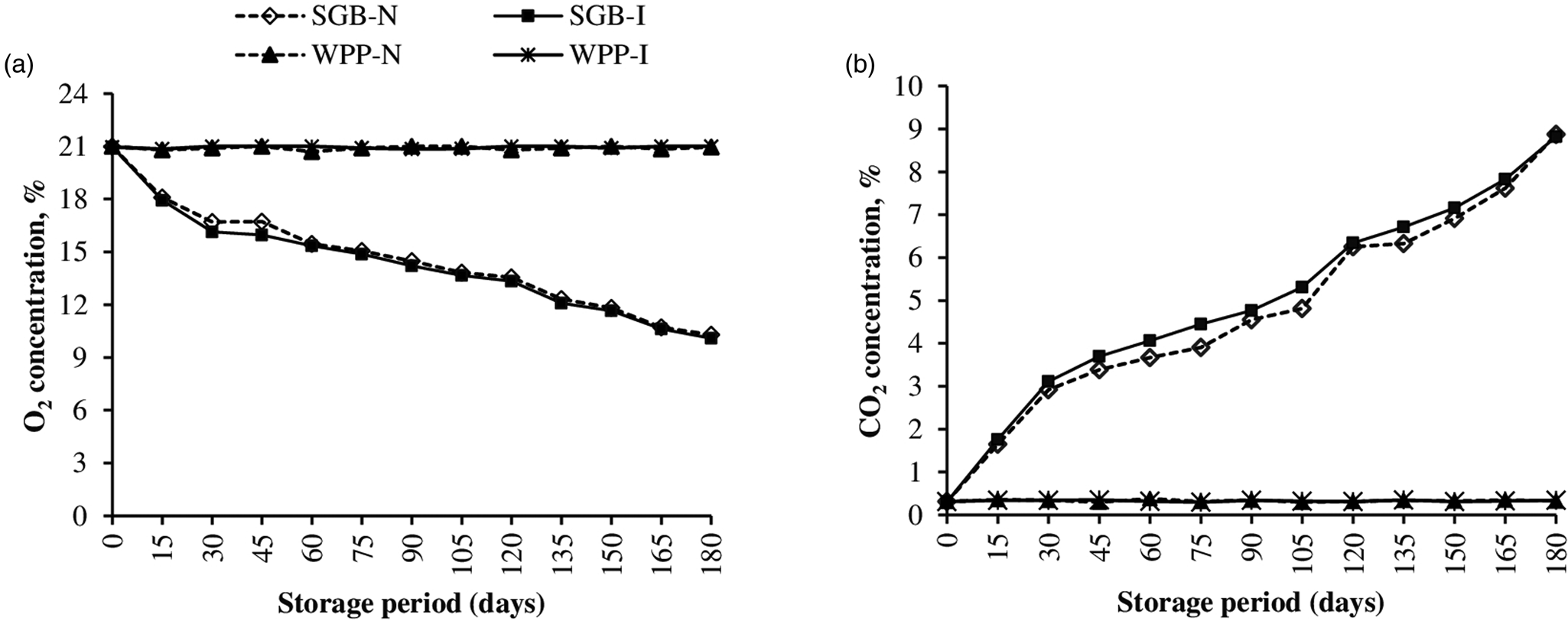
Fig. 1 shows oxygen (O2) and carbon dioxide (CO2) concentration (%) in the treatments (SGB and WPP bags) during 180 days storage period. At the beginning of storage, the concentration of O2 in SGB-I, SGB-N, WPP-I and WPP-N was 20.92, 20.97, 20.95 and 21%, respectively, and corresponding CO2 concentrations were 0.29, 0.31, 0.31 and 0.33%. O2 level was dropped consistently in both SGB-I and SGB-N treatments over the storage period, whereas there was no significant reduction in WPP-I and WPP-N treatments. At the end of the storage period, O2 concentration reached 10.09 and 10.29% in SGB-I and SGB-N, respectively; on the other hand, 20.95% in WPP-I and WPP-N treatments. The CO2 concentration in SGB-I and SGB-N treatments constantly increased over the storage period, reaching 8.82 and 8.87%, respectively. At the same time, no significant increase was observed in WPP-I and WPP-N treatments.
Changes in concentration (%) of oxygen* (a) and carbon dioxide* (b) under SGBs and WPP bags contain mung bean during 180 days of storage. *Mean ± SD, n = 3, P < 0.05.

The result showed that the O2 level was distinctly lower in SGB-I as compared to SGB-N, whereas CO2 level was high in SGB-I than that of SGB-N, which is reliable with the higher population of C. maculatus in SGB-I treatments. The progression of O2 level in SGB-I was significantly different over the storage period (LSD = 0.285, df = 38, F = 949.72, F crit = 2.15, P < 0.05), similarly, in SGB-N (LSD = 0.534, df = 38, F = 274.42, F crit = 2.15, P < 0.05). The progression of CO2 level in SGB-I was also significantly different over the storage period (LSD = 0.191, df = 38, F = 1376.39, F crit = 2.15, P < 0.05), likewise, in SGB-N (LSD = 0.189, df = 38, F = 1346.88, F crit = 2.15, P < 0.05). Besides, no significant decrease in O2 and increase in CO2 level were observed after the 120th day of storage in both SGB-I and SGB-N treatments. In WPP-I and WPP-I treatments, O2 levels varied between 20.7 and 20.95% over the storage period and no significant changes in CO2 level.
Infestation level
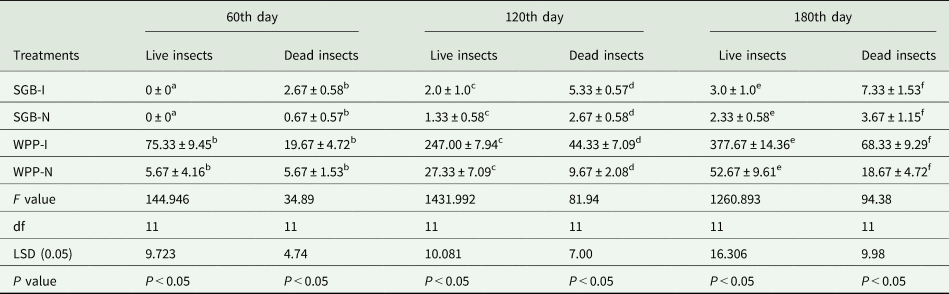
The population of live and dead C. maculatus in SGB-N, SGB-I, WPP-N and WPP-I treatments is presented in table 1. The results showed that no live insects were detected in both SGB-N and SGB-I treatments during the first 60 days of storage, whereas they increased significantly in WPP-N (5.67 ± 4.16) and WPP-I (75 ± 9.45) treatments (P < 0.05). However, few C. maculatus (1–3) were detected in both SGB-N and SGB-I treatments after 120 days of storage, whereas the population increased rapidly in WPP-N (27.33 ± 7.09) and WPP-I (247 ± 7.94) during this period (P < 0.05). After 180 days of storage, C. maculatus count was 2–3 in both SGB-N and SGB-I, whereas it increased drastically in WPP-N (52.67 ± 9.61) and WPP-I (377.67 ± 14.36) treatments (P < 0.05). On the other hand, the dead C. maculatus in SGB-I were 2.67 ± 0.58, 5.33 ± 0.57 and 7.33 ± 1.53 on 60th, 120th and 180th days of storage, respectively, which is higher than in the SGB-N. Similarly, 19.67 ± 4.72, 44.33 ± 7.09 and 68 ± 9.29 dead C. maculatus were recorded in WPP-I during the same storage period, which is higher compared to WPP-N. The C. maculatus population increased significantly in WPP-N treatment without pre-storage infestation. This increase may be due to undetectable natural infestation, often difficult to detect at harvest (Emery and Nayak, Reference Emery, Nayak and Bailey2007). The population density of C. maculatus in WPP-N bags is much lower than in WPP-I bags because artificially introduced C. maculatus in WPP-I bags have multiplied the huge number by 60 days of storage. However, the MA in the SGBs effectively controlled the survival of C. maculatus within the SGB bags. Decrease in O2 and increase in CO2 concentrations are predominantly attributed to aerobic metabolism of C. maculatus within the mung bean in the SGBs.
Number of live and dead adult C. maculatus per kilogram of mung bean stored in SGB and WPP bags during 180 days of storage

Data are presented as mean ± SD values, (n = 3); mean value with same superscript in each column showed significant variation (P < 0.05).
Seed damage and weight loss
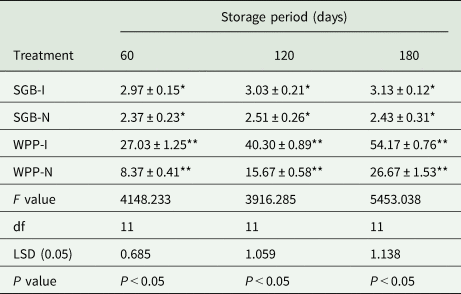
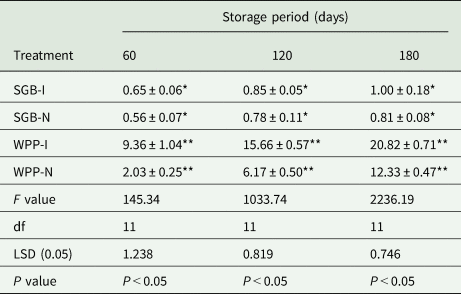
The damage to mung beans stored in both SGB-I and SGB-N bags remained significantly low (2–4%) throughout the storage period. In contrast, the damage level increased gradually in WPP-I bags (54.17 ± 0.76%) and WPP-N bags (26.67 ± 1.53%) during the 180-day storage period (table 2). Mung beans stored in WPP bags were significantly smashed with emergence holes. The mean percentage weight loss of mung beans during storage is presented in table 3. The results showed a significantly increasing trend in weight loss over the storage period in all the treatments. However, mung beans stored in the SGBs recorded substantially lower weight loss of 1.0 ± 0.18% in SGB-I and 0.81 ± 0.08% in SGB-N treatments after 180 days of storage. However, the highest weight loss was showed in WPP-I (20.82 ± 0.71%) and WPP-N (12.33 ± 0.47%) treatments. The SGBs had no significant effect on seed damage and weight loss, whereas WPP bags had a considerable impact (P < 0.05) over the storage period. The results indicate that the seed damage and weight loss are greatly attributed to the population of insects in the storage bags.
Percentage damage in mung bean stored in SGB and WPP bags during 180 days of storage

Data are presented as mean ± SD values (n = 3); *not significant, **significantly different at (P < 0.05).
Weight losses (%) in mung bean stored in SGB and WPP bags during 180 days of storage

Data are presented as mean ± SD values (n = 3); *not significant, **significantly different at (P < 0.05).
Moisture content
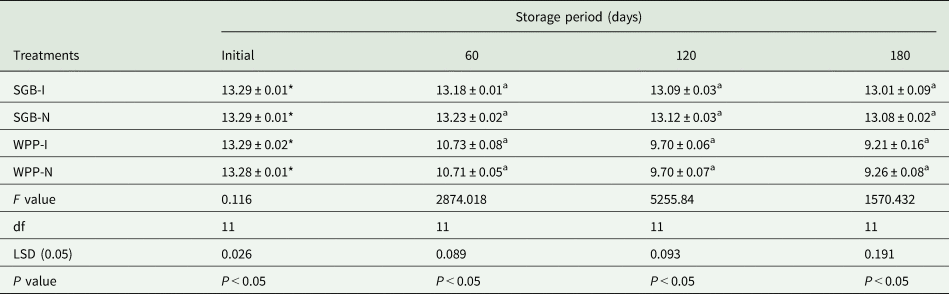
The average moisture content of mung bean at the onset storage was 13.29 ± 0.01% (db). No significant change in moisture content was observed during storage in SGB-I and SGB-N treatments (table 4). The moisture content of mung bean in these treatments did not differ significantly (P < 0.05), maintained as onset storage moisture content throughout the storage period. However, the moisture content of mung bean in both WPP-I and WPP-N treatments reduced significantly, 9.21 ± 0.16% (db) in WPP-I and 9.26 ± 0.08% (db) in WPP-N (P < 0.05). In addition, the moisture content was reduced considerably in WPP treatment combinations during the first 120 days of storage (from 13.29 to 9.7% db). No significant reduction in moisture content was subsequently observed.
Moisture content (%, dry basis) of mung bean stored in SGB and WPP bags during 180 days of storage

Data are presented as mean ± SD values (n = 3); mean value with same superscript in each column showed significant variation (P < 0.05); *not significant.
Seed colour
The seed colour is one of the important indicators to measure the freshness of food products. The changes in colour (ΔE) of mung beans at the beginning and after 180 days of storage were presented in table 5. The result showed that the ΔE values in the storage bags varied significantly (F = 36.07; P = 0.000; CD = 0.48; CV = 0.62%; R 2 = 0.94) at 1% probability level. The ΔE values in the SGB bags showed far with initial ΔE value compared to ΔE values in WPP bags, which indicates that the SGB bags maintained the freshness of mung bean.
Some quality parameters of the mung bean in SGB and WPP bags at the beginning and after 180 days

Data are mean ± SD (n = 3). The same superscript letter in each row showed a significant difference at a 1% probability level.
Hardness
Variations in the hardness value of mung bean before and after storage in SGB and WPP bags are given in table 5. The results showed that a significant variation in the hardness values was observed in the treatments (F = 7.27; P = 0.005; CD = 2.14; CV = 2.08%; R 2 = 0.74) at 1% level. The hardness values in the SGBs showed higher than the hardness values in the WPP bags and closely approached the initial hardness value.
Crude protein and fat content
The changes in crude protein and fat contents of mung bean stored in SGB and WPP bags after 180 days are presented in table 5. The results showed the crude protein values in the bags varied significantly at 1% probability level (F = 25.75; P = 0.000; CD = 0.57; CV = 1.38%; R 2 = 0.91). The crude protein values in WPP bags reduced significantly as compared to initial protein value, however no significant reduction in protein values in SGB bags. On the other hand, no significant difference (F = 0.14; P = 0.962; CD = 0.22; CV = 9.4%; R 2 = 0.05) was observed in crude fat content of mung bean stored in both SGB and WPP bags.
Discussion
Hermetic storage, also called airtight storage, facilitates grains and living organisms (insects and fungi) to create a MA by reducing O2 and increasing CO2 concentrations through respiratory metabolism. In addition, the absence of gas exchange between the inside and outside storage helps the development of MA. The grains and living organisms within the airtight storage consume O2 and liberate CO2 for their respiration, which leads to depletion of O2 (from 21 to 1%) and accumulation of CO2 (from 0.035 to 100%). This MA environment within the hermetic storage media is toxic to insects and controls the growth of aerobic fungi but sustains the quality of stored products for a long time (Weinberg et al., Reference Weinberg, Yan, Chen, Finkelman, Ashbell and Navarro2008; Baoua et al., Reference Baoua, Amadou, Lowenberg-DeBoer and Murdock2013; Hell et al., Reference Hell, Ognakossa and Lamboni2014). In hermetic storage, insect mortality occurs when the O2 concentration decreases to 3% or less (Moreno-Martinez et al., Reference Moreno-Martinez, JimeÂnez and VaÂzquezc2000); feeding, oviposition and other movements become extremely slow and cease when O2 fall below 4% (Murdock et al., Reference Murdock, Margam, Baoua, Balfe and Shade2012). The feeding rate, growth, development and population expansion could be suppressed as the concentration of O2 decreased, and CO2 increased in the hermetic storage and reduced insect fecundity (Baoua et al., Reference Baoua, Margam, Amadou and Murdock2012; Njoroge et al., Reference Njoroge, Mankin, Smith and Baributsa2018).
In our study, the O2 concentration decreased gradually from 21 to 10.09%, and the CO2 concentration raised slowly, reaching 8.87% in SGBs. This study did not achieve such extreme low O2 (below 4%) concentration within the airtight storage. In some other studies, Vales et al. (Reference Vales, Rangarao, Sudini, Patil and Murdock2014) observed an O2 concentration of 6.2% in PICS bags containing pigeon pea infested with C. maculatus within 21 days. It gradually increased to around 18% by 184 days, dropping to 14.2% by 247 days. The CO2 level increased to 6.2% and dropped to 2.6% at 247 days. Mutungi et al. (Reference Mutungi, Affognon, Njoroge, Baributsa and Murdock2014) observed the O2 concentration of 8.67 and 8.72% in PICS bags filled with mung beans infested with C. maculatus and non-infested, respectively, within 2 months, gradually decreased to 4.71% at the end of 6 months. The CO2 levels increased to 5.89 and 7.52% in the bags within 2 months and steadily increased to 4.66% at the end of 6 months. The authors also showed this atmospheric condition negatively affected the bruchids' life cycle and controlled them.
The reduction in O2 and increase in CO2 under hermetic storage depend on several storage elements, including air-tightness, types and population of insects, fungal inoculums, kind of grain and grain moisture content. Besides, well-dried grains cannot modify a microenvironment without insects, and microflora cannot develop even if there is fungal inoculum. This circumstance may slow down the attainment of very low O2 and high CO2 (Moreno-Martinez et al., Reference Moreno-Martinez, JimeÂnez and VaÂzquezc2000). Williams et al. (Reference Williams, Baributsa and Woloshuk2014) reported that O2 concentration remained above 10% after 2 months in maize stored in PICS bags with 12% moisture content. Still, the O2 level was near zero after 1 month at 15% moisture content. This is because of the higher respiration rate of the wetter grain (Huang et al., Reference Huang, Danao, Rausch and Singh2013). Increased levels of CO2 are toxic to many insect species. The mortality rate or rapid killing depends on CO2 concentration and exposure period. Navarro et al. (Reference Navarro, Timlick, Demianyk, White, Hagstrum, Phillips and Cuperus2012) reported that the high CO2 levels, even with 20% O2, rapidly kill insects because of CO2 toxicity. The CO2 levels were at 40% for 17 days, 60% for 11 days and 80% for 8.5 days at temperatures above 20°C (Cao et al., Reference Cao, Xu, Zhu, Bai, Yang and Li2019). Even low levels of CO2 (7.5–19.2%) increase young and adult insect mortality for prolonged periods (White et al., Reference White, Jayas and Muir1995).
The characteristics of SGB films, including water vapour transmission rate (WVTR) and oxygen transmission rate (OTR), play a vital role in maintaining O2 levels within them (Bakhtavar et al., Reference Bakhtavar, Afzal and Basra2019). As the hermetic SuperGrain Bag has very low OTR, ≤4 cc m−2 day−1 (GrainPro, 2018), the diffusion rate of O2 from outside to inside package is very low, decreasing the trend O2 concentration. The respiration rate of stored products decreases significantly when the moisture content of the product is less as the decrease in O2 consumption and vice-versa (Duarte et al., Reference Duarte, Neto, Lisboa, Santana, Barrozo and Murata2004; Kandasamy, Reference Kandasamy2022). In our study, WVTR and OTR characteristics of SGB greatly retard the diffusion of gas through the bag walls. Moreover, a decrease in O2 and an increase in CO2 concentrations in SGBs negatively affect the life cycle of the insects. On the other hand, the large pore size in the WPP bags wall favoured unrestricted airflow between the environment and WPP bags hence no hermetic condition. Similar trends in reduction of O2 and increased CO2 levels were reported for the storage of cowpea in PICS bags (Murdock et al., Reference Murdock, Margam, Baoua, Balfe and Shade2012), maize in SuperGrain bags (De Groote et al., Reference De Groote, Kimenju, Likhayo, Kanampiu, Tefera and Hellin2013) and cowpea in GrainPro and PICS bags (Baoua et al., Reference Baoua, Amadou, Lowenberg-DeBoer and Murdock2013). In WPP bags, an enormous number of bruchids were detected. The storage environment (26 ± 2°C and 50 ± 5% RH) was probably favourable for the development of bruchids.
SuperGrain bags are multilayer coextruded, more rigid plastics with low gas transmission rate and good water vapour barrier properties (Ognakossan et al., Reference Ognakossan, Tounou, Lamboni and Hell2013). The bags have an excellent potential to reduce insect population during storage. Our results were consistent with the findings reported by Vales et al. (Reference Vales, Rangarao, Sudini, Patil and Murdock2014). When pigeonpea was stored in PICS bags, O2 levels dropped rapidly, and CO2 levels increased in the bags infested with C. maculatus and no evidence of bruchids in PICS bags compared to gunny bags. SuperGrain IV-RTM bags have effectively controlled the Prostephanus truncatus population (0–4 adults per kg grain) during 180 days of storage of maize grain and maintained 8–16% CO2 (Likhayo et al., Reference Likhayo, Bruce, Tefera and Mueke2018).
Seed damage and weight loss are the significant direct losses caused by C. maculatus during storage. The effectiveness of the grain storage system is directly influenced by seed damage and weight loss. As the SGBs maintained moisture content at far with onset storage, the seed damage may be prevented due to insects. Moreover, the population growth of insects is controlled effectively to the modified atmospheric condition in the SGBs. Thus, significantly less damage (2–4%) and weight loss (<1%) were observed in both SGB-I and SGB-N. The losses were considerably higher in WPP-I (20.82%) and WPP-N (12.33%) treatments and enormous damage by insects during storage (table 4). Since the edible portion of seeds is a feed for the insects, causing a reduction of dry matter, hence, grain weight is reduced (Freitas et al., Reference Freitas, Faroni and Sousa2016). Our results indicate that the SGBs would be effective, whereas WPP bags are ineffective in preventing damage and weight losses enforced on insects' mung beans. These results were confirmed with the findings reported by Amadou et al. (Reference Amadou, Baoua, Baributsa, Williams and Murdock2016) that showed the mean weight loss of H. sabdariffa grain stored in woven bags was 8.6%, while no weight loss in the PICS bags after 6 months of storage. Maize grains with 12% moisture content stored in hermetic SuperGrain IV-RTM bag showed very low weight loss (1.2%) whereas huge weight loss (35.8%) in WPP bags (Likhayo et al., Reference Likhayo, Bruce, Tefera and Mueke2018).
Moisture content is a critical component that accelerates grain deterioration and encourages insect and fungi growth during long-term storage. Therefore, changes in the moisture content of the stored products must be protected to maintain their quality. In this study, SGB treatments (infested and natural infested) maintained onset moisture content throughout the storage period. The diffusion of moisture between the outside environment and inside the bag was significantly prevented due to its shallow WVTR (≤5 g m−2 day−1). Whereas WPP (infested and natural infested) treatments showed a decreasing trend in moisture content over the storage period. This decrease may be due to the WPP bags having a large pore size that allowed moisture to diffuse towards the outside. The water in the mung bean vaporizes in response to ambient temperature, and RH (<55%) subsequently loses moisture. These results were confirmed by Likhayo et al. (Reference Likhayo, Bruce, Tefera and Mueke2018) reported for maize. They showed no significant changes in moisture content of maize grains stored in SuperGrain IV-RTM bags during 180 days of storage but significantly decreased over the storage period in PP bags.
The degradation of colour in WPP bags could be due to the oxidation reaction of the anthocyanin and carotenoids. As the SGBs have low WVTR (≤ 5 g m−2 day−1), moisture transfer from inside to outside the bag may be restricted. Besides, the product's respiration rate is controlled in the SGBs, reducing the O2 level inside the pack due to its low OTR (≤4 cc m−2 day−1). As WPP bags have large pore sizes, moisture and O2 transfer between inside and outside lead to surface colour degradation. Similarly, Walker et al. (Reference Walker, Jaime, Kagot and Probst2018) reported a reduction in discolouration of maize grain with less than 13.5% moisture content stored under airtight conditions than stored in PP bags.
The reduction in hardness in WPP bags may be due to high moisture absorbed by the beans and leads to softening of the beans. This is also a favourable factor for feeding insects during storage. Besides, moisture diffusion occurred outside to inside WPP bags, whereas there was no such moisture diffusion in the SGBs. Therefore, the grain softening rate in the SGBs is shallow compared to the WPP bags. Prasantha et al. (Reference Prasantha, Prasadi and Wimalasiri2014) reported similar findings during the airtight storage of mung beans for 6 months.
Maintaining the nutritional quality of the stored products is the most critical component during long-term storage. The protein content of mung beans in SGB bags showed no significant changes compared with the initial value. This may be due to lower O2 concentration with very few weevils and turn down respiratory degradation of the protein. The reduction in protein content of mung beans in WPP bags may be due to insect damage. The water vapour and gas transmission through the WPP bags encourage a healthy environment for insect growth. Besides, reduction in protein content of grains is due to the degradation of amino acids over the storage time. In general, proteins are accumulated in the endosperms of the grains and are readily available to feed the stored product insects (Tola et al., Reference Tola, Muleta and Hofacker2020). Similarly, previous studies have also reported tremendous nutritional losses in maize grains due to Sitophilus zeamais during long-term storage (Tefera et al., Reference Tefera, Mugo and Likhayo2011; Keba and Sori, Reference Keba and Sori2013).
In conclusion, this study evaluated the potential of hermetic SuperGrain bags for controlling storage losses caused by C. maculatus and the quality of the stored products. The SGB treatments maintained the moisture content of mung bean as an onset storage condition compared to WPP treatments. There was no significant increase in the C. maculatus population, seed damage and seed weight loss under SGB treatments after 180 days of storage; on the contrary, these parameters were significantly high in WPP treatments. In addition, SGB has a great potential to build up the MA (reduce O2 and increase CO2) condition because of its sound water vapour barrier and shallow gas permeability properties. The surface colour, hardness, crude protein and fat contents of mung beans stored in the SGBs showed no significant differences in the WPP bags. This study concluded that the SuperGrain bag is efficient for preserving mung beans against insect attacks. It is performed well against C. maculatus population, seed damage and weight loss.
Acknowledgements
The authors wish to thank the Department of Farm Structures, College of Agricultural Engineering and Technology, Dr Panjabrao Deshmukh Krishi Vidyapeeth, Akola for providing laboratory facilities to carry out the research work and financial support to procure raw materials. The authors also thank faculty members of the Department of Agricultural Engineering, Institute of Agriculture, Visva-Bharati, West Bengal and Central Institute of Post-Harvest Engineering and Technology, Punjab, India, for their technical support of this study. We are also thankful to the farmers for offering green grams.
Conflict of interest
None.