




Globally, the impact of COVID-19 altered many aspects of daily life, with approximately 664 million COVID-19 confirmed cases and 6·7 million deaths – numbers which are continually rising(1). It is within the context of this global pandemic that students in UK higher education became increasingly isolated in their places of residence, with many unable to work, attend face-to-face university classes or socialise with people outside of their social ‘bubble’.
Given the reported impact of COVID-19 on student populations in the media, it is not surprising that the topic is starting to be researched(Reference Adnan and Anwar2–Reference Toquero4). A number of studies(Reference Owens, Brito-Silva and Kirkland5–Reference Bennett, Allen and Hodge11) examine the correlates of food insecurity among higher education students during COVID-19 lockdown, yet there remains a paucity of research conducted in the UK. This research seeks to fill that gap in the UK literature by investigating those factors associated with food insecurity among a representative sample of UK university students during 2020.
UK Universities and COVID-19
The COVID-19 pandemic reached the UK in January 2020. By March 2020, the British government began closing schools, the hospitality sector and non-urgent healthcare facilities. These restrictions were followed by the first national ‘lockdown’ which limited people’s movement. During this time, the UK government required the population to ‘stay at home’(12). The restrictions were in full effect until July 2020 and resulted in the physical closure of many university campuses and the cancellation of almost all face-to-face teaching. However, many higher education students continued or started their course via remote learning(Reference Lapworth13,14) . Despite online efforts to the contrary, the UK government’s Office for Qualifications and Examinations Regulation(15) reported that during the pandemic students were given less work, felt isolated and lacked access to appropriate resources such as study spaces, computers and the internet.
At the beginning of the national lockdown, 45 % of students continued living at their term time address(16). Some students reported that they were prohibited from leaving their halls of residence by campus security(17) and consequently experienced difficulties accessing food(18). Whilst some universities provided food parcels, the nutritional quality of such parcels varied(18); students reported that there was a lack of consideration for religious or dietary requirements and some universities charged for this service(19). In response, some universities offered students a stipend to spend at local mobile food outlets that were invited to attend residences to sell their produce, whilst other universities sent communications detailing how students could access food and other provisions from local supermarkets(17).
Regardless of endeavours by universities to help students access food, there was simultaneously a growing concern about the negative impact of restrictions on student health and well-being(Reference Lapworth13). Moreover, students experienced trouble paying rent on their accommodation(20). Around sixty universities in England agreed to refund rent or allow students to terminate their rental contracts, alongside reductions by some private landlords and agencies, although many other universities opted not to alter contracts or waiver any fees(20). Student financial hardship was likely compounded by the nature of student employment, and the impact of the pandemic and national lockdown policies on the retail and hospitality sectors(Reference Lashley21).
Food insecurity among university students
Food insecurity is ‘the inability to acquire or consume an adequate quality or sufficient quantity of food in socially acceptable ways, or the uncertainty that one will be able to do so’(22). University students are one population at risk of high levels of food insecurity(Reference Long, Gonçalves and Stretesky23–Reference Price, Sampson and Reppond25). A multitude of demographic factors are found to be correlated with university student food insecurity. For instance, racial/ethnic minority students are more likely than non-racial/ethnic minority students to experience high levels of food insecurity(Reference Payne-Sturges, Tjaden and Caldeira26–Reference Wood and Harris28). University students from low-income households, or with a history of receiving free school meals, are more likely than those from more affluent households to be food insecure(Reference Wood and Harris28). Moreover, students who are not employed(Reference Huang, Kim and Birkenmaier29) and those in receipt of financial aid(Reference Payne-Sturges, Tjaden and Caldeira26,Reference Benson-Egglenton30) are more likely to have higher levels of food insecurity than those who are employed or not in receipt of financial aid.
Research on the correlation between gender and food insecurity is also notable. Findings suggest that female students are more likely to be food insecure than male students(Reference Broussard31,Reference Matheson and McIntyre32) , perhaps because (1) female students are found to be more likely than male students to be economically disadvantaged and therefore more likely to be food insecure as a result(Reference Woldfogel33,Reference Edwards, Allen and Hayhoe34) and (2) female students are found to be more likely than male students to be open about their finances and depend on parental financial support(Reference Edwards, Allen and Hayhoe34).
Finally, student living arrangements can also influence levels of food insecurity among university students(Reference Marandet and Wainwright35). Students who live with their families during term-time or on-campus, as opposed to independently or off-campus, are most often found to report the highest levels of food security(Reference Frank36).
Student food insecurity during COVID-19
Research by the National Union of Students(37) found that 60 % of surveyed students stated that their income declined during the COVID-19 pandemic, with 70 % of students saying they were unsure whether they could manage their finances. In addition, during 2020, one in three UK students said they had to cut back on food for financial reasons, and one in ten reported using food banks(37). As a result, many students returned home mid-semester(Reference Mialki, House and Mathews38). However, changes in housing and living arrangements do not necessarily result in improved levels of food security(Reference Mialki, House and Mathews38). Changes in living arrangements were, however, among the strongest predictors of student food insecurity during the pandemic(Reference Owens, Brito-Silva and Kirkland5,Reference Davitt, Heer and Winham39) .
The COVID-19 pandemic was also disruptive for student health, as students who tested positive for COVID-19 were reported to have heightened levels of anxiety, depression and food insecurity(37,Reference Goldrick-Rab, Coca and Gill40) . Indeed, food insecurity is associated with poorer mental well-being, concentration, academic performance and physical health(Reference Long, Gonçalves and Stretesky23,Reference Martinez, Frongillo and Leung41–Reference McArthur, Gutschall and Fasczewski43) . As countries employed differing approaches in their response to the spread of COVID-19 within higher education, it is important for researchers to explore this topic within individual countries(Reference Carpentier44,Reference Unruh, Allin and Marchildon45) .
Methods
Design
In March 2020, the UK government imposed a set of lockdown restrictions to stop the incidence of COVID-19. Most university students were sent home at the end of the 2019/20 academic year and subsequently asked to begin the 2020/21 academic year in physical isolation where possible: instead undertaking remote or blended forms of teaching and assessment(Reference Van Essen-Fishman46). At the start of the 2020/21 academic year (i.e. in late October 2020), online questionnaires for this study were distributed to higher education students across England, Scotland, Wales and Northern Ireland. As a result, the present study is cross-sectional and based on a questionnaire of students attending UK universities during the peak of the coronavirus (COVID-19) lockdown. These cross-sectional data obtained from the questionnaire were used to understand which variables, if any, predict student food insecurity.
Ethical approval was granted from the Ethics Committee at Northumbria University (ethics reference number: 22790). Students were sampled using the online survey platform Prolific (https://www.prolific.co). Prolific is an online survey platform that compensates each research participant with a small amount of money for answering questions developed by academics, businesses and non-profit organisations. The Prolific database currently consists of over 100 000 potential research participants who can be pre-screened according to a variety of personal characteristics, such as university student status(Reference Palan and Schitter47). In the present study, we asked Prolific to recruit a representative sample of students attending UK universities to better understand their experiences with food insecurity during the COVID-19 pandemic. Prolific selected a sample of UK higher education students (n 640) from a list of 4758 eligible UK higher education students in their database. All students who agreed to take part in the study received compensation (around £2 GBP on average) for their time to complete the questionnaire, which took an average of 7 min.
The present study investigated potential predictors of food insecurity among university students during the COVID-19 pandemic. To identify variables used to predict food insecurity, we relied upon existing literature. As noted previously, gender, race, ethnic status, year of study, economic disadvantage, student loans, parent aid, employment status, financial pressures and living arrangements have all been found to predict levels of food insecurity among students(Reference Broussard31–Reference Frank36). Thus, we included variables to measure these concepts in the present study of food insecurity during the COVID-19 pandemic. The present study also included two measures of coronavirus (something that has yet to be examined in the university student food insecurity literature) and one measure of university food provision in the form of food parcels/boxes that were given to students by some universities at the beginning of the 2020/21 academic year.
Variables
Outcome variable
The outcome measure in this study was food insecurity which is defined as a dichotomous variable where students were classified as food secure (scored ‘0’) or food insecure (scored ‘1’). This variable was created from the six-item USDA Adult Food Security Survey Module (AFSSM) where students were asked about their experiences accessing food since the beginning of the 2020/21 academic year (approximately 30 days)(48). Questions in the AFSSM asked about their access to food (e.g. cut the size of meals or skipped meals, ate less, worried about food or could not afford to eat balanced meals). The items on the AFSSM were used to produce a Food Security Score ranging from 0 to 6 according to the USDA coding criteria. In this study, students scoring between two and six points were classified by the AFSSM as experiencing ‘low or very low food security’ (i.e. we therefore categorised them as ‘food insecure’) and students who scored between 0–1 points were classified by the AFSSM as experiencing ‘high or marginal food security’ (i.e. we therefore categorised these students as ‘food secure’).
Predictor variables
The predictor variables in this study were organised into three broad areas and two indicators of illness. These three sets of variables believed to be correlated with student food insecurity were (1) student focused demographics, (2) education focused demographics and (3) economic factors. Demographic variables included gender, age and ethnicity. To measure gender, students were asked to report the gender they identified as (i.e. ‘female,’ ‘male’, ‘non-binary’, ‘third gender’ or ‘self-describe’). The variable was measured using a dummy variable approach by using the values of ‘1’ to indicate the presence of a category of gender (i.e. ‘female’, ‘male’, or ‘non-binary/third gender’) and ‘0’ to indicate the absence of that category. The categorical effects were estimated by comparing females and non-binary/third-gender participants to males (the omitted category). Age was measured in years. Finally, ethnicity was measured by employing the UK’s official ethnic categories. We again used a dummy variable approach and estimated the effect of being Asian, Black, mixed/multiple ethnicity and other ethnicity in comparison to white (the omitted category).
Educational related demographic variables included international student status, enrolment status, year of study and living arrangements. These variables were found to be related to student food insecurity in previous research(Reference Frank36,Reference Reynolds, Johnson and Jamieson49) . International student was a dichotomous variable that indicated whether a student came from outside the UK (scored ‘1’) or was a UK resident (scored ‘0’). Enrolment status was also dichotomous and indicated part time students (scored ‘1’) or full time students (scored ‘0’). Year of study was an ordinal variable that measured students’ classification on a scale of 1–7. Categories in this variable included ‘foundation year’ (scored ‘1’), ‘first year’, ‘second year’, ‘third year,’ ‘fourth year undergraduate’, ‘post-graduate Masters’ and ‘post-graduate PhD’ (scored ‘7’). Finally, living arrangements measured whether the student lived alone, with other students, with family members/relatives and/or with other non-student relatives. Living arrangements was operationalised using a dummy variable approach where values of ‘1’ indicated the presence of a living arrangement and ‘0’ indicated the absence of that living arrangement. In multivariate regression models, categorical effects of living arrangements were estimated by comparing different arrangements to living alone (the omitted category).
Economic factors are often found to be correlated with food insecurity and include indicators of free school meal history, employment status, financial aid from student loans, unable to pay utilities, difficulty paying accommodation and university food parcel/box. Free school meal history was a dichotomous variable that was scored ‘1’ if a student reported they were eligible for means-tested free school meals in the year prior to enrolling in university as an undergraduate (otherwise scored ‘0’). Employment status was also dichotomous and scored ‘1’ if a student was employed part time or full time and ‘0’ if not employed. Students who said they relied heavily on financial aid from student loans to pay rent and purchase food were given the score of ‘1’ on financial aid from student loans, whilst those who did not rely on loans were assigned a score of ‘0.’ Students struggling financially were considered in two ways. First, students who were unable to pay for their utilities such as water, electricity and gas in the previous month were given the score of ‘1’ on unable to pay utilities (else ‘0’). Second, students who agreed more with the statement ‘I am finding it difficult to pay my rent or mortgage’ were considered more financially insecure. Responses for the variable difficulty paying accommodation were Likert in nature and ranged from ‘Strongly Disagree’ (scored ‘1’) to ‘Strongly Agree’ (scored ‘5’). Finally, we asked students if they received a food parcel or food box from their university during the beginning of the 2020/21 academic year (food parcel/box). Students who said they were given a parcel/box by the university were scored ‘1’ on food parcel/box, whilst those that did not say they received a parcel/box were scored ‘0’.
We measured the impact of coronavirus effects in two ways. First, we identified students who reported testing positive for COVID-19 during the past 30 days (COVID-19 Positive). This was a dichotomous variable so that those who reported testing positive were assigned a score of ‘1’, whilst those that did not report testing positive were assigned a score of ‘0.’ As an alternative to testing positive, we also examined self-reported illness. Many students reported that they were unable or did not have access to COVID-19 tests (or testing facilities) or may not have wanted to tell us they had COVID-19 because of the stigma associated with the virus(Reference Bhanot, Singh and Verma50). Thus, we asked students if they were burdened with any significant illness during the past month. The variable significant illness therefore represented a dichotomous variable where students who reported having a significant illness were given a score of ‘1’ whilst those who did not report an illness were given a score of ‘0’. Importantly, these illnesses may or may not have been thought of as COVID-19 related. Moreover, not all students testing positive for COVID-19 will have had symptoms that they classified as significant illness. As a result, measuring both illness and COVID-19 was important.
Analytic strategy
We firstly looked for potential bivariate associations between the predictor and outcome variables to see if any important patterns appeared. We summarised these bivariate relationships between food insecurity and predictors in two ways. First, for categorical variables (i.e. nominal/ordinal/dichotomous variables), we reported the percentage (and frequency) of students who were food secure/food insecure in each category of the predictor variable (i.e. in a contingency table type format). Chi-square was used to test the null hypothesis that the variables are independent. For the variable Age, we estimated the mean age for food-secure and food-insecure students. We compared these means using a t-test for independent samples. Next, we examined the simultaneous impact of all predictor variables on food insecurity using multivariate logistic regression (LR). In each set of regressions, we present Odds ratios (OR). In the case of dichotomous predictor variables, the OR can be interpreted as the odds that food insecurity will occur when the condition is present compared with the odds that food insecurity will occur when the condition is not present. For continuous variables, the OR in food security are estimated for a one-unit change in the predictors. The software Stata V15 was used for all data analyses. Since the sample was largely representative of the general student population, we did not weight these data. Finally, we conducted alternative statistical analyses using ordinary least squares regression on the range of scores for the AFSSM as the outcome variable. The coefficients for the analyses are found in Appendix A. The purpose of this analysis was to determine if a different operationalisation of food security may have led to a different outcome, potentially questioning the validity of our findings.
Results
Sample characteristics
According to the UK Higher Education Statistics Agency (HESA), in the 2020/21 academic year, there were 281 higher education providers across the UK (i.e. England, Northern Ireland, Scotland and Wales). Students in the current study reported they were enrolled with 161 of those providers. Students participating in the survey were more likely to be undergraduates (93 %) than those in the population, where 73 % of the students in the UK were undergraduates in 2020/21. The remainder of the student sample was relatively reflective of the total UK population of students. In particular, 65 % were female (v. 57 % in the population in 2020/21), 75 % were white (v. 74 % in the population in 2020/21), 42 % were under 21 years of age (v. 38 % in the population in 2020/21) and 20 % said they had received means-tested free school meals during secondary education (v. 19 % in the UK population in 2020/21). Importantly, Office for National Statistics Student Covid Insights Survey (Pilot 3) suggested that as of November 2020, ‘6 in 10 students’ reported that their learning was mainly desk-based (i.e. self-paced or online learning through lectures or tutorials) whilst they were enrolled in university. This estimate is comparable to our estimate in that 55 % of all students said they did not receive any face-to-face teaching on their university campus. In short, sample participants tended to mirror the general population in terms of basic demographics such as race and socio-economic status but were slightly more likely to be undergraduate and female than the general student population.
Bivariate results
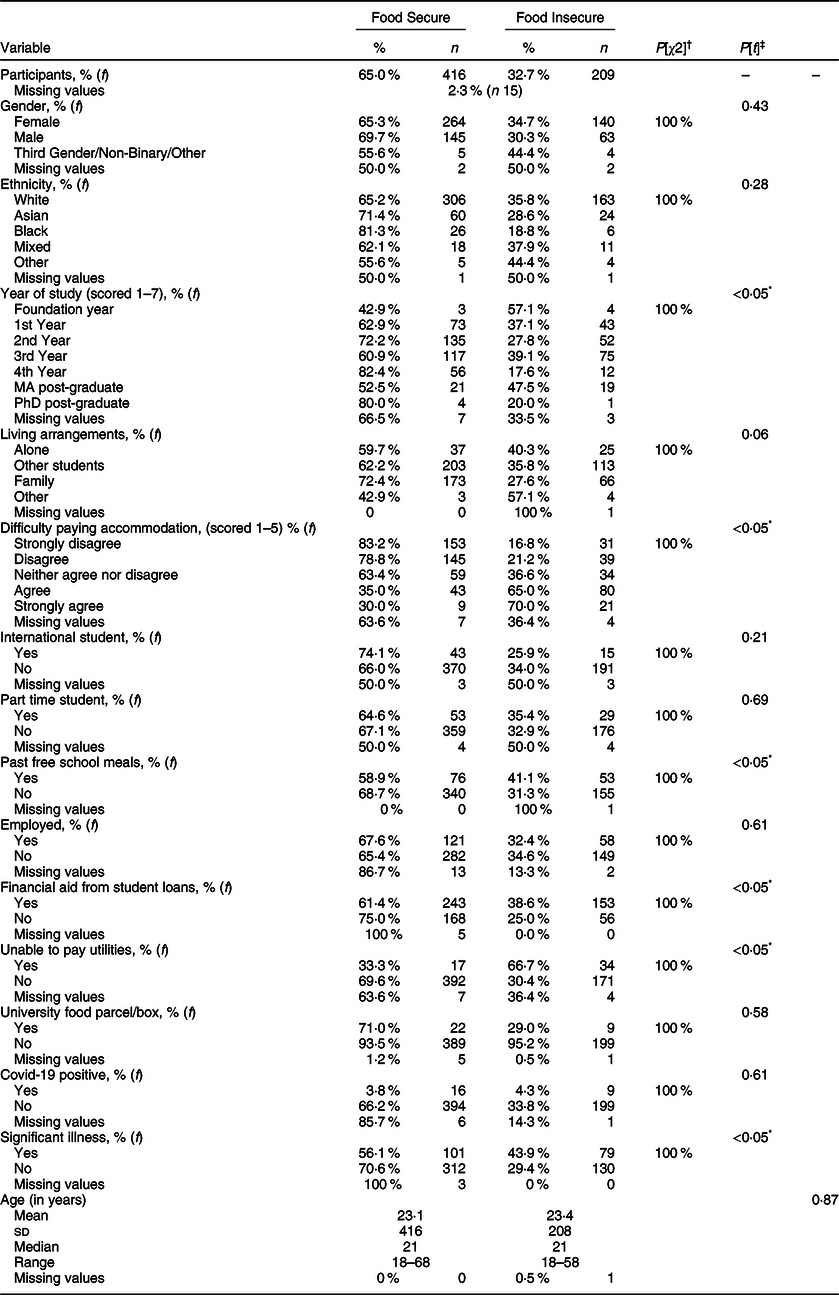
First, we examined bivariate results for predictor variables and student food insecurity. These results are presented in Table 1 and compare frequency distributions for students who say they are food secure (n 416 or 65 %) to frequency distributions for students who say they are food insecure (n 209 or 32·7 %). As Table 1 suggests, some interesting patterns appear in these data.
Characteristics of 640 UK university students according to food security status, October 2020
* Reject null hypothesis, α level = 0·05.
† P value for χ2 test of independence.
‡ P value for two sample t test, 2-sided.
However, in these data food security/insecurity depended on year of study X2 = 19·4, 5 df, P < 0·05). On the one hand, 57 % (or four in seven) of foundation year students were food insecure, 47·5 % (or 19 in 40) of MA post-graduates were food insecure, 39·1 % (or 75 in 192) of 3rd year students were food insecure and 37·1 % (or 43 in 116) of first year students were food insecure. On the other hand, 27·8 % (or 52 in 187) of second year students were food insecure, 17·6 % (or 12 in 68) of fourth year students were food insecure and 20 % (or one in five) of PhD students were food insecure.
Students who had a history of receiving financial aid, relied heavily on student loans, were unable to pay utilities and/or agreed that they were struggling to pay for their accommodation reported higher mean food insecurity scores than those students who did not rely on financial aid from student loans or faced past or present financial hardship. First, 41·1 % (or 53 in 129) of all students who received means-tested free school meals in the past were food insecure compared with 31·3 % (or 155 in 495) who had not received free school meals (X2 = 4·6, 1 df, P < 0·05). In addition, 38·6 % (or 153 in 396) of students who relied on financial aid from student loans said they were food insecure, whilst 25 % (or 56 of 224) who did not receive financial aid from student loans were food insecure (X2 = 11·9, 1 df, P < 0·05). In addition, a large proportion of students (i.e. 66·7 % or 34 in 51) who were unable to pay their most recent utility bill were food insecure whilst a much smaller 30·4 % (or 171 in 563) of students who paid their most recent utility bill were food insecure (X2 = 27·5, 1 df, P < 0·05). As might be expected, nearly 70 % (or 21 in 30) of students who ‘strongly agreed’ they had trouble paying their accommodation reported they were food insecure compared with 16·8 % (or 31 in 184) of students who were food insecure but ‘strongly disagreed’ that they had trouble paying for their accommodation (X2 = 108·8, 4 df, P < 0·05).
Finally, as noted, we found that students who reported being significantly ill during the first weeks of the pandemic were much more likely to report being food insecure. During the pandemic, 43·9 % (or 79 in 180) of students who were ill reported that they were food insecure whilst 29·4 % (or 130 in 442) of those who were not ill reported being food insecure (X2 = 12·0, 1 df, P < 0·01).
Multivariate results
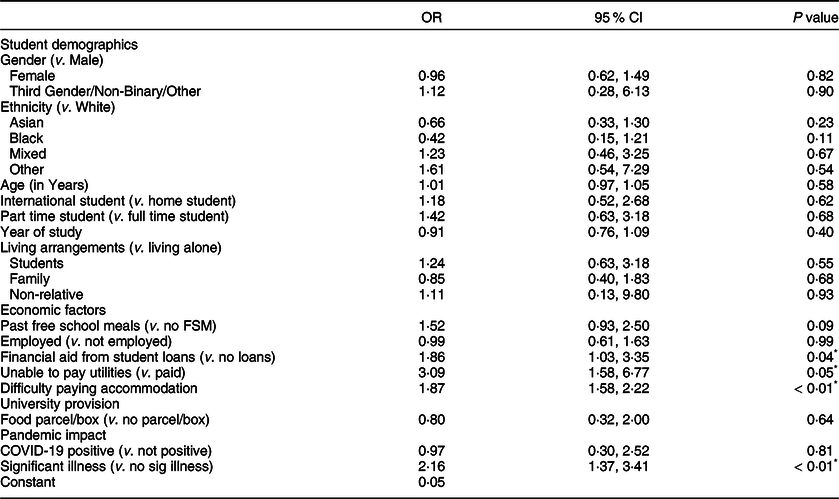
Logistic regression simultaneously estimated OR for all predictors of food insecurity in the UK student sample. When analysing sample data using logistic regression, we used listwise deletion. As a result, the multivariate analysis examined n 555 participants who provided us with answers to all questions used to create the variables included in Table 1. The results of the analysis are presented in Table 2. The table provides the OR and 95 % CI for those ratios. Table 2 explains an estimated 28 % of the variance in student food insecurity (i.e. Cox-Snell R 2) suggesting the model is reasonably specified.
Multivariate logistic regression model for the OR of being food insecure, October 2020
n 555.
-2LL = 585·06.
Pseudo R2 = 0·18.
* Reject the null hypothesis, α level = 0·05.
Turning to the results in Table 2, we found little evidence that gender, ethnicity, age, student status or living arrangements matter when it comes to food insecurity, when economic and pandemic factors are controlled. Whilst student demographics were not statistically significant indicators of food insecurity, economic factors did stand out as potentially important factors in predicting food insecurity. For instance, relying on financial aid from student loans (v. not relying on financial aid from student loans) increased the odds of being food insecure by a factor of 1·9; and being unable to pay your utility bill (v. paying your utility bill) increased the odds of being food insecure by a factor of 3·1. Each increase in a category of agreement that accommodation is difficult to pay was associated with an increase in the odds of being food insecure by a factor of 1·9 (P < 0·05). We also discovered that being ill increased the odds of being food insecure by a factor of 2·2.
Results for ordinary least squares regression where affirmative responses to the six items AFSSM were used as the outcome variable were similar in that the same economic factors and illness variable were statistically significant with two exceptions (see Appendix A). Receiving a free school meal increased the predicted number of affirmative answers to the six items of the AFSSM by 0·62 (P < 0·01); being unable to pay utilities increased the number of affirmative answers by 1·12 (P < 0·01) and each category increase in difficulty paying for accommodation increased the number of affirmative answers on the scale by 0·50 (P < 0·01). We also found that significant illness increased the predicted number of affirmative answers to the six items of the AFSSM by 0·57 (P < 0·01). However, students who received loans to pay for university no longer had different levels of food insecurity than those who did not receive loans (P = 0·06).
Discussion
The results within the present study highlight that a range of economic factors were significantly associated with UK student food insecurity during the COVID-19 pandemic. Unlike prior studies of student food insecurity(Reference Payne-Sturges, Tjaden and Caldeira26,Reference Bolton and Lewis27,Reference Broussard31,Reference Matheson and McIntyre32,Reference Marandet and Wainwright35,Reference Frank36) , few student demographic predictors were associated with food insecurity in the analyses. Thus, the results are unique in that demographic factors have been found to be important in other non-pandemic settings.
Students who were in receipt of loans and students who reported difficulties paying for household utilities and accommodation fees were more likely to be food insecure than those not facing these challenges. As a result, variables that indicated students were facing economic hardship played a large role in their food insecurity status in the UK during the COVID-19 pandemic. This result was not unexpected as economic hardship and reliance on financial aid from student loans is often associated with food insecurity(Reference Payne-Sturges, Tjaden and Caldeira26,Reference Defeyter, Stretesky and Long42) . Being from a low-income household and holding personal debt, as is the case for many students taking out loans during university, have been shown to significantly relate to poorer financial circumstances, particularly if their family cannot offer additional financial support(Reference Benson-Egglenton30). Moreover, those in receipt of financial aid from student loans often have a higher likelihood of food insecurity(Reference Benson-Egglenton30,Reference Broussard31) , and those without the financial capabilities to pay their higher education fees outright may be less able to pay for other resources, such as food and bills(Reference Morris, Smith and Davis51), or need to prioritise their finances to pay for fixed bills such as utilities and accommodation over shopping for food(Reference Defeyter, Stretesky and Long42). These previously recognised challenges, alongside specific challenges resulting from the COVID-19 pandemic and heightened home energy consumption during lockdown(Reference Aimee, Baker and Brierley52), may have contributed further to the findings of the current study.
Unexpected costs, both for students and their families, during the pandemic may have also contributed to the lack of significant findings regarding students’ living arrangements; opposing previous literature which typically demonstrates students who live with family to be most food secure(Reference Owens, Brito-Silva and Kirkland5). In other words, restricted family household income alongside high energy and food prices may have decreased the ‘home advantage’. Moreover, the present study only asked participants where they lived during term-time, and it is unclear whether participants stated where they typically live during term-time, or where they were living during the COVID-19 pandemic. As living arrangements are strong predictors of student food insecurity in many US-based studies(Reference Owens, Brito-Silva and Kirkland5,Reference Davitt, Heer and Winham39) , this factor should continue to be studied in future research regarding food insecurity in higher education in the UK.
Whilst testing positive for COVID-19 was not associated with levels of student food insecurity, students who reported significant illness during the pandemic in the present study were more likely to be food insecure. This finding supports prior literature that has identified a relationship between poor physical health and high food insecurity(Reference McArthur, Gutschall and Fasczewski43,Reference Hagedorn, Olfert and MacNell53) and a relationship between food insecurity and poor student mental health, including anxiety and depression in an international context, both with and without the influence of COVID-19(Reference Defeyter, Stretesky and Long42,Reference McArthur, Gutschall and Fasczewski43) . Whilst the present study did not investigate specific illness, it is novel in investigating self-reported illness in UK students during the COVID-19 pandemic and demonstrating a significant association between levels of student food insecurity and overall illness. Thus, whilst the findings from the present study provide a novel addition to the literature in this area, it is unclear whether the self-reported illnesses were associated with COVID-19, or other types of physical or mental illness.
Similarly, the results within the present study demonstrate, at the bivariate level, a significant decrease in food insecurity across years at university; with the highest rates of food insecurity identified for foundation year students, and the lowest levels for students within their 4th year of study or undertaking a PhD programme. Previous literature similarly demonstrates high levels of food insecurity for students who are new to university(Reference McArthur, Fasczewski and Wartinger54,Reference Hiller, Winham and Knoblauch55) . However, the sample size of foundation year students within the present study was small, thus future research should conduct similar work with a larger sample size to determine whether these findings are replicable in a similar UK context. It is important to note that the findings also showed no evidence that distributing food parcels/boxes to HE students affected household food insecurity; suggesting that alternative approaches, such as cash-based models,(Reference Power, Doherty and Pybus56) should be explored by universities.
Many of the other demographic variables investigated within the present study, including gender and ethnicity, were not found to significantly relate to student food insecurity. This is unexpected, as previous research broadly demonstrates significant differences in these demographic factors on levels of food insecurity, typically depicting higher levels of student food insecurity for females than males(Reference Bruening, Argo and Payne-Sturges57) and for students of a non-white ethnicity(Reference Loopstra, Reeves and Tarasuk58). The COVID-19 pandemic resulted in the same restrictions nationally, regardless of demographic characteristics. However, it is unclear whether the COVID-19 pandemic altered these differences based on demographic characteristics or whether they were not prevalent in the current study sample at all. It is also important to highlight that the current study is cross-sectional in nature and therefore cause and effect cannot be inferred from the data collected. Nevertheless, prior research shows support for many of the present study’s findings.
In conclusion, the present study provides novel findings regarding the factors associated with student food insecurity within the UK during the COVID-19 pandemic. Similar to previous research, the findings suggest that a range of economic factors, including receiving a student loan, and finding difficulty paying utilities and accommodation bills, are significantly associated with higher levels of food insecurity. Moreover, reporting a significant illness during the COVID-19 pandemic was also related to increased levels of food insecurity for higher education students within the UK. Refuting previous literature, however, other demographic factors, including gender and ethnicity, were not found to significantly relate to food insecurity. Importantly, food insecurity was prevalent across all groups investigated, which has implications for how government and universities would address this issue in the context of future pandemics, especially in relation to student finances and the distribution of food parcels.
Acknowledgements
The authors would like to thank all individuals who participated in the research.
Financial support
This research received no specific grant from any funding agency, commercial or not-for-profit sectors.
Conflict of interest
There are no conflicts of interest.
Authorship
Conceptualisation: E.K.R., S.W., P.B.S. and M.A.D.; data curation: P.B.S. and M.A.D.; formal analysis: E.K.R., S.W., P.B.S. and M.A.D.; investigation: E.K.R., S.W., P.B.S. and M.A.D.; methodology: E.K.R., S.W., P.B.S. and M.A.D.; project administration: E.K.R., S.W., P.B.S. and M.A.D.; resources: P.B.S. and M.A.D.; supervision: P.B.S. and M.A.D.; validation: E.K.R., S.W., P.B.S. and M.A.D.; visualization: E.K.R., S.W., P.B.S. and M.A.D.; writing – original draft: E.K.R., S.W., P.B.S. and M.A.D.; writing – review and editing: E.K.R., S.W., P.B.S. and M.A.D.
Ethics of human subject participation
This study was conducted according to the guidelines laid down in the Declaration of Helsinki and all procedures involving research study participants were approved by the Northumbria University Ethics Committee. Written informed consent was obtained from all participants.
Ordinary Least Squares Regression Model for the Number of Affirmative Responses to the Six-Item Adult Food Security Survey Module, October 2020

n 555.
F (21, 533) = 8·85.
Adjusted R 2 = 0·22.


 Open access

