Introduction
Whole breast radiotherapy (RT) following breast-conserving surgery is a standard treatment option for women with breast cancer.Reference Darby and McGale1 Delays in breast RT following surgery can increase patient anxiety and negatively impact tumour control.Reference Huang, Barbera, Brouwers, Browman and Mackillop2–Reference Olivotto, Lesperance and Truong4 In the post-lumpectomy breast RT setting, Huang et al.Reference Huang, Barbera, Brouwers, Browman and Mackillop2 found the 5-year local recurrence rate to increase from 5·8% in women treated within 8 weeks to 9·1% in women treated between 9 and 16 weeks post-surgery. Delay longer than 20-weeks post-surgery has been associated with inferior survival outcomes.Reference Mikeljevic, Haward and Johnston3, Reference Olivotto, Lesperance and Truong4 Mikeljevic et al.Reference Mikeljevic, Haward and Johnston3 observed a trend towards an increased risk of death in women who had delays >9 weeks, with a statistically significant increased risk of death (RR1.49, 95%CI: 1·16–1·92) in patients with RT delays of 20–26 weeks post-surgery. With increasing cancer incidence and escalating utilisation of adjuvant RT, efforts to prevent treatment delays are important to ensure optimal local disease control.
Strategies targeted to improve RT wait-times implemented at national, provincial and institutional levels continue to evolve in an effort to ensure timely patient access to treatment while maintaining excellent standards of care.Reference Benk, Przybysz, McGowan and Paszat5–8 The Princess Margaret Cancer Centre Radiation Medicine Program treats over 1,000 women with breast RT annually; >60% with whole breast RT alone. Technological advances in breast RT planning such as the use of computed tomography (CT)-based simulation, planning and intensity-modulated radiation therapy to optimise and enhance patient specific RT treatment was implemented for this large patient population. In 2008, a standardised procedure to delineate the post-operative seroma cavity as part of the breast clinical target volume was implemented for all patients undergoing whole breast RT to ensure optimal dose coverage and better treatment outcomes. While these innovative but time-consuming treatment planning methods enhanced planning accuracy, their use together with the increasing demands for breast RT has added immense workload pressure to the already limited human and machine resources, resulting in delays in the treatment process. With the constraints of a publicly funded health care system and lack of increased departmental funding, there is a need to develop efficiencies within the current treatment process to meet the clinical needs of patients while minimising delays in starting RT treatments.
The purpose of this study was to expedite the breast cancer treatment process and reduce patient wait-times. We developed an inter-disciplinary team and incorporated a validated treatment planning tool to initiate a ‘QuickStart’ RT treatment pathway for women undergoing whole breast RT. In this study, we evaluate the wait-times of the expedited RT process and its impact on patient time to RT treatment compared with the conventional process.
Methods
RT team
A ‘QuickStart’ RT treatment process was initiated in the Radiation Medicine Program through optimising the use of existing resources within the department. Each step of the process was streamlined through contributions of an inter-professional RT team comprised of two radiation oncologists (RO), a breast-site advanced practice clinical specialist radiation therapist (CSRT), dosimetrists (planners), medical physicists, quality assurance (QA) radiation therapists and treatment unit therapists. The CSRT position is a Cancer Care Ontario (CCO) initiative funded by the Ministry of Health and Long-Term Care to increase staffing flexibility, improve system efficiencies and increase access to cancer care.9, 10 The CSRT is a master’s-prepared radiation therapist with a certification in Medical Dosimetry. Clinical training for the CSRT was provided by breast specialist ROs in areas of breast anatomy, natural history, management, physical assessment and RT treatment. With advanced clinical training and competencies,Reference Lee, Fyles and Cho11, Reference Lee, Harnett, Zychla and Dinniwell12 the CSRT provided support and care for the patients during the QuickStart process. Upon confirmation of a patient’s appointment, treatment details were communicated to all individuals within the team.
RT process
Women seen following breast-conserving surgery by a RO involved in the QuickStart process and suitable for whole breast RT were eligible. Patients were scheduled into dedicated CT simulation and treatment unit appointments. All patients were scanned on a CT simulator according to the standard departmental whole breast procedure. Patients were immobilised using the MEDTEC breast board (MEDTEC, Orange City, IA, USA) in the supine position, with the ipsilateral arm abducted >90°. Radio-opaque markers were placed on the clinically palpable ipsilateral breast and the surgical scar. The CSRT assessed the images on-site as a preliminary review of the clinical and technical parameters of the patient, and performed seroma delineation, which was reviewed and approved by the RO before planning. The planner developed patient specific plans using automated breast planning software, which can generate whole breast RT plans in 5–6 minutes.Reference Purdie, Dinniwell, Letourneau, Hill and Sharpe13, Reference Purdie, Dinniwell, Fyles and Sharpe14 Automated planning is the standard method for treating tangential breast RT at our institution and has been used to treat >2,400 patients since 2009.Reference Purdie, Dinniwell, Fyles and Sharpe14 With the exception of manual seroma target delineation, the software automates breast target delineation, field placement, modulation and generates a detailed quality report. The documentation reports dosimetric and plan data scored against our institutional clinical criteria; including dose–volume analysis for all relevant target and organ at risk volumes, beam analysis in terms of beam weighting, segmentation and modulation complexity. The treatment plan was subjected to the same departmental breast RT QA checks before the initiation of treatment including review of target volume, dose coverage to breast target, dose to organs at risk (ipsilateral lung, heart), tangential field design, dose distribution, prescription dose and dose–volume histogram. Individual patient plans were routinely peer-reviewed through weekly site-based QA rounds to ensure both accuracy and quality. Any clinical deficiencies identified through the QA rounds or error incidences reported via departmental reporting mechanisms were recorded.
Wait-times
The wait-time intervals were prospectively captured at various points of the RT process for QuickStart patients: patient entry/depart (CT Simulation), target delineation, plan approvals (planner/physics/RO), radiation therapy quality checks (planner/therapist/treatment unit) and patient entry/departure (treatment unit).
To assess the detailed wait-time reductions compared with the standard process, a subgroup analysis was performed on the initial 25 patients through the QuickStart process. They were matched to 25 patients who underwent CT simulation for whole breast RT on the same day (±3 days) and were planned using the conventional process. The dates of last surgery (primary or re-excision), chemotherapy (if applicable), RO consultation and RT consent were captured retrospectively. A period of 4-weeks (30 days) planned healing time after their last surgery or chemotherapy (Last Surgery/Chemotherapy) is typical to ensure patient recovery, following which patients would be assessed by the RO and consented if they are considered ready to commence RT treatment. Based on recommendations of our provincial cancer agency, CCO, patients undergoing radical whole breast RT should wait no more than 14 days to start RT after they are medically and personally ready for treatment.15 The wait-time between the patient’s consent to the first RT treatment (consent-to-RT) would capture those patients who waited beyond the recommended CCO targets.
All wait-time measurements were summarised using descriptive statistics. A two-tailed Student t-test was used to compare all continuous variables; p-value≤0·05 was considered as statistically significant. Data analysis was performed with the SPSS (SPSS Inc., Chicago, IL, USA) statistical package.
Results
QuickStart process
From 2010 to 2013, 100 patients were booked for the QuickStart process and completed CT simulation for whole breast RT. A total of 27 patients did not start treatment at the scheduled QuickStart time due to: (i) patients required heart sparing treatment using deep inspiration breath hold (as per our institutional policy),Reference Wang, Purdie, Rahman, Marshall, Liu and Fyles16 necessitating another CT simulation on a subsequent day (n=7), (ii) patients preferred to postpone/cancel treatment (n=9), or patients required a treatment delay based on the clinical decision of the RO for issues relating healing time, additional surgery for close resection margins, information gathering for previous contralateral breast RT, technique change for body habitus and target change for inclusion of nodal volumes (n=11).
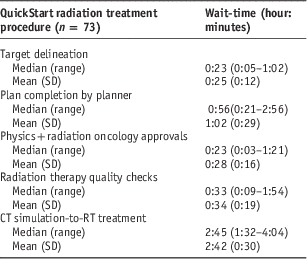
A total of 73 patients continued the treatment process as planned and started their RT treatment on average 2 hours 42 minutes (SD 0:30) after their CT simulation; the median times from CT scan to target delineation, plan completion (planner), plan approvals and radiation therapy quality checks were 0:23, 0:56, 0:23 and 0:33 minutes, respectively (Table 1); 50% of patients started treatment within 2 days or less after consenting to RT (consent-to-RT: median=2 days; range: 0–13); all patients were treated in advance of the 14-day CCO wait targets. Standard departmental breast RT QA checks performed before the initiation of RT treatment showed no clinical or technical deficiencies in any of the plans. The multi-disciplinary site-based QA rounds evaluated the appropriateness of the prescribed treatment plan and demonstrated 100% compliance of each plan to departmental protocol. No error incidences were associated or reported for any patients treated through the QuickStart process.
Summary of wait-times for QuickStart breast radiotherapy process
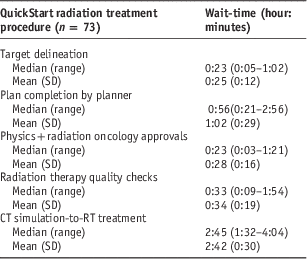
Abbreviations: SD, standard deviation; CT, computed tomography; RT treatment, first fraction of radiotherapy treatment.
QuickStart and conventional process
The initial 25 patients treated through the QuickStart process were included in a subgroup analysis for wait-time comparison with the standard planning process. These patients had similar RT wait-times as the remaining 48 QuickStart patients; there were no significant differences observed in their mean wait-times from CT simulation to first RT (2:47 versus 2:40, p=0·384) and consent-to-RT (70:00 versus 78:46, p=0·679).
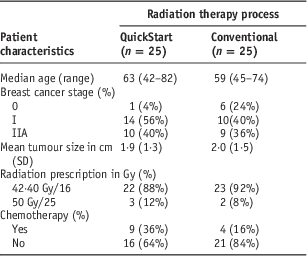
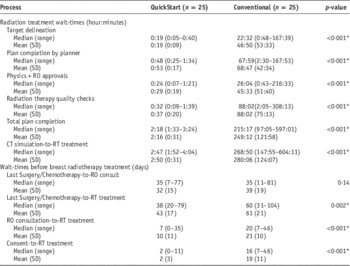
In the subgroup analysis, the 25 QuickStart patients had similar tumour and treatment characteristics as their matched cohorts treated through the conventional process (Table 2). Table 3 presents a summary of the RT process wait-times for both patient cohorts. The median time required for the QuickStart team to complete the entire treatment plan was 2 hours and 18 minutes (range: 1:33–3:24). On average, patients waited 2 hours 50 minutes (SD 0:31) following their CT simulation to the start of first RT treatment. This represented an average decrease of 11 days of waits in starting RT treatment for QuickStart patients compared with those treated through the conventional process.
Patient characteristics of the initial QuickStart subgroup compared with conventional planning cohort
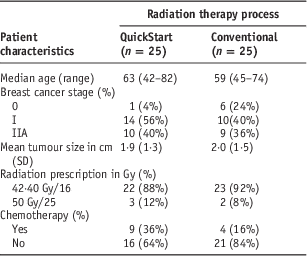
Abbreviations: SD, standard deviation; Gy, Gray.
Summary of breast patient wait-times before and during radiotherapy process of the initial QuickStart subgroup compared with conventional planning cohort

Notes: *Statistically significant p<0·05.
Abbreviations: SD, standard deviation; CT, computed tomography; RO, radiation oncology; RT treatment, first fraction of radiotherapy treatment.
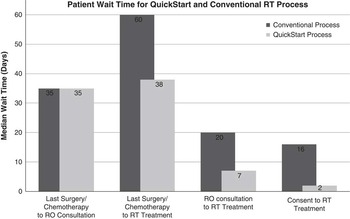
While, there was no difference between the patient cohorts in the median time they waited to access RO consultation after their Last Surgery/Chemotherapy (Table 3), patients treated through the conventional process waited significantly longer to start RT treatment following their RO consult (median 20 days for conventional versus 7 days for QuickStart, p<0·001) and after consenting to RT treatment (16 versus 2 days, respectively, p<0·001). The median wait from Last Surgery/Chemotherapy-to-RT treatment start was 60 days (range: 31–104) for patient in the conventional process and 38 days (range: 20–79) (p=0·002) for the QuickStart process (Figure 1).
Discussion
The avoidance of recurrence is one of the highest priorities for curative breast cancer patients, and they prefer to commence treatment as early as possible following their recovery from surgery and/or chemotherapy. It is typical for patients to wait a period of 30 days post-surgery or chemotherapy for recovery before initiating RT and during this time they are consulted by an RO. The patients treated through the conventional process are representative of the expected wait-times within our RT department. They waited a median of 60 days (range: 31–104) to start RT treatment after their surgery or last chemotherapy. Previous studies have shown that delays of >9 weeks in the post-surgery breast RT setting may impact on treatment outcome,Reference Huang, Barbera, Brouwers, Browman and Mackillop2, Reference Mikeljevic, Haward and Johnston3 thus suggesting that up to 50% of our conventional process patients have incurred delays that may potentially impact on their disease control. The QuickStart process significantly reduced both the median Last Surgery/Chemotherapy-to-RT treatment wait-time to <5·5 weeks (38 days) and consent-to-RT treatment waits to 2 days, thereby compensating for the pre-RT wait-time delays and avoiding potential negative impacts on their treatment outcomes.
Patient wait-times have long been problems in countries with publicly funded health care systems.Reference Mikeljevic, Haward and Johnston3, Reference Benk, Przybysz, McGowan and Paszat5, Reference Bouche, Ingrand, Mathoulin-Pelissier, Ingrand, Breton-Callu and Migeot17, Reference Jack, Davies, Robinson, Sainsbury and Moller18 Without additional resources to expand the existing centre capacities, the use of an inter-professional team model like QuickStart can enhance process efficiency in RT treatment delivery. An inter-professional team allows optimisation and coordination of the treatment process through active communication and reducing delays in hand-over to ensure a smooth passage of treatment plans through the process. In various cancer centres, inter-professional programmes and clinics dedicated to providing rapid timely access for palliative RT have been implemented and their effectiveness is well documented.Reference Pituskin, Fairchild and Dutka19–Reference Danielson and Fairchild23 Through optimising and co-ordinating referrals and treatment processes, palliative patients were assessed, simulated, planned and treated in 1 day. The provision of care offered by an inter-professional team of ROs, nurses, radiation therapists and research students in one Rapid Response Radiotherapy Program enables 85% of patients to be simulated on the same day of consultation, and 60% underwent treatment on the same day.Reference Danjoux, Chow and Drossos20 Fairchild et al.Reference Fairchild, Pituskin and Rose22 describes the success of a ‘fast track’ 1-day clinic specialised in seeing patients with bone metastases suitable for RT. While we recognise that the intent of palliative treatment in providing emergent care is different from radical breast RT, nonetheless, these studies demonstrate the clinical feasibility and efficiency gains of RT process delivered through an inter-professional team model and reorganisation of planning logistics. We foresee a team model approach can be adopted in other cancer centres to expedite the treatment process.
Within the inter-professional team, the clinical involvement and role expansion of the suitably trained health care professionals can improve system efficiency. The CSRT’s involvement in target delineation for the oncologist’s review and approval allows for increased workload flexibility of the RO, allowing them to dedicate time to other complex patient cases and seeing additional new patients; resulting in a more efficient and cost-effective model of care. It is anticipated that the provision of care offered by the CSRT in the QuickStart process can be equally provided by suitably trained dosimetrists or radiation therapists as dictated by the need and available expertise of the local cancer centre. Other studies showed that involvement of specially trained dosimetrists or radiation therapists in target and organ at risk contouring can enhance patient throughput, decrease wait-times and increase system efficiencies.Reference Fitzpatrick, Kelly and Thirion24–Reference Bristow, Saloojee, Silveira, Vakani and Turner28 Boston et al.Reference Boston, Scrase and Hardy25 observed a reduction of 7·5 working days in planning time with the involvement of a trained radiation therapist in target delineation for prostate RT. The role of the head and neck contour specialist (CSRT or internationally trained RO) improved wait-times from CT simulation to treatment start by 2 days and saved ~51 minutes of RO contouring time per patient.Reference Chan, Vakilha and Waldron26 Thus, the development of collaborative models of care can be incorporated through specialised training and role development in existing staff to carry out extended roles.
Beyond the inter-professional team model, the application of planning technologies into the RT process can reduce patient wait-times. While conventional breast RT planning methods may take a few hours to design, automated planning software can reduce dosimetrist workload by reproducibly generating treatment plans in <10 minutes.Reference Purdie, Dinniwell, Fyles and Sharpe14 Application of similar automated planning methods in breast, prostate, head and neck, and anal canal disease sites have demonstrated numerous benefits including improved treatment planning consistency, efficiency and plan quality.Reference Pierburg, Kashani and Baker29–Reference Nguyen, Cao and Ramaseshan32 Although presently limited in accessibility, automated planning tools will undoubtedly continue its integration into current and future clinical practiceReference Purdie, Dinniwell, Letourneau, Hill and Sharpe13, Reference Xhaferllari, Wong, Bzdusek, Lock and Chen30, Reference Nguyen, Cao and Ramaseshan32, Reference Zhao, Kong and Jozsef33 and adoption of these technologies will reduce human resources resulting in direct cost-savings to the department while securing timely RT treatment delivery.
Conclusions
In our current RT environment faced with increased patient numbers and complex RT treatments, we strive to achieve innovative ways to optimise the usage of existing resources to manage workload. Through inter-disciplinary team efforts and the application of automated planning software, we have achieved a RT process that effectively shortens patient wait-time while providing the same quality and effective RT treatment. Similar expedited RT processes can be developed in other contemporary RT programmes through advanced training and education of dedicated RT staff and the adoption of planning technologies to increase cost-effectiveness and planning efficiencies within the RT care pathway.
Patient wait-time for QuickStart and conventional RT process. Abbreviations: RT, radiotherapy; RO, radiation oncologist.

Acknowledgement
The authors would like to thank the Radiation Medicine Program Breast Site Group at the Princess Margaret Cancer Centre for their contributions to the implementation of this project.
Financial Support
Salary support for the Clinical Special Radiation Therapist was provided by the Ontario Ministry of Health and Long-Term Care as part of the CSRT Demonstration Project at Cancer Care Ontario. Automated treatment planning development was funded by Canadian Breast Cancer Foundation – Ontario Region.