Introduction
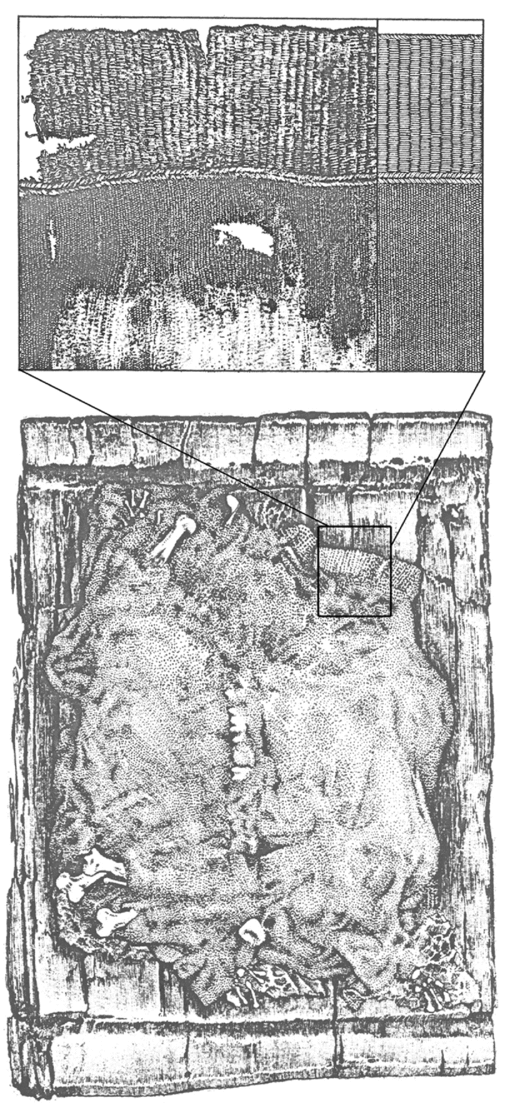
In volume 64 of Antiquity, Alojz Benac presented a short note on a group of tumuli with exceptional organic preservation that he had excavated in 1980–1984 in the valley of Kupreško polje in south-western Bosnia (Benac Reference Benac1990). One of them, Pustopolje tumulus 16, contained a burial with a wooden coffin, parts of a sledge, skin, grass and the skeletal remains of a man who had been covered with a thick woven wool textile. Benac did not attempt to describe the textile except for a drawing illustrating how it covered the entire burial. In an earlier publication, a detail of the fabric border was also shown (BenacReference Benac1986: 109) (Figure 1). The textile did not quite elude the attention of scholars (Bender Jørgensen Reference Bender Jørgensen1992: 103; Grömer Reference Grömer2016: 126, 361), and as the Yugoslavian Wars (1992–1995) made communications difficult, the Pustopolje textile has not been given the attention it deserves. This has recently been remedied. It has been examined, restored and re-dated, and is now on display in the Franciscan Museum and Gallery Gorica in Livno, Bosnia and Herzegovina (Marić Baković & Car Reference Marić Baković and Car2014). In 2011, two of the present authors visited the museum in Livno to examine the textile. Dye analysis, wool analysis and radiocarbon dating have also been carried out.
The Pustopolje burial and detail of the textile. (After Benac Reference Benac1986.)

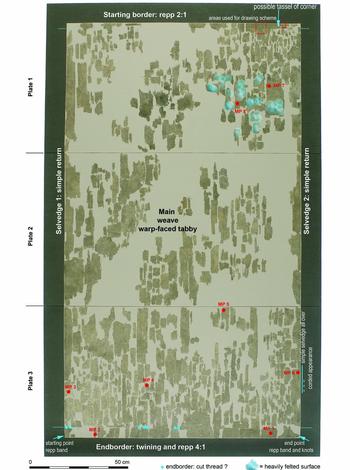
The textile from Pustopolje has been radiocarbon dated to the fifteenth century BC, which makes it the earliest large woollen textile in Europe. It is 1.7m wide and 3m long; although fragmented, almost all of the borders and selvedges are preserved. This means that it is technically complete, which makes it an important source for understanding the beginnings of wool production and the use of textiles in the Bronze Age. This article is the first presentation of the Pustopolje textile (Figure 2) to supply a technical description including information on dating, fibre and colour, followed by a discussion of this magnificent item in the context of contemporaneous Bronze Age textiles, textile technology and possible use.
Overview of the Pustopolje textile. Points of examination (MP/measure points) are marked in red, with felting shown in blue. Important constructional features are marked with arrows. (Photograph by Hrvatski Restauratorski Zavod.)

The Pustopolje textile in the Yugoslavian Wars
After excavation and initial restoration, the textile was briefly on display in Kupres, and was then transferred to the Hasan Brkić Museum in Livno. With the outbreak of war in April 1992, the finds had to be evacuated from the museum. Pieces of the coffin were stored in a wooden military chest and sheltered at the Orlovac Hydropower Plant in Podgradina near Livno; the textile and the remains of the deceased were placed in the basement of the Franciscan monastery in Livno. At the end of the war, the collections of the Hasan Brkić Museum were merged with those of the Franciscan monastery to create the Franciscan Museum and Gallery Gorica Livno.
Conservation, reassessment and restoration
Before being put on display, the Pustopolje textile was restored in the Hrvatski Restauratorski Zavod in Zagreb by textile conservator Gordana Car and her colleagues (Marić Baković & Car Reference Marić Baković and Car2014). The textile had been stored between glass layers, in the form of two plates, each measuring 1.43 × 1.07m. The 596 fragments that now constitute the textile were cleaned, analysed and rearranged. This led to a surprise. Benac (Reference Benac1986) had assessed the size of the textile as 1.7 × 2m; the conservators were able to confirm Benac's assessment of the width of the fabric as 1.68m using the two transverse borders that were preserved, but they found that the fabric must have been at least 3m long, as fragments of the two selvedges total no less than 5.7m. After conservation, the fragments were laid out within the four woven borders according to nuances of colour, width and spots. They were then placed on boards of acid-free cardboard and covered with fine monofilament netting that was sewn with silk thread onto the beige cotton fabric chosen as background. During the restoration process, Stana Kovačević from the University of Zagreb, Faculty of Textile Technology, investigated the textile before it was shielded with a protective cover in the form of a monofilament netting (described in Marić Baković & Car Reference Marić Baković and Car2014). The textile was then catalogued as FMGG 6974.
Radiocarbon dating
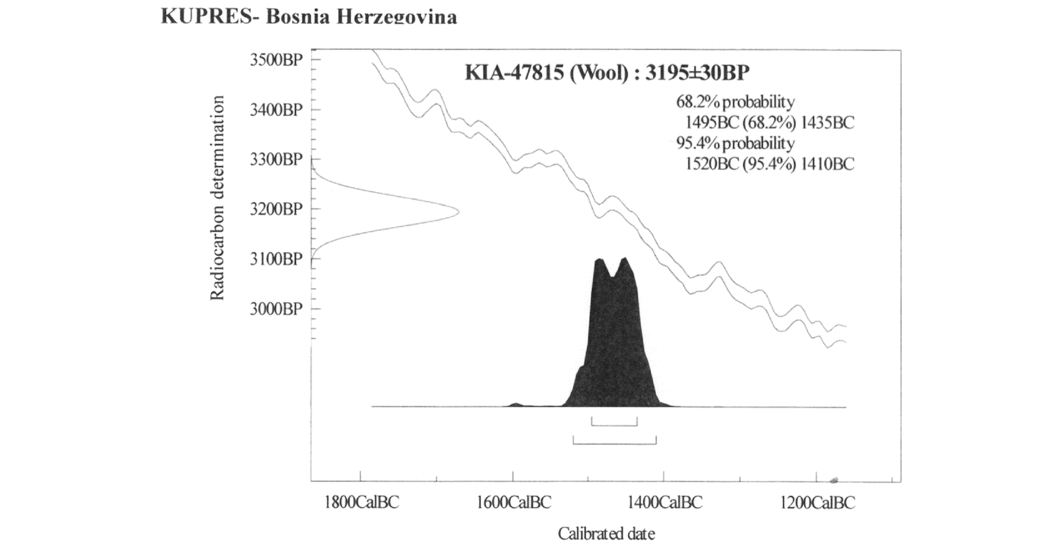
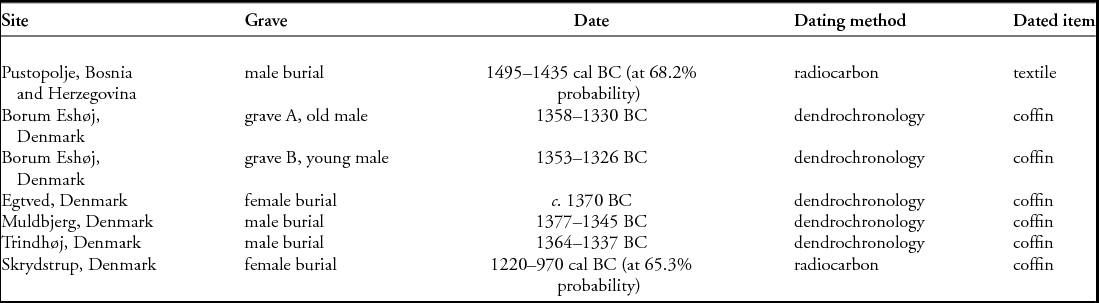
The original dating of the Pustopolje burial (3660±120 cal BP) was limited to samples of the timber structure (Benac Reference Benac1990: 331). Since then, it has become possible to date the textiles themselves by radiocarbon. A sample of the Pustopolje textile was dated by Mark Van Strydonck of the KIK/IRPA in Brussels (Lab-Code: KIA-47815; Van Strydonck Reference Van Strydonck2012) to 3195±30 cal BP, i.e. between 1495 and 1435 BC at 68.2% probability, and between 1520 and 1510 BC at 95.4% probability (Figure 3). It was pre-treated with chloroform twice by immersing it for 15 minutes in an ultrasonic bath to eliminate the polyvinylacetate. Afterwards, the sample was pre-treated with the solvents hexaneaceton-ethanol and Milli-Q water in the ultrasonic bath. Infrared spectroscopy did not detect any PVA after pre-treatment (Van Strydonck Reference Van Strydonck2012). The dating makes the Pustopolje textile approximately a century older than the famous well-preserved garments and textiles found in oak-log coffins in Denmark (Broholm & Hald Reference Broholm and Hald1940; Christensen Reference Christensen2006; Randsborg Reference Randsborg2011: 139) (Table 1).
Radiocarbon dating of the Pustopolje textile (Bronk Ramsey Reference Bronk Ramsey2005; Reimer et al. Reference Reimer, Baillie, Bard, Bayliss, Beck, Blackwell, Bronk Ramsey, Buck, Burr, Edwards, Friedrich, Grootes, Guilderson, Hajdas, Heaton, Hogg, Hughen, Kaiser, Kromer, McCormac, Manning, Reimer, Richards, Southon, Talamo, Turney, van der Plicht and Weyhenmeyer2009).

Dates of Bronze Age graves with large textiles, based on Christensen (Reference Christensen2006) for Danish finds.

Wool
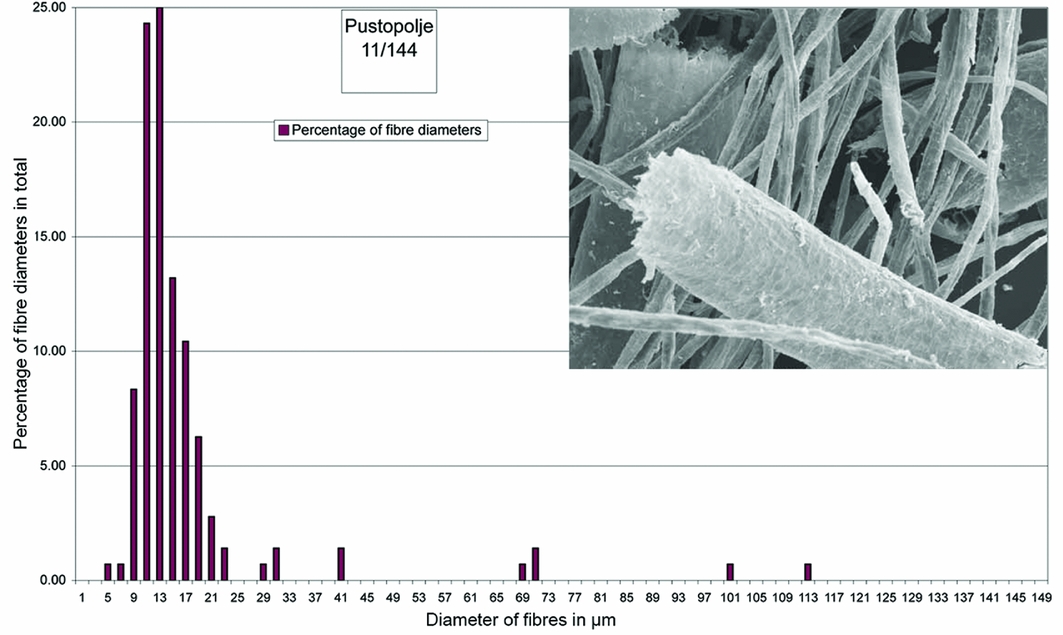
Wool analysis and measurements have been carried out by Antoinette Rast-Eicher of ArcheoTex on four samples from the Pustopolje textile (Rast-Eicher & Bender Jørgensen Reference Rast-Eicher and Bender Jørgensen2013). All showed the same type of wool, where very fine fibres were combined with very coarse ones (Figure 4). This kind of wool is typical of the Bronze Age, although most other finds show evidence of wool sorting (Rast-Eicher & Bender Jørgensen Reference Rast-Eicher and Bender Jørgensen2013). The coarse fibres (kemp) range around (or over) 100μm in diameter. The scales of the kemp fibres are either polygonal-net-like or horizontal lines; longitudinal pleats and breaks indicate some shrinkage (Figure 4). The Pustopolje wools belong to category D as defined by Rast-Eicher (Reference Rast-Eicher2008: 155). The fine fibres were probably slightly pigmented; the kemp appears light with a large dark medulla.
Wool from the Pustopolje textile. Top: Pustopolje sample 11/147. Large fibres with net-like or horizontal-scale pattern (photograph by Antoinette Rast-Eicher). Bottom: Pustopolje sample 11/144. Histogram of wool measurements. Inset: detail of the textile's surface, showing coarse kemp fibres. (Photograph by Hrvatski Restauratorski Zavod.)

The best comparison to the Pustopolje wool comes from mouflon fibres from Sardinia (Rast-Eicher & Bender Jørgensen Reference Rast-Eicher and Bender Jørgensen2013). The European mouflon (Ovis ammon musimon) is a wild remnant of early domesticated sheep (Rezaei et al. Reference Rezaei, Naderi, Chintauan-Marquier, Taberlet, Virk, Naghash, Rioux, Kaboli and Pompanon2010). A sample of mouflon fibres shows the same type of large fibres, some with net-like scales, others with fine horizontal lines. The wool of a textile from Lenk-Schnidejoch, dated to 1891–1634 cal BC, resembles the Pustopolje wool (Rast-Eicher Reference Rast-Eicher and Hafner2015). Further parallels may be found in the wools from Hochkönig-Mitterberg, dated to 1600–1500 BC (Rast-Eicher & Bender Jørgensen Reference Rast-Eicher and Bender Jørgensen2013), and Castione dei Marchesi in Italy, dated to 1600–1200 BC (Gleba Reference Gleba2012: 3645). All of these show indications of wool sorting, as most of the coarse fibres have been removed.
Dyestuffs
Dyestuff analyses have been performed by Maarten van Bommel and Ineke Joosten of the Cultural Heritage Agency of the Netherlands, and Regina Hoffmann-de Keizer of the University of Applied Arts in Vienna (Hofmann-de Keijzer Reference Hofmann-de Keijzer and Grömer2016: fig. 84; and an unpublished report by Van Bommel et al. Reference Van Bommel, Joosten and Hofmann-de Keijzer2012). The fibres of the textile fragments were examined by optical light microscopy (OLM) and scanning electron microscopy coupled to energy-dispersive spectroscopy (SEM-EDS). The fibres are very clean, and the typical scales are still visible. They show many tears and fractures indicating mechanical stress. Their surfaces contain holes that might have been caused by microbes.
High performance liquid chromatographic analysis indicated the presence of unknown yellow and red components in two samples. The yellow components belong to the flavonoid dye classes that are also found in weld, saw-wort, dandelion and camomile, but an exact identification was not possible. The red components found could not be linked to any known plant species. They could be products of degradation products, or they could indicate the presence of an unknown (possibly local) plant. It cannot be excluded, however, that the colouring components originate from the archaeological environment. The composition of the two samples was very similar, yet in sample 5, an unknown orange component was found that is probably not a dye but could be a marker of peat bog or body fluids (Van Bommel et al. Reference Van Bommel, Joosten and Hofmann-de Keijzer2012).
The construction of the textile
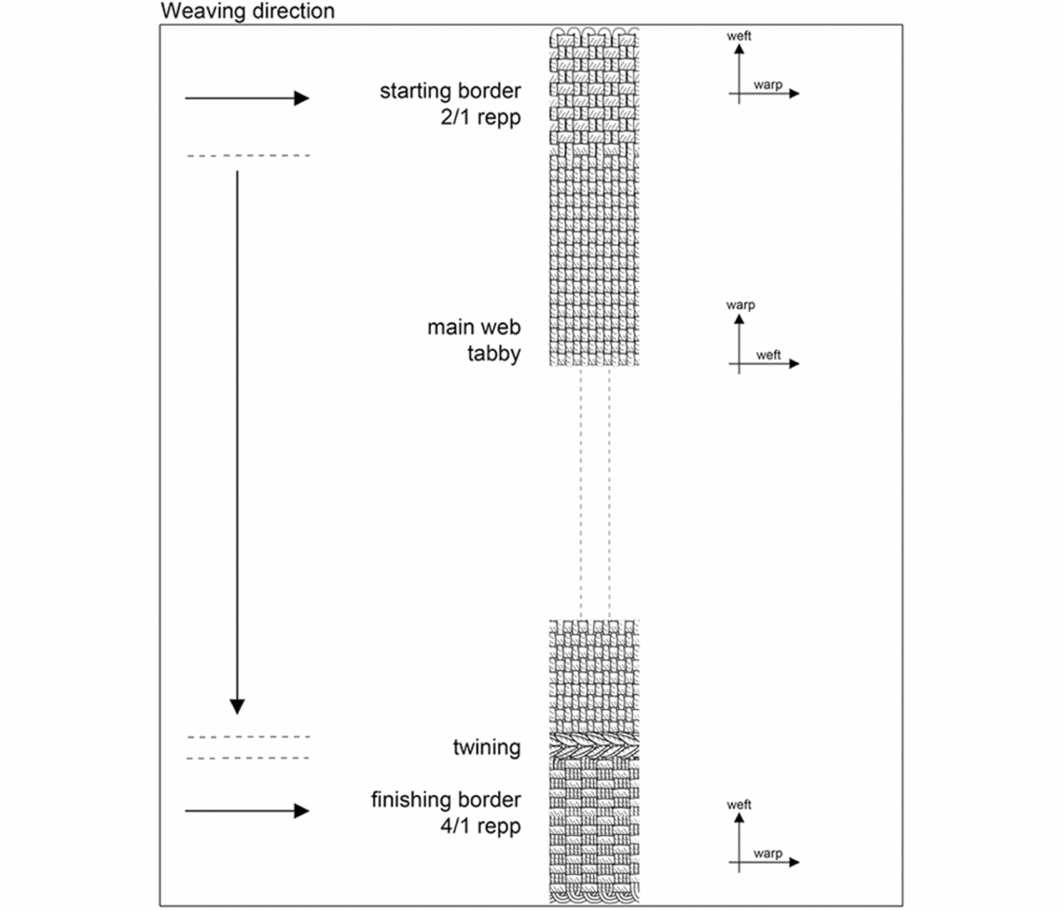
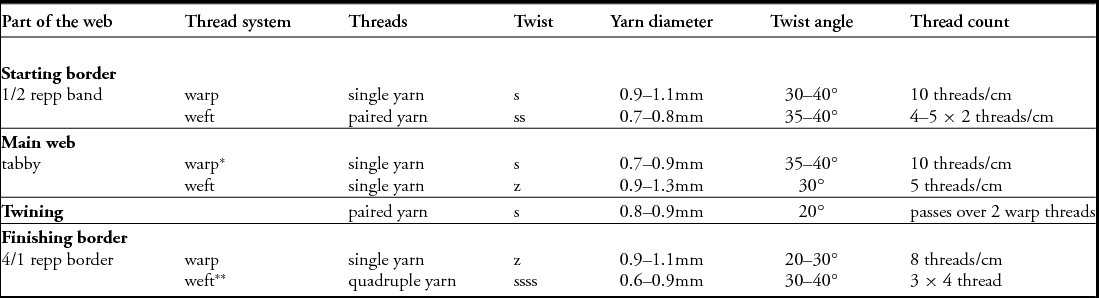
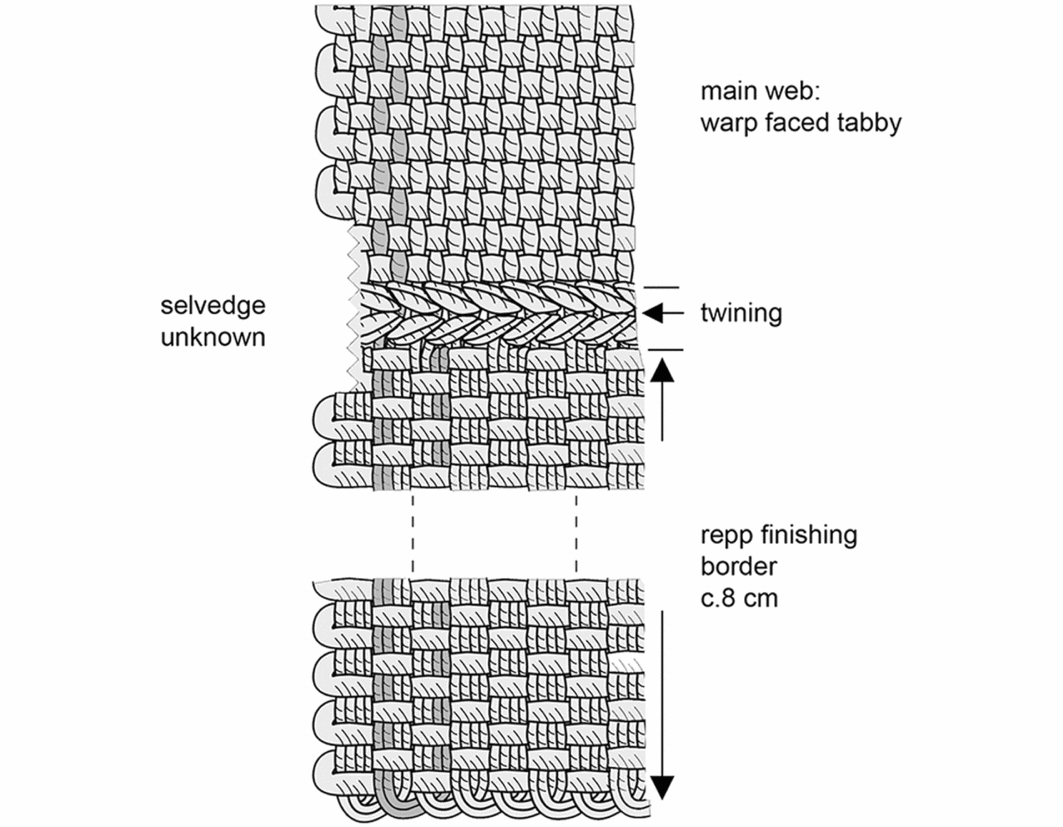
The Pustopolje textile is woven in tabby. It is made with a repp starting border, a main web with simple selvedges and an elaborate finishing border (Figure 5 & Table 2).
The overall construction of the Pustopolje textile. Arrows indicate the direction of weaving in each of the three stages of production: the starting border, the main web and the finishing border. The weft of the starting border becomes the warp of the main web and turns into the weft of the finishing border. (Drawing by Karina Grömer.)

Technical data of the Pustopolje textile. Note that the warp of the main web is the weft of the starting border, and that the weft of the finishing border is the warp of the main web.

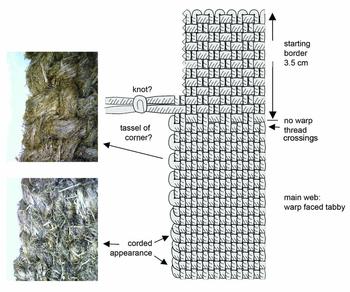
The starting border is approximately 35mm wide, and was constructed as a 1/2 repp band. The paired weft of the band turns into the warp of the main web (Figure 6; cf. Hoffmann Reference Hoffmann1964: fig. 26, Grömer Reference Grömer2016: figs 66–67). Both yarn systems of the starting border are s-twisted. A fragment of the starting border, currently misplaced, displays the felted remains of a knot or tassel, and may represent one of the corners of the fabric (Figure 6). A further piece of the starting border, missing on the mounted fabric, is in the exhibition showcase with the remains of the deceased (Gordana Car, Hrvatski Restauratorski Zavod, pers. comm.; see also Marić Baković & Car Reference Marić Baković and Car2014). No transitional features between the starting border and the main fabric could be observed, such as croisage (crossing of the threads) or cut-off threads.
The starting border and selvedges of the Pustopolje textile. (Graphics by Karina Grömer, and photographs by Hrvatski Restauratorski Zavod.)

The main web is a warp-faced tabby, made from s-twisted warp yarns and z-twisted weft yarns. The fabric appears to be very even and competently woven. The selvedges are simple, i.e. each weft turns around and continues in the next shed without further ado. Occasionally, the turning threads interplay with the outermost warp thread, resulting in a corded appearance (Figure 6).
The finishing border is approximately 90mm wide, and begins with two opposed rows of twining made with paired yarns, concluding the main web, followed by a wide repp 4/1 border (Figure 7). The twining divides the end of the s-twisted warp threads of the main web into pairs that become the weft of the finishing border in two steps. Each pair of those threads was inserted into a shed of the finishing border, turned back into the next shed along with a fresh pair of warp ends and cut just below the twining. Remains of felted, cut warp threads appear regularly just below the twining. The warp yarns of the finishing border are z-twisted.
The finishing border of the Pustopolje textile. (Graphics by Karina Grömer.)

Stitching
A few stitches have been observed at various points of the textile, although without any discernible pattern. The sewing thread is S2z-plied, and is made from darker fibres than the yarns of the fabric (Figure 8).
Stitch made of dark plied yarn in the Pustopolje textile. (Photograph by Hrvatski Restauratorski Zavod.)

Dimensions
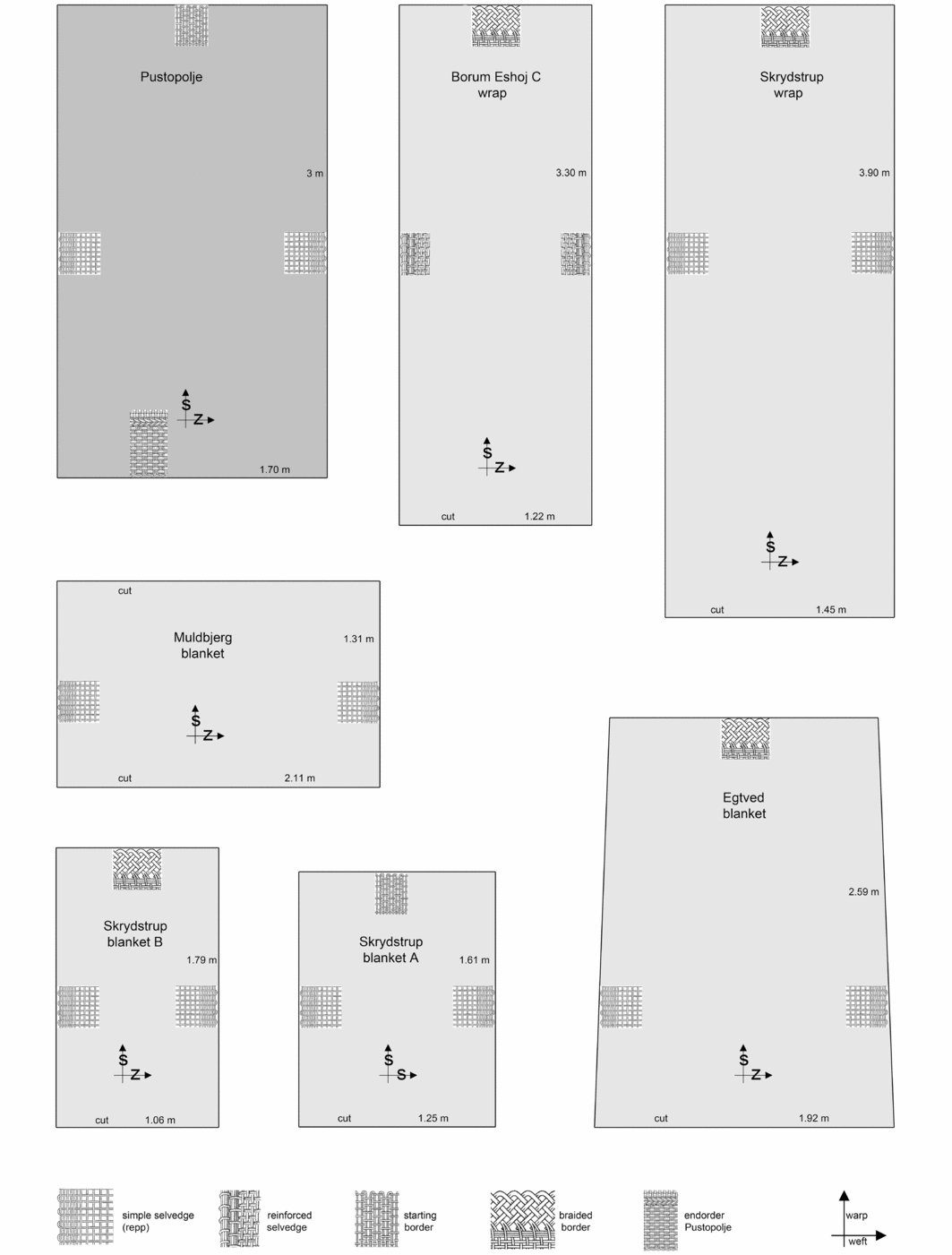
Large wool textiles, including complete items of clothing from the Bronze Age, have been found in a number of oak-log coffins from Denmark (Broholm & Hald Reference Broholm and Hald1940). A series of blankets and wraps/long skirts can be compared with the Pustopolje textile in terms of their dimensions and construction (Figure 9). A blanket from a male burial from Muldbjerg is the widest, at 2.11m across, although as it has been cut at both ends, we have no way ofknowing how long it originally was. The longest are two wraps from the female burials of Skrydstrup and Borum Eshøj C. The Skrydstrup wrap is 3.9m long and 1.45m wide; the Borum Eshøj wrap is 3.3m long and 1.22m wide. The Egtved blanket measures 2.59m at length and has a maximum width of 1.92m. Only one piece, a blanket from Trindhøj, is complete with all four edges preserved. It is 1.33m wide and 1.84m long (Broholm & Hald Reference Broholm and Hald1940). The dates of these finds are given in Table 1. The dimensions of the Pustopolje textile fit well into the overall pattern established by the Danish material. What makes it stand out is the finishing border, which has no known parallels and also appears to be more evenly woven than the Danish fabrics as the number of warp and weft threads per centimetre measured at various parts of the textile seem almost identical.
Dimensions and constructional details of large Bronze Age textiles from Pustopolje, Borum Eshøj C, Skrydstrup, Muldbjerg and Egtved. Measurements of the Danish finds are based on Broholm and Hald (Reference Broholm and Hald1940), but are simplified and do not show minor irregularities in shape. (Graphics by Karina Grömer.)

Technology
The Pustopolje textile is an important contribution to our knowledge of the textile technology of Bronze Age Europe. Well-preserved textiles are rare and unevenly distributed across Europe and are seldom accompanied by textile tools (Bender Jørgensen Reference Bender Jørgensen1992: 117–20; Rast-Eicher & Dietrich Reference Rast-Eicher and Dietrich2015: 114–18; Grömer Reference Grömer2016: 20–31). Starting borders like that found in the Pustopolje textile are generally assumed to indicate production using a warp-weighted loom (Hoffmann Reference Hoffmann1964: 151–83). The textiles and garments from the Danish oak-log coffins do, however, display two types of transverse borders: plaited borders and starting borders (for details, see Figure 9); both appear in almost all finds with substantial textile remains (Broholm & Hald Reference Broholm and Hald1940: 122–23). The Trindhøj blanket ends in fringes at both ends, which are made from closed warp loops (Broholm & Hald Reference Broholm and Hald1940: 37–39).
In their discussion of the technology of the Danish Bronze Age textiles, Broholm and Hald found that two loom types would fit with the available evidence if equipped with two or more short shed rods to divide the warp: the two-beam loom and the warp-weighted loom (Broholm & Hald Reference Broholm and Hald1940: 134–35). Recently, the properties and peculiarities of these two looms, as well as those of the two-beam loom with tubular warp and the ground loom of Pharaonic Egypt, have been investigated by Martin Ciszuk and Lena Hammarlund (Reference Ciszuk, Hammarlund, Alfaro and Karali2008). In an attempt to establish criteria to identify the different looms responsible for specific archaeological textiles, they concluded that hardly any characteristics are distinctive of a single loom type. Regrouping with crossing warp threads could, however, not be done on the warp-weighted loom; and a twined starting cord excludes the possibility of a loom with tubular warp—an intact warp lock, however, is proof of such a warp (Ciszuk & Hammarlund Reference Ciszuk, Hammarlund, Alfaro and Karali2008: 130–31).
Loom weights are another, less equivocal, indicator of the warp-weighted loom. In Bosnia and Herzegovina, loom weights have been recovered from Bronze Age hillforts in the Livno, Duvno, Glamoč and Kupres areas. They are pyramidal with a hole in the top, and made of fired red-brown clay. Specimens in the Franciscan Museum and Gallery Gorica range in height from 90–110mm. Similar loom weights have been found in Dalmatia (Barbarić Reference Barbarić2006: 62 & pers. comm.). Spindle whorls from Middle Bronze Age hillforts in south-west Bosnia are circular, 40–50mm in diameter and appear as flat, or rounded, with smooth or ribbed surfaces.
In Scandinavia, Bronze Age loom weights are rare. Very few have been found, but include those from the remains of a building excavated near the Skrydstrup burial (Ethelberg et al. Reference Ethelberg, Jørgensen, Meier and Robinson2000: 232). Spindle whorls are even rarer. As yet, only one specimen, dated to the end of the Scandinavian Bronze Age (750–500 BC), has been recovered (Mannering et al. Reference Mannering, Gleba, Bloch Hansen, Gleba and Mannering2012: 102).
In the Balkans, loom weights first appear in the Early Neolithic and continue throughout prehistory, although with changing sizes and shapes (Petrova Reference Petrova2015: 217–18). Loom weights and spindle whorls made of fired or unfired clay, or recycled pieces of pottery, are well-known features of Neolithic settlements in Central Europe, starting with the Starčevo and Linearbandkeramik cultures (6000–4400 BC). In the Early and Middle Bronze Ages, cylindrical loom weights of the Neolithic type are relatively common (Gleser Reference Gleser and Gleser2007), but there is a lack of spindle whorls. With the advent of the Urnfield culture in the Late Bronze Age and the Hallstatt Period (1300–750 BC), loom weights and spindle whorls of different shapes recur frequently in settlements and even in graves (Grömer Reference Grömer2016: 81–85, 110–12).
The warp yarns of the Pustopolje textile are between 0.7 and 0.9mm in diameter, while the weft yarns are between 0.9 and 1.3mm. In comparison, yarns from Danish Bronze Age textiles are thicker, usually 1.0–1.5mm, and much more variable, even within individual textiles (Fossøy Reference Fossøy, Jørgensen, Sofaer and Sørensen2018). One item, the kilt of Borum Eshøj grave B, has warp yarns with diameters ranging between 3.5 and 4.9mm (Broholm & Hald Reference Broholm and Hald1940: 161–62). This and the absence of Bronze Age spindle whorls in Denmark suggest that a different kind of spindle or spinning technique was employed there. Spinning can be done solely by using the hands without a spindle, or on a spindle but without a whorl, rotating it in the hand or rolling it down the thigh. A simple crooked stick may also serve as a spindle. Spinning performed by rotating a spindle in the hand was particularly suited for short-stapled wool (Crowfoot Reference Crowfoot1931: 44–45).
In conclusion, the Pustopolje textile was probably made on a warp-weighted loom, due to the starting border and contemporaneous prehistoric finds of loom weights. The presence of spindle whorls of the same date in the region indicates that the yarn was probably made on a drop spindle. This suggests that Bronze Age textile technology and craft traditions of the Balkans and Central Europe differed from those represented by the textiles and garments from the oak-log coffins in Denmark.
Use
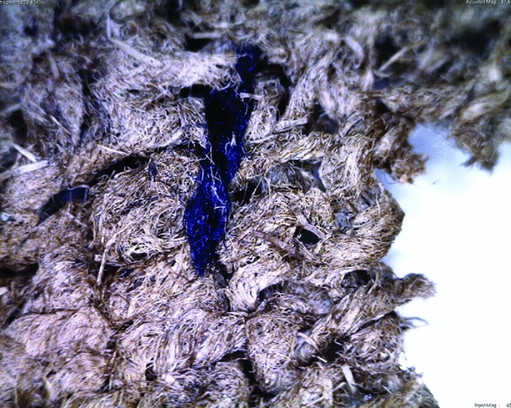
According to Benac, the Pustopolje textile was wrapped around the naked body of the deceased, a man of about 60 years of age and 1.7m tall (Benac Reference Benac1986). Apart from the fabric, no artefacts were found in association with the body. The textile was folded in half, and further folded in the shape of an S to fit into the burial chest where it was deposited on top of a layer of skin. The deceased was placed under the top layer (Car & Meder Reference Car and Meder2010: 26–27). The textile appears to have been used before it was deposited in the grave. Parts of the surface appear felted (Figure 4), and this also applies to the fuzzy ends of cut wool threads at the finishing border and the tassel. This is caused by use-wear or washing, although some may be due to the decomposition of the deceased. The size and shape of the textile suggests that it was a blanket, but it may, perhaps, originally have been a draped garment.
The uses of the large wool textiles from the Danish oak-log coffins have been extensively discussed. The wraps in the Skrydstrup and Borum Eshøj burials have been explained as either long skirts that might have been worn in a variety of ways, or draped or wrapped around the body as an outer garment (Broholm & Hald Reference Broholm and Hald1940: 155, fig. 197; Kristiansen Reference Kristiansen1974; Munksgaard Reference Munksgaard1974: fig. 52; Hansen Reference Hansen1980; Bergerbrant Reference Bergerbrant2007: 56–58; Randsborg Reference Randsborg2011: 41–45, fig. 14). Items designated as blankets have generally been assumed to be unspecified textiles or a form of bedding; recently, Klavs Randsborg has suggested that those from the Skrydstrup grave are long skirts (Reference Randsborg2011: 41).
Further sources of complete, early textiles have been found in the Middle East, coming in particular from Pharaonic Egypt, although all of these are made of flax and belong to entirely different technological traditions. A fourth-millennium burial in the Cave of the Warrior in the Judean Desert contained several items (Schick Reference Schick2003). The largest piece merits comparison with the Pustopolje textile. It was 1.96m wide and 0.69m long, with warp fringes at either end, and a weft fringe along one selvedge. It was folded in half across its long axis, and then folded in half again, forming a four-layered wrapping, enclosing the deceased, much like in the Pustopolje burial. According to Schick (Reference Schick2003: frontispiece), it had served as a long kilt, held in place by a sash.
Pharaonic Egyptian textiles appear in a great variety of lengths; Petrie mentions sheets from Deshasheh dated to the Old Kingdom that are around 9m long (Petrie Reference Petrie1898: 32), and another group of Old Kingdom textiles from Asyut are even longer, measuring more than 20m in length (British Museum EA 46632/3). The width, however, is rarely more than 1.3m (Vogelsang-Eastwood Reference Vogelsang-Eastwood1993: 6). Most items of Pharaonic Egyptian clothing were wrap-around garments, consisting of lengths of cloth wrapped around the body in a variety of ways, such as kilts, skirts, cloaks, shawls and some forms of dresses. Loincloths, bag-tunics and some dresses were cut-to-shape (Vogelsang-Eastwood Reference Vogelsang-Eastwood1993: 5–6).
The stitches observed in the Pustopolje textile suggest that they had served to hold the textile in place, either for the burial or during its earlier use. Unfortunately, the position of only one of these stitches has been documented, complicating interpretation. No pin holes have been detected; the thick shafts of Early Bronze Age pins mean that visible holes would be expected if the textiles had been pinned in any way. Experiments based on the dress depicted on a Bronze Age figurine from the Lower Danube have been carried out to explore how the Pustopolje textile could have been worn as a draped garment (Grömer et al. Reference Grömer, Rösel-Mautendorfer and Bender Jørgensen2013: 235–37). The results were inconclusive, leaving us without a clear answer to the question of the textile's use. We may conclude, however, that as it offers no evidence of tailoring, the Pustopolje textile was used as it came off the loom, either as a large blanket or coverlet, or as a draped garment.
Conclusion
The Pustopolje textile fits well into the context of contemporaneous Bronze Age textiles, except for the presence of an end border. The size and shape corresponds to those of well-preserved textiles and garments found in Denmark, but it appears more even and more competently made than these. Technologically, the Pustopolje textile is more closely related to contemporaneous textiles from Central Europe. The warp-weighted loom is known to have been used there, while evidence suggests that either a different loom, or perhaps several different types of loom, were in use in Scandinavia at that time. Similarly, the lack of spindle whorls in Scandinavia suggests that the employment of a different technology may explain why Scandinavian yarns are coarser and less even. The wool, too, is comparable to wools from Central Europe, yet different from Scandinavian wools (Rast-Eicher & Bender Jørgensen Reference Rast-Eicher and Bender Jørgensen2013). Finally, the Pustopolje textile is among the earliest, known examples of dyed textiles in Europe, and offers an enticing glimpse of Bronze Age textile colours other than those available from the various shades of naturally pigmented wool.
Acknowledgements
The investigation of the Pustopolje textile has been carried out as part of the HERA-funded project ‘Creativity in Craft Production in Middle and Late Bronze Age Europe’ (CinBA; 2010–2013). Thanks are due to Sanjin Mihelić, Zagreb Archaeological Museum, who helped us to locate the whereabouts of the Pustopolje textile, sent us the conservation report by the Hrvatski Restauratorski Zavod and took us on a memorable visit to Bosnia and Herzegovina to investigate it. At a later occasion he arranged a meeting with textile conservator Gordana Car, who led the restoration of the textile.
Our heartfelt thanks go to the director and staff at the Franjevački Muzej i Galerija Gorica in Livno who generously put the Pustopolje textile at our disposal, permitting us to take samples for fibre and dyestuff analyses and for a new radiocarbon dating, and for access to documentation made before and during the conservation process. Gordana Car of the Hrvatski Restauratorski Zavod graciously answered all of our questions and helped us in many ways. She has contributed important information to the present paper. Thanks are also due to Antoinette Rast-Eicher, ArcheoTex, who carried out the fibre analysis; to Mark Van Strydonck, who performed the new radiocarbon dating; and to Maarten van Bommel, Ineke Joosten and Regina Hoffmann-de Keijzer, who did the dyestuff analysis. Vedran Barbarić of the University of Split kindly supplied information on textile tools from Dalmatia, and Hero Granger-Taylor, London, helped with information on Near Eastern textiles.