In 1663, an English Embassy lead by the Earl of Carlisle traveled to Muscovite Russia. Failing to make any significant breakthroughs in Anglo-Russian trade relations, a member of the Earl's Embassy observed that the Russians “will in time leave off that rustick and barbarous humor, which is so natural to them, and learn by degrees to live with more civility… . And were they under a gentler Government, and had a free Trade with every body, no doubt but this Nation would in short time be taken with our civility and decent way of living.”Footnote 1 Even in this short passage, the plan for English economic expansion was clear. The first step was the establishment of free trade between the countries, which would produce widespread cultural change as the Russians adopted the superior English customs. In the end, a transformed Muscovy would become a natural market for English goods, producing only increased profits. This plan remained essentially unchanged from the beginning of regularized trade between England and Muscovy in the sixteenth century to the beginning of the eighteenth, despite the lack of success in changing Muscovite culture in the direction of an English-inspired model.Footnote 2
In fact, while they remained committed to the cause of increasing trade with Muscovy, English traders struggled during the seventeenth century. They expected tremendous advantages from “free trade,” by which they meant their right of unrestricted trade with foreign countries, with severe restrictions on any competitors. Thus, as the Dutch successfully entered the Muscovite market, English merchants protested repeatedly against the injustice of Dutch trade monopolies to both their king and the Muscovite tsar.Footnote 3 When they failed to motivate Moscow to expand their mercantile rights, English merchants placed their hope in tobacco, a commodity that Muscovy had not accepted, as their best chance to create a new market that only they could successfully exploit.
Earlier studies of the English tobacco trade in Russia focused upon either the part it played in the broader history of Anglo-Russian trade or the details of Peter the Great's tobacco contract.Footnote 4 None of these studies questioned the plausibility of a successful tobacco market in Muscovy, and instead they accepted the hopeful predictions of English merchants despite the vast cultural divide that separated England and Muscovy. The English expectation that trade would inspire the adoption of English customs and create consumers of their goods was predicated on a fundamental misapprehension regarding the relative weights of trade and cultural prohibitions against foreign customs. When tobacco was introduced into Muscovy in the seventeenth century, most Muscovite authorities, including the Russian Orthodox Church and the tsar, condemned its use. Furthermore, Muscovy's ongoing reforms created a mercantilistic economic system that depended on the strict regulation of all foreign trade for Moscow's benefit.Footnote 5 Neither an argument based on the idea of the benefits of free trade nor one that suggested a rapid cultural transformation would successfully persuade Russians to abandon their long-held opposition to tobacco. The tobacco trade exemplifies the failure of seventeenth-century English economic ideology, which resulted in Muscovy remaining outside of the English sphere of influence and demonstrated the strength of Muscovite religious and political resistance to Western culture. By showing how the presumed influence of the exporting power failed to alter the importer in any meaningful way, the tobacco trade reveals the limited significance of early-modern globalization.Footnote 6
Introducing Tobacco
English expectations for the importance of tobacco as a trade good reflected England's own reaction to its importation in the late sixteenth century. Upon tobacco's first arrival, English responses varied from praise to condemnation, but it remained legal for both importation and sale.Footnote 7 Among the most eminent of tobacco's opponents was King James I, who summarized the primary objections to the product in his well-known Counterblaste to Tobacco. The king argued that while many assumed tobacco possessed beneficial medicinal properties, a common belief for most of the new commodities of the early-modern world, no one had yet proved these claims. The great danger of tobacco arose from its suspicious origins as a result of its native American discovery. James I wondered, “what honour or policie can moove us to imitate the barbarous and beastly maners of the wilde, godlesse, and slavish Indians, especially in so vile and stinking a custome?”Footnote 8 Despite his objections, James did not forbid the importation or sale of tobacco in England, and it only became more popular as the seventeenth century progressed.
Growing tobacco consumption failed to assuage all English concerns about its medicinal and spiritual dangers, but it was economic fears that dominated the public debate. Because England could not produce sufficient quantity within its imperial borders, Spain prospered as the great exporter of tobacco in the early seventeenth century. Not surprisingly, concerned English merchants voiced their fears about the long-term impact of tobacco importation on England's economic health.Footnote 9 Edward Bennett, for example, raised the public alarm about the loss of specie in his pamphlet, Treatise Touching the Importation of Tobacco out of Spaine. Bennett argued that it would be in the kingdom's best interest to develop tobacco plantations in Virginia to avoid a dependence upon imported tobacco.Footnote 10 Other London merchants concerned about England's balance of trade echoed his assessment. In Thomas Mun's England's Treasure by Forraign Trade, he instructed his fellow merchants that England must “prevent the importations of Hemp, Flax, Cordage, Tobacco, and divers other things which now we fetch from strangers to our great impoverishing.”Footnote 11 As the Virginian plantations became commercially viable by the 1620s, likeminded merchants prospered from the new product.Footnote 12 The growth and success of the industry was sufficient that, despite reiterating James I's objections to tobacco, Oliver Cromwell failed to halt its sale.Footnote 13
Meanwhile, the fortunes of the English merchants in Muscovy, who traded in a joint-stock organization known as the Muscovy Company, were entering a long period of declining influence and returns. The Russians had restricted the English ever since the Muscovy Company's establishment, and limited its trading to a few cities in the north. The English could only operate along a direct line between their port of entry at Arkhangel'sk and Moscow.Footnote 14 This precluded significant English trade with most of Muscovy, leaving them predisposed to equate Muscovy's demand for tobacco with that of the small free peasant population of the Russian north. The restrictions, in this sense, did little to moderate the English idea that their product and methods were sufficient to open the Muscovite market. When Muscovy suffered through its long civil war at the beginning of the seventeenth century, James I and his government considered establishing a protectorate over northern Russia in order to prevent any further influence from Sweden or Poland.Footnote 15 The idea of annexation ended with the conclusion of the civil war, but the Dutch entrance to the market early in the seventeenth century created a new economic threat to the English right of “free trade.” As the Dutch successfully claimed export monopolies, the Muscovy Company believed its commercial interests in Muscovy were diminishing.Footnote 16 By the time the tsar revoked its tax-free trade status during the early years of the English Civil War, the obstacles to the Company's trade seemed overwhelming.Footnote 17 It needed a panacea to recover its position.
Tobacco had already been exported successfully to other foreign countries that had restricted English trade practices. The English East India Company (EIC), for example, had been organized along the lines of the Muscovy Company and faced equal difficulties trading in Safavid Iran and Mughal India. In both countries, tobacco had been prohibited upon its initial entry, but each government reversed its decision shortly thereafter. The EIC began curing tobacco in its India factories as early as 1612. In response, Emperor Jahangir forbade smoking by decree in 1617, but profits from Mughal taxes on tobacco rendered the ban moot. By the 1620s, the Mughals allowed commercial tobacco production inside their borders, creating new opportunities for the EIC as exporters of tobacco throughout Asia.Footnote 18 The EIC followed a similar course in Iran, where Shah ‘Abbas prohibited tobacco early in the 1600s and banned it again in 1621, but then conceded legalization while heavily taxing consumption. The taxes became a valuable source of state revenue and tobacco remained legal, and the EIC began selling tobacco in Iran by 1628–1629.Footnote 19 In both countries prohibitions had been based on religious objections, as well as the personal distaste of each monarch. In both cases profits from the trade overrode prohibitions. Therefore, the Muscovy Company had two favorable examples from the recent past that suggested the tsar's initial objections could be overcome easily, regardless of his beliefs or inclinations.
However, the tsar's ban on tobacco remained in force for more than eighty years. Muscovy's seemingly anomalous reaction to tobacco stemmed from its particular cultural frameworks. Unlike the contemporary English, Safavids, or Mughals, Russians resisted all foreign habits and customs, including tobacco, as a matter of doctrine. Tsar Ivan IV's reforms, imposed in the middle of the sixteenth century (coincidentally, just before the original agreement between the tsar and the Muscovy Company), included the Stoglav.Footnote 20 The hundred chapters of this 1551 document had the primary purpose of standardizing Orthodox rituals within Muscovy's borders, but it also included a comprehensive ban on all foreign habits, declaring that the “evil customs” of other countries and faiths defiled Russia with their “lawlessness.”Footnote 21 Furthermore, since tobacco was not mentioned in the Bible it could be singled out as a particularly illicit commodity.Footnote 22 While the Russian Orthodox Church's objections did not fully prevent Muscovite acceptance of foreign customs, they did become a significant barrier.
As in many other early-modern states, a religious condemnation could have the force of law if the state and Church agreed. The Stoglav was part of a continuing process of defining Muscovite national identity based on its Orthodox faith. Part of both the tsar's and the Church's conception of Muscovy's status in the world was a belief that the country had become a “New Israel,” and Moscow itself was its Jerusalem.Footnote 23 For example, when the Stepennaia kniga, written during Ivan IV's life, traced out the origins of Muscovy, it began with the creation of the world based on the Old Testament and then traced a lineage of emperors from Alexander the Great through the Romans and Byzantines until at last arriving at Ivan and his empire, Muscovy.Footnote 24 The association was clear—Ivan was both a world conqueror like Alexander but also a holy defender of true Christianity, just as Rome had been until the Schism of 1054 and Byzantium until the fall of Constantinople. Ivan's success in conquering the Muslim Khanates of Kazan’ and Astrakhan, the first Orthodox victories against Islam since 1453, justified his role as defender of the faith.Footnote 25 As a result, the concept of Muscovy as a holy kingdom became an inherent feature of Muscovite political culture.
For the remainder of the sixteenth and seventeenth centuries, Muscovy's tsars exploited their subjects' belief in the validity of this message to provide themselves with a charismatic aura of authority.Footnote 26 Throughout his reign Ivan IV traveled on pilgrimages to the holy sites of Orthodox Russia, which became public exhibitions of political hierarchy and his dominance over Muscovite territory.Footnote 27 Ivan also celebrated his conquest of Kazan' with the construction of the Church of the Intercession on the Moat (popularly St. Basil's) on Red Square, as a public sign of the connection between Orthodoxy and his personal victory. Later tsars demonstrated their sacred aura through their participation in two of the most famous yearly spectacles held on Red Square, on the holy days of Epiphany and Palm Sunday. There, the tsar's court, the Russian Orthodox hierarchy, and even the public witnessed the tsar present himself as one of the holiest figures in Orthodoxy.Footnote 28 When a later revision of the Stepennaia kniga added Ivan IV's successors, Fedor Ivanovich, Boris Godunov, and Mikhail Fedorovich, as equally sacred defenders of the faith, it simply confirmed the public perception of the tsar's sacred aura and his kingdom's holy status.Footnote 29
The effect of this cultural conception of Muscovy should not be overstated, and Muscovy was not insulated from all cultural contact with Europe and Asia. However, Orthodoxy did raise significant barriers to the success of the English tobacco venture. The Russian Orthodox Church had a decades-long ban on all foreign customs, and Muscovy's tsars had far more to gain by supporting the Church's position than opposing it. When tobacco arrived in the bags of English merchants, the “lawlessness” feared by Russian authorities was quickly demonstrated. Isaac Massa, the Dutch emissary to Moscow early in the seventeenth century, blamed the English ambassador in Iaroslavl for starting with his tobacco smoking a “great conflagration that caused much damage.”Footnote 30 That this incident might also sabotage English efforts most likely occurred to Massa. Physical damage to property as a result of tobacco's illegal entry through smuggling created a rationale for Orthodoxy's rejection of tobacco even before the Russians had a chance to adopt the habit.
The first tsarist ban on tobacco occurred in Siberia. The tsar's non-Russian and non-Orthodox subjects were always a suspect population for acquiring immoral habits. Therefore their tobacco habit was no surprise, and only reaffirmed tobacco's lawlessness. In March 1627, Tsar Mikhail Fedorovich instructed the governor of Tobolsk in Siberia to stop the sale of tobacco that was being exported to Siberia from the central provinces from Muscovy. The price of tobacco in Siberia was too high, and was driving servitors into debt. This law may have been a reiteration of a law passed as early as 1618.Footnote 31 The tsar's government ultimately prohibited the presence of tobacco in all cities of his kingdom “on pain of the death penalty” in 1633/34.Footnote 32 Adam Olearius, a secretary in the embassy of the Duke of Holstein, during his travels in Muscovy observed on 24 September 1634 eight men and one woman being beaten with a knout for selling tobacco and vodka, demonstrating the immediacy of the tsar's order.Footnote 33
Initial attempts to control tobacco were likely unsuccessful, because the state continued to promulgate even more comprehensive restrictions against its use. When Tsar Aleksei Mikhailovich published the Law Code of 1649 (Ulozhenie), the first compendium of Muscovite law, it included eleven articles supporting the prohibition of tobacco, and upheld the earlier death penalty for Russians and foreigners (inozemtsy) trading or possessing tobacco.Footnote 34 In addition, anyone caught with tobacco would be interrogated, by torture if necessary, to uncover its origin.Footnote 35 Tobacco consumers would not be executed, but: “If musketeers, and wanderers, and various people are brought in for arraignment with tobacco twice, or thrice: torture those people many times, beat them with a knout on the rack . … For many arraignments slit the nostrils and cut off the noses of such people.”Footnote 36
While the Law Code enacted a comprehensive ban against tobacco, even this was not sufficient to completely suppress tobacco usage. By 1664, Tsar Aleksei Mikhailovich added another restriction for Siberia: any dealer in tobacco, whether Russian or foreign, would be whipped publicly and imprisoned for one week. Furthermore, all confiscated tobacco was to be burned “to discourage the people.”Footnote 37
Meanwhile, the Russian Orthodox Church actively promoted a public awareness of tobacco's sinfulness. High Church officials advised Tsar Mikhail Fedorovich on his first ban against tobacco. By the second half of the seventeenth century tobacco's evil nature had become a recurring motif in edifying and miracle tales. For example, two miracles attributed to the Icon of the Savior in Krasnoborsk recorded visions in which the recipients were warned against possessing or smoking tobacco.Footnote 38 While the Church's recording of these visions reflected its official endorsement of them, the belief of being miraculously saved from the evil of tobacco had to emerge from the experiences of the cured.
The combination of the legal restrictions against tobacco sales and the Russian Orthodox Church's longstanding objection to foreign customs fulfilled more than one purpose for the tsar's government. By the seventeenth century, the Muscovite government was consciously crafting a set of mercantilistic policies designed to control economic development. All foreign merchants, including the Muscovy Company, had their movements restricted and monitored both at the border and within the country. The tsar's government increasingly favored export monopolies as the best solution to provide steady revenue and to control all foreigners within the borders, and this was the origin of the Dutch export monopolies.Footnote 39 Imported tobacco would drain revenues just as it had in England, Mughal India, and Safavid Iran. Each of those countries had responded by legalizing tobacco production, but Muscovy's environment could not sustain a tobacco crop. Therefore, it held no interest for any of the tsarist chancelleries. English merchants saw no reason why their trading strategies would not operate as planned there, but any English proposal that contained so little benefit for the tsar had little chance of success.
Just as Muscovite political cultural and religion were not perfect insulators against foreign influence, the legal and economic barriers to tobacco were not entirely successful, and tobacco continued to be sold and consumed inside Muscovy. As early as 1634, shortly after the first comprehensive ban on tobacco, a foreign observer in Moscow commented: “the Russians also greatly love tobacco . … The poor man gave his kopek as readily for tobacco as bread.”Footnote 40 With evidence of consumption, but without legal permission to import tobacco, foreign merchants relied on smuggling, as noted by the Dutch envoy Massa. The most reliable smuggling route into Muscovy was overland via Sweden. Swedish middlemen purchased tobacco from English and Dutch merchants in the Baltic entrepôts, particularly Narva and Riga, and in turn sold the tobacco to Russian merchants, who then smuggled it across the border. Among the seventeenth-century responsibilities for the Swedish resident in Moscow was that of updating Queen Christina on the tobacco trade in Muscovy, particularly its visibility in the capital.Footnote 41 By the late seventeenth century, the Western tobacco being smuggled into Muscovy comprised as much as 7 percent of Riga's total trade.Footnote 42 A second, southern route developed at this same time, traveling from the Ottoman Empire through Moldova.Footnote 43
Smuggling's success encouraged the English to attempt to seize the entire market, and their demands for “free” trade also led them to experiment with a more direct method of illegal importation. Wary of the growing southern route, which they could not control, the English went north and tried to circumvent the Swedish middlemen by smuggling tobacco directly through Arkhangel'sk, their port of the entry to Muscovy. This was risky, and the Muscovite port authorities were vigilant, as Phillip Coffy discovered in 1634 when he was arrested and imprisoned after tobacco was discovered among his possessions. King Charles I entreated Tsar Mikhail Fedorovich to free Coffy, who was “altogether ignorant and innocent” of the charges, adding this request to another complaint against the persistent searches of all English merchants in Arkhangel'sk.Footnote 44 However, just two years later the king again had to call for an Englishman's freedom, this time for John Cartwright, also arrested for smuggling tobacco.Footnote 45 Nevertheless, profitable smuggling continued for the remainder of the century. As an amazed member of the Earl of Carlisle's embassy of 1663 remarked, tobacco purchased for only nine or ten pence a pound in London could be sold for fifteen shillings in Moscow.Footnote 46 Increasingly, the responsibility of the English envoy to Muscovy in the 1670s was to intervene in arrests of these tobacco entrepreneurs. If an English trader was arrested or harassed for smuggling tobacco, the envoy offered the Muscovite government “Wryting Instituted [Several pretended Reasons, etc.] Marked No. A” to preclude punishment.Footnote 47
Institutionalized English smuggling confirmed the Muscovite market for tobacco. The Earl of Carlisle's embassy failed to convince the tsar to legalize the trade, but subsequent envoys continued to press for the privilege. In 1676, for example, Envoy John Hebdon protested to King Charles II that he was unable to secure permission to trade. He hoped Charles' personal request to the tsar might produce a legal tobacco market.Footnote 48 A year later, Hebdon tried again, believing that only a few individuals blocked the legalization of the trade. Perhaps Patriarch Filaret and Tsar Mikhail Fedorovich objected to tobacco, but now “this present Government have found a Gapp to cleare that Scrupell of conscience, and doe find it is more for the Advantage of themselves and the Empire, to graunt a Pattent for the same [tobacco] for they finde that theire Subjects spend a greate quantity which is brought in by stelth.”Footnote 49 Hebdon proved no more successful than earlier envoys, and fell into considerable disrepute in Moscow after his second appeal. First he failed to provide goods that he had promised the tsar, and then, “he entertained severall Foreigners in his house, with whom he went up and down at unseasonable howers of the night, contrary to the practice of Ambassadors. That his Servants being drunk did very often affront and abuse the Emperour's Subjects.” All of this might have been forgiven, but shortly after these complaints one of Hebdon's servants, at his “instigation,” assaulted and ultimately murdered one of the tsar's musketeers who had been placed as a guard near Hebdon's residence.Footnote 50 Such proponents of the trade as Hebdon provided convincing evidence of the inherent “lawlessness” of foreign habits, and did more harm than good for economic arguments in support of the tobacco trade.
Vocal public proponents of the tobacco trade in London were dedicated ever more to forcing open the Muscovite market, and they remained ignorant of local failures and the entrenched official opposition to the weed. The idea of a favorable balance of trade promoted early in the seventeenth century by merchants such as Bennett and Mun was still in favor.Footnote 51 Josiah Child, writing in the 1660s, called for an immediate expansion of trade to Muscovy as necessary to break the growing English dependence on Dutch exports from Muscovy. In particular, he worried that nine-tenths of the English timber supply was purchased from Dutch middlemen; an English return to preeminence in Moscow would correct this situation.Footnote 52 Similarly, John Pollexfen decried the diminishing returns from the Muscovy Company's trade, which resulted in further lost revenues to the Dutch and the ongoing supply problems with limited access to timber, tar, pitch, and hemp.Footnote 53
To these opinions being expressed in London were added those of American tobacco plantation owners, who were plotting an entry into the Russian market. As the price of American tobacco began to drop in the second half of the seventeenth century, plantation owners petitioned the British crown for new markets.Footnote 54 One of the most desirable markets for American tobacco was Muscovy, and the plantation owners explicitly advocated an expansion of exports to Narva, through which tobacco was already being smuggled.Footnote 55 The expectations for Muscovite tobacco consumption were as high as 20,000 hogsheads a year. The owners anticipated a virtuous circle from the trade: the increased demand for tobacco would necessitate an expansion of the market in slaves, which would in turn increase demand for English produce, and the employment of as many as “ten thousand poor people” to manufacture tobacco products in England for export.Footnote 56
Advocates of English mercantile power in London, American plantation owners, and English merchants in Muscovy combined as a united voice pressuring the English crown to take action on the tobacco issue, but it came to naught. The English misunderstood the seriousness of the Muscovite tobacco ban. Rather than slowly accepting the product based on the success of sales or taxes over time, the Muscovite government only reiterated its prohibition. While non-Russians in Siberia and along the western border with Sweden, Poland, and Ukraine became steady consumers of tobacco, its use by non-Russian and non-Orthodox subjects only encouraged further restrictions in ethnically Russian areas. To an early-modern Russian there was no legal difference between a foreign subject of another monarch and one of the tsar's own subjects if he was not Orthodox—both were in the same legal category: inozemtsy (literally “people of different lands”).Footnote 57 Therefore, the adoption of tobacco by the tsar's non-Russian subjects only corroborated the view that the product was a corrupting influence. By 1686, the Muscovite government explicitly banned the importation of Ukrainian tobacco into the central provinces surrounding Moscow in an attempt to prevent tobacco smuggling from the south.Footnote 58 So strongly did Muscovite authorities object to the existence of Ukrainian tobacco production that it became a contentious point in the treaty negotiations with the Cossacks that ultimately resulted in the union with Ukraine in the 1660s.Footnote 59 Throughout the remainder of the century, new laws continued to restrict tobacco sales, demonstrating the state's unwillingness to compromise on its long-held objections to it.Footnote 60
The subtleties of the Russian response to tobacco were lost on the English, who saw a nation of eager consumers ruled by a small elite unwilling to overturn the ban. Yet even where the English traded, tobacco did not take root. There remains no evidence of any sales in the territory between Arkhangel'sk and Moscow between the general ban of 1649 and the end of the century.Footnote 61 Smuggling continued across the western border with Sweden and the southern border with Ukraine, and the English remained convinced by rumors of a tobacco trade in Siberia. However, the New Commercial Code of 1667 prevented English merchants from traveling further south than Moscow, much less to Siberia. Under the Code all foreign trade was restricted to four cities on the border, and the English had no access to Muscovite goods outside of Arkhangel'sk. According to English experience with the tobacco trade both at home and abroad, economic opportunity should have trumped Muscovite religious and political objections, but Muscovite authorities remained unpersuaded. Furthermore, the conflict between Muscovy's mercantilistic reforms and the English goal of favored trading status were inherently opposed. As a result, the Muscovy Company and its English merchants found the second half of the seventeenth century to be an endless quest of unrealized promise.
For Muscovite authorities, the rationale for the ban on tobacco never lost validity. Widespread smuggling along all of the borders flouted both restrictions on tobacco and the government's attempt to regulate the economy more tightly. The inherent “lawlessness” of the foreigners using tobacco only reinforced the moral objections of the Russian Orthodox Church. As economic and religious objections reinforced each other, the ban became ever more firmly entrenched. Furthermore, that tobacco was being consumed in the periphery of the empire where the tsar's non-Orthodox subjects lived underscored the inherent danger of both tobacco and those subjects. Because foreigners and the non-Orthodox were both inozemtsy, their adoption of the same illicit habit would not have surprised any seventeenth-century Russian, and it was ample justification for maintaining a comprehensive ban on tobacco.
Success and Failure
For Muscovy, the pivotal moment in tobacco's history arrives with Peter the Great, who was responsible for many of Russia's Western cultural adoptions. It was Peter who finally legalized tobacco sales in Russia. Partly from personal inclination, and partly from a need to raise revenue to finance his Grand Embassy, Peter granted an exclusive contract over all tobacco sales in Siberia to Martin Bogdanov for one year starting in 1 December 1696. Another law eased restrictions on carrying tobacco into Astrakhan that same year. Tobacco would be confiscated from foreign merchants upon their arrival in Astrakhan, but then returned to them upon their departure, and individual merchants could carry into the city approximately eighteen pounds for their personal use.Footnote 62 The following year, as a further revenue-raising effort Tsar Peter and King William III signed the very first Anglo-Russian contract for tobacco, legalizing its importation and sale. The contract also served in lieu of payment for some of Peter's naval negotiations with the English.Footnote 63 While the English could finally celebrate a victorious result from a decades-long pursuit, the contract strongly favored Russian interests. The English received only an agreement that they could sell tobacco to the central provinces of Muscovy, the very area where resistance to tobacco remained the most entrenched. The tsar, for his part, gained revenue and new technology, which immediately resolved most of the economic objections to tobacco, if not the cultural concerns.
The signed tobacco contract allowed a newly formed Tobacco Company to import 3,000 hogsheads of tobacco (about one and a half million pounds) in the first year (1699), and 5,000 hogsheads in the second. After the second year, the contract was renewable annually for another 5,000 hogsheads. Tobacco could be sold anywhere in the kingdom, and the tsar agreed to ban all other tobacco imports. He agreed that domestic Ukrainian tobacco could only be sold in Ukraine to prevent it from cutting into English sales. With the money received from tobacco sales, English merchants had the right to buy and export any Muscovite product, keeping Muscovite specie in the country. If all the imported tobacco was not sold at the end of the second year of the contract, its clauses remained in effect until it was. For this exclusive privilege, the English tobacco contractors paid £12,000 in advance customs duties.Footnote 64 The contract appeared to mark a new area of English trade success in Muscovy, not just in the tobacco market but also in the trade for naval supplies. The Swedish resident in Moscow, for one, reported with increasing alarm about the potentially devastating loss of revenue for Narva's middlemen in the wake of the English contract.Footnote 65
Considering tobacco's history in Muscovy, it should not have surprised the English that implementing their new contract was difficult and complicated. The problems began in April 1699, when the tsar wrote to William III with a clarification to the contract that forbade the Company to import any other commodity into Muscovy or to purchase any commodity for which other merchants held export contracts. Peter responded that allowing those contractors to export products would limit future “free trade with the usual goods.”Footnote 66 It is noteworthy that Peter appropriated the English concept of “free trade,” with its connotation of restricting trade to the advantage of one party, but now with his own government in place of the English. King William replied that the tobacco contract had been honorably fulfilled with the Company's first delivery of tobacco, and that he would dispatch a negotiator to the tsar to settle any disputes over the contract that might arise.Footnote 67
Giving lie to the Tobacco Company's initial optimism, only 5,500 hogsheads were imported in the two years of the contract, though it called for imports of 8,000. Even at a lesser volume, the contractors failed to sell all of their tobacco. From the success of smuggling, English merchants believed the Russian market to contain willing tobacco consumers; therefore, the Company speculated that its low sales must have been the result of Russian merchants smuggling less expensive Ukrainian tobacco into Moscow, and their own inability to access Siberian markets.Footnote 68
Since tobacco and the balance of foreign trade were of public concern in England, the tobacco contractors quickly published a broadside, in 1700, to explain their early setbacks. Their defense began with an admission: “That Inquisitive and Disinterested Persons, who have lately Publickly treated of Trade, have look'd upon the Trade of Russia as almost wholly lost to this Nation, either by ill Management or Negligence.” It then proceeded to outline “some proper Methods to recover that Trade.” In particular, the Company estimated potential profits in Russia of £200,000 per year, of which £150,000 would be from the tobacco trade. Tobacco would turn “the Balance of all of Our Northern Trades in Our favour,” and end England's need to expend “great Sums” to purchase naval commodities it required from the Dutch.Footnote 69 The only arguments the contractors offered were those that had been unsuccessful throughout the seventeenth century—in essence, the hope of economic profitability justified the trade, regardless of its continuing failure. Public discussion continued in London, but also was reflected in private reports from Moscow. In these reports, the fault for the contract's failure fell solely on the tsar and his government, which continued to frustrate the noble English cause of “free trade.”
Apparently unknown to the English were attempts by the Petrine government to fulfill the contract's terms. The contract was not doomed by obduracy from Peter, and in fact he tried to facilitate the trade. When the English complained of domestic (Ukrainian) tobacco devaluing their imported stock, he instructed his own government officials to stop purchasing tobacco from any source other than the English. In 1701, Peter wrote to Andrei Vinius, a Russian official of Dutch descent, directing that tobacco imported through Siberia could no longer be purchased in Moscow because of the English contract. If the English tobacco trade diminished or suffered financial losses, Peter warned, Vinius “would be questioned.”Footnote 70 Peter also never wavered in his commitment to the importation of tobacco from Western Europe. In 1706, after the failure of the English attempt, he discussed the possible importation of tobacco with Aleksei Kurbatov, future governor of Arkhangel'sk, though with the Dutch or the Swedish as the importers.Footnote 71 Furthermore, it remained illegal to sell Ukrainian tobacco in Muscovy's central provinces until 1727.Footnote 72 Long after the failure of the English tobacco monopoly Peter maintained incentives to encourage the trade in imported tobacco.
Yet despite the English expectation of a high volume of tobacco consumption, and Peter's personal commitment to the trade, tobacco was not popular upon its legal introduction in Muscovy. In the wake of the English tobacco imports, increased supplies devalued tobacco by one-third to one-half of what it had been during the height of smuggling in the seventeenth century.Footnote 73 Having expected unlimited sales, the tobacco contractors must have been astonished at their failure to sell tobacco even at a sharply discounted price, and disheartened at the meager value of their stocks. On all fronts, tobacco imports proved to be a failure.
By 1705, five years after the original end-date of the contract, and with few profits and large quantities of unsold tobacco, the Company improvised, and found at least one method of subverting the long-held suspicion against tobacco and creating new customers. Having had little success with traditional tobacco products in Muscovy, snuff and leaf tobacco, the English merchants decided that new, rolled tobacco might entice Russians. In the spring of 1705, the contractors sent two English tradesmen to Moscow with the necessary tools and products to manufacture rolled tobacco from their supplies of leaf. Possibly because the new product was not immediately associated with the century-long ban against snuff and leaf tobacco, this innovative marketing seems to have paid off. Furthermore, the Petrine government strongly supported the arrival of these new craftsmen, since the Tobacco Company had agreed to train Russians to work in the shop. In terms of Peter's goals, any form of technology transfer from the West would benefit Muscovy.
The tobacco contractors' rolling methods provided immediate rewards, but their action was poorly received in England, where it was seen as an attack on England's global economic position. The English contractors might have anticipated this reaction, since tobacco rolling was already a popular method of increasing the value of re-exported tobacco. The Royal response was decisive. Upon receiving word of the new tobacco factory in Moscow, Queen Anne immediately demanded the recall of the tobacco rollers, and ordered that the Tobacco Company “forbear to send any persons into Muscovy versed in the Mystery of Spinning and Rowling Tobacco or any Instruments or Materials for the same or to employ any Persons therein as they tender Her Majesty's displeasure and will answer to the Contrary at their Perills.”Footnote 74
If the stern reaction from London did not create enough difficulties for the tobacco contract, former supporters of the Muscovite tobacco trade also turned on the Company. The Queen's Privy Council received a petition from tobacco plantation owners of “Verginia and Maryland,” who complained to the crown about the dangerous actions taken by the Tobacco Company. According to these merchants, the Company's factory in Moscow would cure and roll Ukrainian tobacco as well as the remaining English stores. In this way, not only would control over a valuable technology be lost, but English merchants also were promoting the spread of Ukrainian tobacco in a popular form, creating further losses for American tobacconists.Footnote 75 The actions of the tobacco contractors quickly became an international crisis that removed the last support for the tobacco trade with Muscovy outside of those still actively involved in the contract.
On 1 June 1705, the Foreign Secretary sent a letter to the English consul in Moscow, Charles Whitworth, instructing him to destroy this tobacco factory. Ironically, Whitworth had initially been dispatched to Moscow to resolve the ongoing problems with the tobacco contract. He was ordered to “destroy those materials brought from hence to Mosco for the carrying on the manufacture” and “order the Persons concern'd there in forthwith to return home.”Footnote 76 Once those tasks were accomplished, Whitworth should inform the tsar that Queen Anne had demanded these actions. The Foreign Secretary instructed him to assure the tsar that the English shipwrights, artificers, and “volunteers” in service to the tsar would not be recalled, if there was any “alarm [in] the Court of Mosco” over the possible loss of those English specialists.Footnote 77
Upon receiving his instructions Whitworth set about destroying the factory and deporting its craftsmen. He informed the Company's Moscow representatives of the decision of the Queen's Privy Council on 15 July 1705, and warned them to keep the imminent destruction of the factory “very Secret.”Footnote 78 He informed the contractors that the tobacco rollers must return to England, where they would face “no harm or disgrace” and “receive all fitting incouragement and protection from the Government.” Here Whitworth was dissembling, because Queen Anne had already declared that these tobacco rollers would suffer the “pain of Our Highest Displeasure,” and that “our Judges and all other Our officers of Justice that they do proceed with the utmost rigor according to Our Laws against all persons whatsoever.”Footnote 79 Even so, by 25 July Whitworth had succeeded in removing both the English tradesmen and the portable equipment from Moscow, and had destroyed the remaining implements in the factory.Footnote 80 When the tobacco rollers finally arrived in London early in December, the Foreign Secretary congratulated Whitworth upon his victory, but reminded him to assure the tsar of the queen's esteem and good will.Footnote 81
Unfortunately for Whitworth and Anglo-Russian relations, the tsar's government had discovered the destruction of the factory only two days after the rollers had been sent on the road to Arkhangel'sk, leaving Whitworth to wait apprehensively for the consequences. In a typical pattern for the English, their attempts to mollify the Muscovite government failed due to their own incompetence inside the country. Little had been learned from Hebdon's many miscues in the 1670s. The English Consul had dismissed a Russian servant from his household, who apparently brought about the factory break-in that discovered the missing and destroyed equipment.Footnote 82 Word spread through Moscow that Queen Anne wished to remove all her subjects from Russian service during August 1705, which was the precise rumor Whitworth had been instructed to prevent. He met with several representatives of the tsar's government during August to assure them that more English shipwrights for the tsar's service would be arriving in Arkhangel'sk shortly, in hopes of easing relations between the countries. He added that the Queen had no intention of recalling any Englishmen from Russian service.Footnote 83
By the end of 1705, the English tobacco contract was finally resolved when the tsar and the merchants agreed to have all the remaining tobacco purchased by Russians, thereby removing the continuing problem from English hands.Footnote 84 On 12 December 1705, Whitworth wrote to the Foreign Secretary of his successful proposal to the tsar, but stated that he could not “settle the rate nor other particulars” until he consulted with the Tobacco Company.Footnote 85 In order to complete the contract, the Company compiled a list of the total volume of tobacco remaining in Moscow, Vologda, and Arkhangel'sk, which comprised some 2,300 hogsheads of leaf tobacco to be sold for 187,724 rubles, 7 kopeks, and 10 dengi, payable in installments.Footnote 86 The final transfer of tobacco from English to Russian hands was a slow process that lasted several months, but by the end of 1706 the sale of imported tobacco was no longer an English problem.Footnote 87
While the first legal importation of tobacco was the culmination of a long-term goal of English merchants, the tobacco contract itself was unquestionably a failure. The English government, London merchants, and American tobacco producers had all turned against the tobacco contractors. When the contract was finally resolved, however, there were potential signs that the glorious predictions decades earlier by the Earl of Carlisle's embassy might have come true. The English had received new commercial rights, and shortly thereafter there was the spread of a new, “Western” culture under Petrine influence. As part of Peter's policies of Westernizing Muscovy, Russian elites, at least, would soon face penalties based on their dress, hair, education, and even geography if they failed to adopt the new customs. Certainly these new Westernized elites would need increasing supplies of Western commodities in order to fulfill the tsar's plan. This was clear to Whitworth as early as 1707, and he predicted that once the Great Northern War ended, and “since the Introduction of foreign dress and manners,” there would be “no Small prospect of advantage for the English nation, particularly by the Tobacco; and cloath which allready begins to be in vogue.”Footnote 88
Whitworth's assessment, however, was no more accurate than those of the Earl of Carlisle and John Hebdon before him. After a century, the English continued to misinterpret Russian culture. Part of Peter the Great's ability to enforce Western customs flowed from his intentional rejection of Russian Orthodoxy, which had been a primary source of Muscovy's resistance to foreign customs in general, and tobacco in particular. Peter created a new symbolic framework for his political authority, free from the traditional Orthodox rituals utilized by his more pious predecessors. Peter borrowed rather heavily from Roman and Western Christian models to create his own charismatic image, and created a new concept of the Russian Empire in the process.Footnote 89 This was a serious change in the nature of tsarist political authority, and could have created the elite society open to cultural innovations that the English had long hoped for.
Many of Peter's actions affirmed his goal of transforming elite Russian culture, especially by rejecting the centrality of Orthodox religious authority. During the tobacco contract negotiations with the English in 1698, Peter reputedly claimed that the patriarch was “the guardian of the faith, not a customs inspector.”Footnote 90 As if to prove his point, Peter almost immediately embraced tobacco as a component of the culture of his new court. In a sensationalistic account of the Petrine court, the Habsburg secretary to Muscovy in 1698–1699 recorded an inverted Orthodox ceremony, dedicated to Bacchus instead of the Christian God. In the ceremony's opening procession, revelers carried “great bowls full of wine, others mead, others again beer and brandy, that last joy of heated Bacchus … they carried great dishes of dried tobacco leaves, with which, when ignited, they went to the remotest corners of the palace, exhaling those most delectable odors and most pleasant incense to Bacchus from their smutty jaws. Two of those pipes through which some people are pleased to puff smoke—a most empty fancy—being set crosswise, served the scenic bishop to confirm the rites of consecration.”Footnote 91
Peter's use of tobacco transgressed several religious traditions. Tobacco and liquor served as the spiritual host of this mock ceremony, presenting a powerful image to a Russian Orthodox audience. The tobacco pipes in place of a cross, as well as the violation of the palace with the tobacco smoke itself, completed the destruction of a sacred service.
However, Peter's embrace of tobacco and other Western customs did little to persuade the public that the condemnation of foreign customs of more than one and a half centuries was incorrect. While Peter rejected Orthodox mores, the Russian public did not. The Russian Orthodox Church became a center for opposition to Peter's cultural innovations, specifically because of his embrace of foreign, “lawless” customs. For example, Father Avraam of the Andreevskii Monastery personally handed a letter to Peter in 1697 that warned him against the dangers of European customs and reminded him to “fear God.”Footnote 92 Ordinary Russians, too, objected to Petrine innovations, and they offered condemnations of Peter's actions that reflected deeply held beliefs that the tsar could do little to alter. Most common among the complaints were that men were forced to shave their beards, wear European clothing, and smoke tobacco, all of which were said to be destroying the true Christian faith.Footnote 93 On occasion, individuals went even further. One letter decried seventy different innovations of the tsarist government, such as drinking tea and coffee, German dress, Italian singing and art, and smoking.Footnote 94
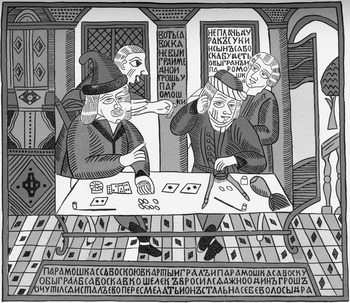
While the initial acceptance of Petrine cultural changes was slow, by the middle of the eighteenth century Western customs had become the norm among Russian elite society, even if this created a widening gulf between Western-oriented nobles and their traditional, Russian Orthodox peasants.Footnote 95 Tobacco was included in this cultural transformation, but it found a place in Russian culture in accordance with its past and under much different terms than those expected by the seventeenth-century English free trade advocates. For example, in a broadside from the second quarter of the eighteenth century (Figure 1), a tobacco pipe appears at the forefront of the picture as one of several images of the illicit habits of Russian elites. Two noblemen in the foreground gamble and smoke, while the peasants in the background are playing some type of questionable (sexual?) “game.”Footnote 96 Even as tobacco consumption became more widespread later in the eighteenth century, it was not unusual among the elite to possess snuffboxes, pipes, or ashtrays depicting rubenesque, exposed women or even explicit sexual acts.Footnote 97
Paramoshka with Savoska, second quarter of the eighteenth century (V. S. Bakhtin, Russkii lubok, XVII-XIX vv. (Moscow, 1962), image #20, n.p.

Thus even Peter the Great did little to persuade Russians that tobacco was not one of the “evil customs” the Russian Orthodox Church had warned the faithful against in 1551. While the Church never officially condemned tobacco again after Peter's legalization, Orthodox Old Believers, free from the official authority of the Church, continued to produce edifying tales that revealed the danger of tobacco. As these sectarians had rejected a reform of Orthodox rituals in the 1660s, they continued to denounce all of the Peter's cultural innovations. Some Old Believers believed that Peter was the Anti-Christ, destroying the last heavenly kingdom on earth, and that tobacco was one of his weapons against the faithful.Footnote 98 In one Old Believer tale, tobacco was an ancient evil, connected with the daughter of Jezebel. Having rejected a chance to repent, God cast her down into the earth, “with the Devil in her belly and the cesspool of filth in her bosom. And then it rained over her grave, and on the very same spot the dirt spewed a weed. The Greeks, in compliance with the Devil's plan, will adopt this weed and plant it in their gardens, and call it ‘tobacco.’”Footnote 99 Here the Greeks take the role of the Devil's advocate, but Old Believers associated the religious reforms of the 1660s with “Greek” innovations, initiating Muscovy's slow descent into world-destroying immorality, of which Petrine tobacco was merely the latest offense.
By the nineteenth century Russian society was far more accepting of tobacco. The Russian peasantry, largely unaffected by any of Peter's innovations, eventually accepted tobacco as part of their daily lives. Tobacco pipes even became a recurrent motif to represent prosperity in traditional gifts such as distaffs, without any of the immoral connotations of the seventeenth or eighteenth centuries.Footnote 100 However, it seems to have taken at least a century before Peter's legalization of tobacco was accepted by Russian society in some version of the free trade and liberty that the English believed to be a natural result of its importation. In other words, the effect of increased trade between England and Russia was, in the end, an acceptance of foreign customs and merchandise, but it was hardly the overnight process the English expected.
In the early-modern period, new commodities such as tobacco did little to change any country's culture upon their first introduction. Rather, each culture found a frame of reference within its own traditions that explained the role of this foreign imposition. In England, where public opinion held influence, and economic concerns were at the forefront of political debate, tobacco was at first a crisis and then an opportunity. Visions of profits and fears of economic ruin forced the acceptance of commodities over religious and medical objections, and immediate profits created widespread support for increasing a commodity's proliferation globally. Early-modern merchants found government power and distance to be effective obstacles to global commerce in this sense. In Muscovy, the tsar's initial prohibition against tobacco remained effective because the embargo suited both the Russian Orthodox Church's view of foreign cultures as immoral and the state's mercantilistic restrictions on the economy designed to control foreign trade. So effective was this ban that once the government reversed course and allowed, if not encouraged, tobacco consumption, Russian society retained its perception of tobacco's transgressive nature, and its unfavorable view of tobacco as a symbol of growing Westernization.
In the end, the tobacco trade reveals the essential misunderstandings that defined this one arena of early-modern globalization. The English never understood that Muscovites possessed a fundamentally different cultural framework, based on a self-defined messianism emerging from Russian Orthodoxy. The English did not bring “free trade and a gentler government” as suggested by the Earl of Carlisle's embassy, but rather moral danger that could destroy the fabric of not only Muscovite society but the entire world. The Anglo-Russian trade in tobacco transformed Russian culture in its small way only after contact endured for a great length of time, and only with the determined support of the state. Nothing that the English offered could be successful in the way English merchants and the English crown desired. Without question, Muscovy was transformed through the contact, but in such a way that tobacco added to Russian society's internal divides by exacerbating a belief in the inherent differences between Russians and non-Russians and between the Orthodox faithful and all other religions. It remains remarkable that the Anglo-Russian relationship remained so apparently worthwhile to both parties, when its value at any one point was so questionable and the potential results so disastrous.