Introduction
Cucumber powdery mildew is caused by Podosphaera xanthii and is one of the most devastating diseases that limits cucumber production worldwide (Fukino et al., Reference Fukino2013). Currently, synthetic chemical fungicides are the main methods used to control this disease, but it is difficult to apply these fungicides at the time of disease outbreak since cucumber fruits are harvested daily (Fukino et al., Reference Fukino2013). However, the widespread use of synthetic fungicides has caused significant problems, including resistance, resurgence and residue (3R). Pesticides are toxic to humans not only at high doses but even in low doses. Long-term exposure may lead to an array of health effects including cancer and neurodegenerative diseases (Bassil et al., Reference Bassil2007; Kanavouras et al., Reference Kanavouras2011; Parrón et al., Reference Parrón2011), reproductive and developmental toxicity (Hanke and Jurewicz, Reference Hanke and Jurewicz2004) and respiratory effects (Hernández et al., Reference Hernández2011). It is now well established that exposure to pesticides during critical periods of development can present lasting adverse effects in early development and later in life: in particular, the developing brain and the endocrine system are both very sensitive targets (London et al., Reference London2012). These problems affect human health and environmental substantially.
At the same time, pathogens are becoming more resistant to currently available pesticides due to the increasing use of synthetic chemicals. This makes it difficult to control plant diseases using synthetic fungicides leading to increased dose rates and a number of applications which makes the 3R problem worse. Thus, a vicious circle arises.
Therefore, safe, efficient and environmentally friendly alternative fungicides for controlling this disease are needed urgently. There are some useful and biorational ways to control powdery mildew on cucurbits. As a fungal mycoparasite, Ampelomyces can inhibit the asexual and sexual reproduction of powdery mildew, destroying the mycelium, conidiophore and immature conidiophores of powdery mildew (Kiss et al., Reference Kiss2010). In addition, Paecilomyces fumosoroseus can also suppress the development and spread of cucumber powdery mildew significantly, and lead to mechanical and physical damage as well as disruption of the vegetative and fruiting structures (Kavková and Curn, Reference Kavková and Curn2005). Gafni et al. (Reference Gafni2015) indicated that Pseudozyma aphidis proliferate on infected tissue and produce long hyphae that parasitize the powdery mildew hyphae and spores as an ectoparasite; they also showed that crude extract of P. aphidis metabolites can inhibit the powdery mildew spore germination in planta. Romero et al. (Reference Romero2007) demonstrated that the iturin and fengycin families of lipopeptides have a major role in the antagonism of Bacillus subtilis toward Podosphaera fusca, which is the main causal agent of cucurbit powdery mildew. Gilardi et al. (Reference Gilardi2008) showed that B. subtilis, when combined with azoxystrobin against P. xanthii at the recommended field dosages, provided better powdery mildew control than the two control measures alone. Meanwhile, pesticides formulated from plant extracts or phytochemicals, which are more environmentally friendly because of their biodegradability, produce minimal side effects impacting non-target organisms and are frequently considered promising candidates for integrated pest management (Cantrell et al., Reference Cantrell, Dayan and Duke2012).
In recent years, numerous studies have indicated that some plant extracts or products have the potential ability to act as natural pesticides to control plant diseases. It has been estimated that there are more than 250 000 plant species on earth that can be evaluated for antimicrobial bioactive chemical compounds. Over the last several decades, researchers have evaluated the impacts of plant extracts and oils against plant pathogens; valuable results have been achieved and some commercial botanical formulations have been prepared and marketed (Zaker, Reference Zaker2016). For example, the essential oil from Thymus vulgaris was found to exhibit fungicidal activity against Verticillium dahliae in olive plants. In treatments, complete inhibition of mycelial growth and microsclerotia was achieved as well as disease reduction of 65 and 42%, respectively, in olive plants (Varo et al., Reference Varo2017). Duan et al. (Reference Duan2016) demonstrated the chemical basis of the fungicidal activity of tobacco extracts against Valsa mali: chemical analysis indicated that cembranoids were the main fungicidal substances, which act by destroying the endometrial structure of the fungus. Their research also suggested that tobacco extracts prepared with solvents of weaker polarity had higher fungicidal activities, and the inhibitory effect of tobacco extracts against V. mali was also cultivar-dependent. Regalia SC is an aqueous product containing an ethanol extract from Reynoutria sachalinensis (Marrone Bio Innovations Inc., Davis, CA, USA) that was previously reported to control powdery mildew in cucumber plants (Daayf et al., Reference Daayf, Schmitt and Belanger1995; Dik and van der Staay, Reference Dik and van der Staay1995; Konstantinidou-Doltsinis and Schmitt, Reference Konstantinidou-Doltsinis and Schmitt1998; Wurms et al., Reference Wurms1999; Petsikos et al., Reference Petsikos-Panayotarou2002). Various plant extracts can be used to manage fungal rotting of fruit and vegetables, thereby prolonging shelf life (Tripathi and Dubey, Reference Tripathi and Dubey2004). Irilin B, the flavonone dihydrowogonin and sesquiterpene pygmol, can inhibit the growth of the plant pathogenic fungus Cladosporium cucumerinum, which is isolated from the dichloromethane extract from the aerial parts of Chenopodium procerum (Bergeron et al., Reference Bergeron1995).
Turmeric is the rhizome of Curcuma longa L., a tropical herb of the Zingiberaceae family indigenous to southern Asia. It is widely used for spice, colouring, flavouring and traditional medicine. Turmeric and its extract have various beneficial effects on human health (Ammon and Wahl, Reference Ammon and Wahl1991).
Turmeric can not only be used in humans but can also be used in agriculture. It has been noted that the extract of C. longa L. has insecticidal (Chander and Kulkarni, Reference Chander and Kulkarni1992), repellent (Su et al., Reference Su, Horvat and Jilani1982; Jilani and Saxena, Reference Jilani and Saxena1990) and antifeeding properties (Jilani and Saxena, Reference Jilani and Saxena1990) against some stored-product insects such as Schistocerca gregaria Forsk and Dysdercus koenigiin Walk (Chowdhury et al., Reference Chowdhury, Walia and Saxena2000). Furthermore, Kim et al. (Reference Kim, Choi and Lee2003) investigated the fungicidal properties of C. longa L. rhizome-derived curcumin against phytopathogenic fungi and indicated a fungicidal action of C. longa. In addition, Pang et al. (Reference Pang2015) demonstrated the effect of crude extract of C. longa L. on the control of cucumber powdery mildew.
However, the most effective fungicidal component of C. longa L. is still unknown. Therefore, the goal of the current work was to isolate, purify and identify the effective component from C. longa L. crude extracts.
Materials and methods
Plant material and fungal pathogen
Turmeric was provided by Gansu Lanzhou Kai Tai Long Food Co., Ltd. (Lanzhou Chengguan District Peach Shuping, China). The conidia of P. xanthii were collected from the Shanghai Jiaotong University School of Agriculture and Biology. The pathogen was obtained from infected leaves of cucumber and identified. Cucumber seedlings were sprayed with a conidia suspension (concentration 105 conidia/ml) to enable infection, then cultured in a room at 23 ± 2 °C, 75 ± 10% relative humidity (RH) and 16L:8D photoperiod. These culture conditions were used throughout the laboratory experiments.
Chemical reagents
All chemical reagents used in the current study were of analytical grade, including petroleum ether, ethanol, ethyl acetate and methyl alcohol. They were purchased from the Shanghai Ling Feng Chemical Reagent Co., Ltd. (Shanghai, China).
Preparation of the extracts of Curcuma longa L
The dry root of turmeric was comminuted through a 40-mesh screen in a comminutor (Shanghai Dianjiu Herb Machinery Manufacture Co., Ltd., Shanghai, China). The powdered material was extracted with ethanol (3000 ml solution per 300 g root powder) and maintained at room temperature (25 °C) for 48 h. The process was performed three times. After filtration, the solutions were evaporated with a vacuum rotary evaporator (Shanghai Shen Sheng Science Technology Co. Ltd., Shanghai, China) at 40 °C. Eventually, 40.5 g of extracts were obtained from the ethanol, and the extracts were detected using a bioassay to investigate the fungicidal abilities.
Solvent partitioning of the crude extracts of Curcuma longa L
To demonstrate the polarity of the fungicidal substance that exists in turmeric, several different polar solvents were used in the experiment. The crude extract was sequentially extracted with four solvents (petroleum ether, ethyl acetate, n-butyl alcohol and distilled water). A volume of 500 ml containing 20 000 mg/l of crude extracts coupled with 500 ml of each solvent was partitioned through a suitable funnel (Shanghai Glass Factory, Shanghai, China). The organic-solvent-soluble fraction was concentrated and dried via rotary evaporation at 40 °C and the water-soluble fraction was freeze-dried. The process was carried out five times for each of the four solvents. For the subsequent bioassays, all fractions of the extracts were dissolved in the same concentration. The fraction that showed the strongest activity was chosen for further isolation.
Bioactivity-directed isolation of the active compound
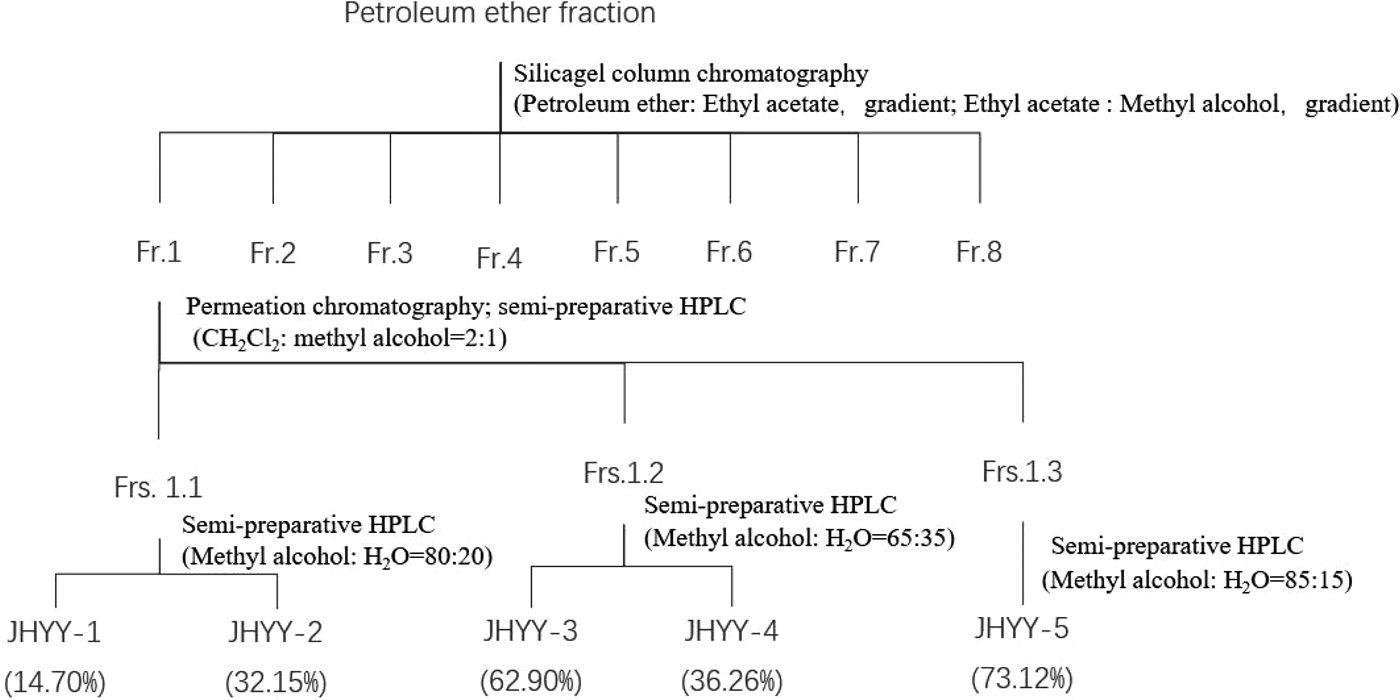
The petroleum ether fraction of the crude extract proved to be more active than the aqueous solution. It was used to further isolate the fungicidal compound using column chromatography. The fraction of C. longa L. (15 g) from the ethanol solution was chromatographed over silica gel, eluted with a petroleum ether (PE)-ethyl acetate (EtOAc) gradient (1:0–0:1, v/v) and an EtOAc-methyl alcohol (MeOH) gradient (1:0–0:1, v/v) to create eight fractions (Fr.1–Fr.8, Fig. 1) that were distinguished by thin-layer chromatography (TLC). Column chromatography (CC) was performed using silica gel (100–200 or 200–300 mesh, Kang-Bi-Nuo Silysia Chemical Ltd., Yantai, China) and Sephadex LH-20 (GE Healthcare Bio-Sciences AB, Uppsala, Sweden). Pre-coated silica gel plates (GF254, 0.25 mm, Kang-Bi-Nuo Silysia Chemical Ltd., Yantai, China) were used for TLC detection. Spots were visualized using an ultra-violet light (254 and/or 366 nm) after spraying with 5% (v/v) sulphuric acid ethanol (H2SO4-EtOH) followed by heating to 120 °C.
Scheme of the isolation of the active compound against S. fuliginea from the petroleum ether fraction of C. longa L. extract.

The eight fractions (Fr.1–Fr.8) were subjected to a bioassay against P. xanthii. Subsequently, Fr.1 was identified as the most active among the eight fractions. It was subjected to gel permeation chromatography (GPC) on Sephadex LH-20 (CH2Cl2: MeOH 2:1, v/v) and was further fractionated by semi-preparative high-performance liquid chromatography (HPLC) to create three sub-fractions (Frs. 1.1–1.3, Fig. 1). Fraction 1.1 was purified by semi-preparative HPLC (MeOH-H2O 80:20, v/v) to furnish compounds 1 (JHYY-1, 67.1 mg, t R = 13.3 min) and 2 (JHYY-2, 90.5 mg, t R = 18.9 min). Fraction 1.2 was also subjected to semi-preparative HPLC (MeOH-H2O 65:35, v/v) to create fractions 3 (JHYY-3, 36.3 mg, t R = 27.4 min) and 4 (JHYY-4, 10.0 mg, t R = 29.1 min). Fraction 1.3 was also purified by semi-preparative HPLC (MeOH-H2O 85:15, v/v) to obtain a pure active compound 5 (JHYY-5, 60.0 mg, t R = 19.3 min, Fig. 1). Semi-preparative HPLC was performed on a Shimadzu system (Shimadzu, Kyoto, Japan) coupled with an LC-20AT gradient HPLC pump, a SPD-M20A Photodiode Array Detector (PAD), and a Cosmosil ODS semi-prep (5 µm, 250 mm × 10 mm) column, using MeOH-H2O as the mobile phase, at a flow rate of 3 ml/min.
Structure characterization of active compound
Optical rotations were measured with a Rudolph Autopol IV-T polarimeter (Rudolph Research Analytical, Hackettstown, NJ, USA). Nuclear magnetic resonance (NMR) spectra were obtained on a Bruker Avance III 400 or a Bruker Avance 600 MHz spectrometer (Bruker, Billerica, MA, USA). Chemical shifts are expressed in δ (ppm) and referenced to the residual solvent signals. Electrospray-ionization mass spectrometry (ESIMS) were measured on an Agilent 1100 Series mass spectrometer.
Bioassays
Effect of Curcuma longa L. crude extracts on cucumber powdery mildew
The crude extracts were diluted to a series of concentrations in distilled water (0.5, 1, 2 and 10 mg/ml) and sprayed on the surface of cucumber leaves 24 h after the conidial suspension. The control was treated with distilled water. Fungicidal activities of the crude extracts on cucumber powdery mildew were evaluated according to the methods described by Zhang et al. (Reference Zhang2008) and Gafni et al. (Reference Gafni2015). The experiment was conducted on cucumber seedlings at the second true-leaf stage (growth stage (GS) 12, BBCH 1997). The treatments were replicated four times, and the experiment was performed three times. The evaluation began when the percentage of diseased leaves in the control (CK) group was >80%. The incidence of powdery mildew was ranked visually as a percentage of the infected area using an index of 0, 1, 3, 5, 7, 9 and 11, where 0 = no symptoms, 1 = 0–5%, 3 = 5–15%, 5 = 15–25%, 7 = 25–50%, 9 = 50–75% and 11 = 75–100%. The disease index and fungicidal effects were calculated using the following equations:
 $$\eqalign{& \hbox{Disease index (\%)} \cr & \quad = \sum {\displaystyle {\rm no.\ diseased\ plant\ leaves\ in\ this\ range \times disease\ range} \over {\hbox{total plant leaves investigated} \times 11}} \cr & \quad \quad \times 100} $$
 $${\rm Fungicidal\; effect\; (\% )} = \; \displaystyle{{(D_{\rm C} - \; D_{\rm T})} \over {D_{\rm C}}}\; \times 100$$
where D T = the disease index of the treatment and D C = the disease index of the control.
Effect of different solvent fractions on Podosphaera xanthii
First, the four partitions were each diluted at the same concentration of 1 mg/ml in distilled water and their effect was assayed as above. Then, the petroleum ether fraction was further bioassayed as above at four concentrations (0.5, 1, 2 and 4 mg/ml).
Effect of eight sub-fractions from the petroleum ether fraction on Podosphaera xanthii
The eight fractions separated from the petroleum fraction were diluted in distilled water at 200 µg/ml and sprayed on the surface of cucumber leaves 24 h after the conidial suspension was inoculated on the seedlings. The next part of the bioassay was performed as above.
Effect of five purified compounds from fraction 1 on Podosphaera xanthii
The five compounds (JHYY-1, JHYY2, JHYY-3, JHYY-4, JHYY-5) separated from fraction 1 were each diluted in distilled water at 120 µg/ml and then the compound JHYY-5 was further diluted at a series of concentrations (60, 120 and 240 µg/ml). The test of five compounds and the series of concentrations on JHYY-5 against both a negative (distilled water) and a positive control (azoxystrobin: the initial rate is 250 mg/ml and it was diluted to the desired concentration 120 µg/ml) were bioassayed as above.
Protective and curative ability of the active compound
The protective and curative ability of the active compound on cucumber powdery mildew were evaluated in cucumber seedlings according to the methods described by Zhang et al. (Reference Zhang2008). The active compound was diluted to 240 µg/ml in distilled water and sprayed on the surface of cucumber leaves at each of three different timings: in order to test the protective ability, the active compound treatment was applied 3 days, 2 days and 1 day before inoculation of cucumber seedlings. Meanwhile, the compound was also applied 1, 2, 3 and 8 days after inoculation on different seedlings, to test the curative ability (Pfender, Reference Pfender2006; Horsfield et al., Reference Horsfield2010; Sakugawa et al., Reference Sakugawa2012; Duan et al., Reference Duan2013). The evaluation of protective and curative ability began when the percentage of diseased leaves in the control (CK) group was >80%. The treatments were replicated four times, and the experiment was conducted three times. The inoculation factor, cultivation condition and disease control effect were performed as above.
Statistical analysis
All statistical analyses were conducted in SPSS 17.0 (SPSS Inc., Chicago, IL, USA). All data are expressed as the mean ± standard error of the four replicates and were subjected to one-way analysis of variance. The EC50 value, 95% confidence interval of the untransformed data and significant differences between the treatments were determined by Duncan's multiple range test. Differences were considered to be significant at P < 0.05. The POLYANOVA model permitted an assessment of factor by partitioning variance into linear and non-linear contrasts.
Results
Fungicidal effect of Curcuma longa L. crude extract
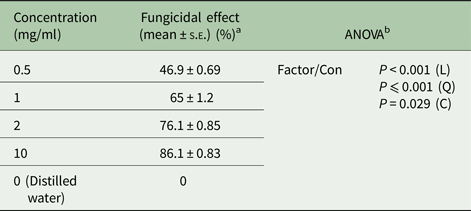
The crude extract of C. longa L. had fungicidal effects against P. xanthii of 46.9, 64.6, 76.1 and 86.1% at 0.5, 1, 2 and 10 mg/ml, respectively. Moreover, the fungicidal effect of the crude extract was dose-dependent as determined by the bioassay (Table 1). The concentrations of 0.5, 1, 2 and 10 mg/ml expressed significantly different (P < 0.05) fungicidal effects.
Fungicidal effects of C. longa L. crude extract

a The fungicidal effect was measured as described in the bioassay section. Values are the mean ± s.e. analysed by Duncan's multiple range test at P < 0.05.
b The POLYANOVA model permitted an assessment of Con (Concentration) by partitioning variance into linear (L) and non-linear (quadratic Q, cubic C) contrasts.
Fungicidal effects of the four fractions of Curcuma longa L. crude extract after solvent partitioning
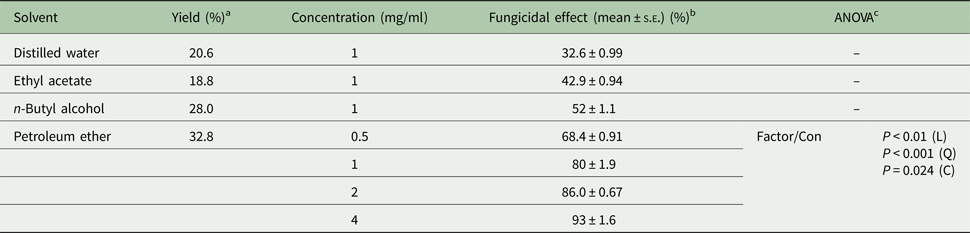
Results of the bioassay testing fungicidal effects of the crude extracts following partitioning with four solvents showed that the petroleum ether solvent achieved the highest fungicidal activity of 79.9% at a concentration of 1 mg/ml, compared with 32.6% in distilled water, 42.9% in ethyl acetate, 52.1% in n-Butyl alcohol (Table 2). These data lead to the conclusion that the petroleum ether solvent was most efficient among the four solvents and should be further researched to identify the active compound.
Fungicidal effect of the four fractions of C. longa L. crude extract after solvent partitioning

a Yield (%) = wt concentrated partition extract/wt crude extract × 100.
b The fungicidal effect was measured as described in the bioassay section. Values are the mean ± s.e. analysed by Duncan's multiple range test at P < 0.05.
c The POLYANOVA model permitted an assessment of Con (Concentration) by partitioning variance into linear (L) and non-linear (quadratic Q, cubic C) contrasts.
Antifungal activities of the eight fractions separated from the petroleum ether partition
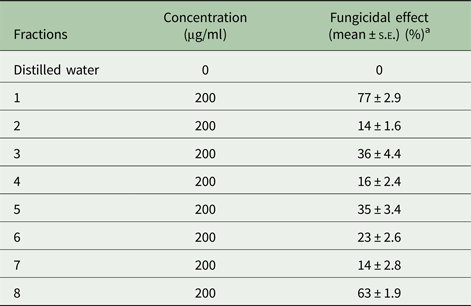
Bioassays of the eight fractions obtained from the petroleum ether partition indicated that Fr 1 had the highest fungicidal efficacy at 76.9% and a significant (P < 0.5) effect against P. xanthii (Table 3). This result is possible because Fr 1 contained the major active substance against the pathogen.
Fungicidal effect of eight fractions against P. xanthii

a The fungicidal effect was measured as described in the bioassay section. Values are the mean ± s.e. analysed by Duncan's multiple range test at P < 0.05.
Antifungal activity of the active compound
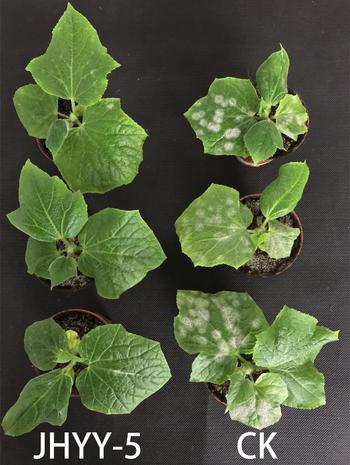
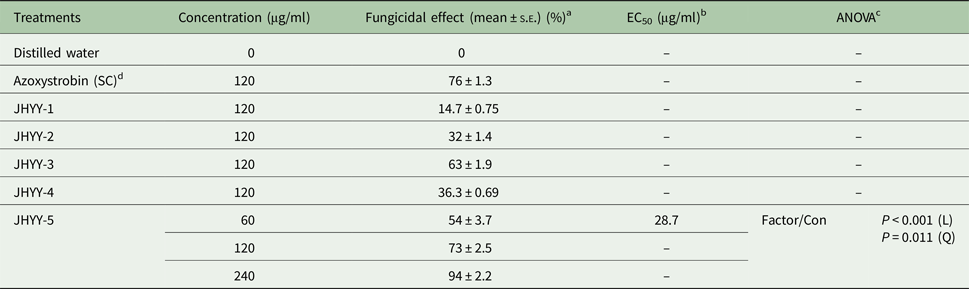
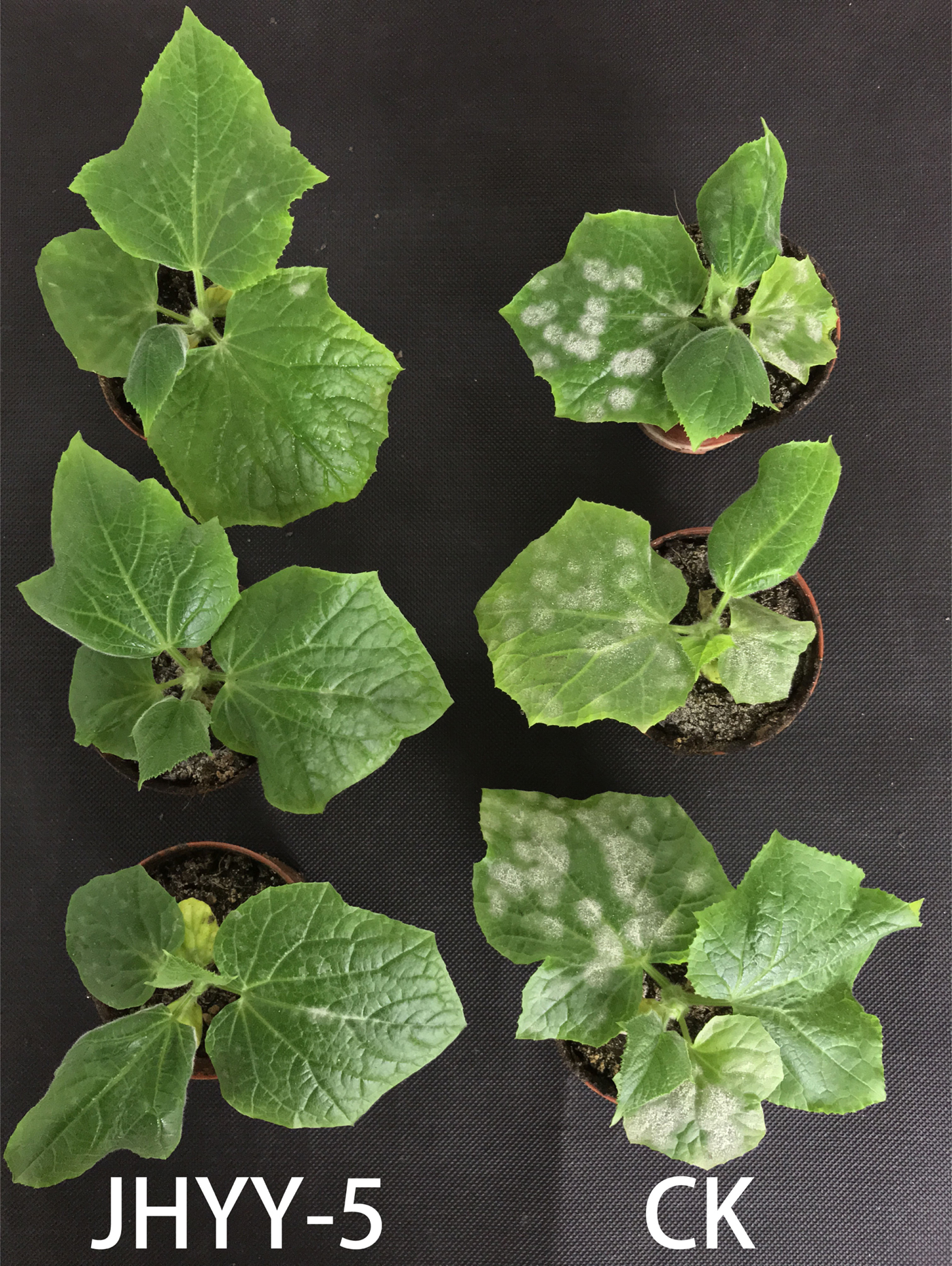
Fungicidal efficacies of the five compounds obtained from Fr 1 were evaluated with bioassays (Table 4). The results indicated that JHYY-5 achieved the highest fungicidal effect among the five compounds at 73.1% at 120 µg/ml. Afterwards, three concentration gradients were set to demonstrate the EC50 (28.7 µg/ml), and all gradients had significant (P < 0.05) effects against P. xanthii. At the same time, JHYY-5 achieved the same efficacy compared with a synthetic fungicide-Azoxystrobin (SC) at the same concentration of 120 µg/ml. JHYY-5 exhibited effective control efficacy of 93.7% at 240 µg/ml against P. xanthii. Meanwhile, visual observations (Fig. 2) showed that there were fewer spots on the surfaces of cucumber seedlings treated with JHYY-5 than the control group.
Visual observation of control efficacy of the active compound JHYY-5 at 240 µg/ml when it was inoculated 14 days later.
Fungicidal effect of active compound against P. xanthii

a The fungicidal effect was measured as described in the bioassay section. Values are the mean ± s.e. analysed by Duncan's multiple range test at P < 0.05.
b EC50 presents the concentration of compound 1 for the 50% fungicidal effect.
c The POLYANOVA model permitted an assessment of Con (Concentration) by partitioning variance into linear (L) and non-linear (quadratic Q) contrasts.
d A fungicide produced by Syngenta called Amistar that contains 25% Azoxystrobin.
Protective and curative ability of the active compound JHYY-5
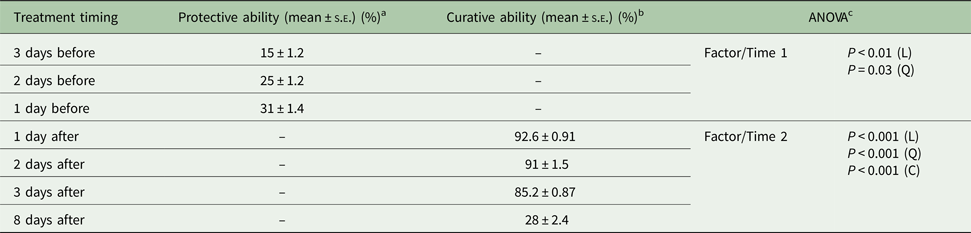
The results show that the active compound JHYY-5 possesses the highest activity among the five compounds isolated. The experiment confirmed its protective and curative ability against P. xanthii on cucumber seedlings at 240 µg/ml (Table 5). Compound JHYY-5 exhibited superior curative ability but little protective ability. The curative ability was time-related; the earlier the active compound was applied to cucumber seedlings, the better control efficacy was, i.e. curative control efficacy was highest (92.6%) when applied 1 day after inoculation and gradually reduced to 27.8% at 8 days after inoculation. Application of the compound either 1 or 2 days after inoculation was very effective (fungicide effects of 92.6 and 91.2%, respectively). With regard to protective ability, however, the active compound JHYY-5 has fungicide effects ranging from 15.1% (3 days before inoculation) to 30.9% (1 day before inoculation). Therefore, the results indicated that the curative ability of JHYY-5 was better than its protective ability against P. xanthii.
Protective and curative ability of the active compound JHYY-5 against P. xanthii

a The protective ability was measured as described in the bioassay section. Values are the mean ± s.e. analysed by Duncan's multiple range test at P < 0.05.
b The curative ability was measured as described in the bioassay section. Values are the mean ± s.e. analysed by Duncan's multiple range test at P < 0.05.
c The POLYANOVA model permitted an assessment of Time 1 (treatment before inoculation) by partitioning variance into linear (L) and non-linear (quadratic Q) contrasts.
The POLYANOVA model permitted an assessment of Time 2 (treatment after inoculation) by partitioning variance into linear (L) and non-linear (quadratic Q, cubic C) contrasts.
The structural characterization of JHYY-5
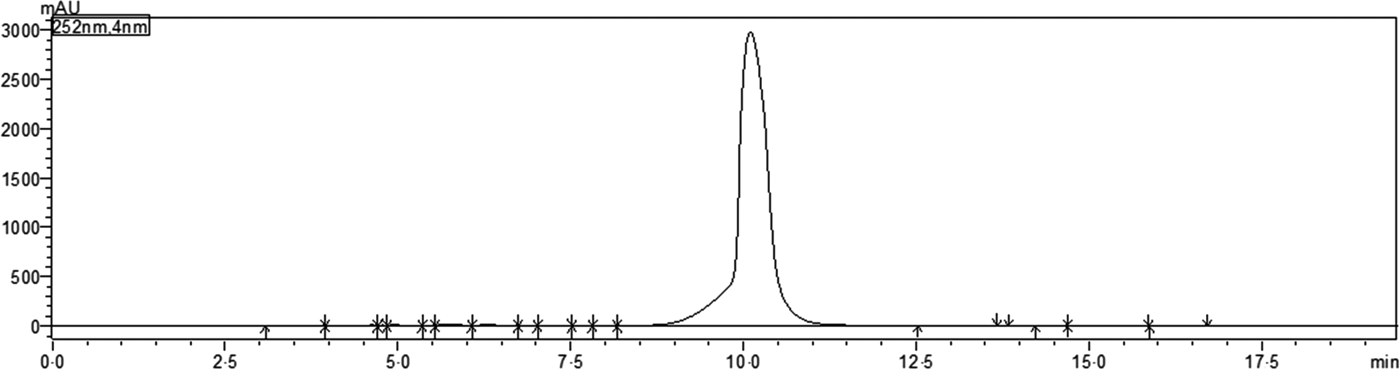
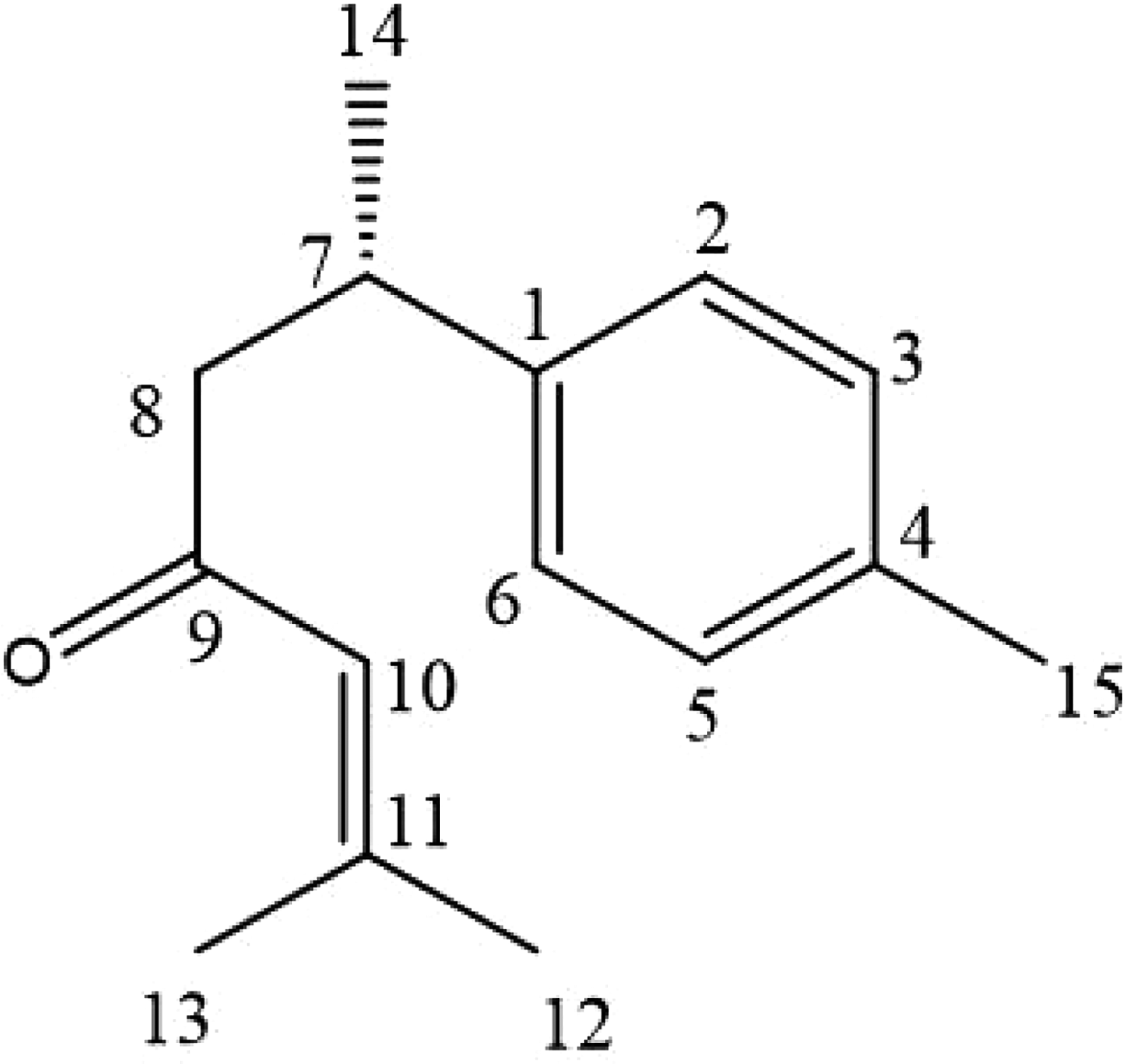
JHYY-5 was obtained as a colourless oil. The semi-preparative HPLC analysis data are presented in Fig. 3. Its 13C NMR spectrum showed a total of 15 well-resolved carbon signals. The 1H NMR spectrum of JHYY-5 together with the 13C NMR experiment displayed one p-substituted toluene ring (δ H 7.13 (2H, br d, J = 8.0 Hz, H-2 and H-6), 7.10 (2H, br d, J = 8.0 Hz, H-3 and H-5), 2.32 (3H, s, Me-15); δ C 143.7 (C-1), 126.6 (C-2 and C-6), 129.1 (C-3 and C-5), 135.5 (C-4), 20.9 (C-15)), one 3,3-disubstituted conjugated carbonyl group (δ H 6.04 (1H, br s, H-10); δ C 199.8 (C-9), 124.1 (C-10), 155.0 (C-11)), one methine group (δ H 3.30 (1H, m, H-7); δ C 35.3 (C-7)), one methylene group and three methyl groups (δ H 1.87 (3H, s, Me-12), 2.12 (3H, s, Me-13), 1.25 (3H, d, J = 6.9, Me-14); δ C 20.7 (C-12), 27.6 (C-13), 22.0 (C-14)). The above spectroscopic data were identical to those of (+)-(S)-ar-turmerone (Nave et al., Reference Nave2010; Fujiwara et al., Reference Fujiwara2011). Finally, the structure of JHYY-5 including the absolute configuration (Fig. 4) was determined to be the same as the naturally occurring (+)-(S)-ar-turmerone, due to the NMR data combined with the measured specific rotation value (α)25D + 66.4 (c 1.00, CHCl3) (lit.1 (α)29D + 63.7 (c 1.00, CHCl3)):
Semi-preparative HPLC assay of JHYY-5. One main absorption peak was detected at 252 nm with a retention time of 10.25 min.

Chemical structure of (+)-(S)-ar-turmerone.

(+)-(S)-ar-turmerone ((6S)-2-methyl-6-(4-methylphenyl)-2-hepten-4-one): colourless oil; (α)25D + 66.4 (c 1.00, CHCl3); 1H NMR (CDCl3, 400 MHz): δ 7.13 (2H, br d, J = 8.0 Hz, H-2 and H-6), 7.10 (2H, br d, J = 8.0 Hz, H-3 and H-5) 6.04 (1H, br s, H-10), 3.30 (1H, m, H-7), 2.72 (1H, dd, J = 15.8, 6.1 Hz, H-8a), 2.62 (1H, dd, J = 15.8, 8.3 Hz, H-8b), 2.32 (3H, s, Me-15), 2.12 (3H, s, Me-13), 1.85 (3H, s, Me-12), 1.25 (3H, d, J = 6.9 Hz, Me-14); 13C NMR (CDCl3, 150 MHz): δ 199.8 (C-9), 155.0 (C-11), 143.7 (C-1), 135.5 (C-4), 129.1 (C-3 and C-5), 126.6 (C-2 and C-6), 124.1 (C-10), 52.7 (C-8), 35.3 (C-7), 27.6 (C-13), 22.0 (C-14), 20.9 (C-15), 20.7 (C-12); ESIMS m/z 216 (M + H)+, 239 (M + Na)+.
Discussion
The current study examined the effects of crude extracts and further isolated fractions from C. longa L. against an important agricultural disease, cucumber powdery mildew, caused by P. xanthii. Based on the research of Pang et al. (Reference Pang2015), which demonstrated an effect of C. longa L. crude extract on the control of cucumber powdery mildew, a pure compound was separated – (+)-(S)-ar-turmerone – that was proven to have efficient fungicidal ability against P. xanthii in the current study. The C. longa L. extract showed effective fungicidal ability compared with other plant extracts. For instance, Zhang et al. (Reference Zhang2008) found that the crude extracts of Robinia pseudoacacia exhibited a 45% effect at a concentration of 20 mg/ml against P. xanthii, which is lower than the fungicidal ability demonstrated in the current study by C. longa L. crude extract at the same concentration. Daayf et al. (Reference Daayf, Schmitt and Belanger1995) applied the crude extract of Reynoutria sachalinensis to control powdery mildew (P. xanthii) on long English cucumber and fund that it exhibited an effective result at a concentration of 2 mg/ml. The crude extract of C. longa L. also exhibited a parallel effect compared with R. sachalinensis. In conclusion, the current results provide evidence that the crude extract of C. longa L. has the potential of controlling this pathogen as a natural plant product.
There are several other plant-derived substances used to treat cucumber powdery mildew, such as chrysophanol, osthol and oligosaccharide, which are well known for their fungicidal efficacies and abilities to improve plant resistance (Herger and Klingauf, Reference Herger and Klingauf1990; Ma et al., Reference Ma2005; Tang et al., Reference Tang, Wang and Zhang2005). Those compounds are currently widely applied in integrated pest management for safety and environmental protection reasons. In a previous study, Su et al. (Reference Su, Horvat and Jilani1982) indicated that two compounds, ar-turmerone and turmerone, repel Tribolium castaneum (Hbst.) with average repellencies of 62.9 and 43.1%, respectively. However, the current study was the first to determine the active compound in C. longa L. that is effective against P. xanthii; furthermore, the compound was isolated, purified and characterized and it was determined that the active compound is (+)-(S)-ar-turmerone ((6S)-2-methyl-6-(4-methylphenyl)-2-hepten-4-one). The compound showed pronounced fungicidal ability against P. xanthii through the bioassay that achieved 93.7% efficacy at a concentration of 240 µg/ml. In the present study, protective and curative ability of (+)-(S)-ar-turmerone against P. xanthii were measured by bioassay, where cucumber seedlings were treated by the active compound at different times. The results suggested that the compound had the effective curative ability and little protective ability. The active compound (+)-(S)-ar-turmerone had a 73.1% fungicidal effect at 120 µg/ml. Meanwhile, the positive control, Azoxystrobin (SC), had a better fungicidal efficacy than (+)-(S)-ar-turmerone at the same concentration, achieving 75.9% efficacy. Azoxystrobin is a strobilurin fungicide discovered by ICI, the agrochemical interests of which are now part of Syngenta. The strobilurins are an important class of agricultural fungicides, the discovery of which was inspired by a group of natural fungicidal derivatives of β-methoxy-acrylic acid (Clough, Reference Clough, Wrigley, Hayes, Thomas, Chrystal and Nicholson2000; Bartlett et al., Reference Bartlett2002). The fungicidal activity of the strobilurins, oudemansins and myxothiazols stems from their ability to inhibit mitochondrial respiration by binding at the so-called Qo site of cytochrome b. It blocks electron transfer between cytochrome b and cytochrome c1, disrupting the energy cycle within the fungus by halting the production of ATP (Sauter et al., Reference Sauter, Steglich and Anke1999). Strobilurins have been extremely successful because they can effectively improve the quality and yield of agricultural crops, and have proven to be one of the most valuable fungicides ever discovered by the agrochemicals industry. There is no significant difference between strobilurins and (+)-(S)-ar-turmerone, yet there is still much work and further research required in order to discover the mechanism of its efficacy and to lay the foundation for the development of a new pesticide. The current study is the first report to demonstrate that the fungicidal compound obtained from C. longa L. is (+)-(S)-ar-turmerone and to determine the efficacy of this substance against P. xanthii.
According to the current research, C. longa L.-derived materials can be used as effective fungicides against P. xanthii. Furthermore, the compound (+)-(S)-ar-turmerone can be made into novel bio-pesticides due to its strong potential to control P. xanthii. In addition, C. longa L. is a common material that can be obtained easily and cheaply because of the wide cultivation of this plant: the active compound (+)-(S)-ar-turmerone isolated from it is a sesquiterpene that can be regarded as safe to human health. Ferreira et al. (Reference Ferreira1992) investigated the antivenom function of ar-turmerone against snakebites. Aratanechemuge et al. (Reference Aratanechemuge2002) demonstrated the suppression of leukaemia cell growth by ar-turmerone, which resulted from the induction of apoptosis by this compound. Hence, extracts of C. longa L. and the active compound (+)-(S)-ar-turmerone can be considered as safe, environmentally friendly and efficient bio-fungicide that can be widely applied to integrated pest management. In addition, efficient extraction technologies make it easier to obtain the compound at low costs. Carvalho et al. (Reference Carvalho2015) obtained (+)-(S)-ar-turmerone using supercritical carbon dioxide and observed fast extraction combined with relatively low solvent consumption at the most suitable condition of 333 K and 25 MPa for a solvent mass to feed mass ratio of 1.31. Also, the active compound (+)-(S)-ar-turmerone can also be artificially synthesized. Grieco and Finkelhor (Reference Grieco and Finkelhor1973) demonstrated the two-step synthesis of (+)-(S)-ar-turmerone from dianions of β-Keto Phosphonates. Rowe and Spilling (Reference Rowe and Spilling2003) exhibited the formal synthesis of (+)-(S)-ar-turmerone through stereospecific Pd (0)-catalysed arylation of an allylic hydroxy phosphonate derivative.
In summary, the current study has demonstrated the efficient fungicidal ability of C. longa L. extract and (+)-(S)-ar-turmerone against P. xanthii as well as the great potential for the development of a biological fungicide. To the best of our knowledge, this is the first report on the fungicidal activities of (+)-(S)-ar-turmerone from C. longa L. extract. Moreover, the current study further supports the promising future and economic value of plant-derived biological pesticides. However, field experiments are necessary to confirm the efficacy of C. longa L. extract in the natural environment, and the environmental influence, environmental toxicology and sub-chronic toxicity of the active compound (+)-(S)-ar-turmerone should be further investigated.
Acknowledgements
The authors extend gratitude to the editor, editorial assistant and reviewers for their constructive comments, and are grateful to phytopathologist Prof. Kang Suzhen, who identified the pathogen obtained from infected leaves of cucumber. Special thanks to M. Q. Xu and J. H. Zhang for their support and assistance in this research.
Financial support
This study was funded by the project of Prospering Agriculture through Science and Technology of Shanghai, China (grant number Hu Nong Ke Gong Zi (2016) No 3-4-1).
Conflict of interest
None.
Ethical standards
Not applicable.