Because words represent the building blocks upon which the facility to produce and comprehend language at all levels is based, the capacity of a child to learn words has immense impact on his or her developing abilities to communicate and engage properly with the outside world. Both the Keynote Article and the Commentaries in this issue demonstrate that this capacity to acquire vocabulary is neither singular nor simple. Children may fail to learn new words in as rapid and efficient manner as their peers for many reasons: they may, for example, have inadequate environmental experience of either the spoken and printed form of the language (Huttenlocher, Haight, Bryk, Seltzer, & Lyons, 1991), or they may have poor abilities to produce the sound contrasts of the language (Mirak & Rescorla, 1998). The focus of the present discussion lies somewhere in between these extremes of influence, in the intervening perceptual and cognitive processes that constitute the speech processing and word learning system. Here, too, complexities abound. The developing language system is characterized by dependencies between the multiple processes involved in processing and learning language (Bishop, 1997), rarely evincing the dramatic dissociations in adults with acquired language disorders that have served cognitive neuropsychology so well in its bid to identify a modular structure of the language system. Weaknesses in perceptual analysis of the sound structure of the language, in the storage of the resulting mental representations, and in the availability of existing representations that can support the processing of new words, often coexist within an individual. As a consequence, it can be extremely difficult to tease apart the developmental underpinnings of language acquisition. In this article, I argue that real progress toward understanding vocabulary acquisition requires a substantial and systematic body of research evidence designed to provide strong empirical challenges to existing (and new) hypotheses and theories. Whereas mere description is unlikely to lead to major advances, systematic experimental analysis and the specification of detailed theoretical accounts should result in a more complete understanding of the complexities and constraints of new word learning.
THE NEED FOR HYPOTHESIS GENERATION AND TESTING
Two crucial steps toward substantial theoretical progress within any area of science are the generation of clear causal hypotheses, and the attempt to disconfirm them through empirical test. Hypotheses that can be expressed in very specific terms and generate clear predictions are crucial to this enterprise. The phonological storage account of vocabulary learning, according to which the learning of the sound structures of novel words is mediated by the temporary storage of phonological representations (Baddeley, Gathercole, & Papagno, 1998), represents one such hypothesis that in recent years we have attempted to put to stringent empirical test. On its own, the hypothesis will never provide a complete account of vocabulary acquisition. As Chiat (2006) and Snowling (2006) point out, learning a new word involves more than merely establishing a stable representation of the phonological structure that must be linked with parallel representations of its conceptual and also other nonphonological features. Being able to recognize and produce the sound pattern of a word while knowing nothing of its meaning would be of little value. I argue that it nonetheless has considerable utility as a potential account of at least one of the constraints on one aspect of vocabulary development: phonological learning.
One strong test of the phonological storage hypothesis was provided by our recent study of children with phonological short-term memory deficits that persisted between 5 and 8 years of age (Gathercole, Tiffany, Briscoe, Thorn, & The ALPSAC Team, 2005). If the quality of temporary phonological storage constrains the gradual process of constructing lexical phonological representations, children with poor phonological storage should struggle to learn new words. Contrary to this prediction, the vocabulary knowledge of these children was entirely appropriate for their age. Interpretation of this null and (for us) theoretically challenging result was aided by the inclusion of a range of measures of long-term episodic memory and learning in this study in which both the nature of the stimulus material and of the children's exposure to it was tightly controlled (Gathercole, Briscoe, Thorn, Tiffany, & The ALSPAC Team, 2006). Tests were included of memory and learning of a variety of verbal and visuospatial materials. In general, the phonological memory deficit groups performed on the measures of both episodic memory and learning at levels comparable to their control group, commensurate with their normal levels of attainments on tests of learning in the areas of reading and mathematics (Gathercole, Tiffany, et al., 2005). However, these children were impaired on three specific measures of verbal memory and learning: on remembering at a later point the name of a person shown on a photograph (The Rivermead Behavioural Memory Test for Children; Wilson, Ivani-Chalian & Aldridge, 1991), on multitrial learning of the names such as Cuthbert Cattermole accompanying four photographs of previously unfamiliar people (Doors and People Test; Baddeley, Emslie, & Nimmo-Smith, 1994), and in recall after multiple trials of word–nonword pairs such as house-tokramud.
The data from this study establish two new important facts that need to be addressed by theory. First, poor phonological memory function is nonetheless associated with slow verbatim learning of verbal material, particularly if the material has an unfamiliar phonological structure that prevents the ready use of alternative strategies to mediate learning. Second, very poor phonological memory skills are not sufficient to impair acquisition of native vocabulary, at least by these middle childhood years. We have suggested that this is due to the possibility of compensatory strategies including lexically mediated learning, in addition to the redundancy of exposure to the native language, which provides ample further learning opportunities for the learner who is initially slow to make progress.
A corollary is that empirical tests of the phonological storage hypothesis, and indeed any theoretical account of vocabulary acquisition, should not depend wholly on measures of word learning such as tests of native vocabulary knowledge, in which environmental exposure is uncontrolled. Of interest, Gray (2004) has compared word learning under fast mapping conditions in which the label for a novel object is not explicitly taught but can be inferred from the informal context in which it is introduced, and found little evidence for marked deficits in such word learning for children with specific language impairment (SLI) who nonetheless were impaired in nonword repetition. In contrast, the learning of new words taught in a more structured explicit manner in the same study was much slower in the group with SLI. Experimental investigation of the constraints on word learning in both young children and older individuals is a priority for further research in this area. As Chiat (2006) argues, understanding the developmental precursors extending back to infancy of nonword repetition is crucial to provide a full theoretical account of vocabulary acquisition. Robust procedures have now been developed for studying the learning of novel words by children as young as 15 months of age (e.g., Schafer & Plunkett, 1998), and these may provide important opportunities for much-needed empirical studies of even younger children than the present research literature provides.
Further experimental investigation is also needed to elucidate the different potential sources of the nonword repetition deficit in poor language learners. Van der Lely has identified the need for systematic examination of higher level factors influencing nonword processing, with a particular focus on the role of prosodic factors including both syllabic and metrical (relating to stress patterns) structures. To this end, van der Lely and her group have developed a valuable new test of nonword repetition, the Test of Phonological Structure, which systematically varies the multiple parameters that determine prosodic complexity (van der Lely & Harris, 1999). Children with a subtype of SLI that involves particular problems with grammatical processing score very poorly on this test, and have particular difficulties with unstressed syllables. More generally, these data show that children are highly sensitive to the prosodic complexity of nonword stimuli, a pattern of findings that cannot be explained simply in terms of variation in short-term memory loads. One important issue to be addressed by future research is the extent to which children with SLI but who do not have disproportionate problems with grammatical processing also show heightened sensitivity to the prosodic structure of nonwords.
Relatedly, Marton (2006) describes evidence that although segmental errors in nonword repetition in children with SLI are very common, they are usually preserve nonsegmental features such as the number of syllables and the stress pattern. She also reports findings that these children fail to show the usual benefit to the inclusion of meaningful syllables in nonwords, suggesting that they may not have sufficient resources to access existing representation in support of the repetition attempt. This focus on both common and distinct features of nonword repetition in typically developing children and children with SLI may lead to substantial inroads in understanding the complexity of the deficit in this task in poor language learners.
A further factor that may cause deficits in nonword repetition is the existing phonological knowledge of the child. Vitevitch (2003) outlines evidence that the phonotactic probability and density of phonological neighborhoods can under some circumstances influence the recognition of spoken words as well as nonwords. Other recent work has focused on which of these two factors is crucial in supporting memory for nonwords: some findings favor neighborhood density as the single crucial factor (Roodenrys & Hinton, 2002), whereas others indicate that phonotactic probability is also important in its own right (Thorn & Frankish, 2005). Ellis Weismer and Edwards (2006) suggest that the particular difficulties in repeating nonwords encountered by children with SLI are an indirect consequence of their relative sparse phonological lexicons for lengthy words. This is an interesting possibility that could possibly be explored more directly, by showing direct links in SLI between repetition accuracy and neighborhood density.
Lisa Archibald and I have adopted an approach of systematic manipulation of nonword forms in a bid to mount a strong empirical test of the hypothesis that the nonword repetition deficit of children with SLI results from a phonological storage deficit. We tested the phonological storage hypothesis in SLI by comparing nonword repetition and serial recall of equivalent syllable sequences in children with a diagnosis of SLI and with typically developing children of the same chronological age (Archibald & Gathercole, 2006a). If the nonword repetition deficit arises simply from inadequate phonological storage, the SLI group should face equivalent difficulties in repeating nonwords and in recalling the syllables in sequence for serial recall, as the latter task represents the paradigmatic phonological storage task. The data run contrary to this prediction, as the nonword repetition deficit in the SLI group persisted even when serial recall scores are covaried. These children therefore had difficulties in repeating nonwords that could not be explained by their phonological storage deficit alone. Note that in our view, the phonological storage hypothesis does not make a strong prediction of a greater deficit in the SLI group in serial recall than nonword repetition due to reduced opportunities for redintegration, as Bowey (2006) argues. We believe these findings are important because they run contrary to the current form of a significant hypothesis (the phonological storage account) and direct attention toward features that distinguish nonword repetition from serial recall. The candidates we have considered are the physical cues to structure provided by coarticulation and prosodic contour (a factor also discussed by Chiat, 2006), speed of information transmission, and speech–motor demands at response. These hypotheses generate an agenda that could fruitfully be addressed by a future research program. It would also be useful to provide a systematic test of Chiat's early phonological sensitivity account that children with SLI have particular problems in registering weak syllables and segmental details within a prosodic structure.
STUDYING NONWORD REPETITION IN ITS OWN RIGHT
Systematic experimental investigation of the component processes of nonword repetition in typically developing children and in adults is also a priority for further research. Gupta's work had made a substantial contribution in this area, demonstrating that the bow-shaped serial position function that characterizes immediate serial recall is also present in nonword repetition of the same syllabic forms (Gupta, 2005; Gupta, Lipinski, Abbs, & Lin, 2005). Gupta points out that in serial recall, a full account of nonword repetition will include specification of how the serial order of the elements in nonwords (phonemes, syllables, metrical feet) are represented and retained. A number of potential mechanisms for retaining order in serial recall have been advanced in computational models in recent years (Brown, Preece, & Hulme, 2000; Burgess & Hitch, 1999; Page & Norris, 1998), in addition to Gupta's own computational model (Gupta, in press; Gupta & MacWhinney, 1997). Comparable primacy and recency effects in nonword repetition and serial recall are not, however, sufficient to establish the equivalence of serial ordering mechanisms in the two paradigms. Detailed characteristics of serial order errors in serial recall such as the migration function (e.g., Henson, Norris, Page, & Baddeley, 1996) are well established, and have provided substantial input into computational simulations of serial recall. Corresponding detailed empirical investigations have yet to be conducted for nonword repetition, and to this end, we have recently conducted a comparison of errors across nonword repetition and serial recall in children (Archibald & Gathercole, 2006b). Although our results concur with those of Gupta (2005; Gupta et al., 2005) in yielding comparable serial position functions for syllables in both tasks, there were some notable differences in the detailed error patterns in the two cases, particularly at the phonological level. Consonant migrations were more common in nonword repetition than serial recall, whereas vowel migrations show a reversal of this pattern, being more frequent in serial recall than in nonword repetition. Moreover, consonant substitutions preserved more articulatory–phonetic features in nonword repetition than in serial recall. These data indicate that although common theoretical accounts of nonword repetition and serial recall may, in principle, be desirable, fundamental differences in the cognitive processes supporting the two paradigms need also to be explained.
MULTIPLE DEFICITS IN SLI
Two related themes concerning SLI that emerged repeatedly in responses to the Keynote Article concern its multiple origins and its putative heterogeneity across affected individuals. On the first point, I wholeheartedly concur. Although the hypothesis that phonological storage constrains the phonological learning involved in vocabulary acquisition receives widespread support that converges across developmental, experimental, and neuropsychological approaches, the data from our study of children with deficits in phonological memory whose language abilities were appropriate for their age (Gathercole, Tiffany, et al., 2005) establish that such a deficit does not on its own represent a sufficient basis for SLI. Bishop reaches similar conclusions on the basis of her investigations of the genetic basis of SLI, which have established substantial but largely independent heritability to both the nonword repetition deficits of this population (Bishop, Adams, & Norbury, 2006; Bishop, North, & Donlan, 1996) and to their poor syntactic skills. Related to this are van der Lely's comments on the potential role played by impairments in morphological processing in the nonword repetition deficit in SLI, particularly in tests such as the Children's Test of Nonword Repetition (CNRep; Gathercole & Baddeley, 1996), which incorporates both morphological and derivational forms. This feature of the test is discussed further by Archibald and Gathercole (in press-c). Based on a large-scale review of research, Bishop and Snowling (2004) also conclude that SLI arises from a conjunction of both phonological and nonphonological deficits.
Some of our own recent data reinforce these conclusions of twin deficits in SLI and indicate more precisely the nature of the impairments. One further area of disproportionate difficulty of children with SLI is performance on complex memory span tasks, which require simultaneous processing and storage of verbal material (Ellis Weismer, Evans, & Hesketh, 1999; Marton & Schwartz, 2003; Montgomery, 2000). The scale of the impairment is worthy of note: in our recent sample of children with SLI (Archibald & Gathercole, in press-a), the mean standard score across three such verbal complex memory span tasks (listening recall, counting recall, and backward digit recall) was 74, more than 1.7 SDs below the population mean of 100. In contrast, the performance of the group with SLI was comparable with that of age-matched control children on visuospatial complex memory span measures (Archibald & Gathercole, in press-b). The current view of adherents of the working memory model of Baddeley and Hitch (1974; Baddeley, 1986, 2000) is that complex memory tasks draw upon multiple components of the working memory system. The storage elements of the tasks are supported by the relevant domain-specific slave system (either the phonological loop or the visuospatial sketchpad), whereas the processing and coordination aspects of the tasks are supported by the domain-general resources of the central executive (Alloway, Gathercole, & Pickering, in press; Bayliss, Jarrold, Gunn, & Baddeley, 2003).
In our study, we directly assessed the functioning of all three components of the working memory model in children with SLI (Archibald & Gathercole, 2006c), using a set of tasks developed by Bayliss et al. (2003) that incorporated all possible combinations of verbal and visuospatial processing and storage within a common complex memory span paradigm. Independent measures of verbal and visuospatial processing efficiency and storage capacity were also taken. An intriguing and striking clear pattern of findings emerged when the children with SLI were compared with an group of typically developing children matched for age. The SLI children were significantly impaired on complex memory tasks requiring verbal storage combined with either verbal or visuospatial processing. On independent measures of the processing tasks in isolation, the children were also significantly slower to perform in both domains. In terms of the working memory model, it therefore appears that the children with SLI have two deficits: an impairment of the phonological storage component of working memory (the phonological loop), and a further deficit in the domain-general central executive that supports the nonstorage elements of the task. However, because central executive support is also required for visuospatial complex memory tasks, a deficit in performance in the SLI group may also be expected here. An alternative explanation is that for individuals with SLI, the storage of phonological material places greater demands on the limited processing resources of the central executive; quite simply, the children have to work harder to maintain representations in this form. Thus, the requirement to process any other material at the same time as storing phonological information is sufficient to give rise to marked decrements in task performance, due to competition for limited resources.
This view represents a specific and readily testable hypothesis that resonates to varying degrees with several of the theoretical accounts of SLI and related disorders advanced by commentators. It fits well with suggestions by Marton (2006), and Ellis Weismer and Edwards (2006) that children with SLI have problems with simultaneous processing, although in the present case the claim is that specifically, such problems arise only when phonological material is being stored. It also has some correspondence with Service's (2006) view that adults with dyslexia have a relatively global processing deficit resulting from noisy representations at the neural level, although this view takes a more specific theoretical form than present data necessarily support. The hypothesis can also be readily extended to nonword repetition. As Service notes, the absence of predictable structures in nonwords means that the demands of processing and storing their phonological representations are much heavier than for as familiar words. Thus, despite its apparent simplicity, nonword repetition places significant burdens on general processing resources, particularly in some individuals with language impairments. Note that this hypothesis is also consistent with the comment by Montgomery and Evans that “NWR performance represents a more complex psycholinguistic exercise for children with SLI.”
SLI: HETEROGENEOUS OR NOT?
I am much less convinced by claims of the heterogeneity of SLI and associated inconsistency in nonword repetition deficits made by Chiat (2006), Gray (2006), Ellis Weismer and Edwards (2006), and Snowling (2006). My reservations arise from the inconsistent use of selection criteria for SLI in relevant research studies. Standard diagnostic criteria for identifying children with specific developmental language disorders are provided both by the American Psychiatric Association's Diagnostic and Statistical Manual of Mental Disorders—Fourth Edition (DSM-IV; American Psychiatric Association, 1994) and the World Health Organisation's International Classification of Diseases—Tenth Edition (ICD-10; World Health Organisation, 1993). Children meeting these criteria have significant language problems that may be either purely expressive or mixed receptive–expressive (DSM-IV), but that are not related to another identifiable cause, such as autistic spectrum disorders, general learning difficulties, hearing impairment, or another relevant sensory deficit, speech–motor problems, severe environmental deprivation, or an acquired disorder. In line with the profile, in a report from the Workshop on Defining the Phenotype for Specific Language Impairment 1998, Tager-Flusberg and Cooper (1999) recommended that researchers include assessments of morphosyntax, semantics, vocabulary, phonology and articulation, and pragmatics in conducting studies of individuals with SLI.
It is notable that the studies of SLI that yield the greatest estimates of heterogeneity do not incorporate these strict exclusions, but typically adopt much laxer selection criteria than those outlined above. The influential work of Conti-Ramsden and colleagues illustrates the extent to which such broad selection criteria may result in the inclusion of distinct subgroups within the sample. Conti-Ramsden, Crutchley, and Botting (1997; see also, Conti-Ramsden, Botting, & Faragher, 2001) report data from a random (50%) selection of 242 7-year-old children attending language units in England. Admission criteria to such units varies both by region and individual unit, but typically require that the child have impairments of language while falling in the normal range on nonverbal cognitive measures. The research team did not use further systematic assessment as a basis for inclusion in the study, although each child did complete a psychometric test battery that provided the bases of a cluster analysis of the sample. Six subgroups were identified. One subgroup (constituting 21.5% of the sample) had normal articulatory skills, poor syntax, and morphology, and receptive language problems that were sometimes accompanied by expressive difficulties. Four of the remaining subgroups were characterized by differing combinations of articulatory, phonology and expressive difficulties (68.2% in total), with a final 10.3% of the children presenting with semantic and/or pragmatic difficulties but normal phonology and articulation.
This study provides a survey of the range of significant language problems at a national level that has proved valuable for professional and academic groups working with children with language impairments. However, it is notable that the majority of the subgroups identified in this study do not conform to the diagnostic criteria of the DSM-IV or ICD-10, as they include children with impairments of articulation (speech–motor function) and semantic/pragmatic deficits. Only the subgroup consisting of approximately one-fifth of the children with normal articulatory skills meet the criteria for the DSM-IV developmental language disorder classification. Although the Conti-Ramsden et al. (1997) study was unusually inclusive in its selection policy, many of the other key studies in this research literature also fail to meet these exclusionary criteria. For example, Ellis Weismer et al. (2000) conducted a large-scale study of 581 children aged 8 and 9 years of age. Adopting the selection criteria advanced by Tomblin et al. (1997), 80 children were classified as having SLI on the basis of a second-grade clinical diagnosis of SLI, obtaining composite scores of more than 1.25 SDs below the population mean on at least two out of five composite language scores (receptive, expressive, vocabulary, grammar, narrative), and performance IQ scores of 85 and above. The study is highly relevant to the present concerns as a measure of nonword repetition, the Nonword Repetition Test (NRT) of Dollaghan and Campbell (1997), was administered to all participants. As expected, repetition accuracy of the SLI group was significantly impaired on the NRT relative to the group with no language deficits. However, low repetition scores did not characterize all members of the SLI group, and were also found in a substantial monitory of the typically developing group. On this basis, Ellis Weismer et al. argued that nonword repetition on its own may not furnish an adequate phenotypic marker for SLI.
However, it appears that in this study, children were not excluded from the SLI group on the basis of either speech–motor or pragmatic impairments. We have reason from our own studies of children with SLI to believe that these exclusions may be crucial to the consistency of both nonword repetition and verbal working memory deficits. We have recently completed a prevalence study of SLI in the 147 children attending eight language units in northeast England (Archibald & Gathercole, 2006d). In this study, receptive and expressive language, nonverbal reasoning ability, articulatory, and pragmatic skills, were assessed for each child. Classification of SLI was based on scores corresponding to more than 1.25 SDs below the population mean on at least two of four standardized language measures (two receptive and two expressive tests), and scores in the normal range (corresponding to standard scores of at least 85) on tests of nonverbal reasoning, articulation, and pragmatic language abilities. Children were also excluded on the basis of diagnoses of attention-deficit disorder/attention-deficit/hyperactivity disorder, autistic spectrum disorders, or hearing impairment, and if their native language was not English. Only a minority of the children in these units (13%) met these criteria, 10% with receptive–expressive deficits, and 3% with expressive-only problems. Given minimal provision of language units in England and the consequent high levels of competition for children with substantial language impairments to gain access to them, it appears that the Tomblin et al. (1997) estimate that 7% of the kindergarten population have SLI corresponds to a much broader definition of the disorder than one based on strict interpretation of the standard diagnostic criteria.
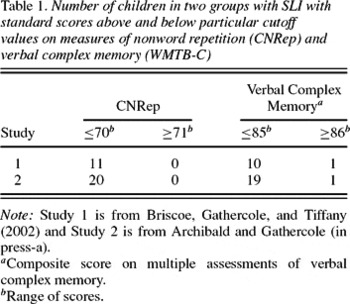
In our experience, highly consistent patterns of nonword repetition and verbal working memory deficits emerge if these strict selection criteria are adopted. In our initial study of children (Gathercole & Baddeley, 1990), all six children with SLI obtained lower scores on a test of nonword repetition (an early and at that point unstandardized version of the CNRep (Gathercole & Baddeley, 1996). Table 1 summarizes performance of two further groups of children with SLI that we have recruited, all of whom completed the CNRep, and measures of verbal complex memory (working memory) performance from the Working Memory Test Battery for Children (WMTB-C; Pickering & Gathercole, 2001). Table 1 shows the number of children obtaining scores above and below particular low cutoff values, corresponding to −1 SD (85) and −2 SD (70). Contrary to claims by Smith (2006) that group tendencies do not strongly generalize to individuals within SLI groups, the individuals that we recruited show remarkably high levels of consistency: of the 31 children in total, everyone showed very sizeable deficits in nonword repetition, and 19 (94%) obtained verbal working memory scores at least 1 SD below the mean. Our belief that the use of strict selection criteria is crucial to this degree of concordance across individuals comes partly from our experience of recruitment for these studies. In the first study in particular (Briscoe, Gathercole, Rankin, & Vargha-Khadem, 2002), of the seven children who were excluded from the final SLI grouping because they performed in the impaired range of the test of pragmatic function, the Children's Communication Checklist (Bishop, 1998), five children obtained scores in the normal range (85 and above) on both the CNRep and the working memory composite score of the WMTB-C.

There are some interesting conclusions to be drawn from the contrasting degrees of consistency in the deficits in samples of children with SLI who have been selected on the basis of either relatively lax or strict criteria. One is that SLI may only constitute a heterogeneous disorder if other potential causes of poor language development are not eliminated. A second conclusion is that the present terminology for classification may not serve the broad literature that incorporates both clinically and theoretically oriented research equally well. One way to reduce confusion may be to use distinct labels for the clinically based diagnosis of language impairment in the preserve of normal range nonverbal ability that serves well the practical purposes of classification and provision of remediation, and for the more specific impairments of language development that cannot be attributable to problems in attentional, sensory, speech–motor, or pragmatic function.
INTERACTIVITY AND TOP-DOWN INFLUENCES
A point raised in several Commentaries (Chiat, 2006; Ellis Weismer & Edwards, 2006; Snowling, 2006) concerns the influences of top-down processes on both nonword repetition and word learning, and the extent to which the framework outlined in the target article adequately captures interactivity of the component processes. In fact, two distinct contributions of existing knowledge on these aspects of behavior were discussed in the Keynote Article. First, factors such as the phonotactic frequency in the language of the sublexical segments of novel stimuli seem most likely to influence the efficiency with which the processing network can identify the structure of an incoming stimulus (Thorn, Gathercole, & Frankish, 2005), although it is possible that phonotactic knowledge may also act to reconstruct incomplete phonological representations at the point of retrieval from temporary storage. The ongoing research described by Vitevitch (2006), Storkel (2001), and Munson (2006) concerning the precise mechanisms by which prior knowledge of the probabilistic and morphological structure of spoken language is brought to bear in processing and learning new structures is extremely valuable in this respect, and will lead to significant advances in understanding in the near future.
Second, it was acknowledged that particularly in individuals who have already acquired a substantial lexicon with a language, much of the learning of the phonological (and probably, nonphonological) structures of new words is accomplished by strategies involving lexical mediation that reduce dependence on the more fragile process of temporary storage of the phonological representation. These strategies may be closely linked with the processes that mediate laboratory tasks such as paired-associate learning of word–word pairs, which we know are constrained by factors other than phonological storage capacity (Baddeley, Papagno, & Vallar, 1988; Gathercole, Hitch, Service, & Martin, 1997; Papagno, Valentine, & Baddeley, 1991). In this respect, I certainly concur with Snowling's (2006) proposal for a reciprocal influence of the knowledge that an individual has already acquired on the learning of novel semantic and phonological forms. The framework outlined in figure 1 of the Keynote perhaps does not capture opportunities for interactivity between different levels of processing and representation sufficiently strongly, as the nonphonological lexical mediation route to learning was not included.
LENGTH EFFECTS IN NONWORD REPETITION: COMPETING EXPLANATIONS
Probably the strongest claim made in the target article is that the well-established interaction between repetition accuracy and nonword length (usually indexed by numbers of syllables) in poor language learners such as children with SLI (e.g., Gathercole & Baddeley, 1990; Gathercole et al., 2006) and individuals with foreign language learning difficulties (Palladino & Cornoldi, 2004) arises directly from impairments in phonological short-term storage. The argument is that because phonological representations decay rapidly with time; nonwords that take longer both to perceive and produce will be prone to greater decay than short stimuli in any individual, causing a decline in nonword repetition accuracy with length. In individuals whose temporary phonological representations have particularly poor endurance, increasing length will cause disproportionate impairments in repetition accuracy. We have shown that it is not the case that any factor depressing overall levels of nonword repetition accuracy will inevitably generate such diverging functions with increasing length: neither hearing loss nor low performance IQ led to disproportionate impairments in nonwords of increasing length (Gathercole, Baddeley, et al., 2005).
Bowey (2006) proposes that a phonological processing account can also accommodate the exaggerated length effect in nonword repetition in poor language learners, arguing that lower quality phonological representations of nonwords will also lead to disproportionate problems in maintaining accurate lengthy stimuli due to decay and interference during retrieval and recall. There are at least some data that suggest this may not be so: Marton and Schwartz (2003) found that children with SLI did not show a deficit in phonological discrimination accuracy that increased in accuracy with increasing nonword length, although their nonword repetition deficit did. There also remain significant problems of interpreting performance decrements on measures of phonological awareness on tasks that involve making mental comparisons of phonological structure, such as the classic measures of rhyme and alliteration judgment. Even with pictorial presentation of the comparison stimuli to aid the regeneration of phonological representation of each stimulus item, it remains a fact that children must minimally be capable of storing the phonological forms of two words for sufficiently long to make the comparisons of corresponding elements of their segmental structure to be accurate. Thus, many phonological awareness tasks inevitably tax phonological storage as well as phonological processing skills.
More generally, it may be that the most powerful discrimination between phonological storage and phonological processing accounts of the nonword repetition deficits in poor language learners may be provided by experimental studies of adult participants rather than developmental samples in which deficits of storage and processing are highly correlated and therefore hard to disentangle. Greater theoretical leverage may be provided by the use of experimental methods such as articulatory suppression to manipulate phonological storage demands more directly, and assess the consequences for the recall of lengthy nonwords.
CONCLUSIONS
Nonword repetition has attracted a great deal of attention in recent years because it is a paradigm that has not only proved useful in illuminating fundamental processes involved in an important aspect of human learning (vocabulary acquisition), but also has considerable clinical utility. As a result, interests in nonword repetition converge from a number of different academic and professional communities, including cognitive psychology, cognitive developmental psychology, communication sciences, special education, and pediatric medicine. It is apparent from this issue that despite the varying interests that representatives of these groups have in the nonword repetition, there is a high degree of consensus on two issues. One belief is that understanding nonword repetition is important, as it has the potential to cast light on the processes involved in language learning, particularly of new words. A second widely held view is that multiple perceptual, cognitive, and motor processes constrain both nonword repetition and word learning. Although a range of different stances regarding the most significant constraints in particular populations are presented in this issue, the belief in the multiple determination of nonword repetition is consistently held. However, the same is true of almost any of the cognitive tasks employed in this research literature, for example, digit span, which is widely viewed as a simple classic task of verbal short-term memory. As Service (2006) states, performance on this task is constrained by a variety of different processes and knowledge that include lexical knowledge of digit names, phonological storage, articulatory rehearsal, metamemory strategies, and articulation of the digit names. Findings that digit span in particular shares a specific and powerful link with an important aspect of learning would undoubtedly trigger a similar program of research activity that encompassed the whole range of candidate causes.
The key issues that remain in understanding nonword repetition and exploiting its potential to cast light on the component processes of language learning appear to me to be as follows. Most theoretical debate at present focuses on whether phonological processing or phonological storage provides the most significant constraint on new word learning. Distinguishing between these hypotheses has proved extremely difficult over the past decade, and greater theoretical specification and more systematic experimentation designed to tease them apart represent crucial steps for further progress on this front. A second issue is how to locate the striking problems in repeating nonwords that individuals with developmental language disorders such as SLI within a more complex framework that encompasses their full range of language problems including syntax. Here, closer attention to the detailed profiles of the groups under study and to the links between these profiles and patterns of performance on tasks such as nonword repetition are essential to develop current understanding further.