INTRODUCTION
Scion citrus fruit production and quality are dependent on the rootstock (Jacquemond et al. Reference Jacquemond, Tison, Agostini, Navari, Roesch, Vittori, Ait-Oubahou and El-Otmani2004; Zekri & Al-Jaleel Reference Zekri and Al-Jaleel2004). The rootstock may also confer tolerance to different biotic and abiotic stresses (Balal et al. Reference Balal, Khan, Shahid, Mattson, Abbas, Ashfaq, Garcia-Sanchez, Ghazanfer, Gimeno and Iqbal2012). Trifoliate orange (Poncirus trifoliata (L.) Raf.) and its hybrids are commonly used as rootstock because of their tolerance to Citrus Tristeza virus (CTV) (Garnsey et al. Reference Garnsey, Barrett and Hutchison1987), Phytophthora root rot (Boava et al. Reference Boava, Cristofani-Yaly, Mafra, Kubo, Kishi, Takita, Ribeiro-Alves and Machado2011), Exocortis and nematodes (Hardy Reference Hardy2004). Trifoliate orange has been used in Corsica not only for its biotic tolerance, but also because of its capacity to improve clementine yield and quality under acidic soil conditions (Jacquemond et al. Reference Jacquemond, Tison, Agostini, Navari, Roesch, Vittori, Ait-Oubahou and El-Otmani2004). However, trifoliate orange cultivars are known to be susceptible to iron chlorosis in calcareous soils, as well as salt stress (Castle Reference Castle, Rom and Carlson1987). Trifoliate orange originated in China (Swingle Reference Swingle, Reuther, Webber and Batchelor1967) and is a unique genus because, in contrast to most citrus species, it has deciduous leaves and undergoes winter dormancy. These marked differences are probably adapted traits acquired during the evolutionary process in Northeast Asia when the trees were subjected to cold conditions (Ziegler & Wolfe Reference Ziegler and Wolfe1975). During hard winters, since no transpiration occurs, they can withstand temperatures as low as −20 °C. However, when grafted, the cultivars are no longer deciduous and their cold tolerance is much more limited, although the use of trifoliate orange rootstock is still one of the most effective ways to boost cold tolerance.
Citrus rootstock must produce polyembryonic seeds for clonal propagation by seedlings. Due to partial apomixis, in polyembryonic seeds zygotic and nucellar embryos grow simultaneously. In such situations non-maternal genotypes, such zygotic embryos could be produced frequently, but generally to a lower extent than nucellar genotypes (Roose & Traugh Reference Roose and Traugh1988). The production of zygotic genotypes in a rootstock trial with trifoliate orange accessions was estimated at 4 and 6·6% by Roose & Traugh (Reference Roose and Traugh1988) and Hussain et al. (Reference Hussain, Curk, Ollitrault, Morillon and Luro2011), respectively. Also, it is worth noting that in the same trial, Hussain et al. (Reference Hussain, Curk, Ollitrault, Morillon and Luro2011) detected around 3% of tetraploid trifoliate orange rootstocks that had not been detected in the nursery before grafting.
In previous studies, P. trifoliata diversity was investigated at phenotypic and genetic levels. Trifoliate oranges were first pooled into large-flowered (Pomeroy) and small-flowered (Rubidoux) cultivar groups (Shannon et al. Reference Shannon, Frolich and Cameron1960; Jacquemond & Blondel Reference Jacquemond and Blondel1986a , Reference Jacquemond and Blondel b , Reference Jacquemond and Blondel c ). In a study on 48 trifoliate orange accessions from the University of California Citrus Variety Collection, Fang et al. (Reference Fang, Roose, Krueger and Federici1997) used isozymes, restriction fragment length polymorphisms (RFLPs) and inter-simple sequence repeats (ISSRs) and highlighted the existence of four major groups. Among these four groups, large-flowered accessions were pooled in one group, while small-flowered accessions were assembled in another group.
Drought stress may limit growth, reproductive development and ultimately plant survival. Drought or water shortages lead to progressive stomatal closure, and therefore to decreases in fundamental physiological parameters, such as water transpiration and photosynthesis and reductions in carbon dioxide (CO2) assimilation capacity. The associated decline in leaf cell turgor limits CO2 diffusion and reduces the quantum yield of photosystem II (PSII), which in turn may induce photorespiration and H2O2 production (Chaves et al. Reference Chaves, Flexas and Pinheiro2009). When subjected to drought stress, plants cope with the accumulation of reactive oxygen species by promoting antioxidant enzymes. They also accumulate primary metabolites, such as carbohydrates, and osmoprotectant amino acids, such as proline, which contribute to maintaining cell turgor by osmotic adjustment (Arbona et al. Reference Arbona, Manzi, Ollas and Gómez-Cadenas2013). Proline concentration increases have been reported in response to different abiotic stress conditions, including water deficit (Molinari et al. Reference Molinari, Marur, Filho, Kobayashi, Pileggi, Júnior, Pereira and Vieira2004). When comparing proline concentrations in plants with different degrees of stress, higher proline concentrations are usually found in the most resistant genotypes. However, there are also many examples in which there is no positive correlation between proline concentration and water deficit or salt tolerance (Ashraf & Foolad Reference Ashraf and Foolad2007; Chen et al. Reference Chen, Cuin, Zhou, Twomey, Naidu and Shabala2007). The ability to synthesize and accumulate proline may thus be considered as a tolerance trait in order to enhance osmotic adjustment. Nonetheless, an increase in leaf proline concentration could also be associated with a response to a faster decrease in water potential of the plant and in the substrate in which the roots are growing – this could therefore be considered as a marker of genotype sensitivity.
In the present study, simple sequence repeat (SSR) markers and flow cytometry ploidy assessment were used to characterize the genetic diversity of 74 trifoliate orange accessions from the INRA-CIRAD citrus germplasm collection (Corsica, France). Moreover, the tolerance behaviour of ten cultivars representative of the different diversity clusters regarding their water deficit tolerance properties are reported.
MATERIALS AND METHODS
Plant material
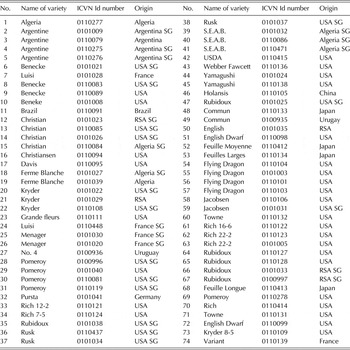
The study focused on 74 accessions representing the complete trifoliate orange (P. trifoliata (L) Raf.) collection of San Giuliano INRA-CIRAD citrus germplasm (Corsica, France) (Table 1).
List of investigated trifoliate orange accessions (P. trifoliata) maintained in the INRA-CIRAD Citrus Germplasm Collection

ICVN, International Citrus Varietal Numbering.
Most of the accessions were introduced as seeds to the INRA-CIRAD collection from 1963 to 1990. After seedling amplification, plantlet screening was performed based on morphological homogeneity in order to select plants from nucellar origin. Three to five trees were then chosen to represent each accession and introduced into the field collection. Many of these accessions have been tested under Corsican conditions as rootstocks associated with clementine (Citrus reticulata × Citrus sinensis) or sweet orange (C. sinensis L. Osb.). At the end of these field trials, the rootstocks from trees of each accession that induced the best fruit production of the grafted variety was selected and amplified by grafting on Carrizo citrange (citrange represents all the hybrids from P. trifioliata × C. sinensis). For those best trifoliate orange accessions, the acronym ‘SG’ (for San Giuliano) was added to the varietal name to denote that they were the result of an agronomic selection process. Many of the trifoliate orange accessions of the present study were introduced from the USA.
Diversity analysis
Genetic diversity analysis by simple sequence repeat marker genotyping
Two out-group genotypes, sweet orange ‘Valencia late’ (C. sinensis L. Osb.) and a citrandarin (Citrus reshni × P. trifoliata) were added to the 74 trifoliate orange accessions for the genetic diversity analysis. Three leaves of each accession were sampled in triplicate to ensure reproducibility of the genotyping results. Total genomic DNA was extracted from leaves by a simplified Doyle & Doyle method (Reference Doyle and Doyle1987), described in Cabasson et al. (Reference Cabasson, Luro, Ollitrault and Grosser2001). The amount of DNA was evaluated by spectrophometry (Nano Drop Thermoscientific, Wilmington, DE, USA) and the absence of DNA degradation was demonstrated by agarose gel electrophoresis.
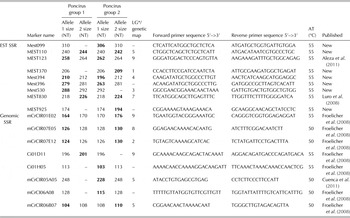
According to their ability to detect a polymorphism among trifoliate oranges, 17 SSR primer pairs were selected among the panel of citrus genomic SSR and expressed sequence tag SSR (EST-SSR) markers developed in our laboratory (Froelicher et al. Reference Froelicher, Dambier, Bassene, Costantino, Lotfy, Didout, Beaumont, Brottier, Risterucci, Luro and Ollitrault2008; Luro et al. Reference Luro, Costantino, Terol, Argout, Allario, Wincker, Talon, Ollitrault and Morillon2008). The selection was based on their capacity to reveal a polymorphism among trifoliate oranges and of also on their location on the reference citrus genetic map (Ollitrault et al. Reference Ollitrault, Terol, Chen, Federici, Lotfy, Hippolyte, Ollitrault, Bérard, Chauveau, Cuenca, Costantino, Kacar, Mu, Garcia-Lor, Froelicher, Aleza, Boland, Billot, Navarro, Luro, Roose, Gmitter, Talon and Brunel2012) with the objective of performing genetic analysis with a relatively good representation of citrus genome with at least one marker from each linkage group (Table 2).
Characteristics of SSR markers used for the analysis of trifoliate orange diversity and the allelic variations detected between the two genetic groups; bold values are sizes of specific alleles of each genetic group

*Linkage group on the clementine genetic map (Ollitrault et al. Reference Ollitrault, Terol, Chen, Federici, Lotfy, Hippolyte, Ollitrault, Bérard, Chauveau, Cuenca, Costantino, Kacar, Mu, Garcia-Lor, Froelicher, Aleza, Boland, Billot, Navarro, Luro, Roose, Gmitter, Talon and Brunel2012).
To analyse genetic diversity of cytoplasmic genomes, three markers amplifying cpDNA mononucleotide microsatellite sequence (ccmp5, ccmp6 and ccmp7) developed by Weising & Gardner (Reference Weising and Gardner1999) were used.
Amplifications of SSR markers were performed according to Luro et al. (Reference Luro, Costantino, Terol, Argout, Allario, Wincker, Talon, Ollitrault and Morillon2008) in a thermocycler (PTC 200, MJ Research) using 10 ng of DNA, 0·5 μm of each primer and 0·8 unit of Taq polymerase (Goldstar, Eurogentec, Fawley, Hampshire, UK). The annealing temperature was fixed for all primer pairs at 55 °C (this condition was taken into account during designing of the primers). Separation of alleles was performed on a 6% polyacrylamide sequencing gel containing 7 m urea in 0·5 × TBE buffer at 60 W for 2–3 h. Three microlitres of polymerase chain reaction (PCR) product was mixed to an equal volume of loading buffer containing 95% Formamide, 0·25% Bromophenol blue and 0·25% Xylen Cyanol and 10 mM of EDTA. This mixture was heated for 5 min at 94 °C to denature the DNA before loading. Gels were stained with silver nitrate following the protocol detailed by Chalhoub et al. (Reference Chalhoub, Thibault, Laucou, Rameau, Höfte and Cousin1997) for gel electrophoresis analysis and by comparison with the ten base pairs (bp) DNA standard ladder (Invitrogen, Paisley, UK).
To determine the genetic diversity structure and relationships between accessions, the SSR alleles for each accession were scored by coding presence (1) and absence (0). Genetic distance between each genotype was estimated by calculating the Dice dissimilarity index (Dice Reference Dice1945) and UPGMA was applied for dendrogram construction. This analysis was performed with the DARwin software developed by CIRAD (Perrier et al. Reference Perrier, Flori, Bonnot, Hamon, Seguin, Perrier and Glaszmann2003).
Ploidy level evaluation
For each accession, two leaves (two repetitions) were collected on the tree. Using a similar leaf surface (2·5 mm2) from Tahiti lime (Citrus latifolia Tan.), a triploid reference, samples were chopped using a razor blade in the presence of 250 μl of a nuclei isolation solution (High Resolution DNA Kit Type P, solution A; Partec, Münster, Germany). Nuclei were filtered through a 20 μm nylon filter and stained with 450 μl of 40,6-diamine-2-phenylindol (DAPI) (High Resolution DNA Kit Type P, solution B; Partec) solution. After 5 min incubation, stained samples were run in a Ploidy Analyser (Partec) flow cytometer equipped with a HBO 100-W high-pressure mercury bulb and both KG1 and BG38 filter sets. Histograms were analysed using the dpac v2·0 software (Partec), which determines peak position, coefficient of variation and the relative ploidy index of the samples.
Morphological diversity: seed weight, leaf area and flower size
Poncirus species do not have high phenotypic diversity and the most distinctive features are the sizes of flowers, leaves and seeds (Jacquemond & Blondel Reference Jacquemond and Blondel1986a ). The flower size has been used by many authors to classify poncirus accessions into large- or small-flowered groups (Shannon et al. Reference Shannon, Frolich and Cameron1960; Tanaka Reference Tanaka1961; Fang et al. Reference Fang, Roose, Krueger and Federici1997; Krueger & Navarro Reference Krueger, Navarro and Khan2007). Thus, these three apparent criteria, which are easy to investigate and reliable for comparing accession trees of the different genetic groups in the San Giuliano germplasm, were selected for study in the present investigation. For each accession, fruit were harvested in November and seeds were extracted. Seeds were then dried for 72 h in the same conditions (18 °C, 85% relative humidity) for all genotypes. Then, ten sets of ten seeds were weighed per genotype. To measure the leaf area and flower petal size, 30 leaves and flowers of each accession were collected and scanned. Mean flower width and leaf area were estimated by comparing with reference length and surface using Image J software (http://rsbweb.nih.gov/ij/), and were expressed in mm and cm2, respectively.
Water deficit
Plant material and growth condition
Among the 74 genotypes, ten cultivars belonging to the two genetic groups and one hybrid identified by SSR marker genotyping were analysed for their tolerance to water deficit. Plant materials were propagated by sowing seeds in a neutral substrate (perlite). Seedlings certified by molecular genotyping as clones of the selected accessions were transplanted 3 months after germination into 3-litre pots containing substrate (sand, turf and peat – 1 : 1 : 1) and placed in a greenhouse for nine additional months. Experiments were performed during the summer in a greenhouse under natural photoperiod conditions with a temperature regime of 15–19 °C (night) and 24–29 °C (day), and a relative humidity between 60 and 85%.
Water deficit application
Pot weights were equilibrated to 3·5 kg by addition of substrate, to better estimate water consumption along the water deficit. Seedlings were regularly watered at field capacity for 2 weeks prior to applying the water deficit. Water requirements to maintain control trees at field capacity were estimated. Seven uniform seedlings per genotype were assigned as controls and were irrigated twice a week to prevent any excess of water that may have been harmful to the roots. The water deficit was applied by ceasing to water seven uniform seedlings per genotype for 4 weeks. A plastic disc with a slot for the stem was placed above the substrate in the pot so that water loss occurred only via leaf transpiration.
Plant water consumption
Leaf surface area was estimated for each seedling. Pot weight was monitored weekly throughout the stress period to estimate pot water loss (Rodríguez-Gamir et al. Reference Rodríguez-Gamir, Primo-Millo, Forner and Forner-Giner2010). At the end of the experiment, after 30 days of stress, the substrate was transferred into plastic bags to measure the soil water potential using a Dew Point Potential Meter (WP4, Decagon, USA).
Stomatal conductance, effective quantum yield of photosystem II, leaf greenness
The area of the leaves of trifoliate orange accessions were too small to allow the use of a gas exchange analyser. Leaf stomatal conductance (g s) was monitored using a leaf porometer (SC-1, Decagon, USA). The effective quantum yield of photosystem II electron transport (ΦPSII), which represents the electron transport efficiency between photosystems within light-adapted leaves, was checked every day using a leaf fluorometer (Fluorpen FP100, Photos System Instrument) (Percival Reference Percival2005). Each measurement (Greenness, g s and ΦPSII) was taken on three mature leaves per plant and seven plants per accession.
Leaf area, leaf stomatal density and area, leaf osmotic potential
The number of leaves per seedling of each accession was counted at the beginning of the experiment. Mean leaf area was estimated as previously described. At the end of the experiment, stressed plants did not present new leaves and, with the exception of Pomeroy 0110081 which lost a few leaves, all other accessions had the same total leaf area. To estimate seedling leaf total area, the number of leaves at the start of the experiment was multiplied by the mean surface area of each accession. Slides for the analysis of stomatal size and the number of stomata per unit of leaf surface area (stomatal density) were prepared according to Morillon & Chrispeels (Reference Morillon and Chrispeels2001). Stomata density and size were estimated using three different slide preparations. Five leaves of different seedlings were harvested at the end of the experiment to measure leaf osmotic potential according to Callister et al. (Reference Callister, Arndt and Adams2006).
Leaf proline concentration
Leaves were frozen at −80 °C and ground using a pestle and mortar in liquid nitrogen: 0·5 g of the frozen leaf powder was homogenized in 10 ml of 3% aqueous sulphosalicyclic acid and the homogenate filtered through Whatman filter paper. Then, 2 ml of the filtrate was reacted with 2 ml acid ninhydrin and 2 ml of glacial acetic acid in a test tube for 1 h at 100 °C, and the reaction terminated in an ice bath. The reaction mixture was extracted with 4 ml toluene, mixed vigorously with a test tube stirrer for 15–20 s. The chromophore containing toluene was aspired from the aqueous phase, warmed to room temperature and the absorbance read at 520 nm using toluene as a blank. The proline concentration was determined from a standard curve and calculated based on a fresh weight (Bates et al. Reference Bates, Waldren and Teare1973).
Statistical analyses
Data are expressed as means ± s.e. (standard error) and were analysed with SIGMASTAT (SPSS, Chicago, USA) and ANOVA was used to detect differences in physiological and biochemical behaviour between trifoliate orange accessions with statistical significance set at P ≤ 0·05.
RESULTS
Genetic diversity in Poncirus trifoliata
All the trifoliate orange accessions were totally monomorphic with the three chloroplastic markers. Nevertheless, nine EST-SSR markers and eight genomic SSR markers (SSRg) were selected from an initial screening of 79 EST-SSR and 48 SSRg primer pairs. Only 13·4% of the total markers (11·4% for EST-SSR and 16·7% for genomic SSR) were polymorphic (Table 2). Except for linkage Group 3, all linkage groups of the clementine citrus map (Ollitrault et al. Reference Ollitrault, Terol, Chen, Federici, Lotfy, Hippolyte, Ollitrault, Bérard, Chauveau, Cuenca, Costantino, Kacar, Mu, Garcia-Lor, Froelicher, Aleza, Boland, Billot, Navarro, Luro, Roose, Gmitter, Talon and Brunel2012) were represented by the 17 SSR markers.
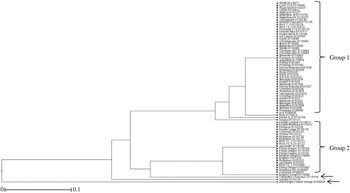
Without considering the two controls (sweet orange and (mandarin × trifoliate orange) hybrid), only seven genotypes or genetic profiles were detected (Fig. 1). The diversity of the trifoliate orange group was organized around two major molecular profiles, clustering 47 accessions (No. 1–47 trifoliate oranges in Table 1) together for Group 1 and 22 accessions (No. 48–69) for Group 2. None of the accessions from each group were differentiated by the set of SSR markers. The genetic distance between the two groups was 0·43, while it was 0·74 between sweet orange and Group 2 and 0·86 between sweet orange and Group 1. Group 2 was more heterozygous than Group 1, with 15 (88·2%) and 11 (64·7%) heterozygous markers, respectively (Table 2).
Dendrogram representing the diversity of trifoliate orange (P. trifoliata L.) accessions of the INRA-CIRAD Citrus Germplasm Collection, based on SSR marker data and the UPGMA clustering method. ‘Washington Navel’ orange and one hybrid (Cleopatra mandarin × Rubidoux trifoliate orange) ICVN-0110154 were used as out-groups (indicated by arrows).

Five accessions (No. 70–74 in Table 1) presented specific molecular profiles: Rich 0110414, Kryder 8-5 0110109, Towne 0110131, linked to Group 1, and English Dwarf 0110099 and Variant 0110135 linked to Group 2. When analysing the allelic composition of these five trifoliate oranges, only Variant 0110135 presented alleles that were absent from the 73 remaining accessions: one specific allele with MEST123 and five common alleles with sweet orange or with the (C. reshni × P. trifoliata) hybrid. This accession was probably a hybrid (Citrus × Poncirus) but not a citrange hybrid (P. trifioliata × C. sinensis). The last four differentiated genotypes only had alleles present in Groups 1 or 2. Kryder 8-5 0110109 originated from self-crossing or a cross between two accessions from Group 1, because it is homozygous with a Group 1 specific allele (124/124 nt) at locus mCrCIR07E12. The three other accessions were intergroup hybrids (Group 1 × Group 2), as demonstrated by the presence of specific alleles from both groups at several loci. For example, English Dwarf 0110099 and Towne 0110131 consisted of two alleles, 244/242 nt, at locus MEST110 which were specific to Groups 1 and 2, respectively (Table 2).
As with the four pure trifoliate orange hybrids (Variant is a Citrus × Poncirus hybrid) other accessions having the same name but different genetic profiles were detected for Pomeroy, Rich and Rubidoux. Rich 12-2 and Rich 7-5 were classified in Group 1 and Rich 16-6 and Rich 22-2 in Group 2. Four Rubidoux accessions introduced from the USA and South Africa (No. 64–67) were included in Group 2, while two accessions (No. 35 and 47) introduced from the USA but selected in Corsican rootstock trials (SG) belonged to genetic Group 1. Finally, a single Pomeroy 0110278 accession (No. 69) was located in Group 2, while four others were in Group 1.
Regarding the ploidy level, all trifoliate oranges were diploid except for four accessions that were found to be tetraploid: Holansis 0110105 (No. 46) and Pomeroy 0110081 (No. 47) from Group 1, and Feuille Longue 0110413 (No. 68) and Pomeroy 0110278 (No. 69) from Group 2. For two supplementary accessions (Pomeroy 0110081 and Ferme Blanche 0101039), a single tree among four was identified as tetraploid, while the other trees were diploid.
For further analyses, the classification obtained by the diversity of SSR markers and by the ploidy level detected by flow cytometer was adopted and four genetic backgrounds were therefore identified in the set of trifoliate oranges: three for diploid accessions (Group 1, Group 2 and hybrids) and one for tetraploid accessions irrespective of their genetic profile (Group 1 or 2).
Morphological diversity
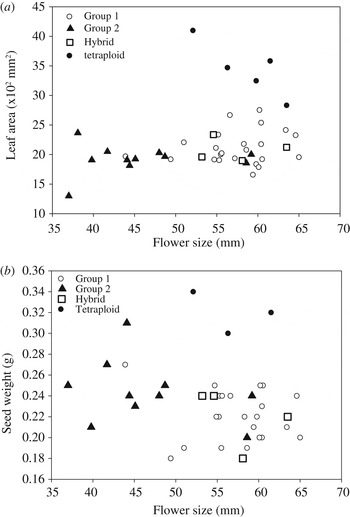
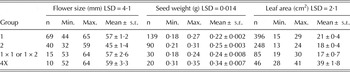
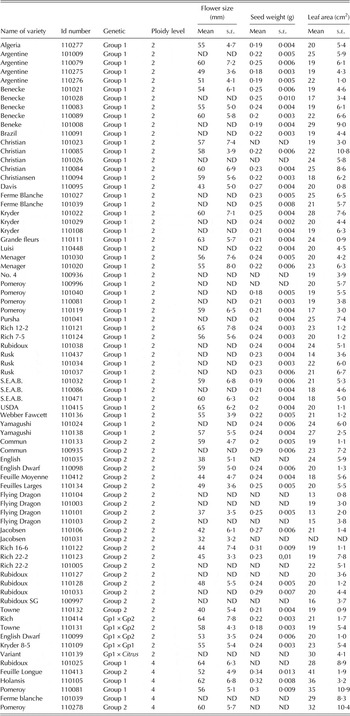
In order to characterize phenotypic traits not dependent on plant development, three apparently variable characters were selected that were easy to investigate and reliable for comparing accession trees of the different genetic groups in the San Giuliano citrus germplasm. Mean seed weight, leaf area and flower size were measured individually for each accession (Table A1, Appendix) and average values were calculated for each genetic group (Table 3). Group 2 presented seeds that were significantly larger and heavier (by c. 15%) than Group 1 (P < 0·001). Tetraploid accessions presented 30–45% heavier seeds than the other diploid groups. Regarding the flower size, Group 1 presented flowers that were c. 30% larger than Group 2. Apparently the ploidy level did not impact the flower size, since the average value did not differ from that of Group 1. Regarding the leaf area, a significant difference (P < 0·01) between both groups was also noted (21·2 and 18·9 cm2, respectively, for Groups 1 and 2) but this character was less discriminating than flower size and, to a lesser extent, seed weight. The effect of chromosome doubling at the origin of tetraploid trifoliate oranges was remarkable regarding this phenotypic trait, with a 60% increase in leaf size. The hybrid group was not differentiated from Group 1 regardless of the hallmark. Although flower size could be considered as the most discriminative hallmark to differentiate Groups 1 and 2, it was not totally efficient because the within-group diversity was high and the per-group value ranges overlapped (Table 3). Even when two characters were combined (Fig. 2), some accessions of each group were still found among accessions belonging to the other genetic group. For instance, Commun 0110133 and English Dwarf 0110098 from Group 2 showed higher flower size (about 58 mm) than expected and, conversely, Davis 0110095 from Group 1 had smaller flowers (about 40 mm) than other Group 1 accessions.
Phenotypic differentiation of trifoliate orange genetic groups according to seed weight, leaf area and flower size. Diversity of trifoliate orange accessions based on (a) flower size and leaf area and (b) seed weight and flower size. Each symbol represents a different kind of genetic group.

Phenotypic differentiation between trifoliate orange genetic groups for flower size, seed weight and leaf area

LSD, Least Significant Difference; n, number of replication.
Water deficit tolerance
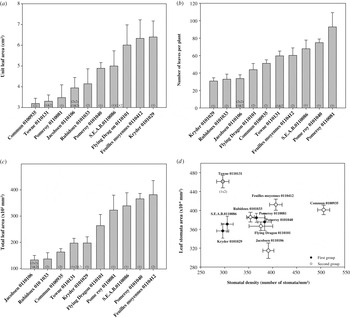
A sub-set of ten accessions from genetic Groups 1 and 2, as well as two hybrids, was selected and seedlings were grown for further experiments. Prior to subjecting seedlings to water deficit for 30 days, the unit leaf area, number of leaves and total leaf area of the ten accessions were estimated and ranked from the lowest to the highest value (Figs 3(a)–(c)). Commun 100935, Towne 110131 and Pomeroy 0110081 presented the smallest unit leaf area per plant, and Flying Dragon 110101, Feuilles moyennes 110412 and Kryder 101029 the largest (Fig. 3(b)). Taking account of the leaf number, Jacobsen 110106 and Rubidoux 101033 were clearly the accessions that presented the smallest total leaf area, while Pomeroy 101040, S.E.A.B. 110086, Pomeroy 110081 and Feuilles moyennes 110412 presented the largest (Fig. 3(b)). Stomatal density and area were estimated to check whether any specific features could be observed depending on the genetic group (Fig. 3(d)). Jacobsen 110106 presented the smallest stomatal area, while Towne 110131 had the largest, with quite a small density. Commun 100935 had a much higher stomatal density than the other accessions.
Phenotypic differentiation for unit leaf area, number of leaves, total leaf area, number of stomata and stomatal density of ten trifoliate orange accessions. (a) Unit leaf area. (b) Mean number of leaves (n ≥ 7). (c) Total leaf area (n ≥ 7). Numbers in brackets represent the genetic groups. (d) Phenotypic differentiation for stomata density and area. Black circles correspond to genotypes belonging to the first genetic group and white circles correspond to the second genetic group (for stomatal density n > 250 and for stomata area n > 100).

Pots were weighed weekly to measure water usage of the selected accessions throughout the water deficit period. As the pots were covered to prevent evaporation, water loss occurred only via leaf transpiration and the pot weight gradually decreased.
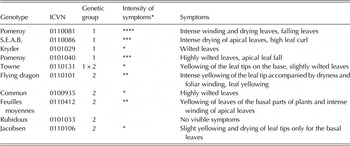
The most severe symptoms were observed in Pomeroy 0110081, with marked leaf fall accompanied by rapid leaf drying (Table 4). The same symptoms were observed in Pomeroy 101040 and S.E.A.B. 110086 but with less intense leaf fall, while other accessions, such as Rubidoux 101033 and Jacobsen 110106, showed few symptoms apart from slight yellowing of the lower leaves.
Symptoms observed on trifoliate orange accessions after 4 weeks of water deficit

* Intensity of symptoms increases with the number of asterisks.
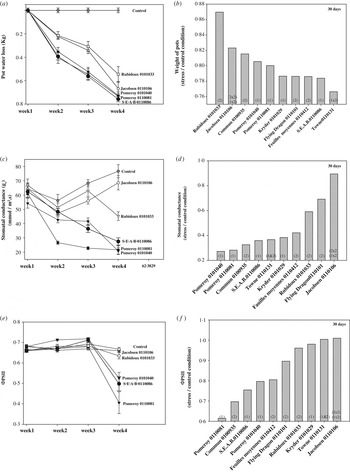
Pot water loss, stomatal conductance (g s) and the quantum yield of PSII (ΦPSII) were monitored throughout the experiment (Fig. 4). For clarity, only five genotypes representing the range of water loss, g s and ΦPSII values were selected to be plotted on graphs in Figs 4(a), (c) and (e). The accessions were chosen to be representative of both genetic groups regarding the different phenotypic traits. During the experiment, pot water loss clearly differed between accessions: accessions were ranked according to the ratio of the pot weight after 30 days of stress compared to the pot weight at field capacity (Fig. 4(b)). Rubidoux 101033 and Towne 110131 were the accessions with lowest and highest water consumption, respectively. Variations in g s in control seedlings were observed due to changes in the greenhouse conditions during the experiment. For stressed accessions, g s decreased during the first week for Pomeroy 110081 and Pomeroy 101040, while g s remained high during the first 3 weeks for Jacobsen 110106, Flying Dragon 110101 and Rubidoux 101033 (Fig. 4(c)). At the end of the experiment, these accessions still had fairly high g s values, as noted in Fig. 4(d), where genotypes are ranked according to the ratio of the leaf g s after 30 days of stress compared with the leaf g s in control conditions. The ΦPSII was also measured using the same type of representation (Fig. 4(e)). Jacobsen 110106, Towne 110131, Kryder 101029 and Rubidoux 101033 were clearly not affected, while a significant decrease in ΦPSII was noted for Pomeroy 110081 (P < 0·01), Commun 100935 (P < 0·01), S.E.A.B. 110086 (P < 0·01), Pomeroy 101040 (P < 0·01) and Feuilles moyennes 110412 (P < 0·01) (Fig. 4(f)).
Physiological parameters investigated in the ten trifoliate orange accessions subjected to water deficit: (a, b) stomatal conductance, (c, d) effective quantum yield of PSII (ΦPSII) within light-adapted leaves and (e, f) pot water loss. (a), (c), (e) Plots represent the variation patterns of each parameter after 4 weeks of water deficit. For each date and each parameter, control represents the mean weight value weight of 21 control pots selected among the ten accessions. Panels (b), (d), (f) represent the ratio of each parameter of stressed plants over control plants after 30 days of water deficit. Numbers in brackets represent the genetic groups.

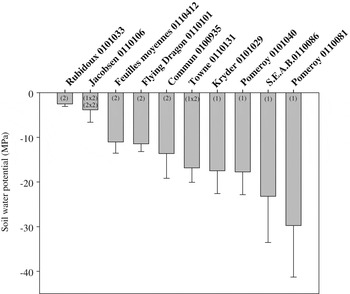
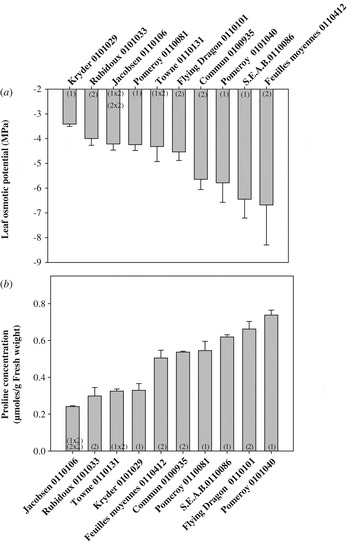
Soil water potential, leaf osmotic potential and leaf proline concentration were measured at the end of the stress period. Rubidoux 101033 and Jacobsen 110106 were the accessions that had the highest soil water potential, while those of S.E.A.B. 110086 and Pomeroy 110081 were almost tenfold lower (Fig. 5). Kryder 101029, Rubidoux 101033, Jacobsen 110106, Pomeroy 110081 and Towne 110131 had the highest leaf osmotic potential and the lowest leaf proline concentration (Figs 6(a) and (b)). Conversely, S.E.A.B. 110086 and Pomeroy 101040 had a low leaf osmotic potential associated with high proline concentration.
Soil water potential after 4 weeks of water deficit for the ten trifoliate orange accessions (n = 3). Numbers in brackets represent the genetic groups.

Leaf osmotic potential and leaf proline content after 4 weeks of water deficit. (a) Leaf osmotic potential for the ten trifoliate orange accessions. (b) Leaf proline concentration for the ten genotypes (n ≥ 4). Numbers in brackets represent the genetic groups.

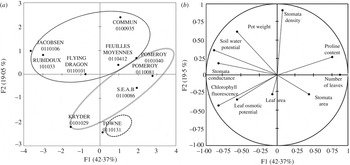
By combining all the physiological parameters analysed under water deficit conditions, behavioural differences between trifoliate oranges from Groups 1 and 2 were summarized in a principal component analysis (PCA) plot (Fig. 7). The two genetic groups were easily differentiated by parameters such as soil water potential or stomatal conductance and density. Nevertheless, variations regarding physiological parameters between accessions were still noted within each group.
Principal component analysis (PCA) representing the diversity of the ten trifoliate orange accessions, plotted with all the physiological parameters measured under water stress conditions (a) and the contribution of each parameter on the two PCA axes (b). Circles on PCA surround accessions from the same genetic group: Group 1 (grey background), Group 2 (white background) and the hybrid within the dotted circle.

DISCUSSION
Diversity in Poncirus trifoliata
The diversity in trifoliate orange accessions from the INRA-CIRAD Citrus Collection was clustered into two major groups. A few accessions diverged from the majority because they corresponded to hybrid genotypes. When using ISSR markers, the diversity pattern in trifoliate orange accessions from the UCR/USDA Citrus Variety Germplasm Collection was similar, with the majority of accessions being distributed in two clusters – one corresponding to small-flowered accessions and the other to large-flowered accessions (Fang et al. Reference Fang, Roose, Krueger and Federici1997). A similar bipartition structure was observed in P. trifoliata by Uzun et al. (Reference Uzun, Gulsen, Seday, Yesiloglu, Aka-Kacar and Tuzcu2011) in a study carried out at the University of Cukurova, (Adana, Turkey). The low diversity of P. trifoliata relative to the low polymorphism (13·4% of polymorphic markers and many accessions with the same molecular profile) indicates that this group has a relatively narrow genetic base, in agreement with the findings of other studies using random amplified polymorphic DNA (RAPD; Schäfer et al. Reference Schäfer, Bastianel and Dornelles2004), amplified fragment length polymorphism (AFLP; Pang et al. Reference Pang, Hu and Deng2007), SSR markers (Aka Kaçar et al. Reference Aka Kaçar, Yeşİloğlu, Yildirim, Sİmşek, Incesu, Kamİloğlu and Tuzcu2009), sequence-related amplified polymorphisms (SRAPs; Uzun et al. Reference Uzun, Gulsen, Kafa and Seday2009) and isozymes (Novelli et al. Reference Novelli, Machado and Lopes2000). Mutation was certainly the major mechanism involved in the diversification of P. trifoliata and hybridization was mainly restricted to intra-specific combinations. Five hybrids were identified in the present study, four of which were generated by spontaneous intra-specific crosses and only one presented a natural inter-generic hybrid origin. In many countries, the P. trifoliata blossom period is shifted relative to Citrus species (for instance, P. trifoliata flowers about 1 month earlier than Citrus in the Mediterranean region), so natural hybridizations between P. trifoliata and Citrus, rarely occur. Trifoliate oranges produce polyembryonic seeds containing both sexual and apomictic embryos. Seedlings from open-pollinated trifoliate orange seeds mainly develop (70–98%) from nucellar (apomictic) embryos that are genetically identical to their mother tree in all characters (Khan & Roose Reference Khan and Roose1988; Moore & Castle Reference Moore and Castle1988; Anderson et al. Reference Anderson, Castle and Moore1991). Developmental competition between zygotic and nucellar embryos, as well as the genotype constitution of zygotes, affects plant germination and development (Kepiro & Roose Reference Kepiro, Roose and Khan2007). Nucellar embryony is considered as a barrier to citrus evolution via sexual reproduction, but this depends on the number of somatic embryos per seed (Moore & Castle Reference Moore and Castle1988). In trifoliate orange, the degree of polyembryony is low (around 2), thus increasing the chances of germination of plantlets derived from zygotic embryos.
Ploidy variation is another source of diversification in P. trifoliata. Tetraploid accessions are double diploid forms originating from imperfect mitosis that do not impact the allelic diversity, but modify the phenotype of the tree (Hussain et al. Reference Hussain, Curk, Ollitrault, Morillon and Luro2011). These trees are mainly propagated from polyembryonic seeds: chromosome doubling in nucellar embryos can affect the conformity of regenerated plants introduced in germplasm collections (Roose & Kupper Reference Roose, Kupper and Khan1992). The frequency of occurrence of chromosome doubling depends on the species and environmental conditions, e.g. cold increases the frequency in the affected areas (Aleza et al. Reference Aleza, Froelicher, Schwarz, Agusti, Hernandez, Juarez, Luro, Morillon, Navarro and Ollitrault2011). The proportion of spontaneous tetraploid trifoliate orange seedlings ranges from 3 to 10% in Corsican conditions. Although chromosome doubling causes readily observable morphological changes in leaf size, colour and thickness or tree growth vigour (Allario et al. Reference Allario, Brumos, Colmenero-Flores, Tadeo, Froelicher, Talon, Navarro, Ollitrault and Morillon2011), several trees or rootstocks with off-type ploidy levels can be inadvertently found in collections or agronomic trials.
The system whereby trifoliate oranges are grouped under small- and large-flowered varieties is accepted by many authors from different countries (Shannon et al. Reference Shannon, Frolich and Cameron1960; Krueger & Navarro Reference Krueger, Navarro and Khan2007). Hence these two trifoliate orange groups have been phenotypically characterized. Large-flowered varieties were found to have an upright growth habit with a single trunk, whereas small-flowered varieties produced multiple trunks, resulting in a bushy growth habit (Shannon et al. Reference Shannon, Frolich and Cameron1960). Fruits from small-flowered varieties matured earlier than those from large-flowered varieties. Japan has a somewhat different system (Tanaka Reference Tanaka1961) where four different strains are recognized based on leaf size: diploid large, medium and small leaf and tetraploid large leaf. Among the three hallmarks studied, flower size is the most variable and the best discriminatory factor for the classification of accessions into the genetic Group 1 or 2. Tetraploid genotypes can be easily identified by larger leaves and heavier seeds. Unfortunately, all of these morphological parameters, used separately or together, are not good enough to systematically obtain the right classification for all accessions. The relatively low phenotype diversity and the absence of strong distinctive morphological traits contribute to false identifications and incorrect classifications of trifoliate orange accessions. It should be noted that this low diversity also favoured homonymy and non-detection of inter- or intra-group hybrids. Indeed, a relatively high frequency of homonymy has been previously reported in P. trifoliata (Uzun et al. Reference Uzun, Gulsen, Seday, Yesiloglu, Aka-Kacar and Tuzcu2011). Genotyping using molecular markers is the only way to accurately classify each trifoliate orange accession. Because of their capacity to reveal polymorphism, locus-specific SSR markers were preferred to ISSR. The accessibility to heterozygosity via the co-dominance of SSR markers also facilitates identification of the genetic origin of hybrid genotypes. Nevertheless, ISSR markers are more powerful than co-dominant markers for identifying each accession (Fang et al. Reference Fang, Roose, Krueger and Federici1997).
When used as rootstock, each trifoliate orange accession may affect the fruit yield of the grafted cultivar. Although tetraploid rootstocks markedly reduce the clementine fruit yield, by about 30% compared with diploid trifoliate oranges (Jaquemond & de Rocca Serra Reference Jacquemond, de Rocca Serra, Tribulato, Gentile and Reforgiato1994; Hussain et al. Reference Hussain, Curk, Ollitrault, Morillon and Luro2011), the use of trifoliate oranges of Group 1 or 2 had a limited impact on clementine production under Corsican environmental conditions. The production of clementine trees grafted onto large-flowered accessions seemed to be slightly higher than that of trees grafted onto small-flowered selections, but only when 18 years of cumulative yields were considered (Jaquemond & de Rocca Serra Reference Jacquemond, de Rocca Serra, Tribulato, Gentile and Reforgiato1994). Shannon et al. (Reference Shannon, Frolich and Cameron1960) reported similar findings regarding sweet orange yield and quality, except for fruit size which apparently led to bigger fruit with grafted large-flowered trifoliate orange trees.
Water deficit tolerance among Poncirus trifoliata accessions
When grafted, trifoliate orange can be considered as a water-deficit-sensitive rootstock (Wu et al. Reference Wu, Wei, Wang, Chu and Shao2007). Conversely, trifoliate orange seedlings of all accessions had a very strong tolerance trait, since most of the plants remained healthy for the first 3 weeks. Interestingly, tolerant rootstock such Rangpur lime (C. limonia Osb.) is known to be very tolerant to drought (Ollitrault & Navarro Reference Ollitrault, Navarro, Badenes and Byrne2012), while the seedlings are much more sensitive. This demonstrates that criteria such as leaf canopy surface area, root-to-shoot interaction or the capacity of the roots to grow deeply in the soil may strongly affect the water deficit tolerance properties of a tree. Among trifoliate orange accessions, Flying Dragon is probably the accession with the greatest phenotypic differentiation. This is a slow-growing accession and the trees can be recognized by highly twisted, contorted stems and large thorns on the shoots. In the field, in non-irrigated conditions, grafted Flying Dragon trees have been shown to have high yield efficiency due to their small canopy (Espinoza-Núñez et al. Reference Espinoza-Núñez, Mourão Filho, Stuchi, Cantuarias-Avilés and dos Santos Dias2011). This rootstock is thus considered to be very suitable for high-density plantations (Wheaton et al. Reference Wheaton, Castle, Whitney and Tucker1991; Cantuarias-Avilés et al. Reference Cantuarias-Avilés, Mourão-Filho, Stuchi, da Silva and Espinoza-Núñez2010). In the present study, Flying Dragon 110101 seedlings presented a limited number of leaves and this accession was ranked as medium in terms of total leaf area. With the exceptions of Rubidoux 101033 and Jacobsen 110106, all accessions had soil water potential <1 MPa, and even lower for Pomeroy 110081, suggesting that at least for that accession the soil water potential was below the permanent wilting point. As expected, the two accessions with the strongest stress symptoms, in addition to leaf fall and yellowing, were Pomeroy 101040 and Pomeroy 110081, both of which belonged to genetic Group 1. For all accessions, the leaf number and total leaf area were estimated prior to stress. Thus, for the two Pomeroy poncirus, the leaf number and leaf total area at the end of the experiment were overestimated because leaf fall during stress probably made these two accessions even more sensitive. Conversely, Rubidoux 101033, Jacobsen 110106 and Feuilles moyennes 110412, which belonged to genetic Group 2, presented the least severe symptoms and the highest soil water potential. Measurements of the leaf osmotic potential and proline content were in agreement with that observation: accessions that were subjected to the lowest soil water potential were those with the lowest leaf osmotic potential and the highest proline contents. Interestingly, Flying Dragon 110101 had one of the highest leaf proline contents, intermediate symptoms along with quite a high soil water potential, suggesting that this accession had a greater osmotic adjustment than the other accessions to maintain leaf cell turgor (Molinari et al. Reference Molinari, Marur, Filho, Kobayashi, Pileggi, Júnior, Pereira and Vieira2004; Arbona et al. Reference Arbona, Manzi, Ollas and Gómez-Cadenas2013). Except in Feuilles moyennes 110412, proline synthesis was suspected to be mostly associated with the plant response to a faster decrease in water potential, and could be considered as marker of sensitivity. In the present experiments, the accessions that were most tolerant were those with the smallest total leaf area, such as Jacobsen 110106 and Rubidoux 101033 (Fig. 3(b)). Feuilles moyennes 110412 had the largest leaf area, which was associated with high stomatal density and large stomata size (Fig. 4(c)) and the lowest soil water potential. However, this was not the most affected accession (Table 4). The leaf osmotic potential of Feuilles moyennes 110412 and S.E.A.B. 110086 was the lowest among all of the accessions, even though the proline concentrations were ranked as medium. This suggests that other compounds such as sugars and/or inorganic solutes may enhance osmotic adjustment, thus possibly favouring their adaption to water deficit (Chen et al. Reference Chen, Cuin, Zhou, Twomey, Naidu and Shabala2007). Stomata allow plants to regulate transpirational water loss from leaves during the simultaneous uptake of CO2 for photosynthesis. Accessions with small stomata and low stomatal density are expected to have enhanced plant fitness in a broader range of environments (Franks & Beerling Reference Franks and Beerling2009). Kryder 101029 and S.E.A.B. 110086 had the smallest stomatal density and size. Interestingly, S.E.A.B. 110086 was shown to be more tolerant than Kryder 101029 even though S.E.A.B. 110086 had the largest total leaf area and thus the greatest water transpiration potential. Note, however, that at the end of the stress period these two accessions showed the most contrast in leaf osmotic potential even though the water potentials were low and quite similar, which could thus explain the difference in trait tolerance. According to the global physiological analysis, mainly regarding the soil water potential, accessions that belonged to genetic Group 2 were less affected by water deficit than accessions of genetic Group 1.
Experiments performed in pots in greenhouse conditions can give clues about the water deficit tolerance of a genotype. However, under severe soil water deficit stress in pots, plants may partition more biomass to roots than above-ground vegetation (Masinde et al. Reference Masinde, Stutzel, Agong and Fricke2006). Also, a genotype having a root system with greater hydraulic conductivity, if confined to a small volume of substrate, may develop water stress faster than one with lower hydraulic conductivity. Also, the transmission of nutrients through the soil may be reduced at low water potential (Nye & Tinker Reference Nye and Tinker1977). Taken together, it is important to note that results in field conditions may be quite different from those in pots due to the greater soil volume occupied by the root system.
Among citrus rootstock, Rangpur lime is used extensively in Brazil since it has been shown in the field to be quite tolerant to drought (Ribeiro et al. Reference Ribeiro, Espinoza-Núñez, Junior, Filho, Machado, Ahmad, Wani, Azooz and Tran2014). However, as a seedling, this genotype is sensitive to water deficit. Conversely, Poncirus rootstocks are known to be sensitive to drought. The present study shows that Poncirus seedlings can support water limitation for weeks and remain alive, and are then tolerant to drought. The water deficit tolerance of a rootstock or a rootstock grafted with a variety depends mainly on the total leaf area, the capacity to regulate water loss through stomata and to root architecture. Indeed, it is known that genotypes that present roots capable of growing deeply in the soil are usually much more tolerant to drought, since they are less affected by soil drying. Therefore, to confirm the interest of Group 2 accessions as rootstock, it will be necessary to investigate the gain of grafting associations between Group 2 trifoliate oranges and drought-sensitive varieties on tree growth and fruit production under water deficit condition. In optimal growth conditions, the present study showed that the yield and the fruit quality of clementine are similar whatever the genotype (Group 1 or 2) of poncirus used as rootstock (Hussain et al. Reference Hussain, Curk, Ollitrault, Morillon and Luro2011). Therefore, when grafted, if some Group 2 accessions are shown to be better tolerant to drought in field conditions, they could be used as potential parents in breeding programmes. Indeed, because of its tolerance to CTV and its cold hardiness (Krueger & Navarro Reference Krueger, Navarro and Khan2007), poncirus is of great interest in breeding programmes, and it is important to look for other traits of tolerance among the poncirus diversity. Thus, it would be of interest to extend this diversity analysis of trifoliate oranges to assess the response of accessions to other abiotic stresses such as growth in calcareous soils or in saline conditions.
In conclusion, many accessions of P. trifoliata can be readily classified into two genetic groups according to genetic markers, but also to morphological and water deficit tolerance traits. Morphological traits such as seed or flower size allow differentiation of the two genetic groups but cannot explain the water deficit properties of the accessions. However, it is interesting that the agronomic tolerance traits revealed during water deficit experiment can also be used to differentiate both genetic groups. Indeed, in water deficit conditions, trifoliate oranges belonging to genetic Group 2 had the highest soil water potential, suggesting that this group experienced less stress at the root level and pooled the most tolerant trifoliate orange accessions and could be exploited through future breeding programmes.
Jihene ben Yahmed was supported by a scholarship for doctorate degree from the Government of Tunisia, Ministry of higher education and scientific research of Tunisia. We are grateful to Angel Boix for technical support. This work was partially funded by ‘Collectivité Territoriale de Corse’ through the 2007–2013 CPER-FEDER programme. This Work is dedicated to Marie Wasmer.
APPENDIX
Values of phenotypic parameters (flower size, seed weight and leaf area) obtained for each trifoliate orange accession according to their genetic classification