Background
In Australia, as in other ageing populations, dementia, musculoskeletal diseases (MSKs) and cardiovascular disease (CVD, mainly heart disease, stroke and hypertension) affect a high proportion of people aged over 65 years, with prevalence increasing significantly with age (Australian Institute of Health and Welfare (AIHW) 2004, 2008; Peut et al. Reference Peut, Hogan, Goss, Mann and Levings2006). These conditions contribute significantly both to the burden of disease among older people and to health system costs (Begg et al. Reference Begg, Vos, Barker, Stevenson, Stanley and Lopez2007; Goss et al. Reference Goss, Jerga, Mann, Ho and Stevenson2005). Most of the disease burden for dementia and MSKs is due to the effect on years of healthy life lost, rather than premature death. By contrast, for CVD, over three-quarters of the disease burden for older people results from early mortality. For some, however, CVD, and particularly stroke and other cerebrovascular disease, can be highly disabling.
Because of the disabling effects of disease, people with these conditions may need to access a range of care services over time to enable them to remain living in their homes (Jorm et al. Reference Jorm, Walter, Lujic, Byles and Kendig2010). Many may eventually need to move into a nursing home. Aged care policy in Australia emphasises supporting people in their own home (Gibson Reference Gibson1998; Howe Reference Howe, Borowski, Encel and Ozanne1997); the flagship programme to effect this, the Home and Community Care programme, is a joint Commonwealth–state government programme which provides a range of services (Duckett and Willcox Reference Duckett and Willcox2011) including health care (about 10% of services provided are nursing care, a further 9.5% are allied health) as well as support services (including domestic assistance, 12.6%; and home maintenance or modifications, 8.2%).
Assistive technology (such as aids and appliances) is often used by people to allow them to remain living at home; however, for people with dementia, as cognition declines, people's ability to use aids decreases (Agree et al. Reference Agree, Freedman, Cornman, Wolf and Marcotte2005). Consequently, the ability of people to remain in their own home is expected to differ between disease groups.
Many studies have examined the relationship between disease (dementia in particular) and nursing home use (e.g. Agüero-Torres et al. Reference Agüero-Torres, vonStrauss, Viitanen, Winblad and Fratiglioni2001; Nihtilä et al. Reference Nihtilä, Martikainen, Koskinen, Reunanen, Noro and Häkkinen2008; Runge, Gilham and Peut Reference Runge, Gilham and Peut2009). The impact of socio-economic factors on the likelihood of transition to nursing home care has also been examined, both in isolation and in conjunction with health conditions (Grundy and Jitlal Reference Grundy and Jitlal2007; Martikainen, Nihtilä and Moustgaard Reference Martikainen, Nihtilä and Moustgaard2008; Miller and Weissert Reference Miller and Weissert2000). More broadly, the importance of care transitions by older people into community care as well as nursing homes is increasingly being recognised (Cheek et al. Reference Cheek, Ballantyne, Gillham, Mussared, Flett, Lewin, Walker, Roder-Allen, Quan and Vandermeulen2006; Martikainen, Nihtilä and Moustgaard Reference Martikainen, Nihtilä and Moustgaard2008; Mehdizadeh Reference Mehdizadeh2002).
Completed studies on care transitions in the community and into nursing homes commonly include small numbers of participants (Cheek et al. Reference Cheek, Ballantyne, Gillham, Mussared, Flett, Lewin, Walker, Roder-Allen, Quan and Vandermeulen2006), are focused on particular population groups (Gaugler et al. Reference Gaugler, Kane, Kane and Newcomer2005b; Mehdizadeh Reference Mehdizadeh2002), or do not include both disease information and aged care service use data (Martikainen, Nihtilä and Moustgaard Reference Martikainen, Nihtilä and Moustgaard2008). There has been little large-scale quantitative analysis of care-use trajectories in the general population, and there is a paucity of evidence concerning the effect of disease on these trajectories.
The aim of this paper is to contribute to understanding about care trajectories of older people, particularly focusing on whether different diseases lead to different care-use pathways, including different use of both community care services and nursing homes as potential care outcomes. Disease impact is in part mediated by the living arrangements of the older person and so the differential impact of carer availability is also explored.
The analysis uses Australian data and focuses on people with CVD, dementia or MSKs because of both their disabling effects and their high prevalence in the older Australian population: CVD accounts for 15 per cent of the years lived with a disability in men aged 75 and over, dementia for 17 per cent and MSKs for 6 per cent; for women, 16, 27 and 7 per cent, respectively (Begg et al. Reference Begg, Vos, Barker, Stevenson, Stanley and Lopez2007).
The study is large scale and national in its focus. Care-use transitions are identified using linked administrative data for a cohort of 33,300 community-living older Australians who had not previously used aged care services. This cohort, described below, is identified through use of an assessment programme that approves access to key community care services and nursing homes. A nationally funded assessment programme of multi-disciplinary Aged Care Assessment Teams provides gate-keeping for access to more intensive aged care services. The size of assessment teams varies significantly across the nation: teams in rural and remote areas are very small with medical specialists only available on a visiting basis while teams in cities are much larger (e.g. >20 staff) with a full range of disciplines available on a full- or part-time basis. A national minimum dataset and national data depository have been established which capture data about each assessment (including demographic, activity limitation, health conditions, and living arrangements). Prior to linkage and analysis, ethics approval and permission to use the required data were obtained from all relevant bodies.
Data: the Pathways in Aged Care cohort
The analysis uses data from the Pathways in Aged Care cohort project, described in detail elsewhere (AIHW 2011). The ‘trigger’ for inclusion in the cohort was an assessment conducted by an Aged Care Assessment Team between 1 July 2003 and 30 June 2004. The target group for Australia's Aged Care Assessment Program is older people, but access to the programme is neither age limited nor means tested, with open referral. A completed assessment results in approvals for programme support (if required) and recommendations for the client's service use and long-term care setting, given the client's health and social circumstances (namely in the community, with low-level hostel care, or with high-level nursing home care) (Peut and Gilham Reference Peut, Gilham, Hewitt, Verhoeven and Al-Yaman2009). Receipt of approved services is subject to availability of places and client preferences. Clients are reassessed if their needs change to the extent that a new approval for a programme is needed. As well as programme approvals and recommendations, the Aged Care Assessment Program dataset records clients' care needs and social circumstances (including availability of a carer) at the time of assessment, and up to ten health conditions affecting care needs – one of which is identified as the main health condition affecting care needs (AIHW 2002).
The Pathways project linked 2003–04 Aged Care Assessment Program assessment data for 105,077 Australian residents to 2002–03 to 2005–06 service use data for four key community-based aged care programmes and residential aged care – the term used in Australia to describe both low-level (‘hostel’-type or assisted living) and high-level (nursing home type) care. Unless otherwise specified, we use the term ‘residential care’ here to include both types of residential aged care. The cohort was also linked to deaths data (Karmel et al. Reference Karmel, Anderson, Gibson, Peut, Duckett and Wells2010). These data therefore allow investigation of programme use for 24 months following the completion of an aged care assessment in 2003–04.
To focus on the beginning of the care pathway, and to ensure a common starting point for the care trajectories, analysis was restricted to 33,300 cohort members who had not previously used aged care services (identified through data linkage as having no service use for 12 months before their first 2003–04 assessment). Consequently, the study group is a set of people who were considering using aged care services, or people for whom medical or care professionals believed that additional care may be warranted. Just 7 per cent of the cohort died within three months of their first assessment and 26 per cent died within two years. The focus of this analysis is those people in this cohort of 33,300 who had CVD, dementia or MSKs.
Results
The analysis commences with a brief description of the characteristics of the cohort by main health condition. The use of various programmes, and the time to key programme use events – in particular time to entry into permanent residential care – are then investigated according to disease group.
Cohort characteristics
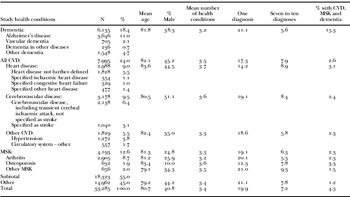
At their first 2003–04 assessment, 81 per cent of the analysis cohort (33,300) reported at least one health condition among CVD, dementia or MSKs – 55 per cent as the main health condition (CVD, 24%; dementia, 18%; MSKs, 13%) (Table 1). For brevity, in the remainder of the paper these main condition groups are referred to as ‘people with’ the health condition (e.g. ‘people with dementia’ refers to people with dementia as their main health condition). People with a condition other than CVD, dementia or MSK as their main health condition are referred to as people with ‘other health conditions’ (45% of the cohort).
Main health condition of the cohort at reference assessment
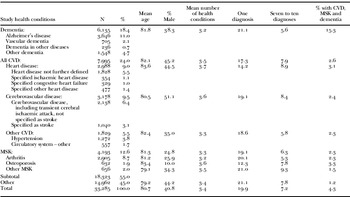
Notes: CVD: cardiovascular disease. MSK: musculoskeletal diseases.
The average age of the cohort was 80.7 years, and 41 per cent were men. People with different main health conditions had different demographic and care need profiles. People with stroke and other cerebrovascular disease were more likely to be men than people with other main health conditions; people with heart disease or osteoporosis tended to be older.
As would be expected in an older population, many in the cohort had conditions affecting more than one body system: four-fifths of the cohort reported more than one health condition affecting care needs, and 4 per cent of the cohort had dementia, CVD and MSK. People with dementia as their main health condition were much more likely than others to have all three focus health conditions: 15 per cent compared with 1–3 per cent for people with other diseases as their main health condition.
Care pathways
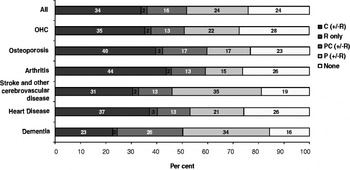
Previous analysis of the cohort shows that a person's use of the various aged care programmes changes over time, and that once people enter permanent residential care they rarely return to living in the community (Karmel, Anderson and Peut Reference Karmel, Anderson and Peut2009). Overall, 76 per cent of the cohort accessed at least one of the programmes included in the study, with 16 per cent accessing both community care and permanent residential care (Figure 1).
Programme use within two years of first assessment by main health condition at time of assessment.
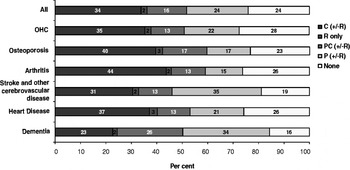
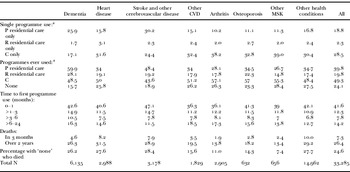
Care pathways were affected by the main health condition (Figure 1; Table 2). People with dementia had a high use of permanent residential care than others, with 60 per cent of people with dementia using permanent residential care within two years of assessment; just under half of these people also used community care before entering residential care. In addition, people with dementia were more likely than others to access residential respite care (28% versus 23% or less). Concomitantly, fewer people with dementia had no service use compared to the whole cohort (16% versus 24%) or only used community care (23% versus 34%).
Programmes used by main health condition at reference assessment,1 by main health condition at assessment (% with additional condition within main health condition group)
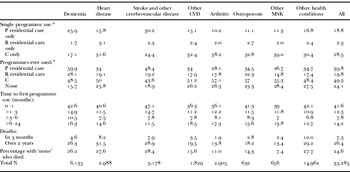
Notes: CVD: cardiovascular disease. MSK: musculoskeletal diseases. 1. Programme use relates to the two years following the reference assessment. 2. C: community care; None: no programme use; P: permanent; R: respite.
People with stroke and other cerebrovascular disease also had relatively high programme use rates: 48 per cent used residential care within two years, but the proportion that used community care before entering residential care was lower than for people with dementia (13/48% versus 26/60%). People with heart disease were more likely than those with stroke and other cerebrovascular disease to use community care and less likely to enter permanent residential care. People with heart disease or stroke both had a high two-year death rate (Table 2).
People with MSKs had different care pathways than those with dementia or stroke and other cerebrovascular disease, but somewhat similar programme use as people with heart disease. The MSK groups were more likely to use community care programmes over the two years (around 57% compared with 44–49%), and less likely only to access permanent residential care (around 11% compared with 26–30%) (Table 2). The death rate among people with MSKs was lower than that of other groups.
Time to programme use
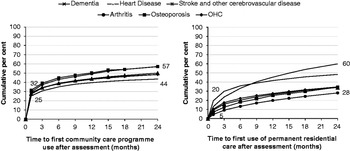
The rate of take-up of care was highest in the first month following assessment. This rate varied with condition, from between 36 per cent for people with arthritis to 47 per cent for people with stroke and other cerebrovascular disease (Table 2). Community care was shown to be quite responsive to assessed need: much of the early programme use was in community care, with between 25 per cent (stroke and other cerebrovascular disease) and 32 per cent (osteoporosis) of the cohort accessing community care services within one month of assessment (Figure 2). This initial take-up of community care accounted for over one-half of its take-up over two years.
Use of aged care programmes within two years of first assessment, by main health condition.
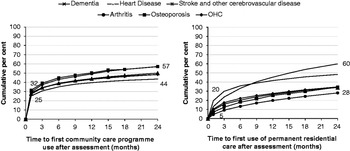
Take-up of permanent residential care was more gradual, and disease group variation was largely driven by differences in use rates in the first month after assessment, with between 5 per cent (osteoporosis) and 20 per cent (stroke and other cerebrovascular disease) entering permanent residential care in that period. Variation in take-up of care between disease groups was more pronounced for residential care than community care. The pattern of take-up of residential care is different for people with stroke and other cerebrovascular conditions, or dementia and all other groups. For people with stroke and other cerebrovascular conditions there was a quite steep take-up rate: about 60 per cent of all people who would use permanent residential care have been admitted within three months. The take-up for dementia was slower with about 40 per cent of those who would ever use residential care having taken up a place in the first three months.
Overall, people with stroke and other cerebrovascular disease or dementia were much more likely than all others to have moved permanently into residential care within three months. Twenty-four per cent of people with dementia and 30 per cent of those with stroke and other cerebrovascular disease entered permanent residential care within three months, compared with 9 per cent of those with arthritis (who had the lowest rate of movement into residential care at three months).
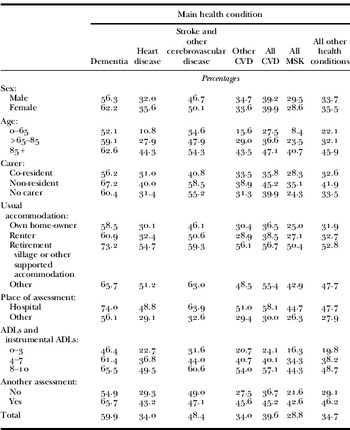
Analysis within disease groups (see Table 3) suggested that older age, having a non-resident carer, living in a retirement village, more activity limitations, assessment in hospital and requiring another assessment (i.e. changes in needs) were associated with higher entry rates into residential care.
Likelihood of use of permanent residential aged care within 24 months after reference assessment, by client characteristics
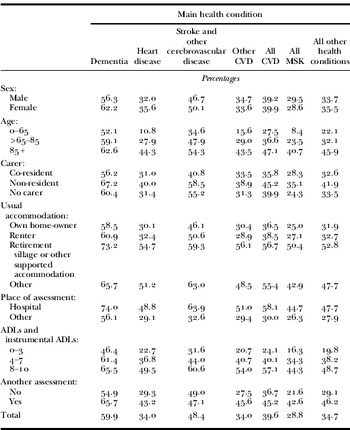
Notes: CVD: cardiovascular disease. MSK: musculoskeletal diseases. ADLs: activities of daily living.
For all characteristics considered, people with dementia had the highest rate of permanent residential care use over two years, usually followed by people with stroke and other cerebrovascular disease; people with arthritis generally had the lowest two-year take-up rate. Within this, patterns of entry into permanent residential care over time by client characteristic were similar across the health condition groups, with variation mainly caused by differences in use in the first few months.
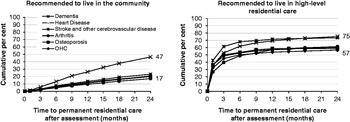
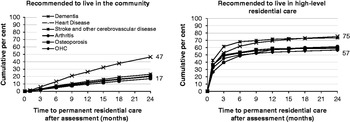
Long-term care setting recommendations reflect assessment team judgements of the ability a person has to remain living in the community, taking both care needs and social resources into account. Consequently, with the exception of people with dementia who had a much higher take-up rate of residential care, there was little difference in the take-up of residential care for people who were recommended to live in the community (Figure 3). Similarly, for those people for whom residential aged care was recommended, people with dementia or stroke (or other cerebrovascular disease) had marginally higher take-up rates, but for all other conditions the take-up rates were similar.
Time to permanent residential care by recommended long-term care setting and main health condition.
Carer availability
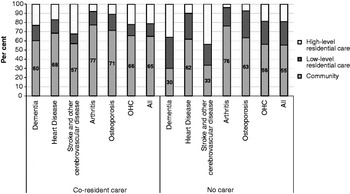
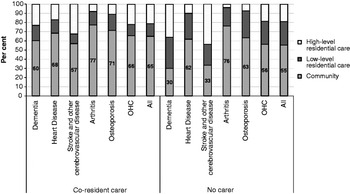
As seen in other studies, carer availability and care needs were associated with entry into permanent residential care (Greene et al. Reference Greene, Lovely, Miller and Ondrich1995; Howell et al. Reference Howell, Silberberg, Quinn and Lucas2007; Miller and Weissert Reference Miller and Weissert2000). The importance of carers for some groups was supported by the relatively small proportions of people without a carer and who had stroke and other cerebrovascular disease or dementia who were recommended to live in the community (Figure 4).
Recommended living setting by main health condition and carer availability.
Discussion
Older people are not a homogenous group: generational or cohort differences between the young old and the ‘old old’ are well known and well documented (Dannefer Reference Dannefer1988; Fuller-Iglesias, Smith and Antonucci Reference Fuller-Iglesias, Smith and Antonucci2009; Manton Reference Manton1988). But our knowledge about combinations of care services used by older people over time is very limited, despite the increasing expenditure on such services. What this paper shows is the strikingly different care trajectories followed by older people with different underlying diseases.
The size and comprehensive nature of the linked dataset provide a broad and powerful platform for the analysis of different aged care pathways. Note, however, there are a number of limitations. First, the dataset does not include older people who had not had an assessment as some community care services may be accessed in Australia without such an assessment. Second, it is estimated that potentially 15–20 per cent of the study cohort may have had an assessment prior to July 2003; client-level data were not available for analysis prior to this period. Third, reporting practices by different assessment teams may be inconsistent (ACAP NDR 2005). Fourthly, the data can only describe ‘realised access’. There is constraint on access to both community and residential care in Australia, with waiting times for access to both types of services. We are not able to measure whether the trajectories reported here would differ in an unconstrained environment.
Care pathways for the study cohort varied with the main health condition affecting care needs, and whether they had a co-resident carer. In particular, the mix of aged care programmes used, and the timing of this use, was different, and the entry rate over time into permanent residential care varied with health condition. People with dementia or stroke and other cerebrovascular disease were most likely to enter permanent residential care within two years of assessment, while people with arthritis were least likely. People with MSKs were most likely to use community care programmes. Overall, people with dementia had the highest use of both types of services (26% versus 13–17%). Absence of a co-resident carer exercised a particularly strong effect on the likelihood of admission to residential care for people with dementia or stroke and other cerebrovascular disease.
The relationship between dementia and increasing cognitive impairment with institutionalisation is well documented (Agüero-Torres et al. Reference Agüero-Torres, vonStrauss, Viitanen, Winblad and Fratiglioni2001; Martikainen, Nihtilä and Moustgaard Reference Martikainen, Nihtilä and Moustgaard2008; Nihtilä et al. Reference Nihtilä, Martikainen, Koskinen, Reunanen, Noro and Häkkinen2008). The pre-eminence of dementia in determining people's care needs is emphasised by the fact that dementia was nominated as the main health condition for over two-thirds of people with the condition (18% out of the 26% with dementia). The difficulty that people with dementia have in staying in the community is seen in their high two-year entry rate into residential care even when initially recommended to stay living in the community.
It was also relatively hard for cohort members with stroke and other cerebrovascular disease to remain living in the community – a finding supported by the relatively small proportions of people with this condition and without a carer who were recommended to live in the community (Figure 4). However, internationally there have been varying results on the importance of this condition on entry to residential care (Agüero-Torres et al. Reference Agüero-Torres, vonStrauss, Viitanen, Winblad and Fratiglioni2001; Miller and Weissert 2000).
Decisions on care transitions are often made during a crisis, and studies have shown that who contributes to the decision making is important and that older people's functioning can decline quite rapidly in hospital (Cheek et al. Reference Cheek, Ballantyne, Gillham, Mussared, Flett, Lewin, Walker, Roder-Allen, Quan and Vandermeulen2006; Creditor Reference Creditor1993; Taylor and Donnelly Reference Taylor and Donnelly2006). Consequently, different assessment circumstances could lead to different decisions (Magro and Ferry Reference Magro and Ferry2005). Anecdotal evidence also suggests that assessment teams prefer to assess clients in their home: an assessment in hospital is normally only performed when a return to home is unlikely. Such factors contribute to the initial high transition rates into residential care seen particularly for people with dementia and strokes assessed in hospital. It also suggests that – as found in other studies (Gaugler et al. Reference Gaugler, Kane, Kane, Clay and Newcomer2005a, Reference Gaugler, Kane, Kane and Newcomer2005b; Howe, Doyle and Wells Reference Howe, Doyle and Wells2006) – timely access to community care for at least a proportion of these people could be important in reducing the rate of entry to residential care after hospitalisation.
The differences seen between the various health conditions add further complexity to aged care planning. Manton (Reference Manton1988: 253), having reviewed the heterogeneity of the older population in the United States of America, noted that aged care planning needs to be ‘bidimensional’, defined as functional impairment and medical condition. Continuing the bi-dimensional approach, more recent literature distinguishes ‘frailty’ (but this is described by Bergman et al. Reference Bergman, Béland, Karunananthan, Hummel, Hogan and Wolfson2004 as an ‘enigmatic concept’, see also Karunananthan et al. Reference Karunananthan, Wolfson, Bergman, Beland and Hogan2009) and ‘disability’, that is the inability to carry out instrumental and basic activities of daily living independently, as drivers of service use. Frailty has been shown to be an independent predictor of mortality (Klein et al. Reference Klein, Klein, Knudtson and Lee2005; Ravaglia et al. Reference Ravaglia, Forti, Lucicesare, Pisacane, Rietti and Patterson2008), after controlling for medical conditions (hypertension, diabetes and cardiovascular disease).
The relationship seen in this analysis between entry into residential care and increasing activity limitations within health condition also illustrates that it is the combination of medical condition and care needs that impacts on the use of care services. But what we have also shown is that these generalised, non-condition-specific measures obscure important considerations for service planning. In his paper, Manton (Reference Manton1988) qualified the effect of medical condition as being related to the ‘duration of functional impairment’, the ‘disability’ effect in the recent literature. What our study shows is that the impact of medical condition is more profound, affecting multiple points on the care trajectory. Take two polar conditions: dementia and heart disease. People with dementia are much more likely than people with heart disease to be recommended for residential care and to take up residential care; they also move into such care more quickly. The disease burden of CVD in Australia is projected to decrease from 2013 to 2023 (Begg et al. Reference Begg, Vos, Barker, Stevenson, Stanley and Lopez2007). In contrast, the disease burden for dementia is projected to increase.
A recent major review of health care in Australia recommended a revision of the basis for residential care planning, to change the target ratio from one based on population over 70, to population over 85 (National Health and Hospitals Reform Commission 2009). The argument was based simply on different patterns of use between younger-old and older-old: there was no discussion of the impact of different conditions on use. Our findings show that the impact of trends in disease on demand for services will be important.
The development of systems dynamics and other simulation approaches to modelling the future care needs of the population obviates the need to rely simply on gross projections of population to estimate future service needs, but even here, recent long-term care models do not incorporate differential patterns for medical conditions (Kim and Goggi Reference Kim and Goggi2005; Zhang et al. Reference Zhang, Puterman, Nelson and Atkins2010). A clear implication of this study is that ratio approaches to planning based on total population at particular age groups are inadequate as a basis for projecting care needs: populations need to be segmented by conditions with needs separately projected for major health conditions which exhibit differential patterns of service use. ‘Frailty’, even though a major predictor of mortality and other service-related outcomes, needs to be augmented for service planning purposes to take account of health conditions. In addition to these service planning implications, studies of the potential impact of ageing on future health system costs need to go beyond projecting disability prevalence (e.g. Jacobzone et al. Reference Jacobzone, Cambois, Chaplain and Robine2000), to consider the nature of the disability and the associated health condition.
Further, clinical advice to individuals about the likelihood of future residential care must also take into account potential trajectories based on health conditions or the nature/underlying cause of a person's frailty.
Finally, the variation in care trajectories, especially the higher use of residential care for people with dementia, also suggests that the service mix within current residential care provision will need to change with a greater proportionate provision of dementia-specific services, recognising the different design considerations appropriate for these services (Day, Carreon and Stump Reference Day, Carreon and Stump2000; Marquardt and Schmieg Reference Marquardt and Schmieg2009). Com-munity services may also need to adapt to recognise different care trajectories. Current home modification programmes in Australia focus on modifications to facilitate remaining at home with a physical disability, but dementia-relevant home modifications have been identified and these may need to be added to the suite of available services (van Hoof et al. Reference van Hoof, Kort, van Waarde and Blom2010).
Conclusion
The patterns of aged care service use, both in terms of care services accessed and the timing of this access, varied greatly for people with different health conditions affecting their care needs. In particular, people with dementia or stroke and other cerebrovascular disease as their main health condition were more likely to enter residential care within 24 months than those with heart disease or musculoskeletal diseases; those with dementia more commonly accessed residential respite care and people with musculoskeletal diseases were high users of community care programmes. These differences in turn imply that projections of demand for aged care services need to take into account these differences. Merely projecting forward current use patterns into the future without taking into account predictions of disease will yield inaccurate predictions of demand for both community and residential care.